BULLETIN: The St. Kitts Nevis Observer is reporting that U.S. Associate Justice Stephen Breyer was robbed last week by a masked intruder wielding a machete. (See report.)
Breyer, 73, is one of nine members of the U.S. Supreme Court and has served the nation in that capacity since being appointed by President Clinton in 1994.
The robbery occurred while the justice was vacationing in Nevis with his wife and several friends, and the FBI has dispatched an agent, the newspaper reported.
Nevis is an island of the West Indies chain in the Caribbean.
The Supreme Court has confirmed the incident to the Washington Post, and CNN is reporting that it was unclear whether the intruder knew Breyer’s professional identity.
Also unclear is the level of security provided the justice during his family vacation.
EDITOR’S NOTE: It’s often said that the so-called “sovereign citizen” movement is loosely knit.
But does it really matter if there is an in-depth, organized management structure, slate of officers or official roster of adherents if an individual anywhere — at any place in time — can borrow pages from a “sovereign” playbook to, say, gum up the legal process?
The PP Blog encourages its audience to visit the site of the Tennessean (link below) and read about how Guy Denton Savage is reaching out from England into the United States to forestall or derail extradition by adopting paperwork tactics associated with U.S. “sovereign citizens.”
Something to think about: How do Democratic nations that necessarily must provide both defendants and victims access to transparent justice deal with “sovereign” groups, lone wolves or sympathizers whose aim may be wholly disingenuous?
Although “sovereigns” commonly purport to be great defenders of constitutional law and individual freedom, their maneuverings often project a preference for anarchy or a breakdown in the rule of law, the key underpinning of civilized society. Among “sovereigns,” it’s often the case that the good of the few outweighs the good of the many.
And it’s also often the case that the blame for a thorny legal predicament gets transferred to investigators, prosecutors, judges and other public officials on a bizarre theory that a contract is self-executing — i.e., if you mail or otherwise deliver a demand for a remedy in your favor — and if the recipient doesn’t respond to the demand or submit to the preordained remedy — the recipient has defaulted or agreed to the demand by remaining silent.
The PP Blog has reported on incidents in which bills or payment demands totaling in the millions, billions or even the trillions of dollars have been sent to public officials. That any person could adopt this line of thought as legitimate remains a source for great introspection. As always, the question becomes one about whether a “sovereign” will be satisfied with the public recording of his fantasies on court dockets — or whether he or she will seek to exact a penalty on law-enforcement officers, prosecutors, judges and litigation opponents by recording fraudulent liens and encumbrances against them.
A separate danger emerges when “sovereigns” turn to other “sovereigns” to begin blanketing courthouses with fantastical pleadings. There also have been cases in which “sovereigns” unhappy with a decision made by a state-trial judge sues the judge in federal court by divining a civil-rights violation.
Purported “sovereign” ideology is magical thinking of the most dangerous sort because it sets the stage for lawlessness to gain an increasing toehold over the institutions of democracy and for the rule of law to take a back seat to the whims of a mob or an extremist with access to a word-processor . . .
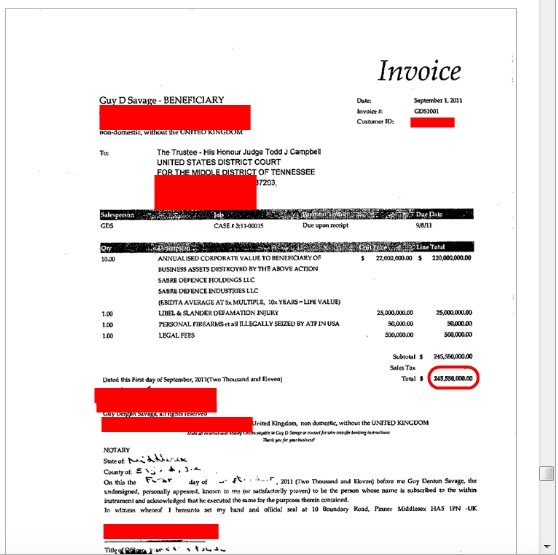
REDACTED SCREEN SHOT: Englishman Guy D. Savage sent this invoice for more than $245 million to a U.S. federal judge in Tennessee.
An Englishman indicted in the United States on gun-smuggling charges has sent a U.S. court a bill for more than $245 million and claims “that the United States, the Department of Justice and the U.S. District Court are ‘legal fictions,’” according to the Tennessean.
When the court did not respond to the invoice, Guy D. Savage essentially argued that the court was in default and tacked on an interest penalty of nearly $5 million, the newspaper reported.
U.S. federal prosecutors now have raised the specter of an international “sovereign citizen” reaching across the Atlantic into Tennessee to derail the U.S. case.