EDITOR’S NOTE: Zeek receiver Kenneth D. Bell has issued the following statement (below). The original is here and is dated July 30, 2014. “RVG” stands for Rex Venture Group, the operator of Zeek. Zeek is alleged to be a Ponzi- and pyramid scheme that gathered on the order of $850 million. The receiver’s statement addresses U.S. domestic class-action claims against more than 9,000 alleged “winners.” Still engaging in willful blindness, pushing HYIP schemes and hoping to harvest “commissions” from them — and perhaps deluding yourself into believing there will be no consequences?
Zeek-related matters have been inside the courts for nearly two years, meaning the litigation is at an advanced stage compared to, say, TelexFree. Zeek’s history therefore may provide a roadmap of sorts on what’s in store downstream for the TelexFree “program” and certain insiders and promoters. On a side note, the trustee in the TelexFree bankruptcy case is seeking court approval to issue subpoenas to many businesses and people who came in contact with that “program.” TelexFree, which operated in the United States, Brazil and other countries and appears to have gathered more than $1 billion, is known to have had promoters in common with Zeek. By one account, Zeek had 100,000 promoters in Brazil alone.
Bell is expected to file litigation against alleged international Zeek “winners.” How deeply that will touch Brazilian affiliates is unclear.
** Editor’s Note update at 2:08 p.m. Please see Comments thread below for possible Zeek promoter tie-ins to the Profitable Sunrise and Text Cash Network schemes. **
** _____________________________ **
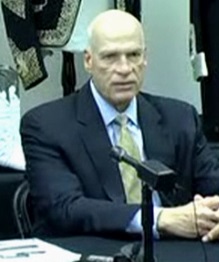
Zeek receiver Kenneth D. Bell. December 2013 screen shot.
ANNOUNCEMENT FROM THE RECEIVER – JULY 30, 2014
On March 3, 2014, I announced the filing of a lawsuit to obtain the return of the money paid out to net winners in the ZeekRewards scheme in excess of the amount they paid into RVG. In that lawsuit, Kenneth D. Bell v. Todd Disner, et al., Civil Action No. 3:14-cv-91, I made claims against more than 10 of ZeekRewards’ largest “net winners” in the United States asking that the Court order them to repay the net winnings they received from the scheme. I also made class action claims against approximately 9,400 ZeekRewards net winners in the United States who each won more than $1,000.
Today, I have filed with the Court a motion asking the Court to certify this Net Winner Class and asked that the Court appoint one or more of the largest net winners sued by name as class representatives because they will, by virtue of their own defense to the same claims, be adequate and appropriate representatives for the rest of the Net Winner Class. Proposed Net Winner Class members are not required to file any response to the motion, but may, of course, discuss this matter with legal counsel if they choose to do so. The deadline for the named defendants to respond to the motion has been set for August 18, 2014.
A copy of the Motion to Certify the Net Winner Class and the Memorandum of Law in Support of the Receiver’s Motion to Certify the Class can be found here: Motion and Memorandum. Also, a list of those individuals whom the Receiver believes won more than $1,000 and therefore would be included in the Net Winner Class can be found here.
BULLETIN: (UPDATED 4:29 P.M. EDT U.S.A.) Zeek Rewards receiver Kenneth D. Bell — for the first time — has referenced the AdSurfDaily Ponzi case in a federal court filing. Zeek, believed to have gathered on the order of $850 million, is known to have had participants in common with ASD, a $119 million fraud.
Some MLM HYIP promoters proceed from fraud scheme to fraud scheme, racking up windfalls along the way.
Bell’s specific reference to ASD is in the context of alleged Zeek “winner” Todd Disner, already the subject of a clerk’s entry of default in a Zeek receivership lawsuit against Disner and other alleged winners.
Disner was defaulted for not entering a defense.
After not defending against the receiver’s claims, Disner then sought to file pro se to set aside the default. Bell is seeking more than $2 million from Disner, including more than $1.8 million in alleged Zeek winnings, plus interest.
Bell said today in court filings that the default entry should stand. Meanwhile, the receiver strongly suggested that Disner, after earlier having played games in ASD-related litigation, now was trying to do the same thing with Zeek.
“Mr. Disner is no stranger to litigation,” Bell said. “For instance, as a promoter of the Ad Surf Daily Ponzi Scheme, Disner earned significant funds and filed a twenty-nine page pro se Complaint for Declaratory Relief against the federal government in late 2011 claiming wrongful seizure of his Ad Surf Daily Ponzi scheme winnings . . . ”
Disner eventually lost the case he filed against the government in the Southern District of Florida — this after he earlier lost a pro se bid to intervene in the ASD case in the District of Columbia.
Disner’s co-plaintiff in the Southern Florida case was former AdSurfDaily pitchman Dwight Owen Schweitzer, potentially a Bell Zeek target along with Disner. Schweitzer, a former attorney whose license to practice law was suspended in Connecticut, is listed as a “winner” of more than $1,000 on the Zeek receivership website.
“Mr. Disner also has a history of dilatory action in litigation,” Bell said. “In the [ASD-related] case he filed against the United States, the government filed a motion to dismiss on May 18, 2012. However, Disner failed to provide any response to the motion to dismiss. As a result, the court was forced to order Disner to file a response . . .
“In light of his history, Mr. Disner was aware of the severe consequences of a failure to plead or defend [in the action against Zeek winners],” Bell said. “Despite this clear knowledge, he nonetheless failed to raise a hand until after default had been entered in this matter. For this reason as well, the motion should be denied.”
Bell also moved today to certify a class of more than 9,000 net-winner defendants from Zeek, all of whom allegedly won more than $1,000. Schweitzer potentially could be a member of this class, given the appearance of his name in a document on the receivership website maintained by Bell.
BULLETIN: (2nd Update 8:29 p.m. EDT U.S.A.) Three individuals alleged to be key insiders of the Zeek Rewards Ponzi- and pyramid scheme have agreed to a $600 million consent judgment with the court-appointed receiver.
Receiver Kenneth D. Bell sued several alleged insiders, including Zeek operator Paul R. Burks, former COO Dawn Wright-Olivares and programmer Daniel Olivares, in late February.
Now, Burks, Wright-Olivares and Olivares have agreed to a consent judgment of $600 million “to be satisfied with substantially all of their assets,” Bell said in court filings today.
The settlement must be approved by the court. Senior U.S. District Judge Graham C. Mullen of the Western District of North Carolina is presiding over the cases of the alleged insiders.
Other alleged insiders continue to challenge Bell’s complaint. If judgments are entered against Burks, Wright-Olivares and Olivares, continued litigation by other alleged insiders increasingly could become an uphill climb.
Bell’s filing today also reveals that the receivership has recovered $107,697 from an FXDirectDealer (FXDD) account linked to Wright-Olivares through an entity known as “Wandering Rex.”
FXDD was sued by the U.S. Commodity Trading Futures Commission (CFTC) last year, amid allegations it failed in its supervisory obligations by “employing a trading system that gave FXDD pricing advantages over [customers] and harmed thousands of its retail customers.”
Whether Wandering Rex was a harmed customer was not immediately clear.
“Wandering Rex was an entity established by Dawn Wright-Olivares and/or her affiliates through which Rex Venture Group funds were fraudulently transferred,” Bell advised Mullen today in a quarterly report to the court.
Only in MLM: In a head-scratching promo earlier this year, TelexFree cheerleaders used an image of the Pyramids of Giza during an active pyramid-scheme probe in Brazil. Red highlight by PP Blog.
If you’ve been following TelexFree developments, you’ve probably heard about “Operation Orion,” the code name for the investigation that led to raids against TelexFree’s Ympactus arm last week by the Brazilian federal police. The Orion name was chosen, police said, because it fit splendidly within the context of a pyramid-scheme case.
How so? The Pyramids of Giza in Egypt were aligned with the Orion constellation, police explained.
Our analysis of the “Operation Orion” name is that it shows heady messaging by Brazilian police. It is direct in the sense that TelexFree, after all, may be the world’s largest MLM HYIP pyramid scheme. And it’s subtle in the sense that so many pyramid-scheme participants have bright stars in their eyes that blind them to the realities of mathematics.
Here we’ll point out that, for whatever reason, someone within the TelexFree sphere got the head-scratching idea earlier this year to use an image of the Pyramids of Giza in a promo for TelexFree during an active pyramid-scheme probe in Brazil.
We believe it notable that Brazilian police also referenced the Pyramids of Giza, given their presence in a TelexFree promo.
For newer readers, we’ll also point out that the HYIP sphere is infamous for taunting the law-enforcement community. Like TelexFree, a “program” known as WCM777 also came under investigation in multiple countries earlier this year. Naturally someone within the WCM777 sphere shoved an image of a pyramid down the throat of law enforcement after word of the investigations became public.
Second Tour (At Least) For ‘Operation Orion’
Did you know that the code name “Operation Orion” chosen by Brazilian police previously had been used by the United States in a major law-enforcement action, albeit in a completely different context? (More on the 2012 U.S. action below.)
What’s your thinking? Are two Operation Orions in two years coincidence?
And did you know that the U.S. Department of Homeland Security (DHS), which has its own TelexFree probe, has an office in Brasilia and a history of cooperating with Brazil’s federal police — and that some criminal investigators from outside the United States receive training at the DHS Federal Law Enforcement Training Center in Glynco, Ga? (The U.S.-sponsored training also sometimes occurs in countries that host the United States. Some Brazilian investigators, for example, have received U.S. training in Peru. See photo below.)
U.S. prosecutors did not respond to a request for comment on whether there was any coordination between the United States and Brazil last week on TelexFree-related events: the indictment of TelexFree figures James Merrill and Carlos Wanzeler in the United States, and the public announcement of “Operation Orion” in Brazil.
What’s In A Code Name?
U.S.-based police, prosecutorial and regulatory agencies regularly conjure up operational names to distill the essence of the law-enforcement goal and to send a message that fraudsters never should be confident. Agencies also sometimes engage in something we’ll describe as reverse black comedy whose purpose is to accent the absurdities of scams and scammers. In New Jersey last year, for example, a law-enforcement action targeted at alleged booze diluters was memorably named “Operation Swill.”
It was an instant classic.
A long-running FBI operation targeted at dozens of penny-stock fraudsters a few years ago was dubbed “Operation Shore Shells,” in part because the probe occurred near the sea and in part because the fraud involved the use of shell companies, often a nemesis of legitimate commerce. The SEC, which regulates the U.S. securities markets, once dubbed an action directed at hundreds of companies ripe for pump-and-dump swindles “Operation Shell Expel.”
To out illegal gambling conduits reaching into the United States, DHS once set up a sting operation and “obtained a business address near Atlantic City, New Jersey” to bolster undercover operatives’ street cred. As part of the operation, the Feds created a bogus “payment processor” known as Linwood Payment Solutions to “negotiate contracts and terms of the processing, and to handle the intricate movement and processing of collection and payment data from the gambling organizations to the banks.”
These well-dressed greeters actually were part of a federal undercover operation dubbed “No Such Thing as a Free Lunch.” Source: U.S. Marshals Service. Red blocks by PP Blog.
The U.S. Marshals Service, in charge of rounding up fugitives, once famously conjured up a sting dubbed “No Such Thing as a Free Lunch” that operated as part of a larger sting dubbed FIST — for Fugitive Investigative Strike Teams.
As part of a six-year FIST operation in the 1980s, marshals created a fake business known as “Flagship International Sports Television Inc.,” obtained the last-known addresses of more than 3,000 wanted persons and sent brunch “invitations” that promised free food and free National Football League game tickets to those addresses. The marshals also offered a shot at free Super Bowl tickets.
The free-food sting netted 100 arrests. FIST overall netted more than 14,700.
Undercover TelexFree Probe
It is known that DHS conducted a TelexFree-related undercover operation that lasted for months. Whether the operation extended to foreign soil and had a formal name is unclear. Based on its research, the PP Blog believes that undercover stings (named and unnamed) operated by U.S. government agencies and aimed at HYIPs have been operating continuously in the United States since at least 2006.
One of the reasons is that the schemes put banks in the line of fire and often target disadvantaged populations. Beyond that, HYIP schemes have a history of trading on the names of the White House and U.S. government agencies, thus confusing people across the world. TelexFree promoters, for instance, traded on the names of President Obama, the cabinet-level office of the U.S. Attorney General, the SEC and Massachusetts Commonwealth Secretary William Galvin. Why? To cloak themselves in a veneer of legitimacy and to drive money to a scheme that purportedly returned $1,040 in a year to people who paid in $289, $5,200 to people who paid in $1,375 and $57,200 to people who paid in $15,125.
Even Bernard Madoff would gag at the thought.
Female police officials from multiple countries, including Brazil, received U.S. training in Peru in 2012. Photo source: DHS.
With the Internet emerging as the favored delivery vessel of both clever and unclever fictions aimed at transferring great sums of wealth and putting unwarranted financial power in the hands of criminals and criminal enterprises, the need has arisen to pursue cross-border frauds aggressively. The only way to minimize the mushroom effect of fraud schemes operating on the Internet is through international cooperation at the highest levels of government and law enforcement.
Put another way, your latest recruit could be a Fed. The person you instructed not to “call it an investment” (as part of a ham-handed cover-up bid) could be a Fed. The person sitting next to you at a hotel “extravaganza” of some sort could be a Fed. So could the person in the cabin next to you on the scammers’ cruise ship. So could the recruit who, at your direction, paid you personally while joining, instead of paying the company. That upline guy — the one who sponsored you and asked you to pay him personally — could have one or more Feds in his downline. Those Feds could be “placing ads” for the program and keeping notes on whether anybody signed up under them.
Channeling?
Could Brazilian authorities who selected the name “Operation Orion” and referenced the Pyramids of Giza perhaps been channeling their U.S. counterparts and engaging in some reverse black comedy to point out the absurdity of scams? Man, we hope so.
As noted above, someone within the TelexFree sphere showcased the Pyramids of Giza during a pyramid-scheme probe in Brazil. Apparently no one in TelexFree thought it prudent, say, to stop the scheme during the Brazilian probe.
Because the HYIP sphere is populated by the most disingenuous “businesses” and people you’ll ever encounter, it’s easy enough to read such an act as telling law enforcement to shove it. Fractured thinking and taunts at law enforcement are core signatures of HYIP frauds, perhaps characteristics every bit as defining as preposterous daily payout rates of between .50 and 2.75 percent.
Good fortune certainly did not shine down on TelexFree from Orion on July 23, the date of the U.S. indictments. Nor did it shine down on July 24, the date the “Operation Orion” pyramid probe was announced in Brazil.
In our view, the name “Operation Orion” selected by Brazilian police was practically perfect.
In addition to being a star constellation, Orion is the great hunter from Greek mythology. With Brazil’s “Operation Orion,” alleged pyramid schemers became the hunted.
Alleged child predators were the hunted in the U.S. version of “Operation Orion,” a 2012 sting engineered by DHS. Arrests were made in the United States, Spain, the Philippines, Argentina and the United Kingdom. The DHS agency that launched the 2012 version of “Operation Orion” is known as Immigration and Customs Enforcement — or ICE for short. Homeland Security Investigations (HSI) is an ICE directorate.
From ICE (italics/bolding added):
HSI investigates immigration crime, human rights violations and human smuggling, smuggling of narcotics, weapons and other types of contraband, financial crimes, cybercrime and export enforcement issues. ICE special agents conduct investigations aimed at protecting critical infrastructure industries that are vulnerable to sabotage, attack or exploitation.
In addition to ICE criminal investigations, HSI oversees the agency’s international affairs operations and intelligence functions. HSI consists of more than 10,000 employees, consisting of 6,700 special agents, who are assigned to more than 200 cities throughout the U.S. and 47 countries around the world.
U.S. court records show that HSI started the undercover investigation into TelexFree at least by October 2013. Other records show HSI has an attaché office in Brasilia, the capital of Brazil.
In May 2014, ICE and HSI announced they had cooperated with federal police in Brazil in a sting known as “Operation Proteja Brasil,” described as aimed at protecting against child porn.
From ICE (italics/bolding added):
Some of the warrants executed during this operation were the direct result of leads provided by HSI Brasilia and the National Center for Missing & Exploited Children (NCMEC).
UPDATED AT 11:10 P.M. EDT U.S.A. JULY 28, 2014: Globo.com (Brazil) is reporting that police raided the headquarters of Ympactus this morning in a law-enforcement action dubbed “Operation Orion.” The story suggests raids also were carried out elsewhere and that Brazilian tax authorities are involved in the actions.
Costa is not named in the U.S. indictment, which appears to refer to him as “a third man” who formed TelexFree in the United States with Merrill and Wanzeler in 2012. Wanzeler, believed to be in Brazil, is considered a fugitive by the United States, which has issued a warrant for his arrest.
Whether Brazilian and U.S. authorities were coordinating events was not immediately clear.
A snippet from the Google translation of the Globo story (italics added):
Altogether, participated in the action 50 federal police officers and 18 auditors from the IRS Brazil. The operation name alludes to the Great Pyramids of Giza in Egypt Plain considering that the Egyptian pyramids are perfectly aligned with the constellation Orion.
UPDATE 11:10 P.M. EDT U.S.A. JULY 28, 2014: Please see this from Mikaella Campos, an economics reporter at A Gazeta Newspaper in Brazil. We are grateful to Mikaella for posting it here.
URGENT >> BULLETIN >> MOVING: 10th Update 9:18 p.m. EDT U.S.A.) TelexFree figures James Merrill and Carlos Wanzeler have been indicted by a federal grand jury.
The indictment, dated today, includes eight criminal counts of wire fraud and one criminal count of wire-fraud conspiracy.
Among other things, the indictment alleged that Merrill and Wanzeler conspired with each other and with “others known and unknown to the Grand Jury” to fleece TelexFree members.
The indictment describes wire transfers involving Merrill and Wanzeler that began on the day after Christmas in 2013 and continued on Dec. 27.
Here are the alleged wire transfers:
Merrill: Dec. 26. $136,200 from TelexFree Inc. account at Fidelity Co-operative Bank to Merrill.
Wanzeler: Dec. 26. $500,000 from TelexFree Inc. account at Fidelity Co-operative Bank to Wanzeler.
Wanzeler: Dec. 26. $136,200 from TelexFree Inc. account at Fidelity Co-operative Bank to Wanzeler.
Wanzeler: Dec. 26. $158,900 from TelexFree Inc. account at Fidelity Co-operative Bank to Wanzeler.
Wanzeler: Dec. 26. $22,700 from TelexFree Inc. account at Fidelity Co-operative Bank to Wanzeler.
Merrill: Dec. 27. $3 million from TelexFree Inc. account at Fidelity Co-operative Bank to Waddell & Reed Inc., to Merrill.
Wanzeler: Dec. 27. $3 million from TelexFree Inc. account at Fidelity Co-operative Bank to Wanzeler.
Wanzeler: Dec. 27. $3.5 million from TelexFree Inc. account at Fidelity Co-operative Bank to Wanzeler.
Prosecutors from the office of U.S. Attorney Carmen Ortiz of the District of Massachusetts said in a statement early this evening that assets seized in the case so far total about $140 million.
From a statement by prosecutors (italics added):
The indictment also specifies approximately 70 assets to be forfeited as proceeds of the alleged fraud scheme, or assets traceable to such proceeds, including approximately $140,000,000 seized from TelexFree’s accounts and various real assets, such as homes, condominiums, cars and two boats.
Also from prosecutors (italics/bolding/carriage returns added):
According to the indictment, TelexFree, Inc., and TelexFree LLC (collectively, “TelexFree”) provided “voice-over-internet-protocol” (“VOIP”) telephone services that allowed customers to use the Internet to make phone calls. The indictment alleges, however, that TelexFree actually operated as a pyramid scheme, in which its ongoing operations were supported, not by actually selling TelexFree’s VOIP product, but by bringing in a constant stream of new investor dollars.
Between early 2012 and March 2014, TelexFree purported to aggressively market its VOIP service by recruiting thousands of “promoters” to post ads for the product on the Internet. Each promoter was required to “buy in” to TelexFree at a certain price, after which they were compensated by TelexFree, under a complex compensation structure, on a weekly basis so long as they posted ads for TelexFree’s VOIP service.
It is further alleged that over the course of the fraud TelexFree derived only a fraction of its revenue from sales of VOIP service and the vast majority of it from new people buying into the scheme, and so TelexFree was able to pay the returns it had promised to its existing promoters only by bringing in money from newly-recruited promoters. The indictment includes eight charges of wire fraud, based on Merrill, in December 2013, wiring about $10,000,000 in TelexFree funds to personal accounts belonging to him and Wanzeler.
Also see May 27 PP Blog story on SEC allegations about how some of the TelexFree money was dissipated.
UPDATED 6:07 P.M. EDT U.S.A. A U.S. Magistrate Judge issued no immediate ruling today on a motion by TelexFree figure James Merrill to release $4 million to pay for his criminal defense.
Instead, Judge David H. Hennessy will take the matter under advisement and issue an order later, according to the docket of the case. Hennessy heard arguments from both sides today.
When the order would be issued was not immediately clear.
Prosecutors in the office of U.S. Attorney Carmen Ortiz of the District of Massachusetts have contended Merrill isn’t entitled to the money because it belongs to victims swindled in a huge pyramid- and Ponzi scheme.
Merrill, who is charged with wire-fraud conspiracy, is represented by Boston-based attorney Robert Goldstein
UPDATED 11:16 P.M. EDT U.S.A. We now may have an answer to some or all of these questions: What happens when you’re Massachusetts-based TelexFree — and apparently so out of touch that Sann Rodrigues, a former SEC defendant in a pyramid-scheme and affinity-fraud case, becomes one of the most recognizable public faces of your company and tells the troops (on video) that he’s made “$3 million?”
What happens when, on your home turf, you’re effectively targeting the same population group (Brazilian immigrants who speak Portuguese) Rodrigues was accused of targeting in his earlier scam, a scam that operated in part from Massachusetts? What happens when you’re also targeting Dominicans who speak Spanish?
And what happens when Rodrigues becomes one of the most recognizable public faces of your company after a federal judge — years earlier — had permanently enjoined him from violating the antifraud provisions of the federal securities laws?
Further, what happens when other promoters are going around telling recruits that $15,125 sent to TelexFree will return a guaranteed payout of $1,100 a week for a year and you don’t have to sell a single product to triple or quadruple your money? Further yet, what happens when Rodrigues plants the seed that all is well because an award-worthy American MLM lawyer is aboard the ship?
What happens when, say, serial MLM HYIP huckster Faith Sloan, fresh off the Zeek Rewards and Profitable Sunrise scams, also emerges as one of your top promoters?
Moreover, what happens when promoters are going around saying things such as TelexFree has gained “SEC approval” and publishing claims such as this?
“With the authorization from the attorney general to launch in the US, many predict we’ll see extraordinary growth in the United States in 2013.” —From promos for TelexFree in 2013
What happens when, say, the claim that U.S. Attorney General Eric Holder has vetted TelexFree appears on a Facebook site purportedly operated by “TELEXFREE TEAM NIGERIA.”
Think you might gain the attention of, say, the U.S. Department of Homeland Security? Think that attention might increase after promoters suggest that President Obama had your back? Think it might further intensify if it turns out that Brazilians and Dominicans in Massachusetts weren’t enough, that you’d also reached into communities in South America, Hispaniola, Europe, Africa and Asia?
Might the attention you’re receiving intensify after you’re suddenly filing bankruptcy on a Sunday night when, during the two previous months, you’d been telling Public Utilities Commissions in one state after another that you’re flush with cash — so much so, that you even can lend millions of it out?
What happens when, say, one of the states you assured of your financial clout played host to the “2012 Cybercrime Conference” hosted by the U.S. Department of Justice at which one of the top national-security advisers to the President of the United States observed that cybercriminals bent on poking holes in banks may be responsible for “the greatest transfer of wealth in history?”
“Outside the public eye, a slow hemorrhaging is occurring; a range of cyber activities is incrementally diminishing our security and siphoning off valuable economic assets” — Lisa Monaco, Assistant Attorney General for National Security, Oct. 25, 2012. NOTE: Monaco now holds the title of Assistant to the President for Homeland Security and Counterterrorism.
What if you’ve used U.S. banks and payment systems to help you gather more than $1.2 billion and then declared bankruptcy just a little more than two years after you launched your “program” in cyberspace? What happens when, just days earlier, you’d been telling Public Utilities Commissions that you were so flush with cash you could lend millions to entities of your creation or choosing, but now are claiming to to have liabilities of as much as $600 million and assets of only approximately $100 million?
What if your bankruptcy filing and program compensation tweaks occurred under conditions that strongly suggested you were trying to beat regulators to the courthouse? What if, only days later, it became known that undercover federal agents had the lay of the land inside your operation before you even went to bankruptcy court?
Think the U.S. Bankruptcy Trustee might use the term “rabbit hole” to describe your operation and push for the appointment of a trustee to burrow down that hole and gain a deep understanding about TelexFree?
And do you think — do you just think — the SEC might be inclined to file something such as this? (Italics added.)
The Securities and Exchange Commission (“Commission”) hereby moves, and defendants TelexFree, Inc., TelexFree, LLC, and relief defendant TelexFree Financial, LLC (collectively “the Debtors”) hereby assent, to modify the May 9, 2014 consent order (docket no. 100) to allow Stephen B. Darr, as Chapter 11 Trustee of TelexFree (the “Trustee”), to maintain bank accounts at RaboBank, NA in the name of the Debtors, as well as permit the Trustee to pursue claims and recover all property of the respective Debtors apart from those assets seized or restrained now or in the future by the United States Attorney for the District of Massachusetts or its agents.
The SEC filed the motion above yesterday.
Darr is now running things at TelexFree. He said in court filings yesterday that has “no intention of reorganizing or reactivating their businesses.”
It seems very much as though Darr’s plan is to go very deep into the rabbit hole of TelexFree.
URGENT >> BULLETIN >> MOVING: (1st Update 8:50 P.M. EDT U.S.A.) The TelexFree trustee said in court filings today in the SEC’s civil case against the firm that he has “no intention of reorganizing or reactivating their businesses” and — based on information and belief — “they were in fact engaged in a Ponzi or pyramid scheme.”
“Based on information currently available to the Trustee, the Trustee admits that the individual defendants operated a Ponzi/pyramid scheme as evidenced by, among other things, the revenues from the retail sales of the VoIP were less than one (1%) percent of the amounts needed to satisfy the promises to the investors who had placed the Internet ads. Further, based upon the information available to the Trustee, it appears that the early investors were paid not from sales of the VoIP services but rather from the money received from the later investors, thus evidencing a classic Ponzi/pyramid scheme,” Trustee Stephen B. Darr said.
Although TelexFree filed for Chapter 11 bankruptcy protection in April, Darr said today that “Debtors have ceased all operations and all other business activities other than to liquidate assets and to pay back creditors.”
Jordan Maglich of PonziTracker.com is reporting tonight that the development may signal a Chapter 11 reorganization may be off the table.
BULLETIN: Federal prosecutors handling the criminal case against TelexFree figure and alleged co-owner James Merrill have asked a judge not to release $4 million Merrill says he needs to pay for his criminal defense.
On July 1, Merrill asked for an evidentiary hearing aimed ultimately at securing “an order returning the identified funds” to him.
TelexFree might be the largest MLM HYIP pyramid- and Ponzi scheme in U.S. history, based on global reach, dollar volume and the number of affected recruits. Regulators have called it a cross-border fraud that gathered more than $1.2 billion.
Prosecutors contended today that the “funds Merrill asks the Court to release, however, are investor funds — money victims gave to TelexFree during the course of the alleged fraud.”
The funds were seized via warrants on April 24. Thirty-seven TelexFree-related seizure warrants were applied for that day, after an undercover probe led by Homeland Security Investigations, an arm of the U.S. Department of Homeland Security. TelexFree had declared bankruptcy 11 days earlier. At least five of the seizure warrants were targeted at Merrill accounts holding more than $4.18 million, according to court filings.
In cases involving assets alleged to be forfeitable, prosecutors typically argue that the assets should be preserved until a trial occurs and a verdict on the alleged underlying crime that led to the seizures is returned. If such assets are returned prior to trial, they will be dissipated and thus lost to victims in the event of a finding of guilt.
Beyond that, prosecutors contended, Merrill is not automatically entitled to an evidentiary hearing on the release of the funds and has not made a threshold showing that he lacks access to other funds to pay for his defense.
“[Merrill] fails to submit any evidence in support of his bald assertion that the United States cannot establish probable cause as to forfeitability of the seized assets, and such failure is fatal to his request for a hearing,” prosecutors argued to U.S. District Judge Timothy S. Hillman of the District of Massachusetts.
Boston-based attorney Robert M. Goldstein is defending Merrill.
“[T]he government cannot establish probable cause to believe that the assets in dispute are traceable or otherwise sufficiently related to the crime charged in the criminal complaint,” Goldstein argued on July 1.
Prosecutors asserted today that probable cause to seize the funds already had been established and that Merrill was trying to get a “sneak preview” at the criminal case against him. Merrill currently faces a single charge of wire-fraud conspiracy brought via criminal complaint in May.
A grand jury has been impaneled, which means that other criminal charges are possible. Some TelexFree members have alleged that the company was a racketeering enterprise.
Merrill’s co-defendant in the existing criminal case charging wire-fraud conspiracy is alleged TelexFree co-owner Carlos Wanzeler, described by prosecutors as an international fugitive who first ducked out of the United States through Canada on April 15 and ultimately fled to Brazil. April 15 was the date of a federal raid on TelexFree’s office in Marlborough, Mass.
Prosecutors from the office of U.S. Attorney Carmen Ortiz of the District of Massachusetts are handling the criminal cases against Merrill and Wanzeler.
It’s one of those things almost too bizarre to contemplate: The stock price of Cynk Technology Corp. increased tens of thousands of percent over a period of days — except the Belize company supposedly in the social-networking business reportedly has no revenue and no assets.
The SEC halted trading in Cynk stock this morning, citing “concerns regarding the accuracy and adequacy of information in the marketplace and potentially manipulative transactions in CYNK’s common stock.”