Federal prosecutors have announced five convictions in an international money-laundering case involving drug proceeds and the use of “stored-value” debit cards. (See subhead below.)
The cases were brought by the Drug Enforcement Administration in 2008 as a result of an undercover operation. The debit cards used in the transactions were provided by Virtual Money Inc., according to court records in Connecticut.
Records show that Virtual Money, known simply as VM, was the same company that provided debit cards to AdSurfDaily and other autosurf companies. VM’s operator, Robert Hodgins, also was indicted in the drug-related cases and “is being sought by law enforcement,” federal prosecutors said.
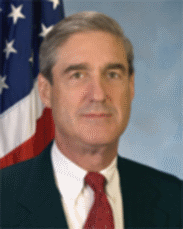
News about the convictions in Connecticut was announced about two weeks after FBI Director Robert Mueller III testified before Congress that “stored value devices” such as reloadable debit cards increasingly were being used to move criminal proceeds through a “shadow banking system” that endangered the United States.
The PP Blog reported in August 2009 that VM’s name appeared in advertising materials for ASD in 2007. Research showed that VM also provided cards to other autosurfs and HYIPs, including the PhoenixSurf autosurf Ponzi scheme.
Records suggest that Hodgins or a VM designate attended an ASD function in Orlando in November 2006, about a month after ASD began its rollout.
During that same year, according to the DEA court filings unsealed in September 2008 after a two-year investigation, VM cards were used in Medellin, Colombia, to withdraw millions of dollars in drug proceeds at ATMs between April and August.
The drug-related, money-laundering indictments against VM initially were filed under seal in April 2008 and then superseded under seal in June 2008. The documents were made public in September 2008, about a month after the federal seizure of tens of millions of dollars from the personal bank accounts of ASD President Andy Bowdoin, amid Ponzi scheme, wire-fraud, money-laundering and securities allegations in an autosurf case.
Some ASD members said they observed large sums of cash at ASD “rallies” and suitcases full of cashier’s checks.
After purportedly operating in the hole throughout much of its existence and allegedly experiencing an unreported theft of $1 million at the hands of “Russian” hackers, ASD suddenly came into possession of tens of millions of dollars in the first half of 2008, leading to questions about whether it was serving as a front to launder proceeds from criminal organizations.
References to VM appear in ASD advertising materials dating back to at least February 2007, and other ASD references to VM date back to the fall of 2006, when ASD was just getting off the ground.
In March 2008, according to records, a DEA informant gave Hodgins $100,000 in undercover funds, saying an uncle needed drug money laundered in the Dominican Republic. Hodgins allegedly agreed to perform the service for a fee of 10 percent of the amount, and the DEA alleged it has audio and photographic evidence of the transaction.
If the allegations are true, it means the DEA has audio and photographic evidence of the man who provided debit cards to ASD and other surf enterprises accepting money to participate in international drug transactions and international money-laundering.
Convictions In Drug/Money-Laundering Cases
On March 30, 13 days after Mueller testified before Congress on the dangers of stored-value devices, Juan Merlano Salazar, 35, of Medellin, Colombia, pleaded guilty in U.S. District Court in Connecticut to 11 counts of money-laundering and one count of conspiracy to commit money laundering.
Merlano was named in the same indictment that charged VM’s Hodgins and the company itself. Merlano was extradited from Colombia in June 2009, a year after he, Hodgins, VM and seven other defendants were charged in the superseding indictment. Merlano has been detained since his extradition and faces sentencing in June.
He faces a maximum penalty of 240 years in prison and a maximum fine of $6 million.
Four other defendants also have pleaded guilty to date to “charges stemming from this conspiracy,” prosecutors said.
Guilty pleas were entered by Francisco Dario Duque, 49, of Medellin, Colombia; Gonzalo Bueno, 72, of Brooklyn, New York; Juan Chavarriaga, 45, of Fort Lauderdale, Florida, and Jose Manotas, 46, of New York, New York.
Each of the defendants is detained and awaiting sentencing, prosecutors said.
“[T]he [drug]organization employed operatives in the United States and funneled millions of dollars in drug proceeds from the U.S. to Medellin, Colombia,” prosecutors said. “The investigation, which utilized a variety of traditional and sophisticated investigative techniques, including court-authorized interception of international e-mail, disclosed that the money laundering organization used direct deposits of cash into third-party bank accounts, as well as payment of third-party debt obligations to move cash drug proceeds from the New York metropolitan area out of the country.
“The organization also used ‘stored value cards,’ which function like debit cards and enabled cardholders to deposit U.S. dollars into accounts locally, to be withdrawn later from banks in Medellin as Colombian pesos,” prosecutors said. “The Government has alleged that the scheme resulted in the laundering of more than $7 million in drug proceeds.”
Hodgins was president and chief executive officer of VM, a Texas-based business.
“Hodgins is being sought by law enforcement,” prosecutors said.
In addition to the DEA, the case is being investigated by the Criminal Investigation Division of the IRS, prosecutors said.