Month: October 2014

  • Top Official Who Warned About Cross-Border ‘Criminal Enterprises’ And ‘Frivolous Libel Cases’ To Mask Them Is Leaving Justice Department

    Deputy Attorney General James M. Cole, the No. 2 official at the U.S. Justice Department, is leaving after four years, Attorney General Eric Holder confirmed in a statement. (Holder also is leaving, a topic for another day.)

    Cole said something in Mexico City at the High-Level Hemispheric Meeting Against Transnational Organized Crime in March 2012 that is as important today as it was on the day the words were spoken.

    Indeed, Cole said on March 1, 2012, “Because of the sophistication of the world economy, organized crime groups have developed an ability to exploit legitimate actors and their skills in order to further the criminal enterprises. For example, transnational organized criminal groups often rely on lawyers to facilitate illicit transactions. These lawyers create shell companies, open offshore bank accounts in the names of those shell companies, and launder criminal proceeds through trust accounts. Other lawyers working for organized crime figures bring frivolous libel cases against individuals who expose their criminal activities.”

    And Cole also said this: “The advance of globalization and the internet, while hugely beneficial to people everywhere, has also created unparalleled opportunities for criminals to expand their operations and use the facilities of global communication and commerce to carry out their criminal activities across national borders.”

    We wish Deputy Attorney General Cole the best and thank him for his dedicated service to his country.


  • CKB/CKB168, WCM777 And TelexFree Prosecutions Make SEC’s 2014 Highlight Reel; Agency Says Its Job In MLM Sphere Isn’t Done

    recommendedreading1The prosecutions of the CKB/CKB168, WCM777 and TelexFree “programs” made the SEC’s highlight reel for fiscal year 2014, which began on Oct. 1, 2013 and ended on Sept. 30 of this year.

    In a statement today, the SEC said “new investigative approaches and the innovative use of data and analytical tools contributed to a very strong year for enforcement marked by cases that spanned the securities industry.”

    Noting the FY 2014 pyramid-scheme actions against the MLM or direct-sales firms included allegations that the “programs” used social media and targeted immigrant communities, the SEC said its work wasn’t done.

    “The Enforcement Division will continue to root out pyramid and Ponzi schemes that prey on vulnerable investors,” the agency said.

    Not specifically noted in the agency’s statement today were the actions against the eAdGear and Zhunrize “programs” announced just prior to the close of the 2014 fiscal year. The eAdGear case was announced on Sept. 26; the Zhunrize case was announced on Sept. 23.

    Since the Zeek Rewards action in 2012, it has become clear that MLM HYIP schemes have tapped participants for spectacular sums. The Zeek scheme alone gathered on the order of $850 million. Filings suggest TelexFree may have gathered on the order of $1.2 billion.

    CKB/CKB168 appears to have gathered at least $20 million. WCM777 gathered on the order of $80 million. Zhunrize gathered on the order of $105 million, and eAdGear gathered on the order of $129 million, according to court filings.

    Zeek receiver Kenneth D. Bell, who is managing Zeek-related cases that involve hundreds of thousands of victims across the world, described Zeek this week as an attempt to put lipstick on a pig.

    It’s a description that could apply across the MLM HYIP sphere. The cross-border, murky nature of the “programs” raise concerns about both economic security and national security.

    On Sept. 21, the PP Blog reported that a small sampling of data from 95-self-identified victims of TelexFree shows they lost an average of $27,578 each. TelexFree potentially created 1 million victims or more.

    The SEC has broad responsibilities across the securities industry and its sectors — from Wall Street to Main Street.

    From the SEC’s statement today (italics added):

    The Securities and Exchange Commission today announced that in fiscal year 2014, new investigative approaches and the innovative use of data and analytical tools contributed to a very strong year for enforcement marked by cases that spanned the securities industry.

    In the fiscal year that ended in September, the SEC filed a record 755 enforcement actions covering a wide range of misconduct, and obtained orders totaling $4.16 billion in disgorgement and penalties, according to preliminary figures. In FY 2013, the Commission filed 686 enforcement actions and obtained orders totaling $3.4 billion in disgorgement and penalties. In FY 2012, the Commission filed 734 enforcement actions and obtained orders totaling $3.1 billion in disgorgement and penalties.

    The agency’s enforcement actions also included a number of first-ever cases, including actions involving the market access rule, the “pay-to-play” rule for investment advisers, an emergency action to halt a municipal bond offering, and an action for whistleblower retaliation.

    “Aggressive enforcement against wrongdoers who harm investors and threaten our financial markets remains a top priority, and we brought and will continue to bring creative and important enforcement actions across a broad range of the securities markets,” said SEC Chair Mary Jo White. “The innovative use of technology – enhanced use of data and quantitative analysis – was instrumental in detecting misconduct and contributed to the Enforcement Division’s success in bringing quality actions that resulted in stiff monetary sanctions.”

    “Time and again this past year, the Division’s staff applied its tremendous energy and talent, uncovered misconduct, and held accountable those who were responsible for wrongdoing,” said Andrew J. Ceresney, Director of the SEC’s Division of Enforcement. “I am proud of our excellent record of success and look forward to another year filled with high-impact enforcement actions.”

  • Lawyers Assemble To Discuss TelexFree Case; Session Sponsored By Boston Bar Association And Led By Jonathan M. Horne And Timothy J. Durken Of Jager Smith PC

    newtelexfreelogoEDITOR’S NOTE: It is hard to contemplate the rich history of the United States without at once contemplating the rich history of the Boston Bar Association. They shall forever be intertwined . . .

    One could imagine that, 241 years ago, a contemplative session of the Boston Bar Association (BBA) might have been advertised with paper handbills and titled, “The Law as It Pertains to Taxation without Representation and the Destruction of Certain Aromatic Tea in Boston Harbor on December 16, 1773.”

    Although yesterday’s noontime session at the BBA appears to have eschewed handbills in favor of Twitter and such, it nevertheless addressed the past and the future. Its simple title: “TelexFree[:] How We Got Here and Where We Are Going.”

    Jonathan M. Horne and Timothy J. Durken of Jager Smith PC were instrumental in putting it together. A PDF of what was covered at the session is available today.

    Other information on the session is available at the website of the BBA.

    The venerable Boston Bar traces its roots to the 18th century. In the 1760s, a local young fellow by the name of John Adams was speaking on important things (such as justice) in and around the coffeehouses and taverns on Beacon Hill. He later helped organize the greatest beacon of freedom the world had ever known: the United States of America. In ways large and small, Massachusetts continues to be a preeminent source of light from this beacon.

    Later yet, Adams would become the second President of the United States, succeeding George Washington.

    President Adams, the father of John Quincy Adams, America’s sixth President, knew towns TelexFree members later would know. (Among them are Quincy and Worcester.)

    Read the bio of President John Adams at WhiteHouse.gov.

  • RECEIVER: Zeek Rewards Was ‘Pig’ To Which MLM Lawyers Attemped To Apply ‘Lipstick’ — While One Of The Lawyers Participated On Massive Ponzi Scheme’s ‘Leadership Calls’

    EDITOR’S NOTE: Kevin Grimes, MLM Compliance VT LLC and the Grimes & Reese law firm have argued that the claims against them should be dismissed. Zeek’s receiver argues otherwise, saying a “bogus ‘compliance course’” advanced by Grimes helped dupe the Zeek masses. Zeek affected hundreds of thousands of people, the SEC has said.

    Legal malpractice and other claims against MLM attorney Kevin Grimes, his entity MLM Compliance VT LLC and the Grimes & Reese law firm should stand, the court-appointed receiver in the Zeek Rewards Ponzi- and pyramid-scheme case said in court filings yesterday.

    One of the reasons, receiver Kenneth D. Bell argued in a motion to Senior U.S. District Judge Graham C. Mullen, is that the defendants “in effect attempted to put lipstick on the ZeekRewards pig.”

    Another reason is that Grimes participated in at least three affiliate “leadership calls” with Zeek insiders and “actively assisted the Insiders in promoting and legitimizing the scheme,” Bell said.

    “Grimes allowed his name and his firm’s name to be used to promote the scheme,” Bell said.

    Mullen should reject bids by the defendants to have the claims dismissed, Bell argued.

    Read the receiver’s argument, courtesy of the ASD Updates Blog.

    Read the Grimes’ brief in support of his motion to dismiss. Read the Grimes & Reese brief in support of its motions to dismiss.

    The SEC has described Zeek as a massive securities fraud that gathered hundreds of millions of dollars in a combined Ponzi- and pyramid scheme.


  • DEVELOPING STORY: Zeek Figure Robert Craddock Accused Of Trademark Infringement And Engaging In ‘Shake-Down’ Bid Against MLM Affiliates

    EDITOR’S NOTE: The story below focuses mostly on a lawsuit filed against Zeek Rewards figure Robert Craddock by a Nevada company known as BTG180. A lawsuit filed against Craddock by a Wyoming company known as OfferHubb.net Inc. makes similar claims against Craddock.

    ** ___________________________________**

    breakingnews72DEVELOPING STORY: (4th Update 10:12 a.m. EDT Oct. 14 U.S.A.) Zeek Rewards figure Robert Craddock has been accused in a private lawsuit filed in Nevada federal court of trademark infringement and using a “shell corporation” to engage in a “shake-down” bid against affiliates of at least three MLM networks: Zeek, OfferHubb and BTG180.

    The alleged shell corporation is known as Fun Club USA Inc., according to a complaint filed Feb. 5, 2014.  It has “no employees,” was  “never capitalized” and created a condition under which Craddock was able to use funds directed to the corporation by MLMers as his personal funds, the plaintiffs contend.

    The plaintiffs in the case are listed as BTG180 LLC and Randall Jeffers. A second complaint against Craddock was filed on the same day, also in Nevada. Plaintiffs in that case are OfferHubb.net Inc. and David Flynn, who allege that Craddock “immediately” embarked on a web-based disparagement campaign against them after OfferHubb chose in July 2013 not to renew a contract with Craddock and FunClub USA.

    OfferHubb.net Inc. further accused Craddock of misrepresenting the company, breaching the OfferHubb Terms of Service by inducing affiliates to make side deals and accept kickbacks from affiliates and cross-selling other MLM opportunities in contravention of his agreement with OfferHubb.

    BTG180 is associated with a “program” known as BidsThatGive, which positioned itself as an opportunity to fight child poverty and the exploitation trades. An apparent prelaunch for BidsThatGive was conducted in July 2012, the month before the SEC moved against Zeek.

    Fun Club and Craddock are referenced in a blistering memo filed in the Zeek Ponzi- and pyramid-scheme case by the SEC on Dec. 17, 2012. In the memo, the SEC accused Craddock of encouraging Zeek affiliates “not to cooperate” with Kenneth D. Bell, the court appointed receiver. The SEC further alleged that Craddock was spreading misinformation about how the agency viewed its own case against Zeek and that Fun Club appeared to have been formed 11 days after the SEC emergency action against Zeek on Aug. 17, 2012.

    Craddock has not been charged by the SEC with wrongdoing.

    Despite the SEC’s December 2012 assertions against Craddock and Fun Club, however, BTG180 appears to have entered into a contract with Craddock and Fun Club on Aug. 12, 2013, just five days shy of the one-year anniversary of the SEC’s complaint against Zeek. In the August 2012 action, the agency accused Zeek of engaging in securities fraud, selling unregistered securities and operating a combined Ponzi and pyramid scheme that had gathered hundreds of millions of dollars in just shy of 20 months.

    BTG180, according to its own lawsuit against Craddock and Fun Club filed in February 2014, paid Craddock and the shell company $50,000 in advance of work Craddock had agreed to perform for BTG180.

    BTG180 says it wants back the $50,000 because Craddock failed to deliver. It also contends other actions by Craddock caused it to suffer damages.

    Part of Craddock’s duties, according to the complaint, was to “market the BTG180 network marketing opportunity to former affiliates of the Zeek Rewards network, which had provided products similar to those provided by BTG180.”

    Craddock did not perform the agreed-to work, according to the lawsuit. Instead, he attempted to “induce BTG180 to promote and incorporate into its product line a so-called checking account draft processing system known as BTM. Craddock is the founder of a corporation  known as BTM Check Draft Inc.”

    Without authorization from BTG180’s Jeffers, according to the complaint, Craddock pitched his BTM check system to the members of BTG180, amid false claims that it “had been approved by BTG180” and was in the company’s product stable.

    Other “confrontations” between Craddock and “BTG180 executives” ensued, and Craddock tried to “induce” BTG180 to “market other products for him,” according to the complaint.

    When Craddock “continued to defy Plaintiffs requests to stop these actions,” according to the complaint, “BTG stopped paying Craddock and Fun Club.”

    Under the terms of the contract, according to an exhibit in the case, Craddock and Fun Club were to receive $20,000 a month through BTG180, plus approved expenses, from Sept. 1, 2013 through Sept. 1, 2014.

    Craddock also was required not to reveal BTG180’s trade secrets and proprietary information, according to the exhibit.

    But at some point during contractually required Craddock visits to BTG180’s operations in Nevada, according to the complaint, BTG180 came to believe that “Craddock used a computer or several computers at BTG180’s offices to access and download and/or retain contact information of BTG180’s affiliates.”

    Craddock, according to the complaint, then sought to harm BTG180 by “disrupting and ruining its relationships with its affiliates.”

    As part of his plan to ruin BTG180, according to the complaint, Craddock established a website styled BTGlegal.com and engaged in trademark infringement while doing so. As a further part of this scheme, according to the complaint, Craddock used the website to paint Jeffers as dishonest and unethical, saying Jeffers and “other principals” of BTG180 had criminal records and a history of defrauding people.

    At the same time, according to the complaint, Craddock claimed that BTG180 had been “classified” a Ponzi scheme, that the company was to be “investigated,” that “reports” about BTG180 had been filed with the North Carolina Attorney General, that a Zeek-like action against BTG180 was planned by investigators and that “BTG180 affiliates could face criminal or other legal charges for signing up new affiliates.”

    Craddock, according to the complaint, issued an “edict” that “all BTG180 affiliates were under a cease and desist order to stop doing business with BTG180.”

    By December 2013, according to the complaint, Craddock was soliciting monthly donations of $25 each from BTG180 affiliates, saying the money would help them get back sums they had paid to BTG180. At the same time, according to the complaint, Craddock was encouraging members to contact a reporter at ABC News by email and to use a subject line that read, “They Took My Money and Used Kids to Lure me In.”

    In 2012, according to the BTG180 complaint, Craddock had solicted donations from Zeek members amid assertions he was protecting their legal interests. He eventually did the same thing to BTG180 and OfferHub participants, a “shake-down” bid targeted at MLMers, according to the complaint filed by BTG180.

    Craddock is accused in the complaint of cybersquatting, trademark infringement, wrongful use of a computer, misappropriation of trade secrets, wrongful interference with economic relations, breach of contract, unjust enrichment, defamation and hiding behind a shell company.

    The trademark-infringement claim may be particularly concerning to the MLM trade, given that Craddock has asserted he works as a copyright and trademark agent on behalf of MLM “programs.”

    On July 22, 2012, while purportedly working as a “consultant” for Zeek, Craddock filed a copyright- and trademark-infringement complaint against a HubPages website operated by Zeek critic K. Chang. K. Chang, who also posts on publications such as the PP Blog and BehindMLM.com, ultimately prevailed in the action brought by Craddock.

    Less than a month later, the SEC brought the Ponzi- and pyramid action against Zeek.

    Earlier this year, a website known as Changes Worldwide identified Craddock as its copyright agent. Filings by the SEC in June 2014 alleged that Faith Sloan, accused in April 2014 of securities fraud by the agency in its Ponzi- and pyramid complaint against the TelexFree “program,” sent more than $15,000 to an entity known as Changes Worldwide LLC after an asset freeze was opposed against Sloan in the TelexFree case.

    Sloan also was a Zeek affiliate. Whether proceeds that originated in Zeek and/or TelexFree made their way into Changes Worldwide is unclear.

    BehindMLM.com, recently the subject of a DMCA takedown notice by Sloan but now back online, reported yesterday that Changes Worldwide and a companion entity known as Changes Trading are having payment problems. As the PP Blog reported on Oct. 2, the email address Sloan used to file the complaint against BehindMLM.com was associated with a 2×2 matrix “program” known as “Diamond Holiday Feeder” that was making the HYIP rounds in 2010.

    Despite the fact Sloan accused BehindMLM.com of using on its website copyrighted material she owned, one of her 2010 promos for Diamond Holiday feeder used nearly three minutes of a soundtrack recorded in 2009 by The Black Eyed Peas to celebrate the 24th season of the Oprah Winfrey Show.

    MPB Today, a collapsed matrix cycler that led to racketeering charges in Florida against the “program” operator, is an example of a 2×2. Another example is Regenesis 2×2, which led to a U.S. Secret Service probe in Washington state in 2009. Some Zeekers are known to have promoted Regenesis 2×2.

    News broke last week that Craddock is listed on Amazon.com as the author of a book on Zeek Rewards. Marketing copy for the book asserts that the U.S. government should have modeled a “stimulus program” after Zeek, rather than shutting it down.

    In the current infringement actions against Craddock, the dockets of the case suggest Craddock no longer has paid counsel and is seeking to litigate pro se against the plaintiffs, contending that the cases should have been handled through binding arbitration, not actions in federal court.

    Craddock’s wife is a co-defendant, amid claims she and her husband used Fun Club USA to dupe MLMers who provided money to protect their legal interests.

    NOTE: Our thanks to the ASD Updates Blog.


  • UPDATE: Ad For Book By Zeek Figure Robert Craddock Appears On Drudge Report

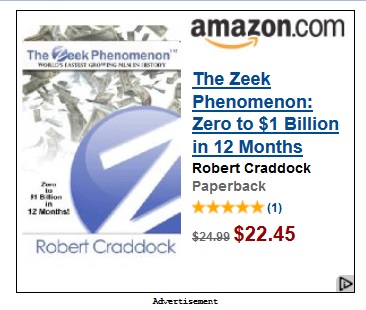
    This ad for Zeek figure Robert Craddock's new book appeared on the Drudge Report today. Source: Screen shot.
    This ad for Zeek figure Robert Craddock’s new book appeared on the Drudge Report today. Source: Screen shot.

    DISCLOSURE: The PP Blog carries ads from AdChoices that are delivered by Google.

    UPDATED 7:22 A.M. EDT OCT. 12 U.S.A. The PP Blog observed yesterday that a new book by Zeek Rewards figure Robert Craddock now is available on Amazon.com after earlier having been listed as “Out of Print” and with “Limited Availability.” The price of the 276-page paperback, as advertised on Amazon.com yesterday and today, is $22.45.

    This afternoon the PP Blog observed an ad for the Craddock book at the top of the Drudge Report, one of the most highly trafficked political websites in the world. A symbol in the ad suggested it originated through AdChoices. Ads on the Drudge Report are arranged through Intermarkets Inc.

    Marketing copy for the book, which the PP Blog accessed directly through Amazon.com, does not mention that Zeek Rewards was alleged to be a massive international Ponzi- and pyramid scheme that gathered hundreds of millions of dollars and affected hundreds of thousands of people.

    The copy argues that the U.S. government should have modeled a “stimulus program” after Zeek, instead of shutting it down.

  • SEC Declines To Comment On New Claims Attributed To Zeek Figure Robert Craddock

    ponziglareUPDATED 8:30 P.M. EDT U.S.A. The SEC this afternoon declined to comment on a confounding claim attributed to Zeek Rewards figure Robert Craddock that Zeek took in $1 billion in 12 months and that the U.S. government should have modeled a “stimulus program” after Zeek instead of shutting it down in 2012.

    News that Craddock apparently had authored a book on Zeek and was making new claims first appeared on BehindMLM.com early today. In 2012, the SEC described Zeek as a massive Ponzi- and pyramid scheme and described Craddock as an obstructionist who was encouraging victims not to cooperate with Kenneth D. Bell, the court-appointed receiver in the agency’s civil case. Craddock has not been been charged with wrongdoing.

    Titled “The Zeek Phenomenon: Zero to $1 Billion in 12 Months,” the book in which Craddock is listed as the author is advertised on Amazon.com as a paperback “Out of Print” and with “Limited Availability.” Sept. 29 of this year is the asserted publication date.

    The office of U.S. Attorney Anne M. Tompkins of the Western District of North Carolina did not respond immediately to a request for comment on the claims. Tompkins’ office brought successful criminal prosecutions against Zeek figures Dawn Wright-Olivares (investment-fraud conspiracy and tax-fraud conspiracy) and Daniel Olivares (investment-fraud conspiracy) in late 2013.

    Wright-Olivares, 45, and Olivares, 31, her stepson,  pleaded guilty to the respective criminal charges against them in February 2014. Earlier, in December 2013, they settled SEC civil charges against them by agreeing to pay millions of dollars each, “the entirety of their ill-gotten gains plus prejudgment interest,” the SEC said at the time.

    In July 2014, Bell said in court filings that Wright-Olivares, Olivares and alleged Zeek operator Paul Burks had agreed to a consent judgment of $600 million “to be satisfied with substantially all of their assets.”

    Other court filings by Bell say a criminal investigation into Burks remains open. Bell also is special master in the criminal case.

    The Confounding Claims

    Craddock’s apparent claim that Zeek took in $1 billion in a year appears to be at odds with court filings by federal prosecutors in December 2013 that claim Zeek gathered a maximum sum of $897 million before collapsing in August 2012. If, as the claim suggests, Zeek took in $1 billion, there may exist a discrepancy of at least $103 million between the claim attributed to Craddock and the government’s account.

    How Craddock apparently arrived at the $1 billion figure was not immediately clear. Such a discrepancy, though, potentially could cause both the SEC and federal prosecutors to revisit the Zeek numbers. The assertions attributed to Craddock suggest that Zeek’s haul could have been much larger and occurred in the narrower time frame of 12 months, not the nearly 20 months cited by the SEC.

    In short, could an undisclosed, unrecovered pile of Zeek cash exist elsewhere?

    According to marketing copy on Amazon.com for the book attributed to Craddock, the government messed up big time by taking down Zeek.

    Here’s a snippet (italics added):

    In 2012, if the present Administration wanted to build a successful stimulus program, it should have used Zeek Rewards as a guide. This pioneering venture went from zero to one billion dollars in just 12 months, paid over 400 million dollars to more than 20,000 people earning an average of $20,000, created 10 people who made over one million dollars, and caused several thousand people to earn incomes in excess of one hundred thousand dollars. This unparalleled example would have been a phenomenal feat for our US Government during a period when our very financial existence was threatened.

    The words “Ponzi” and “pyramid” appear nowhere in the marketing copy on Amazon.com. Whether Zeek “paid”  is immaterial in the context of Ponzi schemes. So is the issue of how much it paid. Bernard Madoff “paid.” All successful Ponzi schemes “pay.” Zeek launched after the collapse of Madoff’s epic fraud, leading to questions about whether Zeek, its insiders and key promoters simply divorced themselves from reality.

    Moreover, Zeek launched after the collapse of AdSurfDaily, a Zeek-like scam that promoted a return of 1 percent a day. Zeek’s purported daily payout averaged 1.5 percent, a percentage grossly superior to Madoff and significantly better than ASD.

    In 2012, less than a month prior to the SEC’s Zeek action, Craddock temporarily succeeded in taking down a HubPages site operated by Zeek critic “K. Chang” by accusing him of copyright and trademark infringement.

    K. Chang ultimately prevailed, but the site experienced downtime.

    As the PP Blog reported at the time, Zeek appeared not to own the trademarks Craddock complained about, purportedly with the authority of North Carolina-based Zeek operator Rex Venture Group. Rather, the trademarks were listed in the name of Ebon Research Systems LLC, a Florida business.

    A business known as Ebon Research Systems Publishing LLC is listed as Craddock’s publisher for the new book on Zeek, according to the Amazon.com listing.

    Florida records suggest that Ebon Research Systems Publishing is managed by Dr. Florence Alexander, the same person behind Ebon Research Systems LLC when the HubPages flap played out more than two years ago.

    The PP Blog spoke with Alexander in 2012. She said she “certainly” knew of Zeek, but said she had “no knowledge” of any trademark or copyright complaint filed at HubPages against K. Chang.

    Although Craddock claimed to be a Zeek “consultant” while filing the claim against K. Chang prior to the SEC action in 2012, Zeek itself did not list him as one after the action, according to court records maintained by the ASD Updates Blog. (See Zeek filing from September 2012 here.)


  • TelexFree Figure Carlos Costa Trounced At Polls For Seat In Brazilian Congress

    UPDATED 9:32 P.M. EDT U.S.A. TelexFree figure Carlos Costa of the state of Espírito Santo appears to have come up far short in his bid to win a seat in Brazil’s 513-member federal Chamber of Deputies, the equivalent of the U.S. House of Representatives.

    Although final numbers appear not to be available yet, more than 99 percent of the vote appears to have been tabulated. Costa appears to be listed in 31st place in a crowded field in which a maximum of 10 candidates from his region would fill vacancies.

    Costa appears to have gleaned about 0.61 percent of the vote, with the successful candidates receiving far higher percentages. At the time of this PP Blog post, the lead vote-getter appears to have gleaned about 8.55 percent. The lowest vote-getter among the top 10 received about 2.68 percent.

    Costa’s campaign appeared to focus on wooing MLMers. Regulators in both Brazil and the United States have described TelexFree as a pyramid scheme. Some TelexFree members have alleged that racketeering violations occurred within the cross-border enterprise.

    Costa’s campaign site appears not to have conceded defeat as of the time of this PP Blog post.

  • KABOOM! Banners Broker MLM ‘Program’ Described As ‘Criminal Enterprise’ That Gathered Tens Of Million Of Dollars

    “Affiliates found to be contributing to the negativity on the Internet will have their accounts locked, they will be banned from participating in the Banners Broker system and they will forfeit all of their inventory and revenue.” —  Banners Broker threat to members, February 2014

    “It is the position of investigators that this business was a pyramid scheme that over time evolved into a straight Ponzi scheme in which new victims were recruited to stave off requests for withdrawals and complaints from older ones.” —  Royal Canadian Mounted Police, July 17, 2014: Source: Affidavit that shows the RCMP, the Toronto Strategic Partnership and the Toronto Police Services Financial Crime Unit are involved in a criminal probe of Banners Broker.

    EDITOR’S NOTE: The double-your-money Banners Broker “program” posed as an online “advertising” company. It appears to have gathered tens of millions of dollars using a series of conduits and employing entities or business identities in money-laundering havens. At least for now, the total sum stolen from participants is unclear. As alleged, funds were “diverted by the suspects and their associated corporations to various offshore and other bank accounts controlled by them.”

    ** _________________________**

    Screen shot from page of court exhibit in Canada.
    How to begin the brainwashing process: Screen shot from page of court exhibit in Canada.

    As an interview subject allegedly told the Competition Bureau of Canada on April 9, 2013, it was all so simple to Banners Broker operator Christopher George “Chris” Smith:

    Indeed, Canadian authorities now have alleged, when the subject “met with Smith [in 2010,] he asked Smith why people lost money in these programs and Smith said it was what the programs were designed for, they bring people in, make some money and then they shut down and people move on to the next one.”

    What was Smith allegedly discussing at the meeting in Toronto? His desire to come up with a “copycat” of Travel Ventures International, a purported “opportunity” also known as TVI Express and described as a scam on multiple continents. (See K. Chang’s MLM Skeptic Blog for a report on how TVI Express spread around the world.)

    This, friends, is whack-a-mole — in the style of MLM huckster Chris Smith. It’s also racketeering MLM-style, whether formally prosecuted as such or not. And so it comes as no surprise that the term “criminal enterprise” to describe Banners Broker and its associated corporations now appears in court filings in Canada. (See links and credits at bottom of this story.)

    In 2011, the U.S. Secret Service described the AdSurfDaily Ponzi scheme, another cross-border MLM fraud, as a “criminal enterprise.”

    Members of the TelexFree MLM “program” allege that racketeering occurred within that enterprise, described by U.S. regulators earlier this year as a billion-dollar, cross-border pyramid- and Ponzi scheme. The Zeek Rewards MLM “program,” alleged to have gathered on the order of $850 million before is August 2012 collapse, launched after the 2008 collapse of ASD. There can be no doubt that TelexFree, Zeek, ASD and Banners Broker had promoters in common.

    There also can be no doubt that “see no evil” MLM cottage industries sprouted up around these foundationally corrupt “programs” and offered services such as “lead” provision and “ad” placement. Victims have piled up in such numbers that, in the TelexFree scam alone, 20,000 Greyhound buses with a 50-seat capacity each would be required to accommodate the fleeced masses.

    But where would they all go to observe events and be acknowledged at once?

    No courtroom can accommodate 1 million victims. Even if Mass-Participation Court existed and were gaveled into session on an unbooked Saturday in Pasadena’s famous Rose Bowl with onetime Tournament of Roses Parade Grand Marshal and U.S. Supreme Court Associate Justice Sandra Day O’Connor coming out of retirement to preside, the huge stadium’s seating capacity of 92,542 still would be far too small to accommodate the injured parties.

    Beyond that, Greyhound’s entire noble fleet consists of only 1,200 buses, not the 20,000 that would be required to transport TelexFree victims to California.

    Despite the best efforts of the courts, victims are being lost as a result of these insidious MLM schemes. Some will be re-victimized in a whack-a-mole reload scam pitched by an MLM predator with a smile on his or her face and a Bible verse at the ready.

    There also can be no doubt that certain members of the “programs” are members of a criminal combine that, whether loosely or closely associated, pushes one racketeering scam after another on the consuming public. It is willful blindness on a global scale. It is so dangerous, so calculating and methodical, so gruesomely injurious to persons and property, that it almost defies description.

    Next time someone tries to recruit you into an HYIP  “program” by telling you the “leaders” are already on board, here’s what to think: The racketeers are either running things or influencing events (again). They’re going to harm me (again). They’re going to harm my community, my country (again). They’re going to say they have been vetted by “attorneys” (again).

    And then, as Chris Smith allegedly said, they’re going to shut down and “move on to the next one.”

    Again.

    Reclaim Your Brain — Right Now!

    Like predecessor scams such as AdSurfDaily and AdViewGlobal and Zeek, the hypnotized and robotic Stepfordians in Banners Broker who’d been brainwashed by cult tactics rose up to “defend” the “program,” including some individuals who continued to champion the scam even after it effectively extorted them into paying more fees to keep their positions intact and to retain any chance of receiving a payout.

    While trying to chill members who remained in control of their gray matter and hadn’t slipped into an MLM trance, Banners Broker naturally counted on the Stepfordians whose brains it had reduced to slush to wage efforts to chill Blogs and websites that report on scams.

    “If you know of a site with content that is negative towards Banners Broker, we ask that you report it to the Community Watch,” the “program” instructed in February 2014.

    Yes. Amazing as it sounds, Banners Brokers called its efforts to cover up its own criminal enterprise a “Community Watch” program. Even earlier than that, it dispatched the Stepfordians to harass and hound a Blogger named Finch, who now says, “I received all kinds of threats, smears and public verbal bashings.”

    On Jan. 17, 2013, the PP Blog reported it was receiving menacing communications about Banners Broker.

    For additional background on bids to chill reporters or program members who publish information about scams and highly questionable “opportunities,” see this Dec. 27, 2012, PP Blog post: Our Choice For The Most Important PP Blog Post Of 2012. (It’s about an effort to chill K. Chang over his reporting on Zeek Rewards.)

    Also read about continuing efforts from the MLM HYIP sphere to destroy the antiscam well at BehindMLM.com and RealScam.com.

    NOTE: A special shout out today to RealScam.com and the Banners Broker Ponzi Scam Community on Facebook. They shared this 275-page court filing in Canada on civil and criminal investigations into Banners Broker.

    ALSO: Visit the website of the msi Spergel inc., the receiver.


  • NEW ENGLAND PUBLIC RADIO: Secretary Galvin Talks TelexFree, Sann Rodrigues And ‘IFreeX,’ Tells Station Accused Huckster’s ‘Current Whereabouts . . . Unknown’

    sannrodriguesUPDATED 8 A.M. EDT U.S.A. New England Public Radio has a minute-long audio report on TelexFree, iFreeX and Sann Rodrigues, including comments from Massachusetts Commonwealth Secretary William Galvin.

    An NEPR text report is available here. Look under the byline of Kari Njiiri for a link to the audio report.

    Rodrigues, accused in April 2014 by the U.S. Securities and Exchange Commission of fraud over his alleged role in TelexFree, earlier (in 2006) was accused of fraud by the SEC in a separate alleged pyramid scheme involving phone products. iFreeX may constitute at least his third dance in securities- and affinity-fraud schemes involving communications products.

    Galvin reportedly told the station that the “current whereabouts” of Rodrigues is unknown. The charged pitchman hails from Brazil, once resided in Massachusetts and also has lived in Florida.

    Rodrigues, according to the SEC, has claimed that “God” started MLM and “binary” MLM “programs.”

    On Dec. 19, 2013, the PP Blog reported that TelexFree puff pieces were appearing in a publication that featured a columnist who asserted Jesus Christ was the person who inspired modern network marketers through his recruitment of 12 disciples.

    Ads for an apparent cash-gifting scheme appeared in the same publication.

    SEC case filings alleged that, on March 15, Rodrigues’ co-defendant Faith Sloan claimed on her website that the TelexFree compensation plan was changing and was not in final form — “[b]ut is Getting BETTER as Jesus said.”

    Regulators have described TelexFree as a billion-dollar pyramid- and Ponzi scheme that operated across national borders.

    Claims of divine authority or inspiration are not unusual in MLM HYIP frauds. In the 2008 AdSurfDaily case, for instance, accused operator Andy Bowdoin claimed God was on his side and compared the U.S. Secret Service to “Satan” and the 9/11 terrorists. Bowoin later was sentenced to federal prison for his $119 million Ponzi scheme.

    Promos showed Bowdoin asserting from a stage in Las Vegas that he was a Christian “money magnet” and that cash would “flow” back to people who gave him tens of thousands of dollars at a time.

    Affinity fraud may occur in many contexts: appeals to religious faith, appeals to common interests, appeals to common heritage, appeals to common political interests and more.

  • Email Address In Faith Sloan’s DMCA Complaint Against BehindMLM.com Appears In 2010 Promo About Purported $10,000 Payout From Matrix Cycler; ‘You Can Do That Over And Over Again,’ Veteran HYIP Huckster Claims

    More than two minutes and forty seconds of a special version of "I Gotta Feeling" recorded by the Black Eyed Peas to honor Oprah Winfrey plays in this "team" promo for a matric-cycler "program" known as "Diamond Holiday Feeder." Neither the group nor Winfrey is credited.
    More than two minutes and 40 seconds of a special version of “I Gotta Feeling” recorded by the Black Eyed Peas to honor Oprah Winfrey plays in this “team” promo for a matrix-cycler “program” known as “Diamond Holiday Feeder.” Neither the group nor Winfrey is credited. Source: screen shot from DailyMotion.com.

    The Gmail address used by TelexFree figure Faith Sloan in a Sept. 23 DMCA takedown notice filed against BehindMLM.com appears below a 2010 video promo for a “program” known as “Diamond Holiday Feeder,” part of a larger “program” purportedly engaged in the travel business while also operating a matrix cycler.

    Matrix cyclers sometimes are known as 2x2s or “get two who get two.” MPB Today, a collapsed matrix cycler that led to racketeering charges in Florida against the “program” operator, is an example of a 2×2. Another example is Regenesis 2×2, which led to a U.S. Secret Service probe in Washington state in 2009.

    In a 3:44 video whose publication date is listed as April 8, 2010, Sloan claims to have made $10,000 in the Diamond Holiday Feeder program and further claims “you can do that over and over again.” The headline of the video is, “Ten Thousand Dollars Proof – Diamond Holiday Feeder – BYC.”

    Another Sloan video for a “team” build of the Diamond Holiday “program” uses nearly three full minutes of a special version of “I Gotta Feeling” recorded by The Black Eyed Peas to honor Oprah Winfrey and the 24th year of The Oprah Winfrey Show in September 2009. Neither Winfrey nor the group is credited in the “team” promo. The “team” build video is dated March 21, 2010.

    Ironically, Sloan has accused BehindMLM.com of copyright infringement, amid allegations it used photos to which she owned the copyright on its website.

    BehindMLM.com says Sloan’s claims are bogus.

    Though TelexFree would come later — after the apparent collapse of Diamond Holiday Feeder, with Sloan blaming events on management  — an image of Sloan posing in front of a TelexFree logo appears on the Diamond Holiday Feeder video site. The site appears now to be driving traffic to a “program” known as “RE247365.” (BehindMLM.com is back online after being offline for all or parts of three days. Read its “RE247365” review.)

    In the current TelexFree case in which she is accused of securities fraud, Sloan likewise is blaming management.

    Sloan’s narration in the April 2010 video shows her Diamond Holiday Feeder back office and suggests she did not withdraw her purported earnings of $10,000 all at once to her bank account, but rather in smaller increments. Such a practice may lead to questions about whether she was engaged in structuring transactions to avoid bank-reporting requirements. In a civil action against TelexFree in April, the Massachusetts Securities Division raised the issue of structuring.

    Other information suggests Sloan gravitated to Diamond Holiday Feeder after the collapse of the Noobing MLM scam in 2009. Noobing, in part, was targeted at people with hearing impairments, including a California woman the PP Blog interviewed in 2010 through her interpreter.

    On a website deemed “The Official Web Blog” of Noobing, the program was described as a “hit” among deaf people. Noobing, according to the Blog, was promoted at Deaf Expos in Kansas, Missouri, New Jersey and Texas in 2008 “to connect with the often overlooked hearing impaired business community.”

    Noobing was under the umbrella of an enterprise known as Affiliate Strategies Inc. that was running a government-grants swindle and was sued by the FTC and three state-level attorneys general for fraud. ASI went into receivership, taking Noobing with it. The enterprise had offshore conduits in Belize and Nevis.

    On one August day in 2009, attorneys assisting the ASI receivership “received thirty two US Mail crates” filled with complaints from scam victims, receiver Larry Cook said at the time.

    “The Receiver’s work over the past three weeks suggests the Defendants’ operations were insolvent on the date [July 24, 2009] the [Temporary Restraining Order] was entered and that for at least all of 2009, Defendants operated only by signing up new victims faster than the old victims could obtain refunds,” Cook said at the time.