Author: PatrickPretty.com

  • Now, A $145 Million Fraud Scheme in Utah; SEC Charges Travis Wright Amid ‘Sandwich In A Can’ Allegations

    A Utah man whose assets — including a taxidermy of a full-body African lion — was put on the action block amid Ponzi allegations earlier this year was selling unregistered securities and running a $145 million offering fraud, the SEC said today.

    Charged in the case was Travis L. Wright. The SEC said the scheme raised “nearly $145 million from approximately 175 investors” by providing investors promissory notes issued by Waterford Loan Fund LLC.

    The notes purportedly were secured by a lien on a trust that held all the assets of the fund, but Wright made “numerous” misrepresentations to investors, the SEC charged.

    Waterford was placed in bankruptcy last year, and Ponzi allegations emerged. The asset sale was billed in April as stemming from the proceeds of “one of the largest alleged Ponzi fraud cases in Utah.”

    Among the taxidermy items put up for bid were a “full body African lion,” Cape Horn buffalo, African antelope and hyena, wildebeest and other exotic animals. Forty-three firearms also were put up for auction, along with “beautiful, top-quality office furniture,” paintings, Persian and Oriental rugs, “fine home furnishings, antiques and more.”

    In June, the FBI said that recent Ponzi schemes and cases of investment fraud have cost Utah residents an estimated $1.4 billion. Some of the schemes were targeted at Mormons, the agency said.

    About 370 investigative “subjects” — defined as “potential perpetrators” in current cases — have been identified, and the agency and its law-enforcement partners have embarked on a public awareness and education campaign aimed at keeping Utahns safe from scammers.

    About 4,400 people have been affected by investment-fraud schemes in the state, the FBI said. The education campaign includes billboards and public-service messages.

    Among the allegations by the SEC against Wright was that he directed money to a company that planned to sell a product through vending machines. The product was described as a “sandwich in a can.”

    The SEC asserted that Wright told investors “that their funds would be used only to make loans secured by commercial real estate, when in fact he used their funds primarily for loans and investments having nothing to do with real estate.”

    Meanwhile, Wright told investors their promissory notes were secured by interests in a trust, “but no such trust existed” and “the notes were not secured,” the SEC said.

    Although Wright told investors that Waterford would never lend more than 50 percent of the value of its real estate holdings, he did not disclose “that he never obtained an appraisal or valuation of real estate before lending investor funds against it” and that “he was using investor funds to pay for a lavish lifestyle for himself and his friends and family,” the SEC charged.

  • IT’S OFFICIAL: One Of Andy Bowdoin’s Lawyers Confirmed As U.S. Attorney; Another Tabbed As Federal Magistrate Judge; Firm Put In Charge Of Unraveling Wayne McLeod Ponzi Scheme

    Andy Bowdoin

    It’s enough to fuel the AdSurfDaily conspiracy theorists for years: Pamela Marsh, who represented ASD President Andy Bowdoin in a pyramid-scheme case in state court in Florida, has been confirmed by the U.S. Senate as the new U.S. Attorney for the Northern District of Florida.

    Meanwhile, Jonathan Goodman, one of the attorneys who represented Bowdoin in the Ponzi-scheme forfeiture case filed in U.S. District Court for the District of Columbia, has been appointed a federal Magistrate Judge in U.S. District Court for the Southern District of Florida.

    At the same time, an attorney for Akerman Senterfitt — the firm that employed both Marsh and Goodman — has been appointed to unravel the alleged K. Wayne McLeod Ponzi scheme that targeted members of law enforcement.

    Akerman Senterfitt’s Michael I. Goldberg already has begun his duties as receiver in the McLeod/Federal Employee Benefits Group case.

    President Obama appointed Marsh U.S. Attorney in April. She was confirmed by the Senate June 22.

    “Pam’s deep understanding of the law and commitment to excellence and ethics in her work made her a strong asset to the firm and she is the perfect choice to lead this important office,” said Andrew Smulian, chairman and chief executive officer of Akerman Senterfitt. “Pam has had great success in both the public and private sector and I am confident she will bring these impressive talents to her new role. We are particularly proud that Pam continues the tradition of Akerman attorneys who have made a special commitment to public service.”

    Marsh and Goodman have considerable experience as both prosecutors and defense attorneys.

    Bowdoin, 75, went on to fire an unclear number of attorneys representing him in state or federal court in ASD-related litigation, citing alleged incompetence and a conspiracy theory that his lawyers were only “looking out for the best interest of the government.”

    In 2008, federal prosecutors claimed Bowdoin had “followers.” In September 2009, they claimed he was “delusional.”

    Court records suggest Bowdoin withheld key information from both his attorneys and ASD members. While claiming in court that ASD was broke and could not pay its rent, Bowdoin did not disclose that ASD had $1 million in an offshore account under a different name, federal prosecutors said.

    He also claimed that “Ponzi” allegations against the company in Florida had been dropped, but the office of Florida Attorney General Bill McCollum pointed out that Bowdoin had never been accused by the state of operating a Ponzi scheme. The state brought pyramid allegations against the company.

    Despite federal allegations that Bowdoin was using an appeal to religion and operating a $100 million Ponzi scheme through 10 bank accounts in his personal name and that ASD was buying real estate, cars, jet skis, a boat and marine equipment with criminal proceeds, followers by the thousands initially lined up to support him.

    Some of his supporters said they associated themselves with a theory that the U.S. Congress met in secret session during the 1990s — a decade in which Bowdoin pleaded guilty to fleecing Alabama investors in a securities scheme — to pass secret legislation in anticipation of a visit by reptilian aliens.

    Some supporters also said they believed President Kennedy was assassinated in 1963 because he was about to expose a banking conspiracy.

    Eventually dozens of pro se litigants attempted to intervene in a forfeiture case brought by the U.S. Secret Service in August 2008. Some of them advanced a theory that prosecutors and judges were conspiring against Bowdoin.

    Others claimed the government had neither evidence nor witnesses, claims that were publicly refuted in court filings even before the claims were made. At least one ASD member sought unsuccessfully to force the ouster of U.S. District Judge Rosemary Collyer, claiming she was conspiring with another federal judge to deny justice to ASD members and operating a “kangaroo court.”

    The same member — Curtis Richmond — also sought unsuccessfully in 2008 to oust a federal judge in a separate case by claiming the judge owed him $30 million.

    Bowdoin himself also tried unsuccessfully to oust Collyer. One of his supporters falsely claimed the government had invested the seized funds and recorded a profit of more than $1 billion.

    In September 2009, Bowdoin claimed that his battle against the government was inspired by a former Miss America. He previously claimed the raid on ASD was the equivalent of the 9/11 terrorist attacks that killed nearly 3,000 people, and described the Secret Service and prosecutors as “Satan.”

  • Receiver For Alleged Wayne McLeod Ponzi Scheme That Bilked Government Workers Opens Website; Michael I. Goldberg Asks For Help From Victims

    Saying he is interested in receiving input from victims, the court-appointed receiver in the alleged K. Wayne McLeod/Federal Employee Benefits Group Ponzi scheme has opened a website titled after the name of one of the companies named a defendant in the case by the SEC.

    Also named a defendant in the SEC case was another McLeod entity known as F&S Asset Management Group Inc. (FSAMG). McLeod died June 22. His death has been described by the Jacksonville Sheriff’s Office as a suicide. The SEC said in court filings last week that McLeod admitted to operating a fraud scheme after being confronted with evidence.

    He initially painted his company in a favorable light, according to court filings.

    The URL for the receiver’s site is FEBGinfo.com. (See link below.) Federal Employee Benefits Group went by the acronym FEBG and allegedly offered two bond funds that used the same acronym: FEBG Bond Fund and FEBG Special Fund. Both purported funds were scams, the SEC said.

    Receiver Michael I. Goldberg, a veteran attorney who also holds an MBA and has considerable experience in unraveling Ponzi schemes, cautioned that his probe was in its early stages.

    Goldberg’s early suggestions for creditors and victims are here.

    He noted that he was open to ideas, while also suggesting at least some of the victims may have “years of investigatory experience” that may be helpful to his probe.

    The SEC said the scheme, which is alleged to have begun in 1988, was targeted at government workers and law-enforcement agents. McLeod allegedly raised at least $34 million from an estimated 260 workers.

    Investigators said the government paid McLeod “up to” $15,000 to speak about benefits and retirement planning to government workers.

    Here is the link to the FEBG receivership site.

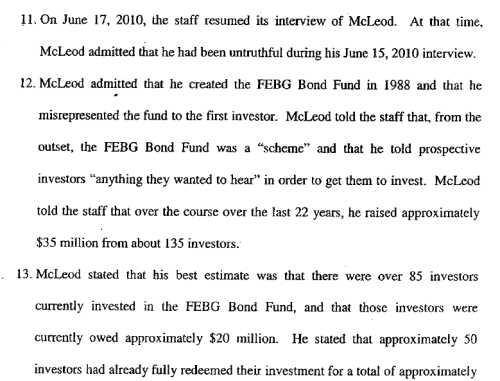
    Here (below) is a snapshot from one of the SEC filings in the case. Read the full document here.

  • UPDATE: June Ends With No Cell-Phone Plan From Data Network Affiliates; Company’s ‘Nature Of Business’ Under Review By BBB

    June closed with no cell-phone package from Data Network Affiliates (DNA), despite claims on YouTube that the firm offers “unlimited” talk and text with a free phone for $10 a month.

    Separately, the Better Business Bureau of Southeast Florida and the Caribbean now says it is looking into the “nature” of DNA’s business and assigned the firm an opening grade of “C-” on its 14-step ratings scale. In recent weeks, DNA, whose website is registered behind a proxy in the Cayman Islands, has listed a street address in Boca Raton, Fla.

    It is not unusual for the BBB to give a company an acceptable rating while it is gathering information and then adjust the rating based on the information it collects. Narc That Car (Crowd Sourcing International) once had a “B-” rating from the BBB. Narc/CSI’s rating eventually was lowered to “F,” but could have remained stable at “B-” or even improved had the organization been satisfied by the explanations it received from the Dallas-based company.

    The information the BBB now has on DNA can aptly be described as threadbare. No complaints have been filed against the firm, according to the BBB. The BBB’s listing for DNA first appeared in late June.

    Like Narc/CSI, DNA purports to be in the business of paying members to record the license-plate numbers of automobiles for entry in a database. The BBB has raised pyramid concerns about the business model Narc/CSI employs.

    DNA originally positioned itself as the “free” alternative to Narc/CSI, which charges “consultants” an up-front fee of $100 to qualify to become data-gatherers and earn the right to recruit other “consultants” and receive commissions based on their recruiting prowess. Like Narc/CSI, DNA said its database product would be helpful to law enforcement and also could be used as a tool to locate abducted children.

    Although positioning itself as “free” and signing up members by the tens of thousands, DNA later pitched a $127 upgrade that purportedly would make it easier for members to enter plate data. The company described its “free” data-entry module as a clunker in an email to members. The company later pitched members on a purported “magnetic” healthcare product and also said it offered “juice.”

    DNA has been associated with a series of communications that even its former chief executive officer described as bizarre. The former CEO, Dean Blechman, resigned Feb. 24 while the company was in prelaunch. Blechman said the firm delayed his resignation announcement for nearly a week, and then butchered the announcement when it finally was issued in early March.

    By April, DNA said it had entered the cell-phone business, declaring “GAME OVER — WE WIN” despite the fact it appears to have had no experience in the cell-phone industry. The company announced it would offer unlimited talk and text with a free phone for $10 a month, but then withdrew the announcement three weeks later, saying it had not studied cell-phone pricing prior to advertising its purported $10 plan.

    The $10 plan was advertised by DNA pitchmen on both Craigslist and YouTube. Some videos on YouTube implied that DNA was offering a branded I-Phone from Apple for $10 a month. Apple did not respond to requests for comment on DNA’s purported branding program.

    DNA, which has used a free Gmail address to conduct customer service, has published an image of an I-Phone for weeks. DNA’s website advertised “Full Operations” for cell phones beginning in “June 2010.” A link on that page leads to a page that incongruously says, “DNA Cellular Begins Full Service May 2010.”

    Visit the BBB’s early listing on DNA.

  • WebsiteTester.Biz Pitched On Reborn GoldenPandaAdZone Forum, Plus MoneyMakerGroup, TalkGold And Other Ponzi Havens

    EDITOR’S NOTE: This story originally was published June 30. The PP Blog later encountered a database problem, which caused the site to go down and resulted in the temporary loss of some data. The data now has been retrieved.

    This story is about a new site known as “WebsiteTester.biz,” but some background is in order.

    It turns out that the April reports of the demise of the Golden Panda Ad Zone Forum, which changed its name to the Online Success Zone (OSZ), were premature.

    OSZ now is back online — and a poster is pitching  “WebsiteTester.biz,”  which appears to be promoting itself as an upstart advertising “testing” platform.

    Positioning surfing sites as testing platforms dates back at least to the CEP Ponzi scheme. Last summer, the failed AdViewGlobal (AVG) autosurf, which had close ties to the AdSurfDaily autosurf, was trying to reposition itself as an ad-testing site.

    Just prior to going offline in April, OSZ was pushing Narc That Car and Data Network Affiliates, two highly questionable companies  whose membership roster includes people linked to alleged Ponzi or pyramid schemes. OSZ got its start as the Golden Panda Ad Zone forum after the U.S. Secret Service seized more than $80 million from ASD and its purported “Chinese” autosurf companion, Golden Panda Ad Builder.

    During the summer of 2008, with ASD at its zenith and about to be accused of operating a Ponzi scheme, a predecessor to the INetGlobal autosurf also was coming online. INetGlobal eventually morphed into a surf site that largely targeted Chinese members, according to the Secret Service, which is investigating INetGlobal as its operator, Steve Renner, is in federal prison serving time for income-tax evasion.

    The ASD and Golden Panda money was seized amid allegations of wire fraud, money-laundering, selling unregistered securities and operating a Ponzi scheme. A forfeiture complaint in the case alleged a conspiracy with unnamed participants, and ASD was sued separately under the federal racketeering statute by members who also alleged a conspiracy was under way.

    Participants’ marketing of WebsiteTester.biz. occurs against the backdrop of a forceful statement by federal prosecutors in Illinois that virtually all HYIPs are Ponzi schemes. Autosurfs are a form of an HYIP program.  The business model of WebsiteTester.biz is unclear, and the company has not been accused of wrongdoing.

    In the Illinois case, Pathway To Prosperity (P2P) was alleged to have operated a global Ponzi scheme that gathered more than $70 million and fleeced more than 40,000 people. Nick Smirnow, P2P’s operator,  has a criminal past dating back to at least 1979, including convictions for breaking and entering, driving the getaway car in a robbery and cultivating and selling drugs. He also told a colleague he was involved in a double homicide in Canada and claimed to have ties to organized crime in Ontario, according to court filings.

    Posts on forums such as ASA Monitor, TalkGold and MoneyMakerGroup sought to sanitize the P2P scheme, authorities said. This important piece of information seems to have escaped the OSZ forum, which apparently continues to operate on the theory that HYIPs, autosurfs and cash-gifting programs somehow are a legitimate form of commerce.

    Incongruities abound in the autosurf and HYIP universes. “WebsiteTester.biz,” the apparent new darling of Ponzi boards such as OSZ, has a domain that is registered behind a proxy. It is unclear if any of its early boosters even know who owns the company or could name a single executive or a board member. Because the site’s business model is unclear, promoters are pitching a program they know virtually nothing about.

    The mere fact the “opportunity” is being pitched on the Ponzi boards shows, at a minimum, that promoters instinctively turned to the cesspools to drive business to the company.

    On its website, Website Tester, which purportedly is in prelaunch,  says this (italics added):

    “FINALLY . . . This is the business you have waited for so long:

    “It is completely free, you earn through EVERYBODY who registers after you, even if you do not sponsor people; you must not sell or buy anything. Guaranteed!

    “The faster you register, the more can be your potential income, even if you do nothing else than register for free . . .

    “How does it work? – It’s simple!

    “A market research company from the USA is searching for internet users all over the world, who get paid for testing websites and giving a short opinion. You also can earn up to 1,000 US$ per month working 1 to 10 hours weekly.

    “Even if the job as a website tester is not for you, you can earn two passive incomes month after month.”

    Excuse us while we vomit.

    Based on information on the landing page of WebsiteTester, the upstart company appears to have a tie to an upstart, Las Vegas-registered company known as Alpha Market Research Inc.  Alpha Market appears to have a Twitter site from which it relentlessly links to self-produced news releases that are posted on PRLog.org, a free press-release distribution service.

    Hey, did you see how the SEC described a scam yesterday that allegedly relied on Twitter and Facebook to help line up people to be fleeced in a securities swindle?

    Here is a paragraph from one of Alpha Market’s PR gems:

    “Global marketing is nothing but marketing done on national and international level and which involves understanding the similarities, dissimilarities and taking advantage of the opportunities to attain the goal.”

    Here is another gem:

    “When you buy something from eBay, Amazon.com or any online store, you’ve participated in e-commerce.”

    Meanwhile, here is yet another:

    “If you do not have a ghostwriter writing your blog content, then it means you will need to spend some time writing some blog posts.”

    Separate from its news releases, Alpha Market says this (italics added):

    “Potential clients who are disturbed by trifles during the ordering process are often unaware of exactly why. For you, the entrepreneur, the big questions remain: why did the potential client visit your website and why did they accept or not accept your offer?

    Alpha Market Research, Inc. starts exactly at this point: we make your website available for thousands of AMR website-testers, assigned in groups of age and interest – this way we get detailed feedback with an honest evaluation of your website.

    Like WebsiteTester.biz, AlphaMarketResearch.com is registered behind a proxy. The Alpha Market site was registered May 28, according to records. The Web Tester site was registered five days later, on June 2. Alpha Market’s Twitter site appears to date back to June 4.

    The buzz about Website Tester also is occurring against the backdrop of the launch of yet-another surfing company: AdPayDaily (APD).

    APD, which appears to have promotional ties to ASD and AVG, is running an AVG-like series of promotions that offer bonuses.

    Interestingly, APD, which appears to have only about 550 members despite virtually nonstop flogging for weeks, now says members can send in as much as $10,000.

    Website Tester, at the moment, appears just to be gathering names — and generating excitement by publishing the names of the latest registrants on the left side of its landing page. The names suggest the enterprise is attracting many people from outside the United States, but it is far from clear if anything about the company is real.

  • Wayne McLeod Becomes Subject Of FBI Probe; Agency Asks Victims, Witnesses To Come Forward

    EDITOR’S NOTE: This story originally was published June 30. The PP Blog later encountered a database problem, which caused the site to go down and resulted in the temporary loss of some data. The data now has been retrieved.

    The FBI in Jacksonville has opened a probe into Kenneth “Wayne” McLeod, the Florida man who appears to have committed suicide last week when his alleged $34 million Ponzi scheme was exposed by the SEC.

    In a statement on its website, the FBI confirmed an investigation was under way and asked victims and witnesses to come forward.

    “Victims and other individuals with knowledge of FEBG are encouraged to call the FBI’s Jacksonville Field Office at (904) 248-7000 or to contact us via e-mail at Jacksonville@ic.fbi.gov and include “FEBG” in the e-mail subject line,” the agency said.

    Individuals are asked to provide the following:

    1. Their full name, address, and contact information.
    2. Their point of contact at Federal Employee Benefits Group (FEBG), McLeod’s company, and how they learned of the company and the investment opportunity.
    3. Their understanding of the terms of their investment(s).
    4. The total dollar amount of their investment(s).
    5. A description of any records they have in their possession that confirm their investment(s) — for example, statements, correspondence, etc.

    “Clients of FEBG should be aware that not all of the firm’s investments are at risk,” the FBI said. “However, individuals who invested in the ‘FEBG Bond Fund’ or ‘FEBG Special Fund’ may be victims of investment fraud and are welcome to contact the FBI.”

    McLeod was 48 when he died June 22. The SEC said his Jacksonville company was paid “up to” $15,000 by government agencies for seminars conducted by McLeod.

    The SEC alleged last week that McLeod was operating a Ponzi scheme dating back to at least 1988. The scheme was alleged to have gathered “at least” $34 million.

    McLeod’s company conducted seminars at various federal agencies, and also used the Federal Law Enforcement Training Center (FLETC) in Glynco, Ga., as a seminar outlet, according to the firm’s website.

    FLETC is operated by the Department of Homeland Security and serves as an interagency law-enforcement training organization for 88 federal agencies.

    If the company’s seminar schedule is accurate, FEBG completed a seminar for U.S. Immigration and Custom Enforcement (ICE) at the FLETC facility in Georgia June 8 — 14 days prior to McLeod’s death. Another ICE seminar was listed for July 2 at the same FLETC facility.

    Seminars for the Federal Air Marshals Service (FAMS) were scheduled July 7-9 in Miami. Dual seminars were scheduled for July 21 — one at the Georgia FLETC facility for ICE, and another in San Antonio for “SSA – OIG,” which stands for Social Security Administration, Office of the Inspector General.

    Seminar schedules dating back to 2006 appear on the site, featuring names such as the FBI, WIFLE (Women in Federal Law Enforcement), the DEA, the IRS, the U.S. Census Bureau, USSS (United States Secret Service), the U.S. Forest Service, USPS (United States Postal Service), ATF (the Bureau of Alcohol, Tobacco, Firearms and Explosives), NAADHS (National Association of African-Americans in the Department of Homeland Security, US Bankruptcy Court and US District Court, the Federal Public Defenders Office, the National Park Service, the US Fish & Wildlife Service, NABNA (National Association of Black Narcotics Agents), DCIS (Defense Criminal Investigative Service), NCIS (Naval Criminal Investigative Service) and others.

    It was not immediately clear if members of each of the agencies or employee associations invested in the alleged scheme. Also unclear was the total exposure of investors to losses.

  • SEC Charges Man Described As ‘Recidivist’ And ‘Felon’ In Alleged Philadelphia Ponzi And Fraud Scheme; Separately, CBS-3 Reports Feds Raid Offices Of Robert Stinson Jr., Life’s Good Inc.

    UPDATED 9:06 P.M. EDT (U.S.A.) A man who filed for bankruptcy twice, has an unpaid federal judgment for running a fraud scheme in the 1990s and managed to rack up convictions for crimes such as grand larceny, wire fraud, mail fraud and bank fraud during his purported business career has been charged by the SEC with operating a $16 million Ponzi and fraud scheme in Philadelphia.

    Separately, CBS-3 in Philadelphia is reporting that federal agents raided the man’s offices earlier today.

    In an emergency action, the SEC has charged Robert Stinson Jr. with fraud. U.S. District Judge Berle M. Schiller of the Eastern District of Pennsylvania has frozen Stinson’s assets, along with the assets of five relief defendants who allegedly received ill-gotten gains from the scheme.

    Relief defendants include Stinson’s wife, Susan L. Stinson, his son, Michael G. Stinson and his ex-wife, Laura Marable. Also named relief defendants were Christine A. Stinson, whose relationship to Stinson was not immediately clear, and First Commonwealth Service, a company associated with Stinson.

    Several Stinson-associated companies were named defendants, including Life’s Good Inc., Life’s Good STABL Mortgage Fund LLC, Life’s Good Capital Growth Fund LLC, Life’s Good High Yield Mortgage Fund LLC, JA Capital Fund LLC and Keystone State Capital Corp.

    “Stinson falsely claimed that the Life’s Good Funds generated annual returns of 10 to 16 percent by originating more than $30 million in commercial mortgage loans, and other investment income gained on the sale of foreclosure and investment properties,” the SEC charged.

    In reality, “Stinson has been stealing investor funds for his personal use, transferring money to family members and others, and using new investor proceeds to make payments to existing investors in the nature of a Ponzi scheme,” the agency said.

    The scheme gathered at least $16 million from more than 140 investors.

    “This fraud is ongoing,” the SEC charged. “Of the $16 million raised since 2006, at least $12.1 million was raised between April 2009 and May 2010. In May 2010 alone, Stinson raised approximately $2.3 million from at least 30 investors.”

    The allegations include a reference to a purported accounting firm — Johnson and Johnson Public Accountants Inc. — that prepared “Consolidated Financial Statements,” but the SEC said there is “no record” of a firm licensed by that name in Pennsylvania.

    Web search results show a domain titled “JohnsonJohnsonCPA.com,” which purports on the site to be a company founded in Philadelphia in 1978. Domain records show the site was registered in the name of “Robert Stinson” of Sunnyvale, Calif., in April 2009.

    Whether that “Robert Stinson” was the Robert Stinson Jr. charged in the SEC complaint was unclear. The SEC noted several accounting miscalculations and irregularities in the purported consolidated statements.

    Stinson Jr. has a long-running criminal record.

    In 1986, he was convicted of wire fraud and larceny in U.S. Court in Delaware, according to records. In 1987, he was convicted of forgery and larceny in New Jersey state court. During the same year, he was convicted of mail fraud in U.S. District Court for the Eastern District of Pennsylvania.

    Meanwhile, in 1996, he was convicted of criminal conspiracy in state court in Pennsylvania. In 2001, he was convicted of bank fraud in U.S. District Court for the Eastern District of Pennsylvania.

    Stinson filed two bankruptcy petitions in 1999, one in October and another in December, according to records.

    Nine years earlier, in 1990, he was charged with fraud by the SEC. He was ordered to pay a judgment of $7,680, but the judgment remains unpaid, according to court filings.

    Read the CBS-3 report.

  • BULLETIN: Now, A Multimillion-Dollar ‘Penny-Stock’ Scheme Operating On Facebook, Twitter; SEC Charges Two Canadians In ‘Scalping Scam’

    UPDATED 1:58 P.M. EDT (U.S.A.) The SEC has obtained an emergency order to freeze the assets of two Montreal residents, alleging they were pushing a penny-stock scheme through their website and on Facebook and Twitter.

    Named defendants in the alleged scheme were Carol McKeown and Daniel F. Ryan, whom the SEC described as a Canadian “couple.” The agency said it worked with the Quebec Autorité des marchés financiers (AMF), which also has obtained an emergency freeze, along with a “cease trade order.”

    The stocks were touted through a website known as PennyStockChaser.com, the SEC said. McKeown is 44; Ryan’s age was not immediately known.

    “As alleged in our complaint, McKeown and Ryan used all the modern methods to communicate with investors including the PennyStockChaser website, e-mail, text messages, Facebook, and Twitter yet failed to adequately communicate that their rosy predictions for touted stocks were accompanied by their sales of those very same stocks,” said Eric I. Bustillo, director of the SEC’s Miami Regional Office.

    The U.S. complaint is filed in U.S. District Court for the Southern District of Florida.

    McKeown and Ryan received millions of shares of touted companies through two corporations — Downshire Capital Inc. and Meadow Vista Financial Corp. — which also were named defendants, the SEC said.

    Both McKeown and Ryan were compensated for pumping the stock, while “PennyStockChaser simultaneously predicted massive price increases for the issuers, a practice known as ‘scalping,’” the SEC charged.

    “McKeown, Ryan and one of their corporations failed to disclose the full amount of the compensation they received for touting stocks on PennyStockChaser,” the SEC charged, saying that the couple and their corporations “have realized at least $2.4 million in sales proceeds from their scalping scheme.”

    The PennyStockChaser website was throwing a server error at the time of this post. Meanwhile, the Twitter site appeared to be locked. The Facebook site appeared to be operational, with a posted dated Sunday that blared, “How many newsletters put their money where their mouth is? PSC will be buying another 500,000 shares on Monday.”

    It was not immediately clear what stock the Facebook site was pumping Sunday because the link led to a page on the PennyStockChaser site that generated a server error.

    It has become somewhat common for scammers to use social-networking sites to hawk investment-fraud schemes and murky businesses. Some fraudsters even have claimed that the so-called autosurf “industry” in which purported “advertisers” get paid for viewing websites is a new form of social networking and that the autosurf sites are building on the success of brands such as Twitter, Facebook and others.

    Read the SEC complaint to see the names of some of the other stocks the agency says the defendants recently have pumped.

  • California Man, 72, Sentenced To 110 Months For HYIP Rip-Off; Richard M. Hersch Also Ordered To Pay ‘At Least’ $9.2 Million In Restitution

    First, Richard M. Hersch, 72, told investors they’d earn up to 6 percent a week by plowing money into his company, All States ATM Inc.

    He then explained the company had “contracts” with major horse-racing tracks in California and elsewhere to operate Automated Teller Machines (ATMs) on the “back side” of the tracks.

    Ordinary horse-racing fans could not use the ATMs, according to Hersch, because the “backside” was off-limits to the general public and situated for the convenience of racetrack employees, horse owners, horse trainers and others — his own, highly profitable niche.

    Hersch then made the investments appear to be even more lucrative by explaining “the racetracks allowed him to operate a check-cashing or loan service on the back side of the track for the exclusive use of those with access to that area,” prosecutors said.

    To further disarm skeptical prospects, “Hersch claimed that he had 160 employees and hundreds of ATMs and that his company was in its eighth year of business,” prosecutors said.

    But the tracks Hersch said used his ATM and check-cashing business “reported having no contracts with him or All States ATM to provide financial services of any sort,” prosecutors said.

    Hersch was charged with mail fraud and structuring, and was arrested last year by the FBI and IRS. Investigators determined he had coaxed more than 150 people to invest about $25 million in his company.

    He pleaded guilty in November and was sentenced yesterday, acknowledging he operated an HYIP fraud and conspired with others to structure 15 transactions totaling $141,500 to evade currency-reporting requirements. Prosecutors said he and co-conspirators withdrew cash from a bank account in amounts between $9,000 and $9,500 because they knew that withdrawals of cash over $10,000 triggered the reporting requirements.

    U.S. District Judge John A. Houston sentenced Hersch to 110 months in federal prison and to pay “at least” $9.2 million in restitution.

    “[Hersch’s] sentencing should remind the public of the financial perils associated with high yield investment fraud scams,” said Keith Slotter, FBI special agent in charge.

    HYIP schemers will get caught, a veteran IRS investigators warned.

    “Currency-report information filed by banks and financial institutions provides a paper trail, or roadmap, for investigations of financial crimes and illegal activities, including tax evasion, embezzlement, and money laundering,” said Leslie P. DeMarco, special agent in charge of the IRS Criminal Investigation unit in the agency’s Los Angeles Field Office.

    “Individuals who deliberately break down cash withdrawals into amounts less that $10,000, so as not to trigger a bank’s reporting requirement, are committing a financial crime,” said DeMarco. “In this investigation, IRS special agents used their financial expertise to uncover Mr. Hersch’s intentionally structured cash withdrawals, designed to hide his investment fraud scheme.”

    U.S. Attorney Laura E. Duffy of the Southern District of California said Hersch’s sentence sent a message to financial fraudsters who are duping investors.

    “[The] sentence demonstrates our commitment to investigating and prosecuting those individuals who prey upon innocent victims in our community through fraudulent investment schemes,” Duffy said.

    Hersch now joins the ranks of Bernard Madoff, 71, (New York/Florida); Richard Piccoli, 83, (New York); Andy Bowdoin, 75, (Florida); Julia Ann Schmidt, 68, (Texas); Judith Zabalaoui, 71, (Louisiana); Arthur Nadel, 77, (Florida/NewYork); Ronald Keith Owens, 73, (Texas); James Blackman Roberts, 71, (Arkansas); Larry Atkins, 65, (North Dakota), Richard Taft Johnson, 67, (Michigan), Maxwell B. Smith, 69, (New Jersey) and others as senior citizens implicated in large financial frauds.

  • BULLETIN: High Court Orders 3 Accused HYIP Swindlers To Pay $173 Million To U.K.’s Financial Services Authority; Case May Be Largest Ponzi Scheme In British History

    A court in the United Kingdom has ordered three individuals accused of operating a colossal Ponzi scheme to pay £115m — roughly the U.S. equivalent of $173 million.

    The alleged Business Consulting International fraud is believed to be the largest Ponzi swindle in British history.

    As a criminal investigation proceeds, John Anderson, Kenneth Peacock and Kautilya Nandan Pruthi were ordered to pay the spectacular sum to the Financial Services Authority (FSA), the U.K. equivalent of the U.S. Securities and Exchange Commission.

    Pruthi was ordered to pay £89,798,938.42 (US$135.1 million); Anderson £13,197,076.15 (US$19.8 million); and Peacock £11,645,052.99 (US$17.5 million).

    FSA accused the defendants of unlawfully accepting deposits. Despite the favorable ruling, victims likely will not recover much, the agency warned.

    “[T]his case again emphasises the importance of taking care to ensure that any firm or individual consumers deal with are authorised or approved by the FSA,” said Margaret Cole, director of enforcement and financial crime. “Authorisation offers consumers valuable protection and access to complaints and compensation arrangements should anything go wrong.”

    Cole noted that the court decision validated the agency’s intervention last year to stop the scheme from mushrooming further.

    “As the Judge commented in his ruling the FSA took quick and decisive action against Pruthi, Anderson and Peacock and was entirely justified in intervening, using the full force of the legislation, to bring the scheme to a speedy conclusion and prevent further consumers being cheated,” Cole said.

    FSA noted that it would seek to make investors as whole as possible.

    “The FSA will be seeking to enforce the judgment and return money that can be retrieved to investors who had dealings with Pruthi, Anderson and Peacock,” the agency said.

    The London Police Department said last year that some of the victims in the mammoth fraud did not want to believe they had been fleeced. A criminal probe continues.

  • Detectives Arrest Staten Island Man For Bilking Clients In Forex Scheme; Thomas Carson Ran .ORG Site; Allegedly Used Money For ‘Luxurious Lifestyle,’ Cigars, Treatment Of Varicose Veins

    Detectives from the office of Richmond County District Attorney Daniel M. Donovan Jr. have arrested a Staten Island man on charges of stealing $2.5 million from investment clients.

    Separately, a New York newspaper is reporting that Thomas Carson used some of the money to pay for 30 separate treatments for varicose veins on his legs. Carson is being called a “mini-Madoff.”

    Still smarting from the $65 billion Bernard Madoff Ponzi scheme, New Yorkers can be downright hostile to accused financial fraudsters. One reader of SILive.com, the website of the Staten Island Advance, left a comment that inmates at New York’s famous Rikers Island prison facility were apt to be impressed by Carson’s cosmetically altered legs.

    Donovan said Carson, 45, operated TDML Inc. and a .org website that bore the company’s name to defraud clients in a securities and forex scheme.

    “[Carson], while not quite rising to the level of a Bernard Madoff, is alleged to have stolen $2.5 million from his investors, who also happened to be friends and social acquaintances,” Donovan said.

    “Instead of making the agreed-to investments, the defendant is alleged to have used the funds to underwrite a luxurious lifestyle, including expensive cigars, cosmetic medical treatments, and trips to resorts in Las Vegas and the Caribbean islands,” he continued. “It is further alleged that he attempted to conceal this fraud and deceive his victims by manufacturing phony account statements with fictitious transactions and balances.”

    Donovan’s Detective Investigators Squad arrested Carson yesterday. He was charged with felony counts of Grand Larceny, Criminal Possession of Stolen Property and Criminal Possession of a Forged Instrument. Carson was listed this morning as an inmate at Otis Bantum Correctional Center, one of 10 jails on Rikers Island.

    Seven friends and social acquaintances gave Carson $4 million to invest, Donovan’s office said.

    “The funds were to be invested into an account at a New Jersey-based foreign currency exchange trading firm,” Donovan’s office said. “Instead, the defendant is alleged to have diverted $2.5 million for his personal use, while investing $1 million in his own accounts at TDML and later returning $500,000 to his investors.”

    The reaction of New Yorkers — and residents of many other cities — to financial fraudsters is in stark contrast to the reactions of members of a bizarre subculture that actually advocates for the legalization of Ponzi schemes.

    Instead of applauding the U.S. Secret Service in August 2008 for halting the alleged AdSurfDaily Ponzi scheme in Florida, some members of the ASD autosurfing enterprise directed forum catcalls at agents and prosecutors, calling them “Satan” and comparing them to the 9/11 terrorists who killed 3,000 people.

    When the SEC acted against a $28 million Ponzi scheme known as Gold Quest International in May 2008, participants in the scheme reacted by attempting to sue the agency for $1.7 trillion.

    If Richmond is convicted of the felony counts in New York, he potentially faces decades in prison.

    Read the story on SILive.com.