An individual or group of individuals believed to be operating internationally created a website that mimicked the website of the U.S. Securities Investor Protection Corp. (SIPC) “in an apparent attempt to target [Bernard] Madoff victims” in a fraud scheme, SIPC said.
SIPC and the SEC issued warnings immediately, as did the court-appointed receiver in the alleged Trevor Cook/Pat Kiley Ponzi scheme in Minnesota. There is no suggestion that a similar effort is under way by con artists to fleece Cook/Kiley investors, but R.J. Zayed, the receiver in the Cook/Kiley case brought by the SEC and the CFTC, urged Cook/Kiley investors to pay attention.
“You should use caution when giving personal information to third parties,” Zayed said on the receivership website. “Before giving anyone your information you should verify that the agency you are communicating with exists and that the individual (or system) purporting to represent that agency actually does so.”
SIPC maintains a special reserve fund mandated by Congress to protect the customers of insolvent brokerage firms such as Madoff’s. A scam site appeared online that used SIPC’s initials in its name, preceded by the letter “I” and a hypen, to form the domain name “I-SIPC.com.”
The site purported to be the “International Securities Investor Protection Corporation.”
Visitors to the bogus domain were told that the purported organization “collaborated with Interpol to recover $1.3 billion in Madoff money from a hideout in Malaysia,” SIPC said.
Meanwhile, visitors were shown “a photo of a huge stack of U.S. currency,” SIPC said, noting a bogus “testimonial” from a purported Madoff victim who was happy with the fraudulent entity appeared on the site.
The I-SIPC.com domain listed a registration address in Nigeria and was registered on Aug. 20, 2009, according to the registration data. It is unclear if the site was registered by a Nigerian or a person posing as a Nigerian. The site appears to be using shared hosting with 597 other domains on the same server, according to web records.
Nigeria has an international reputation for online fraud, and some scammers — recognizing Nigeria’s reputation — have posed as Nigerians to perpetrate fraud and to cover their tracks. Such scammers could be located anywhere in the world.
For its part, the SEC called the I-SIPC.com site a “fictitious entity.”
“The ‘ISIPC’ Web site bears a certain likeness to the Securities Investor Protection Corporation’s (SIPC) Web site, mimicking its look, feel, and content in an attempt to achieve an aura of authenticity with Madoff victims,” the SEC said. “The ‘ISPIC’ Web site claims to partner with several governments including the United States, and links to actual government Web sites to signify an affiliation. ‘ISIPC’ also falsely claims to be sponsored by the United Nations, the International Monetary Fund, and the World Bank.”
SIPC said it was investigating misuse of its trademark and “will seek to have the violator prosecuted to the extent the law allows.”
“We know from information provided to us by individuals that this bogus group is already attempting to obtain funds and confidential financial information from investors in the U.S.,” said SIPC President Stephen Harbeck.
“SIPC wants to be as clear as possible that Madoff victims and other investors should not share any personal financial information via this Web site or rely upon it as an information source. We intend to use every available means to shut down this illicit operation.”
The bogus site now is loading a message that says, “THIS SITE IS TEMPORALLY CLOSED.”
“Investors who lose money in widely publicized schemes are often targeted by con artists looking to cash in on the victim’s desire to recover losses,” said Lori Schock, director of the SEC’s Office of Investor Education and Advocacy. “Victims of fraudulent schemes should be aware that such refund schemes commonly exist, and can be perpetrated through copycat Web sites that appear similar to those of actual regulators or other organizations.”
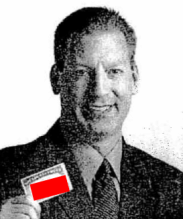
Screen shot: From Exhibit 1 in FTC case against LifeLock, whose CEO, Todd Davis, appeared in ads that published his Social Security number to demonstrate his confidence in the company's services. (The PP Blog added the red highlight. Court filings obscure the number, which LifeLock published openly while prompting customers of its $10-a-month service to "Always protect your social security number. Do not share it unless necessary.")
LifeLock Inc. and its principals have been barred from making deceptive claims and required to take more stringent measures to safeguard the personal information collected from customers, the FTC said.
The FTC charged LifeLock and its co-founders — CEO Richard Todd Davis and former COO Robert J. Maynard Jr. — in the civil case. The case, which has been settled in U.S. District Court for the District of Arizona, alleged that LifeLock “used false claims to promote its identity theft protection services” and “made claims about its own data security that were not true.”
LifeLock agreed to pay $12 million to settle the case, which the FTC described as “one of the largest FTC-state coordinated settlements on record.” The company, Davis and Maynard settled without admitting the allegations were true.
“While LifeLock promised consumers complete protection against all types of identity theft, in truth, the protection it actually provided left enough holes that you could drive a truck through it,†said FTC Chairman Jon Leibowitz.
LifeLock said it welcomed the settlement.
“LifeLock is pleased with this agreement, which, for the very first time, works to set advertising guidelines for the entire industry,” said LifeLock Chairman and CEO Todd Davis. “We welcome federal and state efforts to regulate our industry, because doing so helps to protect consumers from the risks of identity theft.”
In court filings, the FTC said LifeLock did not take adequate steps to protect data it collected from customers — even though Davis appeared in ads that published his own Social Security number to demonstrate his confidence in the company’s ability to prevent identity theft.
“I’m Todd Davis, CEO of LifeLock, and yes, that’s my real social security number,” the ad read.
Illinois Attorney General Lisa Madigan said there is no foolproof way to protect against identity theft.
“This agreement effectively prevents LifeLock from misrepresenting that its services offer absolute prevention against identity theft because there is unfortunately no foolproof way to avoid ID theft,†Madigan said. “Consumers can take definitive steps to minimize the chances of having their personal information stolen, and this settlement will help them make more informed decisions about whether to enroll in ID theft protection services.â€
The FTC said LifeLook “routinely collected sensitive information from its customers, including their social security numbers and credit card numbers,” but did not adequately protect the data.
Among the LifeLock claims, according to FTC court filings:
“Only authorized employees of LifeLock will have access to the data that you provide to us, and that access is granted only on a ‘need to know’ basis.â€
“All stored personal data is electronically encrypted.â€
“LifeLock uses highly secure physical, electronic, and managerial procedures to safeguard the confidentiality and security of the data you provide to us.â€
But the FTC alleged that “LifeLock’s data was not encrypted, and sensitive consumer information was not shared only on a ‘need to know’ basis. In fact, the agency charged, the company’s data system was vulnerable and could have been exploited by those seeking access to customer information.”
Employees and vendors “working from their homes or other locations beyond the Defendants’ headquarters could access the network remotely,” the FTC alleged.
“[U]ntil at least September 2007, Defendants engaged in a number of practices that, taken together, failed to provide reasonable and appropriate security to prevent unauthorized access to personal information stored on its corporate network, in transit through its corporate network or over the internet, or maintained in Defendants’ offices,” the FTC alleged.
You might find yourself a rank amateur in the new business of writing down the license-plate numbers of your neighbors for entry in a database if you don’t pay Data Network Affiliates (DNA) a one-time fee of $97 and a monthly fee of $29.95 for the right to use what the firm describes as a “PRO” data-entry module.
News about the “PRO” module began to spread yesterday, only days after DNA told members who listened to an “Oscar” night conference call that the company’s “free” affiliates would “receive the same kind of commitment and respect from our DNA management team” as paid members received.
Whether the company’s current membership roster of 69,000 — all members of which were targeted in ads and presentations to join DNA for free — will consider the appeal for them to reach into their pocketbooks for $126.95 an example of commitment and respect to free members is unclear.
The “PRO” module is part of what the company is dubbing the “Business Benefit Package” (BBP), which DNA described as an “awesome” value.
“Upon close inspection of the B.B.P. you will find a minimum of 10 times the cost of such package to the end user in value savings and benefits,” DNA said in an email to members. “The two that stand out the most is (sic) the FREE 1000 REWARD DOLLARS with FREE REFILLS and the $402 Travel Agent Value Package for only $49.”
Indeed, DNA is cross-pollinating the data-entry portion of its business with other opportunities, according to the email.
The “PRO” module is included in the BBP upgrade package “at no additional charge . . . to make DATA ENTRY simpler, easier, faster and less time consuming,” DNA said.
DNA’s “free” members may remain as such or get started with the BBP package for an initial outlay of $126.95, including the one-time fee of $97 and the monthly fee of $29.95.
DNA described the free data-entry module as a clunker, compared to the “PRO” module, which the firm asserts has bells and whistles and crunches information faster.
Here is how DNA described the benefits of the upgrade package (italics added):
With PRO Upgrade Software an entry takes up to 1 minute. Without takes up to 3 to 5 minutes.
With PRO Upgrade Software you may repeat address for entry with a click of a button. Without you need to re-enter all address data manually.
With PRO Upgrade Software many fields will be already filled in. Without you need to re-enter all address data manually.
With PRO Upgrade Software you may enter as many entries as you wish at one time. Without you are limited to 5 entries per day.
With PRO Upgrade Software you may enter data for others who also have PRO Upgraded Software. Without you can only enter for yourself and not receive any entries from anyone else who may wish to help.
DNA’s email yesterday also implied that it might not be able to trust some of its own members who entered license-plate data. The company, a multilevel-marketing firm that does not have a contact form on its website and uses an address from Google’s free gmail service as its support address, urged its data-collectors in the field to be honest.
“WARNING,” the company blared in yesterday’s email. “Anyone caught entering bogus tag data information will be automatically suspended from D.N.A. pending a 30/60 day review. We are not talking about a possible error or a potential mistake. We are talking about outright fraudulent entries. You may say who would do such a thing. We say hopefully no one.”
The company did not explain why members caught entering “outright fraudulent” data or “bogus tag data” would merely be suspended pending a review that could take up to two months, rather than banned immediately for life and reported to the police for a criminal attempt to defraud the company.
DNA pitchmen have described the parking lots of major retail stores, churches and doctors’ offices as excellent places to record license-plate numbers. Implicit in the pitches is the suggestion that license-plate data is public information available for the taking from virtually any venue by any DNA member.
Some DNA promoters have suggested that the company’s plate-recorders should behave “inconspicuously” when writing down numbers with a pen and pad or taking pictures of them with cell phones and video cameras for later entry in the database.
The claims have sparked privacy concerns that the data could be used to create profiles on the movement of people. If the data is sold to a company in the business of repossessing automobiles, for instance, the repo man might be able to determine where a car owner shops, receives medical treatment, picks up prescriptions for medicine, receives psychological or spiritual counseling and visits for any purpose under the sun.
Billed as the “Oscar” night presentation because it coincided with the Academy Awards, a conference call hosted by Data Network Affiliates (DNA) lasted for a total of roughly 32:10.
Almost all of the call — about 28 minutes — consisted of hype. (Looking it as a percentage, about 87.5 percent of the call was hype.) Roughly the first three minutes were consumed by people announcing their presence on the line, with the encouragement of a pitchman. The balance of the call largely consisted of hype from two DNA pitchmen, with discussion of issues such as privacy concerns spoken about only indirectly through a reference to Google.
One of the pitchmen made the broad point that Google collects data. DNA says it collects the license-plate numbers of cars for entry in a database. The parallel between what Google does and what DNA does was not made clear in the call, and the pitchman appeared to be trying to make the point that data collection was just a part of life.
The same pitchman — in a previous call — described the parking lots of giant retail stores, churches and doctors’ offices as sources of license-plate data. Those comments, coupled with claims by other DNA promoters that have ignored privacy and other concerns or pooh-poohed them — are among the things fueling critical commentary about the firm.
When Kurek came on the “Oscar” call at roughly the 21:30 mark after more than 18 minutes of hype by the pitchmen, he spoke for about four minutes, covering his business experience that previously had been covered by both pitchmen.
The balance of the call was more hype. No issues raised by critics on matters such as the propriety, safety and legality of DNA were addressed directly. Kurek did say he had experience with companies that maintained private data and that his business experience had taught him about “accountability” and “organization.”
Kurek did not participate in the hype. He thanked members for listening in — and the thanked the pitchmen and DNA’s 63,000 affiliates.
“My true talent is also finding the right people to get the job done,” Kurek said. “I truly believe we’ve assembled the best MLM minds in the world.”
His vision, he said, was to provide services and benefits never before thought of. Kurek spoke with an even voice throughout his time on the line. He did not address comments made last week by Dean Blechman, DNA’s former CEO, that the company had a “back door guy” within its operation and that some communications put out by the company were “bizarre” and misleading.
Because the lines were muted, no caller asked a question. Neither the pitchmen nor Kurek solicited listeners to ask questions during the call. After the call ended, several issues were left dangling, including whether Phil Piccolo somehow had become involved in DNA.
Piccolo is a lightning rod for MLM critics.
Blechman did not rule out last week that Piccolo was involved. When pressed for a definitive answer, Blechman suggested that one could be forthcoming.
Piccolo is the subject of considerable scorn online. Whether he is part of the company remains unclear, and rumors of his involvement continue to swirl.
In other DNA news, some affiliates of the company appear to be pulling their ads from craigslist. Other craigslist ads by DNA affiliates have been labeled “flagged for removal.” Still others have expired.
Some craigslist ads remain. One of them — dated Feb. 26, two days after Blechman’s departure as CEO — is posted in Los Angeles. The ad claims that its contents came from a DNA “press release” dated Feb. 25.
“A very high powered CEO with Public Company Experience is stepping up to the plate with exciting plans being put into place to make D.N.A. one of the most powerful Viral Affiliate Marketing Companies in the U.S.A. and around The World,” the ad reads.
“The D.N.A. company is signing a MEGA MILLION DOLLAR DEAL with a publicly known industry giant. Between this agreement being sign and the D.N.A. Top Secret Product being announced on March 27th, 2010. D.N.A. is positioning itself to be Global Giant.”
Blechman noted last week that the company did not announce his Feb. 24 departure until March 2. He questioned why the company had waited so long.
At roughly the 3:26 mark of the call, one of the pitchmen said, “I mean, I gotta tell ya, if they were giving out some Oscar awards in multilevel marketing, or, you know, something special, I believe DNA would definitely get something tonight.”
The Oscar awards, of course, are for proficiency in acting.
Image of the logo of V-Local.com from a March 2009 news release.
UPDATED 5:43 P.M. ET (U.S.A., Jan. 20, 2011.) On Feb. 23, the U.S. Secret Service raided the Minneapolis offices of INetGlobal, a company operated by Steve Renner under the Inter-Mark Corp. umbrella. The raid occurred amid allegations that INetGlobal was operating an autosurf Ponzi scheme and also engaging in wire fraud and money-laundering.
A week later — on March 2 — a domain titled RGMG.net was registered in the name of Matt Renner, according to web records. The domain lists a different Minneapolis address than the Steve Renner entities, some of which used a “V” theme: “V-Media” and “V-Local,” among others.
Matt Renner, 27, is Steve Renner’s son.
“We’re running a legitimate business,” he said of RGMG.
V-Local, which has a website at V-Local.com that is registered to Renner’s Inter-Mark in Las Vegas, was “offered to iNetGlobal members as a service they could sell,” the Secret Service said in an affidavit last month.
Matt Renner, who worked as an executive at V-Local, said V-Local provided legitimate products and services.
“We at V-Local were doing nothing wrong,” he said.
And Matt Renner defended his father. “I don’t believe any wrongdoing was done,” he said.
Steve Renner was convicted in December of four felony counts of income-tax evasion. He was awaiting sentencing in the tax case, even as the Ponzi allegations surfaced against INetGlobal.
V-Local’s logo is featured prominently on the RGMG.net site, which says, “RGMG LLC is a rising player in Digital Media Planning, Buying, Selling and Development. With over 35 years combined digital marketing experience and more than 800 past and current clients, the team at RGMG has the experience to deliver high value wide ranging services.”
Another section of the RGMG site says, “Based out of the Beautiful city of Minneapolis Minnesota, RGMG started because the demand for a company who’s (sic) Executives pay more attention to their customers (sic) needs, than their own pocket books, was felt by Founder and President, Matthew D. Renner.”
Yet another section of the RGMG site says, “The team at RGMG has developed many custom platforms including in partnership with V-Media and iNetGlobal the powerful local lifestyle and business directory V-Local.com.”
Although there are serious allegations of wrongdoing against INetGlobal and it is possible that Ponzi proceeds were used to fund V-Local, the RGMG.net site does not mention the allegations or inform visitors that the Secret Service painted a picture that Steve Renner’s claims about V-Local were overblown. (Read a section of the affidavit concerning V-Local lower in this story.)
“[T]here is probable cause to believe that [Steve] Renner is operating a large, Internet-based, Ponzi scheme through his umbrella corporation, InterMark, and some of its subsidiaries, particularly Virtual Payment Systems [LLC of Wisconsin/Brackets Denoting the LLC Designation added Jan. 20, 2011], V-Media, Cash Cards International, and V-Local,” the Secret Service said last month. It further alleged that INetGlobal was the “primary vehicle for the perpetration of this fraud.”
NOTE IN BOLD ADDED JAN. 20, 2011: An Indianapolis-based company known as Virtual Payment Systems Inc. has contacted the PP Blog to let it know it is not affiliated with the Renner company Virtual Payment Systems LLC of Wisconsin, which is referenced in the paragraph above.
There have been no assertions of wrongdoing against RGMG, and the RGMG site does not appear to have a surfing component among the services listed. RCMG stands for “Renner Global Media Group,” according to the site.
Matt Renner, who said he read the Secret Service allegations, said he was not worried that problems could spill over into RGMG and create a problem for the emerging brand.
“It’s a legitimate website,” he said. “It’s a legitimate company; it’s absolutely a valuable service.”
The site, however, may come with a built-in PR dilemma: how to navigate the choppy waters of embracing the Steve Renner V-Local brand without addressing the Ponzi assertions against INetGlobal and V-Local, perhaps especially if a Renner family member is at the head of RGMG.
At the same time, certain marketing materials and the prominence with which Steve Renner’s V-Local is referenced on the RGMG site — indeed, V-Local’s logo appears on the site in at least two places and RGMG encourages visitors to make V-Local their “new Homepage” — may leave some customers and employees of INetGlobal and its “V” entities scratching their heads.
V-Local’s name is prominently mentioned in INetGlobal marketing materials, including a news release dated March 25, 2009. The headline on the news release said, “iNetGlobal launches V-Local and iNetSurf on Saturday, March 28, 2009.” The news release included the V-Local.com logo (pictured above.)
Despite the claim that V-Local launched in March 2009, a news release issued 11 months later — in February 2010 — claimed a January 2010 launch date for V-Local under this headline: “V-Local Reports Exponential Growth Following January Launch.” The Feb. 16 news release includes a graphic of a logo for V-Local labeled “BETA.”
Why the news releases list two different launch dates for V-Local is unclear. Steve Renner’s own website — SteveRenner.com — announced the launch of V-Local on March 3, 2009.
“Steve Renner who is known for his knack of creating successful online ventures, has Struck Gold with his latest project, V-Local,” the website reported.
No mention was made that Renner already was under indictment for tax evasion and that another Renner entity — Cash Cards International — had been unable to return money to victims of a Ponzi scheme known as “Learn Waterhouse,” amid assertions that Renner had spent customers’ money as though it were his own and had invested $250,000 in the Learn Waterhouse scheme.
Renner’s site said the type of service V-Local provided “would normally cost the $1,000’s but V-Local has set the price at an extremely affordable price of just $59 per month, for their Top Of The Line ‘Showcase’ listing.”
By clicking on the “Contact Us” link on The V-Local.com website, visitors arrive at a page that lists the street address of Steve Renner’s Minneapolis entities.
A section of the Feb. 16, 2010, news release reads, “V-Local, the first-of-its-kind online business and lifestyle directory, announced today that it has experienced unprecedented growth since its launch on Jan. 15, 2010. Site traffic increased 900 percent in February alone, according to Google Analytics, with more than 100,000 visitors since the site’s launch.”
Going back 11 months, the body copy of the March 2009 news release that announced V-Local’s launch read, in part: “On Monday, March 16, 2009 iNetGlobal did a ‘soft’ launch of iNetSurf. This product and had over 3,000 internet users sign up in one work day. At iNetSurf current pace, we can expect over 200,000 active ‘surfers’ in 6 months!”
Meanwhile, the emergence of RGMG after the Secret Service raid at INetGlobal could lead to questions about why INetGlobal ever used an autosurf component and folded components such a V-Local into the enterprise.
Between Jan. 11 and Jan. 29, according to a Secret Service affidavit, undercover agents logged in to the INetGlobal website on “multiple occasions.”
Among the things agents noted while logging in, according to the affidavit, was that ‘V-Local’ has an address listed as 250 Second Avenue South, Suite 145, Minneapolis, Minnesota, 55401.”
The Secret Service said it conducted surveillance of the office suite in January — prior to the raid — from a skyway and corridor open to the public.
“Agents saw signs reading ‘iNetGlobal’ and ‘V-Local.com’ at the door of Suite 106A, and saw signs reading ‘V-Records’ and ‘VWebs’ at the door of suite 145,” the agency said. The office suites later were searched as part of the raid.
The phone number associated with RGMG.net in its domain registration also is referenced in INetGlobal marketing materials that quote Matt Renner.
In the Feb. 16 news release, which was issued about a week before the Secret Service raid, INetGlobal is described as V-Local’s parent company.
“V-Local is a lifestyle and business directory, featuring over 3.5 million businesses, events, classifieds and coupons,” the release said. “As a premier online advertising resource for businesses, V-Local provides a platform for businesses to leverage their brand and generate local and global exposure. V-Local bridges the gap between businesses and consumers at both global and local levels.”
A week after the Feb. 16 news release, the Secret Service suggested in its affidavit for a search warrant that Steve Renner’s V-Local marketing claims were overblown. Here is a snippet from the affidavit:
“[Steve] Renner claimed that iNetGlobal’s business directory, V-Local, had over 3.5
million businesses signed up. He explained that attendees could make a great deal of money selling V-Local and signing up businesses to participate in V-Local.
“[Steve] Renner stated that V-Local was expanding into Canada, Europe, and China. He claimed that when a company was listed on V-Local, iNetGlobal would list the business with over 65 local directories, plus social networking sites, and would arrange for the business to be input into Garmin and TomTom GPS navigation devices, as well as Cadillac OnStar.
“On January 28, 2010, [an undercover agent] searched for ‘coffee shop’ in Minneapolis, Minnesota on V-Local, asking V-Local to find the nearest coffee shop. There were no results. [An undercover agent] then broadened the search to coffee shop, food and dining. V-Local then identified six coffee shops in Iowa, Kansas, and other states, only one of them in Minnesota (in Byron).
“[Steve] Renner stated that if an attendee wanted to sell V-Local the attendee would need to pay $300, watch several videos, and take a certification test. Renner stated that for every person in a member’s ‘downline’ who got certified to sell V-Local, the original member would receive $100. Renner stated that this would be an enormous jump in a member’s income. Approximately one week after the Freedom Conference [in New York Jan. 23], [an undercover agent] searched on V-Local for ‘gym’ and ‘restaurant. There were no hits in the search for gym, and only one hit in the search for restaurant.”
Matt Renner said he believed RGMG would emerge a leader, despite the assertions against INetGlobal.
“They didn’t shut the company down,” he said, referring to INetGlobal. “No arrests were made. RGMG is a company that will generate good, positive results.”
The president of a Florida-based autosurf company implicated in a Ponzi scheme by the U.S. Secret Service says he is appealing a forfeiture order that gave the government title to more than $65 million seized from his personal bank accounts in 2008.
Notice of the appeal by Andy Bowdoin of AdSurfDaily was filed by his attorneys March 1, about six days after federal agents — citing the Jan. 4 forfeiture order by U.S. District Judge Rosemary Collyer of the District of Columbia — raided the Minneapolis offices of INetGlobal.
In an affidavit for a search warrant last month, the Secret Service said INetGlobal, a company operated by Steve Renner, was operating a similar autosurf Ponzi scheme and also engaging in wire fraud and money laundering.
The INetGlobal affidavit asserts, among other things, that a member of ASD attempted to recruit an undercover Secret Service agent into INetGlobal despite the member’s own reservations about ASD.
INetGlobal was described by the ASD member as a wink-nod enterprise, according to the Secret Service affidavit. The company “uses the same terminology and business model as ASD,” the agency said.
In court filings prior to the INetGlobal raid, Bowdoin’s attorneys laid the groundwork for an appeal of Collyer’s Jan. 4 forfeiture order on the grounds of judicial error, arguing that Bowdoin had not received proper notice about orders Collyer issued last year and did not react to them because of computer glitches at the office of one of his attorneys, Charles A. Murray.
“I experienced as yet unidentified computer/server issues, wherein multiple email messages apparently never loaded to the firm’s Inbox,†Murray said in court filings on Feb. 17.
The glitches occurred between Nov. 10 and “early January†of this year, Murray said.
Paperwork for Bowdoin’s appeal shows a “minute order” issued by Collyer Feb. 21, denying earlier motions by Bowdoin.
A “minute order” is a document that encapsulates legal issues before a judge. Minute orders sometimes are used when paperwork among the parties in a case is flying and a judge memorializes rulings by addressing them in a short entry, as opposed to issuing lengthy orders for each issue.
“The Court’s Order of November 10, 2009 . . . was not a final, appealable order,” according to Collyer’s minute order. “Nor has Mr. Bowdoin shown that the Court erred in entering . . . the November 20, 2009, Order to Show Cause. The order granting default judgment and final order of forfeiture . . . is the final order in this case.”
On Nov. 10, Collyer ruled that Bowdoin no longer had standing in the case after he had battled for 10 months to reenter the case. Bowdoin submitted to the forfeiture in January 2009 — and then changed his mind, first acting as his own attorney and later acting with Murray’s help because Bowdoin had fired his previous paid counsel.
On Nov. 20, Collyer issued an order that gave potential claimants in the case 30 days to come forward. No claimant emerged. On Dec. 17, however, Bowdoin filed a motion to disqualify Collyer, saying she was biased. Collyer denied the motion Dec. 18. She issued the forfeiture order Jan. 4.
In February, Bowdoin, 75, flatly claimed in a sworn affidavit that he was told by a former defense attorney that, if he submitted to the forfeiture in January 2009 of tens of millions of dollars, he would face no jail time if criminal charges were filed in the ASD Ponzi scheme case.
He did not name the attorney in the February filing, referring to him obliquely as “prior counsel.†In an earlier filing, Bowdoin identified his counsel as Stephen Dobson.
“I was assured by my prior counsel that, if I released my claims in this [civil-forfeiture] action, I would not be facing any incarceration,†Bowdoin claimed last month. “My January 2009 motion to withdraw my claim . . . was solely based upon prior counsel’s unilateral mistaken belief that my release of claims would unequivocally assure that any subsequent criminal sentence entered would not include any prison time.â€
Last month’s filing was witnessed by Florida notary public Joe B. Cox of Lee County.
But in a sworn affidavit Bowdoin signed Sept. 15 before a different notary public — Patricia C. Sanson of Lee County — Bowdoin repeatedly said Dobson had said only that there was a possibility Bowdoin would not be sentenced to prison if criminal charges emerged.
In the Sept. 15 affidavit, Bowdoin repeatedly swore that Dobson had not promised him no jail time.
These are among the phrases Bowdoin swore to in the Sept. 15 affidavit (emphasis added):
Dobson represented to me that I could possibly avoid prison or get a reduced sentence if I agreed to disclose details concerning ASD and releasing the assets.
I also signed a document stating that I would release my claims in the abovecaptioned civil in rem forfeiture proceeding, again thinking that necessary for a possible avoidance of a prison term.
I did all of this on the understanding that by cooperating I could possibly avoid a prison sentence.
I agreed not to exercise my rights in the civil forfeiture proceeding, anticipating from representations made by Dobson that this could possibly keep me out of prison.
Dobson lead [sic] me to believe that if I cooperated there was a possibility that I would not be incarcerated or imprisoned.
I believed that my cooperation would still result in a criminal sentence that could possibly not include imprisonment or incarceration.
I slowly came to understand what I understood from Dobson not to be the case: that my agreement to cooperate provided me no benefit in the criminal matter except the possibility of a reduced sentence if the judge desired which would still be a life sentence.
Bowdoin’s filing last month led to questions about whether he deliberately chose to appear before a different notary to swear to the affidavit. At the same time, it led to questions about whether Bowdoin somehow was unaware that Collyer already had cited Bowdoin’s Sept. 15 sworn affidavit in a major ruling that Bowdoin no longer had standing in the case.
On Nov. 10, Collyer noted Bowdoin’s repeated use of the words “possibly,†“possible†and “possibility†in the Sept. 15 affidavit when referring to the advice Dobson had given him on the matter of jail and finding that Dobson had behaved responsibly while representing Bowdoin.
“Such an approach from counsel could be seen as the norm when the Government’s evidence is strong,†Collyer said. “What Mr. Bowdoin hoped to gain from his release of claims/early acceptance of responsibility and his debriefing with the Government was a promise of no jail time. When that was not forthcoming from the Assistant United States Attorney, Mr. Bowdoin balked and tried to back up, as if he had not already released his claims and talked to the Government.â€
There may be other news associated with Bowdoin’s appeal: The filings suggest that William Cowden, who spearheaded the forfeiture case for the Department of Justice as an assistant U.S. Attorney and then accepted a job in the private sector, may be returning as a special prosecutor while maintaining his job in the private sector.
Cowden was derided by Bowdoin supporters as “Gomer Pyle,” but piloted the case through an evidentiary hearing that resulted in a ruling from Collyer in November 2008 that ASD had not demonstrated it was a legal business and not a Ponzi scheme.
With the Secret Service leading the investigation, Cowden then filed a second forfeiture complaint against assets linked to ASD. The second complaint was filed in December 2008 and named members of Bowdoin’s family as beneficiaries of ASD’s illegal scheme.
EDITOR’S NOTE: Untargeted, unfocused traffic and participants who did not have websites to advertise are two of the issues in the AdSurfDaily autosurf Ponzi scheme case. They also are issues in the INetGlobal case.
UPDATED 8:20 A.M. ET (March 10, U.S.A.) Public records and other information suggest INetGlobal was becoming largely dependent on cash from Mainland China and was routing unwanted traffic that did not convert into sales to the sites of Clickbank vendors — while passing along the bandwidth costs to the vendors and grossly distorting their conversion statistics.
In an affidavit for a search warrant, the U.S. Secret Service, citing an analysis of INetGlobal’s money stream by an unnamed employee, said “at least 87% of the company’s revenue was generated from sale of memberships to members residing in China.”
The affidavit also describes an INetGlobal function in Flushing, N.Y., on Jan. 23 that was attended by at least two undercover agents.
About 400 people attended the function, the Secret Service said. The “majority” were Chinese. Attendees to whom an undercover agent spoke “had either little or no facility in English.” The agent noted that that “conference registration took a long time because nobody at the registration desk spoke Chinese, and many of the conference attendees could not make themselves understood in English.”
Moreover, the agent said, when INetGlobal owner Steve Renner “asked, through an interpreter, how many people in attendance had their own business . . . only two raised their hands.”
One attendee — an existing INetGlobal member — was asked by the second undercover agent if she had a website to advertise in INetGlobal’s rotator.
The INetGlobal member — a woman Renner had identified as a “New Jersey resident making $6,000 per day, or $180,000 per month” — said she had no site to advertise in the rotator because having a website “was not required,” the Secret Service said.
A second INetGlobal member approached by the same undercover agent was asked if he had a website to advertise in the rotator. This member — a man described as telling the agent he made $3,000 a month in INetGlobal — explained that he had a website, but did not post it because “it was ten years old,” the Secret Service said.
Renner was observed telling different stories, the Secret Service said. One version had INetGlobal posting $25 million in revenue in December; another version “a short time later” pegged the figure at $20 million. Renner also said “iNetGlobal’s search engine, Access, would soon rival Google’s.
“Renner did not explain to the crowd that Access was simply a link to another search engine, and that an Access web search was just the same as a web search on this other search engine,” the Secret Service said.
Despite the claim that INetGlobal’s search engine would rival Google’s, the Secret Service said, internal company emails discussed “the possibility of the other search engine cutting the link and thus taking down Access.”
A Public Tip-Off From Renner Himself That INetGlobal Was Up To No Good?
Meanwhile, web records suggest that INetGlobal — at least for a time — either took it upon itself to add the sites of Clickbank vendors to its advertising rotator or instructed members who did not own businesses to add Clickbank links, an act that resulted in a surge of traffic from China that led to few if any sales. The apparent lack of sales suggests that Chinese members viewing the ads either did not understand what they were viewing or were viewing the ads simply to get paid.
At the same time, web records suggest that INetGlobal was relying on the websites of individuals and companies that had no tie to the firm to provide surfers something to see in the firm’s advertising rotator — at the bandwidth expense of the unaffiliated companies and individuals, at least some of whom were Clickbank vendors.
One of the Clickbank vendors — writing on the Digital Point Forum Sept. 26 — reported that he was studying his Clickbank affiliate stats and discovered something “REALLY messed up.”
The vendor reported on Digital Point that the ID “inetgbal’ suddenly was sending junk traffic that “appears to be coming from China.”
The vendor published screen shots to support his claim and noted, “If you do a ‘surfin demo’ on the iNetGlobal website, you’ll see it takes you to random CPA offers and Clickbank products.”
On Sept. 27, the vendor reported on Digital Point that he considered the traffic problematic and was considering a means of blocking it at the server level with the use of an .htaccess file.
Working with .htaccess files, which can be used to block traffic from an IP or IP range, is not for the faint of heart. It is not uncommon for inexperienced webmasters to bring down their own servers or create an endless loop of error messages when attempting to tweak server behavior with an .htaccess file.
Recognizing the dilemma, the Clickbank vendor put out a call for “good coders” to walk him through a fix for a problem he believed INetGlobal was causing for him. Other posters inquired about the possibility of asking Clickbank to block the unwanted affiliate link.
The discussion on the forum suggests INetGlobal was creating a situation in which Clickbank affiliates might have to incur an expense simply to block unwanted traffic — while creating the additional burden of polluting conversion statistics, potentially making the products less attractive to affiliates.
If, say, a product ordinarily made one sale per each 100 views of an affiliate link — and if INetGlobal suddenly sent through 1,000 page views from China (er elsewhere) that did not convert because the traffic was untargeted or people simply were surfing to get paid — a vendor’s conversion rate could drop from one in 100 to one in 1,100.
On Nov. 6, 2009, a person posting as Steve Renner — the “Director” of INetGlobal — appeared at Digital Point. A little more than a month later, Renner was convicted of income-tax evasion in a case brought in September 2008.
Less than three months after Renner’s tax conviction, the Secret Service asserted that INetGlobal was part of an international Ponzi scheme that had engaged in wire fraud and money-laundering.
“The problem was we had no Daily Budget in place and so traffic was running rampant,” the Digital Point poster purporting to be Renner explained on Nov. 6.
The Clickbank vendor did not mince words in his response to the Nov. 6 post. Others were equally unhappy.
UPDATED 2:20 P.M. ET (U.S.A.) Did people associated with a company implicated by the U.S. Secret Service in a Ponzi scheme, wire-fraud and money-laundering case participate in a misinformation campaign?
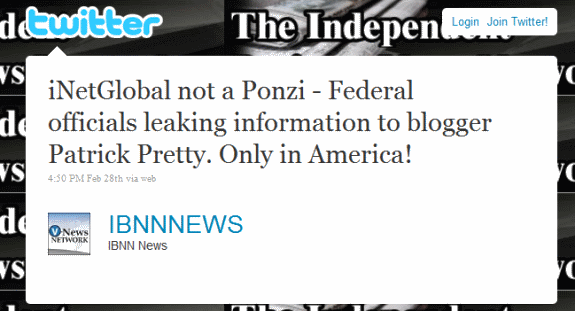
A Twitter website with a tie to the Inter-Mark companies operated by Steve Renner claims that federal officials are “leaking” information to the PP Blog.
“Didn’t happen — ever,” the PP Blog said today. “The information we published was not leaked to the Blog. The Blog obtained the information from a public source, through the normal course of its reporting, and the information was available to reporters and the public before the Blog even published its first story based on the information.”
Meanwhile, another website with a tie to a Renner’s Inter-Mark Corp. is making the claim that a Blogger Inter-Mark is targeting in a lawsuit for calling INetGlobal a “scam” issued an “apology.”
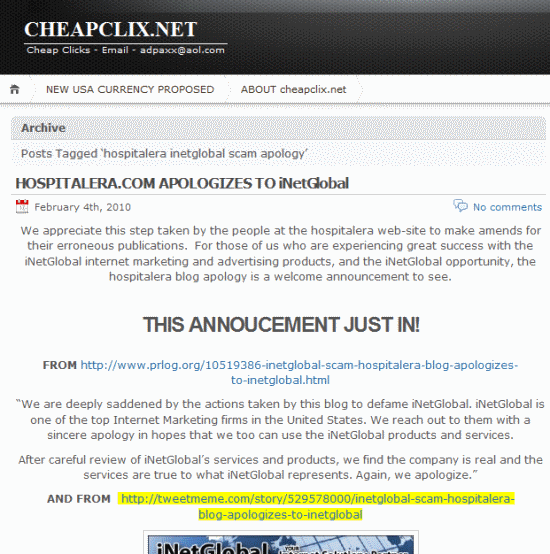
The apology claim appears on a domain titled CheapClix.net, whose domain registration lists V-WEBS.COM as its nameserver. A Renner company dubbed V-Webs LLC appears to be an inactive Minnesota corporation that used the same Minneapolis street address as InetGlobal and other Renner companies, according to public records.
A CheapClix.net post headlined “HOSPITALERA.COM APOLOGIZES TO iNetGlobal” and dated Feb. 4 claims that the Hospitalera Blog issued an apology to INetGlobal on a date uncertain and implies that Hospitalera now even endorses INetGlobal.
“We are deeply saddened by the actions taken by this blog to defame iNetGlobal,” the CheapClix.net site says, apparently quoting from the purported apology. “iNetGlobal is one of the top Internet Marketing firms in the United States. We reach out to them with a sincere apology in hopes that we too can use the iNetGlobal products and services.
“After careful review of iNetGlobal’s services and products, we find the company is real and the services are true to what iNetGlobal represents. Again, we apologize.â€
The apology claim is dubious because Sybille Yates, who operates the Hospitalera Blog from the Czech Republic, told the PP Blog last week that she was not even aware that Renner’s company was suing her until Feb. 25 — three weeks after the date of her purported apology.
Yates did not immediately return an email from the PP Blog today seeking comment on the apology claim and whether she had, in fact, apologized. A Feb. 16 post from Yates on the Hospitalera Blog, however, describes the news release that announced the apology as “faked.”
Whether the apology claim somehow sprouted from some fantastic reshaping of facts by an INetGlobal supporter or was just an outright lie that was part of a misinformation campaign was not immediately clear.
It has been common in the so-called autosurf “industry” for lies, misstatements, misrepresentations, misinformation and claims not based on facts to spread virally on the Internet as though they were truth.
In the AdSurfDaily case, for instance, claims were made that the prosecution admitted ASD was not a Ponzi scheme, that ASD President Andy Bowdoin had received an award from the President of the United States for business acumen, that Google and ASD were partners and that ASD had the backing of huge corporations with huge advertising budgets.
All of the claims were untrue.
The CheapClix.net claim about the purported apology adds another strange twist to the INetGlobal story. If Yates never issued such an apology — and Yates’ Blog says no such apology was issued — it leads to questions about why someone would claim such an apology had been issued and even go so far as to issue a news release to announce an apology that had not been made.
The introduction to Hospitalera’s purported apology as reported by CheapClix net begins, “We appreciate this step taken by the people at the hospitalera web-site to make amends for their erroneous publications.”
The CheapClix.net post from Feb. 4 includes a link to what appears to have been a news release issued by an unknown party to herald Hospitalera’s purported apology. The news release link to PRLog.org resolves to an error page. PRLog.org is a free news-release distribution service.
Yates’ Blog says she contacted PRLog to have the fake news release removed, and that PRLog took down the bogus release “in a heart beat.”
UPDATE 2:20 P.M. Yates has confirmed she never issued an apology.
“I never issued said apology, nor did I ever authorize anybody to do so in my name,” Yates said.
“I never issued or published a press release on prlog.org. As I came across the forged and false press release, I contacted prlog.org immediately and they took it down. I have no information who published/submitted said press release to prlog.org.”
A second link in the CheapClix.net post that heralded the purported apology resolves to TweetMeme.com, a site that aggregates Twitter links. A small icon that reads “V News Network” appears below a headline of “iNetGlobal Scam: Hospitalera Blog apologizes to iNetGlobal.”
Records suggest that “V News Network” may be yet another Renner entity.
A headline heralding a purported apology from the Hospitalera Blog for calling INetGlobal a scam appears on a website known as CheapClix.net. The Hospitalera Blog says the apology was "faked."
‘Leaking’ Claim
Why the Twitter site, which is tied to IBBN.org, made the claim of that the government was “leaking” to the PP Blog is unclear. The Twitter post is dated Feb. 28. IBNN, which stands for The Independent Business News Network, is registered in Renner’s name. The site is operated by Donald W.R. Allen II, IBNN’s editor-in-chief and the the vice president and director of public relations for V-Newswire — a company in Renner’s INetGlobal family.
Renner is listed as the IBNN domain registrant.
Allen did not comment Friday when the PP Blog advised him that the government leaked no information to the Blog. The Twitter site does not list a source for its claim that federal officials “leaked” information to the Blog, but asserts that such an event was possible “Only in America!” The Twitter site continues to make the claim.
The site also claims “iNetGlobal not a Ponzi.” No source is listed for the denial. It is unclear if IBNN has access to audited and certified balance sheets and financial statements of the Renner enterprise that could destroy the government’s Ponzi assertions.
IBNN previously skewered the Star-Tribune newspaper of Minneapolis/St. Paul, asserting that the paper, which covered the INetGlobal raid, was displaying “defamatory contempt [for the Renner entities] prior to a full investigation and a Grand Jury inquiry.”
Allen, who signed the IBNN opinion piece, did not disclose his tie to the Renner companies when the piece was published. The piece went missing after the PP Blog published a story in IBNN’s tie to Renner, but since has been restored — with a few lines added.
The U.S. Secret Service, which raided Renner’s operations in Minneapolis last month, asserted that INetGlobal and other Renner companies were part of an international Ponzi scheme that was engaging in wire fraud and money-laundering.
The PP Blog cited as its source a Secret Service affidavit for a search warrant. The affidavit was published openly on a government website.
At various times in its history, the PP Blog has been accused by participants in alleged Ponzi schemes of being part of a government operation. The Blog has reported on paranoia that often accompanies Ponzi scheme participants, some of whom become preoccupied with thoughts about government “plants.”
Such claims about the PP Blog have been made from one Ponzi scheme case to the next, but they simply are not true. Ponzi promoters have accused the Blog of idiocy, occasionally resorting to name-calling or posting under multiple identities in a bid to create the appearance that a particular company caught up in Ponzi allegations the Blog was covering had more supporters than it actually had.
As was the case with AdSurfDaily, a Florida company implicated in an autosurf Ponzi scheme by the Secret Service in 2008, the Secret Service used undercover agents as part of the investigation into INetGlobal, according to a court affidavit. At least one of the undercover agents also was involved in the ASD investigation, according to court filings.
Other court filings reviewed by the PP Blog have described various investigative techniques the agency uses, including surveillance from automobiles of subjects under investigation at places such as residences, parking lots and post offices — and even trash Dumpsters.
At least two Secret Service agents were in the room to observe an INetGlobal function in New York, according to court filings. Agents also observed an ASD function in Miami in 2008, according to court filings.
An agent involved in the ASD case listened to an INetGlobal sales pitch by an ASD member, according to the affidavit in the case. It is plain from multiple public filings that the Secret Service is well aware of the so-called autosurf “industry” — and also the so-called “matrix” industry.
It was publicly known that Renner had been under federal indictment for income-tax evasion since September 2008, a month after the ASD raid. There also is a considerable, public paper trail consisting of court filings, news releases and other information that links Renner to a Ponzi scheme known as Learn Waterhouse, elements of which were prosecuted by both the SEC and the U.S. Department of Justice.
The public paperwork in the Learn Waterhouse case dates back to 2004. A Renner entity known as CCI provided payment-processing services for the Learn Waterhouse Ponzi scheme.
This Narc That Car promoters' check-waving video is now missing from YouTube's public channel, after being placed there March 1. The video, however, is said to be available through a private YouTube channel. It is unclear whether Narc That Car asked its promoter — "Jah" of the Cash For Car Plates Blog — to remove the video, which also claimed repping for Narc That Car was like working for the U.S. "Census Bureau."
First, some news: A website titled DeanBlechman.com now resolves to a parked page at the offshore registrar directNIC. As first reported on the PP Blog, the site previously redirected to the website of Data Network Affiliates (DNA).
directNIC is “based in Grand Cayman, Cayman Islands,” relocating from its former base in Louisiana after Hurricane Katrina, according to the firm’s website. directNIC is DNA’s registrar, and also the registrar for the DeanBlechman.com domain and a DNA-associated domain known as TagEveryCar.com.
In a bizarre autoresponder message earlier this week, DNA said it had chosen “privacy” protection for $5 “to prevent management from having to “put up with 100 stupid calls a day,†a source told the PP Blog.
In an interview Wednesday with the Blog, Blechman, DNA’s former chief executive officer, said he was “surprised” to learn of the DeanBlechman.com site, painting a picture that the company was not in control of its own message and had a “back door guy” who was authoring “bizarre” communications.
Blechman did not identify the “back door guy.” Precisely when the DeanBlechman.com domain stopped redirecting to DNA’s website is unclear. It was still redirecting to the site early yesterday, but now is resolving to the directNIC page.
Meanwhile, the PP Blog contacted the office of R. Scott McKee, the district attorney of Henderson County, Texas, yesterday. McKee is training for deployment to Iraq, and was not available immediately to answer questions on his inquiry into Narc That Car, according to a woman who answered the phone.
The woman said it was possible that an assistant prosecutor would contact the Blog, but the call was not returned yesterday.
McKee’s office opened a civil inquiry into Narc That Car (NTC) more than a month ago, turning to the office of Texas Attorney General Greg Abbott for assistance and saying it had received “numerous calls and complaints inquiring into the legitimacy and legality” of NTC.
How that inquiry is proceeding is unclear. Two days ago, the Dallas branch of the BBB reduced its rating on NTC from “No Rating” to “F,” the worst possible rating on the BBB’s 14-step scale that begins with “A+.”
It is possible that NTC could improve its score at the BBB over time, but the score of “F” it holds now was arrived at after the company had been given more than a month to explain its compensation program to dampen pyramid concerns. The BBB also said it asked NTC to “substantiate some claims made in its advertising” Jan. 18. That inquiry remains open.
NTC does not publish the name of customers of its database product. Some affiliates have claimed the firm was associated with major automobile manufacturers, the FBI, the Department of Homeland Security and the AMBER Alert program.
The company removed a video reference to the AMBER Alert program after the U.S. Department of Justice, which administers AMBER Alert, denied it had any affiliation with NTC.
ASD never improved its BBB score because it became consumed by a government investigation. ASD is implicated by the U.S. Secret Service in a Ponzi scheme.
Speed of Wealth, which also became consumed in government litigation, also did not improve its BBB score. It is implicated by the SEC in a Ponzi scheme involving Mantria Corp., whose BBB rating is being “updated,” according to the BBB. Mantria currently is listed as “No Rating.”
On another matter, MLM aficionado Troy Dooly now is openly challenging DNA officers Arthur Kurek and Donald Kessler to explain what is happening at the company.
Rumors are rampant that Phil Piccolo, a notorious figure in MLM, somehow had become involved in DNA. Absent a firm denial from company management, the rumors continue to fly.
For his part, Blechman, DNA’s former CEO, did not rule out that Piccolo was involved in the firm.
In the absence of a unified message from DNA and plain statements on issues such as whether Piccolo is involved and what steps have been taken to assure that DNA is compliant with state and federal law, events are controlling DNA, not the other way around.
The suggestion that “privacy” protection was chosen so management would not have to put up with “stupid” calls is patently absurd — as is the amount of hype being put out under DNA’s name.
No one at the company has emerged to speak on issues of legality and privacy. DNA says it is in the business of recording license-plate numbers. Like Narc That Car promoters, DNA promoters have made sweeping statements, asserting that affiliates could record plate numbers at places such as Walmart, Target, church parking lots and parking lots at doctors’ offices.
Company conference calls have been cheerleading sessions — with DNA’s own pitchmen leading the cheers.
Whether DNA and NTC affiliates are required to seek permission from owners of private property or the permission of local jurisdictions to record plate numbers remains unclear. Also unclear is how affiliates are required to behave if confronted by property owners or police who question what they are doing.
Sweeping assertions have been made by affiliates that plate data is “public information” available for the taking in the parking lots of large retail stores. One NTC promoter said on YouTube that his wife recorded plate numbers at a university. The PP Blog believes the university was the University of Nevada, Las Vegas.
The office of Sen. Harry Reid, D.-Nev., did not return a call from the Blog seeking comment on the practice recommended by the NTC promoter. Nor did Reid’s office return an email sent by the Blog. Reid is Senate Majority Leader. One of the buildings on UNLV’s campus bears his name. The same NTC promoter recommended “libraries” as excellent sources of plate numbers.
Among the privacy concerns is whether the companies, which appear to be targeting as clients of the database product firms that repossess automobiles, could use the data to create profiles on the movement of people.
In a DNA conference call, one company pitchman said DNA hoped to attract enough affiliates to make it possible for the company to record a plate number at Walmart at noon — and the same plate number at a “doctor’s office” at 1 p.m. and the same plate number elsewhere at 4 p.m. The same pitchman suggested churches were good sources of license-plate numbers.
Adding to the fog of uncertainty is a pattern of strange communications from the firm, which is using Google’s free gmail service to conduct customer service. Emails received by DNA members do not include a street address, which brings issues of transparency into play and potentially brings issues of federal compliance into play.
The PP Blog, which is a Blog among millions of Blogs, has received repeated affiliate spam from DNA and Narc That Car promoters. For weeks, there was no way even to contact DNA to report spam. The Blog will not contact the company via the gmail address — which was made public only days ago –out of concern its email address will be harvested and added to a database controlled by an unknown party.
Narc That Car, meanwhile, has a “Span Policy” — as opposed to “Spam Policy” — link at the bottom of its website. Some of its promoters have produced check-waving videos, including a video that claimed repping for NTC was like working for the “Census Bureau,” a government agency.
One of the videos showed that NTC payments are issued by check drawn on the account of “National Automotive Record Centre Inc.” That entity, which uses the word “National” in its name and the British spelling of “Centre” — as opposed to the U.S. spelling of “Center” — is registered in Nevada. NTC also is associated with a Texas company known as Narc Technologies, which, according to a YouTube video now made private, once issued checks for affiliates.
These things hardly inspire confidence in the NTC enterprise.
Just this morning, the PP Blog received information from a DNA member that the company emailed members, claiming “D.N.A. archived e-mail communications were erased by design.
“We will send you the last 3 e-mail communications within the next 24 hours,” the email said. “If you do not wish to receive D.N.A. Daily Communications please visit your back office.”
Even if the email was perceived by management as a means of demonstrating that DNA was trying to gain control over its message, such a communication only leads to more questions. The email did not include a street address. It also implied that members needed to opt out of communications by doing so within their back offices, rather than opting out by clicking on a link at the bottom of emails they receive.
The hype from DNA and its promoters — dropping names of icons such as Donald Trump and Oprah Winfrey — and making claims that a “MEGA MILLION DOLLAR DEAL with a publicly known industry giant” and a “Top Secret Product” are on the horizon are rubbing some MLM aficionados the wrong way.
MLM has a miserable reputation. Messages from DNA are doing the industry no favors.
If DNA is attempting to seize back its communications apparatus, it needs to explain precisely why it lost control of it early on. And a corporate face must emerge for the company — one who is willing to answer the hard questions on the propriety, safety, legality and privacy concerns the firm is sparking.
For now, at least, it is a tangled web fueled by hype that ducks the issues and causes the company to look silly — day after day.
It’s starting to read like Ian Fleming fare, something straight out of James Bond and “Octopussy.”
R.J. Zayed, the receiver in the alleged Trevor Cook/Pat Kiley Ponzi scheme in Minnesota, says he did not find Cook’s collection of Faberge eggs when, armed with a court order, he searched Cook’s home in Apple Valley. The precise size of the collection is unclear, but it has been described in court filings as featuring “numerous” eggs.
The fabulous jeweled eggs also didn’t turn up at the Van Dusen mansion in Minneapolis, which Cook and Kiley used as an office. Potentially “millions” of Iraqi dinars once stored on the third floor of the mansion also are missing, according to court filings.
Zayed was able to get cursory information on Cook’s island getaway in Canada, though — thanks to a real-estate appraiser who was willing to venture to the Rainy Lake Island property near Fort Francis, Ont., on a snowmobile.
“Given the difficulty traveling to the island during the winter, however, no other licensed appraisers have been able to make an on-site inspection as of [yesterday],” Zayed said.
Additional appraisals will be obtained with the spring thaw, presumably in April, “when the weather allows easier access to the island,” Zayed said.
The Rainy Lake Island property consists of 2.3 acres of land. There are “several structures on the property, including an 1130 square foot log cabin, a guest cabin, docks and sheds,” Zayed said.
“The dwelling structures are newly constructed and weather tight, but unfinished on the inside. The property is serviced with electrical power supplied by under water cable originating from the Minnesota side of the lake,” Zayed said.
He estimated that the property was worth about $400,000 to $500,000.
Cook, who is jailed for contempt of court for not turning over receivership assets, purportedly purchased a submarine to access the island, but discovered the waters were too dark for the submersible craft.
Because of the unfriendly waters, Cook talked about moving the craft to Panama, whose waters he believed more suited for use of his submarine, according to court filings. The submarine purportedly was purchased on eBay.
Zayed was able to locate 31 watches in a collection described in court filings as “vast,” including a “diamond studded Rolex watch that Cook gave to his wife and that she maintained in a safe deposit box.” He also recovered a ROM exercise machine that retailed for $14,165.
Investors in the alleged $190 million scheme may get “pennies on the dollar,” Zayed said.
Prior to being jailed in January, Cook asked Chief U.S. District Judge Michael Davis for a monthly allowance of $6,679, including a monthly outlay of $105 to cover the expenses of his three housecats and $100 for a gym membership.
While searching Cook’s home, Zayed seized three automobiles: a 2005 Lexus 33 series; a 2004 Lexus L43; and a 1997 BMW 328ic. He is seeking to auction them off.
Zayed already has sold a 1989 Rolls Royce; a 2004 Audi RS6; a 1985 Pontiac Fiero “Lamborghini Kit Carâ€; a 1998 BMW Z3; a 1989 Mercedes 420 SEL; and a 2000 Lexus. The cars, some of which had high mileage, fetched $73,100, according to court filings.
All buyers were required to “sign a statement certifying that they were not serving as a proxy” for Cook or any other person or entity that is part of the probe, Zayed said.
Meanwhile, Zayed sold Cook’s large-screen, high-definition TVs and other items such as computers and gambling equipment for “at least” $24,000 — higher than the expected amount, according to court filings. A final accounting of the auction was not yet finalized.
An inventory of items suggested that the collection featured 10 TV sets with 50-inch screens and two sets with 42-inch screens. Like the car-buyers, the TV-buyers had to certify they were not acting as a proxy.
The Cook/Kiley entities perpetrated “a massive scheme to defraud and that they never operated as legitimate investment vehicles,” Zayed said, noting that he believes the entities “have no value as ongoing businesses” and that “the value of any ‘investments’ in these entities has a present value of zero dollars.”
Zayed said the Van Dusen mansion has a “still-confidential buyer” willing to pay $1.6 million in cash for the historic structure. A deal could close next month, if no buyer willing to pay more emerges.
The property was marketed for $1.995 million, and racked up some big bills for security, repair of furnaces, repair of the alarm system, snow removal, cleaning and other maintenance.
Cook, Kiley and several companies were implicated in an alleged $190 million Ponzi and forex fraud in November by the SEC and the CFTC. Kiley formerly hosted a show on Christian radio.
UPDATED 1:42 P.M. ET (U.S.A.) The Better Business Bureau branch in Dallas has given Narc That Car a rating of “F,” the worst-possible rating on the BBB’s 14-step rating scale.
Narc That Car’s previous rating was “NR,” meaning the firm had no rating with the BBB, which opened an inquiry into the company Jan. 18.
The BBB said that, despite the fact Narc That Car provided some information on the company’s compensation practices Feb. 8, the organization “remains concerned as to whether the business model, in practice, truly provides any significant method of compensation which would not require sponsorship of additional program participants.”
“According to the company, as of February 10, 2010, only 1% of total commissions paid out to independent consultants was for the sale of license plate information to third parties, referred to as ‘client share,’” the BBB said.
“Previously, the company’s ‘client share’ income was the only repeatable form of compensation which did not involve the recruitment of others into the opportunity. However, as of March 1, 2010, the company has provided a modified compensation plan which allows for base-level independent consultants to receive commission payments.”
 An individual or group of individuals believed to be operating internationally created a website that mimicked the website of the U.S. Securities Investor Protection Corp. (SIPC) “in an apparent attempt to target [Bernard] Madoff victims” in a fraud scheme, SIPC said.