Author: PatrickPretty.com

  • THE GREAT PONZI PAPER CHASE: Playing Field Spans Globe, Judge Says; SEC Notes Cook/Kiley Banking Ties In Antigua, Europe, Middle East

    The ruling by a federal judge yesterday that put alleged Minnesota Ponzi schemer Trevor Cook behind bars until he surrenders tens of millions of dollars in offshore bank accounts includes some interesting details.

    For one, Cook, accused by the SEC and the CFTC in a $190 million fraud, had access to a bank account in Antigua. Money connected to Cook was transferred to Antigua Overseas Bank LTD, according to an exhibit Chief U.S. District Judge Michael Davis cited in the case.

    AdSurfDaily, a Florida firm implicated in a $100 million Ponzi scheme, also had money in Antigua. ASD, according to court filings, had at least $1 million in a bank on the Caribbean island — in an account under a different name. The name of ASD’s bank has not been disclosed. Neither has the name under which the account was opened.

    Meanwhile, Cook also had access to bank accounts in “Denmark, the Middle East, Sweden, Switzerland, Germany and Central America,” according to court filings.

    Gold Nugget Invest (GNI), an online HYIP that recently went bust, also purportedly relied on Eurpoean banks. One of GNI’s principals purportedly is named “Jurgen,” and GNI cited a problem with deposits at a “Correspondent Bank” of Yesilada Bank. Money GNI purportedly relied on was frozen “by the German Authorities,” GNI participants said, relying on a convoluted email from the company as their source.

    “This particular frozen account contains all of Yesilada’s client’s foreign exchange funds,” GNI said in a lengthy message to members. It did not identify the “Correspondent Bank.”

    No public documents suggest Cook’s operations were connected to GNI or ASD. But do you wonder just how many players these alleged schemes have in common?

    The documents in the Cook case outline an alleged elaborate fraud that occurred internationally and involved multiple international banks. Those elements have become common in Ponzi scheme probes, some of which are giving new meaning to the phrase “paper chase.”

    Willfull Blindness

    Members of GNI appear not even to know for certain what business the company is in and appear not even to be certain about with whom they’re actually doing business, a sort of willful blindness. Members seem to believe that GNI is in the sports “arbitrage” business, which apparently uses a hedging system to minimize betting risk, but the company also has made references to forex trading.

    GNI members receive nothing that resembles proof of what the company does with investors’ money. Some members suggest that the only thing that mattered to them was that GNI “paid” — before it stopped paying earlier this month, that is.

    GNI began to show signs of an impending failure in the days after Judge Davis froze the assets of the alleged Cook/Pat Kiley scheme in Minnesota, though no linkage has been established between the Cook/Kiley operations and GNI.

    Actions the SEC and federal prosecutors took last year against Antigua banking magnate Allen Stanford — himself implicated in an international Ponzi scheme that perhaps involved as much as $8 billion — appear to have had a ripple effect across the world of online autosurfs and HYIPs.

    Several failed in the wake of the federal actions against Stanford, who is jailed in Texas. The BizAdSplash (BAS) autosurf, for example, reported problems in the aftermath of the alleged Stanford Ponzi.

    Incredible Challenge For Investigators

    What does it all mean? The big picture is far from clear. The autosurf and HYIP landscape is littered with carcasses from one side of the world to another. This universe is dominated by spectacularly corrupt businesses and individuals, many of whom exist in the shadows.

    Last year, the Obama administration announced an initiative to crack down on offshore fraudsters. Some of the litigation that has emerged — or already was in the pipeline when the initiative was announced — produces legal tales that hardly can be believed. The litigation also demonstrates the incredible amount of investigative work and reverse-engineering that is required to prepare a case against defendants.

    Here are some examples from the Cook/Kiley case, which is still very much an investigation in progress:

    There are multiple defendants or relief defendants that allegedly received ill-gotten gains from the scheme, including Cook and Kiley, UBS Diversified Growth LLC, Universal Brokerage FX Management LLC, Oxford Global Advisors LLC, Oxford Global Partners LLC, Basel Group LLC, Crown Forex LLC, Market Shot LLC, PFG Coin and Bullion, Oxford Developers, S.A., Oxford FX Growth LP, Oxford Global Managed Futures Fund, L.P., UBS Diversified FX Advisors LLC, UBS Diversified FX Growth L.P., UBS Diversified FX Management LCC, Clifford and Ellen Berg and other unspecified individuals and companies.

    Note the multiple references to company names that use the word “Oxford” and references to famous corporate initials such as UBS, which investigators believe is a bid to create the appearance of legitimacy by milking off the names of legitimate companies.

    Notice also the reference to PFG Coin and Bullion. Many recent scams have included references to precious minerals or precious metals. Other schemes have mixed purported forex trading — notice the FX references — and gambling in one form or another.

    The task of unraveling the Cook/Kiley network has fallen chiefly to Scott Hlavacek, an SEC accountant.

    Here are some words from Judge Davis, citing allegations and Hlavacek’s early work on the case, a paper chase if ever there was one:

    “From his review of bank records and other documents, Mr. Hlavacek determined that from July 2006 through July 2009, the Defendants’ bank accounts received at least $190 million from at least 1,000 investors,” Davis said, citing records. “Mr. Hlavacek further determined that from August 2006 through July 2009, Cook and Kiley used $108 million of the investors’ money to fund banking and trading accounts, and to trade in foreign currencies.”

    The judge continued (emphasis added):

    “Hlavacek further determined that Cook and Kiley used $42.8 million of investors’ money for their own use: $18 million was diverted to buy ownership interests in two trading firms; $12.8 million to finance the construction of a casino in Panama; $4.8 million that Cook lost through gambling; $2.8 million that Cook used to acquire the Van Dusen mansion [in Minneapolis]; $2.7 million withdrawn in cash and cashier’s checks; $1.3 million to make payments to lawyers; $1 million to a private investment firm; and $1 million to pay personal credit cards and bank payments.”

    Cook, according to investigators, had a Barclay’s credit card that he used to purchase hard-to-trace gift cards after the asset freeze.

    “On December 1, 2009, Cook obtained $2,700 in gift cards from the Cub Foods store in Eagan [Minn.] by charging such purchase to a Barclay’s credit card,” Davis said, citing records. “On December 3, 2009, Cook incurred purchases at the same Cub Foods store totaling $2,784.51 using the Barclay’s credit card.

    “Thousands of dollars were charged to Target Stores to obtain gift cards using the same Barclay’s credit card used at the Cub Foods Store,” Davis said. “On October 20, 2009, Cook sold a car to Morrie’s Motors and received a cashier’s check in the amount of $37,500. Neither the money nor an accounting was turned over to the Receiver as required by the Agreed Orders.

    “On October 15, 2009, Cook sold a car to Premier Marketing and received a cashier’s check in the amount of $16,500. Neither the money nor an accounting was turned over to the Receiver as required by the Agreed Orders,” the judge said.

    “On July 2, 2009, Cook withdrew $600,000 from the Oxford Global FX, LLC account at Associated Bank. Neither the money nor an accounting was turned over to the Receiver as required by the Agreed Orders.”

    Worn out yet? If so, you likely won’t gain any comfort from the fact that the litigation is only two months old and that the investigation still is in its early stages — with the world as the stage.


  • PONZI UNIVERSE: Just How Weird Will It Get? Spammer With Possible ASD Ties Tries To Post News Release In 10 Separate PP Threads; Elsewhere, A ‘Comic Book’ Ponzi Scheme

    On a day a federal judge ordered alleged Minnesota Ponzi schemer Trevor Cook jailed — in part for not turning over a two-passenger submarine allegedly purchased on eBay with Ponzi proceeds — the following things happened:

    • A would-be PP Blog poster attempted to post the same news release about AdSurfDaily mainstay “Professor” Patrick Moriarty in 10 separate threads over a span of 26 minutes. The early indications are that the spammer was associated with both the alleged ASD Ponzi scheme and Gold Nugget Invest (GNI), an HYIP that tanked earlier this month after advertising tax-free returns of 7.5 percent a week. (One poster after another on the Ponzi boards has defended GNI, saying the program was “real” and “honest” because it paid. The same defenses have been uttered for ASD.)
    • The FBI announced the Ponzi scheme arrests of two Greater Chicago men, alleging they had met in federal prison while serving time for previous fraud schemes. After they emerged from prison, they started a Ponzi scheme involving comic books and movies that bilked investors out of $4 million.

    Just how crazy are things going to get in the Ponzi universe? It’s a universe that already includes figures associated with bizarre litigation centered on bizarre claims they are immune from U.S. law because they are adopted members of “Indian” tribes purported to be “sovereign” and that their sovereignty not only is absolute, but also is portable; figures who claim Ponzi schemes are legal as long as participants get “paid”; figures who claim the presence of convicted felons in one scheme after another is mere coincidence; figures who claim prosecutors are not permitted Constitutionally to interfere with commerce even if the commerce is illegal; figures who believe the United States passed secret legislation in the 1990s in anticipation of a visit by reptilian aliens; figures who claim the answer to Ponzi schemes that plague America is even more Ponzi schemes.

    First, a few paragraphs about the would-be serial poster on the PP Blog earlier today:

    We were working on a story this afternoon when our Comments Box in the Blog’s administrative panel began to bulge from spam from a would-be poster. We always check the spam box several times a day in case our filter flags a legitimate comment as spam. When we took a peek this afternoon, the filter had collected 10 consecutive posts from the same sender.

    Each of the would-be posts was targeted at separate Comments threads below stories. Each was a duplicate of a Justice Department news release on “Professor” Patrick Moriarty’s guilty plea to tax charges earlier this month, a story we covered 15 days ago. (If you’re new to the PP Blog, Moriarty was a member of the alleged ASD Ponzi scheme. His tax case was separate from the alleged scheme masterminded by ASD President Andy Bowdoin, and Moriarty is not listed as a defendant in the ASD Ponzi case. He became notable, however, for advancing a theory that the ASD prosecutors had interfered with commerce. Moriarty also once established a nonprofit entity in the name of a man accused of murdering a woman in cold blood and shooting a Missouri police officer four times.)

    In any event, none of the threads the would-be poster selected to copy and paste the news release pertained to Moriarty. Near as we can tell, the poster may have a link to both the alleged ASD scheme and the GNI “arbitrage” program, an HYIP that tanked recently. The would-be poster did not include an actual comment with his copy-and-paste news release; he simply copied and attempted to paste it in 10 separate threads over a period of 26 minutes.

    The first attempt occurred at 3:03 p.m. ET; it was followed by attempts at 3:24 in two separate threads; 3:25 in two separate threads; 3:26 in a separate thread; 3:27 in two separate threads; 3:28 in a separate thread; and 3:29 in a separate thread.

    As often is the case with ASD, the question is why. Based on a preliminary analysis of data, we believe the would be-poster was a member of the now-defunct Surf’s Up forum, a Pro-ASD site that railed against the government and advocated on behalf of Ponzi schemes. Surf’s Up went missing earlier this month. A forum with Surf’s Up ties that had advocated for a surf known as AdViewGlobal (AVG) went missing last summer — after AVG, which had close ASD ties, suspended payouts.

    We’ll update readers on the would-be serial poster if we develop more information. At the moment, the data suggest his effort is connected in some form or fashion to this story. His name may or may not be “joe.”

    Turning now to the alleged “comic book” Ponzi scheme, the FBI said it operated in the Chicago area and was known as Sundown Entertainment Inc.

    Charged with wire fraud in the case were Daniel Parrilli, 59, of Carol Stream, and Christopher Andersen, 59, of Westmont.

    Parrilli and Anderson allegedly met while serving time for fraud in federal prison earlier this decade.

    The alleged Parrilli/Andersen Ponzi scheme was the second to touch Carol Stream in recent weeks. On Jan. 8, the SEC charged Steve Salutric, 51, a church treasurer, with operating a Ponzi scheme by raiding the Charles Schwab accounts of clients of Results One Financial LLC.

    Salutric is accused of misappropriating at least $1.8 million in clients’ funds, including more than $400,000 from a 96-year-old woman with dementia. The woman, identified by the SEC as “Client A,”  resided in a nursing home.

    Fearing his fraud was about to be exposed, Salutric began to approach clients with offers to pay them “hush money,” the SEC said.

  • BULLETIN: Trevor Cook Jailed For Contempt In Minnesota Ponzi Scheme Case; Judge Orders Him To Surrender $27 Million, Submarine, Houseboat, More

    UPDATED 7:55 P.M. ET (U.S.A.) A federal judge has ordered Trevor Cook jailed for not turning over assets in a Minnesota Ponzi scheme case brought by the SEC.

    Chief U.S. District Judge Michael J. Davis found Cook in civil contempt of court. U.S. Marshals “escorted Cook from the courtroom to jail,” the SEC said.

    “Mr. Cook has elected to disregard the court’s orders and will now be a guest of the federal correctional system until he mends his ways,” said Merri Jo Gillette, director of the SEC’s Chicago Regional Office.

    Cook, accused with Christian radio host Pat Kiley in November of operating a complex financial fraud involving forex trading, would remain jailed until he surrendered $27 million “located in offshore accounts, a BMW and two Lexus automobiles, a submarine, a houseboat, a collection of expensive watches, a collection of Faberge eggs, Bon Jovi concert tickets, and $670,000 in cash,” the SEC said.

    An investor said in a court deposition that Cook told him he bought the two-person submarine on eBay for $40,000 to access a private island in Canada. Investigators said the scheme involved at least $190 million.

  • Bowdoin, Prosecutors Clash Anew In August 2008 Forfeiture Case; Dispute May Explain Government’s Announcement Last Week That Separate Case Could Be Delayed For ‘Several Months’

    UPDATED 2:03 P.M. ET (U.S.A.) Two attorneys for AdSurfDaily President Andy Bowdoin are asking a federal judge to vacate orders she issued granting a default judgment to the government and granting a final order of forfeiture to tens of millions of dollars and a home seized in the case.

    Attorneys Charles A. Murray and Michael R.N. McDonnell assert that U.S. District Judge Rosemary Collyer issued the orders granting the judgment and forfeiture in error — before Bowdoin’s legal remedies were exhausted in the August 2008 civil-forfeiture case against ASD-connected assets.

    Although Bowdoin’s defense counsel asserted the government did not oppose the motions, prosecutors fired back with a motion to clarify their point of view, suggesting they did not want anyone to get the impression that they believed Bowdoin’s new arguments had merit.

    Collyer issued the judgment and forfeiture order Jan. 4, Bowdoin’s counsel argued. The order was entered into the record Jan. 6, 57 days after Collyer issued an order in November that denied Bowdoin’s bid to reassert claims to money he forfeited to the government in January 2009.

    Bowdoin still had three days remaining to challenge Collyer’s November ruling when the final judgment and forfeiture order were entered Jan. 6, Bowdoin’s counsel argued, asserting that Collyer had entered the judgment and forfeiture order “erroneously” and prejudiced their client.

    A decision by Collyer not to vacate the orders would result in a “manifest injustice” to Bowdoin, his attorneys argued.

    Bowdoin may turn to the U.S. Court of Appeals for a remedy, his attorneys said. They argued that “intervening circumstances beyond [Bowdoin’s] control” had affected the outcome of the case, suggesting that a clerical error of some sort had prejudiced their client.

    Assistant U.S. Attorneys Deborah L. Connor and Barry Wiegand said Collyer’s issuance of the default and forfeiture orders was legally sound.

    “[T]he United States will contest in every Court at any level any challenge to any of these rulings as error,” Connor and Wiegand said.

    Prosecutors said the government  had spoken with Murray and related to him that it did not oppose providing Bowdoin time to argue his motions. But Connor and Wiegand said the government wanted to make its position “clear” that it did not believe Collyer had erred.

    “The Court’s rulings and issuance of a default judgment and final order or forfeiture were correct in law and fully justified by [the] case’s posture when [Collyer] ruled,” the prosecutors said.

    They added that they intended to file a supplemental brief. How the case would proceed was not immediately clear.

    Prosecutors said last week that there might be a delay of “several months” before final adjudication of a separate forfeiture case brought against ASD-connected assets in December 2008. Bowdoin’s new filings in the August 2008 case suggest both cases could be delayed.

  • POLL RESULT: Readers Say Ponzi Schemes Pose National-Security Threat; Did Surf and HYIP Advocates See Poll As PR Threat?

    By better than a two-to-one margin, readers of the PatrickPretty.com Blog have concluded that Ponzi schemes pose a threat to national security, according to the results of a poll.

    The poll, which began on Jan. 13 and concluded this morning, was unscientific. Still, the results suggest readers are concerned that the criminality associated with Ponzi schemes affects more than individual victims and has broader societal implications beyond the obvious threat to the financial security of investors.

    Sixty-seven percent of the Blog’s readers who participated in the poll said Ponzi schemes pose a threat to national security. Meanwhile, 33 percent said Ponzi schemes do not pose such a threat. A total of 79 readers answered the question. There were 53 “Yes” votes cast, and 26 “No” votes.

    In the poll’s opening hours, those who said Ponzi schemes posed a national-security threat outnumbered those with the opposing view by a margin of nine-to-one. The margin narrowed quickly with a burst of “No” votes, eventually settling in a range that incorporated the poll’s final result. Relatively few votes were cast during the final week of the poll, and the results during the final week generally reflected the overall result: for every two “Yes” votes cast, there was one “No” vote.

    That was not always the case. “Yes” voters surged to an early lead, holding a 90 percent majority. That lead, however, was pared back by short, consecutive bursts of “No” votes. More than one surge of three or four consecutive “No” votes occurred in rapid succession.

    Readers who said Ponzi schemes posed a threat to national security comprised a significant majority throughout the poll, always holding at least 64 percent of the vote. After the opening surge, the majority’s lead never was seriously threatened.

    There are indications, however, of shenanigans to affect the outcome of the poll. These indications do not rise to the level of proof, but are worth noting.

    Because the Blog’s audience includes readers who identify themselves as advocates for autosurf Ponzi schemes and say the government’s efforts to control them are unfair and ill-advised, it is possible that a minor effort was made to organize like-minded voters to cast “No” votes — i.e., to say Ponzi schemes do not pose a threat to national security.

    Advocacy for Ponzi schemes largely is nonexistent outside the corrupt, insular world of autosurf and HYIP Ponzi schemes. Promoters of such schemes sometimes are called “leaders,” and they receive commissions for recruiting participants into the schemes. There also is a culture of “insiders” in such schemes. The “insiders” are people who gain disproportionate shares of revenue created by the schemes through private dealings. The “insiders” also include people who receive compensation not necessarily because of what they do, but who they know.

    Both the “leaders” and “insiders” — along with autosurf/HYIP downline members sometimes known as the “cheerleaders” — have been known to organize efforts to squelch autosurf and HYIP critics.

    Based on voting patterns in the poll, it is possible — though not certain — that leaders, insiders and cheerleaders made an effort to recruit “No” votes in a bloc. The reason it cannot be ruled out is “No” votes were cast in short, consecutive bursts but were almost nonexistent during the opening hours of the poll.

    This possible anomaly occurred even though autosurf and HYIP advocates monitor the PP Blog closely and routinely condemn it.

    After the early, commanding lead of “Yes” voters, “No” voters cut into the lead with short bursts of three or four consecutive “No” votes that were not offset by “Yes” votes.

    Because “No” votes also surged in short, consecutive bursts after we published stories that mentioned Ponzi links to terrorism and murder, it is possible — though not certain — that leaders, insiders and cheerleaders sought to affect the outcome of the poll because they perceived it as a PR threat to their autosurf and HYIP schemes.

    We cannot say conclusively, however, that shenanigans occurred. Even so, the pattern is worth noting because of previous bids across the autosurf and HYIP universes to silence critics, squash legitimate discussion of autosurf and HYIP schemes and position regulators and law-enforcement entities as jack-booted thugs, Nazis, enemies of Constitutional law and even terrorists.

    Even if there were no efforts to line up “No” votes, more than two-thirds of PP Blog readers — a substantial majority — said Ponzi schemes pose a threat to national security. If there were efforts to line up “No” votes, the majority of “Yes” votes could be even higher.

  • GNI Members: Failed Program Was ‘Honest’ And ‘Real’; Critics Should Shut Up And Focus On Haiti Earthquake

    Critics of Gold Nugget Invest (GNI), the collapsed Internet HYIP, do not understand that the program that advertised a return of 7.5 percent a week was “real,” according to a member writing on an online Ponzi board.

    Bickering about GNI only will lead to additional problems for the company, which is faithfully trying to reorganize, and the critics should send money to Haiti instead of infecting the membership with negative thinking, according to the member.

    “[W]hy not use your idle time for [the Haitian people?]” the GNI apologist asked on the ASA Monitor Ponzi board. “l doubt if you can do that ‘cos that is your true nature.”

    Haiti suffered a devastating earthquake Jan. 12. As many as 200,000 people are believed to have perished.

    In earlier posts, the apologist suggested that GNI critics were suffering from “mental illness” and observed that, “I will be very grateful if GNI runs for 20 years as a pronzi (sic) !!!!”

    The poster did not explain how a program purported to be a “real” business could create legitimate profits by operating as a Ponzi scheme.

    GNI, which positioned itself as a betting “arbitrage,” tanked last week. It is among a number of recent investment programs using the name of a precious metal or a precious mineral that have encountered difficulty either from members or law enforcement. GNI did not publish verifiable financial information. There is no way to verify GNI’s claims, including an apparent claim that certain resources are tied up in a purported banking investigation in Europe that has nothing to do with the company.

    GNI now says its program will pay “up to” 20 percent monthly through a “No Risk Wager.” The company did not explain how it had categorically eliminated risk during a period in which it apparently did not have access to the capital it needed to operate and had suddenly changed the rules, leaving existing members holding the bag while apparently still advertising for new members to entrust their funds to the firm.

    Some members, though, insisted they were standing by GNI because it always had “paid” and just hit a bump in the road.

    Canadian regulators last week declared a collapsed program known as Gold Quest International (GQI) a “sham” and both a Ponzi and a pyramid scheme. Investors dumped at least $27 million into the program, according to the U.S. Securities and Exchange Commission.

    GQI, which claimed Panamanian registration while operating from Las Vegas and saying it was immune to U.S. and Canadian law because it was affiliated with a “sovereign” Indian tribe, scammed thousands of investors, according to the SEC and the Alberta Securities Commission.

    At least $3.15 million linked to GQI ended up in New Zealand, in one or more bank accounts tied to a company known as Topaz Group Ltd., according to court filings by Larry Cook, the court-appointed receiver in the SEC case. The majority of that money then was “immediately transferred from the Topaz Group business account to the account of Wendy Smurthwaite Davies, the wife of John Davies,” according to court filings.

    John Davies was identified as the owner of Topaz Group.

    Other GQI money made its way into E-Bullion accounts in California, according to court filings. The E-Bullion money is tied up in a fraud and murder investigation of E-Bullion owner James Fayed, accused of having his wife killed in a Greater Los Angeles parking garage.

    Another “gold-themed” tie involves Brian David Anderson, a former Christian clergyman from Vancouver, British Columbia. Anderson recently was sentenced to 90 months in federal prison in the United States for operating a $4 million Ponzi scheme known as Frontier Assets.

    Anderson also was linked to a mysterious scheme known as the “Alpha Project.”

    U.S. and Canadian investigators identified Anderson as a pitchman for an international HYIP known as Flat Electronic Data Interchange (FEDI). FEDI’s operator, Abdul Tawala Ibn Ali Alishtari, also known as “Michael Mixon,” was convicted in September 2009 of financing terror and fleecing investors in the FEDI scheme.

    Records in the Anderson case include references to E-Bullion.

  • PROSECUTORS: ‘Final Action’ In Second ASD Forfeiture Case Not Expected For ‘Several Months’

    UPDATED 11:46 A.M. ET (U.S.A.) Final judicial action in the second forfeiture case filed against assets connected to AdSurfDaily “is not expected for at least several months,” federal prosecutors said.

    The second action was filed in December 2008. It identified family members of ASD President Andy Bowdoin as beneficiaries of a Ponzi, wire-fraud and money-laundering scheme operated by ASD.

    Among the family members identified in the December complaint were Bowdoin’s wife, Edna Faye Bowdoin, and her son, George Harris. Judy Harris, the wife of George Harris, also was identified in the complaint as a beneficiary of ASD’s alleged illegal conduct.

    Prosecutors filed the initial action against ASD’s assets in August 2008. That case concluded with the Jan. 4 issuance of a final forfeiture order by U.S. District Judge Rosemary Collyer, prosecutors said.

    The government now has title to nearly $80 million seized in the August 2008 case — the lion’s share of the liquid assets (cash) from the combined cases. Only about $635,000 in cash was listed as seized in the December case, meaning prosecutors have control of more than 99 percent of the money targeted in the combined cases.

    Prosecutors did not explain why they anticipated a considerable delay in finalizing the December 2008 case. (UPDATE: 11:46 A.M: Citing an investigation in progress, a Justice Department spokesman declined to comment.)

    Nothing so far suggests, however, that the December case has been delayed as a result of an appeal by Bowdoin in the August case. The record does not reflect an appeal. The delay appears to be procedural.

    The December complaint alleged that Edna Faye Bowdoin and George Harris used money from two ASD Bank of America accounts to open an account at a third bank.

    The new account was funded with an opening deposit of more than $177,000 — more than $157,000 of which was used to pay off the mortgage of the Tallahassee home George and Judy Harris shared, according to the complaint.

    Read the prosecution’s statement.

  • California Man Guilty In $62 Million Ponzi Scheme; Milton Retana Targeted Latinos, Ordered Evidence To Be Hidden In Back Of Religious Bookstore

    In yet another case in which the name of a precious metal or mineral was used in a Ponzi scheme, Milton Retana has been found guilty of six counts of mail fraud and one count of lying to federal investigators.

    Evidence of the fraud was hidden in the back of a religious bookstore operated by Retana’s wife, prosecutors said. When investigators searched the bookstore, they found millions of dollars in cash, prosecutors said.

    Retana, 46, of Huntington Park, Calif., faces a maximum of up to 125 years in prison. Sentencing is set for April 26. Investigators said he operated Best Diamond Funding, a Ponzi, affinity-fraud and real-estate investment scheme that fleeced more than 2,000 victims out of more than $62 million.

    Best Diamond was located next door to the bookstore. The FBI and U.S. Postal Inspection Service smashed the scheme, prosecutors said.

    Jurors returned the verdict in less than an hour, after a week-long trial. Dozens of victims appeared in court to hear the verdict, prosecutors said.

    Beginning in 2006, Retana told investors their money would be used to buy and sell real estate. He targeted mostly a Spanish-speaking audience, and used religion in his pitches, prosecutors said.

    “Retana guaranteed returns as high as 84 percent each year, claiming that he would purchase properties in bulk at below-market prices and immediately sell them for a profit,” prosecutors said.

    But records showed Retana “used only a tiny fraction of the victims’ money to purchase real estate and that his company was actually losing money,” prosecutors said.

    As often is the case in investment schemes, victims “mortgaged their homes and drained their retirement accounts because they believed Retana’s promises that their investments would be safe,” prosecutors said.

    Among the victims were a stone mason, a truck driver and a roofer. The roofer also was the pastor of his church.

    The scheme nearly was detected in 2008, when the California Department of Real Estate audited Best Diamond, prosecutors said.

    Retana, though, stymied the probe “by ordering his employees to hide all of the investor files at the back of his wife’s religious bookstore, La Libreria Del Exito Mundial.

    “His scheme was disrupted in October 2008, when federal agents from the United States Postal Inspection Service and the Federal Bureau of Investigation executed search warrants on the offices of Best Diamond Funding and the bookstore,” prosecutors said.

    Agents found $800,000 in cash stashed in Retana’s desk and $3.2 million in cash hidden in the back of the bookstore. Investigators seized another $8 million from Retana’s bank accounts.

    “Soon after the execution of the federal search warrants, agents interviewed Retana, who lied about how much money he had received from the investors and claimed that he could pay all of them back,” prosecutors said. “Retana was later secretly recorded telling a Best Diamond employee not to tell the government how much money Best Diamond had received from the investors.”

  • BULLETIN: Alberta Securities Commission Rules Gold Quest International A Ponzi Scheme AND A Pyramid Scheme; Panel Concludes GQI Was A ‘Sham’

    UPDATED 7:03 P.M. ET (U.S.A.) The Alberta Securities Commission (ASC) has ruled Gold Quest International (GQI) a Ponzi and a Pyramid scheme.

    An ASC panel determined that GQI met the conditions for a Ponzi scheme because it had no viable product and paid earlier investors with money from new investors. It also was a pyramid scheme, ASC ruled, because of a commission structure that rewarded earlier entrants and left later entrants holding the bag.

    “The Gold-Quest Offering was a sham investment,” ASC ruled. “On the evidence before us, we are satisfied that, during the relevant period, Gold-Quest itself did not receive income from any currency trading, have an active currency trading program or indeed any actual currency traders in its employ, or place investors’ money with external foreign currency traders.

    “Rather,” ASC continued, “Gold-Quest depended on the influx of new investors’ money to make its payments to existing investors.”

    In its ruling, ASC cited the SEC’s probe into GQI, and also referenced GQI’s claim that, although it was registered in Panama and operated from Las Vegas, it was immune from U.S. and Canadian law because of supposed ties to a “sovereign” Indian tribe in North Dakota.

    “[W]hen securities regulatory authorities had begun investigating Gold-Quest, Gold-Quest claimed that it was subject only to the jurisdiction of the sovereign Little Shell Nation of the Anishinabe Culture . . . purportedly headquartered in North Dakota, and that it was not subject to the jurisdiction of Canada or the United States,” ASC said.

    “In a 16 March 2008 e-mail to ‘Gold-Quest Members,’ the ‘Board of Directors’ of Gold-Quest asserted (emphasis added):

    Note that while we have or have had offices in Panama and Costa Rica we operate under the legal Authority, venue, and Jurisdiction, of The Little Shell Nation.

    But GQI had no authority to operate outside of either U.S. or Canadian law, investigators said. For its part, the SEC said the tribe had no federal recognition.

    After regulators in Canada and the United States began to probe GQI, the firm blamed its predicament on the governments of both countries, according to ASC’s findings.

    In late 2008, according to ASC’s findings, GQI told members it was under “attack.” (Emphasis added):

    The recent attack on Little Shell Gold-Quest International and its members by the Securities Commissions of Canada and the United States has caused a severe breakdown of trust in these governments [sic] promise to protect the rights of private men and women to conduct business without governmental interference.

    At the same time, GQI told investors they could get their money back if they paid $40 for a debit card, ASC said. (Emphasis added):

    The use of this debit card Pay card through USA Global Trust is the safest way we can devise to return your investments. Let us pray our governments do not interfere any more.

    GQI, which claimed it would pay back members for the debit card and also pay them 10 percent on their existing investment after they purchased the debit card,  also instructed investors through its website FAQ that they could retrieve their lost profits from the SEC, according to ASC’s findings. (Emphasis added):

    Q: What about the 87½% profit I was supposed to make?
    A: All profits up to the May 6th 2008 seizure of Little [sic] Gold-Quest International by the receiver for the SEC will be paid in full. All other profits after that date were assumed by the receiver for the SEC. We will endeavor to work on your behalf concerning that matter in the near future.

    “Investor witness GD said that he applied for such a debit card but did not pay the administrative sign-up fee and received no response to his application,” ASC said.

    Another witness — “SB” — believed that  “none of the investors she brought into the Gold-Quest Offering received a refund of, or a return on, their investments,” ASC said.

    GQI, which promised an 87.5 percent annual return, misled investors, ASC ruled.

    “The statements that investors would receive an 87.5% annual return were misleading and untrue,” ASC ruled. “The evidence does not disclose that Gold-Quest had produced any trading profits which could generate the promised return. Specifically, on the evidence, we are satisfied that, during the relevant period, Gold-Quest itself did not open any foreign currency trading account, receive income from any currency trading, have an active currency trading program or any actual currency traders in its employ, or place investors’ money with external foreign currency traders.

    “Further,” ASC continued, “the evidence is that any foreign currency trading had been done through foreign currency trading accounts opened in the names of [David] Greene and [John] Jenkins, had been minimal and had resulted in heavy losses. The evidence does not disclose that this foreign currency trading was done for the benefit of Gold-Quest or its investors. Thus, there was simply no possibility that Gold-Quest could pay the promised return to its investors.”

    Both Jenkins and Green — also known as “Lord David Green” — were named in complaints in the United States and Canada. Other named GQI figures included Michael McGee and Delroy Atwood.

    “The evidence shows that millions of dollars of Gold-Quest investors’ money, in total, were transferred to Greene’s, Jenkins’ and McGee’s personal and trading accounts,” ASC ruled. “This money was apparently used to pay for their personal expenses, including purchases at stores, hotels, restaurants, golf clubs and an automobile dealership.

    “It seems that a few investors — those who invested in the early days of the Gold-Quest Offering — received all the payments they expected, but that beginning in February 2008 Gold-Quest began to experience difficulties in making payments to its investors,” ASC ruled.

    “Some investors received their monthly commissions for a time until these payments ceased in early 2008,” ASC said. “Many, if not most, investors received nothing back in principal or interest. In sum, Gold-Quest failed to make the payments promised to its investors, other than from other investors’ money.”

    GQI was doubly bogus, meeting the conditions of both a Ponzi scheme and a pyramid scheme. ASC ruled.

    “The Gold-Quest Offering, which extracted more than US$2 million from approximately 412 Alberta investors (approximately US$29 million from approximately 2940 investors in total), was a sham investment scheme,” ASC ruled. “The Gold-Quest Offering was both a classic Ponzi scheme and a classic pyramid scheme which denied Gold-Quest investors the very protections mandated by the fundamental registration and prospectus requirements of the Act.”

    See related story.

  • RECEIVER: Trevor Cook May Be Hiding ‘Millions’ Of Iraqi Dinars, Faberge Eggs; SEC Has ‘Cooperating Witnesses’ In $190 Million Ponzi Case; Cook Wants $105 Monthly Outlay For Housecats

    Alleged Minnesota Ponzi schemer Trevor Cook may be hiding “millions” of Iraqi Dinars once stored on the third floor of the Van Dusen mansion in Minneapolis, according to the court-appointed receiver in the case against Cook and former Christian radio host Pat Kiley.

    Cook also had a “vast” collection of expensive watches and “numerous” jeweled Faberge Eggs that have not been located. He also had access to an unspecified sum of cash from purported “gambling” winnings stored in a drawer in his home, receiver R.J. Zayed said.

    Despite Cook’s access to funds and his refusal to cooperate in the ongoing search for assets, Zayed said, Cook asked U.S. District Chief Judge Michael Davis to approve monthly payments from frozen assets totaling $6,679.

    Included in the request, according to court filings, was a monthly outlay of $105 to cover the expenses of his three housecats,  and $100 for a gym membership.

    Cook had a ROM exercise machine that retailed for $14,165 in his Apple Valley, Minn., home, according to Zayed.

    Zayed now wants to inspect the home, which Cook shares with his wife, Gina Cook, and the housecats, according to court filings. The purpose of the proposed inspection, which requires judicial approval, is to determine if Cook is hiding assets inside the home.

    The filing by Zayed revealed that the SEC has “cooperating witnesses” in the case, identifying them as individuals who saw the assets before they vanished. Zayed said it was possible that Cook learned about the SEC probe in June 2009, and engaged in efforts to hide assets and shelter them from potential seizure by transferring them to family members, including his wife and brother.

    “[Cooperating Witness] #8, a former associate of Trevor Cook, advised that Mr. Cook had millions of Iraqi Dinars located on the third floor of the Van Dusen mansion,” Zayed said.

    None of the Iraqi currency has been located, Zayed said.

  • CHILLING: Terrorism Link, A Ponzi, An HYIP, Gold, Mysterious ‘Offshore’ Businesses, ‘Rebates’ — And A Brutal Murder In California

    EDITOR’S NOTE: HYIP or autosurf promoter? Can’t say no to the commissions from recruiting people into scheme after scheme? Position yourself as an “expert” on Internet forums — even though you don’t have a clue about the motivations of the program owners and may not even know their names? Find yourself promoting programs that reference “gold” and “funds” and relying on marketing assertions that cannot be verified? Tell your recruits that the programs are money “games” or nontraditional investments? Been involved in one program after another that has failed in this seedy and dangerous world? Think that you’ll have a lifetime of plausible deniability and that professional investigators will believe you when you explain you didn’t really know what was going on — despite the fact you’ve been involved in one failed “program” after another, perhaps for months and even years?

    Here’s a story about what can happen in the sea of HYIP, “Gold,” Ponzi and autosurf corruption . . .

    UPDATED 12:42 P.M. ET (U.S.A.) Yesterday a reader provided us a document that can only be described as chilling. The document, from the Ontario Securities Commission (OSC), includes exhibits from a 2003 Canadian civil-securities case against convicted Ponzi swindler Brian David Anderson, a former Christian clergyman from Vancouver, British Columbia.

    Last week, Anderson was sentenced to 90 months in federal prison in the United States for operating a $4 million Ponzi scheme known as Frontier Assets. Anderson also was linked to a mysterious scheme known as the “Alpha Project.”

    U.S. and Canadian investigators, meanwhile, also identified Anderson as a pitchman for an international HYIP known as Flat Electronic Data Interchange (FEDI). FEDI’s operator, Abdul Tawala Ibn Ali Alishtari, also known as “Michael Mixon,” was convicted in September 2009 of financing terror and fleecing investors in the FEDI scheme.

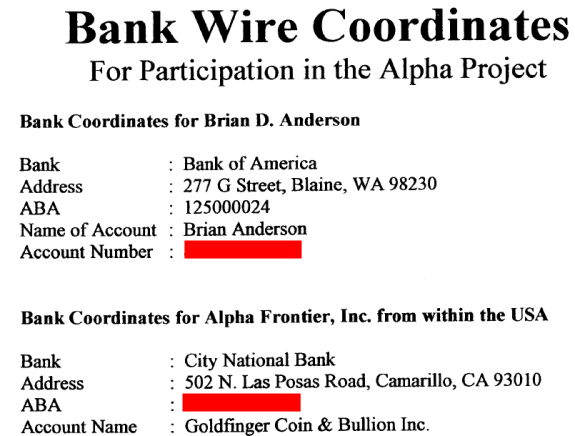
    Why is the document chilling? For starters, its references a bank account held by Goldfinger Coin & Bullion Inc. in Camarillo, Calif. If that name does not ring a bell, think “E-bullion,” the now-shuttered money-exchange business purportedly backed by gold.

    James Fayed, the operator of Goldfinger and E-Bullion, was charged in 2008 with operating an unlicensed money-transmitting business. Investigators said E-Bullion had been used to transact at least $20 million in Ponzi scheme payments.

    During the same general time period in 2008, the SEC was conducting a Ponzi scheme investigation into a separate company known as Gold Quest International (GQI), which used E-Bullion and claimed to be registered in Panama.

    GQI operated from Las Vegas. It initially tried to claim that it was immune to U.S. law because of links to a “sovereign” Indian tribe. GQI was charged in May 2008 by the SEC with operating a Ponzi scheme. The purported “attorney general” of the purported “sovereign” tribe reacted by trying to file a lawsuit against the SEC for the preposterous sum of $1.7 trillion. A federal judge was not amused, and struck the bizarre filings.

    Woman Stabbed To Death

    On July 28, 2008, Pamela Fayed — James Fayed’s estranged wife — was brutally murdered in a parking garage in California. She was stabbed in the chest, neck and face — and left to die, according to court filings. Prosecutors said there was no evidence of robbery or carjacking. The murder, according to court filings, occurred just minutes after a meeting Pamela attended with her criminal attorney and her husband’s criminal attorney.

    James Fayed was present at the meeting, according to court filings. A meeting with separate attorneys — this one involving a divorce hearing — had been scheduled for the next day, July 29, 2008. Prosecutors said that James Fayed was at risk of being ordered to turn over nearly $1 million to Pamela at the divorce proceeding.

    Pamela had advised the government in June 2008 that she wished to cooperate in its criminal investigation of E-Bullion, according to prosecutors.

    “Pamela’s murderer left the crime scene in a red SUV that was captured on surveillance video, along with its license,” prosecutors said. “The license was traced to Avis car rentals in Camarillo, not far from [the] defendant’s business. The vehicle had been rented from Avis on July 3, 2008 using an American Express card issued to defendant and GCB.

    “An American Express credit card with the same account number was found in defendant’s wallet during a search of his residence in the days following Pamela’s murder. During the search of defendant’s residence, officers also found approximately $60,000 in cash wrapped in plastic material; approximately $3,000,000 in gold; and approximately 31 firearms, including one with a long-range night vision scope, along with thousands of rounds of matching ammunition,” prosecutors alleged.

    Prosecutors also alleged James Fayed arranged for the July 28 meeting to create an alibi.

    Read a court filing in the federal case against James Fayed in which prosecutors alleged he operated an unlicensed money-transmitting business. The filing references the alleged murder plot.

    Murder Charges Filed

    James Fayed and an employee — Jose Luis Moya — were charged by the Los Angeles District Attorney’s office with murder and a conspiracy plot in September 2008. Fayed paid Moya “approximately $25,000 to arrange the murder of Pamela Fayed,” investigators said.

    On July 3, 2008, investigators said, “Fayed and his company — Goldfinger, Inc. — rented a Suzuki sport utility vehicle that was used by the killers at the Watt Tower parking garage where Pamela Fayed was killed.

    “The Suzuki SUV was driven to Fayed’s Ventura County ranch on Happy Camp Road after the killing,” according to investigators. Moya returned the vehicle to Avis the next day.

    OSC Document Outlined Purported Anderson/E-Bullion Meeting In 2003

    The OSC document filed in Canada is important — and we suggest you read every word of it from the link below — because exhibits in the document show the murkiness and just plain creepiness of the HYIP and Ponzi worlds. One exhibit suggests Anderson planned to meet with Fayed and his wife in 2003 to discuss business.

    The document also references Alishtari and FEDI, claiming an investment program was backed by $125 billion in gold. Among other things, the document lists the name of Goldfinger Coin & Bullion and an account number, along with directions on how to open an E-Bullion account.

    Screen shot: From exhibit in 2003 OSC filing.

    Also included in the document is a purported joint-venture agreement marked “STRICTLY CONFIDENTIAL” that purportedly was used by Anderson to recruit investors into an international fraud scheme.

    Parallels To AdSurfDaily Case

    Parts of the document include claims very similar to claims made by promoters of the alleged AdSurfDaily (ASD) Ponzi scheme in the United States. Anderson, for example, was positioned as a “very successful business executive” who attended a function to observe Alishtari receive an award “for Republican Business Man of the Year for the State of New York.” Similar claims were made about ASD President Andy Bowdoin.

    Investor payouts, according to an exhibit in the OSC document, were called “rebates.” ASD, whose assets were seized by the U.S. Secret Service in August 2008 amid Ponzi allegations, also called its payouts “rebates.” Exhibits in the OSC document were thick with references to God and family — another similarity to the ASD case.  Anderson’s efforts to promote the program were deemed “heroic,” and business was conducted in part from Boca Raton, Fla. ASD was thick with Florida members.

    In a purported email from Anderson dated April 17, 2003, according to an exhibit within the OSC document, Anderson laid out the case for the new venture.

    “Dear Family,” the email began. Chillingly, the email appears to reference Pamela Fayed, allegedly murdered by her husband and conspirators five years later. The email suggests there once were happy days between the Fayeds.

    “I am very pleased that my recommendations and leg work have paid off and the Alpha Project will be merging its gold value/currency transfer through E-Bullion,” the email purportedly sent by Anderson claimed.

    “E-Bullion is owned by a wonderful couple who have their roots in Egypt and, therefore, are Arab in descent. I will be spending personal time with them on Monday in California.”

    Screen shot: Exhibit of purported Anderson email in 2003 OSC filing.

    The email, which discusses a trip to Panama, promised investors an “offshore” company and outlined a plan to sell “debit cards” through vending machines that would be positioned in posts offices, hotels and college buildings.

    Put “$20 into a vending machine and the machine spits out a loaded Debit card for you,” the email said. “Now you can begin to see why the Alpha Project in will in time be another Microsoft in size.”

    Claims in HYIP and Ponzi schemes that a company is destined to become the “next” Microsoft or Google are common. Beyond that, the use of debit cards in the murky HYIP and autosurf words is becoming increasingly popular — as are appeals for investors to entrust funds to “offshore” businesses, amid claims that such businesses are outside the reach of U.S. law enforcement.

    Read the OSC document from 2003.