UPDATED 8:31 P.M. ET (U.S.A.) Federal prosecutors today asked the Clerk of U.S. District Court for the District of Columbia to enter a default notice for assets seized in the December 2008 forfeiture complaint against AdSurfDaily.
The clerk entered the notice, and the forfeiture of the property is pending. It will be finalized when U.S. District Judge Rosemary Collyer enters a forfeiture order. Collyer issued an order last week for the forfeiture of ASD assets seized in the August 2008 case.
Seized in the December 2008 complaint were the Tallahassee home of George and Judy Harris; a 2008 Honda car registered to the Harrises; a 2009 Lincoln luxury sedan registered to Bowdon/Harris Enterprises; a 2009 Acura registered to Hays Amos, an $800,000 building in Quincy, Fla. paid for in cash; jet skis; a Cabana boat; marine equipment; computers; and $634,266.13 surrendered by Golden Panda Ad Builder.
No claimant ever came forward in the December 2008 case, prosecutors said.
With Collyer’s forfeiture order in the August case, prosecutors now have title to about 99.2 percent of the liquid assets in the overall forfeiture case (August 2008 and December combined). A forfeiture order in the December case, which included only a fraction of the liquid assets, would give them title to 100 percent.
The real-estate, automobiles, computers, boat, jet skis and marine equipment are illiquid assets that must be sold before they can become part of a compensation pool for ASD victims.
Prosecutors alleged that ASD was operating a Ponzi scheme, while selling unregistered securities under the guise of being an “advertising” service and engaging in wire fraud and money-laundering.
UPDATED 5:12 P.M. ET (U.S.A. JAN. 12) So, you want to mislead your clients about your role in your business, rely on the assertions of your business colleague and not perform thorough due diligence and double-check his claims that your investors are making enormous profits? Want to say later — after a Ponzi scheme collapses — that you didn’t know it was a Ponzi scheme?
Those dogs won’t hunt, the SEC said today. A year after the alleged $350 million-plus Arthur Nadel Ponzi scheme collapsed, the agency has charged a father-and-son investment team — Neil and Christopher Moody of Sarasota, Fla. — with civil securities fraud for claiming they were managing hedge funds when the funds actually were being managed by Nadel, an attorney who was disbarred in the 1980s for using client funds to pay off loan sharks.
“The Moodys led investors to believe that they were faithfully managing funds invested with them,” said Glenn S. Gordon, associate director of the SEC’s Miami Regional Office. “Instead, they abdicated their responsibilities to investors and ignored warning signs that should have alerted them to the fraud that was occurring all around them.”
Neil Moody is 71; Christopher Moody is 35. They operated three hedge funds — Valhalla Investment Partners LP, Viking IRA Fund LLC and Viking Fund LLC. — all of which collapsed with the collapse of Nadel’s operation. The SEC said today that it is seeking the return of $42 million in ill-gotten gains from the Moodys.
The Moodys distributed offering materials, account statements and newsletters to investors that misrepresented the hedge funds’ historical investment returns and overstated their asset values by as much as $160 million, the SEC charged.
“[They] based their materials on grossly overstated performance numbers that Nadel created and provided to them, the SEC said. “The Moodys failed to independently verify the accuracy of the figures despite multiple red flags, and relied exclusively on Nadel’s inaccurate information when communicating with investors.”
Christopher Moody’s attorney said his client is working to help recover assets.
“The SEC’s complaint does not allege that Chris Moody knowingly intended to harm investors,” said Jeffrey L. Cox. “The complaint alleges recklessness which Mr. Moody neither admits nor denies. Mr. Moody has cooperated from the outset with the receiver in the recovery of assets and will continue to do so.â€
The SEC alleged that the Moodys lied about their roles in managing the assets of the three hedge funds by claiming that they controlled all of the investment and trading decisions.
“In truth,” the SEC said, “under an arrangement that the Moodys had with Nadel, [Nadel] controlled nearly all of the funds’ investment and trading activities with no meaningful supervision or oversight by the Moodys.”
NOTE: The next several paragraphs are taken verbatim from the SEC’s complaint against the Moodys. We added the italics.
“During the relevant time period, the Moodys also recklessly relied on false information Nadel gave them to misrepresent the value of the Moody Funds’ assets in account statements provided to investors and in verbal communications with investors.
“For example, one investor from Virginia who invested in Valhalla Investment Partners received a statement for October 2008 indicating his investment was valued at $1,170,363.92, and a November 2008 statement indicating his investment was valued at $1,176,848.66. These statements were false because the total value of the entire Valhalla Investment Partners’ holdings was only $9,425.66 at the end of both months.
“Another investor who invested in the Viking IRA Fund received a statement for
November 2008 indicating his investment was valued at $1,327,660.50. This statement was false because the total value of the entire Viking IRA Fund’s holdings was $629,728.01 at the end of November 2008.
“Finally, another investor who invested in the Viking Fund received a statement for November 2008 indicating her investment was valued at $651,327.18. This statement was false because the total value of the entire Viking Fund’s holdings was only $30,929.70 at the end of November 2008.
“At the time the Court appointed the Receiver in mid-January 2009, the account values for the Moody Funds were as follows: (a) Viking IRA Fund – securities worth $2,923.58 and cash of $77,025.20; (b) Viking Fund – securities worth $917.70 and cash of $65,708.33; and (c) Valhalla Investment Partners – securities worth $4,413.66 and cash of $16,158.05.
Investigators said the Moodys did virtually no checking to protect investors from getting fleeced out of millions of dollars
“The offering materials represented that the funds generated investment returns ranging from 10% to 46% between 2002 and 2008, the SEC said in the complaint against the Moodys. “These claimed returns were utterly bogus because the Moody Funds actually lost significant sums of money during those years.
“The Defendants relied exclusively upon Nadel’s fictitious performance information when they represented to prospective investors the yearly historical returns of the Moody Funds,” the SEC said. “However, they failed to verify the accuracy of the information although they had ready access to documents and information that would have revealed that Nadel’s information was false.”
Ignoring Red Flags
NOTE: The next several paragraphs are taken from the SEC’s complaint against the Moodys. We have added the italics.
“While claiming to actively manage and oversee the assets of the Moody Funds, the Moodys, in fact, relied exclusively on Nadel’s fictitious information when they provided the bogus account statements and baseless offering materials to investors. They failed to take any adequate measures to ensure the account statements and offering materials were accurate, and ignored several red flags that should have alerted them that Nadel was engaged in a massive fraud.
“For example, the Moodys never reviewed the Moody Funds’ securities account statements to verify the accuracy of the information Nadel was providing.
“In addition, they allowed Nadel to provide investment advice to the Moody Funds even though he repeatedly threatened to stop providing investment advice if the Moodys insisted on auditing the funds.
“The Moodys furthermore allowed Nadel to exercise sole control over the Moody Funds’ securities accounts and account statements even after he refused to provide the statements to the Moodys accountant.
“Despite knowledge of these facts, the Moodys never audited or examined the Moody Funds’ securities accounts. Nor did they review the monthly securities account statements, or implement any policies or procedures to monitor Nadel’s control of the Moody Funds’ assets. To the contrary, they allowed Nadel to exercise complete control of the Moody Funds’ assets and trading activities without any meaningful oversight or supervision.”
The SEC’s actions against the Moodys occurred just three days after U.S. Attorney General Eric Holder gave a major speech in Florida on the Obama administration’s Interagency Financial Fraud Enforcement Task Force. The Justice Department and the SEC are among the agencies assigned to the Task Force, which is designed to coordinate the government’s response to fraud schemes that are plaguing the United States.
Florida — perhaps more than any other state — has been plagued by financial fraud. In Sarasota alone, three major Ponzi scheme investigations are under way.
Nadel, who was arrested last year after fleeing Sarasota, is jailed in New York. His trial is scheduled for April. Investigators say he employed an unlicensed accountant and simply made up numbers out of then air to keep the Ponzi scheme afloat.
When investors requested redemptions late last year, Nadel fled.
While Nadel was operating the fraud, “the Moody’s received management and performance fees from the Moody Funds totaling approximately $42 million,” the SEC said.
In addition to the SEC’s actions, the Moodys have been sued by investors.
The Moodys have not been charged criminally. Without admitting or denying the allegations in the SEC civil complaint today, they consented to permanent injunctions against future securities fraud violations and agreed to an order that will bar them for five years from associating with any investment adviser.
UPDATED 7:03 P.M. ET (U.S.A. JAN. 12) A Beverly Hills radio host pitched his fraud scheme in Persian and targeted Iranian-Americans in Greater Los Angeles, the SEC said today.
Client funds were used to build a mansion for John Farahi, 52, and and his wife, Gissou Rastegar Farahi, 50, the agency said. Client funds also were transferred to the Farahi Family Trust. John Farahi hosts the daily radio program.
Named defendants in the case were the Farahis, Beverly Hills-based NewPoint Financial Services Inc. and Elaheh Amouei, 54. The SEC identified Amouei as NewPoint’s controller and the “personal bookkeeper” of the Farahis.
A company named Triple “J” Plus LLC operated by John Farahi was named a relief defendant. John and Gissou Farahi have control over the Triple “J” bank accounts, the SEC said.
“They lured victims with false promises of investment safety while secretly enriching themselves and diverting investor funds for their personal use,†said Rosalind R. Tyson, director of the SEC’s Los Angeles Regional Office.
All of the defendants’ assets have been frozen in the case, which includes allegations that clients were told they were investing in FDIC-insured certificates of deposit, government bonds or corporate bonds issued by companies backed by funds from the Troubled Asset Relief Program (TARP).
TARP is the $700-billion program operated by the Treasury Department to shore up banks.
“The vast majority of the money raised was transferred to accounts held by Defendants John and Gissou Farahi,” the SEC said in its complaint. “John and Gissou Farahi, in tum, used the investor funds to, among other things, construct a multi-million dollar personal residence in Beverly Hills, California and to engage in risky options futures trading in the stock market in which . . . John and Gissou Farahi lost more than $18 million in 2008 and the beginning of 2009.”
Investors were asked to invest in the debentures by the Farahis and/or Elaheh Amouei, NewPoint’s controller, after making an appointment to discuss investment opportunities offered by NewPoint, the SEC said.
Since at least 2003, NewPoint has sold more than $20 million worth of debentures to more than 100 investors. Clients were told their investments were low-risk, the SEC said.
At some point, NewPoint prepared Private Placement Memoranda (PPM) literature describing the opportunity as high risk, but most investors said they never received the material, the SEC said. Investors also did not know that they were making loans to John Farahi.
“[N]ot only did Defendants John and Gissou Farahi and/or Defendant Amouei fail to provide the PPMs to most investors, it appears that they only added the disclosure regarding loans to Defendant John Farahi in 2009, after the offering ceased, the SEC said.
“[T]he vast majority of the money raised was actually transferred to accounts controlled by the Farahis, including an account at relief defendant Triple ‘J,’” the SEC said.
Beginning roughly in June 2009, the SEC said, John Farahi and Amouei “made further misrepresentations to investors in an effort to lull them into keeping their money with NewPoint.
“Investors have allegedly been told that their money is safe and that they are guaranteed to get the entirety of their investment back — despite the fact that NewPoint lacks sufficient funds to make all investors whole,” the SEC said. “John Farahi has also paid back some investors on a selective basis while failing to return money to other investors who have asked for a return of their investment.”
Amouei, accordring to the SEC, “falsely told some of the investors who have not received a return of their investment that NewPoint was unable to return their money because the Commission has frozen NewPoint’s financial accounts.”
The NewPoint case in California became the second fraud case since November in which a radio show allegedly was used to pitch a fraudulent investment program.
Christian radio host Pat Kiley of Minnesota was accused by the SEC and the CFTC in November of promoting a $190 million Ponzi scheme with Trevor Cook, who reportedly used some of the proceeds to buy a submarine to access a private island he bought in Canada.
A court-appointed receiver has described the accounting records of Affiliate Strategies Inc. (ASI) as a mess, saying “an opinion on the accuracy of these records is not possible without an extensive audit that would require significant additional costs.”
ASI is the parent company of the Noobing autosurf, which targeted deaf people in sales promotions. ASI and its president, Brett Blackman, were sued by the Federal Trade Commission last year for their alleged roles in a scheme that promised guaranteed government grants of $25,000 from economic-stimulus funds.
Several other companies and individuals were named in the FTC complaint. Although Noobing was not named in the FTC complaint, receiver Larry Cook examined Noobing’s records last year and made a preliminary determination that it was insolvent. The Noobing website has been offline for months.
Attorneys general from Kansas, North Carolina, Minnesota and Illinois joined the FTC in the action.
In October, U.S. District Judge Julie A. Robinson authorized Cook to sell ASI’s assets, including office equipment, a vehicle and a jet ski.
In a report to Robinson filed last week, Cook said the office equipment fetched $12,500 at auction. Meanwhile, the vehicle — a 2003 Saturn L200 — fetched $2,500. The jet ski — a 2005 Yamaha — brought in $1,800.
In August 2009, Cook said in a preliminary report to the court that “the ASI defendants have formed and operated eighteen additional Kansas LLCs as subsidiaries of Defendant Apex Holdings International LLC.” One of the companies was Noobing, which listed registrations in both the United States and Nevis.
Kris Rogers, who was the comptroller for ASI and president of an affiliate company known as Custom Accounting Services LLC, told Cook that “the expenses of [the] combined companies have exceeded the revenues since October or November 2008,” according to court filings.
If Rogers’ assertions are true, it means that both Noobing and ASI — its parent company — were insolvent when the Noobing autosurf was collecting money with the suggestion that participants could earn a return of up to 3 percent a day. Noobing slashed daily payouts in early 2009, an act that caused an uproar on the Ponzi boards.
Noobing blamed the slashed payout on what it described as an unclear ruling in the AdSurfDaily case. The company did not say why it chose to collect money using a business model that U.S. government has challenged in repeated court cases. After Noobing members complained, the company explained that payouts never were guaranteed.
Noobing became popular after the August 2008 seizure of tens of millions of dollars from Florida-based ASD amid Ponzi scheme allegations. After the FTC and the attorneys general took the action against ASI and other defendants in the alleged grants scheme, Cook made a preliminary determination that Noobing was nearly $550,000 in the hole.
When the financial records of the ASI-affiliated records were examined as a whole in Cook’s preliminary analysis last year, he found that “over twenty-five thousand accounting
transactions, including several thousand intercompany transfers” had oocuured.
“The transfers between the various LLCs make it difficult to sort out the net result and profits or losses sustained by each LLC,” Cook said.
“The Receiver’s work over the past three weeks,” Cook said in August 2009, “suggests the Defendants’ operations were insolvent on the date [July 24] the [Temporary Restraining Order] was entered and that for at least all of 2009, Defendants operated only by signing up new victims faster than the old victims could obtain refunds.â€
EDITOR’S NOTE: This story is about the “Most Interesting ASD Figure” poll conducted by the PP Blog. It also includes data from court files that suggest federal prosecutors have won court battles that have secured control over more than 99 percent (99.2 percent) of the liquid assets available in the ASD/Golden Panda civil-forfeiture cases — with less than 1 percent (0.8 percent) of the remaining liquid assets still tied up in litigation.
Here, now, the story . . .
UPDATED 7:40 A.M. ET (U.S.A.) It is said — perhaps apocryphally — that Groucho Marx once entered a Groucho Marx look-alike contest and finished third.
A similar fate almost befell AdSurfDaily President Andy Bowdoin, one of seven choices in our poll that asked readers to select the “Most Interesting Figure In The Alleged AdSurfDaily Ponzi Scheme Story.”
But in the final days of the poll, Bowdoin, who had trailed early and was in second place at various times, eked out a win over eventual second-pace finisher Bob Guenther and the five other poll subjects.
Voting was light with only 53 votes cast, and the sample was not scientifically meaningful. The results, however, at least suggest that readers interested in ASD consider Bowdoin the star of his own story — a story that began in August 2008, when the U.S. Secret Service seized tens of millions of dollars from 10 Bowdoin bank accounts.
ASD was a Florida-based Ponzi scheme that had engaged in wire fraud, money-laundering and the sale of unregistered securities, federal prosecutors said. Just last week prosecutors scored a big win, when a federal judge issued a final order of forfeiture in the August 2008 civil forfeiture case, granting the government title to more than $65.8 million seized from Bowdoin accounts.
In July, the judge issued an order granting the government title to more than $14 million seized from the bank accounts of Golden Panda Ad Builder, whose assets were seized as part of the ASD civil-forfeiture case. A second civil-forfeiture case — filed in December 2008 against ASD/Golden Panda-connected assets — appears to be nearly resolved. The December case involves only a fraction of the money seized in the overall case.
To date, prosecutors have scored wins that secured more than $79.88 million — more than 99 percent of the available cash pool (liquid assets) in both cases, with less than 1 percent of the pool still in litigation. The total pool of liquid assets in both cases amounts to about $80.52 million, according to court records. A prosecution win of the fraction of 1 percent remaining to be secured is a virtual certainty. Neither the ASD side nor the Golden Panda side has secured any financial wins. Golden Panda quit trying shortly after the August 2008 case was brought.
Here is a way to look at the pool from both cases as a fraction. Of the $80.52 million available, prosecutors have control over $79.88 million: 79.88/80.52 — or 99.2 percent. If the prosecutors gain control over more than $600,000 remaining in litigation, they will have gained control over 100 percent of the available pool.
The current cash pool does not count illiquid assets such as real estate, a Cabana boat, automobiles, jet skis and marine equipment that must be sold before it can be converted to cash and added to the pool.
A big wild card is whether Bowdoin, who initially submitted to the forfeiture in January 2009 under advice from paid counsel but attempted to reassert his claims in February 2009 as a pro se litigant, will appeal. U.S. District Judge Rosemary Collyer ruled in November 2009 that Bowdoin no longer has standing in the August 2008 case. Bowdoin never established standing in the December 2008 case.
Poll Results
Bowdoin, 75, captured 36 percent of the vote in the “Most Interesting” poll; Guenther, 62, a government critic who led the poll at times, finished second, capturing 32 percent of the vote.
Guenther is the de facto head of the ASD Members Business Association (ASDMBA). He emerged as a harsh critic of the manner in which prosecutors have handled the case, claiming he planned to rely on “political connections” to embarrass the Justice Department.
“Soon, very soon, I am going to call on some political connections, and I am going to share everything I knew then, know now and everything I tried to provide you with,†Guenther said in an email last year to one of the prosecutors.
Among Guenther’s assertions were that the government ignored leads he provided and that a prosecutor did not return more than 50 emails he had sent. Guenther pleaded guilty to a count of bank fraud in the 1990s in a case in which 10 other counts were withdrawn in a plea deal. Some ASDMBA members said they would not have contributed to the organization, which gathered money with the aim of protecting members’ interests in the ASD case, had they known Guenther had a felony record.
Some ASDMBA members have complained that Guenther did not provide transparent accounting of how the organization spent its money. Guenther said ASDMBA’s accounting was transparent, describing his critics as uninformed whiners and liberals.
Finishing third in the poll were the “Surf’s Up Mods.” Surf’s Up was a Pro-ASD forum that suddenly went missing nine days ago, about two weeks after Bowdoin reportedly made an appeal through a third party for members to search for videos of ASD “rallies.”
“Andy [Bowdoin] wants to know if any of you took Videos and/or Audios of ‘him’ speaking at any of the ASD Rallies,†according to a Dec. 21 post on Surf’s Up. The post cited a third-party email.
“The government is stating that Andy said certain things during the rallies and Andy is confident that he did not, but he does not have the proof without being able to provide the video/audio footage.
“Please share this message with your entire organization so that we can get it out to the masses yet today hopefully to see if someone has the supporting evidence for Andy,†the post urged. “If any of you DO have the video footage (or audio recording) then transfer it to DVD and and contact Catherine Parker at [email address deleted].â€
The post did not specify precisely what video evidence Bowdoin hoped to obtain from members. In the August 2008 forfeiture complaint, prosecutors entered an exhibit that included a members’ transcription of remarks Bowdoin allegedly had made at a July 2008 rally in Miami.
In the exhibit, Bowdoin identified George and Judy Harris as ASD employees, without telling members Harris was his stepson and that Judy Harris — the wife of George — also was a member of the Bowdoin family. Bowdoin described George Harris as head of ASD’s real-estate division, and Judy Harris as a clerical employee.
Prosecutors later said that George Harris and his mother — Edna Faye Bowdoin, Andy Bowdoin’s wife — used more than $177,000 in illegal proceeds from two ASD accounts at Bank of America and opened an account at a third bank. The account was opened on June 10, 2008, less than two weeks after an ASD “rally” had concluded in Las Vegas.
Before June had come to an end, prosecutors said, George Harris used more than $157,000 of the opening deposit to pay off the mortgage on the Tallahassee home he shared with his wife. The transaction was completed via wire transfer, with George Harris making the request over the telephone, prosecutors said.
George and Judy Harris and Edna Faye Bowdoin were identified in the December 2008 forfeiture complaint as beneficiaries of ASD’s illegal conduct. The AdViewGlobal (AVG) autosurf, which launched after the seizure of ASD’s assets, later identified George and Judy Harris as AVG’s owners. Prosecutors seized the Harris home in the December 2008 forfeiture complaint, and neither George nor Judy Harris filed a claim to the home.
Some ASD members said Bowdoin was the silent head of AVG. Surf’s Up received ASD’s official endorsement on Nov. 27, 2008, eight days after a key court ruling went against ASD. AVG emerged in the days ahead as an autosurf purportedly headquartered in Uruguay, and some of the Surf’s Up Mods peeled off and started a forum to promote AVG.
Surf’s Up, whose members reportedly sent brownies and delicious baked goods to Bowdoin after he was implicated in the alleged Ponzi scheme and declared he was “too honest” to testify after Bowdoin had taken the 5th Amendment in the forfeiture case, received 17 percent of the vote in the “Most Interesting Figure” poll.
Finishing in fourth place, with 8 percent of the vote, were the “Conspiracy Theorists” — those ASD members who speculated that President Kennedy was assassinated because he planned to expose a banking conspiracy and that President George W. Bush planned the 9/11 terrorist attacks. Some of the “Conspiracy Theorists” also claimed that the United States passed secret legislation in the 1990s in anticipation of a visit by reptilian aliens.
Curtis Richmond, described by Surf’s Up as a “hero,” finished with “Professor” Patrick Moriarty in a tie for fifth in the poll. Each gleaned 4 percent of the vote. Richmond is associated with the so-called “Arby’s Indians,” a tribe ruled a “complete sham” by a federal judge in a case in Utah.
The “tribe” got its derisive name because it held a meeting in an Arby’s restaurant in 2003. Members also established a sham “Supreme Court” at the address of a doughnut shop in Vernal, Utah, and also established a sham “arbitration” service that it used to pester public officials with spectacular claims that they had defaulted on contracts.
At least two people who used the services of the tribe’s bogus “arbitration” panel were sentenced for federal prison for tax crimes.
One of them was Bruce Robert Travis. Among other things, Travis is the self-published author of “My Past Life As Jesus†and “The Messiah For Hire.â€
Travis, associated with tax denier Royal Lamarr Hardy, now reportedly is working on a book in which he’ll describe what it’s like to be Jesus behind bars.
“Tribe” members, including Richmond, were ordered in 2008 to pay more than $108,000 in damages in a racketeering lawsuit brought by the public officials. Richmond later emerged as a pro-se litigant in the ASD case, cheered on by Surf’s Up. Richmond attempted to have U.S. District Judge Rosemary Collyer disqualified from the ASD case — something Bowdoin himself later tried to do.
Moriarty, who was indicted in March 2009 for filing false tax returns, now has entered a guilty plea in the tax case. He was a co-founder of — along with members of Surf’s Up — of ASD Members International (ASDMI).
ASDMI promised to litigate against the government for its actions in the ASD case, even if the government was behaving legally. Moriarty, cheered on by Surf’s Up, was part of a letter-writing campaign to Sen. Patrick Leahy, chairman of the Senate Judiciary Committee. The campaign was aimed at getting the Senate to investigate the ASD prosecutors.
Finishing last in the poll was “joe,” who received no votes. “joe” purported to be a Vietnam POW and a staunch advocate for autosurf Ponzi schemes.
AdSurfDaily mainstay “Professor” Patrick Moriarty has pleaded guilty in federal court in Missouri to filing a false tax return, federal prosecutors said.
“The total tax loss admitted by [Moriarty] is $135,697,” prosecutors said.
Prosecutors initially brought multiple tax-fraud counts against Moriarty, saying in March 2009 that he had filed false returns for the years 2002, 2003, 2004 and 2005. He pleaded guilty to the 2003 count, and faces a maximum sentence of three years in prison and a fine of up to $250,000.
Moriarty’s trial had been set to get under way this week, but he entered a plea instead. Prior to trial, prosecutors said they had “voluminous†evidence, including seven 4-inch binders of records and records from an unspecified casino.
Moriarty entered the plea before U.S. District Judge Jean C. Hamilton of the Eastern District of Missouri, according to Acting U.S. Attorney Michael W. Reap.
Along with members of the Pro-AdSurfDaily Surf’s Up forum, Moriarty formed a nonprofit organization known as ASD Members International (ASDMI) in October 2008. Among ASDMI’s claims was that it would litigate against the government in the ASD case, even if the government was behaving legally.
At least 167 ASD members gave money to ASDMI, but no litigation ever was filed. ASDMI disbanded in January 2009, less than three months after organizing.
Moriarty, who once sold fake academic degrees on eBay, explaining they were gag gifts, used the title “Rev†and purported to be the “minister†of the Universal Life Church (ULC) of Troy, Mo. He listed his qualifications as a Ph.D. and a D.D., and noted he also is an accountant and “Tax Return Specialist.â€
The credentials were listed on a church-provided website, which included a link by Moriarty to MLM opportunities.
ULC has been the subject of controversy. The church ordains up to 10,000 individuals per month, without charging a fee or holding any classes. Advanced degrees can be obtained for as little as $29.95 with little academic effort, according to ULC’s Wikipedia entry.
Moriarty advanced the legal theories of Curtis Richmond in the ASD case. Among Richmond assertions were that prosecutors were guilty of interference with commerce for disrupting ASD’s operations.
Dubbed a “hero” on Surf’s Up, Richmond is associated with a Utah “Indian” tribe a federal judge ruled a sham in a separate case. Public officials successfully sued Richmond and other “tribe” members under federal mail fraud and racketeering statutes, saying they had been targeted in a vexatious legal campaign that resulted in a bogus judgments for spectacular sums being placed against the officials.
A bogus judgment of $250 million was placed against a local prosecutor in the Utah case.
Richmond signed a bogus “arbitration” award of more than $300,000 against a family-services worker, according to court records.
Moriarty and Surf’s Up led a letter-writing campaign to Sen. Patrick Leahy, chairman of the Senate Judiciary Committee. The campaign sought Leahy’s support in advocating for ASD, an alleged Ponzi scheme, and sought the Senate’s help in investigating the ASD prosecutors.
Prior to his Senate career, Leahy had been named one of the top three local prosecutors in the United States. Even as Moriarty and Surf’s Up members were writing letters, Leahy was calling for U.S. fraud laws to be strengthened.
See this story from February 2009 about the Moriarty/Surf’s Up letter-writing campaign to Leahy. In a letter to Leahy, Moriarty claimed that “[o]ver 50 individual and notarized DEMAND[S] FOR LEGAL EVIDENCE were sent to Jeffrey Taylor, US Attorney; William Cowden, Assistant US Attorney; and Roy Dotson, Special Agent, US Secret Service.â€
EDITOR’S NOTE: These briefs are based on information from recent Ponzi or fraud schemes. As noted yesterday and previously, the United States has formed a Financial Fraud Enforcement Task Force. Cases such as the ones below are part of the reason why.
SOUTH CAROLINA AND TENNESSEE: Among the more than 30 victims in the Oren Eugene Sullivan Ponzi scheme case in South Carolina were five widows, two Alzheimer’s patients and an individual with developmental impairments, the Financial Industry Regulatory Authority (FINRA) reported.
Separately, The Herald newspaper of Rock Hill, S.C., reported that one of the victims was a “woman in a wheelchair, legs amputated, who is retired from a Christmas ornament plant.
“She gave Sullivan tens of thousands of dollars,” the newspaper reported.
“At least eight of the affected clients were over 80 years old and another four were over 70 years of age,” FINRA reported. “Numerous victims considered Sullivan a close family friend.”
Sullivan’s case “shocks the conscience,” said Susan L. Merrill, FINRA executive vice president and chief of enforcement.
At the same time FINRA banned Sullivan, it also banned William Walter Spencer Sr., of Franklin, Tenn.
Over 11 years, Spencer “borrowed” nearly $2 million in a promissory notes Ponzi scheme from elderly members of his church and from customers of his employing broker-dealer, Wiley Bros.-Aintree Capital LLC, FINRA said.
“All of the individuals from whom Spencer borrowed funds were of modest means,” FINRA said.
Among his targets was a 62-year-old school bus driver for special-needs children who gave Spencer $60,000 after her husband’s death.
“Spencer used the loan to repay other customers,” FINRA said. “Another customer faced the threat of foreclosure on his home due to Spencer’s failure to repay the $12,250 loan he made. To avert the pending foreclosure, Spencer used funds from another customer to make the payment owed. An 80-year-old customer loaned Spencer $20,500. She later needed to make repairs to her home, but was unable to do so because of Spencer’s failure to repay the principal and interest due.”
Merrill did not mince words when describing the Spencer and Sullivan schemes.
“The misconduct of these brokers was nothing short of egregious — and their financial exploitation of the elderly, the infirm and people who considered them trusted friends shocks the conscience,” she said.
OKLAHOMA: On Nov. 25, we published an early report on an alleged financial and affinity-fraud scheme in Oklahoma that targeted ethnic Chinese. Named in litigation by the CFTC was Kenneth Lee, who was imprisoned between 1996 and 2001 after being convicted in Texas of two financial felonies.
Lee also had a $3 million civil judgment placed against him in the 1990s in a fraud case, CFTC said. Also named in the complaint was Lee’s alleged business partner, Simon Yang, who was accused of hatching a new scheme with Lee in 2003 that targeted members of Yang’s church in Edmond, Okla.
Information shown prospects to get them to join the scheme claimed Lee was an exceptional trader. But when investigators reverse-engineered literature about Lee’s alleged prowess, they discovered that Lee was in prison during a time in which Lee and Yang claimed Lee was “achieving great returns,†CFTC said.
Investors were told accounts were “insured,” CFTC said. It’s a common claim in various fraud schemes, and sometimes the schemers claim or imply that banks, other lending institutions and even the government protects individual investment accounts against trading or investment losses.
Or, put simply, the schemers say or imply there is no way an individual investor can lose because a lending institution or the government backs the program. Such claims were present in both the alleged Lee/Yang fraud scheme in Oklahoma and the alleged AdSurfDaily Ponzi scheme in Florida.
In ASD’s case, an upline group implied that the FDIC insured individual members’ ASD accounts. The same upline group also claimed that ASD provided “shelter” from the FTC and the SEC.
The Edmond Sun newspaper — as part of its reporting on the alleged Lee/Yang fraud — interviewed experts who said such claims should be viewed as a red flag.
“There are never any kind of guaranteed investment returns associated with any investment account and no investment account of any kind is ever FDIC insured by the financial institution,â€Â Nick Massey told the newspaper.
Massey is regional vice president of Edmond, Householder Group Financial Advisors.
“If anyone ever suggests that, you should turn around and run, and then run to the authorities to report it,†Massey said.
See this story to get a free PDF that compiles President Obama’s Executive Order forming the Financial Fraud Enforcement Task Force and a speech by Attorney General Eric Holder.
UPDATED 11:50 A.M. ET (U.S.A.) There were reports yesterday that things have become so strange at Florida-based AdSurfDaily that a convicted sex offender has emerged as a sort of PR voice for the company. ASD is implicated by the Department of Justice in a $100 million Ponzi scheme, amid allegations of wire fraud, money-laundering and the sale of unregistered securities. Two forfeiture complaints filed against the firm in 2008 also cite a racketeering statute.
After 17 months, more than 165 court filings — some of which can only be described as bizarre — and more than $1 million spent on legal fees by ASD President Andy Bowdoin, the company lost one of the forfeiture cases this week. It was filed by federal prosecutors and the U.S. Secret Service in August 2008, and is the “bigger” of the two cases.
“Bigger,” of course, is a relative term. For the purposes of this post, “bigger” is defined only as involving more money. A second forfeiture case filed by federal prosecutors and the Secret Service in December 2008 involves less money — but is equally grave. In some ways, the second case, which had not been adjudicated to conclusion but may be soon, is even graver than the August 2008 case. The December case defines Bowdoin family members and unnamed others as the beneficiaries of ASD’s fraud. The December case puts the alleged beneficiaries of the fraud squarely in the sights of a potential criminal prosecution for felonies that could lead to prison time.
We believe Bowdoin is more worried about the December case than he is the August case — even though no claims ever were filed in the December case. The names of his wife, his stepson and his stepson’s wife are mentioned repeatedly and prominently in the December case. Prosecutors also have hinted that they are very well aware of the AdViewGlobal (AVG) autosurf, which has Bowdoin family and promotional ties and rose to early prominence after ASD’s assets were seized, a racketeering lawsuit was filed against Bowdoin, a key court ruling went against ASD — and after Bowdoin had chosen to surrender his claims to the money seized in the August 2008 complaint.
Bowdoin then changed his mind, attempting to reassert his claims to the money seized in the August complaint by re-entering the case as a pro-se litigant. Bowdoin’s former paid counsel — a prominent law firm — informed the court that Bowdoin did not consult with it before filing the series of pro se motions.
None of Bowdoin’s pro se motions made an ounce of sense. They were so unclear, in fact, that the judge had to construe a meaning, which is to say what Bowdoin was attempting to do was not clear on the face of the motions. At one point, he appears to have attempted to reverse a decision he never made — namely, to submit to the forfeiture outlined in the December 2008 case. Bowdoin did not file a single document to gain standing in the December case or to make a claim — in fact, no potential claimant did.
And yet Bowdoin seems initially to have tried to overturn a forfeiture to which he never had submitted. Only later did Bowdoin file a specific pro se motion to overturn the August forfeiture. ASD members were so fixated on the August complaint — the “bigger” one in money terms — that they missed the nuclear danger of the December complaint. Lots of potential jail time is described in the December complaint.
Here is Bowdoin’s initial pro se filing to rescind the forfeiture, which was entered into the record Feb. 27, 2009. This motion addresses only property seized in the December 2008 complaint. Bowdoin never even established standing in the December case. Neither he nor attorneys employed by him or family members filed a single document in the case. So, as noted above, Bowdoin initially tried to overturn a forfeiture in a case in which he had no standing and perhaps would have trouble even gaining standing.
His pro se motions were a trainwreck and created even more problems for ASD. The judge ordered Bowdoin’s soon-to-be-former counsel to state their intentions and to instruct Bowdoin on important matters of law before asking for formal permission to withdraw from the case. One of the important matters was that corporate litigants cannot proceed pro se. Corporate litigants must use professional counsel. It is clear from the filings that Bowdoin’s pro se helpers overlooked this obvious flaw in the initial filings. Bowdoin later hired two new paid lawyers to help him navigate the choppy waters and to attempt to undo some of the damage caused by the pro se pleadings.
Now, it’s important to point out here that the Pro-ASD Surf’s Up forum — now suddenly defunct — championed Bowdoin’s pro se pleadings and was positively giddy for days after he attempted to re-enter the case. Bowdoin was heaped with praise. Prayers went out. People cheered him on as though his pro se advisers had scored some sort of dramatic win. As always was the case on Surf’s Up, the prosecution was condemned. Bowdoin urged ASD members to write to President Obama to gain his support in Bowdoin’s fight against the Secret Service.
The disconnect was both startling and troubling.
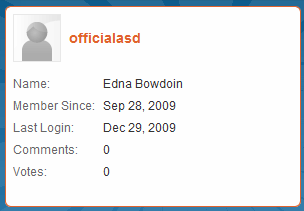
At some point during the late summer or early fall of 2009, someone apparently sympathetic to Bowdoin’s cause started this site at IContact; it’s called “Official ASD Update” and, from what we can tell, has all of one post. One of the names referenced on the site is “Edna Bowdoin” — the name of Bowdoin’s wife — but it is not clear that Ms. Bowdoin ever was at the site. Even so, her name appears in this Dec. 28, 2009, reference.
On some days, it is hard to quantify all the sadness associated with the ASD case.
One thing that is not hard to quantify is the madness. That madness finally eroded the lion’s share of Bowdoin’s support base. Prosecutors deserve a lot of credit for neatly undermining the wink-nod nature of autosurfs in a series of court filings. These filings showed the autosurf “industry” for what is: a cesspool that relies on the repetition of lies to suck new money into the schemes.
The IContact site, which perhaps was conceived as a new channel through which Bowdoin would communicate with members to keep them on his side as his court challenge continued, never emerged as a “voice” for Bowdoin. The madness had driven away the vast, vast majority of the ASD constituency. He even had lost much of the Surf’s Up crowd — something he must have realized. Why even start a second site if you’re confident in the existing communications network?
These days Bowdoin appears to be relying on a small network of insiders to stay in communication with the troops. Surf’s Up is gone. The second forum never gained a following.
Now, according to members, a person with a conviction for sex crimes involving children, is doing PR work for ASD. Whether it’s “official” or not is beside the point. The mere fact it is being done puts the madness associated with ASD on full display for any person on the email list of the promoter to see.
Yesterday (and previously) we wrote about the Interagency Financial Fraud Task Force established by President Obama in November 2009. We also wrote about a speech yesterday by Attorney General Eric Holder outlining responsibilities of the Task Force. Holder gave the speech in Florida, which was no accident. Florida is Ground-Zero for mortgage fraud, Ponzi schemes and various forms of securities and financial fraud — not that other states also do not have the same problems.
We compiled the President’s Executive Order establishing the Task Force and Holder’s speech into a PDF. The document includes the entire Executive Order and the entire speech.
We’ve titled the document, “So, You Want To Join A Ponzi Scheme? Two Good Reasons To Say ‘No’ When A Friendly Upline Sponsor Approaches You In Person Or Via Email And Asks You To Join A Paid-To-Click ‘Advertising’ Program Online Or A ‘High-Yield Income Program’ (HYIP).”
Many, many people have turned their backs on the so-called autosurf “industry” because of their experiences with Andy Bowdoin and ASD. That’s a good thing, of course: Ponzi = Pain. We write about the pain caused by Ponzi schemes every day on this Blog.
Despite the daily news on Ponzi schemes and financial fraud, however, many, many people continue to participate in the schemes. They do so at their own peril, as Holder said yesterday. The White House and the Justice Department clearly have thrown down the gauntlet on mortgage fraud, securities fraud, Ponzi schemes and other types of financial fraud that can undermine local, regional and national economies — and the economy in the homes of families across the world.
What the government is doing is dreadful news to the Ponzi pushers — but it is good news for the global economy and to families across the world. We provide the document in the spirit of education, and sincerely hope that it can make at least a small difference in the lives of people who continue to believe there is something noble about collecting commissions for selling people into misery.
Thank you, Readers, for your daily visits.
Patrick
P.S. In case you missed the link above to the PDF, here it is again. Forum owners are invited to make a copy of this document and post the document in their respective forums.
A federal judge has frozen the assets of Illinois investment adviser Steve Salutric in a Ponzi scheme case in which the allegations are shocking.
Salutric, 51, a church treasurer who took a stab at the fim business and co-produced the 2005 movie “Madison” starring Jim Caviezel and Bruce Dern, raided the account of a 96-year-old woman last year to keep his Ponzi scheme going, according to a complaint filed today by the SEC.
The woman lived in a nursing home and was suffering from dementia, the SEC said, adding that Salutric’s act toward her was “particularly egregious.”
Salutric misappropriated more than $400,000 of the woman’s funds, the SEC said, identifying her only as “Client A.” Other client accounts also were raided.
“Client A has no current memory, cannot retain information for more than 5 minutes, and resides in a nursing home,” the SEC said in the complaint filed in U.S. District Court for the Northern District of Illinois.
In recent weeks, fearing his fraud was about to be exposed, Salutric began to approach clients with offers to pay them “hush money,” the SEC said.
“Client funds thus are apparently being used in effort to conceal Salutric’s previous misconduct and are being used in a Ponzi-like fashion as ‘hush’ money,” the SEC argued today to U.S. District Judge William J. Hibbler. “Unless emergency action is taken, Salutric may attempt to further dissipate client funds by paying clients with misappropriated funds in an effort to gain ‘cooperation’ from some of his defrauded clients.”
Hibbler froze Salutric’s assets.
Salutric, of Carol Stream, Ill., co-founded the investment advisory firm Results One Financial LLC, the SEC said. Results One, which has more than 1,000 clients and more than $160 million under management, was identified in the complaint as a “relevant party,” not a defendant in the case.
Salutric is accused of misappropriating “at least” $1.8 million in clients’ funds by raiding their Charles Schwab accounts, and he “did not have discretionary authority to withdraw funds from client accounts at Schwab,” the SEC said.
Among the allegations, which listed one shocking claim after another, were that Salutric forged signatures to gain access to the Schwab accounts and “transferred approximately $1.2 million of client funds to entities with apparent ties to Salutric,” the SEC said.
Among the entities to which he directed misappropriated funds was his church, where Salutric is the treasurer and has signatory authority over the church’s bank accounts, the SEC said.
The church received $321,000, the SEC said.
A film-distribution company known as Celluloid Distribution LLC received $610,000, the SEC said.
Meanwhile, a Yorkville, Ill., restaurant in which Salutric holds an ownership interest received “about $45,000,” the SEC said, and a now-shuttered restaurant in Carol Stream received $214,000.
“This restaurant went out of business in 2009,” the SEC said. “One of Salutric’s clients is the agent for the restaurant’s corporate entity, and the owner is the brother-in-law of one of Salutric’s defrauded clients.”
Clients who were fleeced were not aware of the transfers and did not approve them, the SEC said.
At one point, Salutric spent down the account of the 96-year-client with dementia to the point that it less than $10,000. The SEC did not say precisely how much had been in the account, but noted the misappropriation exceeded $400,000.
A $50,000 Ponzi payment was made to another fleeced investor from the elderly client’s account, the SEC said. Salutric lied to the client’s daughter in the summer of 2009 about the amount of money in the account and continued to steal from it after telling the lie, the SEC said.
Salutric is listed as a co-producer of the hydroplane-racing movie “Madison,” which starred Caviezel and Dern. The movie had a limited run in 2005, after being completed in 2001 and sitting on the shelf for nearly four years prior to release.
UPDATED 6:15 P.M. ET (U.S.A.) A California man ordered by five states to cease and desist from selling unregistered securities started using a different corporate name, bought an autodialer and database with the names of wealthy investors for $17,737 and used it for at least six months to fleece clients before the scheme collapsed in December 2009, the SEC said.
The scheme, which targeted investors in the United States and Canada, raised at least $1.4 million — some apparently before the database acquisition in June 2009.
The SEC now has gone to court to stop Thomas L. Labry and his company, Cherokee Gas Systems, from fleecing investors in a fraudulent oil-and-gas scheme at a property in Oklahoma known as the “Walters Field Priddy Sand Unit.”
The assets of Labry and Cherokee have been frozen and a receiver has been appointed, the SEC said.
While operating by a different name — Iron Horse Petroleum Inc. — Labry was ordered by five states to cease selling unregistered securities: Illinois, Pennsylvania, Wisconsin, Alabama and Arizona, the SEC said. Some of the orders date back to 2000.
In addition, Labry was sued in California under RICO statutes for fraud, and the plaintiffs secured a judgment of $647,776.12 in a 2006 case.
Cherokee was incorporated in Oklahoma in 1991, and conducted business from Costa Mesa, Calif., the SEC said. It is not registered to sell securities. Labry lives in Newport Beach. The Cherokee website was registered in January 2009, according to web records.
The website appears to use a shared server that hosts 3,751 other sites, which may lead to questions about why a company that charged investors $25,000 per unit and purported that each unit would return $725 a month at a minimum did not use dedicated hosting.
“In approximately December 2008, Cherokee began soliciting potential investors throughout the United States, including through the use of cold calling,” the SEC said.
Investors received a brochure from Cherokee that was “almost identical to the brochure previously disseminated by Iron Horse . . . except that the Cherokee brochure refers to ‘Cherokee’ rather than ‘Iron Horse,’” the SEC said.
The Oklahoma corporate registration of Iron Horse was suspended in August 2006 for failure to pay franchise taxes, records show.
In December 2008, Labry began to use the name of Cherokee in an investment offer, according to the SEC.
“To facilitate this general solicitation, Labry, using Cherokee investor monies, purchased dialing software that can automatically place outbound calls from a preloaded database of numbers,” the SEC said. “In these calls, Cherokee representatives offer investors the opportunity to purchase units in oil and gas wells purportedly owned by Cherokee located on Walters Field in Oklahoma, for $25,000 per unit. In instances where an investor does not want to purchase an entire unit, Cherokee allows the investor to purchase a fraction of a unit. Cherokee representatives tell investors that they will start receiving returns on their investments, paid monthly, within 45 to 60 days of the investment.”
In June 2009, Labry purchased a database that targets telephone numbers of “Homeowners Age 60+ with income $100K and up” and “Homeowners Age 60+ with wealth 1 million,” the SEC said.
Cherokee represented that investors would receive returns of 35 percent a month.
Although investors did not get paid, the attorney who represented Labry in the California lawsuit filed by investors did — as did a convicted felon, the SEC said.
The attorney received cashier’s checks totaling $105,000, the SEC said. The attorney has not been accused of wrongdoing.
Investigators identified the felon as Gary Maddux, whom the SEC said was convicted of wire fraud and mail fraud in 1998. Maddux received cashier’s checks totaling $221,195, the SEC said.
Maddux was charged in 1997 with bilking elderly investors in a fraudulent telemarketing scheme known as “Prizewinners.” In the Prizewinners case, people were told they had won a sweepstakes and could collect their winnings for a fee.
Since December 2008, the SEC said, Labry withdrew at least $268,000 in cash from the Cherokee bank account, as well as $466,283 that was used to purchase cashier’s checks for “various individuals who were not investors.”
Labry also “made withdrawals totaling $148,126 that were used to purchase cashier’s checks made out to ‘SCS,’ one or more of which he then cashed,” the SEC said.
When investors questioned why they weren’t getting paid, they were “falsely told by Cherokee agents that oil production is ‘behind’ and that they will receive payment within a certain number of weeks or by a certain date.”
Ka-boom! A federal judge has frozen the assets of alleged Ponzi schemer Richard Elkinson, accused of fleecing investors in Massachusetts by telling them he brokered deals for government uniforms and uniforms worn by Olympic athletes.
Meanwhile, the attorney general of the United States ventured to Florida today and gave a dramatic speech at the Forum Club of the Palm Beaches. The speech was important symbolically — indeed, Florida is awash in a sea of Ponzi and mortgage-fraud schemes — and Holder wanted to reassure the noontime crowd of 700 that the government was doing everything it could to restore faith in the markets.
But the speech also was important politically. The Obama administration wanted to showcase its new Interagency Financial Fraud Enforcement Task Force, which the President announced in November, and Holder chose Florida to drive home the message that Ponzi schemers, mortgage fraudsters and financial criminals are going to have many sleepless nights in the months ahead.
“To those who see the victimization of others as an avenue to wealth, take notice,” Holder warned. “If you fabricate a financial statement, if you propagate an investment scheme, if you are complicit in an act of financial fraud, you are writing your ticket to jail.”
Even as Holder was delivering his remarks, the SEC announced that it had sued Elkinson in an emergency action in Massachusetts that complemented the FBI’s criminal action in the case, dubbed a “Mini-Madoff” because it allegedly was both a Ponzi scheme and a case of affinity fraud that targeted Jewish investors.
Court records show that the FBI was working the case on Christmas Eve, even as the government was shutting down for the holidays. Records also show that Massachusetts Secretary of State William Galvin sent a team of investigators to conduct interviews and to get to the heart of the matter while Massachusetts residents were doing their last-minute holiday shopping.
State and federal agencies now have filed three separate actions in the Elkinson case. Elkinson, 76, was arrested at a casino in Biloxi, Miss., fresh off a trip to casinos in Las Vegas. The FBI said he had conducted at least $3.7 million in transactions at the Las Vegas casinos since 1998 and that investors in his Ponzi scheme were out $29 million.
The SEC said today that Elkinson had “no relationship” with a uniform manufacturer based in Japan. Elkinson had told investors he had an exclusive arrangement and that only he was permitted to do business with the manufacturer.
“Unfortunately, it was all make-believe,” the SEC said in its complaint. “Elkinson had no
relationship with a Japanese uniform manufacturer, and there were no contracts to purchase uniforms. While some investors did receive payments of principal and interest, those payments were made using funds obtained from other investors, and Elkinson was able to keep the scheme going as long as most of the investors kept rolling over their investments.”
Elkinson’s purported contracts to provide uniforms for government workers also were “fictitious,” the SEC said.
The current attack on financial crime by law enforcement may be unprecedented. Holder said today that the FBI is investigating 2,800 cases of mortgage fraud, up a staggering 400 percent from 2005 case totals.
In his Palm Beach remarks, Holder also dropped the names of Ponzi schemers.
“Palm Beach is, in many respects, ground zero for the $65 billion Ponzi scheme perpetrated by Bernard Madoff — the largest investor fraud case in our nation’s history,” the attorney general said. “Before the house of cards Madoff built collapsed in 2008, before he was sentenced to 150 years in prison last June, before he became a notorious criminal on the cover of newspapers around the world, he was one of your neighbors.
“His former home sits just north of us,” Holder continued. “An 8,700-square-foot mansion that’s worth . . . well, we’ll know what its worth once the U.S. Marshals Service auctions it off and the proceeds are distributed to Madoff’s victims.”
Holder also mentioned the Ponzi cases of Tom Petters of Minnesota, Allen Stanford of the United States and Antigua and disbarred Florida attorney Scott Rothstein of Fort Lauderdale.
“I’m proud that these men, along with more than 450 others convicted of corporate and securities fraud in 2009, have been taken out of the game,” Holder said.
In Massachusetts, U.S. District Judge Joseph L. Tauro issued a temporary restraining that froze Elkinson’s assets. Tauro also entered an order freezing all proceeds of the misconduct held by others, and an order prohibiting the acceptance of additional investor funds.
At the same time, Tauro ordered an accounting of assets and issued an order prohibiting the alteration or destruction of documents.
The orders in the SEC case — as well as the legal action filed earlier this week by Galvin — bottle up any profits made by people who helped Elkinson promote the scheme.
Holder said the law-enforcement community is fighting back against people who have licensed themselves to steal.
“They’ve robbed people of their homes and their economic security,” Holder said. “They’ve depleted bank accounts and pension funds. In some places, they’ve dried up philanthropic giving and shuttered charities. They’ve placed unfair challenges before cash-strapped governments, local police departments, small businesses, and American workers and consumers.”
 UPDATED 8:31 P.M. ET (U.S.A.) Federal prosecutors today asked the Clerk of U.S. District Court for the District of Columbia to enter a default notice for assets seized in the December 2008 forfeiture complaint against AdSurfDaily.