A federal judge has issued an order that enjoins Speed of Wealth principal Donna McKelvy from breaking securities laws and disgorges her ill-gotten gains from the alleged Mantria Corp./Speed of Wealth Ponzi scheme.
McKelvy, 43, of Parker, Colo., consented to the order without admitting or denying the allegations in a complaint filed by the SEC Nov. 16. The Speed of Wealth website, which once prominently featured a video containing images of President Obama, former President Clinton and Secretary of State Hillary Clinton, now is returning a server error and will not load.
U.S. District Judge Christine M. Arguello entered the order against McKelvy yesterday.
“Donna M. McKelvy is prohibited, directly or indirectly, from accepting funds from investors for investment in any investment program,” Arguello wrote in the order.
She further ordered McKelvy to “pay disgorgement of ill-gotten gains, prejudgment interest thereon, and a civil penalty.” The amounts will be determined later, and Arguello said McKelvy “will be precluded from arguing that she did not violate the federal securities laws as alleged in the Complaint” and “may not challenge the validity of the Consent or this Order of Permanent Injunction.”
The SEC said McKevly was a principal in Speed of Wealth and used “the titles of president of Speed of Wealth in charge of investor relations and vice president of Speed of Wealth in charge of investor relations.
“She is a 25 percent owner of Mantria Industries LLC, one of the Mantria subsidiaries that has actively raised funds from investors, as well as three other Mantria subsidiaries. She does not hold any securities licenses, and she has never been associated with a registered broker-dealer,” the SEC said.
Also charged in the SEC complaint last month were McKelvy’s ex-husband, Wayde McKelvy, 46, of Sunny Isle Beach, Fla.; Mantria CEO Troy Wragg, 28, of Philadelphia, and Amanda Knorr, 26, also of Philadelphia. Knorr is Mantria’s COO.
Wayde and Donna McKelvy “particularly targeted elderly investors or those approaching retirement age to finance” Mantria’s “green initiatives,†the SEC said.
The SEC alleged that Mantria operated a $30 million Ponzi scheme pushed by Speed of Wealth.
Mantria’s biochar, a carbon-negative charcoal, was used to appeal to environmentally conscious investors, the SEC said.
“Despite claims that Mantria was the world’s leading manufacturer and distributor of biochar and had multiple facilities producing it at a rate of 25 tons per day,†the SEC said, “Mantria has never sold any biochar and has just one facility engaged in testing biochar for possible future commercial production.â€
Both Mantria and Speed of Wealth showcased a video assembled in part from materials published by the Clinton Global Initiative (CGI), one of President Clinton’s signature undertakings since leaving office in 2001.
Wragg appeared alongside President Clinton and Secretary of State Clinton at the CGI annual meeting in New York in September, and images of prominent attendees were placed in the video, including an image of President Obama.
Less than two months later the SEC alleged that Mantria was a Ponzi scheme.
Federal prosecutors have scored another dramatic win in a Ponzi scheme case.
Raymond Frank Joseph, 55, of Bloomfield Hills, Mich., was convicted of three counts of wire fraud, nine counts of interstate transportation of stolen money or property and 24 counts of conducting monetary transactions in criminally derived property.
Judge Gerald E. Rosen immediately revoked Joseph’s bond after a federal jury returned guilty verdicts on all 36 counts. Joseph was ordered detained, pending sentencing next year.
“Investors or lenders should be wary of unreasonably high promises of massive profits,” said U.S. Attorney Terrence Berg of the Eastern District of Michigan. “Ponzi schemes prey on the expectations of big returns, and use the next person’s money to pay previous investors. In this case, the jury saw through the defendant’s fraudulent scheme.â€
Prosecutors said Joseph fleeced $5 million in the scheme.
“Joseph solicited loans of money from several individuals to invest in a number of business ventures,” prosecutors said. “To induce the lenders to give him their money, Joseph fraudulently promised the victims a specific date of repayment with interest resulting from his claimed business investment of the money.”
But Joseph did not invest the the money, prosecutors said. Instead, he used it to make payments to earlier investors and to pay his personal expenses such as credit card bills, household expenditures and vehicle costs.
A veteran IRS criminal investigator said investors have a duty to be cautious.
“Although the economics of Ponzi schemes are simple, today’s swindlers artfully conceal their greed with sophisticated marketing and numerous misrepresentations,” said Maurice Aouate, special-agent-in-charge of the Internal Revenue Service Criminal Investigation Division.
“Beware, for if is sounds too good to be true, it probably is,” Aouate said.
The FBI also had a leading role in the Joseph probe.
“Investors generally understand that there’s a correlation between risk and reward, and Ponzi scheme cases like this one reinforce the fact that investing money is inherently risky,” said Andrew Arena, FBI special-agent-in-charge.
“Before handing hard-earned money to investors, individuals should know who they are dealing with and how their money will be invested,” Arena said. “In light of recent large scale Ponzi schemes, public awareness is at the forefront. The FBI and its partners will aggressively investigate people who swindle money from others, whether it involves hundreds of thousands or millions of dollars.”
Joseph potentially faces decades in prison. Sentencing is scheduled for March.
EDITOR’SNOTE: We were going to publish this post to commemorate our 500th post since December 2008, but breaking news intervened. So, this is now Post No. 501.
This is the PP Blog’s 500th post (actually it’s now No. 501) since December 2008, the month we switched to WordPress.
It has been a year filled with nonfiction that reads like fiction. Some of the Ponzi tales and allegations are so incredible they require readers to suspend their disbelief — and occasionally even to suspend their disbelief at multiple levels.
A year ago, most members of the reading public knew very little about Ponzi schemes. News junkies and television viewers alive during the 1980s perhaps had a fleeting memory of the “Billionaire Boy’s Club” (BBC) Ponzi scheme from that decade. Joseph Gamsky’s operation led to murders and a TV miniseries.
Ponzi schemes, though, generally were localized stories, and it was easy to miss news about them. Bernard Madoff changed that a year ago. Although authorities were well-acquainted with Ponzi schemes, the public at large was not. Since Madoff’s arrest, the seamy underbelly of one of the world’s hidden cultures of criminality has been exposed. Ponzi schemes now regulary lead to national and international headlines.
Just last week the FBI announced it was investigating at least 1,500 cases of securities fraud, including 314 HYIP schemes in which a Ponzi scheme appears to be an element. Prosecutors now are using racketeering laws to address some of the schemes, while continuing to use mail-fraud, wire-fraud, money-laundering and securities laws to combat the plague.
Some of the cases are just plain bizarre. Many mysteries and questions remain. Here are some of them.
Did Florida Ponzi suspect Scott Rothstein really attract investors by saying he employed former FBI and CIA operatives to dig up dirt on the sexual infidelities or workplace sexual misconduct of wealthy people so he could target them in lawsuits?
Did investors really throw hundreds of millions of dollars at such a business, viewing it as just another way to make money and not even questioning the moral, ethical or legal ramifications of such a bizarre marketplace approach — the packaging of sexual indiscretions as a security?
Did Mantria Corp. and Speed of Wealth LLC, now accused by the SEC of promoting a “green” Ponzi scheme, really believe that it was prudent to beam videos and trade off the reputations of a current President of the United States, a former President of the United States, a current U.S. Secretary of State and a former Secretary General of the United Nations?
And did a Ponzi defendant in the Mantria/Speed of Wealth case really try to recruit a reporter into an MLM by calling her a “fellow Wealthalete†and USING ALL CAPS in the sales pitch — after the SEC brought the charges in the Mantria/Speed of Wealth case?
Did ASD members really believe that one of the best ways to stay under the Feds’ radar when pitching a Ponzi scheme was to claim the President of the United States personally endorsed the business acumen of the man running the Ponzi scheme? (And did Mantria/Speed of Wealth not have any knowledge of the ASD case and how quickly the government reacted when it learned that institutions such as the Presidency were being used in advertising pitches?)
Did the Pro-ASD Surf’s Up forum and a forum some of its Mods established to promote the AdViewGlobal (AVG) autosurf really label Curtis Richmond a “hero” for his pro se legal efforts to derail the forfeiture aspect of the ASD Ponzi prosecution?
Did some ASD members really send President Andy Bowdoin brownies and delicious baked goods after federal prosecutors and the U.S. Secret Service said he was at the helm of an international wire-fraud and money-laundering scheme whose key component was a $100 million Ponzi scheme?
Did the Noobing autosurf really think it prudent to pitch an autosurf to deaf people after the government seized tens of millions of dollars in the ASD case?
Is it really possible that thousands of people believe the answer to Ponzi schemes and the wealth they destroy is even more Ponzi schemes, including ones launched while Bowdoin was under investigation for serious crimes and already had been sued for racketeering?
Indeed, it has been an amazing year in the world of the Ponzi scheme.
EDITOR’S NOTE: As you’re reading this story, keep in mind that the Ponzi scheme “industry” actually has advocates who advance the theory that all commerce should operate under the principle of caveat emptor (“let the buyer beware”), that the government should not be empowered to “interfere” with “commerce” and that “offshore” options are the best.
So many victims fleeced out of their life savings in California by Jeffrey Gordon Butler wish to make statements at the sentencing phase of his trial that it may take a week or more to accommodate them.
Eighty two of Butler’s Ponzi scheme victims were “elderly,” Orange County prosecutors said, noting gloomily for the record that “[a]t least six victims died during the course of the trial and 52 victims died prior to the case being brought before the jury.”
The Ponzi crime raised more than $11 million and affected at least 121 senior citizens. Family members of the deceased victims will speak on behalf of their departed loved ones during the sentencing phase.
Butler, 51, of San Juan Capistrano, was convicted in June of 693 felony counts of securities and tax-related crimes. A jury in Orange County, Calif., returned the verdict after a trial that lasted nearly eight months. Butler faces a maximum sentence of 300 years in state prison.
His wife, Peggy Warmath Butler, 49, faces up to 10 years. She was convicted of four felony tax counts.
So many charges were brought against Jeffrey Butler that it took “two days for the verdict to be read,” prosecutors said.
The sentencing phase now is under way. Prosecutors expect it may consume this entire week and extend into next week because the surviving victims or their family members want to tell the judge their stories about how the scheme affected them.
Part of the scheme involved clients’ money being moved offshore without authorization to a “telecommunications company supposedly located on the eastern Caribbean island of Grenada,” prosecutors said.
Because so many of the victims were nearing the end of their life spans or in poor health, prosecutors recorded their testimony prior to the trial “to ensure that the victim’s testimony was preserved in the event that they were unavailable to testify at trial due to death or illness.”
When the scheme started to collapse, Butler lied to hold investors at bay, prosecutors said.
“Jeffrey Butler first met many of his victims while operating a company called Senior Information Services, which offered to assist senior citizens in the creation of living wills, trusts and other estate planning structures for a fee,” prosecutors said.
“Through this business, the defendant gained the trust of many of his clients, whom he later victimized. Between 1995 and 2004, in a series of businesses that changed forms and names, Jeffrey Butler failed to provide his investors with any documents or other information about his companies, how the companies made money, or any of the risks of investing in the companies as required by law to protect consumers and investors,” prosecutors said.
Butler used all the tricks in the book, including moving money between companies, keeping investors in the dark and skimming, prosecutors said.
He “transferred investments between companies on several occasions without informing or providing only limited information to his elderly investors,” prosecutors said. “[Butler] immediately took 10 percent of the investors’ money for himself without their knowledge or consent.”
And it only got worse from there.
“Investors were not made aware that these investments were not authorized to be sold in California,” prosecutors said. “Some of the victims agreed to invest after being misled into believing that [the offshore company, Global Network Providers] was an Individual Retirement Account (IRA) qualified investment, when in reality the investments were not IRA qualified. In an effort to fool his investors, Jeffrey Butler simply had ‘IRA’ typed at the top of the promissory notes.”
As the scheme was unraveling, Butler blamed his inability to make payments on Mother Nature.
“Butler eventually ran out of funds to maintain his scheme and sent his victims a letter in which he continued to lie to investors, claiming that Hurricane Ivan had caused a delay in payments,” prosecutors said.
Two California men have been charged with securities fraud by the SEC in an emergency court action that alleged they pushed a Ponzi scheme that collected more than $18 million.
Investors were duped into believing that a company known as Bridon Entertainment bought advertising space in bulk and resold it at a substantial profit to famous companies such as Home Depot, Federal Express, DIRECTV, Warner Brothers and Slim-Fast, the SEC said.
No such advertising deals existed and the investors were duped by “fake” contracts that included the famous names, the SEC said.
Named defendants were Dean P. Gross, 47, of Agoura Hills, and Gregory W. Laser, 46, of San Diego. Their assets have been frozen. Gross did business as Bridon Entertainment and diverted $6 million to his own use, the SEC said.
The scheme began in December 2006, according to the SEC.
“Gross provided investors a fabricated contract that appeared to be between Bridon and a representative of the well-known corporation,” the SEC said. “Gross and Laser told investors that Gross would use their money to purchase advertising time and space, and that their promised returns would be generated by the profitable resale of that advertising to the specifically identified company.
But “Gross did not have relationships with the well-known companies he claimed were his clients,” the SEC said. “Gross did not buy or resell advertising, and investors’ purported returns were not generated by the sale of advertising, but instead came from money raised from subsequent investors, in classic Ponzi fashion.”
At least 45 investors were fleeced in the scheme, which featured both short-term and longer-term investments, the SEC said. Interest rates pitched in a 30-to-90-day program ranged from 8 percent to 30 percent.
A year-long program offered rates typically between 10 percent and 20 percent.
“In some instances, Gross offered a 40 percent return,” the SEC said.
Even as stock-car fans were celebrating the news that Indy-car driving star Danica Patrick would hopscotch circuits and participate in a limited number of events in NASCAR’s Nationwide Series next year, federal prosecutors were putting together a Ponzi scheme case against a man alleged to have obtained $10 million by using NASCAR’s name.
Eliott Jay Dresher, 63, of Chatsworth, Calif., was jailed yesterday in California after a federal judge ruled him a flight risk.
In a case put together by the FBI and the U.S. Postal Inspection Service, prosecutors said Dresher “solicited money from investors with promises that their money would be used to finance a business in which [he] purchased NASCAR apparel and sold the merchandise to ‘big box’ stores such as Costco.”
Dresher, however, “did not really operate such a business and all of the funds paid to investors were ‘Ponzi’ payments that came from the victims’ principal investments,” prosecutors said.
NASCAR races are among the most popular spectator sports in the world. Fans are extremely loyal to the brand. It was not immediately clear if investigators were viewing the case against Dresher as a form of affinity fraud or perhaps brand leeching.
Affinity fraud often is an element in Ponzi schemes, which frequently are targeted at specific groups of people, including members of a particular faith or ethnicity.
Brand leeching also is associated with Ponzi models. Such approaches may include claims a company is the “next Google” or the “next Microsoft,” for instance. In the alleged $100 million AdSurfDaily Ponzi scheme, prosecutors said the company tried to leech credibility by falsely claiming that its president, Andy Bowdoin, had received a special award from the White House for business acumen.
Investigators said the Dresher scheme using NASCAR’s name operated for about 10 years before collapsing in 2008.
About 50 participants invested a total of $10 million over the years, lulled by Dresher’s guarantee that they would receive returns “typically between 20 percent and 25 percent every six months,” prosecutors said.
The Dresher case has some of the hallmarks of Ponzi schemes under investigation in Minnesota and Illinois in which investors were told their money was being used to finance sales of goods that would be resold at a significant profit.
Minnesota businessman Tom Petters, 52, was convicted in a $3.65 billion Ponzi scheme earlier this month. Meanwhile, Gerard Frank Cellette Jr., 44, is jailed in the state amid allegations he fleeced $53 million in a Ponzi scheme involving bogus printing contracts.
In Illinois, Matthew Scott, 50, was accused of running a $28 million Ponzi scheme by assuring investors their funds would be used to purchase or finance the purchase of high-speed commercial printers that would be sold to third-party buyers at a profit.
The machines were said to be valued in excess of $100,000, and Scott claimed his mark-up of 20 percent led to big profits, the FBI said.
Scott, 50, of Elmhust, Ill., was charged with mail fraud. His Chicago-area company, Gelsco, neither purchased nor financed such printers, the FBI said.
EDITOR’S NOTE: Is it any wonder so many people believe the Internet is just one giant cesspool? This is the latest news on “joe,” who graduated from Ponzi advocacy to cyberstalking in September.
UPDATED 4:28 P.M. ET (U.S.A.) Saying he wants to give the PatrickPretty.com Blog something else to “chew on” after it announced Saturday that it would share information about cyberstalkers with law enforcement, cyberstalker “joe” now has threatened to file a lawsuit against the Blog.
The lawsuit threat followed on the heels of ceaseless nuisance communications from “joe” and a previous threat by “joe” to start “fires” at the Blog by leeching off insecure computer networks to frustrate attempts to track him. On Dec. 7 between 8:24 p.m. and 8:42 p.m. (ET), “joe” sent six harassing communications from a computer network whose IP resolves to a city government in California.
It is not believed that “joe” is an employee of the city. Rather, it is believed that he used the city’s resources to mask his identity. In September, “joe” claimed he had the ability to access insecure networks near his home and “was able to get online in a few places.” He also claimed there were “a few internet cafes around me” and that the Blog had better “get ready for the return of “joe.”
PatrickPretty.com announced today that it has shared information on seven IPs used by joe, including the IP of the city government in California. The Blog also shared 14 email addresses used by “joe,” one of which used the word “boo,” another of which used the word “eerie” and yet another of which used the word “greatone.”
Some of the email addresses included nonsensical words. At the same time, the Blog since Saturday has shared information on six additional user identities employed by “joe.” The Blog previously reported that “joe” repeatedly used sexual references in his communications, referring to himself in some communications as “Joseph the phallicly gifted.†He also has employed the username “Mr. Wonderful” and “joe the magnificent (and good lookingâ€), among others.
“joe,” an advocate for autosurf Ponzi schemes who says he does not care if they are legal or not as long as they pay, has repeatedly shifted IPs, usernames and email addresses in what the Blog views as a bid to probe it for security vulnerabilities and defeat its ability to prevent his nuisance communications from being published.
In September, “joe” demanded that the Blog publish his unwelcome communications, defining himself as a “bad penny” who would not go away until the Blog agreed to his terms. He has sent dozens and dozens of harassing communications over the Internet to the Blog since then.
Despite announcing his intent to harass the Blog and his plan to leech off insecure computer networks, start “fires,” frustrate efforts to track him and create maintenance problems, “joe” now says he intends to sue.
“You just can’t tell anyone who I am because i would sue you for invasion of Privacy among other things,” joe said Saturday, after the Blog published its announcement it was sharing cyberstalking information with law enforcement. In a separate harassing communication after the Blog published its announcement, “joe” insisted he had a right to send the Blog “behind the scenes comments” and again suggested he may begin to employ YouTube to nuisance the Blog like the cyberstalker “unclefesta26.”
It was the second time “joe” raised the suggestion that he would escalate his cyberstalking mission by employing YouTube. Previously he expressed pleasure in harassing the Blog, saying he feels “some satisfaction that you seem to be intimidated by me.â€
Both “joe” and “unclefesta26” have been blocked from the PatrickPretty.com for spamming, derailing conversations and posing chronic maintenance problems. Other websites have banned them as well.
“joe’s” apparent theory behind the threatened lawsuit is that the use of aliases insulate him from criminal or civil prosecution and give him a lawful platform from which he can send repeated harassing communications.
Under “joe’s” apparent theory, a person is permitted to stalk and harass individuals and businesses on the Internet — and create labor-intensive and time-consuming maintenance work — simply by creating aliases. “joe” appears to believe that it is impossible to commit a crime or subject individuals or businesses to harassment if one does not use his actual name.
At the same time, “joe” seems to believe that those he would nuisance have a duty to permit him to nuisance them because his rights to free speech and privacy trumps the rights of those he would nuisance. Court case after court case demonstrates the fallacy of that thinking.
In 1998, for instance, the Pennsylvania Supreme Court tackled the Constitutional issues of free speech and privacy in a case in which a man was convicted of 36 counts of harassment by communication or address after sending repeated anonymous, harassing communications via wire — in this case, over telephone lines and a fax machine.
A lower court had ruled (emphasis added below) “the right to free speech is not absolute and that certain classes of speech, such as obscenity and fighting words, may be restricted.
“It found that Appellant’s . . . faxes, which were sent repeatedly and anonymously, had no legitimate purpose. The court concluded that the faxes were intended to harass and were not a form of communication safeguarded by the Constitution.”
The Supreme Court also rejected the man’s privacy argument, ruling that the mere fact a communication is sent anonymously does not insulate the sender from prosecution under harassment laws.
“Appellant’s argument, and the cases he cites in support, are misplaced because the statute at issue is directed at the harassing nature of the communications, which the legislature has a legitimate interest in proscribing,” the Supreme Court ruled.
DECEMBER 12, 2009, 12:03 P.M. ET (U.S.A.). The PatrickPretty.com Blog announced today that it has made an arrangement to share data about cyberstalkers “unclefesta26” and “joe” on its own initiative with law-enforcement and, at the Blog’s discretion, with the operators of certain websites.
The Blog’s decision to share a limited amount of information with authorities voluntarily will not affect the privacy of other PatrickPretty.com readers and posters. PatrickPretty.com has the capability of segmenting information on individual readers and posters. No user information beyond data associated with “unclefesta26” and “joe” will be shared.
“unclefesta26” also is known by the handles “Pistol” and “Pistol’s Pal.” He operates a cyberstalking and hate site on YouTube and uses crude sexual references and vulgarities in headlines to promote his site, which includes an image of the federal judge presiding over the forfeiture elements of the AdSurfDaily Ponzi scheme cases.
On his YouTube site, “unclefesta26” employs technology to put words in the mouth of the judge, causing the image of the judge to recite the name of an AdSurfDaily participant, make a disparaging remark about the participant, make a phone call to a “psychiatric hospital” and suggest that “men in white coats” bring a “straitjacket and some leg irons” to detain the participant against her will.
“joe” also is known as “Mr. Wonderful”; “joejoe”; “joe the magnificent (and good looking”); and “Joseph the phallicly gifted,” among other user identities. “joe” regularly uses vulgarities and crude sexual references or crude references to sexual organs in his various harassing communications to the Blog. ‘joe” has sent dozens of illegitimate communications to the Blog over the Internet since September.
“We are taking this action because ‘unclefesta26’ and ‘joe’ are stalking the Blog and creating an untenable situation for PatrickPretty.com and its readers,” PatrickPretty.com said. “unclefesta26” uses material from the Blog to make harassing videos on a cyberstalking and hate site he maintains on YouTube. He has delighted in sending us harassing messages to ‘Enjoy!’ his work and harassing messages with links to new videos that subject the Blog and some of its readers to harassment, while attempting to poison the brand identity of the Blog. He has licensed himself repeatedly to use the Blog’s branding materials to disparage the Blog, and recently published a video is which he captured the intellectual property of Amazon.com that appeared on the Blog, used an Amazon.com flash movie outside its intended purpose and superimposed images owned by Amazon.com to create a video designed to harass the Blog.
“unclefesta26” is diluting the value of the Blog’s intellectual property, creating confusion among members of the public, engaging in repeated acts of cyberpiracy and affecting the goodwill PatrickPretty.com has built up among readers. Readers and targets of the videos have complained to the Blog about the YouTube site. PatrickPretty.com has filed three complaints with YouTube, which has not responded to the complaints.
'unclefesta26,' also known as 'Pistol,' sent us this email message to 'Enjoy!' a YouTube video he produced to pillory the PatrickPretty.com Blog. The message was sent after he was blocked from the Blog for spamming links, derailing discussions and posing chronic maintenance problems.
“Meanwhile, ‘joe’ has sought to disrupt the Blog’s operations for months by sending a steady stream of harassing communications,” PatrickPretty.com said. “Among other things, ‘joe’ has threatened to start ‘fires’ to divert and strain our resources, and also has claimed to have access to insecure wireless networks to mask his IP address and escape detection.”
Screen shot: An outtake of a video made by PatrickPretty.com in which 'joe' threatened the Blog with 'fires' and said he could employ insecure computer networks to frustrate attempts to track him. PatrickPretty.com has the capability of segmenting nuisance communications, placing them in a queue to separate them from legitimate submissions by other readers and videotaping the contents of the queue. The queue from which this particular video was made in early September contained 19 harassing communications from joe. The video includes audio narration of 'joe's' IP addresses, usernames and email addresses, and includes dictation of select passages of his nuisance communications, which served no lawful purpose and were designed to annoy, harass,alarm and distract the Blog from its editorial mission. A 'joe' queue from Dec. 7 and Dec. 8 shows eight harassing communications over a period encompassing about four hours, including six within 18 minutes. He has sent dozens of harassing communications over the Internet since September.
“unclefesta26” and “joe” are believed to be separate individuals. “unclefesta26” purports to detest Ponzi schemes; “joe” purports to advocate for them. “joe” now suggests that he, like “unclefesta26,” is capable of posting videos on YouTube, which the Blog views as an escalation of his threats.
PatrickPretty.com’s Editorial Mission
Along with its reports on Ponzi schemes, PatrickPretty.com publishes commentary from posters who oppose Ponzi schemes. It also publishes commentary from posters who advocate for Ponzi schemes. The Blog believes that the advocacy for Ponzi schemes, though puzzling, misguided and dangerous, is an important part of the Ponzi story.
Some of our readers have expressed shock and outrage that an entire subculture of people — people who actually advocate for Ponzi schemes despite their criminality and obvious danger –Â exists. Ponzi advocates typically argue that the government has no right to limit commerce. They often view autosurf Ponzi schemes, for example, as a lawful business because there is a contract between buyer and seller and because “rebates aren’t guaranteed” under the terms of the contract. They frequently deny they are selling unregistered securities as investment contracts, even though the U.S. government has never lost an autosurf Ponzi prosecution brought under securities laws. Despite claiming they are breaking no securities laws, they typically stress that new companies they are representing (after predecessor companies based on U.S. soil were prosecuted successfully under securities laws) are based “offshore” and thus beyond the reach of U.S. law enforcement and securities regulators. Ponzi promoters’ messages often are impossibly at odds with themselves
Other Ponzi advocates hold views that are even more extreme, insisting they are “sovereign” beings answerable to no government authority. Some extremist Ponzi scheme promoters have declared their own nation-states on U.S. soil, arguing they have diplomatic immunity from U.S. law. Still others claim government has no moral authority to regulate Ponzi schemes or enforce laws because it permits things such as gambling, smoking cigarettes and consuming alcohol. Some Ponzi scheme advocates identify themselves as “Christians” or members of a particular religious faith, thus adding an element of affinity fraud to the Ponzi schemes they promote.
The Genesis Of Our Decision To Share A Limited Amount Of Information On ‘unclefesta26’ and ‘joe’ With Law Enforcement
Despite rumors spread by some Ponzi scheme advocates that PatrickPretty.com is a government entity and strange suggestions that the Blog is part of a government conspiracy to undermine free enterprise, PatrickPretty.com is not an agent for the government or part of any government entity or law-enforcement mission.
PatrickPretty.com is a privately owned publishing venture. The Blog conducts research and produces articles, essays and editorials for a general audience interested in the highly newsworthy topic of Ponzi schemes. Readers and posters of all stripes — from news junkies, online entrepreneurs and journalists to Ponzi scheme victims, members of law-enforcement agencies and employees of regulatory bodies — have equal access to the pages and the reporting of PatrickPretty.com.
Self-described Ponzi advocate “joe” is straining this Blog’s limited resources by playing a relentless game of “ring and run,” using multiple user identities, multiple email addresses and multiple IP addresses to harass the Blog. He says he will not stop, defining himself as a “bad penny.”
Beyond his harassing behavior here, “joe” started a hectoring campaign against the Blog on Scam.com, which subsequently banned him for inappropriate behavior and creating multiple user identities to send illegitimate and nuisance communications. PatrickPretty.com views “joe’s” actions as evidence of intent to dilute the value of the Blog’s brand, affect its goodwill with readers and confuse the public on multiple websites.
“joe” asserts a nonexistent right to to hector the Blog, leech off unprotected communications networks to harass the Blog and set the editorial standards by which PatrickPretty.com operates. In short, “joe” wants to dictate the terms under which we grant a voice to readers, insisting he won’t go away until we submit to his demands.
“I feel some satisfaction that you seem to be intimidated by me,†joe said. “You can deny all you want but it’s true even though [sexual reference/poster’s name deleted] is right, I’m harmless. Now if you’re a good boy and post this unedited we can consider this my final retirement. I don’t really want to keep coming on here but I just wasn’t going to be unceremoniously tossed like a bad penny and you know what they say about bad pennies.â€
We believe “joe” will not stop his resource-draining hectoring campaign, absent proactive steps by the Blog to protect its operations. During the late evening and early morning hours of Dec. 7 and Dec. 8, we received eight harassing communications from “joe” in a period of about four hours, including six within 18 minutes.
“unclefesta26” also has been banned from multiple websites for sending inappropriate and harassing communications. PatrickPretty.com believes the multiple identities created after he has been banned from various sites for misconduct constitute evidence of intent to commit a crime and to tax resources. His harassing messages prompting us to “Enjoy!” his chronic pestering and submission of links to announce new YouTube video creations also constitute evidence of intent to commit a crime, and we view his behavior as a form of extortion.
If one doesn’t play “unclefesta26’s” game, one gets pilloried on YouTube. If one does not accommodate the full license he grants himself to invade a space, one gets pilloried on YouTube.
We believe at least one major provider of free hosting space on the Internet already has taken action to prevent “unclefesta26” from engaging in cyberstalking. His YouTube site, however, remains.
An Impossible Condition
We believe the behavior of “unclefesta’26” on YouTube is consistent with the behavior of an extortionist. The site cannot be construed as legitimate satire, parody, journalism, consumer advocacy or a “fair use” of intellectual property because of his history of stalking behavior and extortive conduct.
“unclefesta26” creates an impossible condition that is inconsistent with satire, parody, journalism, consumer advocacy and “fair use.” He relentlessly harasses the objects of his supposed satire by deliberately making obnoxious posts in spaces they control, gets blocked or banned from forums because of his obnoxious behavior and then retaliates for the condition he created by cyberstalking and exacting a penalty on his cyberstalking targets by skewering them on YouTube.
There is a “cause” and “effect,” we believe, to what “unclefesta26” does. Any attempts to reason with him “cause” an escalation in his outrageous conduct and, finally, a YouTube video to be created. These videos have the “effect” of exacting a penalty and harming individuals and entities. At the same time, they cause a chilling effect on speech. We believe that some readers no longer are posting here or have curtailed their posting because they believe “unclefesta26” will stalk them and subject them to ridicule on his YouTube hate site.
In general, “unclefesta26” creates an impossible condition for forum operators and participants by insisting he is permitted to behave in any fashion he sees fit, however unwelcome and objectionable by the standards of common courtesy and common human decency that most people observe. If a forum operator attempts to assert ownership rights or disagrees with “unclefesta26” even civilly, “unclefesta26” reacts by escalating his obnoxious behavior, which further drains resources and creates maintenance problems — and ultimately results in the retaliation he carries out on YouTube. He is not using YouTube to educate, enlighten and inform. He is using it to harass.
His behavior chills speech. It puts people in fear of caustic, often vulgar reprisal, and it is consistent with an agenda of ravaging human beings. His YouTube headlines include, but are not limited to:
“Has [Name] got the balls”
“Shit for brains”
“Bullshit from [Name] . . .”
“Fat Greedy Bastards”
“Wimpy [Name] throws down the gauntlet to Wimpy [Name]”
“Breaking news from [Name] [Veiled Sexual Vulgarity]”
“The Fat Mod’s battle”
“The bastard had to get greedy”
“[Name’s] blow job”
It is for these reasons that the PatrickPretty.com is segmenting the information on “unclefesta26” and “joe” and sharing it with law enforcement voluntarily.
In the coming hours we will publish a post that revisits some of these issues and explains our point of view on the perils of publishing online during an era in which advertising revenues are plunging, publications large and small are failing, thieves and pirates are leeching off the hard work of others and cyberstalkers are on the prowl looking for ways to subject people and businesses to harm.
Our grandmother could not have imagined this era — and the incivility and criminality it has brought front and center.
In perhaps their most powerful message to date in the Age of White-Collar Fraud, police have thrown the book at a Louisiana insurance agent, accusing her of an astonishing total of 851 crimes.
For good measure, the Louisiana Department of Insurance immediately suspended Jolie R. Bonvillian’s sales license and fined her $21,250.
Bonvillian, 40, of Violet, was charged with three counts of theft totaling $2,945,988.11, Louisiana State Police said. At the same time, she was charged with 85 counts of insurance fraud, 339 counts of bank fraud and 424 counts of forgery.
“The investigation originated when troopers from the Insurance Fraud/Auto Theft Unit received a complaint from Progressive Insurance Company concerning an unusually large number of commercial auto policies being generated by Bonvillian,” police said.
“Troopers learned that Bonvillian has been a licensed insurance agent in St. Bernard Parish since 1993,” police continued. “The investigation revealed Bonvillian had generated 85 fraudulent commercial auto polices utilizing bogus policyholder names, international drivers license information and vehicle information. The Progressive commercial auto policies were created to facilitate 339 fraudulent premium finance agreements. During the investigation, troopers also learned Bonvillian had misappropriated insurance premium cash payments made to her for existing legitimate insurance policies.”
Louisiana Insurance Commissioner Jim Donelon said Bonvillian misappropriated about $149,426.
She was booked at the St. Bernard Parish Jail, authorities said.
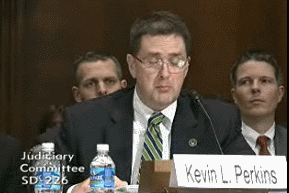
Kevin L. Perkins of the FBI tells the Senate Judiciary Committee that the agency is investigating 1,500 cases of securities fraud and that 314 of them involve HYIP fraud in various forms.
And to think that only months ago — in February 2009 — various members of AdSurfDaily wrote to the Senate Judiciary Committee trying to elicit support for Ponzi schemes. The letter-writing campaign was spearheaded by “Professor” Patrick Moriarty and pushed by the Pro-AdSurfDaily Surf’s Up forum.
But now the FBI has told the committee, led by Sen. Patrick Leahy, D.-Vermont, that it has registered a 105 percent increase in HYIP fraud and opened 314 investigations in 2009, up from 154 in 2008.
“[M]any [had] losses exceeding $100 million,” said Kevin L. Perkins, assistant director of the FBI’s Criminal Investigations Division.
Perkins said the probes cover the gamut — from the massive Ponzi scheme fraud of Bernard Madoff to smaller variations of the Ponzi scheme.
“These schemes use money collected from new victims, rather than profits from an underlying business venture, to pay the high rates of return promised to earlier investors,” Perkins told the Committee. “This arrangement gives investors the impression there is a legitimate, money-making enterprise behind the fraudster’s story; but in reality, unwitting investors are the only source of funding.”
During his testimony, Perkins also referenced “prime-bank schemes” in which victims are told that “certain financial instruments such as notes, letters of credit, debentures, or guarantees have been issued by well-known institutions such as the World Bank, and offer a risk-free opportunity with high rates of return.”
In August 2008, in a forfeiture complaint against the assets of AdSurfDaily and Golden Panda Ad Builder, federal prosecutors revealed that Golden Panda President Clarence Busby had been sued civilly by the SEC in the 1990s after he was implicated in three prime-bank schemes. At the same time, prosecutors revealed ASD President Andy Bowdoin had been arrested for felony securities fraud in Alabama during the same decade.
Despite the Ponzi allegations against ASD and the histories of Bowdoin and Busby, Surf’s Up urged the Judiciary Committee to investigate the prosecutors who brought the forfeiture cases against ASD and Golden Panda in August 2008.
“We each need to explain [to Leahy] how thousands of innocent Americans have suffered and continue to suffer because of these incredible and despicable acts” by prosecutors, Surf’s Up urged members.
Law enforcement is investigating a stunning number of securities-fraud cases, the FBI revealed.
“The FBI continues to aggressively investigate this criminal threat, and currently has more than 1,500 related securities fraud investigations,” Perkins said.
Reporters prepare for news conference last month in the Gerard Cellette Ponzi case.
Gerard Frank Cellette Jr. was implicated by prosecutors in an alleged $53 million Ponzi scheme in Minnesota last month.
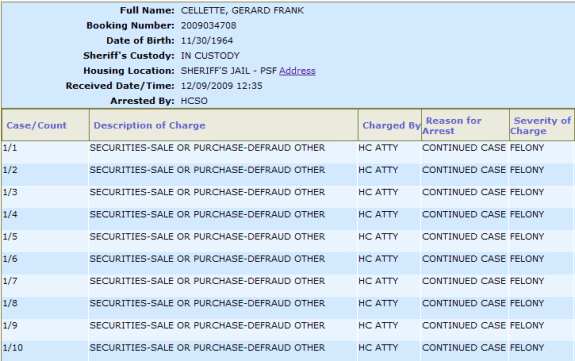
Cellette, 44, of Andover, Minn., asked a judge to jail him yesterday — and the judge granted his wish. Cellette now is Inmate No. 2009034708 in the Hennepin County Sheriff’s Jail. He was charged Nov. 5 with 36 felony counts of fraud in the offer and sale of securities.
The charges were brought by Hennepin County Attorney Mike Freeman. Cellette technically is jailed awaiting trial, but a trial may not occur because he is helping prosecutors unravel his own scheme.
Ponzi schemes are plaguing Minnesota. AdSurfDaily, an alleged $100 million Ponzi scheme operating from Florida, was popular in the state in 2008. Three weeks ago the SEC and the CFTC accused two Minnesota residents — Christian radio host Pat Kiley and money manager Trevor Cook — of operating a $190 million Ponzi scheme involving foreign currency trading.
Cook was said to have bought a private island in Canada with some of his loot — along with a submarine to access the island. Cook took the 5th Amendment at a proceeding last week.
Meanwhile, a jury in Minnesota returned a guilty verdict last week against Minnesota businessman Tom Petters in a $3.65 billion Ponzi scheme.
The early speculation in Minnesota is that Cellette knows he is going to serve time for his Ponzi scheme — so he might as well start serving it early and spare taxpayers the bill for a trial.
Ten of the 36 felony securities counts against Gerard Frank Cellette Jr. in Minnesota.
 A federal judge has issued an order that enjoins Speed of Wealth principal Donna McKelvy from breaking securities laws and disgorges her ill-gotten gains from the alleged Mantria Corp./Speed of Wealth Ponzi scheme.