Author: PatrickPretty.com

  • Madoff Confessed Ponzi Scheme Year Ago Today; AdViewGlobal Prepared Ponzi Roll-Out Even As Stunned Public Watched Madoff Spectacle Unfold

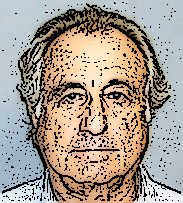
    Bernard Madoff
    Bernard Madoff

    One year ago today Bernard Madoff uttered a memorable phrase, describing his securities business economically as “one big lie” — and his Ponzi house of cards came tumbling down.

    Even as Madoff was uttering those three words to his sons and the FBI soon was to knock on his door, the insiders behind the AdViewGlobal (AVG) autosurf were busy putting together and getting ready to promote their own Ponzi scheme. For many, it would be their second — and they’d be greasing the wheels of their new Ponzi even as virtually the entire world was jeering Madoff and New Yorkers were demanding justice on the streets.

    Hundreds and hundreds of AVG promoters appear to have been slow on the Ponzi uptake, ignoring the lesson of instant villainy the Madoff case provided and seriously misreading their ability to repackage a Ponzi scheme and sell it all over again.

    Madoff was arrested Dec. 11, within 24 hours of confessing “one big lie.”  His arrest amid allegations of a $50 billion Ponzi fraud created a media spectacle. The crime was unimaginably huge. In the hours and days that followed, personal, corporate and charitable fortunes collapsed. The word “Ponzi”  instantly became associated with greed, criminality and reprehensible acts, and was burned into the public consciousness like never before.

    One place it was not used was the Unemployable Hobo Lifestyle Forum. There is a mention of the soon-to-launch AVG dated Dec. 13, 2008, two days after the arrest of Madoff, but no simultaneous reference to Madoff or the word “Ponzi.”

    “Call me if you [don’t] have [a] leader,” said Mark Simmons, the head of the forum and a witness in the Ponzi scheme case involving AdSurfDaily, a company with close ties to AVG. The headline of the thread was, “for those waiting on ADVIEWGLOBAL.”

    In the autosurf Ponzi business, the word “leader” is used to describe the people who make the most money by lining up sheep and leading them to the slaughter. In the months prior to the launch of AVG, the “leaders” had led sheep to the slaughter in ASD, Golden Panda Ad Builder, LaFuenteDinero (the “fountain of money”), MegaLido, Instant2U, Frogress, DailyProfitPond, AdGateWorld, BizAdSplash and Noobing, among others.

    The leaders still are leading the sheep to slaughter on various HYIP and autosurf Ponzi forums — even with Madoff serving a prison sentence of 150 years. They get paid a commission of 10 percent or more for leading people to the slaughter.

    Another reference to AVG appeared on Simmons’ forum Dec. 18, exactly a week after Madoff’s arrest. Some autosurf critics say the leaders are “out of touch.” Others use less-generous phrases to describe them, painting the “leaders” as the purveyors of “Kool-Aid” for consumption by the sheep.

    Some of the sheep sign up to be slaughtered over and over again. They’re sometimes also known as the “Stepfords.”

    “Our specific [AVG] group will have some additional perks that will not be tied to this and will allow you to grow exponentially and outpace everyone,” Simmons said Dec. 18 on his forum. The headline of the thread was, “STAY TUNED FOR ADVIEWGLOBAL.”

    Simmons was a former member of the AdSurfDaily autosurf, which was caught up in pre-Madoff allegations that it was a $100 million Ponzi scheme. The ASD allegations were made in August 2008, about four months before Madoff’s name and “Ponzi scheme” became household words. Simmons’ name was on ASD’s witness list for an evidentiary hearing held Sept. 30-Oct. 1, 2008.

    He never was called to the stand. U.S. District Judge Rosemary Collyer ruled Nov. 19, 2008, that ASD had not demonstrated it was a lawful business and not a Ponzi scheme. ASD had operated from the United States. Within days of the devastating ruling against ASD, word began to spread that AVG would launch and become a sort of ASD2 — only operating “offshore” from Uruguay and out the reach of U.S. authorities

    Collyer is apt to remember the ASD case for many reasons. The key ruling she made against ASD was issued on her 63rd birthday, for example.

    In the months that followed, Collyer would hear from dozens of pro se litigants who appeared to be arguing in favor of a presumptive right to operate or participate in a Ponzi scheme with no interference by the government.

    AVG’s formal launch occurred in February 2009, less than two months after the Dec. 13 reference on Simmons’ forum, less than two months after the spectacular Ponzi allegations against Madoff surfaced.

    But the autosurf’s days of having a tin ear for news and PR were far from over. Indeed, the surf that launched in the midst of the public hue and cry over Madoff’s Ponzi scheme and in the wake of Ponzi and racketeering allegations against ASD, went on to demonstrate for all time that it considered greed a virtue.

    On May 4, the same day the Obama administration announced a crackdown on offshore fraud carried out by Americans, AVG announced it had acquired a new offshore wire facility to replace one lost in March.

    “I’m asking Congress to pass some commonsense [antifraud] measures,” Obama told the American people at 11:37 a.m. on May 4.  At 5:44 p.m., a member of an AVG forum operated by some of the Mods and members of the Pro-AdSurfDaily Surf’s Up forum announced the new offshore wire facility.

    AVG collapsed less than two months later, on June 24. Five days later, on June 29, Madoff was sentenced to 150 years in prison. One day after that, on June 30, AVG’s name was mentioned in a racketeering lawsuit filed against ASD President Andy Bowdoin and ASD attorney Robert Garner.

    Some of the autosurf leaders are still leading on Internet forums, but Simmons’ Unemployable Hobo forum appears not to have had an update on any online program since September

  • AdViewGlobal Recording Suggests Member Cashed Out $10,000 Only Days After Formal Launch And That Insiders Were Awarded Bonuses; Less Than Two Weeks Later, Surf Switched To ‘Private Association’ Structure

    breakingnewsUPDATED 7:19 P.M. ET (U.S.A.) A recording posted on a public website of a Feb. 12 conference call by the AdViewGlobal (AVG) autosurf suggests an unnamed male member of the surf qualified for a $10,000 cashout within days of the company’s formal launch.

    The recording leads to questions about how a participant could qualify for a large payout so soon after launch and whether others also could have benefited from early cashouts funded by members in Ponzi scheme fashion. AVG appears to have had virtually no income streams beyond fees paid by members when it launched earlier in the month.

    AVG suspended cashouts in June, threatening media outlets and members who shared the news with lawsuits and blaming its problems on the greed of members. It later said it had been a victim of a $2.7 million theft and filed reports about the theft with law-enforcement agencies.

    The Feb. 12 call featured a giveaway of money-earning AVG page impressions to both members and their sponsors. One of the bonus-winning sponsors was identified as David Meade, whose bonus-winning enrollee came on the line and jokingly asked whether the bonus he received qualified for an additional matching bonus of 50 percent.

    AVG relentlessly pitched bonuses to enrollees and their sponsors before announcing in June that it was suspending cashouts, making an 80/20 program mandatory and exercising its version of a “rebates aren’t guaranteed” clause.

    Another sponsor who qualified for a bonus because he had enrolled a member whose name was called for a bonus was identified as Larry Alford, the husband of Barb Alford, a Moderator at the Pro-AdSurfDaily Surf’s Up forum. Yet another member whose name was called for a bonus was Joey Shiver, the brother of Judy Harris, identified during the summer as one of AVG’s owners.

    Meanwhile, the call highlighted AVG’s purported “offshore” location in Uruguay, stressing that the company planned to fly high-quality servers to Uruguay on a date uncertain after the call was held.

    Web records show AVG’s servers resolved to Panama, suggesting the company never completed installation of servers in Uruguay. AVG had been collecting money for weeks at the time of the Feb. 12 call, which leads to questions about whether the company was selling unregistered securities from inside the United States or selling unregistered securities illegally to U.S. residents from offshore servers, all while engaging in wire fraud and acts of money-laundering.

    The conference call, hosted by Terralynn Hoy, a Moderator at both the Pro-AdSurfDaily Surf’s Up forum and a ning.com forum set up to promote AVG, did not disclose how the member amassed a large sum in only days and qualified for a cashout. But another participant in the call announced that the man excitedly expected to receive a check for $10,000.

    Neither Hoy nor any other AVG official or representative who participated in the call referenced a racketeering lawsuit that had been filed less than a month earlier against ASD President Andy Bowdoin and ASD attorney Robert Garner. At the same time, no official or representative in the call referenced a second forfeiture complaint that had been filed against ASD-connected assets in December 2008, a month after Surf’s Up received ASD’s official endorsement.

    In August 2008, prosecutors accused both ASD and Golden Panda Ad Builder of not disclosing information members needed to make informed decisions about joining the companies. The allegations were spelled out in a forfeiture complaint formally filed Aug. 5, 2008.

    Among the assertions were that Bowdoin did not disclose his arrest in a felony securities case in the 1990s, and that Golden Panda did not immediately disclose an SEC action against its president, Clarence Busby, in the 1990s. ASD members later said Bowdoin was the silent head of AVG, which began to solicit money in December 2008, a month after a major court ruling went against ASD.

    News about the December forfeiture complaint, which painted a jaw-dropping picture of insider dealings, special favors, a “silent” ASD partner, people getting paid large sums for doing virtually nothing and a claim that Russian hackers stole more than $1 million, broke on Jan. 15.

    The AVG conference call, dubbed the “first” official call, was conducted Feb. 12, about 10 days after AVG’s formal launch and within 30 days of the revelation that the government had filed the December forfeiture complaint and identified members of Bowdoin’s family as beneficiaries of ASD’s illegal conduct.

    Judy Harris was among those the government identified in the filing, as were her husband, George Harris, and his mother, Edna Faye Bowdoin. Edna Faye Bowdoin is Andy Bowdoin’s wife.

    Two weeks after the Feb. 12 conference call, on Feb. 26, AVG announced it was shifting to a “private association” structure. One day prior, on Feb. 25, Bowdoin signed the first of several sworn court documents as a pro se litigant in the ASD case, attempting to set aside the forfeiture of tens of millions of dollars and reverse a decision he made in January to surrender his claims to the money, which had been seized by the government in August 2008 from his 10 bank accounts.

    Less than a month after Bowdoin signed the court document, AVG announced the resignation of Chief Executive Officer Gary Talbert, a former ASD executive. On March 23, AVG announced its bank account had been suspended, blaming the suspension on members who wired too many transactions in excess of $9,500.

    Talbert was a participant in the Feb. 12 conference call. He was introduced by Hoy. Talbert, in turn, passed the the call back to Hoy, who then introduced a person identified as marketing consultant Kathy Robertson. Robertson made the claim about the $10,000 check.

    “I just talked to a friend tonight,” Robertson said in the call. “He’s cashing out and he’s gonna get a $10,000 check into his bank account. He’s more excited than he’s ever been.”

    Robertson urged AVG members to take notes of her remarks, according to the recording.

    “Many of you have wondered, ‘Are we a United States’ business or are we another country[‘s] business?’” Robertson said in the recording. “I gotta tell you we’re based in Uruguay. We’re definitely an offshore business, and we’ll be moving very robust servers — we’ll actually be flying them on a plane to land in Uruguay. So, even the servers that host all of the websites are going to be offshore, so go ahead and write that down as a note. We are truly an offshore business.”

    Robertson said AVG members should “feel secure” in the knowledge the company was operating offshore. She did not explain how the purported offshore venue made AVG’s venture, which targeted U.S. residents and former ASD members, legal. Robertson acknowledged in the recording that AVG had gotten off to a rocky start and that some members who could not fund accounts had had a disappointing experience.

    But she urged members to look to the future and see a well-honed enterprise capable of producing a seamless experience for huge numbers of participants.

    Federal prosecutors said ASD was operating a $100 million Ponzi scheme from inside the United States, while engaging in the sale of unregistered securities to U.S. residents and committing acts of wire fraud and money-laundering.

    Later in the call, during the page-impression giveaway, Meade came on the line to accept his bonus for sponsoring a member whose name was called for a bonus.

    “Thanks a million. Appreciate it,” Meade said.

    Less than two weeks after the Feb. 12 conference call, reports circulated among ASD members that the U.S. Secret Service had seized the bank accounts of unidentified ASD members. AVG announced Feb. 26 that it was switching to a “private association” structure after consulting with a company known as Pro Advocate Group.

    Pro Advocate Group is associated with Karl Dahlstrom, a convicted felon who served time in federal prison in a case involving securities fraud.

    Listen to the recording.

  • INTRIGUE: Is Our ‘joe’ The Surf’s Up ‘joe?’ Egg-Themed HYIP Pitch Leads To Questions As ASD Members Continue To Promote Programs Associated With Ponzi Model

    UPDATED 5:24 P.M. ET (U.S.A.) Is the “joe” who posted here before being blocked for showcasing an utter lack of restraint the same “joe” who pitched four HYIPs on the Pro-AdSurfDaily Surf’s Up forum two days ago?

    We don’t know.

    We do know, however, that both “joes” have pushed Ponzi programs and displayed an astonishing and unsettling amount of gumption. The Surf’s Up “joe,” for instance, used egg-themed, .info URLs that redirected to HYIPs, despite the fact state or federal prosecutors have brought racketeering charges against three alleged Ponzi schemes this week alone and ASD President Andy Bowdoin and ASD attorney Robert Garner have been sued by members for racketeering.

    Meanwhile, our “joe” — who as recently as three days ago still was pelting us with nuisance communications under multiple identities even after his access to posting here was blocked in September and he was warned publicly to cease — insisted we’d restore his posting privileges or else. He then embarked on a smear campaign against this Blog on Scam.com, using multiple posting identities there, too.

    Scam.com banned our “joe,” who has purported to have been a Prisoner of War in Vietnam, to have served harder time than the late Mafia figure John Gotti — and also to have been a graduate of MIT, whose curriculum is heavy on mathematics.

    Our “joe” hurt himself with the MIT claim. It’s highly unlikely that any MIT graduate could leave the campus without a core understanding of the math of Ponzi schemes. In the unlikely event “joe” did graduate from MIT, he’d be hard-pressed to explain to prosecutors he didn’t understand he was promoting illegal programs such as AdViewGlobal and AdVentures4U.

    He’d be equally hard-pressed to explain to POWs how pushing Ponzi schemes, which nowadays are getting widespread, constant publicity for the massive damage they cause, was a noble pursuit.

    Our “joe’s” most recent effort to stalk this Blog occurred Dec. 2, under yet another user identity. He used the wires to tell us that he’d be paying attention to our reports about the notorious cyberstalker “unclefesta26,” who is pillorying this Blog on YouTube and also stalking people who post here by publishing videos about them on YouTube.

    “By the way I can make excellent videos and have,” our “joe” suggestively told us Wednesday over the Internet. “Ole Festa doesn’t hold a candle to me.” Our “joe” called himself “Jake” in Wednesday’s reminder he was stalking us.

    “joe” has sent us dozens of illegitimate communications designed to harass since September. “joe leaves when joe wants to leave,” he said as the U.S. summer was beginning to transition into fall.

    ”You’ll be scrambling to put out fires,” our “joe” promised.

    “joe” no more has the right to do what he tries to do here than he does, say, to keep messaging his hometown newspaper with harassing communications (or any business) after being warned to cease and desist.

    Another thing we noticed about our “joe” during the summer was that he was sensitive to the word “racketeering” and the acronym RICO. He railed against this Blog in June, after it reported that the AdViewGlobal (AVG) autosurf had been mentioned in a racketeering lawsuit against Andy Bowdoin of AdSurfDaily. Indeed, some ASD members sued Bowdoin for racketeering. (See the comments in the thread for the link above.)

    Federal prosecutors later made a veiled reference to AVG in court filings in the ASD forfeiture case. Both the August 2008 and December 2008 forfeiture filings against ASD cite a racketeering statute in the body of the complaints. Regardless, plenty of ASD members went on to promote AVG, which formally launched in February 2009 — after two racketeering mentions in forfeiture complaints and after Bowdoin was sued by members for racketeering.

    Jaws dropped among people who pay attention to such things. The purveyors of AVG might as well have taken out an ad in the New York Times that read, “Yes, we are racketeers — and here’s how you, too, can harvest hefty profits from our racketeering scheme, especially if you belong to a Christian denomination!!”

    It’s clear that law-enforcement agencies with the power of arrest — the U.S. Secret Service, the FBI and state-level strike forces led by attorneys general and local prosecutors and police officers, for example — have had it up to their ears with Ponzi and affinity-fraud schemes and are treating purveyors like mobsters. They’re using both state and federal racketeering statutes to bring down the schemes.

    It’s also clear that the SEC, which does not have the power of arrest but can sue Ponzi scheme operators back to the Stone Age and works proactively with agencies that do have the power of arrest — also has had its fill of Ponzi and affinity-fraud schemes.

    How could it not? There now are allegations that Trevor Cook, implicated with Christian radio host Pat Kiley in an alleged $190 million Ponzi scheme in Minnesota, bought a private island in Canada with his loot and a submarine to access the island. Cook reportedly told his investors he discovered after purchasing the submersible craft on eBay that the waters surrounding the island were too dark to navigate by submarine, but that he planned to move his two-passenger sub to Panama, a country be believed to have clear waters.

    You can’t make this stuff up. It is an embarrassment to free enterprise, an embarrassment to the United States and the rest of the world. The word “Ponzi” has become positively nuclear as more and more senior citizens in their 80s have been fleeced out of their retirements by schemers and go to bed at night wondering how they’ll ever make ends meet.

    Basically, the U.S. law-enforcement and regulatory communities have been responding to the schemers’ crimes with nukes. Rarely a day passes without a detonation.

    Despite major undertakings by U.S. law-enforcement and regulatory entities such as the SEC, CFTC and state-level attorneys general and securities regulators to destroy Ponzi schemes — and despite racketeering, wire-fraud and money-laundering prosecutions — the “joes” of the Ponzi world apparently continue to believe there is something honorable about banking Ponzi profits earned while banks are failing in the United States, the foreclosure rate is surging in certain areas of the country, people of faith are being fleeced in Ponzi schemes, deaf people are being targeted in Ponzi schemes and 90-year-old men and women are looking for jobs to keep a roof over their heads.

    We don’t know if our “joe” is Surf’s Up’s “joe” — but we do know that “joe” is all about greed and the wanton disregard of the rules of a civilized society.

    Fact is, we did scramble to put out the fires promised by our “joe.” He did affect our ability to publish and asserted a nonexistent right to harass.

    joe“What I’m saying is get ready for the return of joe and then you can block all of these people from your site,” our “joe” said.

    He suggested that, although he is Uncle Festa’s superior in video production, he won’t use YouTube to harass this Blog or its readers.

    It’s our “joe’s” way: He dangles a suggestion, and then wraps it in words designed to create plausible deniability. It escapes him that the words alone constitute a crime because they are designed to chill recipients and put them in the position of scrambling to protect their property.

    That’s exactly what racketeers do. They suggest. They chill. They let you know there are consequences for not playing ball with them.

    “It would be fun [to make videos] but I don’t hate you like [Uncle Festa] does,” our “joe” said three days ago. “[I]n fact i don’t hate you at all. I’ll bet everyone misses me.”

    In a final bit of intrigue, it’s possible that the “joe” on Surf’s Up comes from Erie, Pa. That would be ironic indeed if it proved to be true. Erie is the birthplace of Harry Markopolos, the mathematician and financial analyst who exposed the $65 billion Ponzi scheme of Bernard Madoff.

    Erie has some fine high schools.  Harry Markopolos was a graduate of one of them and went on to become a world-class student of math and authority on Ponzi schemes. The Surf’s Up ” joe,” on the other hand, perhaps left Erie schools and went on to become  a cell-phone trafficker facing a $5 million judgment — and a purveyor of Ponzi schemes who said it was important not to have all of your Ponzi eggs in one Ponzi basket, that you should branch out into other Ponzi schemes.

    “ALL MY EGGS ARE NOT IN ONE BASKET,” the Surf’s Up ‘joe said. “I MAKE $2000.00 A WEEK.”

    And the Surf’s Up “joe” said it after Erie’s Harry Markopolos made the phrase “Ponzi scheme” impossible to ignore and kick-started the nuclear responses of the state and federal governments to those who would sell financial peril so they could own a Rolls-Royce or a submarine — or even make $2,000 a week on the Ponzi misery of others.

  • ‘Egg’-Themed HYIP Domains Pitched By Surf’s Up Poster Registered In Last Name Of Man Dubbed A ‘Co-Conspirator’ In Scheme To Defraud Prepaid Wireless Company; Government Of Belize Issued Warning About HYIP Site

    UPDATED 2:22 P.M. ET (U.S.A.) A poster using the handle “joe” at the Pro-AdSurfDaily Surf’s Up forum advertised four egg-themed domain names that redirected to four high-yield investment programs yesterday, saying in all-caps, “ALL MY EGGS ARE NOT IN ONE BASKET.

    “I MAKE $2000.00 A WEEK.”

    It is unclear if the poster has a license to sell securities or act as an investment dealer or broker. The domains to which the .info domains redirected were for programs titled “Gold Nugget Invest” (7.5 percent a week); “Genius Funds” (6.5 percent a week); “Cash Tanker” (2 percent a day); and “Saza Investments” (9 percent a week).

    The domains — all of which used .info extensions, the word “egg” and a numeral in their URLs — are registered to a man with the last name of  “Stablein” in Erie, Pa. The spelling of the owner’s first name in domain-registration data was “Jeffrery.”

    An Erie man named “Jeffrey Stablein” — note the slightly different spelling of the first name from the domain-registration data — was sued in U.S. District Court for the Western District of Pennsylvania in June and identified by attorneys as a co-conspirator in a scheme to defraud TracFone Wireless Inc., a prepaid cell-phone provider.

    The Erie street address associated with Stablein in the TracFone lawsuit is the same address listed in registration data for the egg-themed .info domains. Stablein was enjoined by a federal judge from a practice TracFone attorneys described as “cell-phone trafficking.”

    Cell-phone trafficking involves the “unauthorized resale and hacking” of prepaid mobile phones, TracFone attorneys said. Future violations by Stablein could result in a $5 million judgment being enforced against Stablein, according to court filings.

    Attorneys described how the scheme works after a buyer acquires prepaid phones in volume.

    “The phones are then passed to middlemen who alter or remove the prepaid software and resell the altered phones as new, often in counterfeit packaging, at a significant profit to unsuspecting customers domestically and abroad in Latin America, Asia and the Middle East,” according to attorneys James B. Baldinger and Steven J. Brodie of the Carlton Fields law firm.

    In September, U.S. District Judge Sean J. McLaughlin handed down a stipulated judgment against Stablein and his Erie-based firm, 1st Premier Communications, banning them “from continuing to engage in the bulk purchase, sale, or unlocking/reflashing of TracFone’s wireless phones,” the attorneys said in a news release.

    TracFone aggressively litigates against cell-phone traffickers, according to the company.

    In 2008, Muhammad Mubashir, 28, of Sugar Land, Tex., was sentenced to 57 months in federal prison for trafficking in cell phones.

    “TracFone will continue to aggressively pursue those who participate in prepaid mobile phone trafficking because it undermines our ability to provide affordable wireless phone service to our customers,” said F.J. Pollak, president and CEO of TracFone Wireless, in a statement.

    The U.S. Customs Service seized a shipment of 1,300 TracFones that Mubashir was exporting to a known trafficker in Hong Kong, the company said. TracFone obtained documents proving Mubashir sold approximately 9,000 TracFones, representing more than $1 million in losses to the company.

    “Schemes like those organized by Mubashir exist across the country and involve groups of ‘runners’ who purchase prepaid mobile phones from major retail outlets,” TracFone said. “The phones are then passed to middlemen who alter or remove the prepaid software and resell the altered phones as ‘new,’ often in counterfeit packaging, at a significant profit to unsuspecting customers domestically and abroad in Latin America, Asia and the Middle East.”

    Some Surf’s Up posters criticized the post by “joe,” saying it was in poor taste given the serious allegations against AdSurfDaily. Tens of millions of dollars were seized from ASD President Andy Bowdoin in August 2008, amid allegations of selling unregistered securities and operating a $100 million Ponzi scheme.

    Despite the allegations, some Surf’s Up posters continued to pitch autosurfs and HYIP programs, often using phrases such as “offshore” or “I got paid” as evidence of legitimacy.

    One Surf’s Up poster agreed with “joe” that the programs he advertised by using the egg-themed URLs that redirected to HYIP sites were excellent.

    “Your intentions are good but you are dead wrong about those particular four programs!” a Surf’s Up member exclaimed in a post directed at a member who had been critical of “joe’s” post advertising the HYIP programs.

    “I also make a lot of money from those four and your remarks tell me you don’t know anything about them…..they are very reputable [companies] who have been around for years….and the money is NOT made from ‘new’ people’s money….google them and look at various forums and see what others have to say about them….I don’t even know Joe, but I can vouch for the programs!”

    The government of Belize issued a warning Nov. 12 about the Gold Nugget Invest HYIP advertised by “joe” on Surf’s Up.

    Surf’s Up eventually deleted “joe’s” egg-themed HYIP thread.

    It is not clear if “joe” is Jeffrey Stablein, but the stipulated judgment entry in the TracFone case includes Stablein’s signature and the same address used in the domain-registration data for the egg-themed HYIP domains.

    Read the lawsuit against Stablein.

    Read a document that shows that a Stablein street address in the lawsuit is the same Erie address used in the domain registration data for the egg-themed HYIP domains.

  • Michigan Woman Charged With Racketeering In Alleged Real-Estate Ponzi Scheme; Rita Gosselin Arrested, Jailed Early This Morning In Greater Detroit

    Rita Gosselin: Source: Michigan AG Office
    Rita Gosselin: Source: Michigan AG Office

    Just hours after news broke of a racketeering indictment by Colorado prosecutors against a Denver-area man in an alleged Ponzi scheme, Michigan prosecutors announced the racketeering indictment of a Greater Detroit woman in what was described as a real-estate Ponzi scheme.

    In the past two days, prosecutors from different agencies in different regions of the United States have announced three major Ponzi indictments brought under state or federal racketeering statutes.

    On Tuesday,the FBI arrested former Fort Lauderdale attorney Scott Rothstein, 47, on federal racketeering charges in Florida.

    Yesterday, Mark J. Jackson, 55, was indicted on state racketeering charges in Colorado by Denver District Attorney Mitchell Morrissey.

    Early this morning Rita Gosselin of Grosse Ile, Mich., was arrested by investigators from the Southgate Police Department and the office of Michigan Attorney General Mike Cox.

    Gosselin, 58, was charged under Michigan law with one count of continuing criminal enterprise (racketeering), and three counts of false pretenses over $20,000. In unrelated cases, Michigan prosecutors brought racketeering charges against Michael J. Morris and William T. Perkins in October in an alleged fraud scheme that targeted churches.

    Bail for Gosselin was set at $300,000 cash. She was unable to post it, and was taken to the Wayne County Jail. A hearing for Gosselin is scheduled Dec. 15.

    “Taking advantage of Michigan families, especially in today’s economy, will not be tolerated,” said Cox.

    Prosecutors said Gosselin was at the helm of a Ponzi scheme “involving fraudulent real estate investments and stealing hundreds of thousands of dollars from Michigan families.”

    To pull off the scheme, prosecutors said, Gosselin “enticed investors with claims she was able to purchase foreclosed and distressed properties in bulk and renovate the homes to sell at a profit.”

    Investors were given promissory notes and promised regular returns on the money they entrusted to Gosselin.

    “Few investors received any of the payments promised and all lost some, if not all the money they invested,” prosecutors said.

    The alleged scheme fleeced at least 20 investors out of at least $500,000, prosecutors said.

  • RECOMMENDED READING: ‘Speed Of Wealth’ Defendant In Ponzi Scheme Case Pounds Denver Reporter With Offers To Join Trump Network, Other Opportunities

    EDITOR’S NOTE: The story below references a column by Renee McGaw in the Denver Business Journal. Make sure you read the column. The link is at the bottom of this story.

    The column reminded us of what occurred in the opening hours of the prosecution against the assets of Florida-based AdSurfDaily Inc., accused in August 2008 of operating a $100 million Ponzi scheme. Reporters who called ASD got a recording featuring the voice of ASD President Andy Bowdoin and intoning that God was on the company’s side.

    Within hours, Bowdoin’s supporters were complaining on Internet forums that the media refused to take ASD’s side of the story seriously.  Rather than questioning why the media might find such a recording important enough to mention in stories, Bowdoin’s apologists then sought to discredit reporters by casting them as conspirators in a plot to defame Bowdoin and to discredit members of law enforcment by painting the government as “evil.” The attack even featured a campaign to have a Florida television station and Florida Attorney General Bill McCollum charged with Deceptive Trade Practices for daring to raise the issue of the legitimacy of ASD.

    McGaw’s column on a Colorado company, Speed of Wealth LLC, is remarkable in a number of ways, perhaps principally in the sense that it shines a light on relentless email pitches to join online money-making “opportunities.” Not even serious Ponzi scheme allegations against Speed of Wealth principal Wayde McKelvy prevented McGaw from receiving pitches for other programs from him. The column leaves us with this question: Is it any wonder that much of America and the world views Internet Marketing as a vast wasteland filled with fraudsters and schemers?

    On a side note, readers of the PatrickPretty.com Blog occasionally have chided us about our view that exclamation points should be used like garlic — sparingly. We’ve enjoyed the banter on the topic. McGaw’s column also raises the issue of exclamation points in marketing pitches.

    Here, now, the story . . .

    Denver Business Journal reporter Renee McGaw says she is being pounded with offers from Wayde McKelvy, a defendant in a Ponzi scheme lawsuit filed by the SEC last month.

    McKelvy’s Colorado firm, Speed of Wealth LLC, was accused by the SEC of pitching a “green” Ponzi scheme for Mantria Corp. of Pennsylvania. The names of President Obama, former President Clinton and Secretary of State Hillary Clinton were prominently featured in a Mantria video that played on the Speed of Wealth website. The video, now missing from the site, was based on events that occurred in September at the annual meeting of the Clinton Global Initiative (CGI), one of President Clinton’s signature undertakings after he left the White House in January 2001.

    McKelvy describes himself as a wealth coach — and not even the assertion he was part of a $30 million fraud has slowed him down, McGaw reports.

    In a column yesterday, McGaw said she sent McKelvy an email Nov. 16 to inquire about the SEC allegations. (The SEC had brought the allegations earlier on the same day.) McGaw’s email to McKelvy triggered what she described as automated pitches describing her as a “fellow Wealthalete” and urging her to join money-making programs.

    “I am totally focused on one thing right now which I believe will be very, very fun and the opportunity to put money in your pocket by owning you’re own business with the help of ‘The Donald’,” McGaw quoted McKelvy as writing in an email Nov. 18, two days after the SEC filed civil charges against McKelvy, his former wife, and Mantria officers Troy Wragg and Amanda Knorr.

    The columnist noted she did not correct McKelvy’s spelling or punctuation when reproducing the email for readers of the Denver Business Journal.

    “Yes, I am talking about the ‘Trump Network,’” McKelvy stressed to McGaw.

    McGaw reported that McKelvy’s pitches often featured subject lines consisting of all capital letters and ending with exclamation points.

    “YOU MUST START YOUR OWN BUSINESS Renee!” McKelvy advised McGaw in one email. “What You Have Been Taught About Building Wealth is DEAD WRONG!”

    Through the Mantria video, Speed of Wealth also dropped the names of former U.N. Secretary General Kofi Annan, President Laurent Gbagbo of the Ivory Coast, Mike Duke, CEO of Wal-Mart, Muhtar Kent, CEO of the Coca-Cola Co. and actor Matt Damon.

    All of the individuals were among the prominent attendees of President Clinton’s CGI function. The video featured footage of Wragg appearing on stage next to Clinton.

    Mantria was a “supposed ‘carbon negative’ housing community in rural Tennessee,” the SEC said.

    Screen shot: Troy Wragg, whom the SEC said today was a manager at a janitorial company before becoming CEO of Mantria Corp., next to President Clinton at the annual meeting on the Clinton Global Initiative in New York on Sept. 25.
    Screen shot: Troy Wragg, whom the SEC said was a manager at a janitorial company before becoming CEO of Mantria Corp., next to President Clinton at the annual meeting on the Clinton Global Initiative in New York on Sept. 25.

    But the “green” representations “were laced with bogus claims, and investors were falsely promised enormous returns on their investments ranging from 17 percent to ‘hundreds of percent’ annually,” the SEC said.

    The agency charged that “Mantria’s environmental initiatives have not generated any significant cash, and any returns paid to investors have been funded almost exclusively from other investors’ contributions.”

    “These promoters fraudulently exaggerated Mantria’s green initiatives and used high-pressure tactics to convince investors to chase the promise of lucrative returns,” said Don Hoerl, director of the SEC’s Denver Regional Office. “In reality, the only green these promoters seemed interested in was investors’ money.”

    Read McGaw’s column in the Denver Business Journal.

  • Racketeering Alleged In 14-Year-Old Denver Ponzi Scheme; Mark J. Jackson Indicted Under State Law By Local Prosecutor

    ponziblotterThink the Feds are the only thing to worry about if you’re in the Ponzi scheme business? Think again.

    In yet another prosecution that demonstrates Ponzi schemers have more to fear than federal agencies such as the SEC, the CFTC, the FBI, the Secret Service, the IRS and the Postal Inspection Service, a Colorado man has been indicted by a local prosecutor under state racketeering, securities, theft and forgery laws.

    Mark J. Jackson was sued civilly in April by Colorado Securities Commissioner Fred J. Joseph and Colorado Attorney General John W. Suthers. An order prohibiting the destruction of records was entered, and a receiver was appointed. The receiver now is suing Jackson’s father, Ted Jackson, amid allegations that the elder Jackson was a partner in the scheme and was unjustly enriched.

    Denver District Attorney Mitchell Morrissey, a local prosecutor, opened a criminal probe, with the assistance of the Colorado Division of Securities. That local and state investigation resulted in the criminal indictment against Mark Jackson.

    Mark Jackson, 55, was charged with 59 felony counts, including a single count of violating the Colorado Organized Crime Control Act and, as part of the racketeering scheme, 11 counts of securities fraud, 17 counts of theft and 30 counts of forgery.

    “[B]eginning in 1995 Jackson portrayed himself as a successful day trader and took money from investors with promises of returns from 12 to 36 percent,” prosecutors said. “[I]nstead of investing the money, Jackson used it to pay other investors and also used investor money for his personal benefit.”

    At the same time, prosecutors said, “Jackson prepared phony profit and loss statements and other documents with false statements.”

    Victims sustained losses “estimated to be in the millions of dollars,” prosecutors said. Court documents suggest the alleged scheme involves more than $41 million.

    Jackson is expected to surrender this week. Morrissey’s Economic Crime Unit is spearheading the probe.

    Individual investors also are suing Jackson.

  • REPORT: Former SEC Supervisor Aided Arizona ‘Numerologist’ Running A Ponzi Scheme; SEC Employee In Separate Case Probed For Threatening Boss, Bringing Weapons To Work

    H. David Kotz, SEC Inspector General
    H. David Kotz, SEC Inspector General

    A former supervisor with the Securities and Exchange Commission unwittingly aided a man accused of operating a Ponzi scheme in Arizona, according to a report by SEC Inspector General H. David Kotz.

    Meanwhile, Kotz reported that the Office of Inspector General (OIG) also investigated a case in which an SEC enforcement accountant allegedly threatened a supervisor by email. The supervisor, according to Kotz, reported the incident to the SEC’s Security Branch, claiming that the accountant “routinely brought a ‘large buck knife’ to work.”

    A “buck knife” commonly is associated with hunting, although the report did not identify the weapon as a hunting knife.

    On April 1, investigators interviewed the accountant and discovered he was carrying a folding knife with “a 31/2 to 4-inch blade.” An investigator also discovered two similar knives in the accountant’s back pack. The knives were confiscated “immediately,” and the accountant was placed on leave and banned from the building.

    “The OIG found that the Enforcement Accountant violated Title 18 U.S.C. § 930 of the
    Federal criminal code by knowingly carrying dangerous weapons into a federal facility,” according to the Kotz report. “Specifically, the OIG found that on April 1, 2009, the Enforcement Accountant knowingly possessed at least three ‘dangerous weapons’ in a ‘federal facility,’ as those terms are defined in 18 U.S.C. § 930(g), and had routinely been in possession of dangerous weapons within the SEC building for several years despite his own admission that he knew it was unlawful to do so.”

    Investigators also discovered evidence that suggested the accountant “was not completely truthful in his testimony before the OIG and in his previously-submitted Declaration for Federal Employment regarding his prior criminal conviction and probation for driving while intoxicated.”

    Federal prosecutors referred the case to an administrative proceeding, and the SEC is seeking to fire the accountant. The dismissal case is pending.

    Ponzi Case And ‘Soothsayer’

    In the Ponzi case, the OIG concluded that a former supervisor in the SEC’s Office of Administrative Services used an SEC computer to exchange “approximately 2,300 e-mails that were related to the Ponzi scheme perpetrator and his companies.”

    Although the Kotz report did not identify the specific Ponzi suspect by name, the Arizona Corporation Commission (ACC) did in a June 11 news release: Jerome Carter of Scottsdale.

    ACC identified Carter as a purported “soothsayer” who could predict the future. Carter said on his website that he checked into a hotel in the World Trade Center on Sept. 10, 2001, one day before the 9/11 attacks.

    Getting a “bad feeling” later in the day, Carter said, he checked out of the hotel. The Trade Center complex was struck by two hijacked airliners the next day, killing nearly 3,000 people.

    Carter himself was killed in a motorcycle accident in September 2009, about four months after admitting he had operated the Ponzi scheme.

    “Through a website, video teleconferences, radio shows and event appearances, Carter proclaimed himself as an international numerologist and spiritual adviser who could predict the future,” ACC said. “While working as a life coach to individuals in his VIP coaching program, Carter represented to potential investors that he could, through the use of numerology concepts, improve their financial well-being by investing in futures and commodities.

    “As owner and operator of The Greatest Only Divine Productions, LLC and Good Only Done Productions, Carter sold investment and commodity contracts totaling $432,450 to at least 65 investors,” ACC said. “The Commission found that Carter used investor funds for his own personal use and benefit, but in Ponzi-like fashion, returned a total of $154,450 to some of the investors. In settling this matter, Carter admits to the Commission’s findings and agrees to the entry of the consent order.”

    During its probe of Carter, ACC came into possession of emails from the SEC supervisor and turned them over to the OIG.

    “The ACC investigator also informed the OIG that several other witnesses in the ACC investigation had identified the Supervisor as the person who handled money for this Ponzi scheme perpetrator and his companies,” the Kotz report said.

    OIG investigators did not name the supervisor in the report, but said she took early retirement after the OIG probe began and accepted a $25,000 buyout.

    “The OIG discovered that during the period in question, the Supervisor used her SEC e-mail account to conduct business on behalf of the Ponzi scheme perpetrator and his companies on virtually a daily basis,” the Kotz report said. “The OIG found that the Supervisor was extensively involved in handling the payments to and from his victims, and used her SEC e-mail account to communicate directly with those victims.”

    No evidence was found that the supervisor knew Carter was operating a Ponzi scheme.

    OIG investigators “did find that the Supervisor violated Commission rules and policies on the use of SEC office equipment, as well as the Standards of Ethical Conduct for Employees of the Executive Branch by using the SEC’s email system, her SEC computer, and other SEC resources to assist the Ponzi scheme perpetrator operate his companies, whether or not she knew those companies were a Ponzi scheme,” according to the report.

    Federal prosecutors declined to file criminal charges, the Kotz report said. The OIG recommended that the SEC try to claw back the $25,000 buyout accepted by the former supervisor, and the matter is pending.

    Read the Inspector General’s report.

  • BULLETIN: Tom Petters Guilty On All 20 Counts In $3.65 Billion Ponzi Scheme Case In Minnesota

    breakingnewsBULLETIN: Minnesota businessman Tom Petters has been found guilty by a Minnesota jury.

    UPDATED 6:03 P.M. ET (U.S.A.) Jury deliberations encompassed 32 hours over all or parts of five days. Petters blamed the fraud on subordinates, but the jury did not buy into his explanation that he had been inattentive to business since the stabbing death of his son in 2004.

    “There was a lot of people hurt, not just him,” a juror said, discounting Petters’ assertion that his family pain caused by the death of his son explained a massive fraud.

    It was the largest fraud in Minnesota history, consuming as much as $3.65 billion. The scheme, which featured phantom sales of merchandise to big-box retailers, collapsed in September 2008. All of the counts against Petters were felonies. He effectively faces life in prison.

    In addition to his liquidation business, which purported to buy merchandise from bankrupt retailers and resell it at a handsome profit to discount stores, Petters owned famous companies such as Sun Country Airlines and Polaroid Corp.

    Prosecutors said the scheme was sustained by bogus purchase orders and persistent lying to investors.

    Prosecutor Joe Dixon said the FBI, the IRS and the U.S. Postal Inspection Service put together an excellent case. Dixon noted that Petters faced a maximum sentence of 350 years in prison.

    At 5:45 P.M. ET (U.S.A.), jurors and prosecutors were expected to appear before cameras to answer questions. Here is a video uplink from the Star Tribune of Minneapolis/St. Paul.

    It’s live as of this post: 6:03 P.M. ET.

  • Shawn Merriman Pleads Guilty In Colorado Ponzi Case; Faces 20 Years In Prison For Swindling Investors And Using Money To Buy Rembrandt Paintings And Go On Safari

    breakingnewsShawn R. Merriman has pleaded guilty to mail fraud in a Ponzi scheme case that swindled dozens of investors in Colorado,  Minnesota and Utah. The scheme involved more than $20 million, prosecutors said.

    Merriman, 46, of Aurora, Colo., faces up to 20 years in prison and a fine of up to $250,000. The SEC said he used some of the money to buy valuable art, including works by Rembrandt.

    Like Bernard Madoff and others, Merriman’s scheme featured bogus account statements.

    “Merriman repeatedly deceived investors, many of whom considered him a personal friend, by sending them fictitious account statements showing annual rates of return of 7 to 20 percent,” the SEC said.

    But Merriman “did not trade stocks and options after his first year of operations,” the SEC said.

    Regardless, “he used millions of dollars in investor funds to support his lavish lifestyle and pay out withdrawals by other investors. He also offered ‘rebates’ to existing investors to entice them to invest additional money with him.”

    Merriman also bought “classic cars, motorcycles, motor homes, a cabin in Idaho and fine art collections, including works by Rembrandt that are worth millions of dollars,” the SEC said.

    Partial list of art seized by prosecutors in Shawn Merriman Ponzi case.
    Partial list of art seized by prosecutors in Shawn Merriman Ponzi case.

    Among Merriman’s cars seized by prosecutors were an Aston Martin and a 1930 Lincoln. Prosecutors also seized at least 34 firearms, along with taxidermy. One of Merriman’s pastimes was safari.

    Prosecutors said Merriman operated his scheme for 15 years before it collapsed. He once was a Mormon bishop.

  • MALWARE ALERT: Beware Of Email Purporting To Come From The U.S. Centers For Disease Control And Prevention (CDC)

    The swine-flu (H1N1) outbreak has led to a “strikingly large malware campaign,” AppRiver reports.

    An email being sent out by spammers at a rate of 18,000 per minute purports to be from the U.S. Centers for Disease Control and Prevention (CDC), but is actually from a fake CDC site that installs malware.

    Recipients are asked to complete registration for the “State Vaccination H1N1 Program,” and then their computers become infected.

    “The link is in fact to an executable file that contains a copy of a Trojan most commonly identified as xpack or Kryptik,” AppRiver reports.  “[O]nce installed on your PC, this Trojan will create a security-free gateway on your system and will proceed to download and install additional malware without your authorization. It also enables a remote hacker to take complete control of your computer. This malware can log your typed keystrokes and send confidential personal and financial data (including banking information, credit card numbers, and website passwords) to a remote hacker.”

    News of the swine-flu spam and malware attack came just days after Alan M. Ralsky, the “Godfather of Spam,” and three fellow spammers were sentenced to terms in federal prison.

    Ralsky, 64, of West Bloomfield, Mich., received 51 months. Scott Bradley, 48, also of West Bloomfield, received 40 months.

    Ralsky and Bradley also were sentenced to five years of supervised release following their release from prison. Each man was ordered to forfeit $250,000 seized by prosecutors in December 2007.

    How Wai John Hui, 51, a resident of Hong Kong and Canada, was sentenced to 51 months in prison.

    Hui was sentenced to three years’ supervised release following his prison term, and agreed to forfeit $500,000 to the United States.

    John S. Bown, 45, of Fresno, Calif., was sentenced to 32 months in prison and three years’ of supervised probation after release.  He agreed to forfeit $120,000 to the United States.