Author: PatrickPretty.com

  • U.S. Attorney: Rothstein Ponzi Money Went To Politicians, Charities; ‘High-Ranking’ Police Officers Received ‘Gratuities’

    ponziblotterIn a criminal information and news release dripping with the word “co-conspirators,” federal prosecutors, the FBI and the IRS said Ponzi proceeds were used to grease wheels in law enforcement and pollute the worlds of business and politics in South Florida.

    Former attorney Scott Rothstein of Fort Lauderdale was arrested for racketeering yesterday. He was arraigned, denied bail and jailed. Residents are waiting for other shoes to drop in what is shaping up to be a scandal of monumental proportions.

    No co-conspirators were named immediately. But even police officers were involved and received “gratuities,” prosecutors said.  Politicians received donations designed to evade campaign-finance laws.

    One crime targeted at clients of Rothstein’s law firm involved $57 million, fraudulent legal documents, forgeries and a claim a lawsuit had been won when it actually had been settled against the interests of the clients, prosecutors said.

    “To perpetuate and conceal the fraud, defendant Rothstein and other co-conspirators created a false federal court order, purportedly signed by a Federal District Court Judge, stating that the clients had won the lawsuit and were owed a judgment of approximately $23 million. The false court order also stated that the defendant in the civil suit had transferred the funds to the Cayman Islands to avoid paying the judgment. Defendant Rothstein and other co-conspirators falsely advised the clients that to recover those funds, the clients were required to post bonds. In this way, defendant Rothstein caused the clients to wire transfer approximately $57 million to a trust account he controlled, purportedly to satisfy the bonds.”

    But that was only a single element of a colossal fraud, prosecutors said.

    “Rothstein and other co-conspirators used the funds obtained through the Ponzi scheme for their own benefit,” prosecutors said. “This included, for example, using the money to fund and operate [the Rothstein Rosenfeldt Adler (RRA) law firm], to make contributions to federal, state, and local political candidates, and generous donations to public and private charitable institutions.

    “The money was also used to pay for lavish gifts, including exotic cars, jewelry, boats, cash and bonuses to individuals and members of RRA, to hire local police officers to provide security, and to provide gratuities to high ranking members of police agencies.

    “In addition, the money was used to purchase controlling interests in restaurants and other businesses, and to socialize with politicians and sports figures,” prosecutors continued. “These expenditures were calculated to enhance defendant Rothstein’s reputation and ability to solicit potential investors in the Ponzi scheme, provide an air of legitimacy and credibility to RRA, engender loyalty, and deflect law enforcement scrutiny.”

    Acting U.S. Attorney Jeffrey Sloman of the Southern District of Florida said the crime was epic and had stained the legal profession.

    “Attorneys, like elected officials, hold a special position of trust in our society, and owe a corresponding duty to deal honestly with their clients and to promote their clients’ best interests,” Sloman said. “This attorney breached that duty and stole approximately $1.2 billion from clients and investors. He spent his clients’ money on real estate, cars, yachts, politics and philanthropy, all to create the illusion that he, his law firm, and his schemes were hugely successful.

    “Now, the mansions, Ferraris, yachts, the law firm and his friends are gone,” Sloman said. “[Rothstein] sought to buy power and influence at the expense of his clients, and instead has potentially bought himself a lengthy prison sentence.”

    The New York Times reported that Rothstein, who was disbarred by the Supreme Court of Florida last week, was overheard yesterday giving legal advice to people with whom he shared a holding cell before his arraignment.

    Rothstein, 47, faces up to 100 years in prison if convicted of racketeering and associated crimes such as mail fraud, wire fraud and money-laundering offenses.

    A veteran FBI agent said Rothstein’s world was filled with artificial realities.

    “Scott Rothstein appeared to be a charismatic, reputable attorney one could trust to invest one’s money and make a sizeable profit,” said John V. Gillies, Special Agent in Charge of the Miami Office of the FBI.

    “We now know it was all smoke and mirrors,” Gillies said.

    Daniel W. Auer, IRS Special Agent in Charge, said the investigation is ongoing.

    “We will continue to move forward with this investigation, wherever it leads, and we will bring to justice those who defrauded the American public and members of our community out of their hard-earned money,” Auer said.

  • Senators Ask For Sanctions Against Antigua For Stonewalling Receiver In Alleged Allen Stanford Ponzi Case

    breakingnewsEight U.S. Senators have introduced a resolution calling for banking sanctions against the Caribbean island nation of Antigua for stonewalling in the Ponzi scheme investigation of Allen Stanford.

    The senators said Stanford might have lent the Antigua government “at least” $85 million before the alleged scheme collapsed earlier this year and that the money “presumably came from Stanford investor funds.”

    Stanford is accused by U.S. regulators and criminal prosecutors of presiding over a multibillion-dollar Ponzi scheme through the sale of CDs. He is jailed in Texas awaiting trial.

    The resolution calls on the United States to use its voices in the International Monetary Fund and the World Bank “to oppose making any loans to the Government of Antigua and Barbuda until that Government cooperates with the United States and compensates the victims of the Stanford Financial Group fraud.”

    “Instead of stonewalling efforts to recover assets linked to the scam perpetrated by Allen Stanford and his firm, the government of Antigua and Barbuda should join U.S. and international organizations in trying to find some measure of justice for victims,” said Sen. Thad Cochran, R.-Miss. “Government officials in Antigua and Barbuda must understand that their lack of cooperation is unacceptable.”

    A Democrat — Sen. Jeanne Shaheen of New Hampshire — joined seven Republicans in introducing the resolution.

    One Republican said Antigua and Barbuda were acting in “absurd” fashion.

    “The Ponzi scheme perpetrated by Allen Stanford cheated thousands of people, many of them in the United States, out of their investments,” said Sen. Richard Shelby of Alabama.

    Shelby is ranking Republican on the Senate Committee on Banking, Housing and Urban Affairs.

    “It is essential that to the extent possible these victims get their money back,” Shelby said. “It is absurd that the Government of Antigua and Barbuda is standing in the way of helping victims, while also holding out its hand for funding. This resolution makes clear that the United States will not accept such behavior.”

    A Mississippi Republican agreed.

    “Thousands of people have been victimized by the Stanford Ponzi scheme, including many who lost their life savings,” said Sen. Roger Wicker. “The cooperation of the Antigua government is essential to helping the victims of this fraud, but this assistance has been consistently denied. It is completely unacceptable for Antigua to receive any loan from the IMF and the World Bank, both of which receive significant funding from U.S. taxpayers. The American government needs to let it be known that this lack of cooperation is not acceptable. This resolution will send that message.”

    The alleged Stanford Ponzi sparked a banking crisis that rippled across the Caribbean and into Central and South America.  At least one autosurf made a veiled reference to the crisis in February.

    BizAdSplash was one of three surfs that came to life in the months following the seizure of funds tied to AdSurfDaily Inc., a surf registered in the United States and accused of running a $100 million Ponzi scheme.

    One of the key sales points of BizAdSplash was its purported offshore location. Two other surfs — AdViewGlobal and AdGateWorld — also bragged about being offshore. Promoters for the surfs said the offshore locations provided protection from the SEC, the IRS and state attorneys general. Promotions for the new surfs repeatedly referenced ASD.

    “We want to let you know that even though our banks in Panama are closed for the next day and half, the payment processors are NOT CLOSED,” BizAdSplash said on Feb. 24. “You can still buy Ad Packages through your chosen payment processor. You will get your 100% match today and will continue into next week.

    “So,” BizAdSplash continued, “if you purchased new Ad Packages yesterday from outside your Balance, you received a 100% matching bonus.

    “This 100% matching bonus will continue on today, through the weekend and on through Friday, March 6th!!!” the surf exclaimed.

    On Feb. 27 — just three days later — BizAdSplash told customers it was ending its affiliation with StrictPay, a payment processor with Panamanian ties.

  • Scott Rothstein Arrested; Charged With Racketeering

    breakingnewsUPDATED 1:19 P.M. ET (U.S.A.) Former Fort Lauderdale attorney Scott Rothstein was arrested by the FBI this morning after being charged with racketeering and other offenses.

    The arrest occurred only days after Rothstein was disbarred by the Florida Supreme Court. Rothstein pleaded not guilty. He then was jailed without bail.

    Separately, federal prosecutors moved late last week to seize even more assets tied to Rothstein, including a luxury apartment in New York in the same building convicted Ponzi schemer Marc Drier had an apartment.

    Like Rothstein, Drier was an attorney. He is serving 20 years for defrauding investment and law clients. Drier’s apartment in the building was 34C; Rothstein’s was 42D.

    A prosecution under RICO statutes suggests investigators believe that Rothstein was part of a broader criminal enterprise that included others. The charges, which also included mail fraud and wire fraud, were part of a “criminal information,” as opposed to an indictment.

    Rothstein’s 70-attorney law firm — Rothstein Rosenfeldt and Adler (RRA) — was described  in today’s criminal information as an “Enterprise” as defined under federal racketeering statutes. Prosecutors charged that Rothstein had conspirators “known and unknown” who engaged in “a pattern of racketering activity.”

    No alleged co-conspirators were named.

    “The principal purpose of the racketeering conspiracy was to generate money for [Rothstein] and his co-conspirators through the operation of the Enterprise and through various criminal activities, including mail fraud, wire fraud, and money laundering,” prosecutors charged.

    They asserted that the RRA law firm was the the “base of operations” for a Ponzi and fraud scheme.

    “RRA was utilized by the defendant and his co-conspirators to unlawfully obtain approximately $1.2 billion from investors,” prosecutors charged.

    See Nov. 22 story. See Nov. 23 story on allegations RRA attorneys and employees were being paid with Ponzi proceeds.

    Read a story at SunSentinel.com. (Look to the left on the Sun Sentinel page to see a link to a video, with remarks from Rothstein’s attorney, who notably did not protest Rothstein’s innocence.)

  • Surf’s Up Celebrates One Year As Bowdoin-Endorsed Blather Box; Forum Deletes Another Discussion About AdViewGlobal Autosurf Amid Member Complaints

    A year ago yesterday these words appeared on AdSurfDaily’s Breaking News site:

    “All ASD Members are encouraged to join the ASD Members Advocate forum. The ASD Members Advocate forum should be your source for up-to-the-minute opinions and commentaries about ASD. We encourage you to join and get involved. Log on to http://asdmembers.ning.com/

    “Surf’s Up, Baby!”

    blatherAt about the same time, the AdViewGlobal (AVG) autosurf was preparing to set up shop — purportedly from Uruguay. The announcement by ASD that it had endorsed Surf’s Up occurred eight days after U.S. District Judge Rosemary Collyer issued a devastating ruling that ASD had not demonstrated it was a lawful business and not a Ponzi scheme that had gathered tens of millions of dollars from participants, placing the money in ASD President Andy Bowdoin’s personal bank accounts.

    Some of the Surf’s Up Mods went on to start a forum for AVG. That forum went missing during the summer of 2009, after AVG announced it was suspending cashouts and exercising its version of a “rebates aren’t guaranteed” clause. At first AVG, which had promoted a series of 200-percent, matching-bonus offers virtually nonstop in 2009, blamed its lack of cash on the greed of members.

    It later backed away from that position, saying it had been a victim of a $2.7 million theft. George and Judy Harris were AVG’s purported owners. George Harris is Bowdoin’s stepson. Bowdoin identified Harris as the head of ASD’s “real estate division” at an ASD rally in Miami on July 12, 2008. The company reportedly gathered millions of dollars at the rally.

    Less than three weeks later, the U.S. Secret Service seized 10 Bowdoin bank accounts containing a total of about $65.8 million, according to court filings. Money from two of Bowdoin’s accounts was used to start a new account at a separate bank, and more than $157,000 of the opening deposit was used to pay off the mortgage on the Tallahassee home shared by George and Judy Harris, according to federal prosecutors.

    Prosecutors made the announcement in a forfeiture complaint filed Dec. 19, 2008, exactly one month after Collyer’s November ruling went against ASD. Regardless, AVG launched in February 2009, in the wake of two forfeiture complaints and the filing of a racketeering lawsuit against Bowdoin.

    AVG spent part of the month of December 2008 gathering money from prospects and all of the month of January 2009. By March 20, 2009, AVG was announcing its bank account had been suspended because too many members had wired transactions in excess of $9,500.

    At the same time, AVG also announced the resignation of Gary Talbert, its chief executive officer. In January, AVG said it had no connection to ASD, despite the fact Talbert had been an executive at ASD and filed sworn court filings in the August 2008 forfeiture case against ASD.

    Even as AVG was making its series of announcements about bad financial news, promoter Shad Foss sent out an email claiming that $5,000 spent on ASD turned into $15,000 “instantly!” according to recipients of the email.

    In May 2009 — on the same day the Obama administration announced a crackdown on offshore financial fraud — AVG announced it had found a new company to facilitate offshore wire transfers. The surf provided members detailed wiring instructions. Three days later, the company AVG described as a facilitator of the wire transfers issued a public denial that it had any business relationship with AVG.

    AVG never addressed the denial, choosing instead to say it had removed the new wire facility it had just announced because of a breakdown in negotiations. By June 25, AVG was announcing the suspension of cashouts. The AVG forum set up by the Surf’s Up Mods then went dark, as did a forum set up by AVG itself.

    AVG threatened to sue members who spoke out about the firm, saying its communications were protected by copyright laws. The surf also threatened forum members that it would contact their ISPs and file abuse reports for questioning AVG in public.

    Both Surf’s Up and the AVG forum operated by some of its Mods championed the pro se pleadings of Curtis Richmond in the ASD case. Richmond was convicted of contempt of court for harassing federal judges in a separate case, and was among a number of RICO defendants in a separate lawsuit ordered to pay more than $108,000 in damages and costs for engaging in racketeering and mail fraud by nuisancing public employees with vexatious lawsuits.

    Surf’s Up has a history of deleting posts from members who attempt to raise the issue of AVG. The forum’s official explanation is that it is an ASD forum, not an AVG forum, even though its Mods started the AVG forum. Some Surf’s Up members said they joined AVG because of representations made by the Mods.

    A number of Surf’s Up members participated in letter-writing campaigns on Bowdoin’s behalf. Surf’s Up sent an email to members in February 2009, speaking approvingly of the campaigns.

    The email endorsed a mail campaign led by “Professor” Patrick Moriarty. One month later, Moriarty was indicted on tax-fraud charges in a separate case. Research showed that he once started a nonprofit organization for a Missouri man accused of murdering a woman in cold blood and shooting a police officer four times.

    Dozens of Surf’s Up members congratulated Bowdoin in March 2009, after the forum published a letter from Bowdoin. The letter said Bowdoin was reentering the ASD case as a pro se litigant, even though he had given up his claims to tens of millions of dollars in January, assuring Collyer and the prosecutors that he never intended ever to reassert the claims.

    In April 2009, in their final response to a series of pro se motions from Bowdoin to reenter the case, prosecutors revealed he had signed a proffer letter in the case prior to submitting to the forfeiture in January. Bowdoin, prosecutors said, had admitted ASD was operating illegally at the time of the August 2008 seizure and that the company made up numbers in a bid to keep new money flowing into the firm.

    Regardless, some Surf’s Up members continued to shill for Bowdoin. His critics were referred to as “Rats, Bed Bugs, Maggots, Cockroaches And Everything Else.”

    One Surf’s Up poster called for members to form a militia and take up arms against the government.

    In the fall of 2008 and thereafter, Surf’s Up perpetuated a myth that the government had admitted privately that ASD was not a Ponzi scheme. The claim, which was cited on both the forum and in emails, sustained itself even through the summer of 2009.

    Even after the government filed a second forfeiture complaint in December 2008 that accused ASD of operating a Ponzi scheme, Surf’s Up and some of its members continued to insist that prosecutors had said ASD was not a Ponzi scheme and were filing reckless motions in a bid to save face.

    Surf’s Up has not sought to dispel the myth — and a year into its tenure as a Bowdoin-endorsed blather shop, members have raised questions about why it is improper to discuss AdViewGlobal.

  • Michigan Man Who Claimed Investment Returns Of 131 Percent Guilty In Ponzi Scheme Case; Mark Richard Hamlin’s Day-Trading Scheme Comparable To ASD’s Dangerous ’80/20′ Reinvestment Program

    ponziblotterAs Ponzi schemes go, it was far from the largest. But the case of Mark Richard Hamlin demonstrated that even smaller operators use Ponzi schemes to fuel personal spending that consumes an extraordinary percentage of investors’ funds.

    Hamlin’s day-trading scheme in Michigan gathered about $2 million from at least 90 investors between 2005 and 2008, when it collapsed. Of that, Hamlin used $668,000 for his personal expenses, the SEC said.

    Investors’ funds were dumped into Hamlin’s personal bank accounts, the SEC said.

    “[He] used investor funds to pay, among other things, $66,150 for rent and other rent
    related payments, $67,919 for automobiles, $12,708 for jewelry, $14,185 for his wedding,
    $9,543 for vacations and travel, and $58,553 for cash withdrawals,” the SEC said in May.

    Now Hamlin has pleaded guilty to wire fraud in a criminal case brought by the FBI and U.S. Attorney Donald A. Davis of the Western District of Michigan.

    Hamlin, 28, of Williamston, Mich., faces up to 20 years in prison and a restitution order expected to exceed $1.3 million at his sentencing. The sentencing date was not immediately clear.

    “Hamlin admitted at his plea hearing that he set up a stock trading company known as Kingdom First Trading (KFT) and solicited investors by promising higher than market rate returns,” prosecutors said. “Hamlin consistently lost money in trading, and concealed his insolvency by e-mailing fraudulent account statements to his investors.

    “The statements falsely assured investors that they were earning sizable profits and accumulating large balances,” prosecutors continued. “Hamlin further concealed his insolvency by diverting money from new investors to pay ‘earnings’ to earlier investors. As a result, investors left their money with Hamlin, and in some instances contributed more.”

    Despite assertions that his trading had earned a return of 131 percent in 2005, 116 percent in 2006, 50 percent in 2007 and 17.22 percent in the early part of 2008, Hamlin suffered losses in each of the years — and hid the losses while collecting money from investors to make Ponzi payments.

    “Hamlin’s investments realized losses of $18,118 in 2005, $267,372 in 2006, $218,591 in
    2007, and $140,781 from January 2008 through June 2008,” the SEC said. “His trading was profitable during only nine of the 39 months of the offering, generating a total of $22,150 in profit.”

    During its relatively short lifespan, the scheme sustained itself because investors wooed by Hamlin’s bogus claims kept reinvesting their paper “earnings,” prosecutors said.

    The same thing happens in autosurf Ponzi schemes, which often encourage participants to take out only a small percentage and plow their fictitious balances back into the scheme to preserve a surf’s cash flow.

    Ponzi enablers position themselves as experts when rendering such advice, which often is described as an “80/20” program. Both the AdSurfDaily and AdViewGlobal autosurfs pitched 80/20 programs, and both federal prosecutors and private attorneys have made veiled references to the reinvestment schemes in court filings.

  • A PONZI WORLD FIRST? Regulators Have Evidence Accused Minnesota Schemer Trevor Cook Bought A ‘Submarine’ To Shuttle To Private Island

    You’ve heard about the Ponzi mansions. You’ve heard about the luxury automobiles — Scott Rothstein’s $1.6 million Bugatti and the $350,000 Rolls-Royces he and suspects in other Ponzi schemes enjoyed.

    Now comes word that Trevor Cook, implicated in Minnesota with radio talk-show host Pat Kiley in an alleged Ponzi scheme involving at least $194 million, owned a submarine.

    Not a submarine sandwich, but an actual, two-person, submersible submarine used for underwater transit. It allegedly was purchased on eBay for $40,000 and was used to tool around the waters that surrounded his private island in Canada.

    Yep, he allegedly bought himself his own island, too.

    An old-fashioned speedboat to access the island, perhaps, was too practical. And perhaps building a bridge to the island upon which Cook could pilot his Rolls was too expensive, even for an alleged Ponzi-schemer forcing himself to draw the line somewhere. (Yes, regulators say that Cook, like Rothstein and others, also owned a Rolls.)

    At least two people who’ve been deposed in the Cook case have referenced the submarine. And Cook referenced it himself in an email sent to an associate in Europe last spring, according to the Star Tribune of Minneapolis-St. Paul.

    He appeared to be disappointed after the purchase, the newspaper reported, because the waters surrounding the island were muddy. Not to worry, though: Cook ventured the sub would serve its intended purpose much farther south — in Panama, where he believed the water to be more sub-friendly than those dark waters in Canada.

    We obtained a copy of the Sept. 14 transcript in which SEC attorney Steven L. Klawans was conducting the deposition of witness Gerald Durand. The deposition turned to the matter of Cook’s affinity for expensive things.

    “Does Cook own any boats, planes or anything?” Klawans asked Durand.

    “I heard be bought a sub,” Durand replied.

    The transcript does not capture the emotional feel of the setting, but it’s easy to imagine that people observing the deposition were stunned.

    “A what?” Klawans intoned.

    “Submarine,” Durand reaffirmed.

    A moment later, in response to another question by Klawans, Durand told a story that may become the stuff of legend in the Ponzi world.

    “[Cook] told me . . . he bought the sub because he bought the island, so he needed a submarine to sail around the water up there. It’s a two-man deal. Paid $40,000 for it off of [eBay].”

    Visit the Star Tribune, whose coverage of both the alleged Tom Petters’ Ponzi scheme and the alleged Cook/Kiley Ponzi scheme has been riveting.

    Screen shot: Deposition in Cook/Kiley Ponzi case.
    Screen shot: Deposition in Cook/Kiley Ponzi case.

  • Thanksgiving Thanks For The Word ‘Punters’ . . .

    Dear Readers,

    It is Thanksgiving Day in the United States. We extend to you our warm wishes. Many of you are smarting or downright hurting because of the Ponzi scheme in your life — or, in some cases, schemes. Perhaps this is especially true of our readers who belonged to AdSurfDaily and its so-called clones.

    It is possible that the litigation surrounding the August 2008 seizure of tens of millions of dollars from ASD President Andy Bowdoin’s bank accounts could begin to wind down soon and that a forfeiture order could be granted before Christmas. If that is the case, the ASD affair will become largely ministerial. Rather than having to respond to motions designed to slow down or derail the government’s case, prosecutors will be able to concentrate on getting money back into the hands of victims.

    Many of you have been badly misled by ASD’s cheerleaders and apologists. Andy Bowdoin said he has spent more than $1 million defending your interests in the case and to keep himself out of prison. It very likely is true that the “your” to which he refers includes a small number of people in a universe of 100,000.

    The apologists were able to use 100,000 — and, often, a number that even was higher — as part of a spin campaign. Perhaps you’ve read appeals such as this: “100,000 people can’t be wrong!”

    Or even “120,000 people can’t be wrong!!!!!!!!!!”

    Such words — and their corresponding number of exclamation points — were designed to misinform the public. The figure of 100,000, of course, presumed that Bowdoin had virtually unanimous support among the rank-and-file and that the people who did not support Bowdoin were few in number.

    Dissenters were portrayed as few in number, often as “trolls.” The figure also was designed to set up the government as the bogeyman. ASD wanted you to believe the U.S. Secret Service was in the business of dispossessing widows, instead of chasing down the bad guys who stole their money.

    And this brings us back to our headline: “Thanksgiving Thanks For The Word ‘Punters’ . . .”

    We’ve noticed our readers from the U.K. use “punters” or “punter” as slang to describe the people targeted in Ponzi schemes. Sometimes “punters” or “punter” are used to describe people who choose to become crime victims or people who know they’re part of an illicit scheme and later try to assume the role of victims.

    “Punters” and “punter” are excellent words in multiple contexts of the ASD case. Previously we’ve thanked our U.K. readers for the words “gobsmack” and “gobsmacked” to express utter astonishment.

    Today we thank them for “punters” and “punter.” We were utterly gobsmacked by how well punters and punter described the ASD scheme, reducing a critical element of the case to its essence through the use of a single word.

    While we’re thanking the British on this Thanksgiving Day, we’d also like to thank an American for his use of the word “dreck.” Dreck, too, is a fine word that conveys something that approaches perfect economy in certain contexts. It means “rubbish” or “trash,” and also reminds us of the word “drivel,” which often can be used in the same context as dreck.

    We have used “drivel” to describe various pro se pleadings in the ASD case. We we utterly gobsmacked by the drivel put on full display by some of ASD’s punters. All of it was dreck.

    So much of the ASD scheme came down to the disingenuous use of words — “rebates aren’t guaranteed” and “The U.S. Government has failed to produce any EVIDENCE of alleged wrongdoing,” for instance.

    It turned out that Andy Bowdoin told two different stories about the money. He told a federal judge that it belonged to him. He told members in a Sept. 21, 2009, conference call that it belonged to them. But the money could not possibly have belonged to members if rebates weren’t guaranteed.

    “Rebates aren’t guaranteed” means that only the display of advertising was guaranteed and that Bowdoin’s only duty to members was to display ads in the ASD rotator. It is the core deception of the wink-nod universe of autosurf Ponzi schemes, a deception that creates a license to steal. Strategic punters wanted ASD’s rank-and-file members to believe they were acting in the interests of the members as a whole.

    They weren’t. They were acting in their own interests. The nonpunters posed a risk to them. It’s one of the reasons the government’s case was brought as a conspiracy.

    In the end, Bowdoin didn’t even display the ads. That’s important. Prosecutors now can argue that he wanted to keep the money and not show the ads. In Bowdoin’s world, not only did the money not belong to members, neither did the value of the ads. Showing the ads would have exposed the con.

    Prosecutors have made a veiled reference to the AdViewGlobal (AVG) autosurf. RICO plaintiffs suing Bowdoin for racketeering have made a direct reference to AVG. Both the government and the RICO plaintiffs now have the option of arguing that the real reason ASD decided not to display the ads was that Bowdoin and his in-house punters intended to port them to AVG — just as Bowdoin had done when ASD morphed into ASD Cash Generator.

    It also turned out that the Secret Service filed a 37-page affidavit under seal Aug. 1, 2008, and secured a warrant from a federal magistrate judge to seize the money. The agency said it believed Bowdoin planned to skip the country. Now, put that in the context of AVG and its purported base of operations in Uruguay and ASD’s decison not to show the ads.. It’s hard to imagine a situation more damning to ASD.

    We noted above the screaming pro se claim that “”The U.S. Government has failed to produce any EVIDENCE of alleged wrongdoing.”

    It also turned out that the Secret Service filed 57 pages of evidence on Aug. 1, 2008. The evidence, coupled with the affidavit, was enough to move a federal judge to order Bank of America to freeze the accounts and the U.S. Department of Homeland Security to seize the money as the proceeds of an international crime.

    The no-EVIDENCE-was-produced claim, however, always was disingenuous. Evidence was discussed in open court. Witnesses were cross-examined on the evidence. A judge reviewed the evidence and referred to it in public rulings.

    Some funny things happened after all the public viewing and discussion about evidence: AVG launched (purportedly from an offshore venue); ASD still wasn’t showing ads; Bowdoin tried to reassert claims to money he had surrendered; and dozens of ASD members began to make clumsy, disingenuous and, in some cases, incendiary, attempts to intervene in the case by asserting the government was to blame for trying to preserve assets before they could be plundered.

    Victims waiting for restitution had to wait. Some of the punters then began to tell their downlines that the government was responsible for the delays. A fantastically untrue tale was told that Bowdoin’s efforts were paying off and that the prosecution was on the verge of losing the case. Judicial orders directed at Bowdoin that instructed him to follow up on earlier pleadings were spun by strategic or ignorant punters as orders directing the prosecution to prove ASD was a Ponzi scheme or dismiss the case.

    The punters were Bowdoin’s best friends — not in the sense they regularly broke bread with him or even knew him. The punters were useful to Bowdoin. Widows waiting for their money always could wait.

    So, as Americans break bread today with loved ones, the PatrickPretty.com Blog extends greetings to its readers all over the world — and special greetings to our U.K. readers.

    Indeed, punters is a word that will help victims of autosurf Ponzi schemes see though all the dreck and drivel and emerge gobsmacked by their newfound knowledge base. May they use it to keep themselves out of harm’s way — and, as another year ticks off the calendar, may they have many things to be thankful for in the days and years ahead.

    Thank you, Readers.

    Patrick

  • BREAKING NEWS: Two-Time Convicted Felon With $3 Million Judgment Against Him Emerged From Prison And Targeted Ponzi Scheme At Chinese-Americans In Oklahoma City, CFTC Says

    ponzinewsA man imprisoned between 1996 and 2001 after being convicted in Texas of two financial felonies emerged from the penitentiary and targeted Greater Oklahoma City’s ethnic Chinese in a Ponzi scheme, the U.S. Commodity Futures Trading Commission (CFTC) said.

    Kenneth W. Lee also had a $3 million civil judgment placed against him in the 1990s in a fraud case, CFTC said.

    Despite the felony convictions and the huge judgment against him, Lee and business partner Simon Yang hatched a new scheme in 2003. Yang pitched the scheme to members of his church in Edmond, Okla., CFTC said.

    Information shown prospects to get them to join the scheme claimed Lee was an exceptional trader. But when investigators reverse-engineered literature about Lee’s alleged prowess, they discovered that Lee was in prison during a time in which Lee and Yang claimed Lee was “achieving great returns,” CFTC said.

    CFTC’s announcment of the filing in Oklamoma City came only hours after it had joined with the SEC yesterday in announcing a Ponzi complaint against radio talk-show host Pat Kiley and his colleague Trevor G. Cook in Minnesota.

    The Oklahoma Ponzi scheme operated at least in part from South Carolina and Texas. Two companies named co-defendants along with Lee and Yang claimed to be registered corporations in Panama, CFTC said.

    Charged with Lee and Yang were Prestige Ventures Corp.  and Federated Management Group Inc. (FMG). The Oklahoma Securities Commission joined in the prosecution.

    Regulators said the 13-year-old judgment for $3 million against Lee in Texas also included a company named Federated.

    Lee was convicted of felonies in both 1995 and 1996, CFTC said.

    Yang, the agency said, also used the aliases Simon Chen and Xiao Yang.

    “[T]he defendants fraudulently operated a commodity futures pool that had at least $8.7 million in assets and 140 participants,” CFTC said.

    Lies, Losses, Yacht Fees

    Lee and Yang lied to participants, never telling them about Lee’s felony convictions or the judgment. At the same time, CFTC said, they issued bogus account statements that “consistently showed monthly profits generated by Lee’s purportedly successful trading of commodity futures, foreign currency (forex) and other instruments.

    “However, Lee sustained net losses of approximately $4.3 million trading primarily commodity futures and forex,” CFTC said. “Lee, Prestige and FMG also allegedly misused pool participant funds to pay off other pool participants and for personal use, such as paying for cars and yacht fees and funneling money to family members.”

    Yang was charged with submitting a false declaration to CFTC in response to a subpoena requiring the production of documents and information relating to Yang, Lee, FMG and others.

    “In his declaration, Yang falsely claimed that he solicited only through email based on information on the FMG website, that the persons he solicited did not open accounts and that he no longer solicited for FMG,” CFTC said.

    Both Yang and Lee also failed to tell prospective pool participants that Yang and Lee were under investigation by federal authorities.

    In 2003, just two years after Lee’s release from prison, Yang and Lee reported to prospects that Prestige had $1 billion in assets under management and FMG had up to $379 million, CFTC said.

    They also falsely told participants that Lee “never suffered losses,” that FMG’s marketers or solicitors were members of the National Futures Association and that the accounts of participants were insured by FMG’s credit union.

    U.S. District Judge David L. Russell froze the defendants’ assets and appointed a receiver.

  • BULLETIN: Florida Supreme Court Disbars Scott Rothstein

    UPDATED 3:52 P.M. ET (U.S.A.) The Florida Supreme Court has disbarred Fort Lauderdale attorney Scott Rothstein, who was implicated in a Ponzi scheme that could involve more than $1 billion.

    Here is the Rothstein disbarment order.

    Rothstein had been under investigation by the Florida Bar for stealing clients’ funds. He agreed to the disbarment, which the Supreme Court certified today without comment.

    Federal investigators said Monday that Rothstein’s firm paid attorneys with Ponzi proceeds. Prosecutors pointed to records that showed the firm billed $8 million during an unspecified year, but paid $18 million in salaries to 70 attorneys and about 80 other employees.

    It is not clear if the government intends to claw back the portion of the salaries paid for with Ponzi proceeds.

    Charities also received Ponzi proceeds, as did politicians in both the Republican and Democratic parties, investigators said. Some of the charitable and political donations already have been returned.

    The Florida Bar wasted no time today in updating its website to reflect the formal disbarment of Rothstein by the Supreme Court: “Disbarment – Permanent,” it says — in bold type.

    So ends the legal career of Scott Rothstein, who was admitted to the Florida Bar on Sept. 23, 1988.

  • Conservative Radio Host Allegedly Cited Islamic Law To Dupe Christian Investors; Pat Kiley Issued Dire Warnings About ‘Greed’ Of Former President Clinton And ‘Massive Chaos’ To Come Under Obama

    A radio host pitched his Ponzi scheme to listeners and told some clients that his strategy employed an unnamed Islamic bank that complied with Shariah law in an apparent bid to make investors believe the firm borrowed money to trade currency on international exchanges without having to pay interest, according to the SEC.

    Shariah law prohibits the payment or acceptance of interest.

    Despite Patrick “Pat” Kiley’s assertion that his financial firm took advantage of an Islamic bank to reduce its borrowing costs to zero, Kiley, 71, made no secret that his firm paid spectacular sums of interest to investors, according to the SEC complaint made public yesterday.

    Kiley’s “Follow The Money” radio program was carried on 200 stations and also was available on Christian shortwave radio before going off the air in July, when investors began to raise public concerns about Kiley. The gravelly voiced host and co-defendant Trevor G. Cook now have become the central figures in an alleged $190 million Ponzi fraud in Minnesota.

    Some homemade videos into which the audio of Kiley’s radio broadcasts was dubbed appear on YouTube and other video sites. Kiley’s listener’s appear to have made the videos, rather than Kiley himself.

    One video — with audio from Kiley’s show dubbed in — featured Kiley advising his audience that he was about to share shocking, “confidential” information about an “unprecedented wave of massive, massive social chaos” about to occur in the United States.

    Although the video appears to have been posted in May 2009, the audio appears to have been dubbed from an earlier Kiley program that coincided with Barack Obama’s ascension to the Presidency.

    Things under Obama could get so out of control, Kiley suggested, that the U.S. military was on standby to deal with civilian insurrection through a law-enforcement arm known as the Consequence Management Response Force (CCMRF).

    CCMRF is a real branch of the Army, but it is not designed to engage in war against citizens. Rather, it is designed to respond to “chemical, biological, radiological, nuclear and high-yield explosive” incidents, according to the Army.

    Col. Lou Vogler, quoted on an Army website in September 2008, said CCMRF also was designed to complement local first-responders to disasters and emergencies. The Army cited the 9/11 terrorist attacks as the type of situation to which CCMRF would respond.

    News of the spectacular federal allegations against Kiley and Cook broke yesterday, even as the state was reeling from the alleged $3.65 billion Tom Petters’ Ponzi scheme, the alleged $100 million AdSurfDaily Ponzi scheme and the alleged $53 million Ponzi scheme of Gerard Frank Cellette Jr.

    “Kiley represented to investors that the trading strategy involved investing in a long position in one currency and an offsetting short position in a second currency,” the SEC said. “Kiley also represented to certain investors that the strategy utilized a bank that complied with Shariah law, which forbids the payment of interest, and that because no interest was paid to establish the short position, a greater profit could be earned.

    “Kiley’s representations were false,” the SEC said.

    A scan of the court document showed that investigators had used the word “false” or “falsely” at least 40 times to describe assertions Kiley, Cook and the companies with which they were associated had made to investors to get them to part with money.

    Some of the companies used the initials UBS, but the SEC said the firms had no connection to UBS AG, the famous Swiss firm.

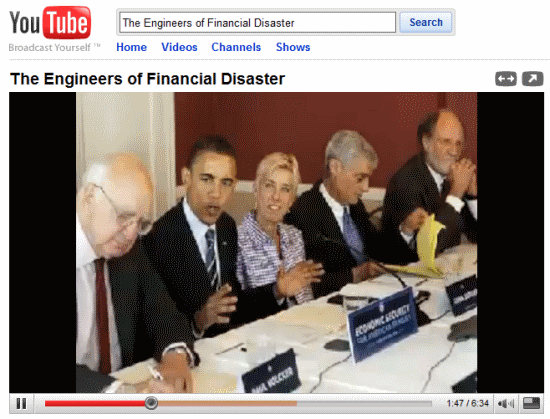
    Screen shot: An audio featuring the voice of radio-talk show host Pat Kiley was dubbed into this YouTube video, which featured a photograph of President Obama meeting with fiscal-policy advisers while Obama was President-Elect. Kiley intoned that the United States seemed ready to return to the "greed and irresponsibility" of fiscal policies advanced by former President Clinton.
    Screen shot: An audio featuring the voice of radio-talk show host Pat Kiley was dubbed into this YouTube video, which featured a photograph of President Obama meeting with fiscal-policy advisers while Obama was President-Elect. Kiley intoned that the United States seemed ready to return to the "greed and irresponsibility" of fiscal policies advanced by former President Clinton.

    Kiley sometimes used his radio show as a platform to rail against the administration of former President Bill Clinton, saying during one broadcast that Clinton’s fiscal policy was based on “greed and irresponsibility.”

    When Barack Obama became President-Elect after winning the White House in November 2008, Kiley warned listeners that Obama’s election signaled the return of Clinton-like financial policy.

    The video was titled, “The Engineers of Financial Disaster.”

    Only months later, Kiley finds himself at the center of a financial storm that may cause some investors and radio listeners to lose tens of millions of dollars.

  • WRAP-UP: Marine Corps Officer Tells Judge Ponzi Schemer Who Fleeced Seniors, Charities ‘Violated Every Character Trait I Hold Dear’

    EDITOR’S NOTE: This column summarizes three Ponzi cases: Joseph Forte, Sean Healy and Tom Petters. Forte has been sentenced; Healy has been convicted, and Petters is waiting to hear his fate from a Minnesota jury. The cases vary widely in size and scope, but demonstrate the terrible consequences of Ponzi schemes on individual investors and charitable institutions

    Joseph Forte scheme.

    A U.S. Marine Corps officer speaking for victims of the Joseph Forte Ponzi scheme in Philadelphia yesterday told a federal judge Forte’s actions caused his family’s charitable foundation to suffer a $15 million loss.

    Lt. Col. William Hooper, a former Marine Corps aviator and member of the U.S. Marine Corps Reserves, said his father suffered a stroke after learning Forte had plundered The Thornton D. and Elizabeth S. Hooper Foundation of Radnor, Pa.

    ponzinewsWilliam Hooper’s father, Bruce Hooper, himself a former Marine, served as president of the Marine Corps University Foundation (MCUF) and is a trustee and member of the Investment Subcommittee, according to the MCUF website. Bruce Hooper is the vice president of the Thornton D. and Elizabeth S. Hooper Foundation and the vice chairman of the Foreign Policy Research Institute of Philadelphia.

    William Hooper, speaking for the Hooper family at Forte’s trial, said Forte’s actions “violated every character trait I hold dear,” according to the Delaware County Times.

    Meanwhile, a woman who lost $109,000 she had inherited from her mother by investing it with Forte called him a “bastard.”

    Forte’s Ponzi scheme unraveled in 2008, after operating for 12 years. George Clark, a U.S. Postal inspector, said in an affidavit that Forte simply made up numbers and collected money until the bitter end.

    “The last statement received by investors for the third quarter of 2008 indicates that the fund had a return of 18.88% for the quarter and that the Joseph Forte LP fund’s total value as of September 30, 2008 was $154,700,189,” Clark said.

    In truth, Clark said, the value of Forte’s trading account was only $150,000. The account was closed in October 2008, but Forte continued to collect money from clients until Dec. 19, Clark said.

    “According to Forte, all reported returns were false in their entirety and were simply numbers that [he] fabricated,” Clark said. “Forte admitted that in every quarter from 1996 through the end of 2008, the reported returns were false.”

    Forte was sentenced to 15 years in prison. He also was ordered to pay $34.8 million in restitution.

    See a story in the Delaware County Times.

    Sean Healy scheme

    Luxury cars and Ponzi schemes go together like money and politics. Federal prosecutors have seized more than 20 cars in the alleged Scott Rothstein Ponzi in Florida, for example. One of them had a price tag of more than $1.5 million.

    Before the Rothstein case came on the Feds’ radar screen last month, there was the case of Sean Healy. It, too, has a Florida tie, although the prosecution occurred in Pennsylvania.

    Healy, 38, of Weston, Fla., was charged in a 55-count indictment unsealed last month with multiple counts of wire fraud, mail fraud, money laundering and obstruction of justice.

    Prosecutors said Healy “spent the money to fund a lavish lifestyle.”

    Purchases included “numerous exotic vehicles and sport cars, including a Bentley and several Ferraris, Lamborghinis and Porsches worth over $2.3 million,” prosecutors said.

    Obstruction of justice was charged because Healy thwarted a grand jury by providing “phony bank statements and phony trading records, indicating that the Pennsylvania investor’s money was used for legitimate trading activity in stocks and commodities,” prosecutors said.

    “When the authentic records were obtained, they revealed that Healy had simply spent the money on his extravagant lifestyle and used some of it to pay back earlier investors who he defrauded between 2003 and 2008,” prosecutors said.

    The grand-jury probe began in March, after an investor who had been scammed in Pennsylvania sued Healy and his wife, Shalese Rania Healy, in U.S. District Court in the Southern District of Florida, alleging that Pennsylvania investors had lost $14.6 million with Healy between April 2008 and February 2009.

    In addition to the automobiles, Healy also bought a $2.4 million waterfront mansion furnished with more than $2 million of home improvements, plus $1.5 million in men’s and women’s jewelry.

    Healy pleaded guilty Monday in Harrisburg to two counts of wire fraud and one count of unlawful monetary transactions. He faces up to 50 years in prison.

    Tom Petters’ scheme

    Minnesota businessman Tom Petters is accused of operating a $3.65 billion Ponzi scheme. The jury began to deliberate late Monday.

    Deliberations continued Tuesday. No verdict was reached, and the jury was dismissed until Monday because of the Thanksgiving holiday in the United States.

    Prosecutors said Petters presided over phantom sales of consumer electronics to big-box retailers, fleecing investors out of millions. His defense counsel acknowledged that fraud had occurred, but blamed it on subordinates.