Will the August 2008 forfeiture case against $65.8 million in the personal bank accounts of AdSurfDaily President Andy Bowdoin end before Christmas?
A federal judge suggested today that it might.
Bowdoin, 74, knew what he was doing when he submitted in January 2009 to the forfeiture of the cash and “knowingly and voluntarily” agreed never again to raise the claims, Judge Rosemary Collyer said in an order today.
Collyer added that the time to file claims has expired, thus agreeing
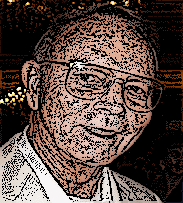
Andy Bowdoin
with an argument advanced by federal prosecutors earlier this month. But Collyer today left the door open for 30 more days before ordering the final forfeiture of the money to the government, issuing an order that any “potential claimant(s)” must “show cause in writing” before Dec. 20 why she should not grant the final forfeiture.
Earlier this month Collyer denied a bid by Bowdoin that began in February with his emergence as a pro se litigant to reassert claims to the money. Prosecutors said Bowdoin’s acts — and acts by dozens of other ASD members who had attempted to intervene in the case — were delaying the implementation of a restitution program for victims of the alleged ASD wire-fraud, money-laundering, securities and Ponzi scheme.
Collyer has denied dozens of bids by ASD members to intervene for money in the case, saying they had no standing and no “cognizable interest” because the money had belonged to Bowdoin alone at the time of its seizure.
On Nov. 10 alone, Collyer denied 13 such bids to intervene. All were filed by ASD members who shared a pro se litigation template. The judge repeatedly denied pro se attempts to intervene, denying the bids en masse in July, August, September and November. More than 70 such motions were filed in the case, dating back to February 2009.
Curtis Richmond, a California man, was one of the pro se litigants. Records show Richmond was a member of a Utah “Indian” tribe a federal judge in a separate case last year ruled a “complete sham” that tried to extort money from public officials to gain a favorable litigation result.
Richmond was hailed a “hero” on the pro-ASD Surf’s Up forum, even as thousands of ASD members were waiting to gain a share of a restitution pool the government is setting up for ASD victims.
Even though Andy Bowdoin and his family knew in January 2009 that the government intended to seize the Tallahassee home of his stepson George Harris and an $800,000 building purchased with cash in ASD’s home city of Quincy, Fla., the AdViewGlobal (AVG) autosurf proceeded with its launch in February 2009, according to an analysis of web records and new court filings.
Although a “Proof of Service” filed by federal prosecutors yesterday did not mention AVG, other records say that Bowdoin was given “direct notice” of a second forfeiture complaint that had been filed in December 2008 against ASD-connected assets. The initial forfeiture complaint against ASD was filed in August 2008.
Yesterday’s filing by the prosecution showed that the Harris home and ASD building in
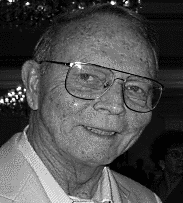
Andy Bowdoin
Quincy were publicly posted for forfeiture on Jan. 8, 2009. AVG launched less than a month later, triggering a virtually relentless series of 200-percent, matching bonus offers to generate cash and events that ultimately led to its collapse after the Harrises were identified by AVG as the owners of the company.
A Nov. 6 filing by the prosecution states that Bowdoin was given “direct notice” of the December 2008 seizure in January 2009, as were “all known potential claimants.” Prosecutors noted in the Nov. 6 filing that they had “signed receipts” from Bowdoin and others.
Other records clearly show that AVG’s launch proceeded in February 2009, pushed by former members of ASD despite the filing of two forfeiture complaints against the firm and a racketeering lawsuit.
Cash and property seized by the U.S. Secret Service in the December 2008 forfeiture complaint against assets tied to Bowdoin, his wife, stepson and Golden Panda Ad Builder are being prepared for liquidation, according to yesterday’s filing in the December case.
The property includes $634,266.13 in cash seized from a Golden Panda bank account. It is being held in a U.S. Customs Suspense account in Indianapolis.
The $800,000 building ASD paid for in cash also is being prepared for liquidation. The building is located in Quincy, Fla. It was promoted by Bowdoin as the site to which the company intended to move to accommodate employees and customers, owing to ASD’s rapid expansion.
ASD’s growth was fueled by both video and written lies that its business was legal, the Secret Service said.
In only months last year, ASD morphed from a company that earlier said it could not afford to pay members because of a malfunctioning computer script that purportedly had overpaid members and an accompanying $1 million theft at the purported hands of “Russian” hackers to a purported cash turbine was was going to buy an interest in an “international bank” and a “call center” in South America, the Secret Service said.
In August 2008 — in the first forfeiture case filed against ASD’s assets — prosecutors told a federal judge that they believed Bowdoin was preparing to flee the United States. After reviewing a 37-page affidavit filed by the Secret Service and an additional 57 pages of evidence, including surveillance photos taken in Quincy prior to the filing of the application for seizure, a federal magistrate judge ordered Bank of America to freeze 13 bank accounts linked to ASD or Golden Panda and the U.S. Department of Homeland Security to seize the money.
Prosecutors later seized two additional Golden Panda accounts at Bank of America, as part of the August complaint, bringing the total of accounts seized in the August matter to 15 — 10 from ASD, and five from Golden Panda. Those accounts, after reconciliations, contained more than $79.88 million, according to court filings.
As the investigation continued, prosecutors established more links to ASD-connected assets. In December 2008, they filed a second forfeiture complaint, naming an additional Golden Panda account maintained by Bartow County Bank, rather than Bank of America. The Bartow County account is the one that contained the $634,266.13 now being held in Indianapolis.
Prosecutors also seized the Tallahassee home of George and Judy Harris in the December complaint, saying its mortgage of more than $157,000 had been paid off with illegal proceeds from ASD. Records show the mortgage was paid off about three weeks after a May 31, 2008, ASD rally in Las Vegas had concluded.
George Harris is the son of Bowdoin’s wife, Edna Faye Bowdoin. Judy Harris is the wife of George Harris. The AdViewGlobal (AVG) autosurf, which came to life four months after the August seizure of tens of millions of dollars from Bowdoin’s bank accounts and approximately one month after a key court ruling went against ASD in November 2008, later identified George and Judy Harris as its owners.
Bowdoin invoked God at the May 2008 Las Vegas rally, imploring members to imagine themselves wealthy and thanking God for providing him tremendous wealth.
“And I always say, ‘Thank you, God, for developing me into a money magnet,’” Bowdoin said at the rally. “And I see myself as a money magnet in attracting money and, I say, attracting large sums of money.â€
Within days of the conclusion of the rally, according to court filings, ASD money was used by Edna Faye Bowdoin and George Harris to open a bank account into which more than $177,000 of illegal proceeds were deposited. More then $157,000 of the opening deposit was used to pay off the Harris home, which was seized in the December complaint.
Neither George nor Judy Harris filed a claim to the home, prosecutors said. In September 2009, prosecutors made a veiled reference to the AVG autosurf in court filings.
“Maybe Bowdoin thought that before the government brought its charges he (like some of his family members) could move to another country and profit from a knock-off autosurf program that Bowdoin funded and helped to start,” prosecutors said.
AVG purportedly was headquartered in the South American country of Uruguay. Servers of the purported “advertsing” firm that operated in largely the same form as ASD resolved to Panama.
Also seized in the December complaint were three automobiles: a 2009 Lincoln luxury sedan that had been acquired in July 2008 for nearly $50,000; a 2008 Honda CRV registered to George and Judy Harris acquired in June 2008 for nearly $30,000 after the Las Vegas rally; and a 2009 Acura TXS registered to former ASD figure Hays Amos for nearly $34,000.
The check to acquire the Acura registered to Amos was signed by ASD Chief Executive Officer Juan Fernandez, prosecutors said.
Also seized in the December complaint were computer equipment, two jet skis and a hauling trailer that were purchased with $20,506 of ASD money; and a Triton Cabana boat, Mercury motor and trailer purchased with $23,445 of ASD funds, prosecutors said.
All of the property seized in December now is being prepared for liquidation, pending an order from U.S. District Judge Rosemary Collyer. Prosecutors said no one made a claim to any of the seized property.
Based on the lack of claims, it is possible that prosecutors may argue that none of the property was claimed because ASD already had a plan to replace it through AVG.
ASD’s seized computers are being held at Secret Service headquarters in Orlando, according to to the prosecution court filing. Meanwhile, the Lincoln luxury sedan registered to Bowdoin/Harris Enterprises and the Honda registered to George and Judy Harris are being held at a company in the auto-auction business in Lakeland, Fla.; the Acura registered to Amos is being held at an auto-auction company in Daytona Beach, Fla.; and the marine equipment is being held at auction companies in Fort Lauderdale and Pensacola, Fla.
The $800,000 building and the Harris home were posted for forfeiture on the same date — Jan. 8, 2009, according to the prosecution filing. Only 5 days later Bowdoin surrendered his claims to the millions of dollars seized in August 2008.
Regardless, the AVG autosurf proceeded with its formal launch in February 2009 — less than a month after the Harris home in Tallahassee and the ASD building in Quincy were posted for forfeiture.
By the end of February, Bowdoin attempted to reenter the August case, acting as his own attorney and saying he’d changed his mind about submitting to the August seizure. Coinciding with Bowdoin’s pro se filings was an announcement by the AVG autosurf that it was becoming a “private association” based offshore.
During the same time period, a poster at the Pro-ASD Surf’s Up forum told members that the Secret Service had seized the bank accounts of ASD promoters. The poster warned members to remove money from their bank accounts before it could be seized.
By June 25, 2008, AVG announced that it was suspending cashouts. After initially blaming its inability to pay members on the greed of some members, it later changed its story and said $2.7 million had been stolen from the firm.
The story was remarkably similar to the story the Secret Service said ASD had told about the purported “Russian” hackers to explain why it couldn’t pay members.
EDITOR’S NOTE: In August, a poster here who defended autosurf Ponzi schemes demanded readers to “show me one time where the [U.S. government] has even started a lawsuit or ‘gone after’ a company off shore.” The post concerned the AdVentures4U (ADV4U) autosurf, which, like a number of autosurfs, claimed legal ties to Panama. Promoters said the purported ties insulated the surf from prosecution. Readers responded by providing several examples of prosecutors extending their reach beyond U.S. domestic soil to pierce the illusion of corporate veils and bring schemers to justice.
The story below is about an alleged Utah Ponzi, real-estate leveraging and forex-trading scheme in which the operator was arrested in Panama, brought back to the United States and jailed.
While Jeffrey Lane Mowen was in jail awaiting trial, the FBI said yesterday, he solicited a fellow inmate scheduled to be released in October to murder four witnesses “with the intent of preventing their attendance and testimony at his federal fraud trial” in the Ponzi scheme case.
UPDATED 4:14 P.M. ET (U.S.A.) In a case that puts more than just the financial dangers of Ponzi schemes on full display, jailed Ponzi suspect Jeffrey Lane Mowen has been indicted in Utah on charges of hatching a plot to hire a fellow prisoner to kill four witnesses in the Ponzi scheme case upon the inmate’s release from prison.
Mowen was indicted yesterday on charges of wire fraud, solicitation to commit a crime of
violence, witness tampering and retaliating against a witness. Mowen, jailed in Davis County, Utah, earlier this year after being arrested by Panamanian authorities working proactively with U.S. officials, was extradited to the United States to face the original charges in the case.
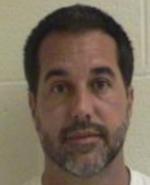
Jeffrey Lane Mowen
Prosecutors indicted Mowen in February under seal for the alleged Ponzi, announcing when the indictment was unsealed April 21 that he was “living outside of the United States.” He was arrested just three days later in Panama “by Panamanian authorities in conjunction with the FBI Legal Attache office,” the FBI said.
U.S. authorities said Mowen used investor funds “to purchase more than 200 high-end antique, classic, and modern vehicles, including cars, trucks, trailers, motorcycles, three-wheelers, and other vehicles.”
Mowen, 47, of Lindon, Utah, used his material possessions “as symbols of his success to investors,” the FBI said. The agency added that Mowen also used investor funds to “pay for personal expenses, including payments to himself and his [former] wife, dining expenses, vehicle storage fees, travel, utilities, and credit card expenses.”
For its part in a separate civil case, the Securities and Exchange Commission alleged that Mowen had three prior convictions in Utah for securities fraud and two for theft. Despite Mowen’s criminal record and history as a fraudster, promoters still did business with him. Their faith drained millions of dollars from investors, the SEC said.
Using language apt to cause unease in the autosurf Ponzi world, the SEC said one promoter “either knew or was reckless in not knowing that Mowen had multiple recent felony convictions involving crimes of dishonesty.”
Indeed, the SEC said, the promoter learned in approximately late June 2007 that Mowen had been convicted of securities fraud . . . [but] continued to solicit new investor funds for several months while failing to disclose Mowen’s criminal history to any of the Promoters or their investors.”
Downstream promoters who entrusted the promoter “conducted virtually no due diligence in connection with [his] purported investment opportunities, but transferred investor money to [him] without any documentation or limitation on his use of the funds,” the SEC said.
“[T]he Promoters were reckless in failing to discover [his] association with Mowen and that their funds were being placed into a Ponzi scheme or used for other undisclosed purposes,” the SEC said.
Among the SEC’s civil allegations against Mowen were that he siphoned off $8 million in investor funds for his personal use and transferred $650,000 to his former wife, who is named a relief defendant in the case.
Authorities painted a picture yesterday of a scheme that had morphed from financial crimes that crossed international borders to murder-for-hire — all in the name of Ponzi profits.
Florida attorney Scott Rothstein became famous in the environs of Miami and Fort Lauderdale for both puffing on and stockpiling cigars.
But he’ll no longer have the opportunity to seek to impress members of the Florida Bar as a cigar aficionado. In fact, even his days as a purported legal aficionado have come to an end.
Rothstein will be disbarred permanently, pending an order by the Florida Supreme Court.
“The Florida Bar and Scott W. Rothstein have agreed to his permanent disbarment — subject to the approval of the Supreme Court of Florida — in lieu of Rothstein defending himself against allegations of disciplinary violations,” said Florida Bar President Jesse H. Diner.
“Rothstein was under investigation for violations of The Rules Regulating The Florida Bar, including misappropriation of funds from trust accounts,” Diner said.
“The Florida Bar has been monitoring the federal investigation of Mr. Rothstein and we have been in contact with the court-appointed receiver for the firm as well as the U.S. Attorney’s Office,” Diner said. “While the case is very complex, it became evident that Bar rules may have been violated.”
It’s bad for all attorneys and the public when a lawyer disgraces the trade, Diner said.
“This is a terribly unfortunate and tragic situation, but it is also a rare circumstance in the legal profession,” he said. “The great majority of Florida attorneys serve their clients admirably and in accordance with the Bar’s rules of professional conduct. However, rule violations are not tolerated and the Bar takes appropriate actions to protect the public against further harm. The Florida Bar will continue to investigate any violations of its rules by other attorneys who may have been involved in this case.”
No charges have been brought against Rothstein, but a sweeping probe into his business practices continues. The FBI said the alleged Ponzi and fraud scheme could involve more than $1 billion.
Federal prosecutors have asked a federal judge to order the formal forfeiture of more than $65.8 million seized from 10 bank accounts in the personal name of AdSurfDaily President Andy Bowdoin.
Prosecutors also asked for a forfeiture order covering Bowdoin’s residence at 8 Gilcrease Lane in Quincy, Fla.
“Plaintiff applies for a default judgment and final order of forfeiture because these eleven defendants in rem were properly served, and no timely paper, pleading, or other claim to the defendant properties remain properly filed that permits any person to challenge their forfeiture,” prosecutors said.
They added that a default notice to the property had been requested, and entered by the Clerk of
Court Nov. 16. Prosecutors said all of the property — the proceeds of the bank accounts and the
Andy Bowdoin
residence — had been advertised for forfeiture beginning on Nov. 15, 2008, more than a year ago.
Court documents unsealed in the case show that the U.S. Secret Service feared Bowdoin had become aware of scrutiny into his business affairs last year and planned to flee the country.
Prosecutors filed 13 separate applications for seizure warrants to trap money connected to ASD on Aug. 1, 2008. A federal magistrate judge ruled that the agency had established probable cause to seize the money, and ordered Bank of America to freeze the accounts.
On the same day, a message appeared on ASD’s website that it was unable to move money in and out of its accounts. Prosecutors said Bowdoin had been talking about South America and planned to stop using Bank of America in July 2008, choosing instead to switch to offshore service-providers, including Canada-based Solid Trust Pay.
Because Bowdoin had suddenly relinquished in July 2008 what had been described as a 50 percent ownership interest in Golden Panda Ad Builder and investigators determined that Bowdoin either had bought or was planning to buy a home in another country — and because a bank other than Bank of America had closed a Bowdoin-connected account just prior to the seizure amid Ponzi concerns — investigators said Bowdoin was setting the stage to flee.