Category: Ad Surf Daily

  • PP Blog Returns After 4-Day Outage Caused By DDoS Attack; Site Flooded Saturday By Millions Of Hits

    Dear Readers,

    The PP Blog was brought down Saturday by a DDoS attack that flooded its servers with more than 6.1 million “hits” during a three-hour window. The Blog was shut down for security reasons, and federal law-enforcement agencies have been made aware of the attack.

    We were made aware of the nature of the attack this morning. Software engineers initially described the event as “suspicious,” saying the Blog suddenly had received an “immense” amount of traffic.

    Our heartfelt appreciation is extended to readers who contacted us and expressed their concern and their support for the Blog’s editorial mission during the outage.

    Thank you.

    Sincerely,

    Patrick

  • BULLETIN: Woman Who Did Not Report Ponzi Schemer Richard Piccoli Sentenced To 18 Months In Federal Prison For ‘Misprision Of Felony’ And Tax Charge; Kathleen Fuoco Turned ‘Blind Eye’ To Fraud, Prosecutors Say

    BULLETIN: In a case that could send shockwaves across the culture of promoting scams and accepting payments from scams, a New York woman who turned a blind eye to Richard Piccoli’s long-running Ponzi scheme in New York state has been sentenced to 18 months in federal prison for misprision of a felony and willful failure to file tax returns.

    Kathleen Fuoco, 60, of West Seneca, N.Y., pleaded guilty to the charges in June. She was sentenced today in Buffalo. Piccoli, 83, was sentenced to 20 years in prison last year. He became infamous in the Buffalo region for targeting people of faith in the scheme.

    Fuoco knew Piccoli was operating a scam, but did not report him, prosecutors said in June. Her failure to report the scheme brought about the misprision charge and also resulted in an agreement with prosecutors in which a financial judgment of $25 million would be placed against Fuoco, the total amount of restitution due victims.

    Piccoli operated a firm known as Gen-See Capital Corp., and directly targeted Christians and senior citizens.

    “Our seniors and clergy are absolutely pleased with Gen-See’s Re-Investment Program,” Piccoli said, according to marketing materials gathered by investigators as evidence in the case.

    The Piccoli prosecution was brought after an undercover sting by the U.S. Postal Inspection Service and the IRS.

    After Fuoco’s guilty plea in June,  U.S. Attorney William J. Hochul said “the public should know that if you attempt to defraud any hard working citizen or turn a blind eye while someone else is committing fraud, you will be caught and prosecuted to the fullest extent of the law.”

    Hochul built on his earlier remarks after Fuoco’s sentencing today.

    “The best defense for investors is to conduct your own due diligence and research,” he said. “When unscrupulous defendants take advantage of others through fraud, however, my office stands ready to bring the full force of law to punish the crime.”

    Misprision of felony is a charge that serial promoters of online scams such as autosurfs, HYIPs and 2×2 matrix cyclers potentially could face. The schemes proliferate in no small measure because promoters who play dumb to the fraud create the conditions that make it possible for the “programs” to go “viral” on the Internet.

    Some promoters help fuel scheme after scheme after scheme, perhaps saying later that they were surprised the programs proved to be fraudulent.

    Such bids to create plausible deniability have been unmasked by the U.S. Secret Service in a number of investigations since 2008. In some cases, the agency has used undercover identities to join the schemes and later advised federal judges that the agents were instructed by members of the schemes to avoid using certain phrases in sales pitches to minimize the chance of getting caught.

    In certain undercover operations, the Secret Service revealed it had agents in rooms or venues from which scammers were delivering sales pitches to an audience. Some schemers have been kept under surveillance for weeks by agents.

    Court documents in the alleged AdSurfDaily (Florida) and INetGlobal (Minnesota) Ponzi schemes — and in the alleged Regenesis 2×2 (Washington state) Ponzi scheme — show that agents moved from location to location and even city to city to build evidence against Ponzi schemers.

    Meanwhile, court documents show that undercover Secret Service operatives and their state law-enforcement colleagues even have posed as interested investors and walked right through the front doors of offices operated by suspected fraudsters.

    Court filings in the alleged Legisi Ponzi scheme brought by the SEC show that the behavior of the alleged schemer changed after he came to understand he was under investigation — a development that allegedly led to even greater chicanery to hide the scheme.

  • UPDATES/NEWS: ASA Ponzi Forum Now Redirects To CashX.com; Arthur Nadel Gets 14 Years In Florida Ponzi Case Brought By Obama Task Force; Former Indiana Pastor Who Bilked Christians Convicted Of Securities Fraud

    President Obama formed the interagency Financial Fraud Enforcement Task Force in November 2009. He later became the subject of an attack ad by an affiliate of the purported MPB Today "grocery" MLM.

    UPDATED 10:56 A.M. EDT (U.S.A.) The ASA Monitor Ponzi and criminals’ forum now is redirecting to a website operated by CashX.com, a Canadian payment processor that hawks MasterCard debit cards and says it permits customers to withdrawn money to Liberty Reserve.

    Liberty Reserve is a Ponzi-friendly payment processor purportedly headquartered in Costa Rica after earlier operating from Panama.

    Meanwhile, confessed Ponzi schemer Arthur Nadel — who briefly went on the lam from Florida in early 2009 as his $390 million scheme was disintegrating and became known as one of the original “mini-Madoffs” — has been sentenced by a federal judge in New York to 14 years in prison.

    It is effectively a life sentence for Nadel, who is 77 and one of several senior citizens implicated in U.S. Ponzi schemes.

    At the same time, a former clergyman from Indiana who told congregants it was their “Christian responsibility” to become pitchmen for his then-undiscovered bond scheme has been convicted of nine counts of securities fraud.

    Vaughn Reeves, 66, is scheduled to be sentenced next month. The jury deliberated only four hours before returning the verdict against Reeves, himself a senior citizen. Congregants believed they were helping raise money for church-building projects, but it was a scam that led to foreclosure proceedings against eight places of worship. (See link to AP report below.)

    Claims made by Reeves are similar to claims made by the Data Network Affiliates (DNA) MLM program, which told members that churches had the “MORAL OBLIGATION” to help bring business to the Florida-based firm and qualify for commissions ten levels deep. DNA purports to be in the license-plate data collection business, claiming it can help law enforcement and the AMBER Alert program recover abducted children.

    Incongruously, DNA also purports to sell a “protective spray” that shields cameras from taking photographs of license plates. Equally incongruously, the company said that it could offer a free cell phone with unlimited talk and text for $10 a month. The company later backtracked on the claim, bizarrely saying it studied pricing structures only after announcing it had become the world’s low-price leader while acknowledging it hadn’t vetted its purported vendor for the service.

    DNA figure Phil Piccolo later threatened to sue critics. Earlier, Dean Blechman, who said he was the company’s CEO before resigning in February, threatened to sue critics. DNA withheld the announcement of Blechman’s departure for nearly a week and then misspelled his name. DNA also described Blechman as the “future” CEO, even though Blechman had described himself as the current CEO.

    Blechman complained to the PP Blog about “bizarre” events at DNA.

    ASA Monitor, which is referenced in court filings as a place from which the alleged Pathway To Prosperity (P2P) Ponzi scheme was pitched and was a site from which the purported “grocery” MLM operated by Florida-based MPB Today was pitched, suddenly announced on Oct. 12 that it was closing.

    Like MPB Today, DNA also was pitched from Ponzi and criminals’ forums.

    The ASA Monitor closure announcement coincided with a flap in which an ASA forum moderator sought to muzzle critics of the MPB Today program, which is being targeted at Christians, foreclosure subjects, Food Stamp recipients, senior citizens, people of color and members of the alleged AdSurfDaily (ASD) Ponzi scheme.

    ASD also operated from Florida before the U.S. Secret Service seized tens of millions of dollars in August 2008, amid allegations of wire fraud and money-laundering. Robert Hodgins, an international fugitive wanted by Interpol in a narcotics-trafficking and money-laundering case filed after an undercover probe by the U.S. Drug Enforcement Administration in Connecticut, provided debit cards to ASD, members said.

    Nadel’s scheme, meanwhile, operated in the Sarasota area.

    “Through his massive Ponzi scheme, Arthur Nadel greased his own pockets and financed his lavish lifestyle, using money his clients relied on him to invest,” said U.S. Attorney Preet Bharara of the Southern District of New York.

    “He cheated his elderly and unwitting victims out of their retirement savings and consigned others to poverty,” Bharara said. “The message of [yesterday’s] sentence should be loud and clear — we will continue to work with our partners at the FBI to find the perpetrators of financial fraud and use every resource we have to bring them to justice.”

    U.S. District Judge John G. Koeltl ordered Nadel to forfeit $162 million, five airplanes, a helicopter and real estate in Florida, North Carolina and Georgia.

    The prosecution of Nadel was brought in coordination with President Obama’s Financial Fraud Enforcement Task Force. U.S. Attorney General Eric Holder traveled to Florida earlier this year to warn fraudsters that the United States was serious about putting scammers in prison.

    By September, an affiliate of MPB Today had created a video in which Obama was depicted as a left-handed saluting Nazi who cowered to U.S. Secretary of State Hillary Clinton, who was depicted as a drunk. First Lady Michelle Obama, the mother of two daughters, was depicted as having experienced an embarrassing gas attack in the Oval Office after sampling beans at a Sam’s Club store.

    Clinton, depicted in the sales promo as “Hitlary,” knocked out Michelle Obama after barging into the Oval Office bawling and carrying a bottle of wine. Clinton, the mother of one, was the first woman ever appointed to the Walmart board of directors.

    Some MPB Today affiliates have claimed Walmart is affiliated with MPB Today and that the government backs the MLM program, which appears to have accounts at at least two banks in the Pensacola area. One of the banks is operating under a consent agreement with the FDIC.

    Read the AP story on the Vaughn Reeves scheme in Indiana.

  • BULLETIN: ASA Monitor Ponzi And Criminals’ Forum Says It Is Closing; Threads Go Missing En Masse; Closure Coincides With Undercover Operations By Law Enforcement And USDA Probe Of MPB Today

    BULLETIN: UPDATED 7:37 P.M. EDT (U.S.A.): The ASAMonitor Ponzi and criminals’ forum — the forum from which the purported MPB Today “grocery” program was being promoted and countless other fraud schemes were being promoted — suddenly has announced that the forum is closing.

    The announcement, which appeared today in red type, was made by “Wanrou,” whose ID says he is “ASA Administrator.” Content from the forum appears to have been deleted or hidden en masse.

    “ASA forum has been a place where members can get information, discuss, share, debate, to educate and be educate about possibilities and risks of online money making programs for the last few years,” the Wanrou post said.

    “Sadly we can no longer keep it online as a free discussion forum because of time consuming and financial reasons,” the post continued.

    “Thanks you all for your long time support and best wishes to your present and future online endeavors.”

    The forum’s sudden closure coincided with reports in recent months that U.S.-based law-enforcement agencies were conducting undercover stings both online and offline and using informants to bring both criminal and civil charges against financial fraudsters.

    It was not immediately clear if ASAMonitor would seek to reopen as a so-called “private” forum. Court records show that undercover operations also have infiltrated “private” forums and that members of the forums who had been scammed have provided helpful information to investigators.

    The sudden closure of ASAMonitor also coincided with yet-another flap in the MPB Today thread. An antiscam poster was specifically warned by a moderator yesterday to refrain from his efforts to inform ASA members about developments in the MPB Today story and his reading of events at MPB Today.

    Specific claims about MPB Today are being investigated by the U.S. Department of Agriculture. The program has been pitched to Food Stamp recipients, people of faith, Ponzi scheme victims, people of color, senior citizens, college students and opponents of President Obama, among others.

    Obama created an entity known as the Financial Fraud Enforcement Task Force in November 2009 to do battle with fraudsters. In January, U.S. Attorney General Eric Holder warned in Florida that the U.S. government was serious about putting scammers in prison.

    ASAMonitor previously closed the MPB Today thread after warning an antiscam poster to back off from challenging “Ken Russo,” a poster promoting the MPB Today program. The thread later was opened after what a Mod described as a “cooling off period” had passed. In an earlier closure of the thread, links to the PP Blog’s coverage of the MPB Today story were deleted from the forum and later restored.

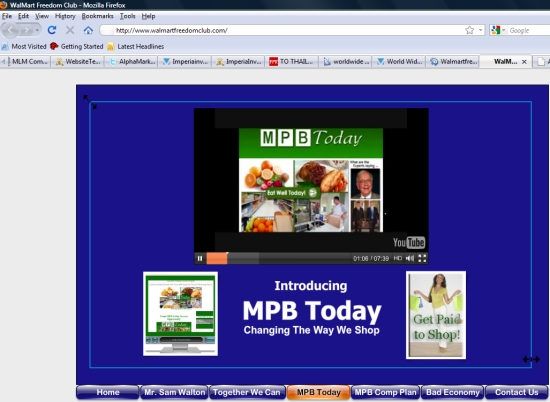
  • Another MPB Today Site Uses Walmart’s Name In Domain Name; Positions ‘Grocery’ Biz As ‘Freedom Club’ In Domain Hidden Behind Proxy; Uses Images Of Buffet, Trump And Late Sam Walton

    This pitch for MPB Today positions it as the Walmart Freedom Club. The pitch misspells the word "prosper" as "prospour." The website registration is hidden behind a proxy, and uses Walmart's name in the domain name. It is unclear if Walmart authorized the domain name or the use of its intellectual property in the MPB Today promo.

    Yet-another domain linked to the purported MPB Today “grocery” program is using Walmart’s name in its domain name. The domain name is registered behind a proxy and uses images of Warren Buffet, Donald Trump and Sam Walton to position the opportunity as a “Freedom Club.”

    Sam Walton is the late founder of Walmart. It is unclear if the owners of the website have Walmart’s permission to use its name and the likeness of Sam Walton in a pitch for the MPB Today program. Also unclear is whether the website owners have the permission of Trump and Buffet to use their images in promos for MPB Today.

    Separately, yet another pitch for MPB Today features a narrator who notes that food is necessary to stay “alive” and laments, “I wish we could sell air too.” The “air” video is on a restricted YouTube site maked as “unlisted.” An unlisted video “means that only people who know the link to the video can view it (such as friends or family to whom you send the link,” according to YouTube.

    MPB Today is a multilevel-marketing (MLM) program based in Pensacola, Fla. The “opportunity” is tied to a grocery business in Pensacola known as Southeastern Delivery. Both companies are linked to Gary Calhoun, who has a poor track record with the Better Business Bureau and was the recipient of a warning letter from the Food and Drug Administration for his marketing of a product that purported to be a treatment for Lou Gehrig’s disease, Herpes and Alzheimer’s, among others.

    The new domain that uses Walmart’s name is at least the third linked to the MPB Today program — and the second to position MPB Today as a “club” tied to Walmart.  The domain was registered Sept. 9, after MPB Today itself removed images of Walmart, Buffet and Trump from the homepage of its website.

    Other MPB Today-linked websites branded with Walmart’s name imply the retail giant offers free groceries or that Walmart is partnered with MPB Today.

    Meanwhile, still-other websites linked to the MPB Today program position it as a “Grocery Assistance” program and a program linked to the Food Stamp program administered by the U.S. Department of Agriculture. MPB Today also is being pitched from known Ponzi and criminals’ forums such as ASA Monitor, TalkGold and MoneyMakerGroup.

    On Wednesday, the SEC filed an emergency action in federal court in Utah to stop a program known as Imperia Invest IBC dead in its tracks, amid allegations it had fleeced millions of dollars from thousands of Americans with hearing impairments. Like MPB Today, Imperia was promoted on the Ponzi forums.

    Among the allegations in the Imperia case were that the operators were using trademarks and the intellectual property of a major company — Visa Inc. — without the company’s authorization. All in all, more than 14,000 Imperia investors were fleeced, the SEC said.

    In this separate promo for MPB Today, a narrator notes that food is necessary to stay "alive" and laments that he wishes members also could sell "air" through the MPB Today MLM program.

  • BULLETIN: SEC Gains Asset Freeze, Seeks Shutdown Of Imperia Invest In Emergency Action; Program Pitched On Same Ponzi Forums Promoting MPB Today; Agency Says Imperia Defrauded Thousands Of Deaf Americans

    BULLETIN UPDATED 5:02 P.M. EDT (U.S.A.): The SEC has gone to federal court in Utah to halt the operations of Imperia Invest IBC, alleging a spectacular fraud that fleeced money from thousands of Americans with hearing impairments.

    Imperia was promoted from the MoneyMakerGroup Ponzi forum — one of the Ponzi forums promoting the MPB Today “grocery” MLM. Imperia also was the topic of discussion and defenses on TalkGold and ASAMonitor, two other forums that are pitching MPB Today.

    The SEC’s allegations against Imperia are stunning. More than 14,000 investors were defrauded worldwide, the agency said.

    Among the victims were thousands of deaf investors in the United States, the SEC said.

    Imperia gathered relatively small sums from thousands of people, the SEC charged, noting that “no evidence has been found that any of the investors have received a single payment.”

    “Imperia Invest IBC is a web-based entity that claimed, until late 2009, to be located in the Bahamas,” the SEC charged. “The Bahamian address listed by Imperia is fictitious. Imperia now claims to be located in Vanuatu. However, Imperia is not registered to do business in Vanuatu and the address listed on its website appears also to be fictitious. Neither Imperia nor its securities are registered with the Securities and Exchange Commission. Imperia is not licensed or registered with the Commission, with any state, or with any Self Regulatory Organization.”

    Categorically absurd representations of earnings and the program’s potential were made to investors, the SEC said.

    “Investors were promised eye-popping amounts of money in return for a simple $50 or $100 investment, and Imperia has made numerous excuses on its website about why these returns haven’t been paid,” said Ken Israel, director of the SEC’s Salt Lake Regional office.

    “The Imperia website shows an example of such earnings in which a $50 investment will return $134,000 to the investor in six months,” the SEC charged. At the same time, the agency said some investors were told that spectacular sums were due them for doing business with Imperia.

    “Imperia represented to one investor who invested $150.00 with Imperia that Imperia owed him $36,610,755.20 within a two year time frame,” the SEC charged. “Another individual’s account statement who invested $500 in July 2007 showed he is owed $43,907,652.20 as of May 2010.”

    It was not immediately clear how so many deaf investors became involved in Imperia. A federal judge has approved an asset freeze.

    Imperia called its product Traded Endowment Policies (TEP), which the SEC described as “the British term for viatical settlements.”

    “A TEP or viatical settlement involves the sale of an insurance policy by the policy owner before the policy matures, and policies are sold at a discount from face value in an amount greater than the current cash surrender value,” the SEC said.

    “There are at least 14,000 [Imperia] investors worldwide with a total investment exceeding $7 million,” the SEC said. “In the United States, there appear to be approximately 6,000 investors, most of whom belong the hearing impaired community, who have invested in excess of $4 million with Imperia.”

    Imperia used offshore payment processors such as “Liberty Reserve, located in Costa Rica; Perfect Money, located in Panama; and Procurrex, located in the British Virgin Islands,” the SEC charged. “Once Imperia received funds from Investors, it appears that Imperia then transferred amounts from these accounts to foreign bank accounts, including but not limited to accounts located in Cyprus and New Zealand.”

    Even as Imperia was ripping off investors, it also was infringing trademarks and the intellectual property of Visa, the credit-card service, the SEC charged..

    “Imperia also requires that investors purchase a Visa debit card to access their investment proceeds,” the SEC said. “Imperia charges customers a fee to purchase the Visa debit card ranging from $145 to $450.

    “Visa has not authorized Imperia to use its name or trademarks and has sent Imperia a cease-and-desist letter to halt its unauthorized use of the Visa name and logo,” the SEC said. “There is no evidence that any investor who has ordered a Visa debit card from Imperia has actually received such a card.”

    One poster on the MoneyMakerGroup forum advised prospects that he would keep an “open mind” about Imperia, according to web records.

    “Anyway, in the final analysis each person must make their own decision,” the poster said in 2007.

    While the MoneyMakerGroup poster was holding forth about keeping an “open mind,” Imperia was cloaking itself to siphon millions of dollars, according to web records and court records.

    “Imperia took proactive steps to conceal the identity of its control persons by using an anonymous browser to host its website, by communicating with all investors via email without disclosing the identity of any control persons and by establishing off-shore Paypal-style bank accounts to conceal the recipient of the investment proceeds,” the SEC charged.

    In July, the Financial Industry Regulatory Authority issued a warning about HYIP schemes pitched online. In May, the U.S. Postal Inspection Service accused an HYIP known as Pathway To Prosperity of defrauding more than 40,000 people in a scheme that took in about $70 million.

    Pathway To Prosperity also was promoted on the Ponzi and criminals’ forums. ASAMonitor, TalkGold and MoneyMakerGroup are specifically referenced in court filings in the Pathway to Prosperity case.

    MoneyMakerGroup is specifically referenced in court documents in the alleged Legisi HYIP and Ponzi scheme, a fraud that allegedly gathered more than $70 million.

    Read the SEC complaint against Imperia.

  • EDITORIAL: Prized Magazine ‘Newsweek’ Acquired For $1; Publishing Continues To Bleed — Even As Autosurf Cheerleaders Say They Have The Answer To Lagging Ad Sales

    The Associated Press reported yesterday that the Washington Post sold Newsweek magazine — an American treasure — for $1. The Post also absorbed $10 million in debt for Newsweek, which lost nearly $30 million last year.

    How much is $30 million? Well, it’s about $1.6 million less than AdSurfDaily President Andy Bowdoin had in a single bank account from his alleged “advertising” Ponzi scheme. It’s also less than one-half the total sum ($65.8 million) the U.S. Secret Service seized from 10 Bowdoin bank accounts.

    This is painful to watch on a couple of levels: First, American publishing companies continue to bleed profusely, leading to a situation in which American treasures are being sold for $1 and skilled administrative, management, editorial, production, sales and advertising professionals are losing their jobs or working for far less money.

    Second, problems in the U.S. economy in general are providing a launching ground for hucksters who would have you believe that Newsweek, the Seattle Post-Intelligencer and many other cherished publications could have saved themselves a lot of heartache by turning to the “autosurf” business model.

    In the autosurf business model as practiced by ASD, a company such as Microsoft that perhaps had relied on Newsweek  to advertise in print could have paid ASD $1 million to advertise online. ASD would have placed Microsoft’s ad in its magical advertising rotator. From that $1 million, Microsoft would have “earned” $10,000 a day more or less for the next 125 days, thus not only “earning” back the full $1 million, but also fetching a “profit” in the neighborhood of $250,000 on top of it.

    And Microsoft also would have sold a bunch of software by advertising on ASD, which purported to have a “captive” audience consisting of advertisers it was paying to view the ads of their fellow ASD advertisers. With Microsoft as a theoretical ASD advertiser, it could have boosted its bottom line by watching ads from a theoretical Apple, for example. The “rebates” Microsoft earned — coupled with the profits from the sale of software products displayed in ASD’s rotator — would have made both Microsoft and America happy, according to ASD’s devoted flock of commission-based, MLM salespeople.

    ASD, its fans said, had the perfect solution: Microsoft would have been paid more money than it spent, meaning it would have emerged in a better cash position within 125 days of doing business with ASD.  The ASD salesperson who recruited Microsoft also would have been paid — $100,000 for the $1 million sale alone. ASD would have made money. The U.S. economy would have continued to gain steam.

    Except it was not perfect, of course. In fact, is was all a colossal lie, according to the U.S. Secret Service, which accused ASD in August 2008 of operating a massive Ponzi scheme. Any money that ASD advertisers received from ASD came from other advertisers.

    So, it is plain to see that ASD was not a good deal for “advertisers” — theoretical or otherwise. ASD could have killed off Microsoft had its management been uninformed enough or desperate enough to trust a single word ASD ever said. Horror of horrors: Why would Microsoft want to limit its ASD ad spend to $1 million? Why not $10 million or $100 million — or more? Why not plow its “profits” right back into ASD, which advertised dramatically higher profits than, say, Bernard Madoff?

    After ASD killed off Microsoft, it would have killed off that MLM salesperson, the one who was paid $100,000 for Microsoft’s $1 million in business while Microsoft itself was paid $1.25 million more or less.

    Indeed, like Microsoft, the ASD MLM salesperson pitching ASD’s cancer would have had to return the “profit” he was paid from the proceeds of a criminal enterprise, even if it meant selling his home to raise the cash.

    But how to sell a home in this economic environment — you know, with all the foreclosures and such, all the bank failures and such — and all of the falling prices of real estate and such because of all the foreclosures and such?

    Want to add an extra layer to the ASD madness? Some ASD promoters who declared themselves committed, free-market Capitalists insisted that companies such as Microsoft would not be interested in profits, that they’d be happy enough just to display their ads and not get paid.

    The corporate benevolence of companies such as Microsoft would have resulted in ASD profits that were redistributed to smaller companies and Mom-and-Pop advertisers, thus creating wealth across the social spectrum. Some of the very same Capitalists who made these claims later complained about what they described as the Socialist redistribution schemes of the U.S. government.

    It also seemed not to occur to the autosurfing Capitalists who were rooting for a Socialist redistribution scheme — a scheme whereby big companies such as Microsoft would finance the profits of smaller players — that companies such as Microsoft could have started an autosurf at any time they wanted and crushed ASD like a bug.

    It’s a pretty safe bet that Microsoft, unlike ASD, could have kept its autosurfing site from going offine and could have produced a site that didn’t look as though it had been assembled by amateurs using a script kit. Meanwhile, it’s also a pretty safe bet that Microsoft wouldn’t have been looking for ways, say, to peel off cash to put Bill Gates in a new Lincoln or a relative of Bill Gates in a sporty, new Honda.

    Along those lines, it’s also a pretty safe bet that Microsoft would not have been seeking ways, say, to route millions of dollars offshore so it could be retrieved later by “management” who suddenly found themselves cash poor and without a country.

    Ay, just another day in Ponzi America, a country that has more than a few people who believe the business cure for what ails America is an ASD-like scheme that runs 24/7/365. You can read all about such schemes on the Ponzi boards — and you can induce people into the schemes and get paid a commission, which you can deposit into your FDIC-insured bank.

    Newsweek, like the Post Intelligencer, didn’t go the autosurf route, despite the fact it could have done exactly what ASD did: Lied to its advertisers by telling them that NewsweekDailyProSurf.com was the cure for all their ills, a cure that would have returned 125 percent more or less in 125 days more or less.

    No, Newsweek sold itself for $1 in a bid to save itself. We wish this American treasure the best as it seeks to retool.

    Finally, did you hear that the affiliate braintrust pitching the purported MPB Today “grocery” program on the ASA Monitor Ponzi and criminals’ forum is promoting an MPB Today “rebate” program?

    Read the AP story on the sale of Newsweek for $1.

  • Florida Drops State-Level Pyramid Case Against AdSurfDaily; Says It Has Supplied Victims’ List To Claims Administrator For Restitution From Assets Seized By Secret Service In Federal Case

    Andy Bowdoin

    UPDATED 7:40 P.M. EDT (U.S.A.) Certain members of Florida-based AdSurfDaily began crowing last week that the office of Florida Attorney General Bill McCollum had dropped the pyramid-scheme case it had filed against ASD in August 2008.

    “The State of Florida has dropped all charges against Ad Surf Daily, Inc. This is wonderful news!” an email received by some ASD members exclaimed.

    Florida prosecutors, however, tell a different story.

    Although McCollum’s office confirmed today that the pyramid case has been dropped “without prejudice” — meaning it can be refiled — it noted that state investigators have forwarded a list of Florida victims of ASD to a federal claims administrator “for processing and reimbursement purposes.”

    Florida initially had sought restitution for victims, along with the dismantling of ASD. ASD essentially dismantled itself in September 2009 by not filing required forms with the state, which revoked its corporate registration. Less than four months later, in January 2010, the federal government was awarded title to more than $65.8 million seized in the case. The government earlier had been awarded title to more than $14 million. In March 2010, the government was awarded title to more than $600,000 that had been seized in a separate forfeiture action filed against ASD connected assets in December 2008.

    All in all, the federal government was awarded title to more than $80 million seized in the ASD case, gaining a clean sweep in the forfeiture proceedings.

    The U.S. Secret Service raided ASD on Aug. 5, 2008.  Florida followed up with a lawsuit of its own a day later, but federal prosecutors later said they intended to form a restitution pool from seized assets. That process now has begun, although ASD President Andy Bowdoin is appealing the January 2010 forfeiture order entered by U.S. District Judge Rosemary Collyer.

    In its paperwork to dismiss the pyramid case, McCollum’s office pointed to Collyer’s forfeiture order, saying ASD victims from Florida and elsewhere had been provided an opportunity for restitution by the federal government.

    On Sept. 28, 2009 — three days after Florida revoked ASD’s corporate registration and dissolved the registration of a shell company known as Bowdoin/Harris Enterprises — federal prosecutors filed a U.S. Secret Service transcript of a conference call ASD had recorded Sept. 21.

    In the call, Bowdoin told members that the government had seized their money. In his court filings, however, Bowdoin claimed the money was his.

    Federal prosecutors said the recording was evidence that Bowdoin could not keep his stories straight, arguing that he had told members one story and a federal judge another. Collyer issued the forfeiture order for more than $65.8 million less than four months later.

    Although an email some ASD members received in recent days claimed that “It looks like things are moving in the right direction” with the Florida dismissal, the email urged members to “only share this with those whom you trust.

    “Do not post on forums or blogs,” the email urged.

    Federal prosecutors noted last month that the U.S. Court of Appeals for the District of Columbia Circuit had dismissed one of two appeals Bowdoin had filed in the forfeiture cases, noting his second appeal was pending before the same court.

    The court should reject that appeal as well, prosecutors argued.

    With the federal procedure for restitution established, ASD victims now have a remedy for reimbursement, McCollum’s office advised a state judge.

    In late 2008, Bowdoin told ASD members that Florida had dropped “Ponzi scheme” allegations against the firm. McCollum’s office immediately countered with a statement that it never even had accused ASD of operating a Ponzi scheme, noting that it had alleged a pyramid scheme only.

    When Bowdoin made the 2008 claim, some ASD members raced to forums and websites to spread the news, which turned out not to be true. He later tried to sell members a VOIP telephone service, explaining the price he offered was a gift to his loyal supporters.

    Even as Bowdoin was telling members in September 2009 that he had big plans for ASD, he did not explain why he had permitted its corporate registration to lapse or explain that the state had revoked the registration.

    Instead, Bowdoin told members that the government had seized their money — a claim in opposition to his own court filings that advised a federal judge the seized money belonged to him.

  • BULLETIN: Florida — Again: SEC Sues Atlantis Technology Group In Alleged Online Television Pump-And-Dump Scheme; CEO Christopher M. Dubeau Threatened ‘Bashers’ For Making ‘Slanderous’ Postings, March News Release Says

    BULLETIN: UPDATED 10:51 A.M. EDT (U.S.A., Oct. 1.) About six months after the chief executive officer of Atlantis Technology Group (Atlantis) was quoted in a Marketwire news release that threatened online commentators for “making slanderous postings” about the company, the SEC has gone to federal court in Florida to accuse Atlantis CEO Christopher Dubeau and the firm of running a penny-stock swindle.

    The SEC’s lawsuit concerns the operations of an Atlantis subsidiary known as Global Online Television (GOTV), which allegedly used a commission-based sales force to promote the purported TV company.

    Dubeau and Atlantis actually were operating a “pump-and dump” stock fraud, the SEC charged in U.S. District Court for the Southern District of Florida.

    “From at least August 7, 2009 through April 5, 2010 . . . Atlantis and Dubeau issued numerous false and misleading press releases that artificially inflated the trading volume and price of Atlantis’s stock,” the SEC charged. “Dubeau benefited financially from Atlantis’s artificially increased trading volume and stock price. In December 2009, he sold more than 60 million shares of Atlantis stock for proceeds of about $240,000, and in August 2009 he received $77,000 of the proceeds from an associate’s sale of more than 16 million shares.”

    A Marketwire news released dated March 26, 2010, and issued under the names of Atlantis and Dubeau accuses “bashers” of making “slanderous” remarks about the company online.

    “I can assure you I will not play the bashers’ games,” Dubeau was quoted as saying. “Atlantis has Launched an Investigation into these Individuals that are attacking the Company and its Associates. Atlantis has Identified at least 3 of these Participants in what we deem to be manipulation of the Company’s Stock price by making slanderous postings. We will seek every avenue available to bring these persons of interest to the forefront of the Judicial System.”

    Now, six months later, the SEC has accused Dubeau of operating a large-scale fraud by fabricating news about the company’s ability to offer online TV and video-phone services.

    “Atlantis’s press releases were false because Atlantis’s subsidiary has never offered
    Internet protocol television service or video phone services,” the SEC charged. “At the time the company and Dubeau issued these press releases, the subsidiary did not offer (and was not able to offer) either service, and it did not have relationships with television networks to offer content to Atlantis’s subscribers. In fact, until March 1, 2010, neither the subsidiary nor Atlantis had any product or service to offer to consumers.”

    Threats against critics who voice concerns about business opportunities online are common, as is the issuance of news releases to spread false information. In the alleged AdSurfDaily Ponzi scheme, for example, ASD President Andy Bowdoin threatened critics with lawsuits. ASD operated from Florida.

    An operation known as AdViewGlobal (AVG) that has close ASD ties and also operated at least in part from Florida also threatened critics. AVG even threatened its own members with lawsuits.

    Critics of Data Network Affiliates (DNA), a Florida company that purports to offer an MLM program that collects license-plate data to aid law enforcement and the AMBER Alert program rescue abducted children, also were threatened.

    DNA figure Phil Piccolo used an online radio program last month to threaten critics.

    Convicted Florida Ponzi schemer Scott Rothstein, who ran one of the largest scams in U.S. history, also threatened critics. Rothstein pleaded guility to racketeering.

    Read the SEC complaint against Atlantis and Dubeau of Fort Lauderdale and Weston, Fla.

  • ASA Monitor Ponzi And Criminals’ Forum Locks MPB Today Thread — Again; Naysayers Scolded By Mod For Challenging ‘Ken Russo’

    EDITOR’S NOTE: The ASA Monitor Ponzi forum now has reopened its thread on the MPB Today MLM program — with a warning in red to “Play nice . . .”

    UPDATED 9:54 A.M. EDT (U.S.A.) A forum infamous for promoting Ponzi schemes and other criminal pursuits has locked the thread from which the MPB Today 2×2 matrix cycler is being pitched.

    The official explanation for locking the thread was that naysayers challenging ASA Monitor member “Ken Russo” needed a “temporary cooling off period.” (See Editor’s Note above: The thread now has been unlocked.)

    “Ken Russo” is a reliable cheerleader for Ponzi schemes and highly questionable business pursuits on ASA Monitor and other forums. ASA Monitor’s name is referenced in a May criminal case filed against the alleged Pathway To Prosperity Ponzi scheme. Prosecutors said the scheme mushroomed globally, gathering about $70 million and defrauding more than 40,000 participants.

    A similar program known as Legisi gathered more than $70 million and also fleeced thousands of participants, according to the SEC. It, too, was promoted on the Ponzi forums. A court filing in the Legisi case specifically references the MoneyMakerGroup forum, another venue from which MPB Today is being promoted.

    This marks the second time the MPB Today thread has been locked at ASA Monitor. It was locked earlier this month and then reopened amid similar circumstances. ASA Monitor initially deleted several references to the PP Blog in the initial closure of the thread, but later restored them.

    One of the principal incongruities of the MPB Today program is that it is being targeted at people of faith from a known Ponzi forum. Because ASA Monitor members routinely promote Ponzi schemes, some of the funds being passed to MPB Today could be criminal proceeds from Ponzi and other fraud schemes.

    “Ken Russo,” for example, promoted the alleged Regenesis 2×2 Ponzi scheme. Like MPB Today, Regenesis used a 2×2 matrix cycler. The U.S. Secret Service executed search warrants in the Regenesis case in July 2009. The agency said in court filings that it had linked the scheme to a convicted felon.

    Spectacular international frauds have been promoted at ASA Monitor. Meanwhile, some of MPB Today’s own members have said there are liars and thieves in the organization, including liars and thieves who are using false information to recruit prospects. The claims have been made in public on YouTube. Incongruously, they have been positioned as reasons to join the program under specific uplines that purport to be honest.

    How MPB Today’s payments to members could be clean if it has come into possession of money tainted by the lies of its own pitchmen and money tainted by Ponzi schemes promoted on forums such as ASA Monitor is left to the imagination.

    Last week the PP Blog reported that a “news release’ that appeared online encouraged MPB Today prospects to sell $200 worth of Food Stamps to raise money to join the program. One of the URLs referenced in the release also was being promoted on ASA Monitor by “Ken Russo.” Other information suggests that promoters of the judicially declared CEP Ponzi scheme are promoting MPB Today.

    Some ASA Monitor members use a strategy of playing dumb to promote Ponzi schemes. One form of the strategy is to repeatedly accept at face value whatever a company says in sales literature — and then blame the company and dishonest affiliates if a scheme collapses or is taken down by law enforcement.

    Another form of the strategy is to include links to the sites of other promoters, apparently on the theory that favorable commentary about an “opportunity” demonstrates that no scam could be occurring. If the opportunity later proves to be a Ponzi or a fraud scheme, promoters who employ the play-dumb method point out that others got taken, perhaps through the actions of a fraudster who was particularly clever.

    Yet another form of the play-dumb method is to position an opportunity as a matter of free choice. Such wink-nod efforts are part of numerous Ponzi schemes.

    In February 2010, the Secret Service said in a search-warrant application in Minnesota that it believed a company known as INetGlobal was operating a Ponzi scheme. In court filings, the agency said an undercover agent was introduced to INetGlobal by a member of the alleged AdSurfDaily (ASD) Ponzi scheme, describing the introduction as a wink-nod deal.

    ASD, which was accused of operating a $100 million Ponzi scheme, also was promoted from websites and forums. Federal agents seized about $26 million in the INetGlobal case, which is still under investigation. Steve Renner, the operator of INetGlobal, is in federal prison for income tax-evasion in a case linked to his money-services business.

    Court records show Renner-related ties to at least four Ponzi schemes.

    Among the targets of promotions for MPB Today were victims of the alleged ASD Ponzi scheme, foreclosure subjects, the unemployed, Food Stamp recipients, senior citizens, college students and other vulnerable populations.

  • Affiliate Promo Says MPB Today Website Fee Will Increase From $10 To $39 Oct. 1; Another Promo Claims ‘It Doesn’t Matter How’ The Program Works

    An upline promo for MPB Today says the company soon will raise the cost to join from $210 to $239, an increase of $29. The purported increase applies to the MPB Today fee for a replicated website, which the affiliate says will increase from $10 annually to $39.

    Will a new price increase that ups a website fee from $10 to $39 cause scores of MPB Today affiliates to change their promos to reflect the price change?

    Or will the MPB Today affiliates behave like some promoters of Data Network Affiliates (DNA) and just leave old information in videos and on websites and Blog posts to recruit customers based on false information?

    An affiliate video for MPB Today claims the price increase will occur Oct. 1.

    “So, in order to get started with MPB Today, the first thing you’ll need to do is pay $239,” the promoter claimed in a YouTube video. “Now, the $39 is an annual fee, and that gives you a replicated website with the company.

    “Some of you might be confused, because that was previously only $10,” the promoter continued. “But, as of Oct. 1, 2010, it will now be $39.”

    MPB Today operates a 2×2 cycler matrix. If incoming prospects soon will have to pay more than original members to join the company, it sets the stage for them to lose more should the program collapse. One analysis of MPB Today’s mathematics shows that 86 percent of the MLM’s members were in position to lose money before the advertised price hike. Incoming members will be among the 86 percent, but stand to lose more because they paid more.

    Some promoters have said MPB Today also is tweaking its program to pay out bonuses. In myriad online scams, program tweaks have signaled trouble or an effort by a company to come into compliance after the fact.

    In early April, DNA announced a cell-phone plan that would provide customers a free phone and unlimited talk and text for $10 a month. “GAME OVER — WE WIN,” the MLM firm declared in all-caps. Members flocked to the web to promote the offer to prospects.

    By the end of April, however, DNA, which has a reputation for bizarre sales pitches, announced it had not studied cell-phone pricing before publicly announcing unlimited service for $10 a month with a free phone. It blamed a vendor for making it believe such a plan was possible, an acknowledgment it had not vetted its purported supplier before instructing members to sell a service.

    There would be no free phones and unlimited service for $10 a month, the company said. It then announced a May debut for a new cell-phone plan, later changing the debut date to June.  No plan has emerged. By July, however, DNA was claiming that churches have the “MORAL OBLIGATION” to help it sell a new mortgage-reduction service that purportedly pays downline commissions 10 levels deep.

    Even after DNA unannounced its “GAME OVER” declaration and the cell-phone plan, affiliates continued to promote the nonexistent plan. At the same time, images of Donald Trump, Oprah Winfrey and Apple Inc. continued to appear in DNA promos, despite the fact there is no evidence to support suggestions that the business titans and the Steve Jobs-led technology giant have any ties to the firm.

    MPB Today and affiliates also beamed images of Trump from the homepages of their  websites, along with an image of Warren Buffet and a Walmart store. The company removed the images from its homepage earlier this month. Affiliates continue to display images of Trump, Buffet and Walmart.

    Separately, an MPB Today affiliate who appears to belong to the same downline group that announced the price increase is claiming that “It Doesn’t Matter How it Works[:] It just does.”

    Why the promoter apparently believes that it “does not matter” how a company that claims a $200, one-time purchase can result in free groceries for life “works” was not immediately clear.

    A short video that makes the claim spells the word “whether” without a leading “h,” and the word “jobs” as though it were a possessive. Among the claims in the promo is that MPB Today works whether prospects “need $500 a month or every day.”