Category: Ad Surf Daily

  • BULLETIN: Autosurf Biz Takes Another Pounding; Federal Judge Adds Noobing As Receivership Defendant In Fraud Case Against Parent Company; 14 Other Subsidiaries Named

    UPDATED 6:05 P.M. EDT (U.S.A., Jan. 20, 2011.) In yet another case that portends disaster for the so-called “autosurf” industry, a federal judge has ordered the Noobing autosurf to be added as a receivership defendant in a fraud case brought against its parent company.

    The FTC and attorneys general from Minnesota, North Carolina and Kansas brought the case against Noobing’s parent — Affiliate Strategies Inc. (ASI) — in July 2009. Several other companies were named defendants in the case, which alleged the firms participated in a scheme that promised guaranteed government grants from economic-stimulus funds.

    Brett Blackman, ASI’s head, also was president of Noobing, members said. Noobing was not initially named a receivership defendant.

    U.S. District Judge Julie A. Robinson issued an asset freeze Sept. 1, along with stern orders to preserve evidence and repatriate to the United States all assets and documents held on foreign soil. She also broadened the powers of Larry Cook, the court-appointed receiver.

    Through his investigation, Cook determined that Noobing was operating under the umbrella of Apex Holdings International LLC, the same company under which ASI operated. Cook also determined that at least 14 other companies were operating under the Apex Holdings umbrella.

    Noobing, which was registered in the United States, also had an offshoot in Nevis, according to court filings. Noobing targeted people with hearing impairments.

    Cook asked Robinson last month to add Noobing and the other companies as receivership defendants after determining “each of the Subsidiaries used the same post office box as the [initial] Receivership Defendants.”

    Moroever, Cook advised Robinson that he had received “receive numerous inquiries from creditors, former independent contractors, and tax authorities for the Subsidiaries.” He further argued that “each of the Subsidiaries was entirely reliant upon the business operations of the [initial] Receivership Defendants.”

    Robinson, saying Cook had shown “good cause,” added Noobing and the others as defendants March 18.

    No party  — including the FTC, the state attorneys general, the initial set of defendants and the new defendants — objected, Robinson noted. In December, Illinois joined the FTC, Minnesota, North Carolina and Kansas in the action.

    On the previous day, March 17, FBI Director Robert Mueller III, without naming names, testified before Congress. Mueller said that “shell corporations” are emerging as a threat to the U.S. banking system because owners were using them “to facilitate the concealing of criminal proceeds” and engage in money-laundering.

    Neither Noobing not its corporate parent has been accused of a crime.

    In February, the U.S. Secret Service alleged in a civil forfeiture complaint that INetGlobal, a company that operates an autosurf, was engaged in money-laundering and wire fraud while operating a Ponzi scheme.

    INetGlobal is operated by Steve Renner, under his “umbrella corporation, InterMark,” the Secret Service alleged. The agency identified what it described as “subsidiaries,” specifically referencing “Virtual Payment Systems [LLC of Wisconsin/Brackets Denoting the LLC Designation added Jan. 20, 2011], V-Media, Cash Cards International, and V-Local,” as well as a company named “INet Global Productions.”

    NOTE IN BOLD ADDED JAN. 20, 2011: An Indianapolis-based company known as Virtual Payment Systems Inc. has contacted the PP Blog to let it know it is not affiliated with the Renner company Virtual Payment Systems LLC of Wisconsin, which is referenced in the paragraph above.

    “The commission by Renner of the federal crimes of wire fraud, in violation of Title 18, United States Code Section 1343, and money laundering, in violation of Title 18, United States Code Section 1957, is essential to the operation of this Ponzi scheme,” the Secret Service alleged.

    In August 2008, the Secret Service said AdSurfDaily, a Florida-based autosurf company, also was engaging in wire fraud and money-laundering while operating a Ponzi scheme.

    U.S. District Judge Rosemary Collyer — on Jan. 4, 2010 — ordered the forfeiture of more than $65.8 million in the personal bank accounts of ASD President Andy Bowdoin. A little more than a month later, on Feb. 23, the Secret Service moved against INetGlobal.

    Records show that ASD’s Bowdoin operated several corporations over the years. In September 2009, the state of Florida revoked the corporate registrations of AdSurfDaily and Bowdoin/Harris Enterprises Inc.

    The revocations occurred just four days after Bowdoin told members he had exciting plans for ASD’s future. Despite his claim, Bowdoin never bothered to submit the paperwork to keep the firm’s registration intact, despite having been given a five-month window to do so.

    In his remarks to members, Bowdoin said the government had seized the assets of ASD members. In his own sworn court filings, however, Bowdoin said the seized assets belonged to him and his company.

    The Secret Service transcribed Bowdoin’s remarks, and presented them to Collyer Sept. 28. Federal prosecutors said Bowdoin’s remarks were evidence that “this con man cannot manage to keep his stories straight.”

    Collyer ordered the ASD asset forfeiture a little more than three months later. In the INetGlobal case, the Secret Service said one of its undercover agents was on the receiving end of a sales pitch from an ASD member who was trying to recruit the agent into INetGlobal.

    Renner’s autosurf  “began operating just weeks after ASD was put out of business by the Secret Service, and this new entity uses the same terminology and business model as ASD,” the agency said in an affidavit for a search warrant.

    At least one of the undercover agents working the INetGlobal case also worked the ASD case, according to court filings. The Secret Service searched the Web for an INetGlobal affiliate site, and the INetGlobal affiliate who pitched the undercover agent also had been an ASD member, according to the affidavit.

    “The member asked if [the undercover agent] was a network marketer,” the Secret Service said. “The member said he had previously been a member of ASD . . . and said, ‘We know what happened there.’

    “The member said he was reluctant to join iNetGlobal due to it being similar to ASD,” the agency continued in the affidavit. “The member said, ‘we all know what this program is.’” The member said his daughter and wife surfed the websites and the member did not care about the services provided. The member said he just wanted to put his money in and get it out. The member said you convert your earnings to V-cash and then receive payouts by check or through an ATM card you can sign up for.”

    Less than a month later, FBI Director Mueller told Congress that “shell corporations” and “stored value” debit devices and “reloadable debit cards” increasingly were being used “to move criminal proceeds.”

    “This has created a ‘shadow’ banking system, allowing criminals to exploit existing vulnerabilities in the reporting requirements that are imposed on financial institutions and international travelers,” Mueller said.

    Mueller did not name any companies in his Congressional testimony.

  • DATA NETWORK AFFILIATES: License-Plate Data A ‘Loss Leader’; Company Statements Will Prove To Be ‘More Than 100% Accurate’

    Using language with which followers of the long-running AdSurfDaily Ponzi/pyramid-scheme saga will be familiar, Data Network Affiliates (DNA) has declared its license-plate data program a “loss leader.”

    Meanwhile, the company declared it has “no competition” and that members will come to understand its advertising claims are true once it rolls out three-fourths of its program.

    “NO ONE or NOTHING could even come close to where we are or where we are going,” the company said in an email laced with sentence fragments and fractured syntax. “When 75% of The D.N.A. Opportunity is fully released. You will know why this statement is more than 100% accurate.”

    DNA, a multilevel-marketing (MLM) company, did not say how a statement could be more than 100 percent true. Nor did the company explain why members would not be able to determine it was telling a truth that exceeded 100 percent until 75 percent of the program was released.

    At the same time, DNA said “it expects” to pay out more than “$100,000” in “PRO” commissions April 5, adding that the addition of “3rd party” affiliates made it “believe” commissions would “grow to over $1,000,000 (one million weekly).”

    Although DNA previously said it has recruited tens of thousands of affiliates for its “free” program that asks members to write down license-plate numbers for entry in a database as a means of helping the “Amber Alert” program recover abducted children, the company now suggests its data may not be all that useful.

    “Currently the #1 benefit for D.N.A. collecting such DATA is the small and hopeful chance that it may help save a child or prevent a crime,” the company said in the email.

    In a previous email, DNA acknowledged it had erected barriers that made it more time-consuming for “free” members to enter information in the database. The barriers can be removed by paying the company a one-time fee of $97 and a monthly fee of $29.95 for the right to use what the firm describes as a “PRO” data-entry module.

    The “PRO” module, DNA says, makes “DATA ENTRY simpler, easier, faster and less time consuming.”

    DNA noted that it was selling other products for which it would pay commissions, including a “$35 to $50 bottle of NUTRITIONAL JUICES at a $10 price” and a “$35 to $50 bottle of LOTIONS & POTIONS at a $10 price.”

    In a separate email, DNA said members who came into the company for free because of the license-plate program have nothing about which to complain.

    “We receive over 50 e-mails a day saying why did you change from “FREE,’” DNA said. “FACT we have not changed anything from our original ‘FREE’ opportunity except to go from up to SIX LEVELS OF PAY ‘TO’ up to TEN LEVELS OF PAY.

    “A person may still sign up as a FREE Affiliate and enter their TWENTY CAR TAGS,” DNA continued. “It will take 5 Minutes per Tag entered since advertising partners is our main source of income from DATA ENTRY. (PRO Affiliates create other sources of income so their per tag data entry time is only 30 to 60 seconds per car tag.[)]”

    DNA encouraged members to “be positive.”

    Details about how DNA has tied its free data-entry program to “advertising” partners are unclear. Also unclear is why the original group of thousands of members weren’t told when they were signing up for free — while perhaps relying on DNA’s assertion it could help the Amber Alert program — that the company intended to treat the data-entry program as a “loss leader” and make it harder, not easier, for free members to enter data.

    Tens of thousands of free affiliates registered for DNA before the “PRO” data-entry module, which comes with an up-front cost of $126.95 and a monthly cost of $29.95 thereafter, was announced.

    Using a largely all-caps presentation, DNA said the sky was the limit.

    “D.N.A. is so much more than CAR TAG DATA,” the company said. “Many have said it but only one will do it. We will do in 3 to 5 years what took AMWAY 50 YEARS. Here is a partial list of current and future opportunities with D.N.A.

    “LOCAL, NATIONAL & INTERNATIONAL ADVERTISING; GOLD FOR CASH; CELL PHONES FOR CASH; LAPTOPS FOR CASH; DIRECT TV; THE DISH NETWORK; SECURITY SYSTEMS; CREDIT REPAIR; DEBT REDUCTION; INTERNET SALES SYSTEMS; 1000’s OF DISCOUNT PRODUCTS; 1000’s OF DISCOUNT SERVICES; ONE STOP SHOPPING; HEALTH BENEFITS; DENTAL PLANS; LIFE INSURANCE; WHOLESALE AUTO BUYING; WHOLESALE TIRES; DISCOUNT DRUGS; TRAVEL and MUCH MORE…”

    In the context of MLM, “loss leaders” can be dicey. In August 2008, federal prosecutors referenced AdSurfDaily’s use of the “loss leader” claim in a forfeiture complaint that seized more than $65.8 million from the bank accounts of ASD President Andy Bowdoin.

    “In a further attempt to make Bowdoin’s business mode sound legitimate, [ASD attorney Robert] Garner describes ASD rebates as ‘function[ing] something like ‘loss leaders’ in that advertisers are presented [with] a way[ ] to earn their money back, plus a little more, in addition to having their ads viewed on the internet.

    “[Undercover agents] have not found any other product or service that ASD sells, aside from new memberships, to cover the ‘losses’ it incurs by allowing its so-called ‘advertisers to ‘earn their money back, plus a little more.’”

    DNA has not been accused of wrongdoing. Whether the company has sufficient revenue streams to defeat a pyramid challenge — if one emerges — is unclear. Also unclear is the number of affiliates who signed up for free and then opted for the “PRO” data-entry module.

    What is clear is that DNA knows the famous Emma Lazarus sonnet, “The New Colossus,” which is mounted on the pedestal of the Statue of Liberty. The company has its own take on it:

    “Give D.N.A. your MLM tired, your MLM poor, your MLM people who are sick and tired of being sick and tired, your huddled masses yearning to breathe free, the wretched refuse of your teeming shore,” DNA said in its email to members. “Send all of these, all who could not make it where they were, the homeless, tempest-tossed to D.N.A. as we lift our golden opportunity for free to all.”

    Another MLM company in the license-plate recording business — Narc That Car — is the subject of an inquiry by the Better Business Bureau in Dallas to substantiate advertising claims and determine if the company is using a pyramid model to pay members.

    The BBB now notes that Narc That Car is using the name “Crowd Sourcing International” — or “CSI” for short.

    Other names associated with Narc That Car include Narc Technologies Inc. and National Automotive Record Centre Inc.

  • ANALYSIS: Another Troubled Autosurf, Another Bizarre PR Approach; Some INetGlobal Supporters Attack The Messenger

    Steve Renner

    If you follow news about the so-called autosurf “industry,” the mind-boggling PR approach by some supporters of Steve Renner’s INetGlobal is apt to remind you of the bizarre approach employed by Florida-based AdSurfDaily and some members of the now-defunct Surf’s Up forum.

    If you’re new to the ongoing saga of AdSurfDaily (ASD), the developing story about INetGlobal and the autosurf “industry” in general, ASD’s case is instructive. Although ASD claimed to be a professional advertising and communications firm, one of its first efforts to counter the federal government’s allegations was to compare prosecutors and the U.S. Secret Service to “Satan” and the 9/11 terrorists who killed nearly 3,000 people in New York.

    ASD President Andy Bowdoin later asked for an evidentiary hearing in the civil-forfeiture case against the company’s assets  — the same sort of case INetGlobal is facing — but Bowdoin then took the 5th Amendment, as did his chief executive officer.

    In a comment that will live for the ages, one ASD supporter explained that Bowdoin, who was running the company with 10 bank accounts in his personal name and let it slip that ASD had $1 million in an account under a different name on the Caribbean island nation of Antigua, was “too honest” to testify.

    One of the issues in the ASD case was the Ponzi issue — specifically, whether ASD had sufficient revenue to pay members “rebates” without resorting to taking money from new members to pay old ones. ASD’s evidentiary hearing lasted two days. The company did not submit an audited and certified balance sheet to refute the government’s Ponzi claims.

    Instead, after the hearing — while ASD was awaiting a decision by U.S. District Judge Rosemary Collyer on whether it was operating lawfully and had demonstrated it was not a Ponzi scheme at the hearing  — the company issued a news release.

    The news release claimed ASD was expecting a revenue infusion of $200 million from a penny stock company. Performing no due diligence at all, some ASD members immediately raced to forums and websites to announce the company had a business deal worth one-fifth of a billion dollars.

    Other ASD members sought to substantiate the company’s announcement and insisted that ASD prove its $200 million claim. The company then deleted the news release.

    Meanwhile, ASD also claimed that Ponzi allegations brought against it by Florida Attorney General Bill McCollum had been dropped. Once again, ASD members who did no checking at all raced to forums and websites to announce the good news.

    In response, McCollum’s office issued a statement that, not only had Ponzi allegations not been dropped, they’d never been filed to begin with. ASD was accused by McCollum of operating a pyramid scheme.

    Earlier, some ASD supporters were part of a bizarre campaign to have McCollum charged with Deceptive Trade Practices for holding the view the company had broken the law. They also wanted to charge a Florida TV station with the same offense, apparently for broadcasting a story they deemed unflattering to ASD.

    Like ASD’s Andy Bowdoin, Steve Renner — now ordered by a federal judge to wear a GPS tracking device as he awaits sentencing on federal tax-evasion charges and plans his defense for the civil Ponzi allegations against INetGlobal — is being portrayed as a victim of a corrupt government bent on destroying small business.

    The approach is absurd. It did not work for Bowdoin, and it won’t work for Renner.

    Renner, of course, is entitled to have supporters. Regardless, his supporters will be hard-pressed to persuade — let alone convince — the Ponzi-hating public that government evil is driving events at INetGlobal when the Secret Service already has produced an affidavit that says a bank closed down Renner-connected accounts prior to the raid because it suspected money-laundering.

    Moreover, federal records show that one of Renner’s companies — a money-services business known as Cash Cards International (CCI) — previously had provided services for a Ponzi scheme that resulted in lengthy prison sentences for four people associated with the scheme.

    When the receiver in the Ponzi case asked Renner to convert electronic credits to cash to fund the estate for Ponzi victims, Renner could not do it because he had spent the money as though it were his own, according to court filings.

    As was the case with ASD, some INetGlobal members are attacking the media, amid claims there has been a rush to judgment.

    Blaming Renner’s predicament on the media or suggesting the media have rushed to judgment also won’t work. The media did not invent the allegations; it simply reported them, as it would do in any other case.

    Some INetGlobal members are pointing to an opinion piece on The Independent Business News Network (IBNN) website that the Star-Tribune newspaper of Minneapolis/St. Paul was guilty of “bias” in its coverage of the Secret Service raid on INetGlobal.

    The IBNN piece, however, did not disclose that Don Allen, the author of the IBNN editorial, also worked as a spokesman for a Renner company. In short, while Allen was opining the Star-Tribune was guilty of bias, he did not make it clear that his own impartiality could be questioned.

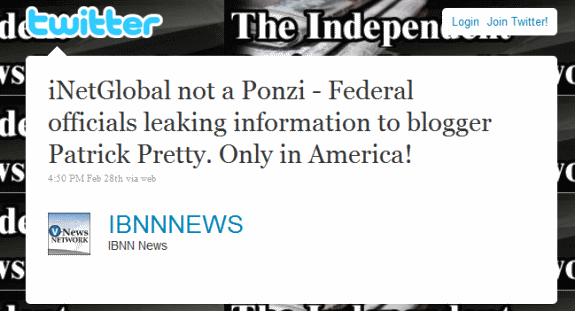
    IBNN’s Twitter site later reported that the Secret Service was “leaking” information to the PP Blog.  It simply did not happen. The Secret Service leaked no information to the Blog.

    While bashing the media in this context may provide some red meat for INetGlobal’s supporters, it does nothing to address the compelling reality that the allegations against Renner and his company are serious:

    Ponzi scheme. Wire fraud. Co-mingling. Suspicious withdrawals. Accounts closed by a bank that suspected criminal activity. Money-laundering.

    It’s the Minneapolis version of the ASD case. As was the case with ASD, INetGlobal is entitled to its day in court. It is entitled to argue passionately in its defense, and it is entitled to poke holes in the prosecution’s case. If the government does not have the goods, INetGlobal is entitled to win the forfeiture case and any future litigation that evolves.

    At the same time, INetGlobal members who support the company are entitled to argue their point of view passionately. They are not entitled, however, to be taken seriously if they spin events in ridiculous ways that cannot pass the giggle test.

    One difference between the INetGlobal forfeiture case and the ASD forfeiture case is that ASD did not appear to have gained traction in China. INetGlobal, though, does appear to have a substantial base of members in China. One of the issues in the INetGlobal case is language barriers: Can members who speak Chinese and have limited or no facility in English understand the business they joined and the complex litigation now engulfing the Renner companies?

    Neither bashing the government nor bashing the media does anything to address those concerns. Such an approach leads to questions about whether INetGlobal’s members who have limited facility in English are being ill-served by the efforts of English-speaking members to spin the story in ways that avoid the unpleasant realities and cloud the critical issues, which can be confusing even if a member has perfect understanding of English.

    On March 16, the PP Blog was provided a copy of an email some INetGlobal members received from their upline.

    “[T]he first court appearance which took place yesterday [March 15] went in favor of iNetGlobal,” the email claimed. It did not mention that a federal judge ordered Renner to wear the GPS tracking device as he awaits sentencing on four felony counts of income-tax evasion.

    Renner was convicted of the tax charges in December, more than two months prior to the Secret Service raid.

    Among the other claims in the email was that “[t]he judge in the case ordered the ‘Feds’ to release iNetGlobal payroll monies back to the company.”

    No such order appears to have been issued. Federal forfeiture law puts property that has been “arrested” — money in a bank account that has been seized, for example — in a state of limbo.

    Judges may entertain motions to have seized money released, but may be reluctant to release it out of concern the money will be “lost” prior to the conclusion of a forfeiture case.

    In general, the law seeks to avoid an inequitable result — for example, a decision to free money to pay employees could lead to a result in which less money would be available to compensate people who invested in a scheme and lost money.

    In the ASD case, the company asked for $2 million to be released. Collyer said no after hearing live testimony, weighing briefs submitted by attorneys from both sides and deliberating on the issues for several weeks.

    “The $2 million that ASD seeks to utilize are funds that were paid to ASD by advertisers and members,” Collyer ruled. “ASD has not demonstrated sufficiently that ASD is a legitimate business. Thus, the Court cannot release the funds to be used by the Company in its current form. And, if the plan to revamp ASD’s business proves unsuccessful, the citizens who paid that money will receive no advertising benefits and no return on their advertisement purchases. Quite simply, the money will be ‘lost’ forever.

    “Despite the obvious hardships endured by the employees of ASD and a great number of its members,” Collyer continued, “the Court cannot ignore its oath to uphold the law, nor can it rightly take the hardships of some and transfer them unto others.”

    Some of the same legal issues may come into play in the INetGlobal case, although the fact sets are not precisely the same. U.S. District Judge Donovan Frank is hearing the case, and the prosecution already has filed papers that reference ASD and a ruling by Collyer that ordered the forfeiture of more than $65 million to the government.

    Another section of the email was worded in a vague way that implied Donovan had arrived at the conclusion that INetGlobal might have the upper hand in the case.

    “Also indicated by the judge that inetGlobal should petition the court to have other funds released,” the email said.

    The mere act of petitioning a court for a result does not mean the court will rule favorably. That’s already been demonstrated in the INetGlobal case.

    Prosecutors sought to jail Renner, arguing he did not abide by the law while awaiting sentencing for his December tax conviction. Instead of jailing Renner, the judge ordered GPS tracking, enabling him to remain free.

    In the ASD case, members routinely spread misinformation after Collyer issued orders. When Collyer ordered ASD to file papers by a certain date, some ASD sponsors told downline members the prosecution had been ordered to prove ASD was a Ponzi scheme by the same date or lose the case.

    When Collyer ordered the government to file motions in response to Bowdoin’s pleadings by a certain date, ASD sponsors told downline members that the prosecution was in a panic because it could not prove ASD was a Ponzi scheme and was trying to find a way to save face.

    For at least a year,  the Pro-ASD Surf’s Up forum spread a rumor based on “inside information” that the prosecution had admitted behind closed doors that ASD was not a Ponzi scheme. The rumor persisted, despite the fact that the government filed a second forfeiture complaint against ASD-connected assets after the rumor started.

    Like the first complaint, the second complaint alleged the company was operating a Ponzi scheme. Not even the filing of the second complaint stopped the rumor, which was being repeated as though the court filings that disproved it simply did not exist.

  • FBI CHIEF: ‘Major Threats’ Emerging From ‘Stored Value’ Debit Cards And ‘Shell Corporations’; ‘Shadow Banking System’ Has Exploited Vulnerabilities

    EDITOR’S NOTE: Autosurf or HYIP promoter? White-collar fraudster of another stripe? Fan of “stored value” debit devices used in the context of well-publicized,  fraudulent business models? Owner of a “shell” company used to disguise the ownership of funds? Figure you’re smarter than the cops and that you’ve perfected your form of deceit as you pocket commissions and other payments based on that deceit?

    The director of the Federal Bureau of Investigation was talking about you in his testimony Wednesday before the House Committee on Appropriations, Subcommittee on Commerce, Justice, Science, and Related Agencies. He said you were making it harder for the FBI to do its job and making it easier on people who might want to do harm to the country’s financial system and the country itself.

    He didn’t mention your name, of course. But Robert Mueller III did ask for an additional budget outlay of $306.6 million next year as a means of neutralizing you before you could cause any more damage to the financial system and the national security of the United States.

    And here, all along, you thought he didn’t know, that the agents who serve under him didn’t know.

    They know. Call it anything you like — an “advertising” business, a financial “game,” a nontraditional investment that yields a high return, a new form of “gambling” or “arbitrage,” a multifaceted, multilevel-marketing program that pays a return based on visiting websites and recruiting other participants, a program for “good Christians” — and they still know.

    Tell your prospects that the government doesn’t understand either the program or the technology in use — and they still know.

    The reason they know is because they’ve seen it all before, watched it evolve, watched the changing explanations and terminology, watched the testimonials, watched the attempts to purify the “opportunities.” What they didn’t know, perhaps, was how devoted you were to your own criminality, how willing you were to put lipstick on a pig, how willing you were to be willfully blind to the obvious financial and security dangers to your neighbors because the money was just too good.

    They know now, though — and they also know about your criminal cousins who conduct equally vile businesses and perhaps have ties to the Mob and other groups of organized criminals, perhaps even terrorist organizations.

    Quick! Name your autosurfing or HYIP neighbor! What does he do at 3 a.m., when you’re sleeping? Are your commissions worth the risk he potentially poses to the security of the banking system and to the United States itself? What if he’s a [fill in the blank]? What if he’s amassing money to buy [fill in the blank?] What if he’s using the ATM machine to [fill in the blank?]

    Is the Cadillac you bought with commissions from a [fill in the bank] worth it? Will it be worth it when it gets seized as the proceeds of a criminal enterprise — and your neighbors wonder aloud how you ever became involved in a criminal enterprise? Will it ring hollow when you try to explain that you didn’t know you were involved in a criminal enterprise — or will it look like an attempt to mask your criminality?

    Mueller proposed an additional $232.8 million for salaries and expenses and $73.9 million for construction. If approved, the outlay would create 812 new positions, including 276 special agents, 187 intelligence analysts and 349 professional staff.

    Why is the agency seeking a larger outlay? Because the “additional resources will allow the FBI to improve its capacities to address threats in the priority areas of terrorism, computer intrusions, weapons of mass destruction, foreign counterintelligence, white collar crime, violent crime and gangs, child exploitation, and organized crime. Also included in this request is funding for necessary organizational operational support and infrastructure requirements; without such funding, a threat or crime problem cannot be comprehensively addressed.”

    The FBI, Mueller said, “saw an unprecedented rise in the identification of Ponzi and other high yield investment fraud schemes, many of which each involve thousands of victims and staggering losses — some in the billions of dollars.”

    New threats such as “stock market manipulation via cyber intrusion” also are emerging, Mueller said.

    Here, below, is the verbatim statement of Mueller when he was talking about you and other fraudsters. Note that he described you as a criminal, not a vastly misunderstood business person in an exciting, new arena that only few people understand. We have added the emphasis . . .

    Robert Mueller III“Money laundering allows criminals to infuse illegal money into the stream of commerce, thus manipulating financial institutions to facilitate the concealing of criminal proceeds; this provides the criminals with unwarranted economic power.

    “The FBI investigates money laundering cases by identifying the process by which criminals conceal or disguise the proceeds of their crimes or convert those proceeds into goods and services. The major threats in this area stem from emerging technologies, such as stored value devices, as well as from shell corporations, which are used to conceal the ownership of funds being moved through financial institutions and international commerce.

    “Recent money laundering investigations have revealed a trend on the part of criminals to use stored value devices, such as pre-paid gift cards and reloadable debit cards, in order to move criminal proceeds. This has created a “shadow” banking system, allowing criminals to exploit existing vulnerabilities in the reporting requirements that are imposed on financial institutions and international travelers.

    “This has impacted our ability to gather real time financial intelligence, which is ordinarily available through Bank Secrecy Act filings. Law enforcement relies on this intelligence to identify potential money launderers and terrorist financiers by spotting patterns in the transactions conducted by them.

    “The void caused by the largely unregulated stored value card industry deprives us of the means to collect this vital intelligence. Moreover, stored value cards are often used to facilitate identity theft. For example, a criminal who successfully infiltrates a bank account can easily purchase stored value cards and then spend or sell them. This readily available outlet makes it much more unlikely that the stolen funds will ever be recovered, thus costing financial institutions and their insurers billions of dollars each year.”

    Here is another snippet from Mueller talking about you . . .

    “The FBI focuses its efforts in the securities fraud arena on schemes involving high yield investment fraud (to include Ponzi schemes), market manipulation, and commodities fraud. Due to the recent financial crisis, the FBI saw an unprecedented rise in the identification of Ponzi and other high yield investment fraud schemes, many of which each involve thousands of victims and staggering losses — some in the billions of dollars.

    “With this trend and the development of new schemes, such as stock market manipulation via cyber intrusion, securities fraud is on the rise. Over the last five years, securities fraud investigations have increased by 33 percent.”

    We’ll close this column with a question or two for you: Did you really think that agencies such as the FBI and the U.S. Secret Service were going to sit back and watch you do this forever?

    Did you really think that you had no exposure as a promoter because you always could blame it on your upline and engage in willful blindness as you proceeded from program to program to program, dragging your downline with you from pig to pig to pig as you demonstrated your relentless willingness to paint with lipstick?

    Final note: They also know that some of you are penny-stock manipulators, tax-deniers, “sovereigns” and underground “credit-repair” specialists. Just a guess on our part, but we figure Andy Bowdoin’s lasting legacy to the “industry” will be as the man responsible for its long-overdue destruction.

    Records show that Bowdoin formed company after company, established corporate shells potentially with co-conspirators,  and that ASD and other knockoff autosurfs used “stored value” debit cards, unregulated or lightly regulated payment processors and money-services businesses, and other means to immerse themselves in the shadow banking system.

    The destruction of these miserable and dangerous “industries” is not going to happen overnight — but it is happening. The FBI, the U.S. Secret Service, the Justice Department, the SEC, the CFTC, the FTC, the U.S. Postal Inspection Service, the IRS and other agencies at the federal, state and local levels are going to make it happen.

    It’s going to happen because it has to happen. There never has been a worse time to be a white-collar criminal. The public at large wants to put you in jail and will not turn you into a folk hero as it did for Bonnie and Clyde and John Dillinger.

    You remind the public of Bernard Madoff, and it — the “it” being comprised of the vast majority of Americans and citizens of other countries who celebrate common decency and support the rule of law — simply is not willing to cut you any slack when you’re picking the pockets of your neighbors or the fellow congregants at your place of worship.

    Indeed, the public has seen all it is willing to take, and could not care less that you got your money without the benefit of a gun.  To the public, you’re worse than Bonnie and Clyde, worse than Dillinger himself, who robbed in the plain light of day.

    Robert Mueller wants to hire 276 more G-men and G-women  and 187 intelligence analysts — just to come after you and your criminal cousins.

  • Death Cycle For BizAdSplash Complete; Site Resolves To Blank Page On U.S. Server; Members’ Losses Unclear

    It entered the autosurf world in January 2009 with the stern bang of a drum in a promotional video. The message was dire: “The World Is In Crisis,” it warned. “Turn On The News, And You’ll See. The Stock Market Is At A Record Low. Foreclosures Are At An All-Time High. Thousand’s (sic) Are Losing Their Jobs. Banks Are Closing. There Has To Be A Solution!”

    The dire bang of the drum faded, replaced by a riff from an organ. The riff grew frantic, building toward a crescendo. The video never said the tones were from a 1999 work by Fatboy Slim: “Right Here, Right Now.”

    Messages flashed in front of viewers’ eyes for more than a minute before the video announced the company’s name — BizAdSplash — and positioned the surf as the cure for all the economic misery in the world.

    “Biz Ad Splash Has The Answer,” it said. “The Plan Is Simple. Advertise Your Business, A Product Or Service, Introduce Others To The Value Of Advertising. View A Few Ads For A Few Minutes A Day. Earn Profits. It’s That Simple!”

    Except it wasn’t, of course.

    BizAdSplash, whose “chief consultant” Clarence Busby was implicated by the U.S. Secret Service in the AdSurfDaily Ponzi scheme probe as the operator of Golden Panda Ad Builder, was in the throes of death out of the gate. The company started out by promoting its offshore location; its servers resolved to Panama.

    Payments slowed, then vanished. The site appeared, then disappeared, then reappeared. Even as BizAdSpash was in the throes of death, Busby talked about how “excited” he was — and how “excited” members who were not getting paid should be.

    The site disappeared again over 2009’s Christmas holiday and into the new year. It then reappeared. In late January, members said they received a platitude-filled note from Busby that BizAdSplash had tanked.

    “Now what about the future?” the email said. “No matter what, there is a future. There are many things on the Internet that will help you in this future, so don’t give up. Make the effort and success is just right around the corner. May your life be full of faith, hope and love. This is where you will find your best rewards. May God bless you all!”

    Busby’s name appeared at the bottom of the email, which carried a business address of Acworth, Ga. The surf came to life in the wake of the seizure of tens of millions of dollars from AdSurfDaily Inc. and Golden Panda Ad Builder. Busby is the former president of Golden Panda, which ceded more than $14 million to the government in the ASD/Golden Panda case.

    Known for syrupy communications, Busby described the BAS staff as “sad,” according to the January email.

    “Our staff has been sad, not just because of losing a job, but because they have developed friendships with many of you and are very sad to ‘break up the party,’” the email said. “With anything that has had life, it is very sad to have that life taken away.”

    Busby was identified in the email as the owner of BAS. In earlier communications, he was identified as “chief consultant.” It was not immediately clear how he purportedly had ascended from consulting work to ownership.

    The site remained online. It now has vanished, however, and has been resolving to a blank page for at least three days. (It might have disappeared earlier.) The site’s server signature is in the United States.

    Now, it seems, the death dance is complete — offshore to onshore, and a fade to nothing but white.

    But the Biz Ad Splash video, the dire beat of the drum and Fatboy Slim’s pulsating tones remain on YouTube: It’s just that there no longer is anything to sell.

    Busby’s simple cure for the world’s economic ills — clicking on ads and introducing others to click on ads — did not work. The extent of Biz Ad Splash member losses is unclear.

    Busby, who used the title “Rev.” at least 120 times in a court filing involving Golden Panda last year, was implicated by the SEC in three prime-bank schemes in the 1990s, according to records.

  • AdSurfDaily’s Bowdoin Says He’s Appealing Forfeiture Order Issued By Federal Judge; Notice Filed 6 Days After INetGlobal Raid; Riddle Of Bowdoin’s Competing Affidavit Claims Unsolved

    Andy Bowdoin

    The president of a Florida-based autosurf company implicated in a Ponzi scheme by the U.S. Secret Service says he is appealing a forfeiture order that gave the government title to more than $65 million seized from his personal bank accounts in 2008.

    Notice of the appeal by Andy Bowdoin of AdSurfDaily was filed by his attorneys March 1, about six days after federal agents — citing the Jan. 4 forfeiture order by U.S. District Judge Rosemary Collyer of the District of Columbia — raided the Minneapolis offices of INetGlobal.

    In an affidavit for a search warrant last month, the Secret Service said INetGlobal, a company operated by Steve Renner, was operating a similar autosurf Ponzi scheme and also engaging in wire fraud and money laundering.

    The INetGlobal affidavit asserts, among other things, that a member of ASD attempted to recruit an undercover Secret Service agent into INetGlobal despite the member’s own reservations about ASD.

    INetGlobal was described by the ASD member as a wink-nod enterprise, according to the Secret Service affidavit. The company “uses the same terminology and business model as ASD,” the agency said.

    In court filings prior to the INetGlobal raid, Bowdoin’s attorneys laid the groundwork for an appeal of Collyer’s Jan. 4 forfeiture order on the grounds of judicial error, arguing that Bowdoin had not received proper notice about orders Collyer issued last year and did not react to them because of computer glitches at the office of one of his attorneys, Charles A. Murray.

    “I experienced as yet unidentified computer/server issues, wherein multiple email messages apparently never loaded to the firm’s Inbox,” Murray said in court filings on Feb. 17.

    The glitches occurred between Nov. 10 and “early January” of this year, Murray said.

    Paperwork for Bowdoin’s appeal shows a “minute order” issued by Collyer Feb. 21, denying earlier motions by Bowdoin.

    A “minute order” is a document that encapsulates legal issues before a judge. Minute orders sometimes are used when paperwork among the parties in a case is flying and a judge memorializes rulings by addressing them in a short entry, as opposed to issuing lengthy orders for each issue.

    “The Court’s Order of November 10, 2009 . . . was not a final, appealable order,” according to Collyer’s minute order. “Nor has Mr. Bowdoin shown that the Court erred in entering . . . the November 20, 2009, Order to Show Cause. The order granting default judgment and final order of forfeiture . . . is the final order in this case.”

    On Nov. 10, Collyer ruled that Bowdoin no longer had standing in the case after he had battled for 10 months to reenter the case. Bowdoin submitted to the forfeiture in January 2009 — and then changed his mind, first acting as his own attorney and later acting with Murray’s help because Bowdoin had fired his previous paid counsel.

    On Nov. 20, Collyer issued an order that gave potential claimants in the case 30 days to come forward. No claimant emerged. On Dec. 17, however, Bowdoin filed a motion to disqualify Collyer, saying she was biased. Collyer denied the motion Dec. 18. She issued the forfeiture order Jan. 4.

    In February, Bowdoin, 75, flatly claimed in a sworn affidavit that he was told by a former defense attorney that, if he submitted to the forfeiture in January 2009 of tens of millions of dollars, he would face no jail time if criminal charges were filed in the ASD Ponzi scheme case.

    He did not name the attorney in the February filing, referring to him obliquely as “prior counsel.” In an earlier filing, Bowdoin identified his counsel as Stephen Dobson.

    “I was assured by my prior counsel that, if I released my claims in this [civil-forfeiture] action, I would not be facing any incarceration,” Bowdoin claimed last month. “My January 2009 motion to withdraw my claim . . . was solely based upon prior counsel’s unilateral mistaken belief that my release of claims would unequivocally assure that any subsequent criminal sentence entered would not include any prison time.”

    Last month’s filing was witnessed by Florida notary public Joe B. Cox of Lee County.

    But in a sworn affidavit Bowdoin signed Sept. 15 before a different notary public — Patricia C. Sanson of Lee County — Bowdoin repeatedly said Dobson had said only that there was a possibility Bowdoin would not be sentenced to prison if criminal charges emerged.

    In the Sept. 15 affidavit, Bowdoin repeatedly swore that Dobson had not promised him no jail time.

    These are among the phrases Bowdoin swore to in the Sept. 15 affidavit (emphasis added):

    • Dobson represented to me that I could possibly avoid prison or get a reduced sentence if I agreed to disclose details concerning ASD and releasing the assets.
    • I also signed a document stating that I would release my claims in the abovecaptioned civil in rem forfeiture proceeding, again thinking that necessary for a possible avoidance of a prison term.
    • I did all of this on the understanding that by cooperating I could possibly avoid a prison sentence.
    • I agreed not to exercise my rights in the civil forfeiture proceeding, anticipating from representations made by Dobson that this could possibly keep me out of prison.
      Dobson lead [sic] me to believe that if I cooperated there was a possibility that I would not be incarcerated or imprisoned.
    • I believed that my cooperation would still result in a criminal sentence that could possibly not include imprisonment or incarceration.
    • I slowly came to understand what I understood from Dobson not to be the case: that my agreement to cooperate provided me no benefit in the criminal matter except the possibility of a reduced sentence if the judge desired which would still be a life sentence.

    Bowdoin’s filing last month led to questions about whether he deliberately chose to appear before a different notary to swear to the affidavit. At the same time, it led to questions about whether Bowdoin somehow was unaware that Collyer already had cited Bowdoin’s Sept. 15 sworn affidavit in a major ruling that Bowdoin no longer had standing in the case.

    On Nov. 10, Collyer noted Bowdoin’s repeated use of the words “possibly,” “possible” and “possibility” in the Sept. 15 affidavit when referring to the advice Dobson had given him on the matter of jail and finding that Dobson had behaved responsibly while representing Bowdoin.

    “Such an approach from counsel could be seen as the norm when the Government’s evidence is strong,” Collyer said. “What Mr. Bowdoin hoped to gain from his release of claims/early acceptance of responsibility and his debriefing with the Government was a promise of no jail time. When that was not forthcoming from the Assistant United States Attorney, Mr. Bowdoin balked and tried to back up, as if he had not already released his claims and talked to the Government.”

    There may be other news associated with Bowdoin’s appeal: The filings suggest that William Cowden, who spearheaded the forfeiture case for the Department of Justice as an assistant U.S. Attorney and then accepted a job in the private sector, may be returning as a special prosecutor while maintaining his job in the private sector.

    Cowden was derided by Bowdoin supporters as “Gomer Pyle,” but piloted the case through an evidentiary hearing that resulted in a ruling from Collyer in November 2008 that ASD had not demonstrated it was a legal business and not a Ponzi scheme.

    With the Secret Service leading the investigation, Cowden then filed a second forfeiture complaint against assets linked to ASD. The second complaint was filed in December 2008 and named members of Bowdoin’s family as beneficiaries of ASD’s illegal scheme.

  • Timeline Suggests INetGlobal Was Pounding Clickbank Vendors With Traffic From China In Months Proceeding Raid While Sucking Bandwidth And Destroying Conversion Stats

    EDITOR’S NOTE: Untargeted, unfocused traffic and participants who did not have websites to advertise are two of the issues in the AdSurfDaily autosurf Ponzi scheme case. They also are issues in the INetGlobal case.

    UPDATED 8:20 A.M. ET (March 10, U.S.A.) Public records and other information suggest INetGlobal was becoming largely dependent on cash from Mainland China and was routing unwanted traffic that did not convert into sales to the sites of Clickbank vendors — while passing along the bandwidth costs to the vendors and grossly distorting  their conversion statistics.

    In an affidavit for a search warrant, the U.S. Secret Service, citing an analysis of INetGlobal’s money stream by an unnamed employee, said “at least 87% of the company’s revenue was generated from sale of memberships to members residing in China.”

    The affidavit also describes an INetGlobal function in Flushing, N.Y., on Jan. 23 that was attended by at least two undercover agents.

    About 400 people attended the function, the Secret Service said. The “majority” were Chinese. Attendees to whom an undercover agent spoke “had either little or no facility in English.” The agent noted that that “conference registration took a long time because nobody at the registration desk spoke Chinese, and many of the conference attendees could not make themselves understood in English.”

    Moreover, the agent said, when INetGlobal owner Steve Renner “asked, through an interpreter, how many people in attendance had their own business . . . only two raised their hands.”

    One attendee — an existing INetGlobal member — was asked by the second undercover agent if she had a website to advertise in INetGlobal’s rotator.

    The INetGlobal member — a woman Renner had identified as a “New Jersey resident making $6,000 per day, or $180,000 per month” — said she had no site to advertise in the rotator because having a website “was not required,” the Secret Service said.

    A second INetGlobal member approached by the same undercover agent was asked if he had a website to advertise in the rotator. This member — a man described as telling the agent he made $3,000 a month in INetGlobal — explained that he had a website, but did not post it because “it was ten years old,” the Secret Service said.

    Renner was observed telling different stories, the Secret Service said. One version had INetGlobal posting $25 million in revenue in December; another version “a short time later” pegged the figure at $20 million. Renner also said “iNetGlobal’s search engine, Access, would soon rival Google’s.

    “Renner did not explain to the crowd that Access was simply a link to another search engine, and that an Access web search was just the same as a web search on this other search engine,” the Secret Service said.

    Despite the claim that INetGlobal’s search engine would rival Google’s, the Secret Service said, internal company emails discussed “the possibility of the other search engine cutting the link and thus taking down Access.”

    A Public Tip-Off From Renner Himself That INetGlobal Was Up To No Good?

    Meanwhile, web records suggest that INetGlobal — at least for a time — either took it upon itself to add the sites of Clickbank vendors to its advertising rotator or instructed members who did not own businesses to add Clickbank links, an act that resulted in a surge of traffic from China that led to few if any sales. The apparent lack of sales suggests that Chinese members viewing the ads either did not understand what they were viewing or were viewing the ads simply to get paid.

    At the same time, web records suggest that INetGlobal was relying on the websites of individuals and companies that had no tie to the firm to provide surfers something to see in the firm’s advertising rotator — at the bandwidth expense of the unaffiliated companies and individuals, at least some of whom were Clickbank vendors.

    One of the Clickbank vendors — writing on the Digital Point Forum Sept. 26 — reported that he was studying his Clickbank affiliate stats and discovered something “REALLY messed up.”

    The vendor reported on Digital Point that the ID “inetgbal’ suddenly was sending  junk traffic that “appears to be coming from China.”

    The vendor published screen shots to support his claim and noted, “If you do a ‘surfin demo’ on the iNetGlobal website, you’ll see it takes you to random CPA offers and Clickbank products.”

    On Sept. 27, the vendor reported on Digital Point that he considered the traffic problematic and was considering a means of blocking it at the server level with the use of an .htaccess file.

    Working with .htaccess files, which can be used to block traffic from an IP or IP range, is not for the faint of heart. It is not uncommon for inexperienced webmasters to bring down their own servers or create an endless loop of error messages when attempting to tweak server behavior with an .htaccess file.

    Recognizing the dilemma, the Clickbank vendor put out a call for “good coders” to walk him through a fix for a problem he believed INetGlobal was causing for him.  Other posters inquired about the possibility of asking Clickbank to block the unwanted affiliate link.

    The discussion on the forum suggests INetGlobal was creating a situation in which Clickbank affiliates might have to incur an expense simply to block unwanted traffic — while creating the additional burden of polluting conversion statistics, potentially making the products less attractive to affiliates.

    If, say, a product ordinarily made one sale per each 100 views of an affiliate link — and if INetGlobal suddenly sent through 1,000 page views from China (er elsewhere) that did not convert because the traffic was untargeted or people simply were surfing to get paid — a vendor’s conversion rate could drop from one in 100 to one in 1,100.

    On Nov. 6, 2009, a person posting as Steve Renner — the “Director” of INetGlobal — appeared at Digital Point. A little more than a month later, Renner was convicted of income-tax evasion in a case brought in September 2008.

    Less than three months after Renner’s tax conviction, the Secret Service asserted that INetGlobal was part of an international Ponzi scheme that had engaged in wire fraud and money-laundering.

    “The problem was we had no Daily Budget in place and so traffic was running rampant,” the Digital Point poster purporting to be Renner explained on Nov. 6.

    The Clickbank vendor did not mince words in his response to the Nov. 6 post. Others were equally unhappy.

    Visit the intriguing thread on Digital Point.

  • Website Of Spokesman For Renner Entity Claims Government ‘Leaking’ Info To PP Blog About INetGlobal Ponzi Probe; ‘Didn’t Happen — Ever,’ Blog Says; Meanwhile, A Bogus ‘Apology’ Claim

    UPDATED 2:20 P.M. ET (U.S.A.) Did people associated with a company implicated by the U.S. Secret Service in a Ponzi scheme, wire-fraud and money-laundering case participate in a misinformation campaign?

    A Twitter website with a tie to the Inter-Mark companies operated by Steve Renner claims that federal officials are “leaking” information to the PP Blog.

    “Didn’t happen — ever,” the PP Blog said today. “The information we published was not leaked to the Blog. The Blog obtained the information from a public source, through the normal course of its reporting, and the information was available to reporters and the public before the Blog even published its first story based on the information.”

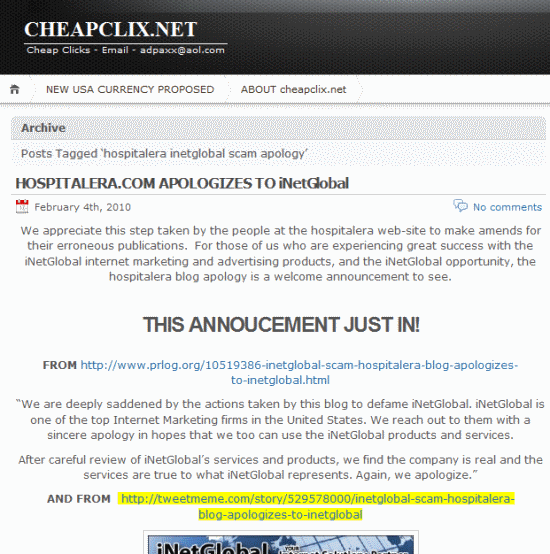
    Meanwhile, another website with a tie to a Renner’s Inter-Mark Corp. is making the claim that a Blogger Inter-Mark is targeting in a lawsuit for calling INetGlobal a “scam” issued an “apology.”

    The apology claim appears on a domain titled CheapClix.net, whose domain registration lists V-WEBS.COM as its nameserver. A Renner company dubbed V-Webs LLC appears to be an inactive Minnesota corporation that used the same Minneapolis street address as InetGlobal and other Renner companies, according to public records.

    A CheapClix.net post headlined “HOSPITALERA.COM APOLOGIZES TO iNetGlobal” and dated Feb. 4 claims that the Hospitalera Blog issued an apology to INetGlobal on a date uncertain and implies that Hospitalera now even endorses INetGlobal.

    “We are deeply saddened by the actions taken by this blog to defame iNetGlobal,” the CheapClix.net site says, apparently quoting from the purported apology. “iNetGlobal is one of the top Internet Marketing firms in the United States. We reach out to them with a sincere apology in hopes that we too can use the iNetGlobal products and services.

    “After careful review of iNetGlobal’s services and products, we find the company is real and the services are true to what iNetGlobal represents. Again, we apologize.”

    The apology claim is dubious because Sybille Yates, who operates the Hospitalera Blog from the Czech Republic, told the PP Blog last week that she was not even aware that Renner’s company was suing her until Feb. 25 — three weeks after the date of her purported apology.

    Yates did not immediately return an email from the PP Blog today seeking comment on the apology claim and whether she had, in fact, apologized. A Feb. 16 post  from Yates on the Hospitalera Blog, however, describes the news release that announced the apology as “faked.”

    Whether the apology claim somehow sprouted from some fantastic reshaping of facts by an INetGlobal supporter or was just an outright lie that was part of a misinformation campaign was not immediately clear.

    It has been common in the so-called autosurf “industry” for lies, misstatements, misrepresentations, misinformation and claims not based on facts to spread virally on the Internet as though they were truth.

    In the AdSurfDaily case, for instance, claims were made that the prosecution admitted ASD was not a Ponzi scheme, that ASD President Andy Bowdoin had received an award from the President of the United States for business acumen, that Google and ASD were partners and that ASD had the backing of huge corporations with huge advertising budgets.

    All of the claims were untrue.

    The CheapClix.net claim about the purported apology adds another strange twist to the INetGlobal story. If Yates never issued such an apology — and Yates’ Blog says no such apology was issued — it leads to questions about why someone would claim such an apology had been issued and even go so far as to issue a news release to announce an apology that had not been made.

    The introduction to Hospitalera’s purported apology as reported by CheapClix net begins, “We appreciate this step taken by the people at the hospitalera web-site to make amends for their erroneous publications.”

    The CheapClix.net post from Feb. 4 includes a link to what appears to have been a news release issued by an unknown party to herald Hospitalera’s purported apology. The news release link to PRLog.org resolves to an error page. PRLog.org is a free news-release distribution service.

    Yates’ Blog says she contacted PRLog to have the fake news release removed, and that PRLog took down the bogus release “in a heart beat.”

    UPDATE 2:20 P.M. Yates has confirmed she never issued an apology.

    “I never issued said apology, nor did I ever authorize anybody to do so in my name,” Yates said.

    “I never issued or published a press release on prlog.org. As I came across the forged and false press release, I contacted prlog.org immediately and they took it down. I have no information who published/submitted said press release to prlog.org.”

    A second link in the CheapClix.net post that heralded the purported apology resolves to TweetMeme.com, a site that aggregates Twitter links. A small icon that reads “V News Network” appears below a headline of “iNetGlobal Scam: Hospitalera Blog apologizes to iNetGlobal.”

    Records suggest that “V News Network” may be yet another Renner entity.

    A headline heralding a purported apology from the Hospitalera Blog for calling INetGlobal a scam appears on a website known as CheapClix.net. The Hospitalera Blog says the apology was "faked."

    ‘Leaking’ Claim

    Why the Twitter site, which is tied to IBBN.org, made the claim of that the government was “leaking” to the PP Blog is unclear. The Twitter post is dated Feb. 28. IBNN, which stands for The Independent Business News Network, is registered in Renner’s name. The site is operated by Donald W.R. Allen II, IBNN’s editor-in-chief and the the vice president and director of public relations for V-Newswire — a company in Renner’s INetGlobal family.

    Renner is listed as the IBNN domain registrant.

    Allen did not comment Friday when the PP Blog advised him that the government leaked no information to the Blog. The Twitter site does not list a source for its claim that federal officials “leaked” information to the Blog, but asserts that such an event was possible “Only in America!” The Twitter site continues to make the claim.

    The site also claims “iNetGlobal not a Ponzi.” No source is listed for the denial. It is unclear if IBNN has access to audited and certified balance sheets and financial statements of the Renner enterprise that could destroy the government’s Ponzi assertions.

    IBNN previously skewered the Star-Tribune newspaper of Minneapolis/St. Paul, asserting that the paper, which covered the INetGlobal raid, was displaying  “defamatory contempt [for the Renner entities] prior to a full investigation and a Grand Jury inquiry.”

    Allen, who signed the IBNN opinion piece, did not disclose his tie to the Renner companies when the piece was published. The piece went missing after the PP Blog published a story in IBNN’s tie to Renner, but since has been restored — with a few lines added.

    The U.S. Secret Service, which raided Renner’s operations in Minneapolis last month, asserted that INetGlobal and other Renner companies were part of an international Ponzi scheme that was engaging in wire fraud and money-laundering.

    The PP Blog cited as its source a Secret Service affidavit for a search warrant. The affidavit was published openly on a government website.

    At various times in its history, the PP Blog has been accused by participants in alleged Ponzi schemes of being part of a government operation. The Blog has reported on paranoia that often accompanies Ponzi scheme participants, some of whom become preoccupied with thoughts about government “plants.”

    Such claims about the PP Blog have been made from one Ponzi scheme case to the next, but they simply are not true. Ponzi promoters have accused the Blog of idiocy, occasionally resorting to name-calling or posting under multiple identities in a bid to create the appearance that a particular company caught up in Ponzi allegations the Blog was covering had more supporters than it actually had.

    As was the case with AdSurfDaily, a Florida company implicated in an autosurf  Ponzi scheme by the Secret Service in 2008, the Secret Service used undercover agents as part of the investigation into INetGlobal, according to a court affidavit. At least one of the undercover agents also was involved in the ASD investigation, according to court filings.

    Other court filings reviewed by the PP Blog have described various investigative techniques the agency uses, including surveillance from automobiles of subjects under investigation at places such as residences, parking lots and post offices — and even trash Dumpsters.

    At least two Secret Service agents were in the room to observe an INetGlobal function in New York, according to court filings. Agents also observed an ASD function in Miami in 2008, according to court filings.

    An agent involved in the ASD case listened to an INetGlobal sales pitch by an ASD member, according to the affidavit in the case.  It is plain from multiple public filings that the Secret Service is well aware of the so-called autosurf “industry” — and also the so-called “matrix” industry.

    It was publicly known that Renner had been under federal indictment for income-tax evasion since September 2008, a month after the ASD raid. There also is a considerable, public paper trail consisting of court filings, news releases and other information that links Renner to a Ponzi scheme known as Learn Waterhouse, elements of which were prosecuted by both the SEC and the U.S. Department of Justice.

    The public paperwork in the Learn Waterhouse case dates back to 2004. A Renner entity known as CCI provided payment-processing services for the Learn Waterhouse Ponzi scheme.

    Visit the Hospitalera site.

    Read about the purported apology on CheapClix.net.

  • EDITORIAL/ANALYSIS: Events Are Controlling DNA, Not The Other Way Around; Prosecutor’s Office Mum On Narc That Car Inquiry In Texas

    This Narc That Car promoters' check-waving video is now missing from YouTube's public channel, after being placed there March 1. The video, however, is said to be available through a private YouTube channel. It is unclear whether Narc That Car asked its promoter — "Jah" of the Cash For Car Plates Blog — to remove the video, which also claimed repping for Narc That Car was like working for the U.S. "Census Bureau."

    First, some news: A website titled DeanBlechman.com now resolves to a parked page at the offshore registrar directNIC. As first reported on the PP Blog, the site previously redirected to the website of Data Network Affiliates (DNA).

    directNIC is “based in Grand Cayman, Cayman Islands,” relocating from its former base in Louisiana after Hurricane Katrina, according to the firm’s website. directNIC is DNA’s registrar, and also the registrar for the DeanBlechman.com domain and a DNA-associated domain known as TagEveryCar.com.

    In a bizarre autoresponder message earlier this week, DNA said it had chosen “privacy” protection for $5 “to prevent management from having to “put up with 100 stupid calls a day,” a source told the PP Blog.

    In an interview Wednesday with the Blog, Blechman, DNA’s former chief executive officer, said he was “surprised” to learn of the DeanBlechman.com site, painting a picture that the company was not in control of its own message and had a “back door guy” who was authoring “bizarre” communications.

    Blechman did not identify the “back door guy.” Precisely when the DeanBlechman.com domain stopped redirecting to DNA’s website is unclear. It was still redirecting to the site early yesterday, but now is resolving to the directNIC page.

    Meanwhile, the PP Blog contacted the office of R. Scott McKee, the district attorney of Henderson County, Texas, yesterday. McKee is training for deployment to Iraq, and was not available immediately to answer questions on his inquiry into Narc That Car, according to a woman who answered the phone.

    The woman said it was possible that an assistant prosecutor would contact the Blog, but the call was not returned yesterday.

    McKee’s office opened a civil inquiry into Narc That Car (NTC) more than a month ago, turning to the office of Texas Attorney General Greg Abbott for assistance and saying it had received “numerous calls and complaints inquiring into the legitimacy and legality” of NTC.

    How that inquiry is proceeding is unclear. Two days ago, the Dallas branch of the BBB reduced its rating on NTC from “No Rating” to “F,” the worst possible rating on the BBB’s 14-step scale that begins with “A+.”

    NTC now joins companies such as AdSurfDaily and Speed of Wealth as firms that have scored an “F.”

    It is possible that NTC could improve its score at the BBB over time, but the score of “F” it holds now was arrived at after the company had been given more than a month to explain its compensation program to dampen pyramid concerns. The BBB also said it asked NTC to “substantiate some claims made in its advertising” Jan. 18. That inquiry remains open.

    NTC does not publish the name of customers of its database product. Some affiliates have claimed the firm was associated with major automobile manufacturers, the FBI, the Department of Homeland Security and the AMBER Alert program.

    The company removed a video reference to the AMBER Alert program after the U.S. Department of Justice, which administers AMBER Alert, denied it had any affiliation with NTC.

    ASD never improved its BBB score because it became consumed by a government investigation. ASD is implicated by the U.S. Secret Service in a Ponzi scheme.

    Speed of Wealth, which also became consumed in government litigation, also did not improve its BBB score. It is implicated by the SEC in a Ponzi scheme involving Mantria Corp., whose BBB rating is being “updated,” according to the BBB. Mantria currently is listed as “No Rating.”

    On another matter, MLM aficionado Troy Dooly now is openly challenging DNA officers Arthur Kurek and Donald Kessler to explain what is happening at the company.

    Rumors are rampant that Phil Piccolo, a notorious figure in MLM, somehow had become involved in DNA. Absent a firm denial from company management, the rumors continue to fly.

    For his part, Blechman, DNA’s former CEO, did not rule out that Piccolo was involved in the firm.

    In the absence of a unified message from DNA and plain statements on issues such as whether Piccolo is involved and what steps have been taken to assure that DNA is compliant with state and federal law, events are controlling DNA, not the other way around.

    The suggestion that “privacy” protection was chosen so management would not have to put up with “stupid” calls is patently absurd — as is the amount of hype being put out under DNA’s name.

    No one at the company has emerged to speak on issues of legality and privacy. DNA says it is in the business of recording license-plate numbers. Like Narc That Car promoters, DNA promoters have made sweeping statements, asserting that affiliates could record plate numbers at places such as Walmart, Target, church parking lots and parking lots at doctors’ offices.

    Company conference calls have been cheerleading sessions — with DNA’s own pitchmen leading the cheers.

    Whether DNA and NTC affiliates are required to seek  permission from owners of private property or the permission of local jurisdictions to record plate numbers remains unclear. Also unclear is how affiliates are required to behave if confronted by property owners or police who question what they are doing.

    Sweeping assertions have been made by affiliates that plate data is “public information” available for the taking in the parking lots of large retail stores. One NTC promoter said on YouTube that his wife recorded plate numbers at a university. The PP Blog believes the university was the University of Nevada, Las Vegas.

    The office of Sen. Harry Reid, D.-Nev., did not return a call from the Blog seeking comment on the practice recommended by the NTC promoter. Nor did Reid’s office return an email sent by the Blog. Reid is Senate Majority Leader. One of the buildings on UNLV’s campus bears his name. The same NTC promoter recommended “libraries” as excellent sources of plate numbers.

    Among the privacy concerns is whether the companies, which appear to be targeting as clients of the database product firms that repossess automobiles, could use the data to create profiles on the movement of people.

    In a DNA conference call, one company pitchman said DNA hoped to attract enough affiliates to make it possible for the company to record a plate number at Walmart at noon — and the same plate number at a “doctor’s office” at 1 p.m. and the same plate number elsewhere at 4 p.m. The same pitchman suggested churches were good sources of license-plate numbers.

    Adding to the fog of uncertainty is a pattern of strange communications from the firm, which is using Google’s free gmail service to conduct customer service. Emails received by DNA members do not include a street address, which brings issues of transparency into play and potentially brings issues of federal compliance into play.

    The PP Blog, which is a Blog among millions of Blogs, has received repeated affiliate spam from DNA and Narc That Car promoters. For weeks, there was no way even to contact DNA to report spam. The Blog will not contact the company via the gmail address — which was made public only days ago –out of concern its email address will be harvested and added to a database controlled by an unknown party.

    Narc That Car, meanwhile, has a “Span Policy” — as opposed to “Spam Policy” — link at the bottom of its website. Some of its promoters have produced check-waving videos, including a video that claimed repping for NTC was like working for the “Census Bureau,” a government agency.

    One of the videos showed that NTC payments are issued by check drawn on the account of “National Automotive Record Centre Inc.” That entity, which uses the word “National” in its name and the British spelling of “Centre” — as opposed to the U.S. spelling of “Center” — is registered in Nevada. NTC also is associated with a Texas company known as Narc Technologies, which, according to a YouTube video now made private, once issued checks for affiliates.

    These things hardly inspire confidence in the NTC enterprise.

    Just this morning, the PP Blog received information from a DNA member that the company emailed members, claiming “D.N.A. archived e-mail communications were erased by design.

    “We will send you the last 3 e-mail communications within the next 24 hours,” the email said. “If you do not wish to receive D.N.A. Daily Communications please visit your back office.”

    Even if the email was perceived by management as a means of demonstrating that DNA was trying to gain control over its message, such a communication only leads to more questions. The email did not include a street address. It also implied that members needed to opt out of communications by doing so within their back offices, rather than opting out by clicking on a link at the bottom of emails they receive.

    The hype from DNA and its promoters — dropping names of icons such as Donald Trump and Oprah Winfrey — and making claims that a “MEGA MILLION DOLLAR DEAL with a publicly known industry giant” and a “Top Secret Product” are on the horizon are rubbing some MLM aficionados the wrong way.

    MLM has a miserable reputation. Messages from DNA are doing the industry no favors.

    If DNA is attempting to seize back its communications apparatus, it needs to explain precisely why it lost control of it early on. And a corporate face must emerge for the company — one who is willing to answer the hard questions on the propriety, safety, legality and privacy concerns the firm is sparking.

    For now, at least, it is a tangled web fueled by hype that ducks the issues and causes the company to look silly — day after day.

  • Spokesman For Renner-Related Company Did Not Disclose Tie In Opinion Piece That Attacked Star-Tribune Newspaper; Name Is Referenced In Secret Service Affidavit; Declines To Answer Questions From PP Blog

    UPDATED 2:25 P.M. ET (March 2, U.S.A.) The vice president and director of public relations for V-Newswire — a company in Steve Renner’s INetGlobal family — authored an opinion piece lambasting a Minnesota newspaper’s coverage of a Secret Service raid at INetGlobal’s Minneapolis offices last week on his personal Blog, but did not disclose his tie to the firm.

    Donald W.R. Allen II operates a Blog known as The Independent Business News Network (IBNN). Allen did not disclose his INetGlobal tie when authoring an editorial titled, “Minneapolis’ Star Tribune newspaper’s bias reporting causes defamatory speculation at Internet marketing firm.”

    The piece began, “If the Star Tribune newspaper can use its ‘power’ to taint a company’s image prior to investigation by authorities, whose (sic) to say the news you get is true and accurate?”

    The Star-Tribune was among the first media outlets to report that federal agents believed INetGlobal was operating a Ponzi scheme.

    Information gleaned during the federal probe led to allegations that INetGlobal also was engaging in wire fraud and money-laundering.

    Allen, whose name is referenced in a search-warrant application in the INetGlobal case, now says he should have disclosed the tie in the IBNN editorial.

    “I will give full disclosure on the iNetGlobal piece today because I have 3 more follow up stories,” he said this morning. He asserted that the IBNN domain, which is registered in Renner’s name under the organization of V-Webs LLC, “has nothing to do with iNetGlobal other than being registered by the company as part of my employment agreement.”

    Allen defined the IBNN Blog as a “Civil Rights, Politics and News Blog for mostly the Twin Cities area.” IBBN’s site content includes an endorsement of the Tea Party Movement in the United States and a “Declaration of Tea Party Independence.”

    Allen emailed the PP Blog Sunday after appearing at the Blog, posting comments and using the IBNN URL, not a URL associated with the Renner companies. He dismissed the Blog as “minor league,” writing it was engaging in a “witch hunt.” The Blog responded to Allen’s email by asking him to comment on a number of issues concerning INetGlobal and inquiring why he was using the IBNN URL if he was a spokesman for a Renner entity.

    Later in the day, Allen responded to the Blog’s questions by saying he would answer questions about his role at V-Newswire, but he did not address the questions the Blog asked previously.

    The Blog then resubmitted the questions, adding several more questions to a list of four it previously had asked. Allen responded to the email, but chose not to answer a number of questions.

    Among the questions Allen declined to answer was whether INetGlobal, in the aftermath of the Ponzi scheme allegations, believed it should inform members about Steve Renner’s December conviction on four felony counts of income-tax evasion. Allen also declined to answer a question on whether INetGlobal had a duty to inform members that Cash Cards International (CCI) — a payment processing firm once operated by Renner — could not return money to Ponzi scheme victims in a case brought by the SEC against a California company known as Learn Waterhouse because Renner had spent the customers’ money.

    Allen did say he saw “nothing illegal with V-Newswire or the V-News Network.”

    The Blog asked Allen whether he was the “Donny Allen” referred to in an INetGlobal news release and the “Donald Allen” referred to in a Secret Service affidavit that alleged “Donald Allen” provided confusing information to a person who attended an INetGlobal function in New York.

    Allen did not answer the question, which the Blog posed twice.

    Undercover Secret Service agents also attended the New York function, according to the affidavit.

    The PP Blog also asked Allen whether he believed he should disclose his tie to INetGlobal when responding to Blog and forum posts. He declined to answer the question, which was posed twice.

    He also declined to answer a question about how it served INetGlobal’s PR ends to dismiss as “minor league” Blogs that report the serious allegations against the company.

    AdSurfDaily, a Florida company implicated in a $100 million Ponzi scheme, employed a similar PR approach. The ASD case is referenced in the Secret Service affidavit, amid allegations that an ASD member described INetGlobal as a wink-nod enterprise and attempted to have an undercover Secret Service agent participate in a three-way call with the ASD members’ sponsor for the purpose of recruiting the agent into INetGlobal.

    Allen also declined to answer a question on whether he was the author of an INetGlobal news release after the raid that said federal agents had arrived at Renner’s offices “looking for something to substantiate their claim that illegal activity was occurring in the business.”

    The news release used Allen’s email address, which he described as temporary in an email to the PP Blog, but did not mention Renner’s income-tax conviction and the allegations that Renner had spent money belonging to CCI customers.

  • DEVELOPING STORY: Blogger In Czech Republic Who Called INetGlobal A ‘Scam’ Last Summer Says She Was Threatened With Lawsuit; Blogger’s Name Means ‘Prophetess’ Or ‘Oracle’

    EDITOR’S NOTE: Sybille Yates, the subject of the story below, contacted the PP Blog Feb. 26 and Feb. 27  from an IP in the Czech Republic, after reading our coverage of the Ponzi scheme allegations against INetGlobal. The PP Blog asked Yates questions in follow-up emails, and this story is based on her responses and the PP Blog’s own reporting.

    A woman who described herself as a Blogger in the Czech Republic says she was threatened with a lawsuit after calling INetGlobal a “scam” in a post in September 2009 and after owner Steve Renner was convicted of federal income-tax evasion in a case that alleged he had converted customers’ money in a separate company to his own use.

    Sybille Yates, who said she runs a Blog at hospitalera.com, called INetGlobal a scam in a post on Sept. 3, 2009.

    Ironically, the name “Sybille” means “prophetess” or “oracle,” according to ThinkBabyNames.com, a website that provides a dictionary on the meaning of names.

    About three months later — on December 8, 2009 — Renner was convicted of four felony counts of income-tax evasion. Last week, federal agents raided his offices in Minneapolis, amid allegations that INetGlobal was operating a Ponzi scheme and engaging in wire fraud and money-laundering.

    Although Yates said paperwork directed at her appears to have originated in the United States on or around Dec. 18 — about 10 days after Renner’s conviction — Yates added that she did not know she was the target of a prospective lawsuit until on or around Feb. 25, about two days after the Feds raided INetGlobal.

    Yates said she was summoned to a Czech court to retrieve the papers, adding that “I think [INetGlobal] tried to silence me, but didn’t count on the amount of time it would take to serve them overseas.” She noted that she was puzzled by the paperwork because “I never received a cease and [desist] email or letter.”

    The Czech court appeared not to be the venue from which any lawsuit would be heard. Rather, the court contacted Yates to let her know that “that legal papers were waiting for me [since the] middle of January.”

    “This notice didn’t state what the papers were all about, just that they were legal and from the USA and that the courts here in the Czech Republic are not involved,” Yates said. “I kind of felt paralyzed, I lead a pretty law obedient life and didn’t have any experience with such situations.”

    INetGlobal’s website was offline early this morning, throwing an error message that said “Our Web Servers appear to be experiencing technical difficulties.”

    Yates, who described English as one of four languages she speaks, said she was not a member of INetGlobal.

    “I toyed with the idea for a second to sign up for free /[or the] minimum fee in order to get better insider info, but only for a second,” she said. “I would not have felt comfortable enough to give them even the most basic personal information, not to speak of my debit card details.”

    INetGlobal went to the time and expense of translating the documents sent from the United States into Czech, Yates said.

    “[T]hat was completely wasted on me as I don’t speak Czech!” she said. “I live here, because my husband works here.”

    Yates said she believed INetGlobal perceived her “as a pain in the backside” because of the “scam” reference and because she has a high search-engine ranking for terms associated with INetGlobal.

    “I don’t concentrate on scams, but I am convinced that it is perfectly possible to make money online without scamming and ripping people off, so if I come across something that I think is a scam, I say so,” Yates said.

    On Sept. 3, Yates wrote, “Inetglobal is a scam and a really bad one. Stay away from them and save your money!”

    Her Sept. 3 post suggested INetGlobal had a “daily re-purchase,” program in place, which she interpreted to mean “your credit card will get continuously charged and drained until you are in deep debts.”

    In an affidavit for a search warrant in the INetGlobal case last week, the U.S. Secret Service described an “automatic repurchasing” program that the firm allegedly employed by default and prevented customers from overriding.

    It was not immediately clear if Yates and the Secret Service were referring to the same repurchase program.

    Visit the hospitalera.com Blog to read Yates’ Sept. 3 post. See Yates’ Feb. 25 post that announced she had been targeted in a prospective lawsuit.