BULLETIN: (UPDATED 9:55 A.M. EDT, JULY 3, U.S.A.) The court-appointed receiver in the Zeek Rewards Ponzi- and pyramid case has moved for default against alleged Zeek winner Todd Disner. Disner, of Miami, also was a pitchman for the 2008 AdSurfDaily Ponzi scheme, a $119 million fraud that put ASD operator Andy Bowdoin in federal prison.
Disner received more than $1.875 million through Zeek, receiver Kenneth D. Bell alleged. Zeek launched after the U.S. Secret Service exposed the ASD Ponzi scheme. ASD was a 1-percent-a-day scam. Zeek, according to court filings, sucked in participants with claims payouts averaged more than 1.4 percent a day over the course of a week.
Bell said in court filings today that Disner was among a number of Zeek winners who have failed to plead or otherwise defend against the clawback lawsuits filed against them in February. June 30 was the deadline for filing responsive pleadings.
The receiver also is seeking default against alleged Zeek winner and clawback defendant Michael Van Leeuwen, also known as “Coach Van,” of Fayetteville, N.C., and David Sorrells of Scottsdale, Az. Van Leeuwen allegedly received more than $1.4 million through Zeek, and Sorrells allegedly received more than $1 million.
Meanwhile, Bell also is seeking default against alleged Zeek insider Darryle Douglas of Orange, Calif.
Douglas received more than $1.975 million from Zeek, Bell said in court filings in February.
From a promo for Zeek online in 2012. The “program” operated through Rex Venture Group and later was charged by the SEC with selling unregistered securities as investment contracts.
EDITOR’S NOTE: On Feb. 5, 2014, Zeek figures and alleged insiders Dawn Wright-Olivares and Daniel Olivares pleaded guilty to federal crimes. Wright-Olivares pleaded guilty to investment-fraud conspiracy and tax-fraud conspiracy. Olivares pleaded guilty to investment-fraud conspiracy. Federal prosecutors in the Western District of North Carolina are maintaining an information site here.
Kenneth D. Bell, the court-appointed receiver in the SEC civil case, also is the special master in the criminal prosecution. The charging document in the criminal case references unnamed “co-conspirators” who are “known and unknown” to federal prosecutors.
UPDATED 5:10 P.M. EDT U.S.A. In court filings apt to find favor in MLM HYIP Ponzi Land, some alleged “winners” in the Zeek Rewards “program” have tried to turn the tables on the court-appointed receiver by claiming he owes them “treble” damages for alleged violations of the North Carolina Unfair and Deceptive Trade Practices Act.
Similar claims were made from the sidelines of the AdSurfDaily MLM Ponzi scheme in 2008. Some ASD members contended that then-Florida Attorney General Bill McCollum should be charged with Deceptive Trade Practices, apparently for having the temerity to bring a pyramid-scheme action against ASD.
Other ASD members contended at the time that federal prosecutors and a U.S. Secret Service agent should be investigated and charged with crimes for their roles in the ASD Ponzi prosecution.
Among the alleged winners in Zeek who’ve filed a counterclaim against receiver Kenneth D. Bell are Rhonda Gates of Nashville, an alleged winner of more than $1.425 million; Durant Brockett of Las Vegas, an alleged winner of more than $1.72 million; and Aaron and Shara Andrews of Lake Worth, Fla., alleged winners of more than $1 million through a Florida shell entity known as Innovation Marketing.
In addition to claiming Bell owes them damages for Deceptive Trade Practices, the counterclaimants assert Bell interfered in contracts with payment processors such as Payza and NXPay and violated their rights under the Fourth Amendment to the U.S. Constitution.
Bell sued them in late February, alleging in a clawback action that their gains were illicit because Zeek was illicit. He also sued several other Zeek alleged winners, including former ASD members Todd Disner of Miami and Jerry Napier of Owosso, Mich. Disner allegedly received more than $1.875 million through Zeek; Napier allegedly received more than $1.745 million.
Disner, in 2011, sought unsuccessfully to sue the United States for alleged violations of his Fourth Amendment rights in its prosecution of the ASD Ponzi case. His co-plaintiff in the case was Dwight Owen Schweitzer, whom filings by Bell described as a Zeek winner of more than $1,000. Several alleged Zeek winners ventured into the “program” after earlier stints at ASD, including Terralynn Hoy, a Florida MLMer who moderated a forum that called purported “sovereign” being Curtis Richmond a “hero” for his efforts to derail the civil-forfeiture action against ASD-related assets.
Richmond, a Californian, was a member of a “sham” Utah “Indian” tribe that once sought to have U.S. Marshals serve bogus arrest warrants against federal judges. ASD figure Kenneth Wayne Leaming later was arrested by an FBI Terrorism Task Force, after allegedly harboring federal fugitives from a separate home-business caper, being a felon in possession of firearms and filing false liens against a judge and prosecutors involved in the ASD case.
Other alleged Zeek winners sued by Bell in clawback litigation include Trudy Gilmond of St. Albans, Vt. (more than $1.75 million); Darren Miller of Coeur d’Alene, Idaho (more than $1.635 million); Michael Van Leeuwen, also known as “Coach Van” of Fayetteville, N.C. (more than $1.4 million); David Sorrells of Scottsdale, Az. (more than $1 million); T. Le Mont Silver Sr. of Orlando, Fla. (more than $773,000 under at least two user names, and more than $943,000 through a Florida shell entity known as Global Internet Formula Inc. with one or more Zeek user names); Karen Silver, Silver’s wife (more than $600,000); David and Mary Kettner of Peoria, Az. (more than $930,000 via one or more user names and shell companies known as Desert Oasis International Marketing LLC and Kettner & Associates LLC); and Lori Jean Weber of Land O’Lakes, Fla. (more than $1.94 million through a shell company known as P.A.W.S. Capital Management LLC.)
Whether other alleged winners would join Gates, Brockett and Aaron and Shara Andrews in asserting claims for damages against Bell was not immediately clear.
What is clear is that a legal war has broken out over Zeek, with alleged winners challenging Bell’s clawback claims by asserting Zeek wasn’t selling unregistered securities as alleged in 2012 by the SEC, that they worked for the money they received or were due, that the alleged winners were not investors, that the SEC’s case against Zeek cannot withstand scrutiny under the “Howey Test” for what constitutes a security, that the SEC had a duty to catch Zeek much earlier — and, in any event and if all else fails, attorneys Bell sued last week and Bell himself are to blame for the unpleasantness.
From Brockett’s June 30 “affirmative defenses” to the receiver’s clawback claims (italics added):
The Receiver has filed suit against two attorneys who provided legal advice to [Zeek operator Rex Venture Group] and Affiliates, including Brockett. Brockett relied on that advice in concluding that RVG was a legitimate business and in committing over $100,000 in his personal resources to grow his now defunct business. Because Brockett’s damages were caused in part by the conduct of the two lawyers, Brockett is entitled in equity at and at law to a credit for all money the Receiver recovers from the two attorneys as a result of his claims against them.
Also from Brockett’s “affirmative defenses” (italics added):
On information and belief, the SEC knew or should have known of the RVG Ponzi scheme, but delayed unreasonably in its prosecution of claims against RVG. Alternatively, the SEC knew for some time that RVG was operating as a Ponzi scheme but intentionally delayed disclosing that information to Affiliates and to the public. That unreasonable delay has prejudiced Brockett because he has paid taxes on the money he earned working on behalf of RVG, contributed a significant portion of his earnings to his retirement plan, and has incurred business expenses as a part of his work on behalf of RVG. The Receiver in this action stands in the SEC’s shoes and also delayed to Brockett’s detriment and now seeks return of all monies Brockett earned in connection with RVG, with no credit for the taxes or business expenses that Brockett legitimately paid, but that could have been avoided had the SEC or the Receiver timely advised Brockett of RVG’s true nature or acted in a more expeditious manner.
And from Brockett’s counterclaims against the receiver (italics added/editing for space performed):
On information and belief, RVG was not involved in the sale or marketing of any securities, so the SEC was without jurisdiction and the Court did not have subject matter jurisdiction over the SEC Action. Consequently, the appointment of the Receiver was void and of no effect, and all of the Receiver’s actions in his capacity as receiver for RVG have been unlawful and without justification . . .
RVG’s and the Receiver’s conduct described above and in the Complaint constitutes unfair methods of competition, unfair trade practices, and deceptive trade practices in violation of the North Carolina Unfair and Deceptive Trade Practices Act, N.C. GEN. STAT. § 75-1.1, et seq.
The conduct was illegal, offends public policy and is immoral, unethical, oppressive, unscrupulous, and deceptive.
Bell, the Zeek receiver, is a former federal prosecutor who once received a prestigious award from the U.S. Department of Justice for his work prosecuting a Hezbollah terrorist cell operating in North Carolina.
But some of the alleged Zeek winners now describe him with adjectives that could peel paint.
And as they do this, they seek to gut or circumvent the SEC’s authority to prosecute HYIP schemes while contending the agency fumbled the ball in investigating and prosecuting Zeek — that is, if anything was worth investigating and prosecuting at all.
It is a narrative apt to go over well in MLM HYIP Ponzi Land, the latest major expression of which is TelexFree, a rabbit hole case if ever there was one.
MLM attorney Gerald Nehra, his law partner Richard Waak and their law firm are now lawyered up in the TelexFree bankruptcy case.
Groups of TelexFree members have sued them in bankruptcy court, alleging violations of the federal racketeering (RICO) statute and violations of federal securities laws. TelexFree filed for Chapter 11 bankruptcy protection on a Sunday evening in April, just prior to fraud actions filed by securities regulators.
Attorneys Christopher F. Robertson and William J. Hanlon, partners in the Boston office of Seyfarth Shaw LLP, entered appearance notices for Nehra, Waak and the firm yesterday.
Also named defendants in some or all of the actions are TelexFree, alleged officers or executives James Merrill, Carlos Wanzeler, Carlos Costa, Steve Labriola and Joe Craft, alleged promoters Sann Rodrigues, Randy Crosby, Santiago De La Rosa and Faith Sloan, and several alleged financial vendors or service-providers.
In a complaint filed May 3, 2014, plaintiffs accused Nehra of counseling TelexFree “on methods to evade United States securities laws that were intended to offer, in part, protection from pyramid Ponzi schemes; all to enrich himself financially and serve his own selfish interests.”
He further was accused of encouraging unknowing TelexFree members to “participate in the evasion of federal and state securities laws.”
Sloan, in response to fraud allegations against her filed by the U.S. Securities and Exchange Commission, said she “believed what [SEC Co-] Defendants Carlos Wanzeler, James Merrill, Steve Labriola and their attorney, Gerald Nehra, had told her, until TelexFree continued to miss the deadlines for the launch of its new products.”
Nehra, Waak and the law firm are not defendants in the SEC action. Nor are they defendants in a TelexFree-related securities action by the Massachusetts Securities Division. Sloan, who later was accused by the SEC of violating the asset freeze against her in the SEC case by sending thousands of dollars to another “program” and transferring her interest in a real-estate trust to her mother, is a longtime HYIP huckster.
In a separate criminal case that alleges wire-fraud conspiracy against Merrill and Wanzeler, Merrill has signaled that he intends to use a defense of reliance on Nehra’s lawyering. The Massachusetts Securities Division has described TelexFree as a “financial pariah” and a combined pyramid- and Ponzi scheme that had gathered more than $1.2 billion. The SEC likewise has accused TelexFree of hatching a billion-dollar pyramid-and Ponzi scheme, saying it was aimed largely at Brazilians and Dominicans.
Nehra, according to plaintiffs suing him in in at least one of the TelexFree-related actions in bankruptcy court, advised at least two other “programs” regulators accused of operating massive pyramid or Ponzi schemes: Zeek Rewards (2012/$850 million) and AdSurfDaily (2008/$119 million).
Sloan is known to have promoted Zeek Rewards. Some HYIP promoters move from scheme to scheme to scheme, piling up purported “earnings” alleged to be fraudulent along the way.
“Attorney Nehra’s extensive experience in multi-level marketing, and particularly his involvement with the Ponzi schemes involving Ad SurfDaily and Zeek Rewards, armed him with the knowledge of what constitutes violations of United States securities law,” plaintiffs alleged. “Indeed, Attorney Nehra was well aware that the use of semantics and obscured phraseology to obfuscate securities laws fails to legitimize TelexFree’s illegal Pyramid Ponzi Scheme.”
Zeek-related actions still are winding their way through the courts. The Zeek “program” was back in the news yesterday, with the court-appointed receiver alleging that an affiliate who appears to have invested $10 filed a claim for $30 million and that a vendor alleged to have aided Zeek wanted nearly $15 million.
(2nd Update 2:12 P.M. EDT U.S.A.) Acceris Realty Estate LLC, a Massachusetts company that listed Katia Wanzeler as its registered agent, was formed by Joe H. Craft in February 2013, according to corporation records in Massachusetts.
Craft, accused by the SEC last month of securities fraud at TelexFree, is TelexFree’s former CFO. The appearance of Craft’s name in the Acceris document raises new questions about the length and breadth of his ties to TelexFree. It also raises questions about his knowledge of ancillary businesses with ties to TelexFree and his objectivity when appointed TelexFree CFO on April 13 in what effectively was a board meeting conducted by co-owners Carlos Wanzeler and James Merrill.
Both Carlos Wanzeler and Merrill now are accused of felonies in the operation of TelexFree, with federal prosecutors alleging they engaged in a wire-fraud conspiracy. Merrill was arrested and jailed on May 9. Carlos Wanzeler has been labeled a fugitive. Records show both men also are under criminal investigation for securities fraud and money laundering.
Massachusetts resident Katia Wanzeler, the wife of Carlos Wanzeler, was arrested last week on a material-witness warrant at John F. Kennedy International Airport in New York by the U.S. Department of Homeland Security. Court papers link her name to Acceris and say she sought to board a plane bound for Brazil.
The extent of her knowledge about TelexFree, Acceris and her husband’s business activities is unclear. A court document in the material-witness case signed by Katia Wanzeler asserts her husband “owns [a] real estate company” and that “some houses” may be in the name of Katia Wanzeler.
The document further asserts that Katia Wanzeler received an “unknown” amount of compensation from a real-estate business and had $3,000 in cash on her person when arrested in New York. The source of the cash and how she had traveled to JFK Airport are unclear in court filings.
Carlos Wanzeler ducked into Canada and flew to Brazil after raids on TelexFree’s office in Marlborough (Mass.) and his home in Northborough (Mass.) in April, according to prosecution filings.
Records in Worcester, Mass., link Acceris to at least four properties: two on Coburn Avenue, and one each on Barnard Road and Mount Avenue. The $162,600 Barnard Road property lists “WANZEIER, CARLOS” as the assessed owner, apparently misspelling the TelexFree co-owner’s last name. “WANZELER, CARLOS” is listed as the assessed owner of the $120,300 property on Mount Avenue. The two Coburn Avenue properties list Aurora Loan Services LLC, a Colorado firm in the mortgage-lending and servicing business, as the assessed owner. The properties have an estimated combined value of $337,100. Aurora appears to have no ties to TelexFree.
The Craft link to Acceris may suggest that TelexFree money was diverted to acquire real estate, not for operational purposes at TelexFree, which says it is a VOIP company. A TelexFree-related entity in Brazil (Ympactus) linked to Carlos Wanzeler and TelexFree figure Carlos Costa also purportedly was in the real-estate development business, perhaps using funds from TelexFree members to fund a purported project involving Best Western Hotels.
“The representation and other suggestions that TelexFree has a business relationship with Best Western is false,” the SEC alleged last month.
It is somewhat common in the HYIP sphere for “programs” to plant the seed they have ties to major companies as a means of leeching off famous brands and sanitizing purported opportunities. It also is common for “programs” quietly to divert resources and plow them into investments or acquisitions external to the “opportunities.”
Much to the surprise of members of the AdSurfDaily “advertising program” taken down by the U.S. Secret Service, now-jailed ASD operator Andy Bowdoin suddenly announced at a 2008 “rally” in Florida that ASD had a real-estate division. ASD later was alleged to have peeled off money from members to retire the mortgage on a Florida home occupied by Bowdoin’s stepson and the stepson’s wife, both of whom later emerged as alleged players in an ASD reload scheme known as AdViewGlobal.
Other ASD money allegedly was peeled off to purchase a building and a lakefront property in Florida equipped with a Cabana boat, jet skis and other marine equipment. The Feds seized the properties and equipment as fraudulent proceeds of ASD’s $119 million scam.
It is believed that AdViewGlobal’s start-up capital consisted at least in part of money not seized in the Secret Service probe of ASD because Bowdoin and others had hidden it to avoid capture by law enforcement. AdViewGlobal, for instance, appears to have had at least one bank account in Switzerland, along with access to cash held by offshore processors such as AlertPay and SolidTrustPay. Both AlertPay and SolidTrustPay later were linked to the $850 million Zeek Rewards Ponzi- and pyramid scheme.
Acceris marks at least the second possible TelexFree offshoot linked to Craft. In April, the SEC said Craft incorporated an entity known as TelexFree Financial Inc. of Coconut Creek, Fla. TelexFree Financial, TelexFree Inc. of Massachusetts and TelexFree LLC of Nevada filed for bankruptcy two days before the SEC brought its fraud action.
When federal agents raided TelexFree’s Marlborough (Mass.) headquarters on April 15, they allegedly found Craft in possession of 10 TelexFree-related cashier’s checks, including one made out to Katia Wanzeler for more than $2 million.
New TelexFree CEO Stuart MacMillan said in bankruptcy court that he did not believe that “Mr. Craft was attempting to divert any of the Debtors’ cash or other resources.”
Both MacMillan (as CEO) and Craft (as CFO) were appointed to their TelexFree positions by Carlos Wanzeler and James Merrill during what effectively was an emergency board meeting in the hours immediately before TelexFree’s April 13 bankruptcy filing.
The Acceris corporation record in Massachusetts that identifies both Katia Wanzeler and Craft was filed 14 months before Craft was appointed TelexFree CFO and raises questions not only about his objectivity when appointed, but also whether he knew TelexFree had planned to divert resources into real estate.
Under certain conditions, such diversions can constitute securities fraud and embezzlement.
MacMillan said during the bankruptcy proceeding earlier this month that Craft resigned as CFO on April 17.
A Florida attorney the SEC has described as “anything but lawyerly” is now the subject of an FBI “Wanted” poster and is considered “armed and dangerous.”
The FBI issued the poster after Michael Ralph Casey “failed to appear for a court hearing and a bench warrant was issued for his arrest by the United States District Court, Southern District of Florida.”
Casey, 67, was required to appear in court on April 29, but did not show, the FBI said. Along with James C. Howard III and Louis N. Gallo III, Casey was charged both civilly and criminally in September 2012 for his alleged role in Commodities Online.
The SEC has described Commodities Online as a securities swindle led by two convicted felons (Howard and Gallo) with narcotics rap sheets. The “program” allegedly was married to a boiler-room operation and tried to sanitize itself by bringing in Casey, who allegedly turned a blind eye to the scam.
Commodities Online is alleged to have gathered tens of millions of dollars. The “program” operators were accused of moving millions of dollars offshore while the SEC was closing in in 2011.
The alleged Commodities Online swindle also is notable for peripheral ties to other HYIP debacles. A Nevada company known as SSH2 Acquisitions sued James Clark Howard in 2010, alleging it had been ripped off in a Ponzi scheme. AdSurfDaily Ponzi figure Terralynn Hoy, later listed as an alleged winner in the Zeek Rewards Ponzi scheme, was listed in Nevada records as a director of SSH2.
Meanwhile, BWFC Processing Center LLC, the registered agent of SSH2, is associated with Joseph Craft, a figure in the alleged TelexFree pyramid- and Ponzi scheme.
ASD was an alleged $119 million Ponzi scheme; Zeek was alleged to be a combined Ponzi- and pyramid swindle that gathered $850 million, and TelexFree has been described by regulators as a combined pyramid- and Ponzi fraud that gathered $1.2 billion.
Hoy was a moderator at the now-defunct “Surfs Up” forum that cheered for ASD Ponzi schemer Andy Bowdoin. She also moderated a defunct forum that led cheers for AdViewGlobal, an ASD reload scam that collapsed in 2009. Surf’s Up disappeared mysteriously in early 2010. Earlier this year, the court-appointed receiver in the Zeek case identified Hoy as a Zeek winner.
“Still, a man hears what he wants to hear/And disregards the rest” — “The Boxer,” Simon & Garfunkel, from “Bridge over Troubled Water,” Columbia Records, 1969.
“After changes upon changes/We are more or less the same/After changes we are more or less the same” — The “missing verse” from “The Boxer,” Simon & Garfunkel. (Paul Simon and Art Garfunkel have sung the verse at rare public performances, including the famous reunion concert in New York’s Central Park in 1981. The duo had broken up in 1970. The version of “The Boxer” on the “Bridge over Troubled Water” album did not include the verse.)
Simon & Garfunkel sang “The Boxer” and included the famous “missing verse” at a Central Park concert in 1981 attended by 500,000 people. From YouTube.
EDITOR’S NOTE: AdSurfDaily, Zeek Rewards and TelexFree were investment-fraud schemes that led to staggering losses. People heard what they wanted to hear — and disregarded the rest. At the same time, the “programs” were cosmetically tweaked versions of one another, demonstrating for the ages that changes can occur but something can remain more or less the same.
**________________ **
Sept. 19, 1981: In what perhaps was the shortest speech of his political career, then-New York City Mayor Ed Koch descended the four steps leading to the main stage set up in Central Park. The mayor, hearing boos after earlier suggesting the city no longer could afford such a high-maintenance gathering place, spoke exactly six words to an estimated 500,000 people.
“Ladies and gentlemen,” he intoned, “Simon and Garfunkel.”
Though some accounts of the event put an exclamation mark after Koch’s “Simon and Garfunkel” phrase, the mayor seems not to have inflected one. But if a verbal misdemeanor occurred that day, Hizzoner recovered quickly. A former infantryman, Koch made a semicrisp quarter-turn, focusing 1 million eyes on the stage door through which the city’s greatest divided treasure would appear and re-fuse into a single gem again after 11 years as solo diamonds.
A tremendous roar went up. Art Garfunkel, the personification of “talent on loan from God” long before Rush Limbaugh popularized the phrase, was first to come into view. The incomparable Paul Simon was behind him, carrying a guitar.
“The Boxer” — with its famous “missing verse” — was the 17th song of the concert, according to the set list. The work often is described as a lament that includes the famous refrain “lie-la-lie.” People being people, it naturally triggered conspiracy theories about precisely who might be lying. Bob Dylan perhaps? The last thing some folks wanted to believe, apparently, was that “lie-la-lie” was simply a catchy, harmonic bridge to other verses.
What cannot be doubted is the wisdom of the song (highlighted above). A man does hear what he wants to hear and disregards the rest. And even after changes upon changes we are more or less the same.
Some TelexFree members sent doodles to the federal judge presiding over the SEC’s fraud case. Redaction by PP Blog.
(UPDATED 9:24 am EDT MAY 14 U.S.A.) The PP Blog previously has reported on campaigns by members to petition judges to “bail out” TelexFree and consider the purported upside of the “program,” which may be the largest combined Ponzi- and pyramid scheme in MLM HYIP history. (Campaigns referenced in this May 10, 2014, PP Blog editorial.)
The docket of U.S. District Judge Nathaniel M. Gorton of the District of Massachusetts now shows that members have written letters to the court in support of TelexFree. Gorton is presiding over the SEC’s civil case against TelexFree. The complaint was brought on an emergency basis on April 15. Assets of TelexFree and alleged managers and certain promoters have been frozen.
At least one TelexFree supporter contended in a letter to Gorton that he can “assure” the judge that “media disinformation” is responsible for the problems at TelexFree and that the company “revolutionized” MLM in a manner that “put out of extreme poverty thousands and thousands of people around the world, if not millions.”
TelexFree, according to the sender, was like a drop of “heaven for poor families.”
Some of the letters appear to be in Spanish, sent to the judge via fax. Some are handwritten. Some are typewritten. A few of them include doodles.
There are letters from the United States. There are letters from the Dominican Republic. Some of the letters appear to have used a shared template, which likely means TelexFree upline/downline groups organized the campaign.
In the 2008 AdSurfDaily case, shared litigation templates were used by certain members who appeared to be more interested in advancing conspiracy theories than understanding the facts of the case. Some of the letters/emails of “support” submitted by ASD in 2008 were used by the government to undermine ASD’s assertion it was not selling securities and was not a Ponzi scheme.
At least one TelexFree member asserted in a letter to Gorton that the “program” gave him an opportunity to earn money from TelexFree by posting ads on the Internet.
On Friday, it became known that the U.S. Department of Homeland Security was involved in an undercover probe of TelexFree that began at least by October 2013.
In a criminal complaint and affidavit filed in support of wire-fraud conspiracy charges against TelexFree figures James Merrill and Carlos Wanzeler, a DHS agent involved in the probe alleged an intelligence research specialist within DHS placed more than 700 ads for TelexFree online.
“The ads have resulted in no retail sales of TelexFree’s VOIP product,” the agent alleged.
And, the agent asserted, “the sites on which these ads were posted contained page after page after page of hundreds of nearly identical ads placed by various TelexFree promoters for the identical VOIP service.”
Zeek Rewards, an $850 million Ponzi- and pyramid scheme shut down by the SEC in 2012, also had an “advertising” component. So did ASD, a $119 million Ponzi scheme shut down by the U.S. Secret Service in 2008.
MLM HYIP schemes have defrauded billions of dollars from participants in recent years. The combined hauls of TelexFree, Zeek and ASD alone may exceed $2.169 billion. That’s nearly double the size of the epic Scott Rothstein Ponzi and racketeering scheme in Florida in 2009.
MLM HYIP swindles typically are aimed at vulnerable populations, with MLMers who have big email lists and experience in one fraud scheme after another scoring tremendous windfalls.
MLM attorney Gerald Nehra at a TelexFree rah-rah event in California last year. Source: YouTube.
In case you missed the big news yesterday, TelexFree figures James Merrill and Carlos Wanzeler were charged criminally.
Unofficially this brings the number of charged MLM HYIP “programs” (or clients) with links to MLM attorney Gerald Nehra to three in recent years. Nehra was an “expert witness” for AdSurfDaily in 2008. He testified that ASD, a 1-percent-a-day “program,” was a legitimate business and not a Ponzi scheme.
ASD operator Andy Bowdoin, who compared the men and women who guard the President of the United States to “Satan” and the 9/11 terrorists and clucked that “God” * was on his side, later was charged criminally and sentenced to a lengthy term in federal prison.
Nehra was brought in for marquee value and as an adviser to Zeek Rewards, Zeek operator Paul Burks said in late 2011 or early 2012. Zeek executives Dawn Wright-Olivares and Daniel Olivares later were charged criminally. Zeek was a 1.5-percent-a-day “program.”
At some point in 2012 or 2013, Nehra began to advise TelexFree. TelexFree executive Steve Labriola, like Zeek’s Burks before him, also saw marquee value in Nehra, according to Labriola’s comments in a TelexFree promo on YouTube. Now, Merrill and Wanzeler face the prospect of jail. Because the investigation is ongoing, others may, too.
TelexFree’s bogus returns were not tied to sales of its VOIP product and computed to more than 200 percent a year, making the “program” a classic Ponzi- and pyramid swindle, according to court filings. Some promoters claimed $15,125 returned $57,200. One promoter allegedly told an undercover federal agent that he’d scored $1.6 million in TelexFree “without selling a TelexFree product.”
This is a column about willful blindness and feigned obtuseness. (Think Faith Sloan.) It’s also a column about missed signals, whether they’re missed purposely or otherwise. (Think: Why would TelexFree hire Nehra after ASD and Zeek — and why would Nehra ever accept the work, which was bound to lead to racketeering allegations? Put another way, if you’re at the scene of too many highly suspicious fires, you shouldn’t be surprised if serious people start to believe you’re the arsonist or the arsonist’s helper. Even assuming Nehra is no MLM arsonist or racketeer, accepting the TelexFree work potentially put him in the position of being extorted or otherwise abused by the trade’s arsonists and racketeers.)
Spot any common themes or information roadmaps in the quoted material below?
AdSurfDaily “is not” a Ponzi scheme. “It is a legally structured, direct selling business model with multilevel compensation.” — Gerald Nehra, MLM attorney, Aug. 18, 2008. (Context: Nehra’s submitted testimony as defense witness in civil forfeiture action in the $119 million AdSurfDaily MLM HYIP Ponzi case. **)
“[AdViewGlobal] is the next iteration of the Ponzi scheme auto-surf programs, which [are] staffed with former [AdSurfDaily] executives and Bowdoin disciples.” — Class-action attorneys suing AdSurfDaily operator Andy Bowdoin and AdSurfDaily attorney Robert Garner of North Carolina, June 30, 2009. (Context: Motion in member-filed lawsuit against Bowdoin and Garner that alleged RICO (racketeering) violations.)
“With all of our efforts to punish and deter this criminal enterprise, the rights of innocent parties are protected and will subsequently be returned.” — A.T. Smith, assistant director, U.S. Secret Service Office of Investigations, Sept. 26, 2011. (Context: Successful forfeiture actions and remission (restitution) in AdSurfDaily MLM HYIP Ponzi case.)
“We will continue to use every tool at our disposal to bring justice to the citizens defrauded by these insidious schemes.” — Assistant Attorney General Lanny A. Breuer, U.S. Department of Justice, Criminal Division, Sept. 26, 2011. (Context: Successful forfeiture actions and remission (restitution) in AdSurfDaily MLM HYIP Ponzi case.)
“Just having him on retainer and having him on our team, it goes a long way from keeping anybody from launching an attack. Because generally when Gerry Nehra is involved, the Feds know that he’s cleaned up the act really well.” — Paul Burks, Zeek Rewards operator, c. December 2011. (Context: Burks’ remarks to early Zeek members that MLM attorney Nehra was on board.)
“I am pleading guilty because I am in fact guilty of the offense(s) identified in this Plea Agreement.” — Andy Bowdoin, AdSurfDaily operator, May 2012. (Context: Plea agreement to wire fraud in which Bowdoin disagreed with MLM attorney Nehra and acknowledged AdSurfDaily was a Ponzi scheme.)
“Capitalizing on the strength of our financial task force partnerships, we aggressively pursue criminals using computer experts, forensic specialists, investigative experts and intelligence analysts.” — Dennis Ramos Martinez, special agent in charge, U.S. Secret Service Orlando Office, Aug. 29, 2012. (Context: Prison sentence imposed on AdSurfDaily operator Andy Bowdoin.)
“While [Gregory] McKnight himself referred to Legisi as a “loan” program, and demanded that “members” not refer to their “loan” and an “investment,” Legisi was, in reality, an investment contract, which is considered a security and therefore regulated by the Securities and Exchange Commission. This semantic obfuscation was quite obviously an attempt to sidestep the securities laws.” — Office of U.S. Attorney Barbara L. McQuade, Eastern District of Michigan, September 2012. (Context: Sentencing memo against Gregory McKnight in Legisi $72 million HYIP swindle.)
“I’m not sure how many of you have heard the name ‘Gerry Nehra.’ But it is a very big name in this industry.” — Steve Labriola, TelexFree executive, Newport Beach, Calif., July 2013. (Context: Labriola introducing Nehra to TelexFree members at “Super Weekend” MLM rah-rah fest.)
“ZeekRewards used the enormous power of the Internet to rip off $850 million from hundreds of thousands of victims in less than two years. We will continue to work with our law enforcement partners to take down greedy scam artists who think nothing of stealing the savings of hard working people.” — U.S. Attorney Anne M. Tompkins, Western District of North Carolina, Dec. 20, 2013. (Context: The filing of criminal charges in the Zeek Rewards MLM/HYIP case.)
“The Massachusetts Securities Division charged TelexFREE Inc., with running a Ponzi scheme targeting Brazilian-Americans that has raised over $90 million from Massachusetts residents and around $1 billion globally.” — U.S. Department of Homeland Security,April 17, 2014. (Context: U.S. financial infrastructure protection. Sourced from DHS Daily Open Source Infrastructure Report.)
“At this [TelexFree] ‘super weekend’ event, Attorney Nehra spoke at length to attending investors, assuring them of the legality of TelexFree’s operation stating: ‘It is legally designed . . . you are on very solid legal ground.’” — Class-action attorneys, May 3, 2014. (Context: The filing of a prospective class-action against TelexFree and Nehra that alleged RICO (racketeering) violations.)
“Attorney Nehra’s extensive experience in multi-level marketing, and particularly his involvement with the Ponzi schemes involving AdSurfDaily and Zeek Rewards, armed him with the knowledge of what constitutes violations of United States securities law. Indeed, Attorney Nehra was well aware that the use of semantics and obscured phraseology to obfuscate securities laws fails to legitimize TelexFree’s illegal Pyramid Ponzi Scheme.” — Class-action attorneys, May 3, 2014. (Context: The filing of a prospective class-action against TelexFree and Nehra that alleged RICO (racketeering) violations.)
“Investigating the flow of illicit money across U.S. borders and the criminal enterprises behind that money is one of our top priorities.” — Bruce Foucart, special agent in charge, Homeland Security Investigations, May 9, 2014. (Context: Comment on the filing of criminal charges in the TelexFree Ponzi- and pyramid case.)
“As alleged, these defendants devised a scheme which reaped hundreds of millions of dollars from hard working people around the globe.” — U.S. Attorney Carmen Ortiz, District of Massachusetts,May 9, 2014. (Context: Comment on the filing of criminal charges in the TelexFree Ponzi- and pyramid case.)
* Like jailed AdSurfDaily operator Andy Bowdoin, TelexFree figure Carlos Costa contends God is on his side. While Bowdoin talked of “Satan,” one TelexFree promoter has called a prosecutor in Brazil a “blonde she-devil.”
** Two members of AdSurfDaily who went on to become members of Zeek Rewards liked Nehra’s opinion so much they used it in a failed lawsuit (2011) against the U.S. government. The members, Todd Disner and Dwight Owen Schweitzer, both are listed as “winners” in the $850 million Zeek Rewards’ scheme. Disner’s Zeek haul was alleged to be more than $1.875 million.
The court-appointed receiver in the Zeek Rewards Ponzi- and pyramid case says his “multitilayered investigation into [Zeek operator Rex Venture Group] and its insiders, advisors, and financial institutions” continues.
Receiver Kenneth D. Bell has been at the helm since the epic collapse of the Zeek MLM HYIP scheme in August 2012. The SEC initially filed civil charges to halt the $850 million fraud. A parallel criminal probe by federal prosecutors in North Carolina to date has resulted in the arrest and prosecution of two Zeek insiders, both of whom pleaded guilty.
Bell did not say in his May 7 report to Senior U.S. District Judge Graham C. Mullen precisely who the receivership was investigating. Zeek is known to have had members and vendors in common with the $119 million AdSurfDaily Ponzi scheme, which collapsed in 2008.
Bell so far has sued several members of ASD who became alleged winners in Zeek. (See March 3, 2014, PP Blog story and Comments thread.) Zeek also had members in common with TelexFree, an alleged Ponzi- and pyramid scheme that gathered more than $1.2 billion. Class-action attorneys have alleged RICO violations at TelexFree involving vendors and MLM attorney Gerald Nehra, who also performed work for Zeek, according to Zeek promos.
“The Receiver has begun to investigate possible claims against financial institutions that facilitated the [Zeek] scheme,” Bell advised Mullen. “If the Receiver becomes convinced that there are colorable causes of action against banks and other financial institutions, he will solicit other law firms to undertake this work.”
And, Bell noted, “The Receiver continues to evaluate potential claims against RVG’s third-party advisors, consultants, and others who received fraudulent transfers but who were not Affiliate Investors.
“These claims,” he continued, “are varied in light of the diverse range of involvement these parties had with RVG. The Receiver intends to file multiple third-party actions, likely grouping defendants in these actions based on the similarity of claims asserted against them.”
Moreover, Bell said, he “has been investigating allegations that certain insiders and net winners may be sheltering, hiding, or dissipating assets fraudulently transferred or held. The Receiver intends to fully pursue legal recourse in these situations so that funds are preserved and may be returned to victims of the ZeekRewards scheme.”
Bids to flummox the receivership were not limited to insiders and winners, Bell said.
“The Receiver Team also identified one creditor that appears to have taken numerous actions that were in direct violation of the Freeze Order and greatly damaged the estate,” Bell said. “The Receiver is in the process of determining what actions should be taken in regard to these violations.”
Bell did not identify the creditor.
An examination of of transactions that occurred at offshore processors such as Payza and SolidTrustPay continues, Bell said.
“The Receiver Team is continuing its investigation of and pursuit of any outstanding funds, including any potential transfers or withdrawals, from Payza and Solid Trust Pay,” Bell said.
Foreign transactions involving Payment World and CyberProfit also are under scrutiny, Bell said.
In addition, he asserted that his team “is investigating potential improper transfers totaling approximately $5.8 million from a Trust Account set up by Preferred Merchants’ CEO Jaymes Meyer for which Rex Venture Group was the beneficiary,” Bell said. “The Receiver Team has issued a subpoena to Preferred Merchants to obtain additional information and is engaged in conversations with Preferred Merchants’ counsel regarding these transfers and the production of this information.”
Transactions at Plastic Cash International also are under scrutiny, Bell said.
‘The Receiver Team is investigating potential improper transfers or withdrawals from Plastic Cash International,” Bell said. “This inquiry includes an analysis of the flow of funds through Network Merchants and SecureNet, which facilitated the flow of funds between Rex Venture Group and Plastic Cash International.”
Meanwhile, scrutiny of transactions involving NXPay, another Zeek Vendor, continues, Bell said.
“The Receiver Team completed its reconciliation of account information for NxPay, determining an outstanding amount of over $13 million, including improper post-freeze Order disbursements, and is analyzing potential options to recover this outstanding amount,” Bell said.
Negotiations with various parties over document production and information-sharing continue, Bell said.
“As part of this effort, the Receiver recently conducted an interview of a key fact witness with knowledge of the scheme,” Bell said.
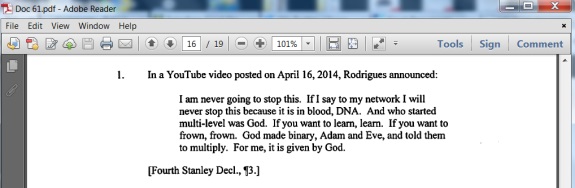
(UPDATED 8:21 P.M. EDT U.S.A.) The U.S. Securities and Exchange Commission says in new court filings that accused TelexFree promoter and securities fraudster Sann Rodrigues appeared in an April 16 YouTube video and asserted that “God” made MLM and “binary” and that Rodrigues claims he’s “never going to stop this.”
Rodrigues is now a two-time SEC defendant. He settled charges in 2007 that he was operating a pyramid scheme targeted at the Brazilian community through the purported sale of phone cards.
TelexFree is a combined Ponzi and pyramid scheme with a phone product that masked a massive, underlying fraud that gathered more than $1.2 billion, the Massachusetts Securities Division alleged on April 15. The SEC said the TelexFree scam mainly was targeted at Brazilian and Dominican immigrants.
Fellow TelexFree defendant Faith Sloan, meanwhile, appears to have removed certain videos but nevertheless has invoked “divine authority” elsewhere, according to SEC filings.
On March 15, the SEC alleged, Sloan claimed on her website that the TelexFree compensation plan was changing and was not in final form — “[b]ut is Getting BETTER as Jesus said.”
Sloan, a former promoter of the Profitable Sunrise and Zeek Rewards securities swindles, earlier claimed that the SEC was “picking on” her.
Separately, the agency alleged that TelexFree may be violating a temporary restraining order by putting its website back online.
“It appears that TelexFree and/or one or more of the individual defendants may be improperly using investor funds for that purpose,” the SEC alleged.
Moreover, the SEC said, none of the defendants has submitted the written accounting required under the order.
Sloan and Rodrigues are among four promoters charged by the SEC. TelexFree executives or co-owners James Merrill, Carlos Wanzeler, Joe Craft and Steve Labriola also were charged. The firm and related entities filed for bankruptcy protection in Nevada April 13.
Claims of divine authority or inspiration are not unusual in MLM HYIP frauds. In the 2008 AdSurfDaily case, for instance, accused operator Andy Bowdoin claimed God was on his side and compared the U.S. Secret Service to “Satan” and the 9/11 terrorists.
Bowdoin, who also fraudulently traded on the name of then-President George W. Bush to sanitize the ASD scam, had experience as a securities swindler prior to ASD, according to court records. He is now serving a 78-month term in federal prison for his role in the $119 million ASD swindle. One of his business partners, according to federal records, was implicated by the SEC in the 1990s in three prime-bank swindles, including one that touted a return of 10,000 percent.
Brazil-based TelexFree figure Carlos Costa also routinely invokes God over TelexFree-related issues.
On Dec. 19, 2013, the PP Blog reported that TelexFree puff pieces were appearing in a publication that featured a columnist who asserted Jesus Christ was the person who inspired modern network marketers through his recruitment of 12 disciples.
Ads for an apparent cash-gifting scheme appeared in the same publication.
Images of Jesus Christ also were used in the alleged Profitable Sunrise and WCM777 HYIP swindles.
Prior to TelexFree’s bankruptcy filing, this curious graphic was used to promote the “program’s” purported “international convention” in Spain. Red highlight by PP Blog.
URGENT >> BULLETIN >> MOVING: Carlos Wanzeler refused to resign from TelexFree-related entities and has been fired by interim CEO Stuart A. MacMillan, according to new filings in the TelexFree bankruptcy case.
MacMillan also caused the resignations of former TelexFree President James Merrill and interim CFO Joe H. Craft, according to the filings. MacMillan now is controlling the TelexFree businesses.
“Mr. Merrill, Mr. Wanzeler and Mr. Craft no longer have access to the Debtors’ facilities and their access to the Company’s email has been terminated,” MacMillan advised U.S. Bankruptcy Judge August B. Landis of Nevada. “I am the only person authorized to act as a signatory on any bank account that the Debtors have or may have.”
Whether the moves would satisfy the SEC and the U.S. Bankruptcy Trustee, however, was far from clear early this morning. Tracy Hope Davis, the trustee, alleged last week that there were “reasonable grounds” to believe that “criminal conduct” occurred at TelexFree.
Among the Davis allegations was that “[t]wo companies controlled by Craft received more than $2,010,000.00 between November 19, 2013 and March 14, 2014.” She also contended that “[t]he modus operandi of Merrill and Wanzeler and their cohorts suggests that it is more likely than not that anyone handpicked by them to manage their wholly owned companies will be another cohort.”
MacMillan advised Landis today that “I did not have a pre-existing relationship with the Company, Mr. Wanzeler or Mr. Merrill prior to this initial engagement by TelexFree.”
Whether he had a preexisting relationship with Craft was not immediately clear.
Davis is seeking the appointment of a trustee, a process that could put the firm on the path toward liquidation, rather than reorganization under Chapter 11.
The firing of Wanzeler and the resignations of Merrill and Craft, according to MacMillan, occurred on April 17, a day after the SEC alleged that Craft was in the TelexFree office in Massachusetts with nearly $38 million in cashier’s checks and sought to leave the premises with the checks while a federal raid was under way.
News of the management maneuvers came on the same day it was learned that the state of Montana had halted TelexFree, alleging that it was unable to obtain complete and accurate information from the MLM company after months of trying. Other states are questioning TelexFree’s ability to provide telecom service
In a separate filing in bankruptcy court today, TelexFree pledged to “cooperate with the SEC and the Massachusetts Securities Division in their ongoing investigations related to the Debtors and prosecutions against third parties, including the Debtors’ former employees and equity holders of TelexFree Nevada and TelexFree Massachusetts.”
Wanzeler and Merrill are the asserted equity holders. They, along with Craft and TelexFree marketing director Steve Labriola, were charged with fraud April 15 by the SEC. Four alleged TelexFree pitchmen also were charged with fraud.
Despite the pledge to cooperate, TelexFree is resisting the SEC’s bid to transfer the bankruptcy case from Nevada to Massachusetts.
From an assertion today by TelexFree (italics added):
The Debtors chose the Nevada Bankruptcy Court because inter alia TelexFree Nevada, a Nevada entity, is a counter-party to more than 700,000 contracts governed by Nevada law. The Debtors anticipate that nearly all of the claims against the Chapter 11 estates will result from these contracts. Although both Nevada and Massachusetts residents will be asserting some of these claims, the Debtors’ creditor base resides all over the world. Some 90% of the creditors reside outside Nevada and Massachusetts. In fact, approximately three-quarters of the creditors are from foreign countries.
MacMillan also suggested today that Wanzeler and Merrill owned TelexFree Dominicana, a company to which a cashier’s check for more than $10 million was made out just days before the April 13 bankruptcy filing. The check and nine others, including one for more than $2 million made out to Wanzeler’s wife, were seized by federal agents on April 15, after being found in Craft’s possession.
MacMillan said he did not believe that “Mr. Craft was attempting to divert any of the Debtors’ cash or other resources.
“Instead,” MacMillan continued, “he was acting at the direction of Mr. [William] Runge and me to secure the cashier’s checks in a safe and reliable location for the benefit of the Debtors’ constituencies.”
Runge, a turnaround specialist, is TelexFree’s chief restructuring advisor.
MacMillan, in his declaration today, said it was his “understanding” that TelexFree “struggled to maintain a consistent cash management system.
“It is also my understanding that on or about March 14, 2014, Wells Fargo Bank, N.A. . . . notified the Debtors that Wells Fargo was closing their depository account and that the Debtors needed to remove their cash on deposit.”
This may be the cash that was used to acquire the cashier’s checks. Regardless, the account closures signaled serious trouble for TelexFree, which the SEC and the Massachusetts Securities Division alleged have a history of not disclosing important information to members.
The assertion by MacMillan potentially means that TelexFree continued to gather money from both existing participants and new recruits after one of its key vendors notified it that an account was being closed.
Beyond that, if Merrill and Wanzeler owned a company in the Dominican Republic, it could lead to questions about whether they owned other firms in offshore venues and diverted money to those entities.
The same circumstance of account closures by major vendors arose in both the AdSurfDaily Ponzi scheme in 2008 and the Zeek Rewards Ponzi scheme in 2012.
 BULLETIN: (UPDATED 9:55 A.M. EDT, JULY 3, U.S.A.) The court-appointed receiver in the Zeek Rewards Ponzi- and pyramid case has moved for default against alleged Zeek winner Todd Disner. Disner, of Miami, also was a pitchman for the 2008 AdSurfDaily Ponzi scheme, a $119 million fraud that put ASD operator Andy Bowdoin in federal prison.