Category: Ad Surf Daily

  • Widow Shares Story Of $20,000 Loss In AdSurfDaily

    EDITOR’S NOTE: This is the story of Shannon Allison, an Idaho widow with five children. It is in her own words. Only light editing has been performed.

    My name is Shannon Allison and I’m a widow with 5 children. My husband, 5 kids, and I were involved in a horrific car accident in July of 2003. A driver fell asleep at the wheel on the highway and hit our camper trailer, which resulted in our SUV rolling 8 times into the median. My husband was killed and me and my children suffered numerous injuries.

    In a matter of seconds, my entire life had become a nightmare and it took many years to physically and emotionally recover from the accident. At times, I wanted to die myself until finally, one day I realized that my children and I survived for a reason and I needed to learn to live life again. We were given a second chance at life and I knew my husband would want us to be happy!

    After all was said and done, I received a lump sum of money from insurance and settlement funds. I tried to make sound financial decisions and invest my money wisely. I even hired a financial planner and invested in various developments and projects. I bought some real estate and looked for ways to start my own business at home so I could spend more time with my kids.

    I was a registered nurse but needed a change in my life. I started marketing a product I really believed in and set up my own website through the product I sold. I was introduced to the product by a good friend’s brother-in-law who was an oral surgeon in California. During that time he also introduced me to ASD.

    No Early Reason To Doubt

    He, my friend’s brother-in-law, had wonderful things to say about ASD! He himself had earned thousands over his original investment and really believed the rebates were legal and everything was on the up and up, so to speak. He loved the fact he could advertise his business through ASD and make money! In fact, he was so excited about it that he shared the site information with all his family and friends.

    He had originally been introduced to the site by his Aunt, I believe, who didn’t invest a lot of money in the beginning but was making substantial returns. He said at first he was skeptical but once he got into ASD, he started making money right away.

    A 20K Leap: Sent Check To One Of The ‘Top Guys’

    I was always looking for ways to advertise my new product. This seemed like an easy way plus make money at the same time! He showed me his own site and his returns. He got me so excited about the site that I decided to take the risk and put 20k into it. In fact, I was given a name and address to one of the top guys in the company to send my certified check to overnight and I would start making money right away since he could set up my account personally. Basically, there would be no delays since sometimes it could take up to a month to get going or so I was told. I was nervous but the pressure to get going took precedent.

    Back Office Showed 7K Profit In Weeks

    Everything was set up right away as promised and I started building money right away, according to my ASD account. In the beginning, which was in June of 2008, I surfed my required pages and reinvested my rebate returns daily. By the beginning of July, my ad packs were worth 27k and I decided to start pulling out some money.

    My gut told me to start taking out enough money every week until my original principal was returned. You could only get your rebates back on certain days. During this time, the site started having trouble. It would be unaccessible or it would freeze up often. It was nearly impossible to even get to your ASD account. Sometimes, it would take days before it was up and working again!

    There would be a message on the site stating the site was down because of the increase in traffic and new software to handle the traffic was being installed. By the time I got back into my account and requested a check, the seizure of ASD assets by the govt. had begun. The first and only check for $1,800 sent to me by ASD bounced and that was it.

    Finding Out Info From ASD ‘Nearly Impossible’

    At that time, ASD members were promised daily that all would be cleared up and we would be back online in no time at all. Weeks turned into months and months into a year and a half! Finding out info. was nearly impossible and I had come to realize that I was a victim of a Ponzi Scheme.

    I told you this story because I wanted you to know that many of us truly just got into ASD because it was a way to advertise and make money at the same time. We would spread the word because we were getting rebate returns and thought we were part of something legal. Yes, I should of known that some things are just too good to be true but I guess I thought if it was illegal, why did it continue on for so long before they were caught?

    I trusted the system and had no idea it was a Ponzi. Apparently, I’m not the only one as many members lined up at numerous rallies in different states to give ASD money. I thought for sure if this was illegal there would be no way he would hold public rallies to increase revenue. Wouldn’t you think the govt. would of been suspicious after the first rally?

    I have learned a lot since this whole ordeal started. I research and research before ever investing any money or what money I do have which isn’t much anymore. Unfortunately, I am so distrustful now that often I pass on good investments. It’s so frustrating. I feel there are more corrupt people out there than just plain good, honest folks.

    What ever happen to having a conscience? How do these people live with themselves like Madoff and Bowdoin after they destroy good people and their families?  We need to educate ourselves and make informed decisions, not ones based on impulsivity and making a quick buck! I feel if you don’t have the time to do the research, you don’t have the money to invest! Hopefully, things will change and these criminals will finally be punished for their illegal acts!

    Shannon Allison
    Pocatello, Idaho
  • BREAKING NEWS: Prosecution Seeks More Than $65.8 Million From Andy Bowdoin’s Bank Accounts; Asks For Default Entry

    Federal prosecutors have filed an affidavit that seeks to give the government permanent control over more than $65.8 million seized from 10 bank accounts in the name of AdSurfDaily President Andy Bowdoin.

    Prosecutors already have permanent control over money seized from the bank accounts of Golden Panda Ad Builder in the same case.

    Today’s move against ASD’s bank accounts followed quickly on the heels of a ruling Tuesday by U.S. District Judge Rosemary Collyer that Bowdoin would not be permitted to reassert claims to the money. Prosecutors said they intend to implement a restitution program for victims of the alleged ASD Ponzi scheme.

    “[T]he time for filing pleadings to intervene has expired,” said Barry Wiegand, one of the prosecutors handing the case, in today’s affidavit.

    In all, the government seized $65,838,999.70 from Bowdoin’s bank accounts, according to court filings.

    The largest Bowdoin account contained more than $31.6 million. Another Bowdoin account contained more than $23.7 million. A third Bowdoin account contained more than $4.99 million. (An additional $107 would have made it an even $5 million.)

    Three Bowdoin accounts contained the exact same amount: $1,000,338.91. Three other accounts contained smaller amounts, and one additional account contained more than $1.088 million. Bowdoin’s smallest account contained $13,286, prosecutors said.

    Bowdoin surrendered claims to the money in January. He attempted to reassert his claims in February. Collyer ruled Tuesday that he would not be permitted to reenter the case.

    Today’s affidavit by the prosecution asks the Clerk of Court to enter a default notice. The default would become finalized with a formal order of forfeiture from Collyer, meaning the government would perfect its title to the money.

    In July, Collyer signed an order of forfeiture against assets once held by Golden Panda Ad Builder, giving the government formal title to more than $14 million seized from Golden Panda. Golden Panda ‘s assets were seized as part of the ASD probe.

    Golden Panda President Clarence Busby’s five accounts — some of which also included the name of his daughter, Dawn Stowers — contained $14,045,598.07 in total, prosecutors said. The largest account contained exactly $6 million. Another Busby account contained more than $3.007 million. A third Busby account contained more than $2.282 million. A fourth Busby account contained more than $1.642 million. Busby’s smallest account contained more than $1.112 million.

    In May, prosecutors tallied the ASD money as follows:

    (a) $1,088,246.48 from account #[deleted by this Blog] at Bank of America, in the name of
    Thomas A. Bowdoin, Jr., Sole Proprietor, DBA ADSURFDAILY;
    (b) $31,674,039.13 from account #[deleted by this Blog] at Bank of America, in the name of
    Thomas A. Bowdoin, Jr., Sole Proprietor, DBA ADSURFDAILY;
    (c) $937,470.18 from account #[deleted by this Blog] at Bank of America, in the name of
    Thomas A. Bowdoin, Jr., Sole Proprietor, DBA ADSURFDAILY;
    (d) $13,286.89 from account #[deleted by this Blog] at Bank of America, in the name of
    Thomas A. Bowdoin, Jr., Sole Proprietor, DBA ADSURFDAILY;
    (e) $403,791.04 from account #[deleted by this Blog] at Bank of America, in the name of
    Thomas A. Bowdoin, Jr., Sole Proprietor, DBA ADSURFDAILY;
    (f) $4,999,893.00 from account #[deleted by this Blog] at Bank of America, in the name of
    Thomas A. Bowdoin, Jr., Sole Proprietor, DBA ADSURFDAILY;
    (g) $23,721,256.25 from account #[deleted by this Blog] at Bank of America, in the name of
    Thomas A. Bowdoin, Jr., Sole Proprietor, DBA ADSURFDAILY;
    (h) $1,000,338.91 from account #[deleted by this Blog] at Bank of America, in the name
    of Thomas A. Bowdoin, Jr., Sole Proprietor, DBA ADSURFDAILY;
    (i) $1,000,338.91 from account #[deleted by this Blog] at Bank of America, in the name
    of Thomas A. Bowdoin, Jr., Sole Proprietor, DBA ADSURFDAILY;
    (j) $1,000,338.91 from account #[deleted by this Blog] at Bank of America, in the name
    of Thomas A. Bowdoin, Jr., Sole Proprietor, DBA ADSURFDAILY.

    Golden Panda money was tallied as follows in May:

    (k) $2,282,999.72 from account #[deleted by this Blog] at Bank of America, in the name of
    Clarence Busby Jr. and Dawn Stowers, DBA Golden Panda Ad Builder Deposit
    Account;
    (l) $1,112,978.42 from account #[deleted by this Blog] at Bank of America, in the name of
    Clarence Busby Jr. and Dawn Stowers, DBA Golden Panda Ad Builder Operating
    Account;
    (m) $1,642,039.08 from account #[deleted by this Blog] at Bank of America, in the name of
    Clarence Busby Jr. and Dawn Stowers, DBA Golden Panda Ad Builder Cashout
    Account;
    (n) $6,000,000.00 from account #[deleted by this Blog] at Bank of America, in the name
    of Golden Panda Ad Builder; and
    (o) $3,007,580.85 from account #[deleted by this Blog] at Bank of America, in the name
    of Golden Panda Ad Builder.

    The government seized more than $79.88 million combined from the bank accounts of ASD and Golden Panda.

  • BREAKING NEWS: Justice Department Establishes Information Hotline For AdSurfDaily, GP, LFD Victims

    Victim of the alleged AdSurfDaily autosurf Ponzi scheme? Want the latest information about claims and how the proposed restitution program is shaping up?

    The Department of Justice has established a special telephone number for the ASD case. By calling the number, you’ll hear a recording that updates members on developments in the case, which involves ASD, Golden Panda Ad Builder and LaFuenteDinero.

    Here is the phone number: 202-616-2420

    “The United States Attorney’s Office for the District of Columbia will update this message on a regular basis,” the Justice Department said.

    Prosecutors also have updated an informational website. Here is the URL:

    http://www.justice.gov/usao/dc/Victim_Witness_Assistance/adsurfdaily.html

    The site includes a page for Frequently Asked Questions. The FAQ page can be accessed by clicking on a link. Look for a list of bullet points on the page you’ll visit by clicking on the link above. The FAQ link currently is at the bottom of the list of bullet points. The headline for the FAQs is “Answers to Frequently Asked Questions.”

    The page answers these questions:

    • Why did the government get involved in Ad Surf Daily, Golden Panda, Ad CashGenerator, and La Fuente Dinero?
    • Why is the U.S. Secret Service involved?
    • What is a forfeiture case?
    • How much money has the government recovered from Ad Surf Daily and related schemes?
    • How did the government recover money from Ad Surf Daily and related operations?
    • Will the forfeited funds be distributed to people who were defrauded in these schemes?
    • How long will it take to distribute the forfeited money to victims?
    • Why will the claims process take so long?
    • Will victims recover their full losses?
    • What are the next steps in the process?
    • Where can I get more information and keep up to date?

    Here is the answer to the question, “Will the forfeited funds be distributed to people who were defrauded in these schemes?”

    Yes. Money that has been declared forfeited will be returned to victims of the schemes through a process called “remission.” Remission occurs when forfeited assets are returned to the victims of a crime underlying a forfeiture. The remission process is governed by the Code of Federal Regulations, Title 28, Part 9 (2009). When forfeiture is ordered by a federal court, authority to grant remission rests with the United States Attorney General. This authority has been delegated to the Chief of the Asset Forfeiture and Money Laundering Section (AFMLS), which is located in the Criminal Division of the United States Department of Justice. AFMLS will manage the remission process, and other agencies involved in the case, including the U.S. Secret Service, as well as the United States Attorney for the District of Columbia, will have a role in the remission process.

    Here is the answer to the question, “Will victims recover their full losses?”

    Because the total value of the seized assets is less than the estimated member losses, it is unlikely that members will receive full compensation for their losses. Accordingly, each member will receive a pro-rata share of the forfeited money based upon his or her loss amount. The exact amount of each person’s recovery will not be known until the claims review process is completed.

  • BREAKING NEWS: Two Madoff Computer Programmers Charged With Conspiracy For Enabling Massive Ponzi Scheme

    Federal prosecutors and the FBI demonstrated again this morning that people who enable Ponzi schemers are subject to arrest and prosecution.

    Today’s announcement that two computer programmers for Bernard Madoff have been charged with serious felonies could send shockwaves across the so called autosurf “industry,” which relies heavily on computers and programming tweaks to fleece participants.

    Charged in New York were programmers Jerome O’Hara, 46, of Malverne, N.Y., and George Perez, 43, of East Brunswick, N.J. If convicted, they each face up to 30 years in prison and fines that could total in the millions of dollars.

    O’Hara and Perez were charged with conspiracy, falsifying books and records of a broker-dealer, and falsifying books and records of an investment adviser.

    “Jerome O’Hara and George Perez allegedly helped construct Bernie Madoff’s house
    of cards,” said U.S. Attorney Preet Bharara of the Southern District of New York. “The computer codes and random algorithms they allegedly designed served to deceive investors and regulators and concealed Madoff’s crimes. Today they have been charged for their roles in Madoff’s epic fraud, and the investigation remains ongoing.”

    An FBI official said Madoff could not have pulled of his Ponzi scheme without the aid of programmers, adding that Madoff bought their silence for a a price.

    “O’Hara and Perez are charged with being instrumental in facilitating the Ponzi scheme that was the Bernard Madoff investment advisory business,” said Joseph M. Demarest Jr., assistant director-in-charge of the FBI’s New York field office.

    “Their subterfuge was designed to conceal the fraud from regulators and others, and when they told Madoff they would no longer lie for him, their continued complicity was bought for a price,” Demarest said.

    It is common knowledge in the autosurf “industry” that the operators install scripts to make the programs functional online and that the scripts are tailored by programmers to the specifications of the operators.

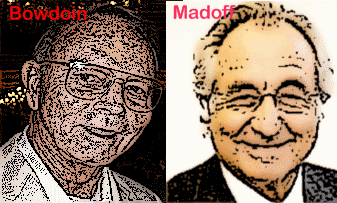
    bowdoinmadoffart2Today’s charges against O’Hara and Perez give surf operators — and their programming employees and contractors — something else to worry about, beyond being forced to give up ill-gotten gains in forfeiture proceedings and being charged with crimes such as wire fraud and money-laundering.

    By charging the programmers who helped Madoff carry out the scheme, the Feds sent a clear message that they view Ponzi-enablers as co-conspirators.

    The website of AdSurfDaily, a Florida company accused of operating a $100 million Ponzi scheme, was offline for much of July 2008, amid reports that programmers were tweaking the website and programming the system to enable it to accommodate higher volumes of traffic and perform more database functions.

    ASD President Andy Bowdoin repeatedly relied on programmers to tweak systems, members said.

  • ‘MISPRISION OF FELONY’: Could It Be Used In Autosurf Ponzi Cases? Feds Trot Out Old-Fashioned Law To Combat Ponzi Epidemic; Georgia Woman Gets Jail Time

    It’s called “misprision of felony” under Section 4 of the U.S. Code, and here’s how it reads:

    “Whoever, having knowledge of the actual commission of a felony cognizable by a court of the United States, conceals and does not as soon as possible make known the same to some judge or other person in civil or military authority under the United States, shall be fined under this title or imprisoned not more than three years, or both.”

    It has been used as a weapon in certain drug cases involving violence left unreported, and in cases against public employees who did not report crimes.

    And today “misprision of felony” was used in Georgia against Saundra McKinney Pyles, who was accused of concealing a Ponzi scheme operated by her friend, Gary Sheldon Hutcheson. Hutcheson pleaded guilty to mail fraud and money laundering.

    In essence, Pyles was accused of choosing not to report Hutcheson, even though she knew he was operating an investment scheme and committing mail fraud.

    Pyles was sentenced to 14 months in prison, and made equally responsible with Hutcheson to pay $1.6 million in restitution to victims. Hutcheson was sentenced to five years in prison.

    Do autosurf promoters who turn a blind eye to fraud or choose to become a participant in a wink-nod Ponzi enterprise now have something new to worry about?

    Watch the video on 13WMAZ-TV.

  • EDITORIAL: Bowdoin, Family Suffered Second Legal Blow Yesterday; August AND December Cases Will Proceed To An Outcome Apt To Send A Chill Across ‘Surfing’ Universe

    adviewglobalstreetaddressmagnifiedYesterday’s ruling by a federal judge that AdSurfDaily President Andy Bowdoin would not be permitted to change his mind about submitting to the forfeiture of tens of millions of dollars in a case brought in August 2008 dealt the embattled surf firm a crippling blow.

    But a virtually unnoticed ruling yesterday by Judge Rosemary Collyer in a second forfeiture case brought in December 2008 against other ASD-connected assets was equally devastating — at least from the point of view of Bowdoin’s champions on the Pro-ASD Surf’s Up forum and unnamed members of a mysterious “group” of surf participants who had advised him earlier this year to embark on a scorched-earth campaign against the government.

    Yesterday’s ruling by Collyer in the December case did not generate headlines, in part because Bowdoin had managed to rivet the attention of ASD members on the August case and the enormous sum of money involved. The ruling in the December case, though, was the second clear win for prosecutors yesterday because it maximized the leverage they can apply to destroy the alleged ASD Ponzi scheme operation.

    In the December case, Collyer used exactly 13 words to discharge an order that had required prosecutors to defend against dismissal for failure to prosecute the action, which involves assets held by Bowdoin family members.

    Collyer issued the order Oct. 5. Prosecutors responded to it Friday, saying Bowdoin and unnamed others were served “direct notice” in January 2009 of the complaint but did not file claims to property the government intends to seize as proceeds of a crime.

    In short, Bowdoin was defending a case (August) and making personal claims to tens of millions of dollars with great fanfare — but was not defending the second case, which involved family members and far less money, at all.

    Here is a question all ASD members should ask themselves: Why didn’t Bowdoin fight for the money and property seized in December?

    If circumstances warrant, prosecutors now can argue that the reason neither Bowdoin nor family members defended against the second case was because they did not need the money and a plan was in place to generate even more cash — perhaps to replace all the property seized in the December case.

    Prosecutors have suggested in court filings — through a veiled reference to the AdViewGlobal autosurf — that Bowdoin indeed had a plan to replace the lost money and property by operating an autosurf offshore. They could argue, for example, that while Bowdoin was negotiating to settle the August case, he was not negotiating in good faith because of a secret plan to launch a second surf to cover losses sustained by ASD.

    And they could argue that, while Bowdoin was telling members in a conference call that the tens of millions of dollars seized in August belonged to them, he was so unconcerned about the December money and property that he didn’t bother even to stake a claim to it.

    Along those lines, prosecutors could argue that, if the August money belonged to members as Bowdoin claimed, so, too, did the December money.

    Why didn’t he file a claim to it if it belonged to members?

    Prosecutors, in effect, could argue that the December money was chump change to Bowdoin because there already was a plan to replace it.

    The ruling in the December case paves the way for the government to seek a default judgment to more than $1 million in personal property prosecutors said was acquired with illegal proceeds from ASD. Owners of the personal property include George and Judy Harris.

    George Harris is the son of Bowdoin’s wife, Edna Faye Bowdoin. Judy Harris is the wife of George Harris.

    Even Edna Faye Bowdoin had been a potential claimant in the December case. Prosecutors said she and George Harris opened a bank account in June 2008, funding it with an opening deposit of more than $177,000.

    George Harris later called the bank on the telephone and caused more than $157,000 of the opening deposit to be transferred by wire to a third bank to pay off the mortgage on the Harris home in Tallahassee, prosecutors said.

    In the December complaint, prosecutors described the transaction as money that had been obtained illegally by ASD and deposited in Bank of America in a wire-fraud and money-laundering scheme — and money that ultimately left Bank of America through the actions of Bowdoin, his wife and George Harris to be used in a second wire-fraud and money-laundering scheme involving two other banks.

    There’s your answer to the question about why Bowdoin didn’t fight for the money in the December case. Fighting for it would have forced ASD’s rank-and-file to focus on the inconvenient  facts of the twin cases, not the convenient story Bowdoin and his shills were putting out about the August case.

    The December allegation, which laid out a case for wire fraud and conspiracy, put George Harris, Judy Harris and Edna Faye Bowdoin in jeopardy of losing their freedom. Andy Bowdoin had to know that — and yet he focused the attention of members on the August case, even saying he was inspired to keep fighting for them by a former Miss America who had to learn to walk again after being seriously injured in an automobile accident.

    By not explaining to members the gravity of the December complaint — indeed, by virtually ignoring it in communications with members and relying on shills to deflect attention away from the more sinister elements of the case — Andy Bowdoin demonstrated that the rank-and-file was just a tool he used to serve his own ends.

    Some of his most prominent shills even tried to keep members from filling out the government victims’ form. They were not serving the members at large; they were serving only themselves. They didn’t want to give up the money any more than Bowdoin — and they certainly didn’t want to join Bowdoin as a defendant in a criminal prosecution.

    So, they painted the government as evil. And they chose to cloud the issues and not share information that members could use to make informed choices. People who insisted on discussing the actual facts were dismissed as “Rats, Bed Bugs, Maggots, Cockroaches And Everything Else.”

    You can look it up.

    “In keeping with the likely outcome of this notification [of the December complaint], plaintiff also is preparing a motion for default judgment and a final order of forfeiture,” prosecutors said last week. “As things now stand, plaintiff expects that the Court will be in a position to grant such a motion, which should result in the dismissal of this case, by approximately January 15, 2010, that is, in 70 days.”

    No one from ASD filed a claim to an $800,000 building in Quincy, Fla., prosecutors said.

    The building had been paid for in cash and had been described as the new headquarters for ASD and its dozens of employees. Regardless, the building ultimately proved expendable. That’s noteworthy, considering the fact that Bowdoin argued in the August case that the government was responsible for the job losses. He blamed the government — and then didn’t fight for the building he told employees would be their new home.

    Also noteworthy is that neither George Harris nor Judy Harris filed a claim to their own home. At the same time, neither George nor Judy Harris filed a claim for a 2008 Honda automobile with a value of nearly $30,000. Prosecutors said the car also had been acquired with criminal proceeds.

    Claims also were not filed for two other cars — a 2009 Acura and a 2009 luxury Lincoln sedan with a combined value of more than $80,000, prosecutors said. Marine equipment valued at more than more than $44,000 also was not claimed.

    Fighting for members and employees? Hardly. Andy Bowdoin and his crew were lying to them — both overtly and through lies of omission.

    The December case provided plenty of leverage to the prosecutors, and Collyer’s ruling yesterday means the case will proceed to an outcome, rather than dying on the vine.

    Indeed, the “Rats, Bed Bugs, Maggots, Cockroaches And Everything Else” have been exposed.

  • BREAKING NEWS: Judge Denies Bowdoin’s Bid To Reenter AdSurfDaily Case; Says ASD President’s Claims Lack Merit

    UPDATED 5:18 P.M. ET (U.S.A.) A federal judge has denied the bid of AdSurfDaily President Andy Bowdoin to reverse his decision to forfeit tens of millions of dollars to the government in a case that features allegations of wire-fraud, money-laundering and operating a Ponzi scheme.

    Andy Bowdoin ina video for 'Paperless Access.'
    Andy Bowdoin in a video for 'Paperless Access.'

    “As Mr. Bowdoin’s own descriptions of events fail to support these arguments, and there is no other reason to grant reconsideration . . . the Court will deny the motion,” said U.S. District Judge Rosemary Collyer.

    Collyer also denied a motion by Bowdoin for a second evidentiary hearing, saying the matter was moot because she was not permitting him to reenter the forfeiture case after he previously submitted to the forfeiture. Collyer ruled after an evidentiary hearing last year that ASD had not demonstrated it was a lawful business and not a Ponzi scheme.

    “[N]othing in Mr. Bowdoin’s own sworn statement justifies the conclusion that he was mistaken [in releasing the claims in January], that the Government engaged in any misrepresentation or misconduct, or that his attorney provided bad advice,” Collyer ruled. “He also fails to present any meritorious defense.”

    The ruling was a crushing blow to Bowdoin, and Collyer minced no words, saying evidence in the forfeiture case against him “appears to be strong” and that Bowdoin “balked” after submitting to the forfeiture.

    “The Government charges that Mr. Bowdoin operated a Ponzi scheme on the Internet,
    whereby he, using ASD as a vehicle, bilked hundreds of people,” Collyer said. “Presented by affidavit and testimony outside the crucible of a criminal trial, its evidence appears to be strong. In the face of the civil in rem proceedings and the expected criminal prosecution, it is no surprise that his criminal lawyer would recommend a cooperation plea with demonstrated early acceptance of responsibility, i.e., withdrawal of claims to the seized assets, so that Mr. Bowdoin might earn a motion for a downward departure under Section 5K1.1 of the United States Sentencing Guidelines and/or 18  U.S.C. § 3553, both of which allow the Court to impose a sentence below the statutory minimum to reflect a defendant’s ‘substantial assistance’ to a Government investigation.”

    Bowdoin’s former attorney, Stephen Dobson, whom Bowdoin’s current attorney Charles A. Murray claimed served Bowdoin poorly while Bowdoin was meeting with prosecutors last winter to settle the forfeiture case and discuss a potential criminal plea, behaved responsibly, Collyer said.

    “Such an approach from counsel could be seen as the norm when the Government’s evidence is strong,” Collyer said. “What Mr. Bowdoin hoped to gain from his release of claims/early acceptance of responsibility and his debriefing with the Government was a promise of no jail time. When that was not forthcoming from the Assistant United States Attorney, Mr. Bowdoin balked and tried to back up, as if he had not already released his claims and talked to the Government.”

    Collyer cited several claims from Bowdoin himself when issuing her ruling this afternoon, repeating Bowdoin’s own words back to him to demonstrate he had not been ill-served by Dobson or lied to by the government: (Emphasis added.)

    • Dobson represented to me that I could possibly avoid prison or get a reduced sentence if I agreed to disclose details concerning ASD and releasing the assets.
    • I also signed a document stating that I would release my claims in the abovecaptioned civil in rem forfeiture proceeding, again thinking that necessary for a possible avoidance of a prison term.
    • I did all of this on the understanding that by cooperating I could possibly avoid a prison sentence.
    • I agreed not to exercise my rights in the civil forfeiture proceeding, anticipating from representations made by Dobson that this could possibly keep me out of prison.
    • Dobson lead [sic] me to believe that if I cooperated there was a possibility that I would not be incarcerated or imprisoned.
    • I believed that my cooperation would still result in a criminal sentence that could possibly not include imprisonment or incarceration.
    • [Prosecutor William] Cowden explained that I would be subject to the maximum penalty under the statute, but that he would inform the judge that I cooperated.
    • I slowly came to understand what I understood from Dobson not to be the case: that my agreement to cooperate provided me no benefit in the criminal matter except the possibility of a reduced sentence if the judge desired which would still be a life sentence.

    “Each of these statements indicates that Mr. Bowdoin completely understood what he
    was doing: releasing his claims and cooperating to ‘possibly avoid a prison sentence,’” Collyer said.

    In September, prosecutors argued that any thought by Bowdoin that a $100 million, wire-fraud and Ponzi scheme crime would not result in imprisonment upon conviction was ludicrous.

    Collyer said the allegations were serious and easily could result in prison time.

    “If he proceeds to trial and the evidence persuades a unanimous jury beyond a reasonable doubt that Mr. Bowdoin is guilty as charged, he will face a term of incarceration for sure,” Collyer said. “Mr. Dobson’s hope was to avoid such a result by avoiding a trial and persuading the Government to file motions with the Court that could be used to argue for a sentence that did not include jail time.”

    Collyer said Bowdoin’s behavior has been puzzling.

    “It is very strange that Mr. Bowdoin passed that opportunity by, despite clear knowledge that it ‘could possibly keep me out of prison,’” she said. “Perhaps the delay in obtaining an indictment has led Mr. Bowdoin to believe that he will not be indicted after all.”

    Collyer also pointed to a stated belief by Bowdoin that a grand-jury indictment had been returned, saying she hasn’t see one.

    “Mr. Bowdoin believes the Government ‘submitted charges before a grand jury on or about May 2009,’” Collyer said, using Bowdoin’s affidavit as her resource. “[B]ut as of this date no indictment has been returned against him in a federal court.”

    Read Collyer’s ruling.

    Read Collyer’s order denying Bowdoin’s motions.

  • Alleged Scott Rothstein Ponzi Probe Unfolding Like ASD Case; Forfeiture Proceeding Filed, But No Early Arrest

    Federal prosecutors and agents today began the process of seizing assets from Florida attorney Scott Rothstein, amid allegations he had been operating a Ponzi scheme involving hundreds of millions of dollars since 2005.

    The early probe is shaping up in largely the same way as the early probe into AdSurfDaily, a Florida business accused last year of operating a $100 million Ponzi scheme.

    Rothstein, for example, has not been arrested. Agents from the FBI and IRS seized real estate, boats, cars and bank accounts today. Meanwhile, prosecutors brought a civil-forfeiture case against property tied to the alleged scheme.

    Prosecutors used largely the same approach against ASD. ASD President Andy Bowdoin, for example, was not taken into custody when news of the allegations broke. As is the case with Rothstein, the ASD probe began with forfeiture complaints.

    Like the ASD case, the government believes others perhaps were involved in the fraud. Unlike  Bowdoin of ASD, however, Rothstein does not appear to be enjoying an early surge of support.

    In the context of Ponzi schemes, civil forfeiture helps the government stop potentially massive financial crimes in their tracks, before they can mushroom and consume even more wealth. Investigating Ponzi schemes can be a mammoth undertaking that involves reverse-engineering thousands and thousands of transactions and following global and electronic trails.

  • BREAKING NEWS: Prosecution Says It Will Seek Default Judgment Against ASD Assets Named In December 2008 Complaint; Asserts Bowdoin, Others Were Served ‘Direct Notice’ In January 2009, But Did Not File Claims To More Than $1 Million In Property Paid For By Members

    UPDATED 8:09 A.M. ET (NOV. 7 U.S.A.) Easy come, easy go?

    ASD President Andy Bowdoin and unnamed others were served “direct notice” in January 2009 of a forfeiture complaint filed in December 2008 but did not file claims to property the government intends to seize as proceeds of a crime, federal prosecutors said this morning.

    Bowdoin’s failure to file claims to less-valuable items seized in the December complaint are in stark contrast to his aggressive bids to reassert claims to tens of millions of dollars seized from bank accounts in Bowdoin’s name in an August 2008 forfeiture complaint.

    The notice of the December complaint was given “very promptly to known potential claimants in January 2009,” and yet none of them acted to assert an ownership interest over cars, marine equipment, computer equipment and real estate name defendants in the December complaint, prosecutors said.

    The total value of property to which neither Bowdoin nor family members asserted claims exceeded $1 million, according to court filings. Prosecutors said all of the property was paid for by members who participated in Bowdoin’s autosurf Ponzi scheme.

    One of the seized items was a building ASD had paid $800,000 in cash to acquire, prosecutors said. ASD said it planned to move its operations — and its dozens of employees to the building — but never filed a claim for the building, according to records in the December 2008 case.

    How Bowdoin intends to explain to employees and members that an $800,000 building paid for by participants was not worth fighting for is unclear. In a September conference call transcribed by the U.S. Secret Service, Bowdoin said ASD wanted to reopen — and yet never filed a claim to the building, prosecutors said.

    Bowdoin had described the marine equipment — including two jet skis, a Cabana boat and other property — as recreational items for members who came to visit him in Quincy, Fla. — members said.

    Regardless, neither he nor any other ASD insider staked a claim to the items, prosecutors said.

    “In keeping with the likely outcome of this notification [of the December complaint], plaintiff also is preparing a motion for default judgment and a final order of forfeiture,” prosecutors said. “As things now stand, plaintiff expects that the Court will be in a position to grant such a motion, which should result in the dismissal of this case, by approximately January 15, 2010, that is, in 70 days.”

    Today’s filing by prosecutors Barry Wiegand and Deborah Connor may prompt ASD members to question why Bowdoin, who has positioned himself as a champion to participants, is fighting hard for cash seized in August 2008 — but not at all for less-valuable property named in the December 2008 complaint.

    It also raises questions about why Bowdoin’s wife, Edna Faye Bowdoin, and her son, George Harris, are not fighting for property seized in the December 2008 complaint. At the same time, it raises questions about why Judy Harris, the wife of George Harris, also is not fighting for the property.

    Prosecutors said Edna Faye Bowdoin and George Harris opened a bank account in June 2008, less than two weeks after a May 31, 2008, ASD rally in Las Vegas had concluded.

    The account was funded with an opening deposit of more than $177,000 from illegal proceeds from ASD, prosecutors said.

    The Tallahassee home of George and Judy Harris was seized in the December 2008 complaint, which followed on the heels of an August 2008 complaint against other ASD-connected assets, collectively including huge sums of money in 10 Bank of America accounts in Andy Bowdoin’s name. Prosecutors said the Harris mortgage of more than $157,000 was paid off with criminal proceeds from ASD, from the account opened by Edna Faye Bowdoin and George Harris in June 2008.

    Also seized in the December 2008 complaint was a 2008 Honda automobile registered to George and Judy Harris. Prosecutors said the car also was acquired with criminal proceeds from ASD.

    George and Judy Harris later emerged as the purported owners of the AdViewGlobal (AVG) autosurf, which formally launched in February 2009 — after two forfeiture complaints had been filed against ASD and after Andy Bowdoin had been named a defendant in a separate racketeering lawsuit.

    Bowdoin never responded to the racketeering complaint, which also names ASD attorney Robert Garner a defendant.

    Although Andy Bowdoin eventually submitted (in January 2009) to the forfeiture of the money seized in August 2008, he changed his mind in February and began to file as a pro se litigant to reassert his claims.

    Some members of the Pro-ASD Surf’s Up forum championed Bowdoin’s reemergence as a pro se litigant in the August 2008 case, offering prayers and well-wishes but never asking why Bowdoin and family members appeared to be ignoring the December 2008 forfeiture case and why Bowdoin was ignoring the January 2009 racketeering case.

    Bowdoin chose not to assert an ownership interest in the less valuable marine equipment, computers and other assets seized in the December 2008 complaint, prosecutors said this morning.

    In recent weeks, however, he has aggressively reasserted claims to the tens of millions of dollars seized in August 2008 case, according to court records in the August case.

    But Bowdoin and family members did nothing at all to secure the return of the water equipment, the $800,000 building, the Harris automobile, a model-year 2009, $50,000 Lincoln luxury sedan for presumptive use by Bowdoin and his wife, and a 2009 Acura automobile acquired in the name of a former ASD employee, according to court records in the December case.

    The automobiles had a combined value of more than $110,000, according to court filings. The combined value of the water equipment totaled nearly $44,000. Based on the value of the cars, the water equipment, the building — and the Harris home — neither Bowdoin nor family members filed claims to more than $1 million in property.

    Prosecutors said all of the property was acquired from money directed at ASD by members.

    Prosecutors said they had expected a “global resolution” of both forfeiture cases in 2009, based on assertions by Bowdoin. Early in the year, Bowdoin met in person with prosecutors and admitted ASD had been operating illegally, according to court filings.

    In August 2009, Bowdoin announced in court filings that he was reentering negotiations with prosecutors. Bowdoin asked for at least two extensions to continue negotiations, according to records. U.S. District Judge Rosemary Collyer granted extensions from Aug. 7 to Sept. 14.

    On Sept. 14, Bowdoin filed motions that reasserted his claims to the seized millions, triggering blistering motions by the prosecution that Bowdoin was trying to lie his way back into the case, while also lying to members.

    In September — for the first time — prosecutors made a veiled reference to the AVG autosurf, saying, “Maybe Bowdoin thought that before the government brought its charges he (like some of his family members) could move to another country and profit from a knock-off autosurf program that Bowdoin funded and helped to start.”

    Prosecutors suggested today that, when negotiations broke down, they sought seizure warrants to take possession of the assets named in the December complaint.

    “Promptly when it appeared that a global resolution of all related litigation had become much less likely, the government applied to this court in late October for seizure warrants for several of the defendant properties.” prosecutors said. “Within days of the Court issuing the warrants, federal law enforcement agents had swiftly executed them, and all defendant items of personal property are in the custody of an agency of the U.S. government.”

    All of the property seized in the December complaint now is advertised for forfeiture on the government’s official forfeiture website: forfeiture.gov. Along with the building, boats, cars and other real estate, the government also advertised formal notice of forfeiture of “[a]pproximately Six Hundred Thirty Four Thousand, Two Hundred Sixty Six Dollars and Thirteen Cents ($634,266.13), in U.S. funds previously deposited at the Bartow County Bank, Account #xxx-602, in the name of Golden Panda Ad Builder.”

    Read today’s filing by the prosecution in the December 2008 forfeiture case.

  • Another Massive Ponzi Scheme Probe Under Way In Minnesota; Case Reminiscent Of Alleged Ponzis Of Tom Petters, Matthew Scott And Andy Bowdoin

    Gerard Frank Cellette Jr. is suspected of operating a Ponzi scheme that involved tens of millions of dollars and was based on bogus printing contracts, prosecutors in Minnesota said yesterday.

    Cellette, 44, of Andover, Minn., owes investors at least $53 million, according to the felony complaint filed by the office of Hennepin County Attorney Mike Freeman.

    Prosecutors charged Cellette with 36 counts of fraud in the offer or sale of securities, saying the scheme extended from Minnesota to California, Georgia, and Illinois, and that Cellette has “admitted” he engaged in a pattern of fraudulent conduct from 2005 through September 2009.

    News about the Cellette charges broke as accused Ponzi schemer Tom Petters was being tried in Minnesota, amid allegations he orchestrated a $3.65 billion fraud. Minnesotans’ attention has been riveted on the Petters’ case, which includes allegations he fleeced investors by tricking them into believing their money was being used to finance the sale of huge quantities of electronics to big-box retailers.

    Prosecutors described the Cellette allegations as a Petters-like operation, only on a smaller scale. The allegations also were reminiscent of allegations against Florida-based AdSurfDaily because Cellette held hotel meetings with participants in Minneapolis to promote the investment program.

    Like ASD’s program, Cellette’s program had elements of revenue-sharing, with participants believing profits stemmed from the sale of a legitimate service. ASD was operated by Andy Bowdoin.

    Bowdoin’s ASD purported to be an “advertising” company. Federal prosecutors said it sold unregistered securities and engaged in wire fraud and money-laundering while operating a $100 million Ponzi scheme. ASD was popular in Minnesota, members said.

    Cellette ran a company known as Minnesota Print Services. In 2004, he sought capital to expand, promising “to split the profits with the investor.” Investors expected a return of about 10 percent in 60 days, prosecutors said.

    But “in fairly short order,” prosecutors said, Cellette started selling “fictitious contracts,” paying earlier investors with money received from “new investors for new fictitious contracts.”

    Eventually Cellette began to offer the contracts through Steve Quarles, a California man, prosecutors said. They described Quarles as “the brother of a friend of a previous Minnesota investor.”

    Cellette “reports that he has never told Quarles, or anyone other than his attorney and the Hennepin County Attorney’s Office, that fictitious contracts were the primary foundation” of the scheme.

    Prosecutors said Cellette is cooperating in the probe.

    The allegations against Cellette also are reminiscent of the allegations against Matthew Scott in Illinois.

    The FBI and federal prosecutors said last week that Scott told investors their funds would be used to purchase or finance the purchase of high-speed commercial printers that would be sold to third-party buyers at a profit. The machines were said to be valued in excess of $100,000, and Scott claimed his mark-up of 20 percent led to big profits, the FBI said.

    Scott, 50, of Elmhust, Ill., was charged with mail fraud. His Chicago-area company, Gelsco, neither purchased nor financed such printers, the FBI said.

    “Instead, Scott allegedly fabricated false purchase orders, invoices, promissory notes and other documents that he provided to investors,” the FBI said.

    The Scott scheme collected at least $28 million between early 2000 and March 2009 before unraveling, the FBI said. At least 60 investors were fleeced. The initial loss estimate was pegged at $4.5 million.

    “Throughout the duration of the alleged scheme, Scott had to continually raise funds from investors to make payments to earlier investors, all of which he concealed and intentionally failed to disclose to new and old investors alike,” the FBI said.

    All of the cases — Petters, Cellette, Scott and ASD — lead to troubling questions about how many other companies are engaging in similar schemes that have not been detected.

    Read the allegations against Cellette in the Minnesota case.

  • Important Filing Deadline In ASD Prosecution Nears

    Andy Bowdoin
    Andy Bowdoin

    Tomorrow is the deadline for prosecutors to advise U.S. District Judge Rosemary Collyer how they plan to proceed with the December 2008 forfeiture complaint filed against assets of AdSurfDaily Inc.

    A month ago Judge Rosemary Collyer pointed out that no person or entity had filed claims to property seized in the complaint, the second tied to ASD-connected assets. The first complaint was filed in August 2008 and was nearly litigated to conclusion in January 2009, with ASD President Andy Bowdoin’s submission to the forfeiture of tens of millions of dollars “with prejudice.”

    Bowdoin, 74, changed his mind about giving up the money in February, and reentered the August case as a pro se litigant after meeting with a mysterious “group” of ASD members.

    Prosecutors now say Bowdoin is a “delusional” con man who “cannot manage to keep his stories straight,” arguing that he is telling Collyer one thing and members another. On Sept. 28, the U.S. Secret Service filed a transcript of a conference call Bowdoin held with members Sept. 21.

    In the transcript, Bowdoin repeatedly told members the government had seized money from them. He specifically used the phrase “your money” four times in the short recording.

    Prosecutors said Bowdoin’s words to members were at odds with his own court filings in which he claimed ownership of the seized assets — and also at odds with the filings of Charles A. Murray, one of Bowdoin’s attorneys.

    Prosecutors quoted from a September filing by Murray, who has been arguing that Collyer should permit Bowdoin to change his mind after advising the court in January that he was giving up the money and did not intend to reassert his claims in the future.

    “Mr. Bowdoin’s release in the above-captioned case is illogical,” prosecutors quoted Murray as saying. “He received nothing of value for the release. Bowdoin has consistently demonstrated an intent to aggressively defend ownership of his property in the civil in rem forfeiture proceeding.”

    Prosecutors were quoting from Page 2 of this Sept. 14 filing on Bowdoin’s behalf by Murray.

    One week later — on Sept. 21 — Bowdoin held the conference call, using the phrase “your money” four times to describe to members the assets he had told Collyer belonged to him,  prosecutors said.

    Bowdoin’s official court claims to the property date back to Aug. 15, 2008, less than two weeks after the seizure. No claims to any of the assets seized in the December forfeiture complaint that followed appear in the record of the case.

    Potential December claimants included Bowdoin, his wife, Edna Faye Bowdoin, George Harris, Judy Harris and Hays Amos. Judy Harris is married to George Harris, the son of Edna Faye Bowdoin and Bowdoin’s stepson. Hays Amos is a former employee of ASD.

    ASD money was used to buy a car registered to Amos, and also a car registered to George and Judy Harris, prosecutors said. It also was used to buy a car for Bowdoin/Harris Enterprises Inc., which prosecutors said was set up by George Harris and Edna Faye Bowdoin to help Andy Bowdoin and Edna Faye Bowdoin hide assets.

    At the same time, prosecutors said, more than $157,000 in ASD money was used to retire the mortgage on the home Judy and George Harris shared in Tallahassee, and to purchase a Cabana boat, jet-skis, haul trailers and other marine equipment. Bowdoin also spent $800,000 cash to purchase a building in Quincy — initially to the delight of the Gadsden County Chamber of Commerce, but later to its embarrassment.

    The Gadsden Chamber went on to contact the FBI about ASD, questioning whether the company was legitimate, prosecutors said.

    George and Judy Harris emerged later as the purported owners of the AdViewGlobal (AVG) autosurf, which launched in the aftermath of two forfeiture complaints filed against ASD’s assets and a separate racketeering lawsuit filed against Bowdoin and ASD attorney Robert Garner.

    Florida now has dissolved both ASD and Bowdoin/Harris Enterprises for failure to file required annual reports. The state gave the firms nearly a five-month window to file, but neither firm — both of which purport to be legitimate — followed through.

    Within hours of the breaking news about Florida’s actions against the firms, a poster on the Pro-ASD Surf’s Up forum described it as a conspiracy between the federal government and state authorities in Florida.