Category: The Economy

  • URGENT >> BULLETIN >> MOVING: Zeek Vendor Pleads Guilty To Obstructing Probe

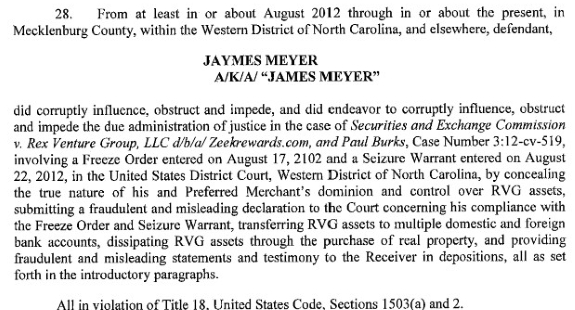
    From the criminal charges filed against Zeek payment vendor Jaymes Meyer in the Western District of North Carolina.
    From the criminal charges filed against Zeek payment vendor Jaymes Meyer in the Western District of North Carolina.

    URGENT >> BULLETIN >> MOVING: (12th Update 2:57 p.m. EDT U.S.A.) In what may be a warning shot fired across the bow of payment vendors who hope to profit from Ponzi schemes, Zeek Rewards’ vendor Jaymes Meyer of Preferred Merchants Solutions LLC has pleaded guilty to a criminal charge of obstructing investigators in the Zeek Ponzi- and pyramid-scheme case.

    Meyer, 47, of Napa, Calif., was charged criminally March 10 by federal prosecutors in the Western District of North Carolina. They alleged he hatched an “elaborate obstruction of justice scheme to conceal millions of dollars from the Government using a series of domestic and foreign nominees and related bank and brokerage accounts.”

    He was specifically accused of impeding the SEC’s Zeek probe beginning in 2012 and later lying to a federal judge and Zeek receiver Kenneth D. Bell.

    Senior U.S. District Judge Graham C. Mullen is presiding over the SEC’s Zeek case.

    As the PP Blog reported in October 2014, Bell accused Meyer of directing a $4.8 million transfer from a Rex Venture Group trust account to Preferred Merchants’ account “just 19 minutes after the SEC told them about the asset freeze and imminent shutdown of RVG” on Aug. 16, 2012.

    Rex, or RVG, was the operator of Zeek. It was under the control of accused Zeek Ponzi schemer Paul R. Burks. Burks is scheduled to go on trial in July.

    By March 2015, Bell and investigators had tracked Zeek money that flowed through Preferred to the Cook Islands and real estate in the Turks and Caicos. Prosecutors’ allegations against Meyer include a notice of forfeiture of $4.8 million.

    U.S. Magistrate Judge David S. Cayer accepted the guilty plea from Meyer on March 22. Certain documents in the case remain sealed. One document shows Meyer withdrew $195,000 in Zeek money in cash.

    At least two other payment vendors may be in Bell’s sights. On Feb. 21, 2016, the PP Blog reported that millions of dollars that originated through Zeek-related transactions involving Payza and Payment World may have ended up in a collapsed Russian bank.

    NOTE: Our thanks to the ASD Updates Blog.


  • Hoax Weaves Conspiracy Theories And Taunts Rep. Gabby Giffords, Victims Of Arizona Mass Shooting

    Jared Loughner. Source: Wikipedia.
    Jared Loughner. Source: Wikipedia.

    Jan. 8, 2011, was a horrifying day in U.S. history. It’s the day Jared Lee Loughner shot then-U.S. Rep. Gabrielle Giffords in the head. Grievously wounded, Giffords, remarkably, survived. Six others died in the Tucson attack, including U.S. District Judge John Roll of Arizona.

    In this Jan. 9, 2011, story, the Washington Post remembers Christina-Taylor Green, a 9-year-old slain by Loughner, a conspiracy theorist who opened fire at an outdoor constituent event hosted by Giffords in the parking lot of a supermarket. Christina’s granddad, Dallas Green, once was the manager of the Philadelphia Phillies and led the team to a World Series title in 1980.

    News circulated yesterday that Loughner had just sued Giffords for $25 million, bizarrely alleging emotional distress. The document painted incredibly wild conspiracy theories. Example: The congresswoman hadn’t really been shot. Instead, she was playing a role she learned by watching Ronald Reagan movies.

    Today, however, the filing docketed in Arizona federal court appears to be a hoax. For starters, it had a Philadelphia postmark, according to Tucson News Now. Loughner is detained in Minnesota. Beyond that, the envelope sent to the Arizona court was strikingly similar to one sent earlier this month to federal court in the Eastern District of Michigan.

    The Michigan document also had a Philadelphia postmark. It purported to be a lawsuit filed against Uber by Jason Brian Dalton, a former Uber driver accused of a mass shooting in Kalamazoo. This was a hoax carried out by Jonathan Lee Riches, posing as Dalton, according to the Smoking Gun.

    If this name seems familiar to you, perhaps it’s because you read it on the PP Blog — on Jan. 28, 2009. Riches, now listed by the Bureau of Prisons as a resident of a Philadelphia halfway house with a May 10 release date from federal custody, is a fraudster and notorious pro se litigant who once tried to enter the Bernard Madoff Ponzi fray.

    As a federal prisoner, Riches eventually tried to sue Loughner, alleging that Loughner might “try to kill me for being a moderate Democrat,” according to Above The Law. Now, it seems possible that the man who once filed against Loughner now is posing as the convicted mass murderer.

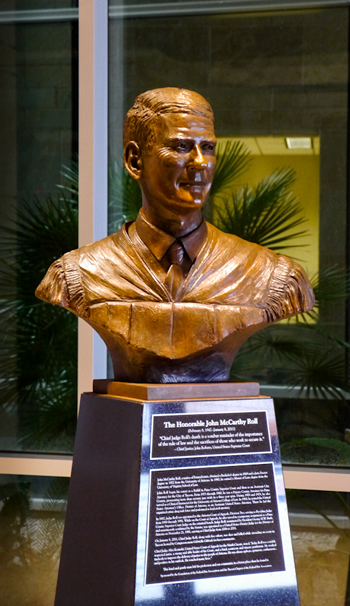
    Judge Roll is memorialized in this bust at the federal courthouse in Tucson. The courthouse in Yuma is named after him and also includes a bust. Image source: Ninth Circuit Public Information Office.
    Judge Roll is memorialized in this bust at the federal courthouse in Tucson. The courthouse in Yuma is named after him and also includes a bust. Image source: Ninth Circuit Public Information Office.

    The attack on Giffords, Judge Roll, little Christina and the others was one of the most notorious in recent U.S. history. It is sickening to contemplate that they have been subjected to a hoax in which Loughner may be a victim.

    If Riches pulled this off, he’d better lay low if he attends any Phillies games this summer. The Philadelphia fans aren’t apt to take kindly to someone who serves up even more pain for the Green family while using Giffords, an American hero, as his target-in-chief.


  • CSA: ‘No Business Is Currently Registered Or Authorized To Market Or Sell Binary Options In Canada’

    Offshore scammers have their eyes on your pocket book.  “[N]o business is currently registered or authorized to market or sell binary options in Canada,” the Canadian Securities Administrators said in an Investor Alert today.

    The risk is not merely the loss of money, CSA said.

    “Canadians are exposing themselves to the high risk of identity theft and fraud when signing up for these platforms that often request their credit card information,” said Louis Morisset, chair of the CSA and president and CEO of the Autorité des marchés financiers, Quebec’s secutities regulator. “The CSA warns investors that if they deal with these platforms, they risk the threat of thousands of dollars in unauthorized withdrawals on their credit cards and of being stuck with high-interest payments for a non-existent investment.”

    Binary options, CSA said, “are like ‘bets’ on how an asset (currency, stock, etc.) will perform in a limited amount of time – they are ‘all or nothing’ wagers, similar to gambling. However, even when investors see virtual gains, they often cannot access these profits as they don’t exist.”

    Read the CSA alert.

    On March 15, the U.S. Commodity Futures Trading Commission announced charges against two purported binary-options firms purportedly operating on the web from Israel.

    CFTC identified the defendants as Vault Options Ltd. and Global Trader 365.

    From the CFTC (italics added):

    In addition to alleging that Vault and GT 365 solicited more than $1 million from at least 50 U.S. customers, the Complaint alleges that Vault and GT 365 defrauded their customers by, among other things, misrepresenting and omitting the likelihood of profit and loss that customer make trading binary options, falsely claiming that customer funds were insured against losses, fraudulently inducing customers to send them more money before initial funds could be returned, and misappropriating customer funds. According to the Complaint, while Vault and GT 365’s websites touted large profits, many customers lost nearly all of their funds sometimes within days or a few weeks.


  • SEC, Lawyer Clash Over Representation Of TelexFree Figure Sann Rodrigues; Lamborghini Once Owned By Accused DFRF Enterprises’ Ponzi Schemer Daniel Fernandes Rojo Filho Was Used To Pay Sann’s Legal Fees

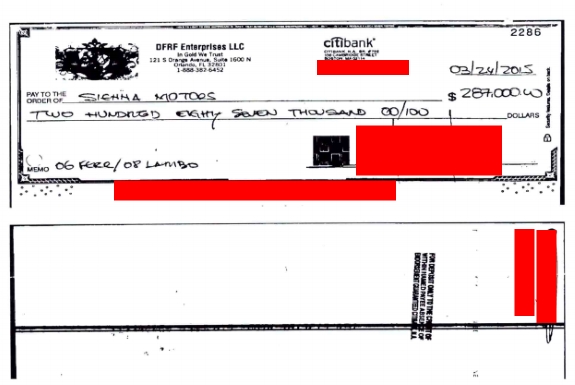
    In court filings, the SEC says it has traced the ownership of a 2008 Lamborghini once owned by TelexFree figure Sann Rodrigues and determined the car once was owned by accused DFRF Enterprises' Ponzi schemer Daniel Fernandes Rojo Filho. This was the check Filho used to purchase the vehicle. Source: Federal court fililes. Masking by PP Blog.
    Small world between accused scammers: In court filings, the SEC says it has traced the ownership of a 2008 Lamborghini owned by TelexFree figure Sann Rodrigues and determined the car once was owned by accused DFRF Enterprises’ Ponzi schemer Daniel Fernandes Rojo Filho. This, according to an SEC exhibit, was the check Filho used to purchase the vehicle and, apparently, a 2006 Ferrari. Source: Federal court files. Masking by PP Blog.

    3RD UPDATE 9:36 AM EDT MARCH 17 U.S.A. This one features highly questionable dealings between an alleged MLM securities fraudster (TelexFree’s Sann Rodrigues) and an alleged Ponzi schemer (Daniel Fernandes Rojo Filho of DFRF Enterprises). Filho also has been linked to the alleged 2010 Finanzas Forex/Evolution Market Group Ponzi scheme, a Ponzi-board “program” that allegedly had ties to the narcotics trade.

    Suffice to say, this developing story has a lot of moving parts. Here’s our distillation:

    On March 14, the SEC alleged that Rodrigues — whose assets are frozen — had transferred two expensive cars to Florida attorney Robert Eckard. Eckard is representing Rodrigues in the SEC’s civil case against him and other TelexFree figures and also in the Justice Department’s criminal case against him for immigration fraud.

    The transfers potentially created a conflict of interest for Eckard, given that Rodrigues currently is jailed for civil contempt for violating the asset freeze and has not purged that contempt, according to the SEC. Getting out of hock with the court will cost the huckster at least $334,000, perhaps more. Rodrigues claims he cannot pay and that the court should free him and put him on a payment plan.

    U.S. District Judge Nathaniel M. Gorton of Massachusetts is hearing the case.

    Why didn’t Rodrigues apply the two cars to purge the contempt?

    Well, according to the SEC, the cars — a 2008 Lamborghini Gallardo and a 2012 Fisker Karma — were transferred to Eckard after the agency moved for contempt against Rodrigues in August 2015.

    The SEC further suggested in its filings that Eckard paid far below book value for the cars. In the case of the used Lamborghini, the SEC said, the lawyer paid only $30,000 for a car that months earlier had sold for five times that sum.

    Eckard paid only $20,000 for the Fisker Karma, which months earlier had sold for three times that sum, the SEC said. Fisker Karma is an electric luxury vehicle whose operator declared bankruptcy..

    Reached by the PP Blog today, Eckard pointed to court filings in which he says Rodrigues — strapped for cash because of the freeze — paid him with cars, rather than cash. And, the lawyer contended, no conflict existed and the SEC had cleared the cars from the asset freeze.

    Because Rodrigues paid with cars, not cash, it created an unusual situation with vehicle taxes, Eckard said. He added that he consulted with authorities in Pasco County and with the Florida Department of Revenue when transferring the cars to his name.

    “I did not pay anything for the vehicle, but was required to put an amount down for tax purposes, since it was not a gift,” Eckard advised Gorton about the Lamborghini.

    The Fisker Karma was accepted from Rodrigues as payment for legal fees and proved to be a lemon with bad electrical parts and bad tires, Eckard contended.

    Eckard is moving to strike the SEC’s assertions from the court docket.

    Both Rodrigues and Filho are Brazilian by birth and Florida residents. How they came together remains unclear.

    The SEC linked Rodrigues to Filho last year.

    NOTE: Our thanks to the ASD Updates Blog.

    UPDATE 3:53 P.M. EDT U.S.A. MARCH 22: Looks as though Rodrigues will be released from jail, after coming up with a plan to purge the contempt. This matter is separate from the SEC’s securities-fraud case against him filed in April 2014.


  • TelexFree Trustee Seeks Approval Of Settlement With PricewaterhouseCoopers

    newtelexfreelogoBig Four accounting firm Pricewaterhouse Coopers posted more than $115,000 in fees from the TelexFree Ponzi/pyramid scheme and will pay it all back under the terms of a stipulated settlement with TelexFree Trustee Stephen B. Darr, according to court filings.

    PwC admits no liability in the settlement, which requires the approval of Chief Bankruptcy Judge Melvin S. Hoffman of the District of Massachusetts.

    In January 2014 — just three months before TelexFree collapsed in a pile of Ponzi rubble — the firm hired PwC to provide “tax consulting and tax structuring advice,” according to a stipulation filed by Darr and PwC.

    PwC issued three invoices in the coming weeks, and TelexFree paid them all, according to the stipulation. These totaled $115,335.66. The document suggests TelexFree may have made a $50,000 payment to PwC in advance of the receipt of an invoice and in the final hours before the bankruptcy filing.

    This invoice was dated April 15, 2014, but TelexFree paid it on April 11 of that year. Two days later, according to records, TelexFree filed for bankruptcy in Nevada.

    Darr contended that payments made by TelexFree to PwC were preferential and thus recoverable. The trustee also “raised issues regarding the value of the services that were provided by PwC to TelexFree, LLC and whether such payments could be recovered as fraudulent transfers.”

    Read the stipulation.


  • In Wake Of Herbalife Probe And Vemma Litigation, ESPN Asks If AdvoCare Is Pyramid Scheme And Pusher Of False Hope

    “And while the company claims its primary objective is selling products, many of its distributors tell a different story. ESPN interviewed more than 30 current and former salespeople, the vast majority of whom said their focus, and the focus of their superiors, was on recruiting other distributors. These new members, many of whom are drawn to the business’ strong religious culture or convinced of its credibility by its ties to the sports world, infuse the company with new funds — money that ultimately flows up to the powerful people who walk the stage at Success School.”From “Drew Brees Has A Dream He’d Like To Sell You,” ESPN The Magazine And “Outside The Lines,” March 15, 2016

    advocarelogoWith Herbalife under investigation by the Federal Trade Commission and Vemma charged by the FTC with operating a pyramid scheme, ESPN has asked one of its own sponsors — AdvoCare, an MLM company — whether it is pushing a pyramid scheme.

    “Absolutely not,” replied Allison Levy, AdvoCare’s executive vice president and chief legal officer. (Link to March 11 AdvoCare video below. In its story (link below), ESPN said AdvoCare set up two cameras to record ESPN’s recording of the March 2 interview and also changed some info on its website after the network began to ask questions.)

    With MLM, one of the key questions is whether a significant percentage of products end up in the hands of retail users or whether a program’s distributors load up on product to qualify for commissions.

    Levy did not discuss the Herbalife and Vemma matters, although AdvoCare says on its website that it has 320,147 “retail customers.” Herbalife once famously said it didn’t have “visibility” into its number of retail customers, fueling concerns it was a pyramid scheme.

    One of the questions posed in the ESPN story is whether AdvoCare is drafting the unwary into its MLM program by relaying on professional athletes such as Drew Brees of the New Orleans Saints to be spokespeople for the firm. And is the company also trading on religion?

    Read the ESPN story.

    Visit the AdvoCare website to view its March 11 “media update” in advance of the ESPN story, published today.


  • Bot Attack At PP Blog

    The PP Blog is experiencing a spambot attack that almost exclusively is trained at a single story and Comments thread from February 2010, more than six years ago. Since early Tuesday, the onslaught has included about a spam per minute.

    The attack, a sort of miniDDoS involving scores and scores of IPs and email addresses likely stolen from across the web, is consuming bandwidth and creating maintenance chores. As of 5 p.m. ET today, it had filled a full 159 pages with spam, consisting of 20 spams per page. The word waste alone likely totals in the hundreds of thousands.

    A content scraper appears to be involved and, of course, nothing is sacred. One of the spams scraped the obituary of a person unknown to the PP Blog and sought to republish it here. In the instance of the obituary, the name of the deceased individual was used in a bid to redirect traffic to a website that had nothing to do with the individual. A typical spam includes one or more links to a host of websites and sales schemes.

    We have a couple of theories:

    • Someone not keen on our reporting is trying to blast it off the web, as was the case with the DDoS attacks here in the fall of 2010 and the traffic floods that occurred in 2011.
    • A purported SEO expert or specialist in removing “negative” information is using a bot to relentlessly target the story and accompanying Comments thread in a bid to force us to remove the information. The hope is that the drip-a-minute approach will wear us down and cause us to remove the story/thread.

    Ain’t gonna happen.

  • BULLETIN: Darryle Douglas, Alleged Zeek Insider, Arrested

    BULLETIN: (4th update 9:11 p.m. ET U.S.A.) Alleged Zeek Rewards’ insider Darryle Douglas has been arrested in Riverside, Calif.

    Court filings docketed March 7 in the SEC’s civil case against Zeek say Douglas, whose age was not listed, was arrested March 2 by the U.S. Marshals Service.

    On Dec. 10, 2015, Senior U.S. District Judge Graham C. Mullen of the Western District of North Carolina ordered marshals to arrest Douglas for civil contempt of court. On Jan. 5, 2016, marshals said they had not located him and that Douglas was the subject of an ongoing investigation.

    He is believed to reside in Orange County, Calif., an area close to Riverside in the southern part of the state.

    Word of the arrest was received tonight. The warrant issued by Mullen in December specified that Douglas was to be brought to North Carolina. The PP Blog could not immediately determine this evening if a transport had taken place.

    Douglas, who allegedly had access to Zeek’s database and did not return it as ordered, may be involved with a nascent scheme known as Auction Attics, the PP Blog reported last year. Others have said Auction Attics was morphing into something called Auction Addicts.

    Zeek was a penny-auction fraud that gathered on the order of $900 million, the SEC has said.

    NOTE: Our thanks to the ASD Updates Blog.


  • SEC: Binary Options Case Triggers Investor Alert

    breakingnews725Is there a double whammy in your MLM future — first being ripped off in a binary-options “program,” only to be ripped off a second time by scammers posing as government agencies and offering purported refunds for a fee?

    Naturally some MLMers have added binary options to their offerings, with some incredible solicitations and tales being told online. BehindMLM.com, for example, recently reported on the purported death of “Bob Roberts,” an asserted figure from a “program” known as Options Rider.

    In 2015, the PP Blog reported that Quebec’s securities regulator was concerned that binary-options scammers were steering people into reload schemes and posing as government entities. Meanwhile, there was the tale of SpotFN, a purported binary-options platform that reached across the oceans and plains to pluck investors in Missouri.

    At least one Missouri investor was told his money could be retrieved by paying a fee to a purported insurance company, authorities said.

    Binary-options “programs” also are appearing on the Ponzi boards, alongside HYIP, cycler and “advertising” scams.

    In 2013, the SEC brought an action against Cyprus-based Banc de Binary Ltd., its founder Oren Shabat Laurent and three affiliates alleging “that they failed to register the offering before soliciting U.S. customers through YouTube videos, spam e-mails, and other Internet advertising.”

    Banc de Binary has agreed to pay $11 million in a settlement, the SEC said today.

    This includes “$7.1 million in disgorgement and $1.95 million in penalties to the SEC as well as $2 million in penalties to the Commodity Futures Trading Commission (CFTC), which filed a parallel action,” the SEC said.

    “Banc de Binary and its affiliates completely disregarded U.S. laws and registration requirements, and as a result they must surrender millions of dollars and be suspended from the industry,” said Michele Layne, director of the SEC’s Los Angeles Regional Office.

    Harmed investors will receive a distribution from a Fair Fund administered by the National Futures Association, the SEC said.

    Although it is nice that money apparently is available to compensate Banc de Binary customers, that’s not always the case, perhaps particularly with cross-border schemes.

    The settlement wasn’t the only news the SEC announced today. Indeed, the agency announced an Investor Alert that warns of “impersonators” tag-teaming the Banc de Binary case.

    “The SEC has become aware of some impersonators claiming to be affiliated with the SEC or other government agencies who have contacted harmed investors in this Banc de Binary case and asked them to pay a fee to facilitate their settlement payout,” the SEC said.  “It’s important for all investors to know that the SEC never makes people pay to get their money back.”

    Read the Investor Alert. “Avoid becoming a victim twice,” the SEC urged.

    Read the CFTC’s statement, which says a U.S. federal court has imposed “a permanent ban on offering or trading any further off-exchange binary options to U.S. customers.”

    Read Banc de Binary restitution information from the National Futures Association.


  • At Chicago Symposium, SEC Highlights Pyramid Scheme Task Force And Notes ‘Whack-A-Mole’ Nature Of Online Scams

    “These frauds are easily duplicated, and at times, we find ourselves playing ‘whack-a-mole,’ chasing the same set of fraudsters who, after feeling a bit of heat, simply close down one scheme and quickly set up a new one under a different name.”Andrew Ceresney, SEC Enforcement Division director, March 2, 2016

    EDITOR’S NOTE: Type “whack-a-mole” into the PP Blog’s search box near the upper-right corner to find our stories that touch on frauds rising to replace other frauds. Examples include so-called “programs” that claim to be “advertising” companies or to have an “advertising” component — for example, Zeek Rewards, TelexFree, Banners Broker and AdSurfDaily. If you’re in an “advertising” program such as MyAdvertisingPays (MAPS) or TrafficMonsoon, you should asking some serious questions and thinking about whether serial fraudsters are whacking you.

    When one scheme collapses, another quickly rises to replace it. Many such schemes operate simultaneously, drafting the unwary into multiple miseries. Ill-gotten gains or losses pile up in the billions of dollars. Yes, billions.

    Of course, “whack-a-mole” is not limited to “advertising” schemes. There are “cycler” schemes such as “The Achieve Community” and its Ponzi-board equivalents. Meanwhile, there are HYIP schemes such as “Profitable Sunrise” and its Ponzi-board equivalents. MoneyMakerGroup and TalkGold are examples of Ponzi boards. The scammers now have added social media such as YouTube, Facebook and Twitter to their arsenal. Vulnerable people and population groups are constant targets.

    Scams such as WCM777 that claim to have a “product” also are part of “whack-a-mole.”

    **________________________________**

    cautionflagLet’s begin by encouraging you to read Andrew Ceresney’s opening remarks at a joint symposium today sponsored by the SEC and the University of Illinois at Chicago. (Link at bottom of story. Also see Twitter links.)

    UIC promoted the event on its website, titling it “How to Detect and Combat Fraudsters Who Target Our Immigrant Groups and Affinity Communities Through Pyramid and Ponzi Schemes.” The institution notes it is “one of the most ethnically and culturally diverse universities in the country,” so it was a perfect place to host such a confab.

    Ceresney is the SEC’s director of enforcement. One of the things the PP Blog noted while reading the text of his remarks is that it included a subhead titled “Pyramid Schemes and Multi-Level Marketing.”

    This reflected on ongoing effort by the SEC to educate the public that the presence of a “product” in a scheme does not necessarily mean no scam is under way. Many MLMers erroneously believe that a “product” (or purported one) offered for sale cures all ills. That is simply not the case. A year ago in Congressional testimony, the director spoke about a “coordinated effort” to disrupt pyramid schemes.

    Ceresney today provided more details on a new Task Force that is combating pyramid fraud. Here is part of his remarks (italics/bolding added):

    After seeing an increase in complaints regarding pyramid schemes and affinity fraud, the SEC formed a nationwide Pyramid Scheme Task Force in June 2014 to provide a disciplined approach to halting the momentum of illegal pyramid scheme activities in the United States. The goal of the Task Force is to target these schemes by aggressively enforcing existing securities laws and increasing public awareness of this activity.

    The Division is deploying resources to disrupt these schemes through a coordinated effort of timely, aggressive enforcement actions along with community outreach and investor education. More than fifty SEC staff members are part of the nationwide Task Force, which is enhancing its enforcement reach by collaborating with other agencies and law enforcement authorities. We are also using new analytic techniques to identify patterns and common threads, thereby permitting earlier detection of potential fraudulent schemes.

    Collaboration with other regulators, including criminal authorities, is an important goal of the Task Force. To advance this goal, the Task Force has hosted an interagency summit attended by over 200 representatives from other federal and state agencies and has presented at local trainings and agency-specific conferences. And, of course, we have partnered with other regulators and criminal authorities to bring high-impact actions in this space. For example, one month after we filed our enforcement action against the operators of the TelexFree pyramid scheme, two of TelexFree’s principals were charged by the criminal authorities.

    Will the “program” you’re currently pitching become the subject of a “high-impact action?” Time will tell.

    In 11 SEC actions since 2012 involving pyramid operators, the damage resulted in ill-gotten gains or losses totaling more than $4.2 billion, Ceresney said today.

    Read his opening remarks at today’s Chicago symposium.
  • DEVELOPING STORY: TelexFree Rep Sued By Trustee Claims Herbalife ‘Executives’ And ‘Personnel’ Helped Sell Him On Alleged Ponzi/Pyramid Deal

    newtelexfreelogoDEVELOPING STORY: (Updated 9:23 p.m. ET U.S.A.) A TelexFree rep being sued by the court-appointed bankruptcy trustee for the return of more than $2.6 million in alleged winnings from the judicially declared Ponzi- and pyramid scheme claims that Herbalife “executives” and “personnel” attended a March 2014 TelexFree event in Boston and helped sell him on the ill-fated deal.

    In January, Trustee Stephen B. Darr sued Jose Neto of Worcester, Mass., in one of two proposed defendant class actions that includes thousands of other alleged TelexFree “winners” globally. Neto was one of 23 named winners with U.S. addresses. The other lawsuit is against 33 named winners with addresses outside the United States. All in all, the cases could affect nearly 100,000 TelexFree members who allegedly received fraudulent transfers.

    Neto responded to the lawsuit in a filing docketed Feb. 16. Among other things, he claims he believes TelexFree was a legitimate business and that executives from both TelexFree and Herbalife showed proof of TelexFree’s legitimacy.

    From the body of Neto’s response (italics added/light editing performed):

    TelexFree was presented to me as a multi-level marketing network, similar to Herbalife . . . (as a matter of fact, executives of Herbalife gave us several lectures and workshops about this topic). As such, it is intrinsic to the nature of this business that the highest level members, meaning the ones that started to work with the product before and built a stronger network, will have higher gains compared to the others.

    From an affidavit by Neto (italics added):

    In March 2014 at the International Love Event in Boston (ON YOUTUBE), TelexFree announced that it would be launching its own credit card, and people could no longer use money order or cashier’s check to buy more “partnership shares”, but solely the “TelexFree Card”. On this same, held for over 4,000 people, Carlos Wanzeler and James Merrill asserted to us once again that the company was 100% in compliance with the laws and along with the Herba Life personnel, he showed us on a PowerPoint presentation the certificates from the Secretary of State.

    The filing by Neto does not name the Herbalife “executives” or “personnel” on hand at the Boston TelexFree event. Wanzeler and Merrill are TelexFree executives who were charged criminally by the office of U.S. Attorney Carmen Ortiz of the District of Massachusetts after an investigation by the U.S. Department of Homeland Security. The SEC has sued Wanzeler and Merrill.

    Herbalife, which is confronting a Federal Trade Commission probe over its business practices, did not immediately respond to a request for comment from the PP Blog on Neto’s claims. The claims raise new questions about whether MLM firms may be targeting vulnerable population groups and the extent to which Herbalife reps also were involved in TelexFree.

    Neto claims in his filing that he recruited 24 participants for TelexFree. Many members of his downline appear to have Hispanic names. The SEC has said TelexFree targeted Spanish- and Portuguese-speaking communities.

    Activist investor and short-seller Bill Ackman has claimed Herbalife targets vulnerable population groups and is a pyramid scheme. Herbalife had denied the allegations.

    Neto claims he has paid taxes on TelexFree money he earned legitimately and that Darr is trying to hold him accountable for money he never removed from the program.