Randall Jeffers in a pitch for BidsThatGive. From the PP Blog archives, July 2012.
UPDATED 12:41 P.M. ET U.S.A. Remember “BidsThatGive,” the bizarre auction “program” linked to MLM huckster Randall Jeffers that surfaced just prior to the spectacular collapse of Zeek Rewards in 2012 amid Ponzi-scheme allegations?
Among other things, BidsThatGive was notable for reckless name-dropping and claiming it existed to feed children and prevent them from becoming sex slaves. The then-upstart commandeered the names of Chelsea Clinton, presidential adviser Doug Wead and NBC News anchor Lester Holt — all while soliciting $25,000 in “certified funds” from purported “founders” and promising “Presidential Ambassadors” they could qualify for an”Exotic Car, Yacht, RV or Home.”
One promo for BTG, as it was known, promised that that the “opportunity’s” most successful distributors would receive an “orphanage in your name.”
From the 2012 BTG promo, as reported by the PP Blog (italics added):
“ . . . what we do is we take a quarter-million dollars out of the company’s profit, right? It’s not coming out of your pocket; it comes out of the company profit, and we’re going to establish an orphanage in your name. So, that’s your little slice of heaven. You don’t have to manage it or run it. We’ll put some cameras up and you can see the kids that you actually pretty much saved their life, and that’s just an emotional reward for you, as well as all the monetary things that you’ve already earned.”
Nevada has revoked the business registrations of BidsThat Give and a related company known as BTG180.
And now, according to a Feb. 25 story in the Oregonian that cites state records, Randall Jeffers is Oregon’s biggest individual tax scofflaw, owing more than $3.8 million in personal income tax.
In 2014, Jeffers was a plaintiff in a trademark-infringement case that named Zeek figure Robert Craddock a defendant and accused him of engaging in a “shake down” bid against BTG affiliates.
In an unrelated matter, Craddock later was charged and convicted of scamming the Deepwater Horizon oil-spill fund of more than $100,000.
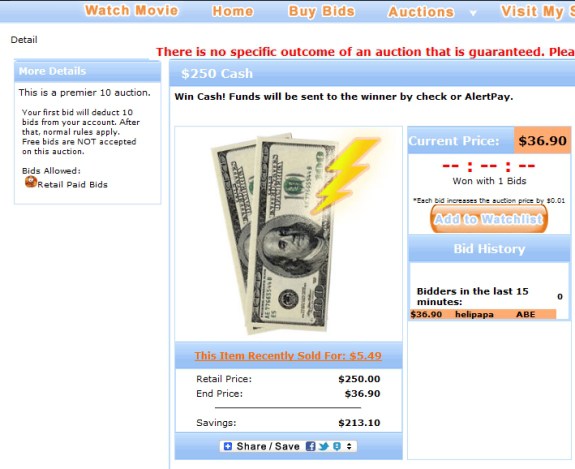
Funds from Zeek, which once auctioned sums of U.S. currency, may have ended up in a collapsed Russian bank. Graphic from the PP Blog archives: April 2012.
(Updated 11:14 a.m. ET U.S.A.) Money due victims of Zeek Rewards from transactions involving Payza and Payment World may have been transferred from VictoriaBank in Moldova to JSC TusarBank in Russia in violation of an asset freeze imposed in 2012 by a U.S. court, according to court filings by Zeek receiver Kenneth D. Bell.
Meanwhile, OboPay’s name now has surfaced in filings by Bell. This is in the form of an October 2012 email from a Payment World official to a Payza official questioning Payza’s relationship with OboPay. The U.S. Justice Department last year announced a criminal investigation involving Payza and OboPay. The specific reason behind the probe and the targets are unknown.
Senior U.S. District Judge Graham C. Mullen of the Western District of North Carolina last week lifted the seal on Bell’s 258-page filing in which Bell alleged Payza, Payment World and VictoriaBank enabled Zeek’s Ponzi scheme shut down by the SEC in 2012. The filing consisted of a 26-page motion and 232 pages of exhibits, including emails between Payza and Payment World. As noted above, one of the exhibits raises the name of OboPay.
Mullen imposed the asset freeze in August 2012.
Whether the possible transfer of Zeek-related funds from Moldova to Russia is part of the Russian probe is unclear.
Adding to the international intrigue is that a second Russian bank that somehow might have been involved in the Payment World-related money flow reportedly collapsed in 2013. This institution is known as Master Bank and is described in Bell’s exhibits as a “sponsoring bank” of a Payment World entity in Hong Kong.
A sponsoring bank provides processors access to Visa or MasterCard networks
On Sept. 13, 2015, just prior to the collapse of TusarBank, the Moscow Times listed Master Bank as one of “Russia’s Biggest Banking Crashes of the Last 2 Years.” This crash occurred in 2013 and was notable for something beyond the 31.3-billion-ruble bailout.
Even having Igor Putin, a cousin of President Vladimir Putin, on the board of directors could not save Master Bank. The lender’s license was revoked in November 2013 with the Central Bank alleging the bank had violated money laundering legislation and processed large suspicious transactions.
In 2012, just prior to the collapse of Zeek, Zeek figure Keith Laggos claimed he had helped Zeek move payment operations offshore, including to Hong Kong. Specific details of that asserted move are unknown. Zeek had about 15 financial vendors, according to court filings.
Payza, under the leadership of Firoz Patel, has claimed it conducted due diligence on Zeek, according to Bell’s filings. Even if true, it somehow appears to have missed that Zeek was offering an outrageous and unusually consistent return averaging about 1.5 percent a day and also claimed “compounding” was possible.
The SEC has described Zeek as a cross-border Ponzi scheme that gathered nearly $900 million while operating from North Carolina.
From Bell’s filing (italics added):
On August 29, 2010, Paul Burks [of Zeek] onboarded an account with Payza (then, known as AlertPay) in the name of Rex Venture Group LLC that was associated with two websites: www.zeekrewards.com and www.zeekler.com. Prior to the boarding of the account, Payza purportedly conducted due diligence, collecting and reviewing information about Paul Burks and the business. According to Payza, during the course of the relationship, it monitored and mitigated risk. Despite these procedures, Payza did not identify or address the red flags indicating that ZeekRewards was a Ponzi scheme and, instead, together with PaymentWorld and VictoriaBank [of Moldova], facilitated access and payment to and from ZeekRewards by numerous affiliates worldwide.
Bell’s 258-page filing is available on the landing page of the receivership website. It is styled, “Memorandum in Support of the Receiver’s Motion for an Order Directing Payza, Payment World, and VictoriaBank to Turn Over Receivership Assets and/or Find Them in Contempt of the Court’s Order Freezing and Preserving Receivership Assets.”
Zeek Rewards’ receiver Kenneth D. Bell has gone to federal court in the Western District of North Carolina, alleging that the Payza and Payment World payment processors “facilitated” the epic cross-border Zeek Ponzi- and pyramid scheme.
More than $13.1 million in funds from North Carolina-based Zeek that could be used to compensate victims ended up in VictoriaBank in Moldova, owing to a processing relationship among Payza, Payment World and the bank, Bell alleged.
Now, Bell contends, “based on recent developments in the Receiver’s investigation, there is an open question as to whether the Receivership Assets held on Reserve at VictoriaBank remain or were transferred from the account.”
Prosecutors haven’t revealed the target of the criminal probe. It is unclear whether there is any nexus with the Zeek case, alleged overall to involve $897 million. Zeek, a Ponzi forum “program,” allegedly created tens and tens of thousands of victims worldwide.
Payza is a Ponzi-forum darling. Its predecessor, AlertPay, is referenced in court filings in the 2008 AdSurfDaily Ponzi case. Scores of Ponzi-board “programs” claim to accept Payza, including an emerging scheme known as Traffic Monsoon.
Bell accused Payza, Payment World and VictoriaBank of violating an asset-freeze order issued in 2012 by Senior U.S. District Judge Graham C. Mullen.
In a novel legal maneuver, Bell has persuaded Mullen to freeze a correspondent account VictoriaBank holds on U.S. soil at Bank of New York Mellon. Mullen authorized the freezing of more than $13.1 million in the account.
If the account proves not to hold that sum, VictoriaBank must deposit with the receivership the difference between the frozen sum and the $13.1 million Bell claims as receivership assets, according to the order.
Bell signaled on Feb. 1 that the receivership would pursue Payza, Payment World and VictoriaBank.
Moldova is situated in Eastern Europe. It shares a border with Ukraine, a world hot spot.
The office of U.S. Attorney Channing D. Phillips of the District of Columbia originally anticipated making an announcement about a criminal investigation involving the Payza and OboPay payment processors “shortly” after Jan. 22.
On Feb. 10, however, prosecutors updated their Victim/Witness site to say they now do not expect to make an announcement until “shortly” after April 29.
Payza, alleging fraud, sued OboPay last year. As the PP Blog reported in October, prosecutors intervened in the civil case and requested a stay while the criminal probe continued.
U.S. District Judge Phyllis J. Hamilton of the Northern District of California initially paused the civil case until Jan. 22. The stay now has been extended until April 29 at the request of prosecutors with agreement by the parties, according to court filings.
The target of the criminal probe has not been revealed.
UPDATE MAY 23, 2016, 4:03 P.M. The stay in the civil case has been extended until June 29, 2016. The Victim/Witness site has been updated to reflect this.
URGENT >> BULLETIN >> MOVING: Antonin Scalia, an associate justice of the nine-member U.S. Supreme Court, has died in Texas, according to multiple media reports.
“Justice Antonin Scalia was a man of God, a patriot, and an unwavering defender of the written Constitution and the Rule of Law. He was the solid rock who turned away so many attempts to depart from and distort the Constitution. His fierce loyalty to the Constitution set an unmatched example, not just for judges and lawyers, but for all Americans. We mourn his passing, and we pray that his successor on the Supreme Court will take his place as a champion for the written Constitution and the Rule of Law. Cecilia and I extend our deepest condolences to his family, and we will keep them in our thoughts and prayers.”
Scalia, 79, was known for his conservatism. He was appointed to the court by President Ronald Reagan in 1986.
From Justice Scalia’s official bio on the Supreme Court website (as of 5:45 p.m. EDT today):
Antonin Scalia, Associate Justice,
was born in Trenton, New Jersey, March 11, 1936. He married Maureen McCarthy and has nine children – Ann Forrest, Eugene, John Francis, Catherine Elisabeth, Mary Clare, Paul David, Matthew, Christopher James, and Margaret Jane. He received his A.B. from Georgetown University and the University of Fribourg, Switzerland, and his LL.B. from Harvard Law School, and was a Sheldon Fellow of Harvard University from 1960–1961. He was in private practice in Cleveland, Ohio from 1961–1967, a Professor of Law at the University of Virginia from 1967–1971, and a Professor of Law at the University of Chicago from 1977–1982, and a Visiting Professor of Law at Georgetown University and Stanford University. He was chairman of the American Bar Association’s Section of Administrative Law, 1981–1982, and its Conference of Section Chairmen, 1982–1983. He served the federal government as General Counsel of the Office of Telecommunications Policy from 1971–1972, Chairman of the Administrative Conference of the United States from 1972–1974, and Assistant Attorney General for the Office of Legal Counsel from 1974–1977. He was appointed Judge of the United States Court of Appeals for the District of Columbia Circuit in 1982. President Reagan nominated him as an Associate Justice of the Supreme Court, and he took his seat September 26, 1986.
On behalf of the Court and retired Justices, I am saddened to report that our colleague Justice Antonin Scalia has passed away. He was an extraordinary individual and jurist, admired and treasured by his colleagues. His passing is a great loss to the Court and the country he so loyally served. We extend our deepest condolences to his wife Maureen and his family.
Laura and I mourn the death of a brilliant jurist and important American, Supreme Court Justice Antonin Scalia. He was a towering figure and important judge on our Nation’s highest court. He brought intellect, good judgment, and wit to the bench, and he will be missed by his colleagues and our country. Laura and I send our heartfelt sympathies and condolences to his wife, Maureen, their nine children, and the entire Scalia family.
Let’s begin by pointing out that Daniil Shoyfer and Scott Miller have not been charged by the SEC in its 2014 TelexFree action. There are asset freezes aplenty in that government-brought case, including freezes against alleged promoters Sann Rodrigues, Faith Sloan, Randy Crosby and Santiago De La Rosa.
The asset restraints imposed yesterday by U.S. District Judge Timothy S. Hillman against Shoyfer (of New York) and Miller (of Indiana) flow from an altogether different case: a proposed class-action brought by plaintiffs last year.
Indeed, private plaintiffs represented by private attorneys — as opposed to government plaintiffs represented by government attorneys — have now managed to persuade a judge to block the flow of funds alleged to be tainted by fraud.
This is horrible news if you’re a serial promoter of MLM fraud schemes or Ponzi-board “programs” because it demonstrates that the government no longer is your singular worry. Put another way, even if the SEC or some other agency “misses” you, aggressive class-action attorneys may not.
They even may be tracking you as you move from scheme to scheme — and, of course, agencies such as the SEC follow court filings in related actions closely.
Even though the private lawyers did not get everything they sought in yesterday’s order by Hillman, they got enough to seriously complicate the lives of their targets. Although the judge did not restrain assets with no nexus to the alleged $3 billion TelexFree Ponzi- and pyramid scheme, both Shoyfer and Miller now must make monthly financial reports to the court.
From the order:
“Each Individual Defendant shall file a statement of accounting with the Court, under seal, on the last day of each month by 5:00 p.m. EST, setting forth all monetary expenditures and the sale and/or transfer of all assets made in the prior month . . . To the extent that any Individual Defendant seeks to expend money or to sell, transfer dissipate, assign, pledge, alienate, encumber, diminish in value, or otherwise dispose of any funds or other assets which they would not be permitted to do under the terms of this Order, such defendant may file a motion with the Court setting forth, in detail the nature of the transaction.”
And, the judge continued, “The Individual Defendants may petition the Court to exempt from this Order any fund or other assets in any bank, brokerage or other financial institution accounts and any other assets held by of for the benefit of such defendant on the grounds that such assets are not traceable to monies received by him in connection with his involvement with TelexFree. The Individual Defendants shall submit detailed financial statements and/or other documentary evidence to establish the funds held or assets in question are funds or assets were acquired independently. The Individual Defendants shall also submit an accompanying affidavit signed under the pains and penalties of perjury attesting to the authenticity and truth of the evidence submitted in support of their motion to exempt. All filings made pursuant to this section shall be filed under seal. After reviewing the filing, the Court will determine whether notice to the Plaintiffs, discovery and/or a hearing will be required.”
So, under the terms of the order, it would appear that, if Shoyfer wants to keep any MAPS income that flowed to him on the grounds it did not originate with TelexFree, he would have to petition the court to do so.
Miller, known for telling a “Carlos Danger” joke to a TelexFree audience and pitching the program to Americans while it was under investigation in Brazil amid reports of threats against a judge and prosecutor, was part of an effort to solicit sums as high as $15,125 from TelexFree prospects. Viewers were told their $15,125 would return at least $1,100 a week for a year.
In restraining the assets of Miller and Shoyfer, Hillman found that the plaintiffs likely would prevail on the merits. Unlike Shoyfer. Miller did not seek to block the preliminary injunction.
But Hillman also cautioned the plaintiffs that more work was needed and that the “depiction of Shoyfer as a ‘Top Level Promoter’ who swindled TelexFree victims out of millions of dollars is, on the current record, nothing more than unsupported rhetoric.”
EDITOR’S NOTE: This is a follow-up to our Feb. 4 article that reported TelexFree figure James Merrill potentially could be forced to take the Fifth Amendment in front of a large audience at a music hall in Worcester, Mass., on Feb. 10.
**____________________________**
James Merrill
Forcing him to take the Fifth Amendment tomorrow at Mechanics Hall in front of an expected large crowd at a meeting of TelexFree creditors could affect his right to a fair trial in the criminal case against him in October, James Merrill argued yesterday in bankruptcy court.
Through attorney Robert Goldstein, Merrill argued that a “spectacle” easily could ensue and that all of it could end up on the Internet.
Trustee Stephen B. Darr’s plan to hold the meeting at the hall may set the stage for news outlets to photograph or record Merrill’s invocation of his right not to incriminate himself and for attendees with cell phones to do the same thing and “widely disseminate the spectacle on the Internet,” Merrill argued.
Merrill will “appropriately, and necessarily” invoke the Fifth if forced to appear “and will respectfully decline to answer any questions regarding” TelexFree, which filed for Chapter 11 protection on a Sunday evening in April 2014.
Shortly after the filing, state and federal regulators called TelexFree a massive, cross-border fraud. Darr went on to deem it a Ponzi- and pyramid scheme, and Chief Bankruptcy Judge Melvin S. Hoffman agreed. Merrill and Carlos Wanzeler, another TelexFree executive, were charged criminally in 2014, after an investigation by the U.S. Department of Homeland Security.
TelexFree, which operated over the Internet and may have produced about $3 billion in illicit transactions in about two years, was the top story in DHS’s Daily Open Source Infrastructure Report on April 17, 2014.
In the 2008 AdSurfDaily Ponzi scheme, accused operator Andy Bowdoin invoked his Fifth Amendment right at a civil proceeding while a parallel criminal investigation was under way. Some ASD supporters immediately used the Internet to circulate a story that Bowdoin was “too honest” to testify.
ASD, a $119 million Ponzi scheme that ultimately sent Bowdoin to prison, and TelexFree operated in similar fashion. Prosecutors have described TelexFree as having cult-like qualities.
Read Merrill’s brief. Hoffman has ordered Darr’s motion to compel Merrill’s attendance “continued generally.” How that would affect tomorrow’s meeting was not immediately clear.
BULLETIN: TelexFree Trustee Stephen B. Darr today asked Judge Melvin S. Hoffman for an order that would compel TelexFree executive James Merrill to appear at a meeting of creditors at 11 a.m. on Feb. 10 at Mechanics Hall in Worcester, Mass.
Darr also wants Hoffman to designate Merrill as TelexFree’s corporate representative, setting the stage for him to be questioned by the office of the U.S. Trustee, an arm of the U.S. Department of Justice that participates in bankruptcy cases.
Carlos Wanzeler, another TelexFree principal, reportedly fled to Brazil in 2014, a circumstance that makes Merrill the only remaining shareholder known to be on U.S. soil. Merrill, who faces criminal charges of operating a Ponzi scheme, has been under close supervision with an ankle monitor since 2014, although he is permitted to leave his Massachusetts home to attend court functions and certain other events.
An appearance by Merrill at the meeting potentially sets the stage for him to invoke his Fifth Amendment right against self-incrimination before a large crowd at Mechanics Hall. On Jan. 13, the Telegram & Gazette reported that Darr had made plans to accommodate up to 1,000 people at the meeting, owing to the immense size of the TelexFree scheme.
Mechanics Hall, which calls itself “an acoustical masterpiece,” typically is known as a venue for music and performances.
“The historic performance hall, which can hold about 1,600 people, is an unusual choice for a meeting of bankruptcy creditors,” the Telegram & Gazette reported last month.”In most Worcester bankruptcy cases, creditors meet in a small room in a downtown office building.”
UPDATE 6:08 P.M. Feb. 8. Randall G. Reese, via Twitter (@Chapter11Cases), is showing a screen shot of a document today that says Merrill opposes the motion to appear on Wednesday and questions whether his right to a fair trial in the criminal case could be compromised if he is forced to appear at the meeting. See shot in No. 2 position in Comments thread below.
UPDATED 6:29 P.M. ET U.S.A. Kenneth Goldstein, who became a curious sidebar in the bizarre story of the SVM Global Initiative “program” led by Sheila V. Tabarsi, has pleaded guilty to unlicensed practice of law and offering a false instrument for filing.
The latter charge is a felony, according to the office of Bronx County District Attorney Darcel D. Clark in New York.
Clark’s office confirmed the guilty pleas today to the PP Blog, saying they occurred on Jan. 22. Sentencing is set for March 22, absent a postponement. Clark’s office declined to comment on the possible penalties.
“He pled guilty to both [charges],” Clark’s office said.
In April 2015, after Tabarsi had claimed she was under investigation by the FBI, the PP Blog raised questions about whether “sovereign citizens” in the United States and Canada were involved in SVM and whether certain members have ties to the UFunClub cross-border scheme under criminal investigation in Thailand. (See link in opening paragraph above for details.)
Goldstein was described in 2014 in the New York Post as an “ex-petty officer in the Coast Guard” who had “pawned himself off as a former military lawyer and nearly fooled a Long Island judge — until he started rambling like Joe Pesci in ‘My Cousin Vinny.'”
He is suspected of unlicensed practice of law in at least two New York jurisdictions. The Bronx Chronicle reported in October 2015 that he was accused of “posing as a military lawyer in the Bronx and several other counties in New York and misrepresenting veterans in separate Family and Civil Court cases.”
In a separate case, he is accused of threatening a veteran over the phone, according to the Chronicle.
Tabarsi, who describes herself as a former Air Force member, a medical intuitive, a psychic and, most recently, a “Rev.,” has described Goldstein as a “USCG JAG OFFICER” and as “LIEUTENANT COMMANDER KENNETH GOLDSTEIN.”
At one point in 2015, Tabarsi described the PP Blog as part of a terrorist organization that sought to “INCITE A RIOT and commit unprovoked ATTACKS on DECORATED UNITED STATES WARTIME VETERANS” and additionally carry out a “HATE CRIME.”
Goldstein has claimed to the PP Blog that Tabarsi “already presented her business plan to a senatorial body and has their seal of approval.”
BULLETIN: New court filings in the Zeek Rewards’ Ponzi- and pyramid-scheme case brought by the SEC in 2012 say Zeek receiver Kenneth D. Bell may ask a federal judge for a finding of contempt against Payza, a payment processor.
The news comes as federal prosecutors continue a criminal investigation involving Payza and Obopay, another payment processor. Prosecutors are expected to make an announcement on the Payza/Obopay matter soon.
Payza is Ponzi-forum darling.
Some of the Zeek money ended up in Moldova, according to previous filings by Bell. Precisely how that happened remains unclear, but Bell says he is working with authorities in both Moldova and the United States “to locate and recover the funds.”
The Receiver Team continues its efforts to investigate and pursue outstanding funds from the processing relationship and flow of funds between Payza, Payment World, and Victoria Bank . The Team is working with government officials in both the United States and Moldova and with members of McGuireWoods Consulting to locate and recover the funds. The Receiver Team has also begun efforts to file a motion against these entities seeking the return of receivership assets and for a finding of contempt. The Receiver Team continues to investigate and pursue outstanding funds from Solid Trust Pay and Cyberprofit and is working with various government agencies in pursuit of these assets.
Another pyramid scheme has proven costly for its operators. Here, according to the SEC, is the rundown from the EAdGear case brought in 2014.
eAdGear Holdings Limited and eAdGear Inc. have been ordered to disgorge $21 million in ill-gotten gains, pay prejudgment interest of $640,000 and pay a civil penalty in the amount of $1,000,000.
Charles S. Wang and Cathy Zhang were ordered to disgorge $2.019 milion in ill-gotten gains and pay prejudgment interest of $61,280; Zhang further was ordered to a civil penalty of $200,000. Francis Y. Yuen and relief defendant Laurata Chan were ordered to disgorge $1.571 million in ill-gotten gains and pay prejudgment interest of $48,000.
U.S. District Judge Richard Seeborg of the Northern District of California entered the final judgments in the SEC’s civil case.


 URGENT >> BULLETIN >> MOVING: Antonin Scalia, an associate justice of the nine-member U.S. Supreme Court, has died in Texas, according to multiple media reports.
 Let’s begin by pointing out that Daniil Shoyfer and Scott Miller have not been charged by the SEC in its
 UPDATED 6:29 P.M. ET U.S.A. Kenneth Goldstein, who became a curious sidebar in the
  BULLETIN: New court filings in the Zeek Rewards’ Ponzi- and pyramid-scheme case brought by the SEC in 2012 say Zeek receiver Kenneth D. Bell may ask a federal judge for a finding of contempt against Payza, a payment processor.
 Another pyramid scheme has proven costly for its operators. Here, according to the SEC, is the rundown from the EAdGear case