“Consumers represented by the FTC knowingly and voluntarily, and possibly unreasonably, exposed themselves to any claimed losses with knowledge or appreciation of the risk involved.” — Part of Vemma’s Sept. 30 defense to pyramid-scheme and deceptive-advertising charges filed by the FTC in August
Consumers can be forgiven if they view part of Vemma’s defense to the FTC’s pyramid-scheme and deceptive-advertising charges as a reason to avoid the MLM trade altogether.
Not taking time and expenses into account, the odds of losing money in MLM already are high and the odds of making money are low. But Vemma now is asserting that while the risk affiliates took when joining its program may have been unreasonable, they took it knowingly.
Meanwhile, Vemma is claiming that “[a]ny losses sustained by the FTC and/or the consumers it purports to represent were caused by the acts or omissions of third parties over whom the Corporate Defendants had no control or right to control.”
Vemma did not identify the third parties. But if the firm was referring to its own affiliates, including those who hyped the program on college campuses and through constant banging on social media, consumers again can be forgiven for avoiding the trade.
There is little reason for consumers to trust any MLM if one of the industry’s most famous companies is saying it cannot control affiliates, especially if it earlier benefited from the toxic tradecraft of those affiliates.
Vemma’s defense is pretty much a blanket denial of the FTC’s material allegations contained in the complaint here.
Vemma critic Truth In Advertising has a link to Vemma’s response to the FTC complaint. (See Vemma’s Answer to FTC’s Complaint for Permanent Injunction here.)
A week before Vemma filed its response, one of its top affiliates took to the web and made crude remarks about the FTC while at once asserting that Vemma itself had a “douchebag element” in its affiliate ranks. This occurred just days after CEO B.K. Boreyko had made an appeal for people to pray for the company.
The firm’s defense that affiliates may have knowingly made an unreasonable choice in joining would come later.
Has a globetrotting serial huckster facing a civil-contempt proceeding in the SEC’s pyramid- and Ponzi case against TelexFree, key executives and promoters set the new standard for vomitous MLM?
Accused of repeatedly violating U.S. court orders, Brazil native, TelexFree promoter and two-time accused securities fraudster Sann Rodrigues now effectively is hoping to convince a federal judge that spokenwords don’t mean things. In the face of multiple videos showing him speaking English, Rodrigues is claiming through attorneys that he “does not speak English” and that he “is almost completely unable to read English and has between no proficiency and an elementary proficiency in speaking in English,” according to the SEC.
And, Rodrigues contends, he “did not understand the asset freeze orders because he can barely speak English,” the SEC contends.
The claims amount to “nonsense,” the SEC argued in a memo to U.S. District Judge Nathaniel M. Gorton. The memo included links to two videos showing Rodrigues speaking English. (One of them is below.)
Whether Rodrigues will be able to convince the judge that spoken words don’t mean things is a question likely to be answered in the days immediately ahead — and the task perhaps just got harder.
That’s because the SEC today filed an affidavit from a Florida banker who says he spoke with Rodrigues in person approximately every two weeks from August 2014 to May 2015.
Rodrigues had eight corporate accounts, and all of them were closed by the bank, according to the banker.
Moreover, all the conversations took place “entirely in the English language,” the banker said.
And, the banker said, all of the forms “filled out and signed by Mr. Rodrigues were entirely in the English language.”
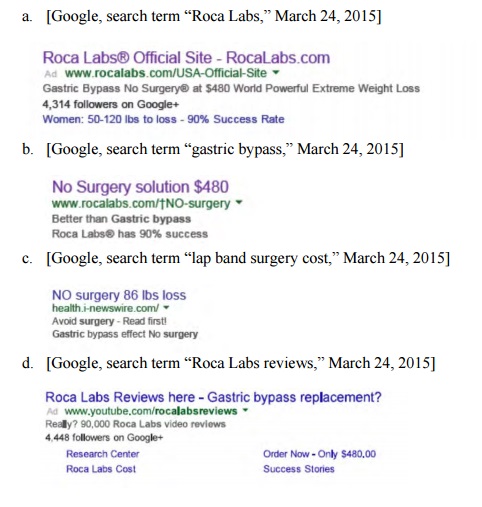
Image from FTC complaint against Roca Labs of Sarasota, Fla.
Let’s say you’re a direct-seller and manage to persuade yourself that trying to threaten and intimidate your own customers is a good business practice.
How might you accomplish this?
Well, the FTC alleged today that Florida-based Roca Labs Inc. and Roca Labs Nutraceutical USA Inc. inserted “gag clause provisions” in purported customer agreements in a bid “to stop [consumers] from posting negative reviews and testimonials online.”
From an FTC statement dated today (italics added):
“In a complaint filed in federal court, the FTC alleges that Roca Labs, Inc.; Roca Labs Nutraceutical USA, Inc.; and their principals have sued and threatened to sue consumers who shared their negative experiences online or complained to the Better Business Bureau, stating that the consumers violated the non-disparagement provisions of the ‘Terms and Conditions’ they supposedly agreed to when they bought the products. The FTC alleges that these gag clause provisions, and the defendants’ related warnings, threats, and lawsuits, harm consumers by unfairly barring purchasers from sharing truthful, negative comments about the defendants and their products.”
Said Jessica Rich, director of the FTC’s Bureau of Consumer Protection:
“Roca Labs had an adversarial relationship with the truth. Not only did they make false or unsubstantiated weight-loss claims, they also attempted to intimidate their own customers from sharing truthful – and truly negative – reviews of their products.”
The FTC accuses Roca Labs of advertising its “Formula” and “Anti-Cravings” lines as “safe and effective alternatives to gastric bypass surgery.” In addition, the agency alleges, “[t]hey also claimed that users could lose as much as 21 pounds in one month, and that users have a 90 percent success rate in achieving substantial weight loss.”
Meanwhile, according to the FTC, “the defendants used testimonials and supposed ‘third-party’ reviews to illustrate the weight-loss success consumers achieved with their products. They solicited ‘Success Videos’ from purchasers by offering to pay 50 percent of the products’ price for providing positive reviews. In addition to threatening consumers who violated the gag clause provisions, the defendants claimed that consumers who posted negative reviews would owe the ‘full price’ for their products – hundreds of dollars more than advertised or actually paid, according to the complaint.”
Customers have directed at least $20 million to the firms for the powder products since 2010, the FTC alleges.
“The defendants sold the products starting at $480 for a three-to-four month supply, and have sold at least $20 million of the powder since 2010, according to the complaint.
In addition to the FTC’s unfairness charges based on the defendants’ gag clauses, the FTC alleges that the defendants’ weight-loss claims are false or unsubstantiated. The FTC also charges that the defendants failed to disclose that they compensated users who posted positive reviews. In addition, the FTC alleges that defendants violated consumers’ privacy by disclosing their personal health information in some cases to payment processors, banks, and in public court filings.”
Also named defendants were Don Juravin, also known as Don Adi Juravin and Don Karl Juravin, and George C. Whiting, also known as “Dr. George Whiting” and “George C. Whiting, Ph.D,” the FTC said.
Roca Labs implemented oppressive Terms and Conditions to stifle customers from complaining, the FTC charged. Here is one example, according to the complaint. (Italics and bolding added/light editing performed.)
A version of the Terms Defendants used prior to December 2014 . . . provided that Defendants, in the event a purchaser violated the Gag Clause, had the right to sue purchasers for an injunction, immediately bill them for $3500 in court costs and legal fees until they are determined in court, and immediately revoke all “discounts” that purchasers purportedly received. This version of the Terms further provided that Defendants could, after thirty days, report any such charge that remained unpaid to consumer reporting agencies, and forward the unpaid charges to a collection agency. This version of the terms also provided that Defendants could require purchasers who violated the Gag Clause to execute a notarized affidavit stating that their “disparaging remarks or review contained factually inaccurate material, was incorrect and breached [the Terms].” A version of the Terms used from approximately September 2012 into mid-2014 . . . provided that the purchaser further agreed that “any report of any kind on the web will constitute defamation/slander,” and agreed “to a predetermined compensation of $100,000. You agree and understand that you can not [sic] talk badly about the Formula because of any frustration you might have with the support department or your misunderstanding.”
In 2015, Public Citizen, a nonprofit group, sued Michigan-based KlearGear.com amid allegations the company effectively fined a Utah couple $3,500 after the wife posted a negative review of KlearGear at RipoffReport.com after her husband never received a desk toy and a keychain he’d ordered as Christmas gifts in 2008.
KlearGear also was accused in the lawsuit of causing a debt collector to go after the couple and of lying to credit-reporting agencies when asserting the debt was valid.
BULLETIN: Class-action attorney Robert J. Bonsignore has asked a federal judge for permission to file a third amended consolidated complaint that effectively would sue at least 20,000 “net winners” in the TelexFree scheme shut down by the SEC last year.
The proposal would name alleged TelexFree promoter Daniil Shoyfer the lead class-action defendant, effectively making him the Todd Disner of TelexFree-related court actions. Disner is a Zeek Rewards figure sued by Zeek receiver Kenneth D. Bell in clawback actions aimed at more than 9,000 alleged winners in the Zeek scheme shuttered by the SEC in 2012.
Disner also promoted the AdSurfDaily Ponzi scheme broken up by the U.S. Secret Service in 2008.
The PP Blog reported in June 2015 that Shoyfer also was promoting a scheme known as MyAdvertisingPays — or MAPS, for short.
If the judge approves the proposal by Bonsignore, it would appear to mark the first time alleged TelexFree winners have been targeted en masse for the return of their alleged winnings from a scheme the SEC has described as a massive pyramid- and Ponzi fraud. Up to $1.8 billion flowed through TelexFree, now in the hands of a court-appointed trustee who has called it a pyramid scheme.
Web records showed that Shoyfer also was promoting MAPS alongside MAPS colleagues such as U.K. hucksters Simon Stepsys and Shaun Smith.
Bonsignore’s proposed amended complaint on the TelexFree front may lead to similar questions. At a minimum, the development highlights the dangers of fraud schemes that spread at least in part though the Internet to involve hundreds of thousands of participants. Victims can pile up in extraordinary numbers, and a fraction of participants who emerge as winners can end up confronting lawsuits and expensive, emotionally draining litigation.
MAPS, a purported advertising scheme similar to AdSurfDaily, continues to operate.
EDITOR’S NOTE: On some days, it seems as though no one in MLM has any PR savvy. This is one of those days.
Positioning himself as an insider who has spoken with Vemma CEO B.K. Boreyko, one of the company’s top affiliates took to the Internet today to declare the Federal Trade Commission appears to have worn a “very overlarge, extra-size strap-on dildo” and initiated a “bend-over job” against the company in the agency’s pyramid-scheme and deceptive-advertising case last month.
This approach apparently has hampered Vemma’s ability to get restarted, the pitchman suggests.
The crude, videotaped remarks by self-identified Top 25 Vemma affiliate Lanny Morton on Periscope came while Pope Francis was visiting the United States and occurred just days after Boreyko took to Instagram and asked “prayer warriors worldwide” for 24 hours of nonstop prayer in advance of a key Vemma hearing on Sept. 15.
The PP Blog was unable to contact Vemma today for its reaction to Morton’s comments, which were recorded while he drove a car on an Arizona highway. His video, titled “vemma vs FTC update,” also blamed the company’s troubles on Vemma promoters who were a “douchebag element.”
6th Update 6:41 p.m. EDT U.S.A. A federal judge has issued a much-anticipated order in the Federal Trade Commission’s pyramid-scheme case against Vemma that says “[t]he evidence before the Court leaves little doubt that the FTC will ultimately succeed on the merits in demonstrating that Vemma is operating a pyramid scheme.”
U.S. District Judge John J. Tuchi is doing away with the receivership approach established in August and instead will appoint a monitor, according to the order.
This section of the order suggests the judge views Vemma’s products as marketable if it can get its sales process under control both in-house and externally. Even so, a limited restart may prove to be a hollow win for Vemma. Although the company will be able to restart operations under the order, Tuchi has banned the sale of “Affiliate Packets” and a compensation system that “links or ties an Affiliate’s eligibility for bonuses, or the Affiliate’s accumulation of bonus qualifying points, to that Affiliate’s purchase of the Corporate Defendants’ product, such as through autodelivery or Two & Go.”
Was Vemma a good ambassador for the MLM trade?
Vemma’s marketing material was “replete with deceptive income statements,” Tuchi found.
And, the judge observed, “Some Vemma material also contains representations the Court would characterize as ridiculous—bordering on absurd—such that a listener could not reasonably be expected to believe them. ”
From the order (italics added):
In practice, [Vemma] Affiliates are very likely engaging in inventory loading. The great majority of Vemma product sales is to its Affiliates and, as [FTC expert witness] Dr. [Stacie] Bosley noted, under the current bonus system there is no way to unbundle the Affiliates’ intent to consume Vemma products as ultimate users from their desire to remain qualified for bonuses— bonuses that are largely driven by recruitment of other Affiliates. But their intent in purchasing Vemma products must be viewed in light of Vemma’s program design as well as its training and marketing materials, which explicitly provide that Affiliates should enroll in auto-delivery for the purpose of remaining qualified for bonuses.
In all likelihood, Affiliates’ purchases of Vemma products are incidental to the right to qualify for and obtain bonuses . . . Moreover, Vemma’s purported anti-inventory-loading safeguards are neither effective nor enforced . . . Vemma contacts only 15 of its over 90,000 Affiliates a month to ask if at least 70% of their sales were for consumption or retail. And Vemma’s Vice President of Legal Affairs admitted in her testimony that the script for those calls does not really investigate the reason an Affiliate purchased product or check for inventory loading. Moreover, the Receiver found that, in practice, Vemma is five months behind on its inventory loading audits and has never suspended or disciplined an Affiliate who failed to make the requisite sales to ultimate users. And Vemma does not even attempt to apply a rule similar to the ten customer rule that was found to be a reliable way to control inventory loading in Amway.
Also from the order:
” The FTC’s evidence is certainly sufficient to show Vemma was operating an illegal pyramid scheme through 2014, and although evidence is not yet complete for 2015, the Court notes that Vemma’s 2015 “Two & Go” program contains the same indices of pyramidal structure as the former programs. Defendants have not produced evidence that the critical defects in their programs have been remedied since 2014, and the Court thus has no reason to believe at this stage that Vemma’s violations of the FTC Act are not continuing or likely to recur in the absence of injunctive relief. In sum, the Court finds the FTC has again met its burden to show a likelihood of success on the merits in demonstrating Vemma and Mr. [B.K.] Boreyko are operating a pyramid scheme, even in light of the argument and evidence provided by these Defendants.
Tuchi has lifted the asset freeze, saying the monitor and court supervision and “an injunction against the alienation by Defendant Boreyko of any of his real estate holdings during the pendency of this action” should be enough to protect against mass dissipation.
More analysis upcoming.
Read the order at the website of Truth In Advertising, a Vemma critic that has worked with the FTC on the pyramid and deceptive-advertising case.
Vemma critic Truth In Advertising has posted a transcript of the Sept. 15 battle in Arizona federal court between Vemma and the Federal Trade Commission over the preliminary injunction, asset freeze and appointment of a receiver. Vemma hopes to undo these things or at least to modify them in a way that would put the company back in business. (Link to transcript below.)
Truth In Advertising — TINA, for short — is a witness against Vemma and has been investigating the company since at least 2013. TINA says its mission is to empower consumers to protect themselves and one other from false advertising and deceptive marketing.
As a preliminary matter, the PP Blog observes that the transcript shatters the myth advanced by some Vemma supporters that the firm — alleged by the FTC last month to be a pyramid scheme — has been denied due process.
At least five attorneys appeared for Vemma. Two others appeared for Vemma CEO B.K. Boreyko, a charged FTC defendant. Still two others appeared for Tom Alkazin and his wife Bethany. (Tom is an alleged promoter charged by the FTC; Bethany is a relief defendant alleged by the agency to have profited from the scheme.)
Vemma cross-examined FTC witnesses and advanced witnesses of its own.
The transcript consists of 228 pages. The FTC claims that Vemma was a pyramid scheme through which Vemma told its own distributors they effectively could buy commissions. Vemma, meanwhile, accuses the FTC of gross overreach, orchestrating a sneak attack against a legitimate business and cherry-picking facts to make it appear as though the only appropriate way for the court to deal with the company is to kill it through the imposition of an asset freeze and the installation of a court-appointed receiver.
The judge is expected to issue a key order by 2 p.m. Arizona local time tomorrow.
Trooper Joseph Cameron Ponder of the Kentucky State Police was shot “multiple” times late last night and died a short time later at Caldwell Medical Center in Princeton, Ky., state police said.
Ponder, 31, a rookie who’d graduated from the Academy in January 2015, was stationed at Post 1, Mayfield. He was assigned to Trigg County.
Police identified Joseph Thomas Johnson-Shanks, 25, of Missouri, as the alleged assailant.
The incident began with a traffic stop near the 58-mile marker westbound on I-24 at about 10:20 P.M CST yesterday, police said.
A nine-mile chase ensued after the suspect vehicle fled, police said.
After making contact with the driver, the vehicle fled from the stop. A pursuit ensued with the suspect stopping abruptly around the 49 mile marker, causing the front of Trooper Ponder’s police cruiser to make contact with the rear of the suspect vehicle. At this time, the driver of the suspect vehicle fired several shots into the police cruiser striking the hood, windshield and Trooper Ponder multiple times. The suspect fled the scene on foot.
A manhunt then ensued.
Police found Johnson-Shanks in a wooded area near I-24 at about 7 a.m. today.
“Upon making contact with Johnson-Shanks, Troopers of the Special Response Team (SRT) observed him with a firearm and instructed him to relinquish it,” police said. “Johnson-Shanks refused verbal commands and aimed the weapon at the Troopers. An SRT Trooper discharged his agency issued weapon striking Johnson-Shanks. He was transported via ambulance to the Caldwell Medical Center in Princeton, KY for treatment where he later succumbed to his injuries at 08:23 A.M. CST.”
From Facebook video posted by Palm Beach County Sheriff’s Office.
On Sept. 1, a deputy from the Aggressive Driving Unit of the Palm Beach County (Fla.) Sheriff’s Office ticketed a woman for going 51 MPH in a 20-MPH School zone, the Sheriff’s Office said. The traffic stop was recorded on the deputy’s dashcam.
“No wonder you people get shot,” the woman told the deputy who ticketed her for going 31 MPH over the speed limit near an elementary school. “You’re absolute assholes.”
The deputy maintained his calm.
NBC Miami reports the ticket was for $606. The woman can request a hearing.
Showing a police presence in school zones is a tradition in American law enforcement, perhaps particularly at the beginning of a new school year. Motorists near the stop almost certainly will know why it occurred and will pay closer attention to their speedometers.
Keeping kids safe is a top priority. WATCH the reaction when we cited this woman going 51 MPH in a School Zone. https://t.co/8usZfu8lrS
2ND UPDATE 4:16 P.M. EDT U.S.A. Former Herbalife President’s Team member Anthony Powell is referenced in a report by the court-appointed receiver in the Vemma pyramid-scheme case filed by the FTC last month.
The mention is potentially embarrassing to the MLM trade, which has a reputation for recruiters dragging financially strapped prospects from scheme to scheme.
Powell, an MLM recruiter, joined Vemma after leaving Herbalife in 2013 and has been a subject of scorn by activist-investor and Herbalife short-seller Bill Ackman. Herbalife is under investigation by the FTC. Ackman has claimed since 2012 that Herbalife is a pyramid scheme.
With the FTC calling Vemma a pyramid scheme, Vemma receiver Robb Evans says a firm operated by Powell was the subject of at least 16 complaints to Vemma and that Vemma appears disingenuously to have tried to distance itself from Powell.
At least one such complaint about Global Pro Systems or GPS — the Powell firm — was submitted to the Arizona Attorney General, according to the report by Evans.
Trying to play dumb about Powell could constitute a material misrepresentation by Vemma, the receiver opines.
From the receiver’s report dated Sept. 4 (carriage returns added/formatting may not be precise):
The Temporary Receiver has made reference to GPS several times in this report. The Temporary Receiver located a document at the premises that stated GPS is operated by Anthony Powell. In a letter to the Arizona Attorney General dated August 29, 2013 wherein the Field Compliance Manager attempted to distance themselves from GPS by stating that, “Global Pro Systems is not owned or operated by Vemma Nutrition Company or BK Boreyko.”
Similar statements were made by the company in all of the responses sent to the Arizona Attorney General and the Arizona BBB regarding complaints that also involved GPS. While these statements on their face are true and may not be a misrepresentation, they are not completely forthcoming. In an email communication from the field compliance
manager to the BBB, the company stated, “Unfortunately, since Global Pro Systems (GPS) is not owned or operated by Vemma Nutrition Company or BK Boreyko, we do not have any control over their marketing tactics (emphasis added).”
The Temporary Receiver has determined that Anthony Powell is in fact a Star Ambassador with Vemma. Assuming Mr. Powell had to sign an Affiliate Agreement like every other Affiliate, he and his business practices would be subject to the same terms and conditions as any other Affiliate. The company made a material misrepresentation when they claimed that they had no control over GPS’ marketing tactics.
The Temporary Receiver also viewed a video posted by the company showing the defendant, Boreyko personally welcoming Anthony Powell to Vemma. Anthony Powell claims that he made millions with Herbalife and decided to bring his team to Vemma. The video indicated that Mr. Powell was a Star Ambassador. The Temporary Receiver is not aware of any disciplinary action taken against Mr. Powell or any of the other Affiliates associated with GPS. This would indicate that the most successful Affiliates are not subject to the same level of scrutiny as the less successful Affiliates.
UPDATED 6:44 P.M. EDT U.S.A. The Federal Trade Commission voted unanimously (5-0) to charge Vemma Nutrition Co. with operating a pyramid scheme. So much for the absurd proposition that Republicans on the commission are like hapless “Wheel of Fortune” contestants who couldn’t form the term “pyramid scheme” if spotted 12 of the 13 letters that comprise it.
Want to put yourself on the FTC radar? Develop a scheme. Target college students. Plant the seed that a higher education in an academic setting is a waste of time and perhaps even a conspiracy to keep students and their parents chained to college-loan debt. By all means make sure your CEO and most visible figure (Benson K. “B.K.” Boreyko) has a history such as this.
The PP Blog encourages readers to pay careful attention to the wording of today’s FTC announcement about the Vemma action. Make no mistake: the agency clearly is calling Vemma a “multilevel marketing company” that is operating a “pyramid scheme.” That’s important because it speaks directly to an absurd claim from practiced hucksters that no MLM can operate as a pyramid scheme because the two terms — MLM and pyramid scheme — are mutually exclusive.
Put another way: Not all MLM is legitimate.
Meanwhile, the FTC is seeking a permanent injunction that would prohibit Vemma from continuing to operate a pyramid scheme. As of Aug. 21, the company is in receivership. A federal judge has ordered an asset freeze.
Vemma is a member of the Direct Selling Association. DSA, notably, did not come out today with word daggers aimed at the heart of the FTC. Such a muted response by the DSA will hardly be a source of comfort to Vemma’s cheerleaders in the field.
“Earlier today, the Federal Trade Commission (FTC) announced action against Vemma Nutrition Company alleging violations of federal law, which, if true, would also constitute violations of DSA’s Code of Ethics.
“Every member of our Association, including Vemma, is required to abide by our Code as a condition of membership. All companies which use the direct selling model must uphold the highest ethical business standards, including polices that protect consumers and members of the salesforce against unrealistic earnings, lifestyle and product claims.
“The Code’s independent administrator will be alerted to the action and will review the FTC’s allegations against Vemma. If they are proven to have merit, the administrator may pursue punitive measures to ensure that appropriate standards of consumer protection are enforced.
“The allegations against Vemma have yet to be proven, and the company is entitled to due process of law. Any consumers or salespeople who have concerns regarding any DSA member, including Vemma, should contact the Code Administrator.”
“Consumer losses are inevitable because Vemma is an illegal pyramid scheme that rewards affiliates for recruiting participants rather than for selling products, the FTC alleges. The defendants provide affiliates little guidance for selling products, but instead teach them to give away products as samples when recruiting new participants. Vemma offers no meaningful discounts or incentives to encourage retail sales, according to the complaint.
“In addition to allegedly running an illegal pyramid scheme, the defendants are charged with making false earnings claims, failing to disclose that Vemma’s structure ensures that most people who join will not earn substantial income, and furnishing affiliates with false and misleading materials to recruit others.”
 Consumers can be forgiven if they view part of Vemma’s defense to the FTC’s pyramid-scheme and deceptive-advertising charges as a reason to avoid the MLM trade altogether.