UPDATED 9:47 P.M. EDT (U.S.A.)AdViewGlobal has disabled its forum. The move followed on the heels of complaints from members that the surf company was confusing them when trying to explain its new pay-out program. The payout program was introduced with great fanfare today, and included a prediction that AVG would become a Fortune 500 company.
The surf blamed the decision to disable the forum on members, saying confused members were posting information that confused other members. AVG has a history of blaming problems on members, saying in March that its bank account had been suspended because too many members wired transactions in excess of $9,500.
The forum suspension announcement was signed “George and Judi Harris,” and identified them as the “Owners.” A separate AVG forum operated by Mods and members of the Pro-AdSurfDaily Surf’s Up forum went dark a few days ago. AVG said it would inform members through “breaking news,” apparently in their back offices.
Here, our earlier post . . .
AdViewGlobal (AVG), which purports to be a professional advertising and communications company based in Uruguay, has withdrawn an announcement of its new pay-out plan, members said.
AVG members reported confusion over the initial plan, which suggested members could earn back their entire advertising spend and a profit of 25 percent during an unspecified time period.
Some members questioned whether they would have to view advertisements for eternity to record a profit. Others said they expected profitability to return quickly after AVG emerged from a dark period in which it announced the suspensions of cash-outs for at least 30 days and the implementation of a mandatory 80/20 program.
Many members joined AVG expecting to earn back their initial spend, plus full profit, in 150 days. AVG later moved the redemption date to 180 days, and then 210 days, according to its website. The date for full redemptions now appears to be up in the air, members said.
Some members raised concerns that they would not receive credit for matching bonuses AVG advertised.
For weeks, AVG advertised bonuses of 200 percent, for both prospects and sponsors. To celebrate the launch of a new website last month, AVG advertised a 250 percent match for prospects.
The initial payment plan AVG announced appeared to reflect only cash purchases and did not seem to address matching bonuses, members said. In March, one AVG promoter told prospects that $5,000 turned into $15,000 “instantly.”
Some AVG members complained about smug responses from AVG after they made simple inquiries about the payment plan and matching bonuses.
Members said AVG appeared to have an unfathomable number of page impressions on its books, owing to the 200-percent promotions and the presence of a member-to-member cash button than enabled participants to “stack” earnings within individual downline groups.
Some AVG members held more than 1 million page impressions, members said.
In other news, AVG members said the company announced that its program was “100% Legal.” The announcement came on the heels of a court filing yesterday in a RICO case that mentioned AVG’s name as a new iteration of AdSurfDaily and other autosurf programs.
ASD and AVG have close ties. Tens of millions of dollars were seized from ASD last year as part of a wire-fraud, money-laundering, securities and Ponzi scheme investigation.
UPDATED 1:26 P.M. EDT (U.S.A.) AdViewGlobal has been cited in a racketeering lawsuit against AdSurfDaily President Andy Bowdoin as an extension of ASD.
In a motion filed this morning, the plaintiffs pointed out that a bank had closed a Bowdoin account while he was running ASD, after suspicious banking activity triggered Ponzi concerns. The plaintiffs then said suspicious banking acvivity also occurred with AdViewGlobal.
“Likewise, a bank recently suspended or closed the accounts of Adview Global due to excessive wire transactions exceeding $9500,” the plaintiffs said.
“AVG is the next iteration of the Ponzi scheme auto-surf programs, which [are] staffed with former ASD executives and Bowdoin disciples, including George Harris, the stepson of Bowdoin, who is listed as an AVG trustee, Gary Talbert, former ASD executive served as CEO of AVG and now serves as an accountant, Nate Boyd, a former compliance officer at ASD, serves as “Protector†of the AVG association, and Chuck Osmin, a former ASD employee who testified on ASD’s behalf at the evidentiary hearing before this Court last fall is a customer service representative of AVG.”
It was not immediately clear if the plaintiffs in the RICO case — all of whom are members of ASD — intended to file an amended complaint that would specifically name AVG a RICO defendant.
The original RICO lawsuit was filed in January against Bowdoin, ASD attorney Robert Garner and Golden Panda Ad Builder President Clarence Busby. The lawsuit was amended in April. Bowdoin has not responded to the complaint. The plaintiffs dismissed Busby as a defendant earlier this month.
Among other things, the motion filed by the plaintiffs this morning also claims millions of dollars under Bowdoin’s control held offshore have never been repatriated. The motion includes a link to the PatrickPretty.com Blog, noting its reporting on ties between ASD and AVG.
At the same time, today’s motion by the plaintiffs asks U.S. District Judge Rosemary Collyer to deny a motion to stay the lawsuit until the government’s lawsuits against assets tied to ASD are litigated.
Bank of America was accused in the lawsuit of aiding and abetting Bowdoin and ASD. The bank is not named a RICO defendant and says it has done nothing wrong.
The plaintiffs disagree.
“For well over two years Bank of America embraced and never said no to the RICO Defendants who operated this nationwide scheme from a former floral shop in tiny Quincy, Florida,” the plaintiffs said. “ASD’s legitimacy and business model were never questioned despite being borne out of the demise of “12Daily Pro and Phoenix Surf†which were nothing more than naked Ponzi schemes investigated and eventually prosecuted by the Securities and Exchange Commission in 2006.”
Among other things, Bank of America argued that the plaintiffs already have a compensation remedy because the government has seized approximately $80 million in the ASD case.
Attorneys for the plaintiffs, however, argued that the remedy is insufficient because ASD victims cannot be fully compensated if the government establishes a restitution program and that the plaintiffs are seeking treble damages under U.S. law.
“Without Bank of America, [ASD] could have only existed in the dark alleys of the financial world where they would need to rely on off-shore accounts and questionable deposit facilities. There this scheme would have been far less likely to [metastasize] and wreak the havoc it did on so many people. Thus the stay requested by Defendant should be rejected.”
AdViewGlobal (AVG) has announced the suspension of cash-outs and a decision to make an 80/20 program mandatory. AVG members should ask the “management team” if there is any possibility that any of the following three things happened.
1.) Money paid to AdSurfDaily members by ASD ended up in the AVG system. (For example, a member got paid by ASD, and then later moved the money to AVG. Or, alternatively, an ASD member sold ad-packs directly to ASD downline members, deposited the money in his personal bank account, and later moved the money to AVG.)
2.) “Founders” and insiders of AVG used fictitious paper profits that once existed in ASD as their capital contribution to AVG.
3.) Founders/insiders of AVG took a disproportionate share of AVG’s early revenue and cashed out their fictitious ASD profits — in whole or in part — through AVG .
Here is why these questions are important:
1.) ASD’s visible cash and other assets were frozen by the U.S. government in a wire-fraud and money-laundering investigation, but other cash that once resided in ASD’s bank accounts had made its way into the bank accounts of ASD members. It also is known that some ASD members collected money directly from customers for the purchase of ad-packs, and then deposited the money in their personal bank accounts and used ASD’s internal system to move the ad-packs to the purchasers. Money from No. 1 (above) is money laundered twice, which means it is doubly dirty. If it was unclean when it resided in ASD, it is doubly unclean inside AVG.
2.) Money from No. 2 above doesn’t really exist, which means AVG created value where none existed and had non-founders/non-insiders fund the value — as ASD allegedly did with its ASD Cash Generator iteration.
Looking at it another way, AVG could have used the theoretical value of money now held by the government in the ASD case — and also the fictitious paper profits — to fund the launch of the company, passing the real cost off to non-insiders/non-founders.
3.) Money from No. 3 above would mean founders/insiders paid themselves disproportionate shares before anyone else got paid, thus plundering the company.
The autosurf landscape is littered with stories about plundering. To explain suspended cash-outs, ASD President Andy Bowdoin once claimed script problems were to blame. Meanwhile, Bowdoin claimed Russian “hackers” had stolen more than $1 million from the company.
Bowdoin never filed a police report — not even to report a purported theft in excess of $1 million, prosecutors said.
The reason one has to consider each of the possibilities above is that AVG suspended cash-outs after collecting money for 5+ months, then made 80/20 mandatory, while also changing the maturity dates for “page impressions” from 150 to 180 to 210 days.
As one of our readers pointed out, the situation AVG currently confronts is like the situation a bank would confront if it advertised CDs and couldn’t fund redemptions on their maturity dates.
Customers would buy the CDs, expecting a return in 150 days. On cash-out day, the bank would tell customers that it couldn’t fund the redemptions, hoped to be able to fund them by adding two months to the maturity date in anticipation of new revenue — but, in any case, when customers went to cash-out two months later, they could take only 20 percent of the money they were owed and were told they must keep 80 percent of their money in the system.
Financier Allen Stanford faced a similar problem with CDs earlier this year on the Caribbean island nation of Antigua, and has been indicted on Ponzi and fraud charges. Prosecutors said he created the mirage of value by employing a series of accounting tricks.
There is a fourth possibility to consider with AVG: Not all founders/insiders were created equally and that the people closest to the money cherry-picked some of it for themselves, and then told the other founders/insiders that AVG simply wasn’t generating enough revenue or that “bad members” had siphoned off cash.
Putting it in the context of the ASD case, did Russian “hackers” really steal more than $1 million — or was it simply more convenient to blame them to cover up theft and insider dealings?
Here is another possibility: No one at AVG stole anything, no one paid themselves early, the founders/insiders kept all their money in the company — and AVG simply flopped because it couldn’t generate enough cash.
A few things could be in play in this scenario. AVG, for example, could have relatively few customers willing to pay for its “advertising” services — and that the existing base of AVG’s “advertisers” willing to spend money is too small to support the weight of the liabilities or even a break-even line.
It also is possible that the banking system “caught” AVG early and choked off its access to wires and the money supply, thus starving the company.
UPDATED 4:40 P.M. EDT (U.S.A.) Before AdViewGlobal (AVG) even shared what it described as a members-only, “Breaking News” announcement that it was suspending cash-outs, the embattled surf firm threatened media outlets with copyright-infringement lawsuits if they published the announcement.
Members almost immediately shared the news outside the confines of the AVG “private association,” despite the firm’s bid to compartmentalize its announcement. Members said they had grown increasingly frustrated by AVG’s ham-handed efforts to operate in an environment of secrecy and the predisposition of some promoters to scold participants for asking questions about the company in public.
AVG informed members that cash-outs would be suspended for at least 30 days. An 80/20 program that further separates members from their money would be made mandatory. At the same time, AVG claimed it had solved payment-processing and banking problems that had dogged it for months.
The firm did not explain how it had solved the problems.
Recently, though, the firm entered into a partnership with a new company based in Canada. Members said AVG now was selling a debit card that could be used for “page impression” purchases through PayPal, whose Acceptable Use Policy expressly forbids the company’s services to be used for pyramid schemes and Ponzi schemes, two things associated with the business model AVG employs.
The debit card is offered through Texas-based Secure Cash Network Inc. (SCN), which says in its Terms of Service that the card cannot be used for the purchase of illegal products and services. Many jurisdictions consider the autosurf business model to be illegal, and the U.S. government has successfully prosecuted a number of surf firms in recent years.
AVG also said it was hiring “new management” within two weeks, but did not say whether it was firing old management — or even identify its current management team. Incongruously, the surf promised to identify its new management team, members of which may be stepping into a hornet’s nest. AVG engages in an industry frequently linked with wire fraud and money-laundering, and is closely associated with a firm under investigation for those crimes.
As is typical of AVG announcements, the company suggested members were responsible for the firm’s problems.
In this post, the PatrickPretty.com Blog listed the Top 5 reasons to avoid AVG, which purports to be a professional “advertising” and communications firm headquartered in Uruguay. There now is a sixth reason: The news AVG hoped to compartmentalize within its organizational walls — news that now is being talked about openly in forums — may be evidence of a crime in progress.
Could the AVG announcement become an important piece of evidence in an ongoing wire-fraud, money-laundering and Ponzi scheme investigation involving Florida-based AdSurfDaily Inc. (ASD) and unnamed others?
There is good reason to believe AVG is part of the ASD probe.
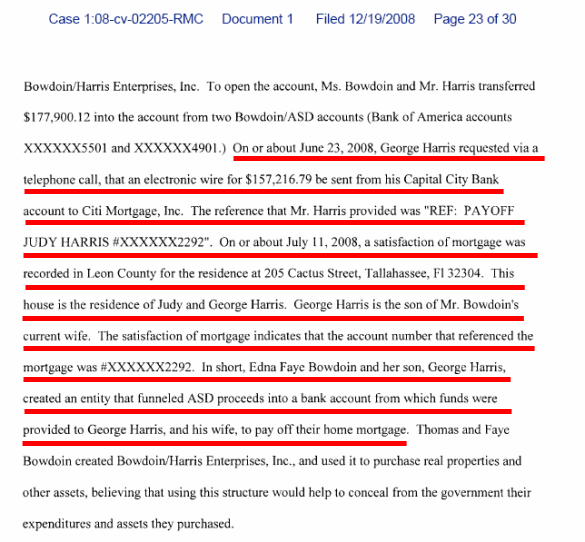
Two of AVG’s trustees — George Harris III and his wife, Judy Harris — are named in a federal forfeiture complaint as beneficiaries of illegal conduct by ASD. George Harris is the stepson of ASD President Andy Bowdoin. The Tallahassee home Harris shared with his wife — and an automobile registered to the couple — were named in the forfeiture complaint as the proceeds of a crime.
AVG trustees George Harris and Judy Harris are named in a federal forfeiture complaint as beneficiaries of illegal conduct by AdSurfDaily Inc., a surf firm with close ties to AVG.
Bowdoin is described in court filings as a target of a federal criminal investigation. AVG graphics once appeared on a website controlled by ASD, and AVG listed its street address as 13 S. Calhoun Street, Quincy, Fla., in the graphics. That is the same mailing address ASD listed, and federal prosecutors said it is bogus, which may signal ASD also is part of a mail-fraud investigation.
AdViewGlobal says Quincy is its home, but also says Uruguay is its home.
Moreover, prosecutors said in court filings that Bowdoin signed a proffer letter in the ASD case before firing his paid attorneys and proceeding as a pro se litigant. Bowdoin told ASD members that he decided to represent himself in court after consulting with a “group.”
His first pro se pleading was dated Feb. 25. The following day, AVG introduced members to Pro Advocate Group, which says it helps businesses form “private associations” and individuals practice specialties such as law and medicine without a license.
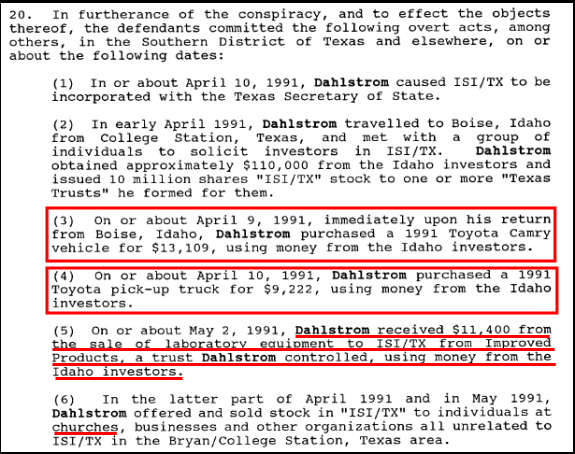
Karl Dahlstrom was accused of using investors' funds to purchase new vehicles and pitching the opportunity to church groups.
Pro Advocate Group is associated with Karl Dahlstrom, who was convicted in the 1990s of securities fraud and sentenced to 78 months in federal prison. Prosecutors said Dahlstrom bought automobiles with investors’ money, an assertion also made against Bowdoin and George and Judy Harris, the AVG trustees.
Dahlstrom also pitched his program to church members — yet another assertion made against Bowdoin.
Meanwhile, an AVG forum operated by some of the Mods and members of the Pro-AdSurfDaily Surf’s Up forum appears to have gone dark. It is unclear if content from the forum has been deleted.
** UPDATE 4:40 P.M., June 25: The website of a firm closely associated with AVG — eWalletPlus — also has gone dark. The site has been throwing a server error for at least 24 hours. eWalletPlus provided certain money services for AVG and once operated from the Phoenix area. As is the case with AVG’s servers, the servers for eWalletPlus now resolve to Panama.
EWalletPlus stopped accepting registrations from new members during the same spring time frame in which AVG announced its bank account had been suspended. ** END 4:40 P.M.UPDATE **
AVG launched after federal prosecutors seized tens of millions of dollars from Bowdoin, whom prosecutors said had a history of taking money from customers and moving it from one company to another when his enterprises encountered difficulties and could not pay members.
Like AVG, Bowdoin suspended member cash-outs and announced retrenchment plans, which fundamentally shifted the burden of paying participants from one group to another within the organization.
AVG appears to be doing the same thing, but appears also to still be collecting money from prospects who visit the firm’s main website. AVG’s retrenchment plan is not mentioned on its sales site, even though the site has a “Breaking News” banner. AVGÂ also does not inform prospects about the ties to ASD on its sales site.
New members may not learn about the retrenchment plan until after they join the organization.
Lack of disclosure is one of the allegations against ASD, which prosecutors said also engaged in the sale of unregistered securities.
AVG’s announcement of the retrenchment program raises new questions about whether the company is engaging in the sale of unregistered securities while operating an unregistered money-services business.
UPDATED 11:07 A.M. EDT (U.S.A.) AdViewGlobal (AVG) members have asked the company to produce a photograph of the company’s purported headquarters building in Uruguay. Meanwhile, members are complaining about slow payouts or no payouts from the autosurf and requesting photographs of the company’s management team.
At the same time, they are complaining about a lack of communication from the company, which purports to be headquartered in Uruguay but recently issued a news release with a dateline of Tallahassee, Fla.
As tensions build, AVG members say they are being left in the dark. And they question why queries do not get answered and why the surf’s payout rate is so “low.”
Although some promoters have suggested the company is conducting an internal “audit” to determine how much fraud occurred within the system because of misuse of a member-to-member cash button, the company itself provided the button.
How the company will determine what constitutes fraud is unclear. Some members acquired millions of page impressions by taking advantage of 200 percent — and even 250 percent — matching-bonus programs that ran virtually continuously for months.
In May, AVG announced a deal that permitted members to wire money to an offshore bank to acquire page impressions (ad-packs). Within days, however, one of the companies AVG identified as a facilitator of the wire transfers denied it had any business relationship with AVG and said it believed it had been targeted in a scam.
AVG withdrew the announcement after the company issued the denial, which raised the prospect that AVG had attempted to route money to itself by using the account of a separate company located in Florida.
A debit card that costs $30 — and permits people to pay AVG for “advertising” but not to withdraw “earnings” — also has led to questions. Members said the company was selling the debit card through PayPal, even though PayPal’s Acceptable Use Policy expressly forbids the company’s services to be used for pyramid schemes and Ponzi schemes.
The company that provides the debit card, Secure Cash Network Inc. (SCN), says in its Terms of Service that the card cannot be used for the purchase of illegal products and services. Many jurisdictions consider the autosurf business model to be illegal, and the U.S. government has successfully prosecuted a number of surf firms in recent years.
It is unclear if AVG has its own PayPal account or if a third-party account is being used to collect the money for the debit card, with the money somehow routed to AVG later. The utility of the debit card itself also is in question, since SCN says the card cannot be used to purchase illegal products or services.
More than 70 percent of AVG’s web traffic originates in the United States, according to one web service.
Many of you are familiar with “Pistol,” one of the posters here. In recent days, Pistol repeatedly sent us communications we deem harassing through our Comments form and our Contact form. When we didn’t submit to his hectoring, he published a video about us on YouTube.
The message, of course, is that if we don’t do as he says, he’ll dial up the harassment to extract the result he seeks.
Pistol has been banned at other sites for antisocial behavior. Some of it was mildly antisocial — steering threads off-topic in ways that squelched productive discussion and shifted attention to himself, for instance.
Some of it, however, was more than mildly antisocial — publishing videos that treated human beings like soulless, unfeeling objects incapable of redemption or even of having a teachable moment, for example.
Early on, we made a mistake by extending to Pistol the maximum benefit of the doubt that he would exercise some restraint and not disrupt things here. The early disruptions were somewhat minimal — Pistol occasionally promoted his videos by spamming in threads, for example.
Eventually, though, the disruptions grew in number, accompanied by an increase in toxicity. Despite his obvious intelligence, Pistol began to pose a daily maintenance problem for this Blog. If this were high school, he would be the brightest kid in the class, but also the most disruptive. Teachers would marvel out loud at his brain one moment, and want to march him to the principal’s office the next.
You knew that kid, right? He was the one who knew the difference between “innumeracy” and “illiteracy” and couldn’t wait for the teacher to confuse the terms so he could scold her for not being as smart as he — or to hold her out as a case study in hypocrisy for presuming even to be a teacher when she could not demonstrate perfect vocabulary at all times.
The problem with Pistol is that he licenses himself to walk into a house and, ultimately — sorry about this, readers — vomit all over the floor.
If you ask him politely to stop, he feigns obtuseness and then engages in sarcasm or passive-aggressive posturing, all the while insisting it’s all justifiable because he doesn’t suffer fools gladly. We recognized our own role in the insanity a few weeks ago, when we found ourselves asking this grown man not to vomit on our floor.
If you’re going around asking an adult not to vomit on your floor, well, you’re the problem. We were wrong to think we could finesse this. An adult who presumes the right to soil your floor needs to be dispatched to the curb, not to be coddled. We should have dispatched him weeks ago.
Pistol has a score to settle with us now — and now we have joined a long line of people he has pilloried on YouTube and elsewhere. Last week we deleted a few posts in which he was being deliberately obtuse, disruptive, disingenuous, baiting and just plain mean to other posters here.
As is his way, Pistol now wants the discussion to digress into a discussion over the meaning of the word “mean.” Other posters also are guilty of meanness, he suggests, and yet their meanness is tolerated so long as it is directed at, say, Pistol or autosurf promoters.
In other words, “Johnny did it! Why can’t I!” This from a man who purports to detest foolishness while using the playground arguments of a child. It’s Pistol’s way of letting us know we haven’t achieved perfection in moderating a Blog, rather like the teacher who confuses innumeracy and illiteracy.
A small number of our posters are less thoughtful in their responses to autosurf supporters than we’d prefer them to be. At the same time, some ASD and AVG posters are less thoughtful to autosurf critics than we’d prefer them to be. No matter what side of the issue these posters are on, however, they do not pose the maintenance challenge Pistol presents — and, of course, he knows this.
One of our posters — one Pistol has pilloried in video — used some choice language after being provoked by Pistol here — and Pistol responded by dialing up the provocation, essentially arguing that posters also must be etymologists.
Pistol, of course, understands the roots of language and the power of words, which is why he uses the handle “Pistol.”
We did not publish Pistol’s responses to the poster’s response to Pistol. Pistol started the problem, provided the fuel for it to escalate, and now asserts disingenuously that this Blog is engaging in censorship.
In other words, Pistol is a victim.
Two days ago it simply became too much work to deal with the maintenance problems Pistol creates. On one hand, Pistol purports not to suffer fools gladly. On the other, he subjects this Blog regularly to his own foolishness.
So, we adjusted our software settings to direct everything Pistol submits to a holding queue. Pistol responded by subjecting us to even more foolishness
We soon heard from “Pistol’sPal,” for example — more foolishness from a man who says he cannot suffer fools gladly.
Yesterday we were hit by this foolishness:
'Pistol' skewers PP on YouTube
Pistol wrote to us Saturday morning through our Contact form, presenting the URL for a YouTube video he had created to skewer us.
After Pistol used the Contact form, he submitted another post headlined “THE THIRD ATTEMPT.”
The strategy, if it can be called that, appeared to be to nuisance this Blog into publishing his comments. When that didn’t work, the strategy shifted to producing a YouTube video — basically, publish my comments or expect to see yourself pilloried on YouTube.
When that didn’t work, the strategy reverted back to haranguing: “THE THIRD ATTEMPT” means that two prior attempts to get a comment published failed: The message: Play my game or you might not like the consequences. It is, among other things, both extortive and foolish.
All this foolishness . . . from a poster who purports not to suffer fools gladly.
What Pistol seems unwilling to do is forgive any human foibles. Some of our posters, for example, are former ASD members who have “seen the light” and now post here and elsewhere to help people steer clear of scams. Pistol has pilloried some of them in videos.
Beyond that, though, Pistol regularly skewers them here, while at once insisting he opposes scams. He is attacking people who are trying to help, using flaws and imperfections he perceives to demean their worth as human beings.
The message: How can they now presume to be teachers — or to have any worth at all?
Other posters here never had anything to do with ASD or AVG, but work to educate and inform the public about scams. Pistol skewers them, too, dismissing or ignoring the value they add and focusing on what he perceives to be their imperfections as human beings.
Every appeal we’ve made to the greater angels of his nature has been met with hostility and obtuseness.
Ever wonder why there are relatively few Blogs and forums that cover autosurf scams? One of the reasons is that there is no money in it. Another is that you pay a price — from the scammers themselves, and from the Pistols of the world, who purport to detest scams while derailing the efforts of people who are trying to do something about them.
Here is the math:
In April, we paid a bill for $153.52 for our PACER subscription. In January our PACER bill was $62. There are other expenses associated with running this Blog, including the enormous investment in time. This story, for example, took two weeks to research and report, and we had to pay for certain documents. We reviewed hundreds of pages of records.
This Blog has generated $448.22 in total revenue year-to-date. May revenue was $70.70. Our “pay” is pennies per day — if that.
And now Pistol, who purports not to suffer fools gladly and to detest autosurf scams and scammers, has joined with them in spreading the lie that this Blog is lining its pockets with advertising fees.
With respect to Pistol and his participation on the PatrickPretty.com Blog, we gave him way too much latitude.
We apologize to readers for doing so.
This Blog is not written for people who agree with our point of view; it is written for the “CORRECTIONs” of the surf world, even though we know CORRECTION and other surf supporters never may agree with us.
But we also know we have made a difference in the lives of people once immersed in the convoluted world of the autosurf, and watching their thought processes evolve has provided joy.
UPDATED 11:04 A.M. EDT (U.S.A.) Plenty of AdViewGlobal (AVG) members are quick to criticize the U.S. government and the Federal Reserve for propping up sick companies.
Under pressure from “advertising” participants, however, the autosurf firm may be on the verge of implementing its own bailout plan for rank-and-file members who are sick of “low” payout rates.
The plan appears to feature accounting tricks and a redistribution scheme of the same ilk some AVG members accuse the government of foisting on the American people. If implemented, it may go down in history as the first example of Autosurfism, an economic theory that apparently holds wealth can be created by taking away vast holdings from some members so other members with smaller stakes can enjoy higher daily payout rates from the company’s advertising rotator.
AVG members say the company is considering a plan that would reduce the maximum number of “page impressions” (ad-packs) an individual member may hold to 250,000. Some members reportedly have more than 1 million page impressions on the books. Their holdings would be reduced to 250,000 by fiat, with the excess placed off the books in a nonearning state of suspended animation for at least 30 days.
After 30 days, members said, AVG would try to place the excess holdings back on the books. It is unclear how the system will be able to sustain the excess then if it cannot sustain it now.
One promoter, with hopeful words, said AVG expected to record multimillion-dollar sales soon by offering a suite of communications services. AVG announced the new services earlier this month, about five months after the surf launched.
Smoke And Mirrors?
Capping the page-impression ceiling at 250,000 may raise serious concerns about solvency, an issue frequently associated with the autosurf trade. Liabilities typically cannot be erased simply by pretending they don’t exist or by hiding them until it is more convenient to own them, anymore than assets can be created by divining them into the system. (See Enron.)
In the autosurf trade, liabilities accrue the instant a member completes a paid-to-surf session. If a surf has thousands of members, liabilities due each surfer accrue daily. A company is insolvent if its liabilities exceed its assets or if it cannot pay liabilities as they mature.
AVG members said the company was considering a scheme by which the maturation dates of liabilities would be pushed back to 210 days. The initial maturation date, members said, was 150 days. In other words, members who expected to receive back 100 percent of their advertising expenditure, plus profit for clicking on ads in AVG’s rotator, would have to wait two more months to get their payouts — while clicking every day during the two extra months to qualify for the maximum payout.
Members said AVG may place millions of page impressions in a state of suspended animation, something that could be construed as a bogus accounting practice. One of the principal accounting tricks of the autosurf trade is to pretend liabilities don’t exist by saying “rebates (payouts) aren’t guaranteed.” This infamous line is what permits autosurfs, in effect, to wipe away liabilities by fiat or to disguise liabilities by treating them as assets.
Despite the plan, which promoters are positioning as a means by which AVG can improve the daily payout rate from its current state of near 0 percent to 1 percent, members insisted AVG has a healthy balance sheet. AVG, however, does not publish audited and certified financials and largely operates in an environment of secrecy, saying it is a “private association” headquartered in Uruguay.
Promoters have said the Uruguay location was chosen to insulate the company from agencies such as the U.S. Securities and Exchange Commission.
Did The 200 Percent Promotions And AVG Cash Button Backfire? Members Complain About Manipulation And Abuse
AVG created conditions that enabled some members to acquire vast numbers of page impressions, in part through an almost nonstop series of 200-percent, matching-bonus promotions for prospects and sponsors. At the same time, the company provided a member-to-member cash button that reportedly was rife with abuse by promoters who “stacked” friends and family members within their organization to maximize daily earnings within individual downline groups.
The member-to-member cash button — coupled with the matching-bonus promotions — heightened concerns about wire fraud and money-laundering, but some members said their colleagues simply were taking advantage of a service AVG provided. Others disagreed, describing “stacking” as unethical.
Upon the launch of a new website earlier this month, AVG quickly did away with a whopping, 250-percent, matching-bonus program it had implemented to celebrate the website launch. Although the 250-percent program was advertised to last through June 29, AVG moved the expiration date back to June 5.
The surf removed the cash button after a member shared a strategy by which sponsors could gather payments directly from prospects, deposit them in the sponsors’ banks, send checks by overnight mail to processors in Canada and Panama or use the banks’ wire facilities to route the money to the offshore processors, and then cause the processors to wire the funds to AVG.
Under the strategy, sponsors would fund their own AVG accounts with prospects’ money, and then use the AVG system to transfer the money back to prospects’ accounts so they could quality for the 250-percent matching bonuses. The bonuses alone created astronomical liabilities.
Some members, though, described the convoluted, money-transfer process as all in a day’s work for helpful sponsors committed to the success of their downlines. Others called it wire fraud and money-laundering.
A number of AVG members have called for the company to identify members who abused the system and to claw back ill-gotten gains from them. AVG, however, may encounter difficulty defining what constitutes abuse, since the company itself provided the means that made the purported abuses possible.
Moreover, some members favored by management could have benefited from the same practices other members described as abusive.
Processor Problems And New Debit Card
Meanwhile, members are reporting that AVG — which purportedly is based in Uruguay — is having trouble with SolidTrustPay, a payment processor based in Canada. At the same time, members say, AVG is recommending that members cancel current payout requests through SolidTrustPay and route the requests through StrictPay, a payment processor based in Panama.
AVG also is pushing a debit card, which members say costs $30 and one day is envisioned as the preferred payout method. The card currently can be used to pay AVG, but cannot be used for cash-outs.
The card comes with this fee structure:
Monthly fee: $7.95
ATM fee: $2.00
International ATM fee: $5.00
International inquiry/decline fee: $1.50
ATM declined fee: $1.50
ATM inquiry: $1.50
Point-of-sale purchase fee: $1.50
Point-of-sale purchased declined fee: $1.50
Pinless transaction: Free
ACH inbound to card fee: $7.00
U.S. wire inbound to card fee: $10.00
International wire inbound to card fee: $15.00
Moving money from AVG account to card fee: $3.00
ACH outbound fee: $7.50
Domestic wire outbound fee: $25.00
International wire outbound fee: $35.00
Other fees may apply.
The card is known as First Debit Gold, and is issued by a company in Texas known as Secure Cash Network Inc. (SCN). In its Terms of Service, SCN says the card may not be used to purchase illegal goods or services. Many governments view the autosurf trade as an illegal enterprise.
Amounts members place on the card are stored in SCN’s computer system are are not insured by the FDIC, according to SCN’s Terms of Service. The amount members can place on the card is unclear. Some members said $10,000; others said $1,000.
Some members said AVG was selling the SCN card through PayPal. PayPal’s Acceptable Use Policy expressly prohibits use of its services for pyramid schemes and Ponzi schemes. It is unclear if the PayPal account used by AVG is in AVG’s name, but the advertising-rotator facet of its business frequently is associated with Ponzi schemes.
AdSurfDaily, a company with close ties to AVG, was accused by federal prosecutors last year of operating a multimillion-dollar Ponzi scheme and by state prosecutors in Florida with operating a pyramid scheme.
Some members of the AdViewGlobal (AVG) autosurf say they received no paper profits for surfing yesterday. For weeks, members have complained about “low” payouts, not “no” payouts.
Concern now is spreading about the complete absence of payouts yesterday. Some members, however, are saying that complainers have to understand that payouts never were “guaranteed.”
AVG is awash in a sea of incongruities. On one hand, the surf has released a forward-looking promotion that suggests members can earn back the money they spend on “advertising” — plus a profit of 10 percent — in the first six months of membership.
On the other hand, however, current members are grumbling about minuscule payouts — and, now, no payouts at all.
The no-payout development came on the heels of a PowerPoint presentation AVG released that advertised a conversion rate “in the neighbourhood of 37 percent,” a claim that implied the rate could be achieved across-the-board, regardless of the nature of the product, the quality of the audience, the state of the economy, pricing and other variables.
Under the conversion claim, an “advertiser” who pitched free doughnuts could expect 192 conversions out of each 519 AVG visitors. An “advertiser” who sold doughnuts for $10,000 each also could expect 192 conversions out of each 519 visitors.
“Advertisers” could expect to “garner” the rate as long as their sales copy didn’t “suck,” AVG said in the presentation.
The presentation included a “case study” that incorporated events that had not happened and concluded with an AVG surfer “on the beach” two years from now enjoying his success.
One AVG promoter complained that this Blog’s reporting on the PowerPoint presentation was unfair, saying the promotion was “not complete and is still being polished.” The member explained that the presentation was released because promoters were eager to have a new sales tool, but did not explain why AVG ever would release a tool prematurely, especially when the tool paints a rosy picture despite the fact current members are complaining about major problems within AVG.
AVG provided no context and no proof of its 37 percent conversion claim — a claim that was at odds with a separate claim of a “10%” conversion rate elsewhere in the presentation. The 10 percent claim was punctuated with an exclamation point, even though it was 27 points lower than the incredible, 37 percent claim.
Any person who achieved the lower conversion rate reasonably could ask why he hadn’t achieved the higher one — and why the 10 percent rate was something to celebrate with an exclamation point when the advertiser’s ad had underperformed the standard claim by a misery factor of nearly four to one.
Conversion rates vary wildly, as does the definition of a successful conversion rate. Depending on the nature of the product, pricing, market conditions and other variables, some advertisers would celebrate a conversion rate of 1 percent or even lower. A 37 percent conversion rate — especially if the implication is that it can be achieved across-the-board — is absurd on its face.
AVG Members Want Thieves Identified
Meanwhile, amid reports that some members had stolen from the company by abusing a member-to-member button AVG had provided, some members have called for AVG management to identify the thieves.
Earlier this month, an AVG promoter described a strategy by which prospects could pay upline sponsors directly for the purchase of ad-packs, which AVG calls “page impressions” or “viewer impressions.”
Under the strategy, the prospect would pay the sponsor directly, instead of paying AVG. The sponsor, in turn, would deposit the money into his private bank account. In the next step, the sponsor would send a check by overnight mail to payment processors either in Canada or Panama.
Alternatively, the sponsor could use his bank’s wire facility to route his prospect’s money to the offshore processors.
Once the processors received the money, the sponsor would instruct them to wire it to AVG. Once the money reached AVG, the sponsor would use it to fund his own account, and then use AVG’s internal system to distribute it back to the prospect.
The approach raised serious questions about mail fraud, wire fraud, tax evasion, money-laundering, selling unregistered securites and acting as a securities broker-dealer without a license.
AVG now has removed the member-to-member button.
At the same time, members have complained that promoters were misusing the button to siphon windfall profits through a process known as “stacking” — thus the call for AVG to identify the cheaters.
There were calls yesterday for AVG to reclaim the money promoters who cheated were paid. How the surf intends to proceed is unclear.
Some members pointed out that AVG itself provided the member-to-member button, saying that members who used it to their advantage had done nothing wrong and simply were taking advantage of a tool the surf had provided.
AdSurfDaily, a Florida company with close ties to AVG, which purports to be based in Uruguay, had problems with massive internal theft, federal prosecutors said in December.
In one case outlined by prosecutors, more than $1 million purportedly was stolen from ASD by Russian “hackers.”
ASD President Andy Bowdoin never filed a police report, despite the huge theft, prosecutors said. In fact, they added, Bowdoin ignored other thefts, too, because he knew that calling the police could expose ASD to the scrutiny of law enforcement.
Prosecutors said Bowdoin had set up ASD so family members and insiders actually could benefit from theft. In one instance, prosecutors said, ASD paid an employee to surf for Bowdoin’s son, who received rebates for having performed no work.
Bowdoin and family members later set up a separate company, using ASD proceeds to do so, prosecutors said. The separate company was used to retire the $157,000 mortgage on the home of Bowdoin’s stepson, who is a trustee for AVG.
Whether AVG will call the police to report the purported thefts by insiders is unclear.
And the company may face another problem: If AVG tries to reclaim money from promoters who took advantage of a member-to-member button the company itself provided, it is possible that the promoters themselves would consider the action a matter for law enforcement to investigate.
Jurisdiction also is fuzzy. AVG purports to be based in Uruguay, but recently issued a news release with a dateline of Tallahassee, Fla.
Three members of AdSurfDaily Inc. who sued Golden Panda Ad Builder President Clarence Busby amid allegations of racketeering have asked a federal judge to dismiss the allegations against Busby.
Meanwhile, Bank of America has asked the judge to stay the case until a federal forfeiture proceeding invoving AdSurfDaily and Golden Panda is adjudicated.
In essence, the bank is arguing that the forfeiture case provides a remedy for ASD members to gain refunds. The plaintiffs are expected to oppose the motion for a stay.
Bank of America was not named a RICO defendant in the racketeering lawsuit against Busby, AdSurfDaily President Andy Bowdoin and ASD attorney Robert Garner. Rather, the plaintiffs alleged the bank had aided and abetted Busby, Bowdoin and Garner in a fraudulent scheme.
The plaintiffs asked U.S. District Judge Rosemary Collyer to dismiss the complaint against Busby “with prejudice,” meaning they do not intend to bring it again.
UPDATED 10:23 A.M. EDT (U.S.A.) AdViewGlobal (AVG) autosurf members again are complaining about “low” payout rates, confusion about debit cards and how best to fund accounts. They also are grousing about an absence of comprehensible guidance from the top.
Meanwhile, some members are grumbling about a culture of super-secrecy, a preoccupation by some leading advocates with spies and “plants” and passive-aggressive lectures from insiders who blame the company’s problems on members.
Some members have been clamoring for more “tools” to sell AVG’s surf and the “VIP” payout “opportunity,” viewing the “advertising” rotator as the Main Event and saying nonsurf products and services AVG recently introduced have little appeal to the surf crowd, despite claims AVG has “fortune 500” (sic) clients.
Other AVG members continue to complain about vague messages from the company.
A PowerPoint presentation produced by the company claims that 519 page views “should garner you in the neighbourhood of 37% conversion if not higher,” adding a strange disclaimer: “Given your sales copy doesn’t totally suck.”
The presentation includes charts and graphs, including one that speciously boasts of a “400% increase in Traffic!”
AVG “advertisers” pay to have their sites shown in what the company now describes as a “testing platform.” Because “advertisers” are paid incentives to view the ads of fellow “advertisers,” the quality of the traffic is dubious. The claim of a 37 percent conversion rate — and a claim elsewhere in the presentation of a 10 percent conversion rate — strains credulity.
The conversion rate claim of 37 percent implies it can be achieved across-the-board, regardless of the nature of the product, the quality of the traffic, the state of the economy, the demand for the product or the pricing of the offer. As the PowerPoint presentation stands, a doughnut priced free or a doughnut priced at $10,000 both could expect to enjoy a conversion rate of 37 percent, something absurd on its face.
Surf And Sun
AVG, which has been operating for about six months, also includes what it calls a two-year “Case Study of a BIG thinker.” Why a company that formally launched in February 2009 would choose to call events that have not happened a “case study” is left to the imagination. The “study” includes vague, speculative updates in six-month intervals, concluding with the subject of the two-year study “on the beach” and enjoying his autosurfing success.
As the “case study” subject is enjoying life at the shore and still doing his AVG surfing, the company challenges viewers to “do the math now” without providing any solid numbers that actually would permit members to do the math. The “case study,” for example, does not say how much the subject spent, describing his first purchase vaguely as an “initial quota of Advertising.”
Within six months, the subject — who appears not to do any recruiting — recovers “all of his costs + around 10 percent.”
Although AVG has released the PowerPoint presentation with the speculative, two-year “case study,” current members are grumbling that significant sums of money they sent the company for “advertising” are generating minuscule returns — chump change as opposed to beach money — and that downline members (and family members recruited into the program) are losing faith and having to square off against embarrassment for having joined.
Other Complaints
At the same time, members are complaining about the sudden removal of a member-to-member button that enabled them to move cash or cash-equivalents to other members. They also are complaining about a promotional video with a low-quality voiceover that smacks of amateurism and the company’s inability to solve problems that have dogged it for weeks.
Meanwhile, some AVG members have called for the company to make participation in a so-called 80/20 program mandatory, suggesting that trapping people’s money is the tonic AVG needs to succeed. If implemented, however, such a mandatory program could heighten concerns that AVG was trying to cover up a Ponzi scheme, selling unregistered securities and acting as a bank or financial-services company without a license.
Indeed, the mere existence of a nonmandatory 80/20 program is one of the hallmarks of an autosurf Ponzi scheme that is thumbing its nose at securities, wire-fraud and money-laundering laws. Such programs are designed to stem the outflow of cash — and outflow should not be an issue when a company claims it does not rely on funds from new members to pay older members.
The Accountability Equation
Perhaps the greatest AVG mystery of all is how the company, which purports to be a professional advertising and communications firm based in Uruguay, can send so many confusing messages.
Some of the incongruities border on the comic. Although the company purports to be operating from Uruguay, insiders routinely describe “international” members as those who live outside the United States. If AVG truly was operating from Uruguay, all members from any country other than Uruguay would be “international” members, including members who lived in the United States.
Stop Being So Stupid!
AVG promoters also have a curious habit of scolding fellow members. This habit is accompanied by awkward appeals for loyalty and aggressive, even paranoid appeals that stymie members who ask too many questions.
In March, AVG announced its bank account had been suspended. Incredibly, it blamed members in the very first sentence of its announcement for causing the problem.
“Due to people bank wiring too many transactions over $9500.00 each, the bank we were using for Bank Wires and ACHs suspended our account,” AVG said at the time.
Although AVG announced in May it had struck a deal that enabled members once again to wire money to the surf, one of the companies it identified as a facilitator of the wire transfers issued a public denial it had any business relationship with AVG.
AVG is engaged in a highly questionable “industry.” The U.S. government has destroyed several autosurf firms. Several government agencies have issued warnings about the autosurf trade in general, and the U.S. Secret Service issued a news release last year, noting that it had seized more than $93.5 million from Florida-based AdSurfDaily Inc.
AVG, which launched after the government seized ASD’s assets, has close ties to ASD. Unlike ASD promoters, however, AVG promoters used the surf’s purported offshore location to drive business to the company.