Category: The Economy

  • Bowdoin’s ‘Paperless Access’ Video Removed From Site

    UPDATE 11:16 A.M. EDT (March 26, U.S.A. See bottom of post and see Comments.) A video starring Andy Bowdoin that enraged some members of AdSurfDaily has been removed from its sponsor’s site.

    The video formerly was at this URL. No explanation for the removal appears at the site. Bowdoin pitched a new surf site called Paperless Access in the video.

    PaperlessAccess, Bowdoin said, was a way members could recapture funds federal agents seized in August as part of the ASD Ponzi scheme investigation. Bowdoin insisted he was not involved with the Paperless Access business.

    But Bowdoin did not name the company owners in his video pitch. Nor did he say where the company was located.

    Jaws dropped with Bowdoin’s video appearance. He did not describe how Paperless Access was legal, making only the vague claim that the company employed a business model “based solely on outside revenue.”

    Just days prior to the release of the video, Bowdoin acknowledged in court filings that ASD was operating illegally when federal agents seized tens of millions of dollars last summer. Archived Web files showed that Paperless Access was using a template identical in places to a template ASD had used in 2007.

    The Pro-ASD Surf’s Up forum has deleted at least two threads critical of Bowdoin’s appearance in the Paperless Access video. Prior to the deletions, some members expressed shock and horror that Bowdoin would appear in a video to promote a surf site. Some were equally horrified that a surf site would use Bowdoin as a spokesman, given ASD’s troubles and the possibility of a criminal indictment against Bowdoin.

    Bowdoin appears to be losing credibility rapidly among people who formerly were supporters.

    ADViewGlobal (AVG), another surf site with close ties to ASD, announced Monday that its bank account had been “suspended.”

    UPDATE: A discussion thread critical of Bowdoin started by a Surf’s Up member late yesterday has been deleted. The member said Bowdoin’s video appearance was telling and that he had come to believe ASD was a scam and that he’d been taken in by a scammer. In a bitterly sarcastic response to the poster, a Bowdoin apologist said she was certain the poster and the government now would get along nicely. But the poster also had supporters in the thread. This is at least the third time Surf’s Up has deleted a thread critical of Bowdoin’s Paperless Access video appearance.

  • Attorney: Guenther Devastated By Felony Conviction, But An ‘Honorable Man’ Who Never Should Have Been Charged

    UPDATED 10:26 P.M. EDT (U.S.A.) Bob Guenther never should have been prosecuted for bank fraud in 1994, but accepted a plea deal after a cost-benefit analysis concluded his best chance to minimize a prison sentence was to accept the deal, Guenther’s defense attorney said in a 1996 memo.

    Guenther pleaded guilty to a single felony count of bank fraud. In exchange, 10 other counts were dropped by federal prosecutors.

    Rather than sentencing Guenther to prison, U.S. District Judge Paul Brown ordered Guenther to serve three years’ probation. Guenther ultimately paid resitution of $76,134 in full.

    Michael McColloch, Guenther’s lawyer, said the sentence Brown imposed was an “extraordinary” downward departure of six levels under federal sentencing guidelines.

    McColloch’s comments about the case are included in the memo, which Guenther provided this Blog today.

    Guenther said today that he had expected to be sentenced to up to a year in jail.

    “I fully thought I was going to jail for 8-12 months,” Guenther said, in an email to this Blog. “And for what, absolutely nothing[.] [B]ut after 3 tours in Vietnam, a year at club-med in Seagoville Texas was not the end of the world.”

    McColloch said the conviction was “devastating” to Guenther. He described his client as an “honorable man” who got caught up in circumstances beyond his control because a banking crisis in Texas spilled over into Guenther’s automobile dealership.

    “I have no doubt that Bob would have preferred even a prison sentence to the burden and blemish of carrying around a federal felony conviction for the rest of his life,” McColloch said.

    “This is the real tragedy of this case, that an honorable man who was only guilty of trying to save a business from extinction would be branded a felon by a system which shows little mercy to those caught up in its web by circumstances beyond their control, victimized by finger-pointing bankers and overzealous investigators,” McColloch said.

    Guenther is the de facto head of the ASD Members Business Association (ASDMBA) Trust. He has been criticized by ASDMBA members for not providing transparent accounting of how the Trust spent money it collected.

    Guenther was charged in Maricopa County, Arizona, with two felony counts of aggravated harrassment March 13. Police alleged he violated a court order that prohibited him from making harassing contact with Cheyenne Mountain and Affiliates, an Arizona company.

    ASDMBA members said Guenther engaged in threatening behavior when his management of the Trust was questioned.

    The Trust was created last summer to protect members’ legal interests in the AdSurfDaily case. Federal prosecutors said ASD engaged in the sale of unregistered securities, wire fraud and money-laundering, and also operated a $100 million Ponzi scheme.

    This Blog broke the story about Guenther’s bank-fraud conviction on March 21. Guenther initially directed an email threat at this Blog over its publication of the story. This Blog did not reply to Guenther’s threat via email, instead advising Guenther in a post that it would not submit to threats and encouraging him to submit information he wished to be considered for publication in a nonthreatening fashion.

    Guenther emailed this Blog this morning, asking in a civil tone for submission instructions. This Blog responded to Guenther’s email, and provided the instructions. Early this evening, Guenther provided the document he wished to have considered for publication, along with a supporting email.

    We have made the decision to publish this story — and also a link to the document — because of its news value.

    Read the document from Michael McColloch, Bob Guenther’s lawyer in the case. McColloch explains his point of view on the matter, saying he took over the case from an attorney who was ill — only two months prior to the scheduled trial date.

  • In Vague Claim, AVG Says Bank Problem Being ‘Rectified’

    In yet another vague claim, AdViewGlobal (AVG) said a problem that resulted in the suspension of its bank account is being “rectified.”

    AVG did not describe how the problem was being solved. Nor did it provide a date by which it expected the problem to be solved. Instead, under a three-exclamation point headline of, “AVGA Breaking News: Thanks and Good News!!!,” the company said sales were brisk.

    “Tuesday member purchases continued to be good thanks to those purchases made with cash balances,” AVG said.  “We appreciate your continued cooperation and purchases through cash balances through the end of the week.

    “If you have had difficulty making purchases through the bank, you will be happy to know that the difficulty is being rectified.”

    The company then cited unspecified banking regulations, claiming changes in the regulations limited online purchases to $2,500.

    AVG previously blamed its bank-account suspension on members who wired too many transactions in excess of $9,500.

    “Changes in banking regulations require that you limit online purchases to $2500 plus the processing fee of $9.00,” AVG said.  “Strict banking regulations require that we eliminate bank wires and ACH transactions. We will continue to take all money orders and cashier/bank checks. To speed up the cash out process, we are eliminating all manual cash out transactions which includes checks and bank wires. We will use the debit card, Strict Pay and Solid Trust Pay. All three methods are automated.”

    Unlike previous announcements about its banking problem, AVG this time included the name of the employee making the announcement: Gerald Castor.

    Castor was said to be employed in AVG “Compliance.”

    See this previous AVG story.

    Also, see this one.

    AVG has been running a 200-percent, matching-bonus program. The company has close ties to AdSurfDaily Inc., a Florida firm federal prosecutors said was operating a $100 million Ponzi scheme.

    Gary Talbert, AVG’s chief exeutive officer, suddenly resigned last week. Talbert is a former ASD executive.

    The resignation was announced Friday. On Monday, the banking problem was announced. Members have not been told whether the two events are connected. AVG has not said when the banking suspension occurred.

  • BREAKING NEWS: Bowdoin Volunteered Answers To Secret Service, Prosecutors Say; No ‘Miranda’ Violations Occurred

    UPDATED 2:26 P.M. EDT (U.S.A.) ASD President Andy Bowdoin voluntarily answered questions during a noncustodial interview with Secret Service agents on Aug. 5, 2008, federal prosecutors said in a court filing today.

    In fact, prosecutors said, Bowdoin was “quite voluble, and voluntarily so.”  The interview occurred while agents were executing a search warrant of Bowdoin’s home.

    “Voluble” means talkative.

    Bowdoin, acting as his own attorney, filed a motion to exclude and suppress evidence last month. The prosecution responded to it in today’s filing.

    In his pro se motion, prosecutors said, Bowdoin inexplicably argued that “any information or evidence given by [him] constituted an unreasonable search.”

    Prosecutors said Bowdoin never was in custody. They acknowledged that he initially raised a concern about talking about ASD and Golden Panda Ad Builder with the agents, but quickly changed his mind.

    “Although Mr. Bowdoin initially said that he did not want to discuss the ASD and GP Operations without a lawyer present, he quickly changed his mind, agreeing to speak with the agents while they were there,” prosecutors said. “He certainly never declined to answer any of the federal agents’ questions, and Mr. Bowdoin never said he only would answer questions if he could have an attorney present during the interview.”

    Judge Rosemary Collyer should reject Bowdoin’s motion to suppress because his claims are “meritless,” prosecutors said.

    “Mr. Bowdoin asserts that he never received what are colloquially known as ‘Miranda warnings,’ and claims, therefore, that his statements should be excluded from evidence in this case,” prosecutors said. “Mr. Bowdoin’s argument has no merit because he was not in custody when he spoke to the federal agents at his home on August 5, 2008.”

    Contrary to Bowdoin’s claim that he currently is a “defendant,” prosecutors pointedly said Bowdoin is “not now a defendant.”

    Bowdoin also argued bad case law in his motion to suppress, prosecutors said.

    Read the prosecution’s response to Bowdoin.

  • AVG Members Report Confusion Over Bank ‘Suspension’

    AdViewGlobal (AVG), which purports to be a professional advertising company operating as a private association headquartered offshore, appears to have mangled an announcement that its bank account was “suspended.”

    The suspension announcement was made Monday, March 23. On Friday, March 20, AVG members said Chief Executive Officer Gary Talbert had resigned but would continue with the company as an accountant.

    Ismeal Santiago was identified as AVG’s new chief executive officer and was reported to be moving to Uruguay because “all officers should live offshore.”

    Members have not been told if the banking suspension occurred this week or last week. Nor have they been told if Talbert’s sudden resignation last week had anything to do with AVG’s banking problem.

    Adding to the confusion were the lack of a definition for the word “suspended” and a clear explanation on what would happen to funds AVG members wired into the suspended account.

    AVG did not name the bank in its announcement about the suspension. Nor did it say whether the bank was in the United States or offshore. At the same time, it did not say whether funds remained in the suspended account or if the funds were removed prior to the suspension.

    Nor did AVG identify the person notified about the suspension or the party who told the company about it. Given the lack of clarity over the banking issue, questions are being raised about whether the account was seized as part of a law-enforcement investigation.

    No AVG executive or employee signed the suspension announcement. It was signed “The AVG Management Team.”

    AdSurfDaily Inc., a Florida company with close AVG ties, had its bank accounts seized by the U.S. Secret Service on Friday, Aug. 1, 2008. Federal prosecutors said ASD was engaging in wire fraud and money-laundering, and also running a $100 million Ponzi scheme.

    Gary Talbert was a former ASD executive. George Harris, the stepson of ASD President Andy Bowdoin, was listed as an AVG trustee.

    In its announcement about the suspension, AVG blamed members — in the very first sentence — for the suspension.

    “Due to people bank wiring too many transactions over $9500.00 each, the bank we were using for Bank Wires and ACHs suspended our account,” the company said.

    AVG recently has been promoting a 200-percent, matching-bonus program. Yesterday the promotion was extended through April 3, despite the banking suspension and lack of clarity on the issue.

    Today AVG members were told about a “great” conference call AVG will hold tomorrow. Members were encouraged to invite guests, but also told to explain to guests that they would have to leave the call when requested.

    Members were given a script on how to address prospective call guests (italics added):

    “Important: When inviting guests to Thursday’s call you must use the following wording to keep us in compliance with the rules of our association.

    ‘AVGA is a Private Membership Association. I would like to invite you to a private conference call Thursday Night so you can listen to some of the exciting benefits our members enjoy. You’ll find out how our members are making themselves recession proof with our dynamic money making program.’”

    The script did not identify AVG as an “advertising” service. Rather, it identified the company as a “dynamic money-making program.” Federal prosecutors said ASD also stressed money-making elements over advertising benefits.

    AVG then instructed members that guests would have to exit the line when private association business was being discussed (italics added).

    “When you have a guest on the line and your name is called you & your guest will qualify to win page impressions. In order to win Page Impressions you must have a guest on the call. Be sure to provide your AVGA enrollment link to each of your invited guests.

    “Once the opportunity portion of the call is completed we will have to ask all Guests to exit the call. This is very important and we ask that you inform your Guests that once the Page Impression Give Away is completed that they will be asked to hang up.

    “Let your Guest know that this is standard protocol.”

  • Our Take On ‘Rebates Aren’t Guaranteed’: What’s Yours?

    bowdoinmadoffart2A few days ago one of our readers noted that the AdSurfDaily case is much more interesting than, say, the Bernard Madoff case.

    We agree.

    The Madoff case was about the collapse of a Ponzi at the point of maximum strain. Strain on the general economy is what brought Madoff down. He simply ran out of Joes to pay Josephines and Peters to pay Pauls. The Feds showed up to hear the confession — and that was that.

    There was appropriate wailing and gnashing of teeth, of course. The big question was why the Feds didn’t move sooner. It’s a fair question, but it’s also a question that serves as a key point of departure and makes the ASD investigation much more interesting.

    While Madoff’s customers jeered the government for not acting sooner to prevent the Ponzi from mushrooming, some of ASD’s customers jeered the government for stopping the Ponzi from mushrooming. They’re still doing it — even post-Madoff.

    One does not encounter such fractured thinking on an everyday basis, unless one is following the ASD case closely. As recently as last week, one apologist for ASD President Andy Bowdoin offered that the company never would run out of customers because the world’s daily birthrate exceeded its death rate.

    Madoff must be kicking himself for not running  the birthrate defense up the flagpole before ratting himself out to the FBI — or perhaps he recognized that his own Ponzi collapsed even with the birthrate advantage.

    Just today a Mod at the Pro-ASD Surf’s Up forum said a prosecution claim that there were thousands of ASD victims was a “bald-faced lie!”

    Exclamation points are not like garlic to Bowdoin apologists, which is to say they’re not used sparingly.

    Why did Andy Bowdoin have champions in certain quarters and Madoff did not? Why did Bowdoin get folk-hero treatment in certain quarters and Madoff did not?

    Greed. Criminality. Monumental stupidity.

    Unlike Madoff, Bowdoin still had Joes to pay Josephines and Peters to pay Pauls when the Ponzi was exposed, a circumstance his blackly comedic cheerleaders seized to create the appearance of plausible Ponzi deniability. He also had a natural constituency of greedy people willing to sell their souls to keep the world safe for their Ponzi profits.

    No amount of rationalizing is out of bounds: If Grandma is on Food Stamps now, Grandma needs to blame the government, not Bowdoin. After all, Grandma is an adult and had the duty to know the government is corrupt and actually enjoys the thought she has been made destitute.

    At the same time, Bowdoin had like-minded criminals with a vested interest in clouding the issues, owing to fear of getting arrested or sued (or both). Meanwhile, he had people who couldn’t spell Ponzi if you spotted them all five letters and sounded it out.

    AdSurfDaily was an obvious Ponzi scheme that relied on wordplay to insulate itself from Ponzi claims. The Feds moved in, seizing Andy Bowdoin’s asssets and preventing a Madoff-style collapse. The real world applauds such an event.

    Top autosurf players and people with civil and criminal exposure, however, do not. They lie to their downlines. They paint the government as evil and say things such as “rebates aren’t guaranteed.”

    Here is what “rebates aren’t guaranteed,” a so-called “genius” business concept, really means. (Just don’t expect to read it spelled out clearly in the Terms of Service for an autosurf.)

    Our business model is to draft you into a conspiracy to sell unregistered securities and engage in wire-fraud and money-laundering by advertising an unreal rate of return of 30 percent a month and masking the true nature of our business. We call it ‘advertising’ sales as opposed to ‘securities’ sales.

    We are criminals using the cover of MLM.

    The tip-off that we are criminals can be found in our preposterous claim that we are able to pay out $1.25 for each dollar we collect. What enables us to perpetuate this scheme is our ‘rebates aren’t guaranteed’ disclaimer.

    Indeed, ‘rebates aren’t guaranteed’ permits us to ignore the debit side of the ledger and our constantly accruing liabilities. We’ll treat every dollar you send in as evidence of your intent to become criminals like us, and expect you to behave as such if we get caught. Ours is a wink-nod deal. ‘Rebates aren’t guaranteed’ is the ‘wink’; your acceptance is the ‘nod.’

    We’ll send out a few strategic shills to explain that they have performed a ‘due diligence’ test on us and that we’re the real deal. These shills will position themselves and us as important, studious, thoughtful players in a real industry. Get acquainted with that word — ‘industry.’ The more we use it the more likely it will be that people will continue to send us money. ‘Industry’ makes us seem real.

    If the Feds later claim we’re running a Ponzi scheme, we’re going to show them evidence that you agreed ‘rebates aren’t guaranteed.’ Our books will reveal upon inspection that we couldn’t possibly have addressed accrued liabilities based on the advertised pay-out rate. This is why ‘rebates aren’t guaranteed.’ We have to be able to wipe away liabilities in case the Feds come knocking.

    It should be plain to you that you are a potential co-defendant in lawsuits and a criminal prosecution. You need to recognize that you are a potential co-defendant. In the coming days, we’ll show you in forums and in emails how to change the subject and obfuscate.

    Remember: The more you obfuscate, the cloudier the issues become and the less likely it will be that you’ll actually get sued or arrested. It is to your benefit to obfuscate to reporters, radio hosts, TV hosts, politicians, inspectors general, DOJ supervisors and important members of Senate and House committees. Make sure you raise the issue of your Constitutional rights. This will provide cover for your obfuscations.

    So, that’s our take. What’s yours?
  • BREAKING NEWS: AVG Loses Banking Privileges

    UPDATED 5:09 P.M. EDT (U.S.A.) AdViewGlobal (AVG), a surf site with close ties to AdSurfDaily, reportedly has lost its banking privileges.

    The event occurred as AVG was running a 200-percent, matching-bonus program. The news is not posted on AVG’s main webpage. It is posted on a forum some of the Mods and members of the Pro-ASD Surf’s Up forum set up to promote AVG.

    AVG’s early explanation was that its bank account had been “suspended.” The development may signal that the bank, whose name was not disclosed, suspects it is being used to launder money or for another criminal purpose.

    It also may signal that AVG, which purported to be operating offshore, actually is operating from inside the United States. Promoters had been flogging the AVG 200 percent bonus program for days when news about the account suspension was announced.

    Matching-bonus programs can result in huge cash infusions for autosurfs — but also create enormous downstream liabilities.

    In a news release on Aug. 18, 2008, the U.S. Secret Service cited bank cooperation with law enforcement as one of the elements that made the seizure of tens of millions of dollars from ASD possible.

    “Cooperation among investigators, including the private sector partners who brought this case to our attention, allows us to combine not only our resources, but also our expertise in order to more effectively address evolving criminal methods, such as these online schemes,” said Michael Merritt, assistant director of investigations.

    Federal prosecutors said the ASD seizure prevented a Ponzi scheme from mushrooming.

    Banks outside of the United States also have ramped up efforts to detect money-laundering in the wake of the Allen Stanford Ponzi scheme in Antigua. The scheme had a ripple effect on banking from Antigua in the Caribbean to Central America and South America.

    Here is the AVG announcement (italics added). Notably, the message was not signed by an individual executive of AVG. Rather, it was signed “The AVG Management Team.”

    Due to people bank wiring too many transactions over $9500.00 each, the bank we were using for Bank Wires and ACHs suspended our account. We will get this resolved as soon as possible but in the meantime we will have to postpone bank wires and ACHs until we secure a bank that will accept them without a problem. Until we find the right bank, sales and cash outs must be done through Strict Pay and Solid Trust Pay. We will soon be able to pay cash outs on our debit card.

    If you have requested a cash out through a bank wire or an ACH, the transaction will be voided and your funds will be returned to eWallet. You can then request your cash out through Solid Trust or Strict Pay.

    Sorry for the inconvenience, but we were eliminating all wire transfers and ACHs with the new site because of the U.S. banking system and their resistance to a lot of large bank wires. We want to abide by all banking laws and keep AVG a safe place for people to advertise.

    The AVG Management Team

    George Harris, the stepson of ASD President Andy Bowdoin, is listed as an AVG trustee. Gary Talbert, a former ASD executive who filed sworn documents in the ASD civil-forfeiture case, at one time served as AVG’s chief executive officer. Only days ago, Talbert relinquished his AVG title and was said to be working as a U.S.-based accountant for the firm, an AVG promoter told downline members last week.

    The precise date AVG lost its banking privileges was not immediately clear. Ismeal Santiago is AVG’s new chief executive officer and will move to Uruguay because “all officers should live offshore,” according to the promoter.

    Nate Boyd, a former compliance officer at ASD, was listed as “Protector” of the AVG association. Chuck Osmin, a former ASD employee who testified on ASD’s behalf at a Sept. 30-Oct. evidentiary hearing, later identified himself as an AVG employee.

    In November, after a federal judge ruled that ASD had not demonstrated at the hearing that it was a legal business and not a Ponzi scheme, ASD gave its official endorsement to the Surf’s Up site. In December, early promotions for AVG began to appear online, and some of the Surf’s Up Mods and members ultimately created a forum to support AVG.

  • BREAKING NEWS: BOA Asks Court To Dismiss Claims Against It In RICO Lawsuit Against Bowdoin, Busby, Garner

    Bank of America has filed a motion to dismiss claims against it in a class-action racketeering lawsuit against ASD President Andy Bowdoin, ASD attorney Robert Garner and Golden Panda Ad Builder President Clarence Busby.

    BOA was not named a RICO defendant in the lawsuit. Instead, former ASD members Mike Collins of Savage, Minn.; Frank Greene of Washington, D.C.;  and Natures Discount of Aventura, Fla., accused the bank of aiding and abetting Bowdoin, Busby and Garner in an organized effort to defraud.

    Tens of millions of dollars connected to ASD, Golden Panda and LaFuenteDinero were seized by the U.S. Secret Service in August, amid allegations of wire fraud, money-laundering, selling unregistered securities and operating a Ponzi scheme.

    “Banks are not guarantors of their customers’ conduct,” BOA argued in its motion to dismiss. The bank further argued that the complaint was vague and speculative, lacking in facts to such a degree that U.S. District Judge Rosemary Collyer of the District of Columbia must dismiss BOA as a defendant.

    The bank filed the motion on its behalf, not on behalf of the RICO defendants. Neither Bowdoin nor Garner nor Busby has responded to the lawsuit, which was filed Jan. 15, more than two months ago. The court reissued the summons last week to the trio of RICO defendants.

    “All told, Plaintiffs’ allegations merely describe Bank of America as having engaged in legitimate banking services without pleading any facts that Bank of America engaged in any wrongdoing whatsoever,” BOA said in its motion.

    The plaintiffs, however, said BOA ignored red flags that should have signaled the bank that surf-operators Bowdoin and Busby were using it to launder money and conduct a criminal enterprise.

    “From ASD’s inception in November 2006, Defendant Bank of America played an integral role in ASD’s operations and success,” the plaintiffs charged. “While other financial institutions and payment processors refused to facilitate ASD’s fraud, Bank of America, even in the face of significant banking best practices ‘red flags’ and likely violations of the Bank Secrecy Act and relevant anti-money laundering statutes, not only conducted business with ASD and the RICO Defendants, but it also substantially assisted the expansion of the ASD scheme.”

  • Guenther Was Charged With Financial Fraud In 1990s

    The de facto head of the ASD Members Business Association (ASDMBA) Trust was charged by federal prosecutors with 11 counts of bank fraud in July 1994, according to records.

    Bob Guenther pleaded guilty to a single count in December 1994. In a plea agreement, prosecutors dropped 10 counts.

    ASDMBA members said Guenther has refused to provide details on how the association had spent money it began collecting last summer to ensure contributors’ legal interests were covered in the AdSurfDaily Ponzi scheme case.

    After a year-long series of delays in the 1994 Texas bank-fraud case, Guenther was sentenced to three years’ probation, in December 1995. He was ordered to pay $76,134 in restitution, which U.S. District Judge Paul Brown labeled “due immediately.”

    In July 1998, his probation was modified, enabling Guenther to pay restitution in installments of $3,000 monthly. Why restitution remained unpaid more than two years after sentencing is unclear. Brown extended Guenther’s probation by one year to ensure payment.

    Guenther made good on the restitution and was discharged from probation in April 1999.

    Guenther was charged in Maricopa County, Arizona, with two felony counts of aggravated harrassment March 13. Police alleged he violated a court order that prohibited him from making harassing contact with Cheyenne Mountain and Affiliates, an Arizona company.

    ASDMBA members said Guenther routinely used threats and menacing talk when the subject of his management of the association’s business affairs was brought up.

    One of Guenther’s lawyers in the bank-fraud case was Michael McColloch. McColloch’s name was referenced in an an Oct. 27, 2008, document prepared by Dallas attorney Larry Friedman.

    The document advised Guenther on how to behave when he interacted with a federal prosecutor in the ASD case, and warned him to quit threatening ASDMBA members.

  • BREAKING NEWS: ‘PaperlessAccess’ Web Files Mirror ASD

    A web page in Google cache from March 12, 2009, that shows information about a new surf program known as Paperless Access is identical in places to a June 16, 2007, archived page for ASD Cash Generator.

    ASD President Andy Bowdoin introduced members to Paperless Access in a video two days ago, saying the company could help ASD members recover money seized by the government in August 2008. Bowdoin said he is not involved in Paperless Access, and was vague in his description of the company program.

    Paperless Access appears to be in prelaunch phase. Google cache from March 12 reveals that a template used by the company or a promoter was similar to the template ASD used in its formative stages.

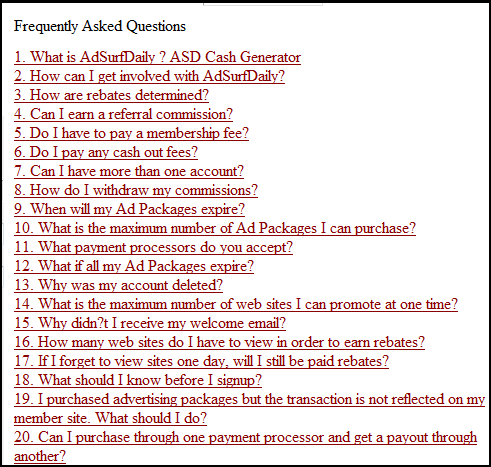
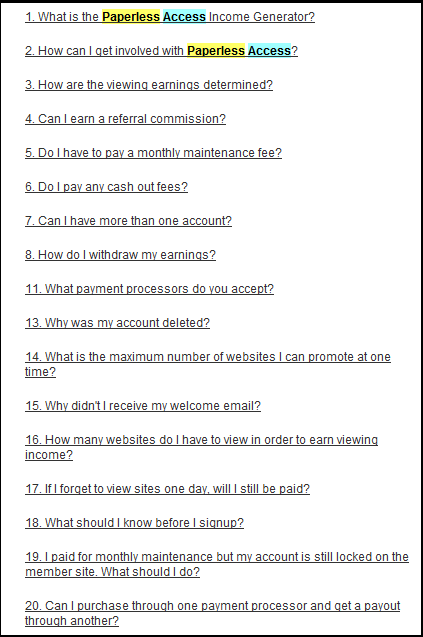
    The word “Generator” was used by both companies: Paperless Access saying it was an “Income Generator” and ASD calling itself a “Cash Generator.” Meanwhile, the FAQs for both companies were largely identical in certain places and precisely identical in others.

    Below are two screen shots of the first 20 FAQs for both companies.What ASD called “rebates,” Paperless access appears to be calling “viewing earnings.”

    Paperless Access FAQs

    Screen shot taken today from March 12, 2009, Google cache page for Paperless Access. This screen shot is of a section of FAQ's on the page and has been magnified.
    Screen shot taken today from March 12, 2009, Google cache page for Paperless Access. This screen shot is of a section of FAQ's on the page and has been magnified. Compare to the ASD Cash Generator FAQs, as reproduced in a screen shot below.

    ASD Cash Generator FAQs

    Screen shot taken today of section of ASD Cash Generator FAQs, as it existed on June 16, 2007.
    Screen shot taken today of section of ASD Cash Generator FAQs, as it existed on June 16, 2007.

    Here is the Google Cache URL from March 12, 2009, for Paperless Access. There are references on the page to PaperlessAccess.com and PaperlessAccess.org.

  • Members Criticize Bowdoin’s ‘PaperlessAccess’ Video; Some Surf’s Up Posters Say Enough Is Enough

    UPDATED 12:15 P.M. EDT (U.S.A.) AdSurfDaily Inc. President Andy Bowdoin once had members eating out of his hand, but his faithful flock now appears to be splintering.

    Helping drive Bowdoin’s fall from grace is a video in which he positions “Paperless Access,” a  company that appears to use a surf model, as a way ASD members can recover money seized by the government in August by participating in the new venture.

    AdSurfDaily President Andy Bowdoin, whose video for ASD is a major part of a federal fraud investigation, is now a video pitchman for 'Paperless Access.'
    AdSurfDaily President Andy Bowdoin, whose video for ASD is a major part of a federal fraud investigation, is now a video pitchman for 'Paperless Access.'

    The video first appeared online two days ago. Bowdoin did not identify the owners of Paperless Access, describing them only as a small group of people. Nor did Bowdoin mention that the government is establishing an ASD refund program.

    One of the reasons it hasn’t been able to implement the program is because of Bowdoin’s self-filed legal maneuverings.

    Except for a letter Bowdoin released through Surf’s Up several days ago, he had been silent for months.  Bowdoin, for example, did not tell members about a second forfeiture complaint filed in December against assets linked to ASD. Nor did Bowdoin tell members about his January decision to submit to the forfeiture of tens of millions of dollars seized in August.

    Before Bowdoin went silent late in the fall, he tried to sell members VOIP telephone service, positioning the $20-a-month offer as a gift.

    Bowdoin, now acting as his own attorney, has changed his mind about submitting to the forfeiture, an act that will delay any government refund program because prosecutors can’t liquidate seized assets to create a victims’ pool until the case is fully litigated.

    At the same time, other ASD members also are filing pro se pleadings in the forfeiture case — something the government says also affects its ability to implement a refund program.

    Why Paperless Access would choose Bowdoin for a commercial spokesman at the risk of being dragged into a major federal fraud investigation is unclear, especially when one of the issues in the federal case is Bowdoin’s appearance in a video to promote ASD.

    Prosecutors said Bowdoin was the head of a criminal enterprise. Private litigants have accused him of racketeering, and Bowdoin was accused of 89 separate counts of fraud in four Alabama counties in the 1990s, pleading guilty to felonies.

    Database Decision Ruffles Feathers

    Some ASD members were angry that Bowdoin had turned over the ASD database to Paperless Access, saying the move invaded their privacy and exposed them to identity theft.

    “They have been given access to the database for the purpose of determining losses and the structure of the network,” Bowdoin said.

    In short, Bowdoin appears to have turned over the database to a company whose owners he appears unwilling to identify. If ASD member “losses” are recorded in the database as Bowdoin says, the new owners might gain insider’s knowledge about possible targets in a federal criminal probe into ASD’s business practices. At the same time, the database would provide Paperless Access with the names of thousands of potential witnesses against ASD and the spending habits of ASD members at large.

    Bowdoin does not identify himself in the Paperless Access video. Nor does he refer to ASD by name a single time. At the same time, Bowdoin’s claims about Paperless Access are filled with vagaries and confusing information.

    Paperless Access has a “variety of outside revenue-generating sources,” Bowdoin said, without revealing the sources.

    Bowdoin said the company’s business plan was based “solely on outside revenue.” Vague claims of outside revenue was one of the things that got ASD in trouble.

    Meanwhile, Bowdoin makes the odd claim that the goal of Paperless Access is to “return the members’ legally purchased funds.” ASD members used funds to make their purchases, but they did not purchase funds.