
Category: The Economy

  • EDITORIAL: On The War In Zeekland And HYIP Rabbit Holes

    From a promo for Zeek online in 2012.
    From a promo for Zeek online in 2012. The “program” operated through Rex Venture Group and later was charged by the SEC with selling unregistered securities as investment contracts.

    EDITOR’S NOTE: On Feb. 5, 2014, Zeek figures and alleged insiders Dawn Wright-Olivares and Daniel Olivares pleaded guilty to federal crimes. Wright-Olivares pleaded guilty to investment-fraud conspiracy and tax-fraud conspiracy. Olivares pleaded guilty to investment-fraud conspiracy. Federal prosecutors in the Western District of North Carolina are maintaining an information site here.

    Kenneth D. Bell, the court-appointed receiver in the SEC civil case, also is the special master in the criminal prosecution. The charging document in the criminal case references unnamed “co-conspirators” who are “known and unknown” to federal prosecutors.

    UPDATED 5:10 P.M. EDT U.S.A. In court filings apt to find favor in MLM HYIP Ponzi Land, some alleged “winners” in the Zeek Rewards “program” have tried to turn the tables on the court-appointed receiver by claiming he owes them “treble” damages for alleged violations of the North Carolina Unfair and Deceptive Trade Practices Act.

    Similar claims were made from the sidelines of the AdSurfDaily MLM Ponzi scheme in 2008. Some ASD members contended that then-Florida Attorney General Bill McCollum should be charged with Deceptive Trade Practices, apparently for having the temerity to bring a pyramid-scheme action against ASD.

    Other ASD members contended at the time that federal prosecutors and a U.S. Secret Service agent should be investigated and charged with crimes for their roles in the ASD Ponzi prosecution.

    Among the alleged winners in Zeek who’ve filed a counterclaim against receiver Kenneth D. Bell are Rhonda Gates of Nashville, an alleged winner of more than $1.425 million; Durant Brockett of Las Vegas, an alleged winner of more than $1.72 million; and Aaron and Shara Andrews of Lake Worth, Fla., alleged winners of more than $1 million through a Florida shell entity known as Innovation Marketing.

    In addition to claiming Bell owes them damages for Deceptive Trade Practices, the counterclaimants assert Bell interfered in contracts with payment processors such as Payza and NXPay and violated their rights under the Fourth Amendment to the U.S. Constitution.

    Bell sued them in late February, alleging in a clawback action that their gains were illicit because Zeek was illicit. He also sued several other Zeek alleged winners, including former ASD members Todd Disner of Miami and  Jerry Napier of Owosso, Mich. Disner allegedly received more than $1.875 million through Zeek; Napier allegedly received more than $1.745 million.

    Disner, in 2011, sought unsuccessfully to sue the United States for alleged violations of his Fourth Amendment rights in its prosecution of the ASD Ponzi case. His co-plaintiff in the case was Dwight Owen Schweitzer, whom filings by Bell described as a Zeek winner of more than $1,000. Several alleged Zeek winners ventured into the “program” after earlier stints at ASD, including Terralynn Hoy, a Florida MLMer who moderated a forum that called purported “sovereign” being Curtis Richmond a “hero” for his efforts to derail the civil-forfeiture action against ASD-related assets.

    Richmond, a Californian, was a member of a “sham” Utah “Indian” tribe that once sought to have U.S. Marshals serve bogus arrest warrants against federal judges. ASD figure Kenneth Wayne Leaming later was arrested by an FBI Terrorism Task Force, after allegedly harboring federal fugitives from a separate home-business caper, being a felon in possession of firearms and filing false liens against a judge and prosecutors involved in the ASD case.

    Other alleged Zeek winners sued by Bell in clawback litigation include Trudy Gilmond of St. Albans, Vt. (more than $1.75 million); Darren Miller of Coeur d’Alene, Idaho (more than $1.635 million); Michael Van Leeuwen, also known as “Coach Van” of Fayetteville, N.C. (more than $1.4 million); David Sorrells of Scottsdale, Az. (more than $1 million); T. Le Mont Silver Sr. of Orlando, Fla. (more than $773,000 under at least two user names, and more than $943,000 through a Florida shell entity known as Global Internet Formula Inc. with one or more Zeek user names); Karen Silver, Silver’s wife (more than $600,000); David and Mary Kettner of Peoria, Az. (more than $930,000 via one or more user names and shell companies known as Desert Oasis International Marketing LLC and Kettner & Associates LLC); and Lori Jean Weber of Land O’Lakes, Fla. (more than $1.94 million through a shell company known as P.A.W.S. Capital Management LLC.)

    Whether other alleged winners would join Gates, Brockett and Aaron and Shara Andrews in asserting claims for damages against Bell was not immediately clear.

    What is clear is that a legal war has broken out over Zeek, with alleged winners challenging Bell’s clawback claims by asserting Zeek wasn’t selling unregistered securities as alleged in 2012 by the SEC, that they worked for the money they received or were due, that the alleged winners were not investors, that the SEC’s case against Zeek cannot withstand scrutiny under the “Howey Test” for what constitutes a security, that the SEC had a duty to catch Zeek much earlier — and, in any event and if all else fails, attorneys Bell sued last week and Bell himself are to blame for the unpleasantness.

    On June 25, Bell sued MLM attorney Kevin Grimes and tax attorney Howard N. Kaplan, alleging they helped Zeek thrive while helping Zeek gain unwarranted credibility by lending their professional reputations to a fraud scheme.

    From Brockett’s June 30 “affirmative defenses” to the receiver’s clawback claims (italics added):

    The Receiver has filed suit against two attorneys who provided legal advice to [Zeek operator Rex Venture Group] and Affiliates, including Brockett. Brockett relied on that advice in concluding that RVG was a legitimate business and in committing over $100,000 in his personal resources to grow his now defunct business. Because Brockett’s damages were caused in part by the conduct of the two lawyers, Brockett is entitled in equity at and at law to a credit for all money the Receiver recovers from the two attorneys as a result of his claims against them.

    Also from Brockett’s “affirmative defenses” (italics added):

    On information and belief, the SEC knew or should have known of the RVG Ponzi scheme, but delayed unreasonably in its prosecution of claims against RVG. Alternatively, the SEC knew for some time that RVG was operating as a Ponzi scheme but intentionally delayed disclosing that information to Affiliates and to the public. That unreasonable delay has prejudiced Brockett because he has paid taxes on the money he earned working on behalf of RVG, contributed a significant portion of his earnings to his retirement plan, and has incurred business expenses as a part of his work on behalf of RVG. The Receiver in this action stands in the SEC’s shoes and also delayed to Brockett’s detriment and now seeks return of all monies Brockett earned in connection with RVG, with no credit for the taxes or business expenses that Brockett legitimately paid, but that could have been avoided had the SEC or the Receiver timely advised Brockett of RVG’s true nature or acted in a more expeditious manner.

    And from Brockett’s counterclaims against the receiver (italics added/editing for space performed):

    On information and belief, RVG was not involved in the sale or marketing of any securities, so the SEC was without jurisdiction and the Court did not have subject matter jurisdiction over the SEC Action. Consequently, the appointment of the Receiver was void and of no effect, and all of the Receiver’s actions in his capacity as receiver for RVG have been unlawful and without justification . . .

    RVG’s and the Receiver’s conduct described above and in the Complaint constitutes unfair methods of competition, unfair trade practices, and deceptive trade practices in violation of the North Carolina Unfair and Deceptive Trade Practices Act, N.C. GEN. STAT. § 75-1.1, et seq.

    The conduct was illegal, offends public policy and is immoral, unethical, oppressive, unscrupulous, and deceptive.

    Bell, the Zeek receiver, is a former federal prosecutor who once received a prestigious award from the U.S. Department of Justice for his work prosecuting a Hezbollah terrorist cell operating in North Carolina.

    But some of the alleged Zeek winners now describe him with adjectives that could peel paint.

    And as they do this, they seek to gut or circumvent the SEC’s authority to prosecute HYIP schemes while contending the agency fumbled the ball in investigating and prosecuting Zeek — that is, if anything was worth investigating and prosecuting at all.

    It is a narrative apt to go over well in MLM HYIP Ponzi Land, the latest major expression of which  is TelexFree, a rabbit hole case if ever there was one.

    NOTE: Our thanks to the ASD Updates Blog.


  • Plaintiff To TelexFree Crew: You’re All Crooks And Racketeers — And Carlos Costa Is The ‘Mastermind’

    Carlos Costa
    Carlos Costa

    UPDATED 10:48 P.M. EDT U.S.A. A plaintiff bringing a prospective class-action lawsuit in Massachusetts federal court has accused 10 TelexFree figures of committing crimes and — as a group — committing racketeering violations through an “association-in-fact enterprise.”

    Unlike other prospective TelexFree-related class-actions, this one names neither attorneys nor banks nor TelexFree itself defendants. Rather, it pins the onus of the conduct exclusively on James Merrill, Carlos Wanzeler, Steve Labriola, Joe Craft, Fabio Wanzeler, Sann Rodrigues, Santiago De La Rosa, Randy Crosby, Faith Sloan and Carlos Costa.

    Costa, a Brazil-based TelexFree figure, is described in the complaint as the “mastermind of the TelexFree pyramid scheme of fraud.” The complaint further asserts Costa conducted business in Massachusetts, where TelexFree operated an entity known as TelexFree Inc.

    Olavo F. Magalhaes of Milford, Mass., is the plaintiff. The complaint says Magalhaes invested more than $209,000 in TelexFree LLC, the Las Vegas-based TelexFree business that operated in a Massachusetts office suite.

    The crimes alleged against the defendants include fraud, securities fraud, wire fraud and conspiracy. Violations of civil law also are alleged.

    On the racketeering front, the complaint alleged, the members of the “association-in-fact enterprise” associated together between January 2012 and April 15, 2014, “for the purpose of conducting an illegal pyramid scheme and wrongfully enriched themselves” at the expense of Magalhaes and others.

    “Each member of the enterprise played a role in the targeting of victims, advertising and working together to make the TelexFree enterprise work,” the complaint alleged.

    Fabio Wanzeler is the brother of Carlos Wanzeler, an alleged international fugitive accused criminally by federal prosecutors of wire-fraud conspiracy in the United States. Carlos Wanzeler is believed to be in Brazil.

    Fabio Wanzeler, formerly of Worcester, Mass., is believed also to be in Brazil, according to the Magalhaes complaint.

    In other TelexFree news, a federal judge has denied a motion by Faith Sloan to make more than $15,000 available to her.

    The SEC has accused Sloan of violating the asset freeze imposed against her in the case.

    NOTE: Our thanks to the ASD Updates Blog.

     

  • URGENT >> BULLETIN >> MOVING: Zeek Receiver Sues MLM Attorney Kevin Grimes For Sum In Excess Of $100 Million

    breakingnews72URGENT >> BULLETIN >> MOVING: (11th Update 9:43 p.m. EDT U.S.A.) The court-appointed receiver in the Zeek Rewards Ponzi- and pyramid case has sued MLM attorney Kevin Grimes and the Grimes & Reese law firm, alleging malpractice, negligence and breach of fiduciary duty.

    In the Grimes action, the receiver is seeking “an amount in excess of $100 million.”

    In another action concerning a professional who worked for Zeek or was associated with purported “opportunity,” the receiver has sued attorney and tax consultant Howard N. Kaplan. Zeek operated an MLM “program” tied to a purported penny auction.

    As is the case in the Grimes action, the receiver is seeking a sum of more than $100 million against Kaplan for alleged damages.

    Both Kaplan and Grimes should have known better, but nevertheless helped Zeek thrive while helping Zeek gain unwarranted credibility by lending their professional reputations to a fraud scheme that gathered hundreds of millions of dollars, receiver Kenneth D. Bell alleged.

    “By virtue of his knowledge of [Zeek operator Rex Venture Group] and ZeekRewards and his legal expertise, Grimes knew or should have known that RVG was perpetrating an unlawful scheme which involved a pyramid scheme, an unregistered investment contract and/or a Ponzi scheme. Despite this knowledge, Grimes actively encouraged investors to participate in the scheme by creating a so-called ‘compliance’ program that provided a false façade of legality and legitimacy and knowingly allowed his name to be used to promote the scheme,” Bell said in the complaint against Grimes.

    Bell accused Grimes of turning a “blind eye” to markers of fraud at Zeek such as unusually consistent payout percentages.

    “This fake consistency should have, at a minimum, caused reasonably diligent legal counsel to inquire further about the validity of the alleged profits,” Bell alleged. “Indeed, the program publicly advertised historical average returns of 1.4% per day, which no legitimate investment could accomplish. But, Grimes deliberately turned a blind eye to these incredible claims and chose not to seek further information.”

    And Kaplan, Bell alleged, “knew or should have known that insufficient income from the penny auction business was being made to pay the daily ‘profit share’ promised by ZeekRewards.

    “Kaplan knew or should have known that the money used to fund ZeekRewards’ distributions to Affiliates came almost entirely from new participants rather than income from the Zeekler penny auctions,” Bell continued. “Further, Kaplan knew or should have known that the alleged ‘profit percentage’ was nothing more than a number made up by [Zeek operator Paul R.] Burks or one of the other  Insiders. Rather than reflecting the typical variances that might be expected in a company’s profits, the alleged profits paid in ZeekRewards were remarkably consistent, falling nearly always between 1% and 2% on Monday through Thursday and between .5% and 1% on the weekends, Friday through Sunday.”

    From Bell’s complaint against Kaplan (italics added):

    Instead of properly informing Affiliates of the different tax implications they would face if their Zeek payments were properly characterized as coming from an ‘investment’ rather than a ‘trade or business,’ Kaplan failed to inform Affiliates, either on the calls or in his FAQs, of the material fact that payments to Affiliates should be characterized as investment income for tax reporting purposes.

    For example, in the FAQs that he drafted and allowed ZeekRewards to post to its website, Kaplan advised that Affiliates should use IRS Schedule C (“Profit or Loss from Business”) to record their income, making no mention of the fact that they should use IRS Schedule D (“Capital Gains and Losses”) . . . If Kaplan had candidly disclosed the material fact that Affiliate income would be properly characterized by the IRS as capital gains, the obvious negative tax implications would have caused many Zeek Affiliates to remove their cash earnings from the program rather than reinvesting them, short-circuiting the scheme much earlier. Since he did not, Affiliates were placated in their misguided belief that ZeekRewards was a lawful program.

    It has been a remarkably awkward time for MLM attorneys. Gerald Nehra, Richard Waak and their law firm have been accused by plaintiffs in TelexFree-related litigation with racketeering and violations of the federal securities laws. TelexFree plaintiffs have asserted Nehra also counseled Zeek.

    From the Zeek receiver’s complaint against Grimes and Grimes & Reese (italics added):

    Defendants played an indispensable role in the scheme. Because of the lucrative, seemingly ‘too good to be true’ claims being made by RVG and ZeekRewards, many potential investors were skeptical of whether the scheme was legal and legitimate. So, RVG enlisted the aid of Grimes and other legal counsel to assist in promoting and legitimizing the scheme.

    Grimes helped in several ways. First, despite his knowledge that ZeekRewards was a fundamentally flawed and unlawful pyramid and/or Ponzi scheme and was selling unregistered securities, Grimes offered to create and did create a so-called
    ‘compliance course’ specifically designed to encourage investors and potential investors to believe that if they satisfied the course then it would be a lawful enterprise.

    Thus, Grimes knowingly allowed Zeek to portray a false appearance of legality through his bogus ‘compliance’ course.

    Grimes profited personally from the compliance courses while allowing ZeekRewards yet another source of investor money. Upon information and belief, Grimes received payments from ZeekRewards not only for his legal counsel, but also for sales of his compliance course to Affiliates. Upon information and belief, Grimes provided the compliance course to ZeekRewards for $5 per affiliate, while allowing ZeekRewards to charge affiliates $30 each for the course, personally profiting from it and allowing RVG yet another means of extracting money from unsuspecting Affiliates.

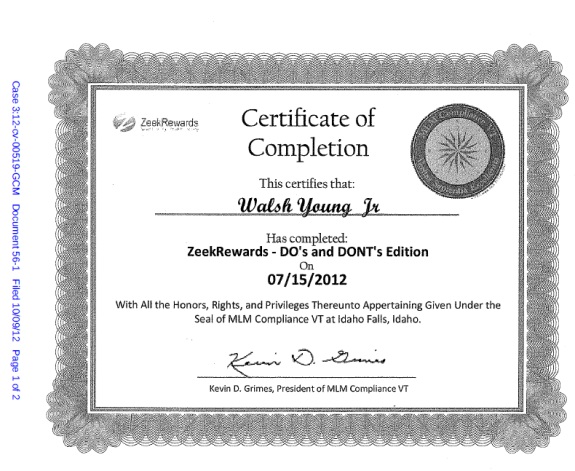
    Zeek collapsed in August 2012. The SEC and federal prosecutors now say the “program” gathered on the order of $850 million in less than two years. Two months after the collapse, two members of Zeek sent Senior U.S. District Judge Graham C. Mullen a copy of the “compliance” certification allegedly provided by Grimes (pictured below):

    zeekcomplianceBoth Grimes and Kaplan were aware that the Zeek “program” raised issues about the sale of unregistered securities, but nevertheless marched forward, Bell alleged.

    In February 2012, Bell said, Grimes emailed a Zeek adviser, saying, “I am still in the process of getting my arms around its program, but I have some SERIOUS concerns that it very likely meets the definition of an ‘investment contract.’ It may have other issues as well, but I’m still reviewing their documents.”

    By June 2012, according to Bell, a Zeek participant contacted Grimes, saying, “I have completed your compliance course with Zeek and really loved it. I am a great advocate of Zeek and have signed up 31 people whom I feel responsible for. . . . One of my downline is asking questions . . . there is a tremendous amount of income going into Zeek and he is concerned the profit share is coming from the new affiliates – which would make it a ponzi scheme. Can you direct me as to what is the best way to confirm this is not a ponzi scheme[?]”

    In response, Grimes emailed Zeek executive Dawn Wright-Olivares, stating, “Do you want me to forward these types of communications to you or anyone else, or would you prefer that I simply discard them? I get several of these each week.”

    Grimes, Bell alleged, appeared to have “no concern” about the affiliate’s email.

    The MLM lawyer “took advantage of the situation, creating and marketing a compliance training course as window dressing for this illegitimate scheme, allowing the course to be sold to the Affiliates for his own profit,” Bell alleged.

    NOTE: Our thanks to the ASD Updates Blog.
     

  • MLM Attorney Gerald Nehra Now Lawyered Up In TelexFree Bankruptcy Case

    newtelexfreelogoMLM attorney Gerald Nehra, his law partner Richard Waak and their law firm are now lawyered up in the TelexFree bankruptcy case.

    Groups of TelexFree members have sued them in bankruptcy court, alleging violations of the federal racketeering (RICO) statute and violations of federal securities laws. TelexFree filed for Chapter 11 bankruptcy protection on a Sunday evening in April, just prior to fraud actions filed by securities regulators.

    Attorneys Christopher F. Robertson and William J. Hanlon, partners in the Boston office of Seyfarth Shaw LLP, entered appearance notices for Nehra, Waak and the firm yesterday.

    Also named defendants in some or all of the actions are TelexFree, alleged officers or executives James Merrill, Carlos Wanzeler, Carlos Costa, Steve Labriola and Joe Craft, alleged promoters Sann Rodrigues, Randy Crosby, Santiago De La Rosa and Faith Sloan, and several alleged financial vendors or service-providers.

    In a complaint filed May 3, 2014, plaintiffs accused Nehra of counseling TelexFree “on methods to evade United States securities laws that were intended to offer, in part, protection from pyramid Ponzi schemes; all to enrich himself financially and serve his own selfish interests.”

    He further was accused of encouraging unknowing TelexFree members to “participate in the evasion of federal and state securities laws.”

    Sloan, in response to fraud allegations against her filed by the U.S. Securities and Exchange Commission, said she “believed what [SEC Co-] Defendants Carlos Wanzeler, James Merrill, Steve Labriola and their attorney, Gerald Nehra, had told her, until TelexFree continued to miss the deadlines for the launch of its new products.”

    Nehra, Waak and the law firm are not defendants in the SEC action. Nor are they defendants in a TelexFree-related securities action by the Massachusetts Securities Division. Sloan, who later was accused by the SEC of violating the asset freeze against her in the SEC case by sending thousands of dollars to another “program” and transferring her interest in a real-estate trust to her mother, is a longtime HYIP huckster.

    In a separate criminal case that alleges wire-fraud conspiracy against Merrill and Wanzeler, Merrill has signaled that he intends to use a defense of reliance on Nehra’s lawyering. The Massachusetts Securities Division has described TelexFree as a “financial pariah” and a combined pyramid- and Ponzi scheme that had gathered more than $1.2 billion. The SEC likewise has accused TelexFree of hatching a billion-dollar pyramid-and Ponzi scheme, saying it was aimed largely at Brazilians and Dominicans.

    Nehra, according to plaintiffs suing him in in at least one of the TelexFree-related actions in bankruptcy court, advised at least two other “programs” regulators accused of operating massive pyramid or Ponzi schemes: Zeek Rewards (2012/$850 million) and AdSurfDaily (2008/$119 million).

    Sloan is known to have promoted Zeek Rewards. Some HYIP promoters move from scheme to scheme to scheme, piling up purported “earnings” alleged to be fraudulent along the way.

    “Attorney Nehra’s extensive experience in multi-level marketing, and particularly his involvement with the Ponzi schemes involving Ad SurfDaily and Zeek Rewards, armed him with the knowledge of what constitutes violations of United States securities law,” plaintiffs alleged.  “Indeed, Attorney Nehra was well aware that the use of semantics and obscured phraseology to obfuscate securities laws fails to legitimize TelexFree’s illegal Pyramid Ponzi Scheme.”

    Zeek-related actions still are winding their way through the courts. The Zeek “program” was back in the news yesterday, with the court-appointed receiver alleging that an affiliate who appears to have invested $10 filed a claim for $30 million and that a vendor alleged to have aided Zeek wanted nearly $15 million.

  • BULLETIN: $30 Million Claim Filed By Zeek Affiliate Who Appears To Have Invested Only $10, Receiver Says

    breakingnews72BULLETIN: (5th Update 9:20 p.m. EDT U.S.A.) How absurd and abusive is HYIP Ponzi Land?

    The court-appointed receiver in the Zeek Rewards Ponzi- and pyramid case says a Zeek affiliate who appears to have invested only $10 has filed a claim seeking $30 million.

    Receiver Kenneth D. Bell asserted in a court filing today that the $30 million claim is the highest encountered in the case. Precise details about the claim, whose denial is pending, were not immediately available.

    Viewed another way, a Zeek member who invested $10 appears to believe he or she is entitled to tens of millions of dollars that otherwise would go to thousands of Zeek victims.

    A separate claim for $14.9 million filed by an asserted Zeek vendor known as Plastic Cash International LLC (PCI) may have a gall factor nearly as high, court filings by Bell today suggest.

    The $14.9 million claim by PCI was the second-highest in the Zeek case, exceeded only by the affiliate seeking $30 million on an apparent $10 investment, Bell said.

    PCI “was a trade creditor of the Receivership Defendant that processed credit card payments from Affiliates for the Receivership Defendant,” Bell said in court filings. “The processed payments were deposited into an account to be held for the benefit of the Receivership Defendant. PCI contends that it should be permitted to ‘retain’ funds that it collected for the Receivership Defendant in its role as a trade creditor.”

    Bell said in court filings today that PCI had a “role in perpetuating the ZeekRewards Ponzi Scheme,” but now was behaving disingenuously — in part by asserting in had no knowledge of the asset freeze ordered by a federal judge in 2012.

    The proposition that PCI did not know about the freeze was “absurd,” Bell said.

    From Bell’s filings (italics/carriage returns added):

    As disclosed in the PCI Claim, PCI acted as a credit card processor for the Receivership Defendant for the two-month period from June 2012 to the appointment of the Receiver. The PCI Claim further asserts that PCI either held a security interest in the funds that it held for the benefit of the Receivership Defendant or, in the alternative, PCI owned all of the amounts that it had collected for the Receivership Defendant pursuant to its contracts with the Receivership Defendant.

    No disclosure regarding the amounts collected by PCI during the time it acted as a credit card processor for the Receivership Defendant was made in the PCI Claim.

    Prior to the filing of the PCI Claim, the Receivership Team did not know that PCI had been involved in perpetrating the ZeekRewards Ponzi Scheme, nor did the Receivership Team know that PCI held Receivership Assets generated by the ZeekRewards Ponzi Scheme. The filing of the PCI Claim caused a preliminary investigation into the assertions made in the PCI Claim.

    This initial review of the records of the Receivership Defendant did not show any significant economic relationship between PCI and the Receivership Defendant because no payments were made by PCI to the Receivership Defendant in the two-month period in which PCI was operating for the Receivership Defendant.

    Moreover, the Receiver never received any funds from PCI or accounts held by PCI upon entry of the Freeze Order.

    Subsequent investigation unearthed a relationship between SecureNet and PCI, leading to a bank account at Eagle Bank that, even though it was held in SecureNet’s name, held approximately $812,433.96 (the “Eagle Bank Account”) in Receivership Assets. Upon its discovery, the United States Secret Service sought and obtained a seizure warrant to recover those funds. The United States Secret Service thereafter seized all of the funds contained in the Eagle Bank Account.

    At that time, PCI did not identify any additional accounts that were involved in the RVG transactions that PCI processed, and it represented that it did not hold any additional Receivership Assets. When the Receivership Team subsequently interviewed PCI’s counsel, the Receivership Team specifically asked about any additional accounts that held RVG [Rex Venture Group] funds or through which RVG funds flowed. PCI failed to identify any additional accounts.

    As the Receivership Team investigated further and obtained documents from PCI, the Receivership Team determined that PCI had collected approximately an additional $8.9 million over the two-month period in which they acted for the Receivership Defendant. This $8.9 million was held and/or distributed from Los Angeles Firemen’s Credit Union n/k/a Firefighters First Credit Union (the “Firemen’s Account”).

    PCI never paid any of the approximately $9.8 million in Receivership Assets it collected to the Receivership Defendant or the Receiver. Only $812, 433.96 of the $9.8 million in Receivership Assets has been recovered, and those assets were recovered solely through a seizure by the United States Secret Service.

    Moreover, PCI never informed the Receiver that it held such Receivership Assets. Instead, after the entry of the Freeze Order, PCI remained silent regarding the funds it held and i) withdrew or otherwise expended approximately $4.5 million of the Receivership Assets in the Firemen’s Account to allegedly pay certain processing fees, alleged fines, alleged chargebacks, and “commissions” to its insiders; and ii) converted the remaining approximately $4.5 million for its own uses (this $4.5 million was removed from the Firemen’s Account by PCI and has never been accounted for) on the alleged theory that such withdrawals were covered by the governing contracts, which the Receiver disputes, and their contractual rights are somehow superior to the express terms of the Freeze Order.

    And, Bell advised Senior U.S. District Judge Graham C. Mullen:

    “It is disingenuous for PCI to assert that it did not have notice of the Freeze Order or that it was not somehow constrained from dissipating the Receivership Assets in its care. It is beyond reason that PCI would not inquire as to why thousands of credit card transactions that it was processing and generated revenue of in excess of $4.5 million per month would suddenly cease. Moreover, the Receiver caused a notice reflecting the entry of the Freeze Order to be published across the United States. Finally, significant transfers from the account that held Receivership Assets just prior to and after the freeze order suggests that PCI was on notice of the freeze and was seeking to avoid the constraint to its revenue stream. Any assertion that PCI did not know of the pendency of the Freeze Order is absurd.”

    Bell further contended today that efforts by PCI to inject itself into the distribution plan proposed to the court in which distributions to victims would begin Sept. 30 should be short-circuited by Mullen.

    Bell said the receivership already has denied PCI’s claim.

    NOTE: Our thanks to the ASD Updates Blog.

  • Quatloos Mod, RealScam.com, PP Blog Targeted In Bizarre Hectoring Campaign

    harassmentrs(3RD UPDATE 2:43 P.M. EDT U.S.A.) wserra, an attorney, Quatloos moderator and occasional poster on the PPBlog and RealScam.com, appears recently to have been targeted by a crackpot who desires to hector wserra with complaints to the bar association.

    Among other things, Quatloos publishes information on the bizarre undertakings of “sovereign citizens” in the United States and Canada.

    It is not uncommon for “sovereign citizens” and/or “supporters” of HYIP “programs” and/or bizarre MLM “programs” to hector sites such as Quatloos and RealScam and the PP Blog.

    Whoever advanced the hectoring campaign against wserra appears also to be interested in simultaneously hectoring RealScam and the PP Blog. The PP Blog occasionally posts on RealScam.com, typically providing context on scams-in-progress or comparisons with previous scams.

    Over the years, both RealScam.com and the PPBlog have been targeted with DDoS attacks and bizarre forms of menacing.

    The most recent campaign includes a conspiracy theory that the PP Blog and Lynn Edgington, an antiscam activist, own RealScam individually or jointly. The bogus theory further holds that the PPBlog fraudulently joined the JSSTripler/JustBeenPaid HYIP “program” (2 percent a day/precompounding) to “gain access to all the conference call recordings.”

    In addition, the theory seems to hold that JSS/JBP was a legitimate “program” and that the PP Blog was engaged in espionage in violation of U.S. law.

    JSS/JBP may have links to the so-called “sovereign citizens” movement.

    In November 2013, the PP Blog received a threat that federal authorities would move against it over its coverage of the Profitable Sunrise “program”  if the Blog did not meet certain conditions imposed on it by fiat by an apparent “supporter” of the “program.”

    The Blog also has been threatened with astronomical fines by individuals who appear to believe they can trademark their names as a means of assuring that reporters cannot use them when covering matters of public record or public discussion.

    Whoever is carrying out the hectoring campaign against wserra, RealScam.com, Edgington and the PPBlog appears to believe it prudent to encourage HYIPers to purchase firearms, apparently out of concern that the antiscam community may organize a flash mob and appear at the homes of HYIP purveyors.

    The individual, for instance, asserts that it is important “legally to stand your ground” and to “go purchase a firearm right away [l]egally if it gets that serious to protect your home or place of business.”

    And, the individual further suggests, the White House should be brought into the loop about perceived plots in the antiscam community to harm the HYIP trade.

    Apparently after determining there was a need for HYIP purveyors to conduct a swift  intelligence-gathering operation on critics who post on RealScam, one or more HYIP colleagues “have dissected this [RealScam.com] group in the matter of 2 days,” the individual asserted.

    This apparently led to a determination that the RealScam posters who advocate against HYIP schemes come “down to . . . maybe 2-6 lonely, depressed, lousy, white, obese, out of shape, old, uneducated group of Losers.”

    The individual offered no guidance on how to deal with RealScam posters who may, for example, have no issues with social rejection, depression or head lice while at once being African American or of another race, trim, in shape, young or youngish and educated.

    RealScam, according to the individual, also includes “dedicated snitches,” a line that plants the seed such snitches should be dealt with harshly by HYIP purveyors.

    And, the individual suggests, the HYIP field could benefit by carrying out extortion campaigns against RealScam and some of its posters — perhaps particularly those who may live in fear of being outed for being gay, aged, bigoted, afflicted with disease and living in poverty while serving their porn addictions. (Italics added to the individual’s claim below):

    RealScam admins have deep secrets amongst each other. Some are gay, some are OLD, some are Fat, Some have HIV, Some are addicted to Drugs, Some are Racist, Some are Broke/Poor, Some are addicted to the internet but mainly addicted to the realscam website and a few porn sites. It gets deep once you really sit down and ask yourself why are these strange group of losers out to harm so many innocent individuals?”

    Part of the individual’s “strategy” — if it can be called that — appears to be to overwhelm authorities with complaints about RealScam and some of its posters. Such an approach may be consistent with the approach of a “sovereign citizen” or a person who has fallen down a “sovereign citizen” rabbit hole. One of the “sovereign” strategies is to overwhelm courts and agencies with paperwork and to make false claims against individuals.

    The approach has been described as “paper terrorism.”

    Coinciding with the most recent attack on RealScam and some of its posters is an apparent bid to encourage complaints to RipoffReport. These events are taking place against the backdrop of continued efforts by a well-known cyberstalker to use lurid sexual innuendo in attacks against the antiscam community, including the depiction of one antiscam advocate as a diaper-wearing pole dancer.

  • UPDATE: Purported ‘Sovereign Citizen’ Convicted In Bizarre ‘Liens’ Caper Targeting Judges, Law Enforcement

    From 2012.
    From 2012.

    We first wrote about Cherron Marie Phillips in November 2012, after she was arrested on charges that she had filed bogus liens against a chief U.S. District Judge, a U.S. District Judge, two U.S. Magistrate Judges, a former U.S. Attorney, an assistant U.S. Attorney, a federal court clerk, four federal Task Force officers and a federal agent.

    All in all, Phillips allegedly sought the staggering sum of $1.2 trillion.

    Things only got crazier from there.

    By July 2013, a federal judge admonished Phillips by telling her that “I hesitate to rank your statements in order of just how bizarre they are.”

    Now, the Chicago Tribune is reporting that Phillips has been convicted of most of the charges against her. From the paper (italics added):

    Following the verdict, U.S. District Judge Michael Reagan ordered Phillips taken into custody, calling her “a paper terrorist” who “will continue on her misguided bent” if he allowed her to remain free until her sentencing in October.

    Also see the thread on Phillips at Quatloos.com.

    Among other things, Quatloos covers scams involving “sovereign citizens.”


  • BULLETIN: Judge Frees TelexFree Figure James Merrill On Bail, But Imposes Tight Restrictions

    James Merrill.
    James Merrill.

    BULLETIN: (3rd Update 5:56 p.m. EDT U.S.A.) A federal judge in Massachusetts has permitted TelexFree figure James Merrill to be freed on bail, but has imposed tight restrictions.

    In granting Merrill bail, U.S. District Judge Timothy S. Hillman overruled U.S. Magistrate Judge David Hennessy, who agreed with federal prosecutors and ruled last month that Merrill should continue to be detained pending trial because he posed a flight risk.

    Hillman today yanked Merrill’s passport, placed him in the custody of his wife Kristen, ordered his wife to supervise him and “to notify the court immediately in the event the Defendant violates any conditions of release or disappears,” ordered three pieces of real estate to be used as collateral for a $900,000 bond, ordered Merrill to remain in Massachusetts and to seek permission to travel outside the state and ordered him not to seek international travel documents.

    In addition, Hillman imposed an 8 p.m. to 8 a.m. curfew on Merrill, ordered him to wear an electronic monitoring bracelet and to “avoid all contact directly or indirectly, with any persons who are or who may become a victim or potential witness in the subject investigation or prosecution and any co-conspirators.”

    At this stage, the judge said in his bail ruling, the government “has presented a strong case against Merrill,” but “has failed to meet its burden of proof that no condition or combination of conditions would assure the Defendant’s presence” at trial on a charge of wire-fraud conspiracy.

    Merrill’s family bonds and community ties in Massachusetts appeared to have weighed heavily in the judge’s decision to free Merrill on bail. Regardless, Hillman placed travel restrictions on Merrill’s wife and children.

    “The Defendant’s wife and children must agree to surrender their passports and agree not to seek new passports or international travel documents without prior written approval of the Court,” Hillman ruled.

    The bail ruling does not mean that TelexFree has been found not to be a pyramid- or Ponzi scheme. Rather, it means that Merrill can go free pending trial. Some TelexFree affiliates falsely have claimed repeatedly that the “program” has been cleared of fraud charges.

    From the judge’s ruling (italics/carriage returns added):

    This Court recognizes that Merrill, if convicted, could face a substantial sentence and that the case against Merrill appears, at this juncture, to be a strong one. Additionally, the government argues that Merrill, unlike many white collar criminals, has both a place to flee to and the means to go there. It is this factor that Magistrate Judge Hennessey’s decision to detain Merrill relied most heavily upon. However, this Court finds the government has not been able to offer enough concrete evidence supporting this argument to overcome the factors discussed above which weigh against Merrill’s risk of flight.

    While the government has identified overseas accounts belonging to TelexFree, it cannot show how much money is in these accounts nor that Merrill is able to access them; in fact the affidavit of TelexFree’s interim CEO states that Merrill no longer has signatory authority over any accounts. Moreover, while the government points to Merrill’s international network of supporters, it has not offered proof that there are any individuals, with the possible exception of [co-defendant Carlos] Wanzeler, who would actually help Merrill flee.

    Prosecutors have contended that TelexFree had “a disturbingly cult-like quality” and that U.S. promoters would be in position to assist Merrill in going on the lam. Wanzeler allegedly fled to Brazil after TelexFree’s headquarters in Marlborough, Mass., was raided on April 15.

    Prosecutors said they had no comment on the bail decision.

  • MONTANA: Former Zeek Pitchman Who Also Pushed TelexFree Now Required To Give State Notice Of MLM Activities

    recommendedreading1A former pitchman for the Zeek Rewards MLM Ponzi- and pyramid scheme also acknowledged he participated in TelexFree, the state of Montana said in a consent agreement and final order.

    James D. Helgeson was fined $5,000 by the office of Monica Lindeen, Montana’s Commissioner of Securities and Insurance (CSI) and state auditor.

    The case demonstrates that accountability for a “program” can apply to both the operators and individual promoters. It also demonstrates that promoters who may move from one dubious MLM scheme to another may encounter state-imposed restrictions.

    As part of the agreement, Helgeson must notify Montana for the next five years “prior to his participation in any multilevel distribution company.”

    From Helgeson’s agreement with Montana, which was finalized this month (italics/carriage returns added):

    This condition applies regardless of whether the MLM is registered with the State of Montana as required under §30-10-216.

    “Participation” includes selling any MLM product or service; directly or indirectly promoting, recommending, or referring a person to any MLM product, service, or compensation plan; participating in any MLM compensation structure wherein Respondent sponsors or is sponsored by another person in the structure, or receives a pecuniary or other benefit based upon the efforts of other persons within the structure; or paying a MLM or its representative, whether directly or through the purchase of a product or service, for the opportunity to participate in a compensation plan or structure.

    “Participation” does not include the purchase of a MLM product or service for personal consumption or use, so long as the MLM does not market or offer that product or service as a means for the purchaser to earn income.

    In April 2014, Montana issued a cease-and-desist order to TelexFree, saying it unsuccessfully had sought complete information from the MLM “program” for months and alleging that TelexFree continued to do business in the state after claiming it had pulled out.

    Alleged TelexFree co-owners James Merrill and Carlos Wanzeler were charged criminally by federal prosecutors in May 2014 with wire-fraud conspiracy. They also face serious allegations of fraud filed by the U.S. Securities and Exchange Commission, as well as at least four prospective class-action lawsuits.

    The SEC has sued four alleged individual promoters, saying they engaged in securities fraud. Helgeson, who neither admitted nor denied wrongdoing in Montana, is not among the federal defendants.

    During the Zeek-related action brought against him in Montana, Helgeson acknowledged to authorities that he also had been involved in TelexFree and an MLM “program” known as Apex Revenue, the state said in its order.

    The filing asserts that Helgeson, who was a registered securities salesperson and investment adviser while pushing Zeek, pushed Zeek’s unregistered securities.

    Helgeson supplied the state with a list of the names of his Zeek recruits and “has offered certain Montana resident-participants payment for monies lost through participation in the Program,” according to the order.

    “Respondent has further informed the CSI that he has terminated his Participation in the TelexFree and Apex Revenue MLM programs prior to the date of this Agreement,” the state said in the order, which was dated June 2.

    Zeek gathered $850 million in its scam, federal officials have said. TelexFree gathered more than $1.2 billion, according to the Massachusetts Securities Division.

  • ** CAUTION: Report Of Bogus TelexFree Site **

    cautionflagThere is a report on social media this morning of a bogus TelexFree site that mirrors an old TelexFree site that existed when the company was actively soliciting business. The site creates the impression TelexFree has reopened.

    TelexFree has not reopened.

    It is Sunday. Federal prosecutors handing the TelexFree criminal case involving alleged fraudsters James Merrill and Carlos Wanzeler did not immediately respond to a request for comment.

    The actual TelexFree site says the firm has suspended all business activity. The trustee in the TelexFree bankruptcy case has begun his investigation and announced in court filings that he is seeking court authority to issue subpoenas. (See documents 261-265 here. Link current as of today’s date.)

    Because the report about the bogus site was made on social media and the intent of the poster is not known, extreme caution is warranted. Clicking on the link to the asserted hacking site through the social-media site potentially could have bad consequences. So could entering any information on forms at the site.

    The social-media poster positioned the report as a warning hackers seeking to profit from the troubles at TelexFree could be at work.  The site used the word “telexfree” as part of its URL.

    Even if the social-media poster was being sincere in his warning and it proves true the site is bogus and designed for hacking, clicking on the link potentially could expose you to harm.

    And if the site is not a hacking or phishing site, it leads to questions about why such a site that mirrors TelexFree’s “old” site exists to begin with. Could it be an old TelexFree affiliate’s site created with swiped code and designed to dupe prospects into believing they were dealing directly with the TelexFree corporate entity? Could it be an orphaned site of TelexFree itself?

    The asserted hacking site uses the name of a male individual with an address in Chicago, according to a database search. The Registant Organization is listed as “telexfree.”

    Some TelexFree affiliates are alleged to have accepted TelexFree payments directly, a circumstance the Massachusetts Securities Division said in April resulted in a condition in which “participants received uncontrolled cash deposits outside of the TelexFree system.”

    The social-media poster who issued the warning appears to be pushing a “program” known as ViziNova that may be linked to the alleged $80 million WCM777 scam allegedly operated by Phil Ming Xu.

    It is common for HYIP hucksters to be in multiple “programs” simultaneously. After “working” a “program” for months and cleaning up with it, the most disingenuous promoters then may turn on the “opportunity,” perhaps particularly if a regulatory action occurs or there is a sense one is imminent.

    Such promoters then may try to port entire “teams” to a new scam.

    Read a report on ViziNova at BehindMLM.com.

  • BULLETIN: SEC Accuses Faith Sloan Of Violating Asset Freeze In TelexFree Case By Sending Thousands To ‘Changes Worldwide LLC,’ Company That Lists Zeek Figure Robert Craddock As Copyright Enforcer

    From an SEC filing today that alleges Faith Sloan violated the TelexFree asset freeze by sending money to a "program" known as Changes Worldwide LLC. Redactions by PP Blog.
    From an SEC filing today that alleges Faith Sloan violated the TelexFree asset freeze by sending money to a “program” known as Changes Worldwide LLC. Redactions by PP Blog.

    BULLETIN: (4th Update 10:01 a.m. EDT June 13 U.S.A.) The SEC has accused Faith Sloan of violating the asset freeze imposed against her in the TelexFree pyramid- and Ponzi case by sending nearly $15,000 to Changes Worldwide LLC for the purchase of “business promo packs.” On its website, Changes Worldwide identifies Robert Craddock as its copyright agent. He also is believed to be an affiliate for Changes Worldwide.

    Whether the SEC would seek return of the money from Changes Worldwide was not immediately clear. Recipients of ill-gotten gains can become relief defendants in SEC actions.

    Craddock emerged as a figure in the Zeek Rewards Ponzi scheme case, with the SEC asserting in 2012 that he encouraged affiliates not to cooperate with the court-appointed receiver in the Zeek case. The receiver said at the time that he had obtained information “indicating that large sums of Receivership Assets may have been transferred by net winners to other entities in order to hide or shelter those assets.”

    While a purported consultant for Zeek in July 2012, Craddock, citing alleged trademark and copyright violations, sought to shut down a Hubpages site by K. Chang that questioned the Zeek program, which the SEC and federal prosecutors later described as an $850 million fraud. K. Chang publishes the MLM Skeptic site.

    One of the assertions against Sloan today by the SEC is that she had the sole power of direction and was the sole beneficiary of a real-estate trust, but amended trust documents after the TelexFree freeze to transfer her interest to her mother — in violation of the asset freeze. Sending money to Changes Worldwide and a separate entity known as Changes Trading LLC also violated the freeze, the SEC alleged.

    The SEC said that it had linked Sloan to three transactions with Changes Worldwide on April 25, eight days after Sloan learned of the asset freeze. Two of the transactions were for $5,000 each, and a third was for $4,854, the SEC asserted.

    On April 28, 11 days after she learned about the freeze, Sloan sent $3,990 to Changes Trading, using two separate checks for $1,995 each, the SEC alleged.

    Neither of the “Changes” entities nor Craddock has been accused of wrongdoing, but the alleged Sloan transactions lead to questions about whether MLM promoters accused of fraud are hiding money in other “programs” and abusing trusts in bids to avoid detection and keep their interests in schemes intact.

    A crime known as structuring also could be occurring if the transactions are set up to evade bank-reporting requirements. In a civil action against TelexFree in April, the Massachusetts Securities Division raised the issue of structuring.

    The SEC said today that Sloan had asserted her Fifth Amendment right against self-incrimination over a TelexFree related matter involving the asset freeze cited in a preliminary injunction. The injunction requires her to identify her assets. She has not been charged criminally, but it is known that a criminal probe is under way.

    Read a November 2013 review of Changes Worldwide on BehindMLM.com.

    NOTE: Our thanks to the ASD Updates Blog.