Category: The Economy

  • BULLETIN: Nevada Attorney General To Intervene In TelexFree Licensing Matters Before The State Public Utilities Commission

    The office of Nevada Attorney General Catherine Cortez Masto intends to intervene in TelexFree-related matters before the state Public Utilities Commission, according to this filing. Source: Nevada Public Utilities Commission. Red highlight by PP Blog.
    The office of Nevada Attorney General Catherine Cortez Masto intends to intervene in TelexFree-related matters before the state Public Utilities Commission, according to this filing. Source: Nevada Public Utilities Commission. Red highlight by PP Blog.

    BULLETIN: (Updated 8:56 p.m. EDT U.S.A.) The Consumer Protection Bureau of Nevada Attorney General Catherine Cortez Masto says in regulatory filings that it intends to intervene in TelexFree-related licensing matters before the Nevada Public Utilities Commission.

    TelexFree, accused of conducting a Ponzi scheme that gathered $1.2 billion, has Nevada telecom applications pending for TelexFree LLC and TelexMobile. TelexFree filed for bankruptcy in Nevada last week.

    Beatriz Aguirre, a spokeswoman for Masto, had no immediate comment on why the attorney general intended to intervene. More information may become available later, she said.

    [** Update 8:56 p.m. In a letter dated March 31, according to Nevada records, TelexFree asked for telecom authorization. An application with 2013 financial information for TelexFree was submitted with the letter. TelexFree, according to the application, wanted the information “FILED AS CONFIDENTIAL — UNDER SEAL.” In a separate letter dated March 4, according to Nevada filings, TelexFree referred to a “Refiling of the Confidential Financials of Applicant,”  saying “these financials contain trade secrets and should remain Confidential for as long as possible under Nevada Administrative Code.”

    In an email to the PP Blog this evening, Aguirre referenced TelexFree’s request for confidentiality. The attorney general’s office filed its notice to intervene, according to a document provided by Aguirre, to represent “the public interest” with respect to TelexFree’s applications before the state PUC. Original story continues below. End of update **.]

    Trouble with licensing could affect TelexFree’s ability to persuade a bankruptcy judge that it could continue as a going concern.

    The SEC says TelexFree may owe $1.1 billion to promoters of its MLM scheme.

    The agency further alleged that records suggest TelexFree co-owners James Merrill and Carlos Wanzeler “have caused more than $30 million to be transferred from TelexFree operating accounts to themselves and to affiliated companies in the past few months.”

    Separately, the PP Blog has learned that Joe Craft, an accountant and TelexFree’s alleged CFO, is associated with a New Hampshire payment-processing business known as BWFC Processing Center LLC. A company by the same name operates in Nevada as a registered-agent service.

    Craft was listed as “manager” of the New Hampshire entity in a filing in that state on Feb. 27, 2014. His role in the Nevada entity is unclear.

    Regardless, documents exist that instruct customers looking to set up a “Nevada Mailing Address” to fax payments to an Indiana number associated with Craft. The service charges a “onetime” fee of $125 to “set up” a “Nevada Post Office box,” and an additional $180 as an “annual fee.” An additional fee of 3 percent for “merchant processing” is charged, bringing the first-year charges for the mailbox service to $314.15.

    “**Payments will be made to the Indiana BWFC office**,” the instructions note. “**Post office box service will be performed by the Nevada BWFC office**” (Asterisks appear in the original document.)

    Like Merrill and Wanzeler of TelexFree, Craft was accused by the SEC of securities fraud.

    Two of the issues surrounding TelexFree concern precisely when Craft became CFO and his precise role in TelexFree prior to becoming CFO.

    Regulatory filings to obtain a telecom license in Alabama identify Craft as TelexFree’s CFO during the opening week of March 2014. Page 19 of the 99-page Alabama filing shows an image of a March 8, 2014, document from the office of Alabama Secretary of State Jim Bennett. The document notes that the name TelexFree LLC was “reserved as available” in the state.

    “This name reservation is for the exclusive use of BWFC Processing Center, LLC, 825 East Main St, Boonville, IN 47601 for a period of one year beginning March 08, 2014 and expiring March 08, 2015,” the document reads in part.

    The East Main Street address is the address of both Craft’s accounting firm and the address of BWFC Processing Center LLC, the company listed in New Hampshire as a payment processor. As noted above, a company with the same name operates in Nevada and provides registered-agent services.

    “Joe Craft” is listed on Page 3 of the March Alabama TelexFree filing as holding the “Official Title” of “CFO” of TelexFree LLC. Page 15 includes an oath recorded March 5, 2014, before a Massachusetts notary public. The oath bears the name and signature of Jim Merrill, who is listed as “President” of TelexFree LLC. The oath attests that the information in the Alabama document — an “Application for a Certificate of Public Convenience and Necessity to provide interexchange telecommunications services in Alabama” — is true to the best of Merrill’s knowledge and belief.

    The document appears accidentally to have identified Merrill as a woman, given that the certification line actually reads “the statements made herein are true to the best of her [emphasis added by PP Blog] knowledge and belief. Merrill appears not to have noticed when signing the document.

    Despite the sworn oath of Merrill that Craft was the “Official” TelexFree “CFO” on March 5, 2014, however, TelexFree’s board appears not to have named Craft CFO until sometime after 8:11 p.m. on April 13, 2014, the same day TelexFree and related entities filed for bankruptcy in Nevada.

    According to TelexFree’s bankruptcy filing, “Joe H. Craft” of “Joe H. Craft, CPA” was present at the meeting, which was called to order by Carlos Wanzeler.

    During the meeting, the board and other attendees, including CPA Craft, “considered the Company’s liabilities, the strategic alternatives available to it, and the impact of each of the foregoing on the Company’s businesses,” according to the bankruptcy filing.

    During the meeting, the board decided to file for bankruptcy. It then was resolved that “Joe H. Craft” would become one of TelexFree’s “authorized persons.” After this resolution, it then was resolved that “the Authorized Persons be, and they hereby are, authorized and directed to employ the accounting firm of Joe H. Craft, CPA to provide Joe H. Craft to serve as Chief Financial Officer of the Company while the Chapter 11 case is pending and to assist the Company in carrying out its duties under the Bankruptcy Code.”

    Another resolution resolved that “Joe H. Craft be, and he hereby is, elected to serve as Chief Financial Officer of the Company.”

    Three TelexFree related firms filed bankruptcy: TelexFree LLC of Nevada, TelexFree Inc. of Massachusetts and TelexFree Financial Inc. of Florida.

    TelexFree Financial Inc., one of the companies included in the filing, was was “incorporated by Craft on December 26, 2013,” with Wanzeler and Merrill as its directors, according to the SEC.

    TelexFree has pushed back on reports last week that Craft attempted to leave TelexFree’s Massachusetts office with a laptop computer and nearly $38 million in cashier’s checks while a search warrant was being executed by federal agents..

    “The cashier’s checks were in Mr. Craft’s possession because the Company’s bank accounts had been closed, which necessitated the Company obtaining the funds in the form of cashier’s checks,” TelexFree said in a statement. “Upon the filing of the Chapter 11 cases, the Company determined to marshal all of the Company’s funds for the benefit of the Chapter 11 bankruptcy estate. Mr. Craft had taken possession of the cashier’s checks at the request of the Company’s counsel and advisors in order to assure that the estate funds were protected. Mr. Craft was holding the checks until they could be deposited in either a newly-established Company safe deposit box or an escrow account that the Company was in the process of establishing. The laptop was Mr. Craft’s personal property.”


     

  • Now, Zeek- And AdSurfDaily-Like Petitions For TelexFree; Bankruptcy Judge Asked To ‘Bail Out’ MLM ‘Program’

    From a petition circulating online today.
    From a petition circulating online today.

    On Monday, the PP Blog reported that TelexFree — through its bankruptcy filing Sunday in Nevada — was seeking to reject contracts with its promoters. Yesterday, Jordan Maglich of PonziTracker.com published a lengthy article under this headline: “TelexFree Asks Bankruptcy Court To Eliminate Promoter Obligations.”

    In between, the Massachusetts Securities Division described TelexFree as a massive Ponzi- and pyramid scheme that had gathered more than $1.2 billion. The SEC filed an emergency action against TelexFree and eight of its owners, executives and promoters.

    From PonziTracker’s April 18 story (italics added):

     . . . a casual read of the Motion makes clear that the company accused by regulators of being an “egregious” pyramid scheme seeks now to use the Bankruptcy Court’s power to eliminate the obligation to pay accrued compensation likely totaling hundreds of millions of dollars to “promoters” – under the theory that elimination of these obligations will allow the company to “ultimately prove successful and profitable.” Ironically, one of the chief concerns cited by TelexFree related to questions “raised as to whether the Original Comp Plan is compliant with law, which jeopardized the Debtors’ business.

    On the same day, the PP Blog reported that TelexFree was the top story in Thursday’s infrastructure report by the Department of Homeland Security. Meanwhile, the Blog reported that TelexFree is calling the actions by Massachusetts and the SEC “precipitous and unnecessary.”

    The Blog noted that some TelexFree members appear errantly to believe that the company already has been cleared of the Ponzi and pyramid charges. Uplines could be feeding them misinformation. Separately, BehindMLM.com reported that the federal judge in the SEC action has granted a Temporary Restraining Order against TelexFree.

    As BehindMLM noted in its coverage, quoting the judge (italics added):

    the Commission has shown that

    1. It is reasonably likely to establish that TelexFree and the individual defendants James Merrill, Carlos Wanzeler, Steven Labriola, Joseph Craft, Sanderly Rodrigues de Vasconcelos, Santiago De La Rosa, Randy Crosby and Faith Sloan have directly or indirectly engaged in the violations alleged in the complaint . . .

    At the moment, major civil litigation against TelexFree in the United States is occurring on at least two fronts. The number could rise, given that TelexFree allegedly operated in at least 20 U.S. states. And because the SEC has described a “search warrant” that was executed in Massachusetts, it is almost certain a criminal probe by at least two U.S. agencies is under way.

    TelexFree also is under investigation in Brazil.

    To hear some TelexFree members tell it, however, none of these things seem to matter or can be regarded as ordinary events.

    At least two petition drives in support of TelexFree have started in recent hours. One of them asks a U.S. Bankruptcy Judge to “Bail out Telexfree.” Another appears not to petition a specific judicial officer. Rather, it appears to ask TelexFree members to support the firm’s bankruptcy filing because TelexFree “has meant a real opportunity to bring sustenance to each of our homes.

    Similar petitions popped up after the SEC alleged in 2012 that the Zeek Rewards “program” was a Ponzi- and pyramid scheme that had gathered $600 million. Further investigation now puts that number at between $845 and $897 million. In the interim, two Zeek insiders have been charged with federal crimes and the court-appointed receiver in the case is pursuing clawback claims from thousands of alleged Zeek winners.

    In the 2008 AdSurfDaily MLM Ponzi-scheme case, petitions to support ASD also popped up. The Ponzi dollar figure in that case mushroomed from $53 million to $119 million over the course of the probe. Like Zeek, the ASD case started as a civil prosecution with a parallel criminal investigation. ASD President Andy Bowdoin has been in prison since mid-2012. He was sentenced to serve 78 months.

    The Zeek and ASD proceeds combined total at least $969 million. If the $1.2 billion asserted in the Massachusetts complaint proves accurate, it means that TelexFree not only fetched more than Zeek and ASD combined, but also may end up holding the title of the largest MLM HYIP Ponzi- and pyramid scheme in history.

    There is no doubt that Zeek and ASD members helped fuel the TelexFree machine.

  • TelexFree, Allegedly One Of The Largest Ponzi Schemes In History, Says State And Federal Actions Against It ‘Precipitous And Unnecessary’

    newtelexfreelogoEffectively having been accused of rivaling Scott Rothstein’s epic Ponzi scheme, TelexFree issued a statement this afternoon that calls the government actions against it “precipitous and unnecessary.”

    Rothstein’s Florida-based Ponzi scheme collapsed in 2009. It gathered about $1.2 billion before toppling, and is one of the largest Ponzi schemes in U.S. history.

    On Tuesday, Massachusetts Commonwealth Secretary William Galvin described TelexFree as a combined Ponzi- and pyramid fraud that had fetched about $1.2 billion. On Thursday, the U.S. Securities and Exchange Commission — the nation’s top securities regulator — described TelexFree as a collapsed pyramid scheme that recorded $1.3 million in sales of its VOIP product between August 2012 and March 2014, but racked up liabilities of about $1.1 billion because of an attached investment scheme and tiered payouts due members.

    TelexFree largely was targeted at Brazilian and Dominican immigrants, the SEC said.

    In its statement today, TelexFree said it disputed “the material allegations made by these agencies and regrets that their actions impede our ability to continue to serve our customers, restructure our operations, and thereby emerge as a stronger and more competitive company.”

    “Unfortunately,” TelexFree said, “the precipitous and unnecessary actions taken by the state and federal agencies have temporarily suspended the VoIP services TelexFREE customers rely on.”

    Meanwhile, it asserted its Sunday Chapter 11 bankruptcy filing in Nevada demonstrated its “belief in the strength of our core business and products and the enthusiasm and dedication of our independent sales associates as well as our determination to protect the assets of the Company and maximize the recoveries for all constituents.”

    The statement did not say whether four alleged hucksters charged by the SEC with fraud for pushing the TelexFree “program” would have to pay for their own lawyers. Four alleged TelexFree executives or co-owners also were charged.

    TelexFree’s statement was at odds with claims made by some of its own promoters today. While TelexFree itself acknowledged the litigation filed against it by the Massachusetts Securities Division and the SEC and acknowledged its own unfinished bankruptcy case, some promoters claimed the firm had been ruled not to be Ponzi scheme and that the court had confirmed the legality of TelexFree.

    See such a claim in Spanish here. See a Google translation to English here.

    Read the TelexFree statement at PR Newswire.

  • TelexFree ‘Top Story’ In Department Of Homeland Security’s Daily Infrastructure Report

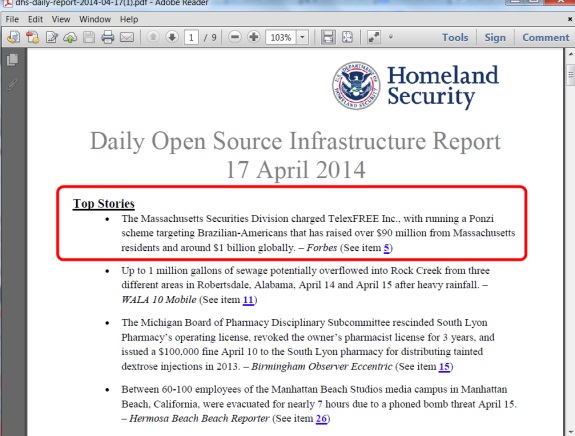
    From yesterday's national infrastructure report by the U.S. Department of Homeland Security.
    From yesterday’s national infrastructure report by the U.S. Department of Homeland Security. Red highlight by PP Blog.

    TelexFree — specifically the Ponzi- and pyramid complaint filed against it Tuesday by Massachusetts Commonwealth Secretary William Galvin — was the top story yesterday in the U.S. Department of Homeland Security’s daily infrastructure report.

    DHS was formed after the terrorist attacks of Sept. 11, 2001. Galvin alleged that TelexFree had gathered more than $1.2 billion in a massive, international fraud scheme.

    Yesterday’s infrastructure briefing singled out four “Top Stories” in the United States, with TelexFree listed at the top of the thumbnail reports.

    “The Massachusetts Securities Division charged TelexFREE Inc., with running a Ponzi scheme targeting Brazilian-Americans that has raised over $90 million from Massachusetts residents and around $1 billion globally,” the thumbnail read.

    DHS pointed to a story by Jordan Maglich in Forbes on the Massachusetts action. The agency listed the TelexFree matter in the infrastructure category of “Financial Services.”

    Yesterday’s infrastructure report did not mention that DHS itself had a role in executing a search warrant and securing the premises of TelexFree’s headquarters in Marlborough, Mass.

    Agents were at the site Tuesday,  the same day Galvin filed a state-level action and the SEC filed a federal action. An SEC affidavit credits DHS and a Bristol County Sheriff’s Deputy with stopping a bid by an accused TelexFree executive to remove nearly $38 million in cashier’s checks from the premises.

    The DHS infrastructure report is culled from various media reports. Although yesterday’s report highlighted four top stories across a broad spectrum, it also listed stories in various categories of infrastructure protection.

    These include:

    • Energy
    • Financial Services
    • Chemical
    • Transportation Systems
    • Nuclear Reactors, Materials, and Waste
    • Information Technology
    • Critical Manufacturing
    • Communications
    • Defense Industrial Base
    • Commercial Facilities
    • Dams
    • Government Facilities
    • Food and Agriculture
    • Emergency Services
    • Water and Wastewater Systems
    • Healthcare and Public Health

    The DHS Daily Open Source Infrastructure Reports are available here.

  • UPDATE: In SEC’s TelexFree Case, Agency Says Department Of Homeland Security And Sheriff’s Deputy Stopped Nearly $38 Million From Leaving Firm’s Massachusetts Office During Execution Of Search Warrant; Money Is Now Frozen

    This check for more than $10 million is dated April 3, 2014, and is made out to XXX, according to an SEC exhibit. Redactions by PP Blog.
    This check for nearly $10.4 million is dated April 3, 2014, and is made out to TelexFree Dominicana SRL, according to an SEC exhibit. Redactions by PP Blog.

    EDITOR’S NOTE: See story from earlier today on the SEC’s complaint and fraud allegations against the TelexFree “program,” executives and key promoters.

    ** ______________________________ **

    A Bristol County Deputy Sheriff at the scene of a Tuesday raid by the Department of Homeland Security at TelexFree headquarters in Marlborough, Mass., stopped nearly $38 million in cashier’s checks from leaving the premises in a “bag,” the SEC says in court filings.

    On Wednesday, a federal judge froze the money, securing “millions of dollars of funds” and preventing “the potential dissipation of investor assets,” the SEC said.

    Joseph H. Craft, TelexFree’s chief financial officer, was at the scene Tuesday and attempted to grab “a laptop and bag,” asserting that he was a TelexFree “consultant” assisting with the firm’s bankruptcy and that the items were “personal items,” the SEC said in an affidavit.

    Craft, 50, of Boonville, Ind., is a defendant in the SEC’s TelexFree action announced earlier today. He and several other defendants are accused of fraudulent or deceptive conduct in connection with the purchase or sale of securities, fraud in the offer or sale of securities and the offer or sale of unregistered securities.

    He is a certified public accountant, has prepared financial statements for TelexFree and has worked for other MLM companies, the SEC said.

    TelexFree, the SEC said, was a massive pyramid scheme that may have more than $1.1 billion in liabilities.

    “The Deputy Sheriff told Craft he could not take the laptop and bag and that these items would be subject to the search,” the SEC said in the affidavit. “[Homeland Security Investigations] Agents searched the bag and identified ten Wells Fargo Bank, N.A. cashier’s checks totaling $37,948,296.”

    Nine of the checks were dated April 11, 2014, just two days before TelexFree petitioned for bankruptcy in Nevada, according to the SEC affidavit and other court filings.

    The nine checks were “remitted to” James M. Merrill, TelexFree’s co-owner and former president. Of the nine, five were made out to TelexFree LLC “totaling $25,548,809, and one was made out to Katia B. Wanzeler,” believed to be the wife of TelexFree co-owner and treasurer Carlos Wanzeler,” the SEC asserted in the affidavit.

    The Katia Wanzeler check was for the sum of $2,000,635, the SEC alleged.

    A check dated April 3 was “remitted to” Carlos Wanzeler and made out to “TelexFree Dominicana SRL in the amount of $10,398,000,” the SEC alleged in the affidavit.

    TelexFree Dominicana SRL’s relationship to TelexFree was not immediately clear.

    On April 15, two days after the TelexFree bankruptcy filing and apparently just hours before the raid, Merrill “submitted an unsolicited order to sell $1,150,000 of his mutual fund holdings” and to have the money transferred to a bank in Massachusetts, the SEC said in the affidavit.

    “Bank statements show that two companies controlled by Craft received more than $2,010,000 between November 19, 2013 and March 14, 2014,” the SEC said in its complaint.

    The SEC complaint also references American MLM attorney Gerald Nehra, though not as a defendant.

    Nehra, the SEC said, said in a TelexFree video posted online in August 2013 that “[t]he special ingredient is that you have a real product.”

    The product, the SEC said today, was a VOIP system used to mask a massive pyramid scheme that collapsed.

    And the video appeared after a TelexFree-related probe in Brazil had begun, according to the SEC complaint.

    Carlos Costa, another TelexFree figure not named a defendant in the SEC action, also was referenced in the SEC complaint. Costa is based in Brazil, where an arm of TelexFree has been under investigation amid pyramid-scheme allegations since at least June 2013.

    In a video posted online weeks after the Brazilian pyramid probe began, “Costa stated that TelexFree ‘never was, never will be an illegal pyramid because of the sales of the VoiP service,’” the SEC said. “He asserted, ‘We do not depend on everyone coming in in order to pay the people who are already in.’”

    The reality, the SEC said, “is quite different.”

    NOTE: Our thanks to the ASD Updates Blog.


  • URGENT >> BULLETIN >> MOVING: SEC Charges TelexFree, Executives And Key Promoters — Including Sann Rodrigues And Faith Sloan

    Faith Sloan as show in a YouTube video promoting TelexFree, an alleged pyramid scheme that "mainly targeted Dominican and Brazilian immigrants in the U.S," the SEC said.
    Faith Sloan as shown in a YouTube video promoting TelexFree, an alleged pyramid scheme that “mainly targeted Dominican and Brazilian immigrants in the U.S.,” the SEC said.

    URGENT >> BULLETIN >> MOVING: (19th Update 5:45 p.m. ET U.S.A.) The U.S. Securities and Exchange Commission (SEC) has filed charges against the alleged TelexFree pyramid scheme and a federal judge has granted an asset freeze.

    TelexFree was a sham to mask an investment scheme known as “AdCentral” in which affiliates were told they could earn money without selling anything as long as they placed “meaningless ads” for the the program’s VOIP product on the Internet “and recruit[ed] others to do the same,” the SEC charged.

    The TelexFree “program” was targeted mainly at “Dominican and Brazilian immigrants in the U.S.,” the SEC alleged.

    One of its key promoters, Sanderley Rodrigues de Vasconcelos, also known as Sann Rodrigues, has a history of both pyramid-scheming with telephone products and affinity fraud, the SEC said.

    On March 9, after TelexFree had received subpoenas on Jan.  22 and Feb. 5 from the Massachusetts Securities Division, according to assertions in TelexFree’s bankruptcy case filed earlier this week, TelexFree changed its compensation scheme. The Securities Division is the state-level regulator in Massachusetts and is overseen by Commonwealth Secretary William Galvin.

    Galvin filed a state-level civil action against TelexFree on Tuesday that alleged an epic Ponzi and pyramid scheme that had gathered more than $1.2 billion. Records now show the SEC was in court on the same day, filing a federal case under seal and seeking an asset freeze. A federal judge granted the freeze yesterday, and the seal was lifted today, the SEC said.

    “Prior to the rule change on March 9, 2014, there was no requirement that AdCentral promoters actually sell any VoiP packages in order to receive their weekly payments,” the SEC charged. “Indeed, TelexFree and its promoters repeatedly emphasized that AdCentral members did not have to sell anything — they simply had to post the internet ads. The slogan repeated over and over was “everybody gets paid weekly.”

    Named defendants in the SEC’s action are TelexFree Inc., TelexFree LLC, TelexFree co-owner James Merrill of Ashland, Mass., TelexFree co-owner and treasurer Carlos Wanzeler of Northborough, Mass., TelexFree CFO Joseph H. Craft of Boonville, Ind., and TelexFree’s international sales director, Steve Labriola of Northbridge, Mass.

    Also charged were four individual promoters:  Sanderley Rodrigues de Vasconcelos, formerly of Revere, Mass., now of Davenport, Fla., Santiago De La Rosa of Lynn, Mass., Randy N. Crosby of Alpharetta, Ga., and Faith R. Sloan of Chicago.

    How much they allegedly earned was not immediately clear.

    Sloan is a notorious pusher of HYIP fraud schemes, and de Vasconcelos, also known as Sann Rodrigues, is a former defendant in an SEC pyramid-scheme and affinity-fraud prosecution.

    The SEC is the top securities regulator in the United States.

    “This is one of several pyramid-scheme cases that the SEC has filed recently where parties claim that investors can earn profits by recruiting other members or investors instead of doing any real work,” said Paul G. Levenson, director of the SEC’s Boston Regional Office.  “Even after the SEC and other regulators have alleged that such programs are a fraud, the promoters of TelexFree continued selling the false promise of easy money.”

    Named a relief defendant as the alleged recipient of fraud proceeds from TelexFree was TelexFree Financial Inc. of Coconut Creek, Fla.

    “It was incorporated by Craft on December 26, 2013,” the SEC alleged. “Its officers and directors are Wanzeler and Merrill, and Wanzeler is its registered agent. On December 30 and December 31, 2013, it received wire transfers totaling $4,105,000 from TelexFree, Inc. and TelexFree, LLC.”

    Also named a relief defendant was TelexElectric LLLP of Las Vegas. “It was formed on December 2, 2013,” the SEC charged. “Its general partners are Wanzeler and Merrill. Financial statements prepared by Craft indicate that TelexFree made a $2,022,329 ‘loan’ to TelexElectric.”

    In addition, Telex Mobile Holdings Inc. of Las Vegas was named a relief defendant.

    “It was incorporated on November 26, 2013,” the SEC alleged. “Its officers are Wanzeler and Merrill. Financial statements prepared by Craft indicate that TelexFree made a $500,870 ‘loan’ to Telex Mobile.”

    The PP Blog reported the existence of asserted TelexFree intracompany loans on March 9.

    Craft, the SEC said, “has been the chief financial officer of other multi-level marketing companies.”

    The Boston Globe is reporting this afternoon that during a raid of the TelexFree Massachusetts office Tuesday by the FBI and the Department of Homeland Security, Craft “tried to leave the scene with a laptop and cashier’s checks totaling nearly $38 million.”

    In its complaint, the SEC said that “on April 11 (just before TelexFree filed for bankruptcy), Merrill and the wife of Wanzeler obtained cashier’s checks in the total amount of $25,552,402. The checks are payable to TelexFree, LLC.”

    Citing information it had received from a bank, “TelexFree, LLC sent $10,389,000 to an entity known as TelexFree Dominicana, SRL,” the SEC alleged. Records suggest this transaction occurred on April 3, 2013.

    And federal “wire transfer records show that Wanzeler wired $3.5 million to the Oversea-Chinese Banking Corporation in Singapore on January 2, 2014, the SEC alleged.

    “The Commission has not yet been able to obtain a complete set of statements from the defendants’ banks, brokerage firms, and credit card payment processing services,” the SEC said in its complaint. “However, the information available to date, from bank records and other financial records as well as from statements made by various defendants, indicates that Merrill and Wanzeler, who had sole authority to transfer TelexFree corporate funds until the bankruptcy filing, have caused more than $30 million to be transferred from TelexFree operating accounts to themselves and to affiliated companies in the past few months.”

    Merrill received $3,136,200 on Dec. 26 and Dec. 27, 2013, the SEC alleged, citing bank statements. On the same dates, Wanzeler “received $4,317,800,” the SEC alleged.

    Again citing bank statements, the SEC alleged that approximately $14.3 million “was transferred to newly-created brokerage accounts in the name ofTelexFree, LLC” in December 2013. The complaint outlines other money routes prior to the bankruptcy filing, which seeks the “authority to reject all existing AdCentral contracts” with TelexFree promoters.

    The PP Blog reported on Monday that TelexFree was seeking to reject the contracts.

    SEC investigators, according to the fraud complaint, plucked a number of online videos featuring TelexFree’s top promoters.

    “When telling his success story in an internet video on March 13, 2013, Rodrigues stated, ‘Just place your ads every day and everyone gets paid weekly,’” the SEC charged. “He also asked and answered the following question: ‘What company in the country, in the world, you can make money . . .  you don’t need to sell anything? Now it exists. TelexFree.’”

    In April 2013, Crosby was quoted in a video as saying, “What if you were with a company that would pay you just to advertise the service? . . .  They’re paying us to advertise the service. It’s just that simple.”

    He added that members do not have to “worry about selling to the public,” the SEC charged.

    During the same month — April 2013 — the SEC brought fraud charges against a “program” known as Profitable Sunrise, calling it an international pyramid scheme. Sloan also was a Profitable Sunrise promoter, according to her website.

    Just two months after the Profitable Sunrise action, Sloan allegedly was flogging TelexFree.

    “Sloan stated in an internet video on June 12, 2013, ‘Place your ads, and you go about your day,’” the SEC charged.

    “You do that for seven days a week, you get paid every single week,” the SEC continued, quoting Sloan.

    She added, “You don’t have to build,” the SEC charged.  “You don’t have to sell.”

    Like similar schemes before it that had collected hundreds of millions of dollars — AdSurfDaily, Zeek Rewards, Imperia Invest IBC, Pathway To Prosperity and Profitable Sunrise — TelexFree had a presence on well-known Ponzi scheme forums such as TalkGold and MoneyMakerGroup.

    And what about the photos showing Merrill posing in front of a large building In Massachusetts? The SEC said they were part of the scheme to defraud.

    From the SEC’s complaint (italics added):

    The “Founder” section of the TelexFree website includes a photo of Merrill standing in front of a large three-story building, with the caption “Mr. Merrill in front of the headquarters of Telexfree in the USA.” At least two versions of the marketing presentation on the company website contained a photo of Merrill and a photo of the same building with the caption “The Company HS: United States.” The use of the building photo is misleading. TelexFree, Inc. does not own or occupy the entire building. In fact, it originally shared a single suite (consisting of a receptionist, conference rooms, and cubicles) with 28 other companies. Only in December 2013 did it move into its own suite, which occupies a portion of the first floor. TelexFree, LLC has no physical office at all, just a mailing address in Nevada.

    From the SEC’s statement on the TelexFree case (italics added):

    According to the SEC’s complaint, the defendants sold securities in the form of TelexFree “memberships” that promised annual returns of 200 percent or more for those who promoted TelexFree by recruiting new members and placing TelexFree advertisements on free Internet ad sites.  The SEC complaint alleges that TelexFree’s VoIP sales revenues of approximately $1.3 million from August 2012 through March 2014 are barely one percent of the more than $1.1 billion needed to cover its promised payments to its promoters.  As a result, in classic pyramid scheme fashion, TelexFree is paying earlier investors, not with revenue from selling its VoIP product but with money received from newer investors.

    Read the SEC complaint.

  • DEVELOPING STORY: Federal Agents Raid TelexFree, Massachusetts Newspaper Reports (And Publishes Photo)

    (UPDATED 9:58 A.M. EDT U.S.A.) Agents from Homeland Security Investigations (HSI) have raided the TelexFree office in Marlborough, Mass., the MetroWest Daily News is reporting.

    And the newspaper has published a photo showing federal agents and police officers inside the TelexFree office. The scene is similar to a scene at AdSurfDaily’s Florida headquarters in August 2008 in which the U.S. Secret Service and local sheriff’s deputies participated in a raid. ASD was a $119 million Ponzi scheme.

    Here, in part, is how HSI describes itself (italics added):

    HSI investigates immigration crime, human rights violations and human smuggling, smuggling of narcotics, weapons and other types of contraband, financial crimes, cybercrime and export enforcement issues. ICE special agents conduct investigations aimed at protecting critical infrastructure industries that are vulnerable to sabotage, attack or exploitation.

    TelexFree’s website has been offline since yesterday.

    The Massachusetts Securities Division alleged yesterday that TelexFree was a massive Ponzi and pyramid scheme that gathered more than $1 billion and targeted the Brazilian community.

  • URGENT >> BULLETIN >> MOVING: Massachusetts Securities Division Says TelexFree Is Billion-Dollar Ponzi And Pyramid Scheme That Targeted Brazilian Community

    breakingnews72URGENT >> BULLETIN >> MOVING: (11th update 3:03 p.m. EDT U.S.A.) The state of Massachusetts has alleged that TelexFree is a “massive” Ponzi- and pyramid scheme that gathered more than $1.2 billion and targeted the Brazilian community.

    In alleged dollar volume, TelexFree appears to be at approximately the same level of the epic Scott Rothstein Ponzi and racketeering scheme in Florida in 2009. Rothstein is serving a 50-year prison sentence.

    TelexFree, the office of Massachusetts Commonwealth Secretary William Galvin alleged in an action, raised $90 million in Massachusetts alone. The scheme, according to the filing, is “untenable without a continuous influx of new capital.”

    The 46-page complaint paints a picture of an incredibly elaborate domestic and international fraud scheme featuring interconnected companies and operated by individuals who told tales of incredible riches — at one time supplementing the story by plunking down more than $100,000 at a Mercedes-Benz dealership in Orlando, Fla., to acquire what effectively were stage props to lure the masses.

    A check uncovered by Massachusetts investigators, according to the complaint, had a memo line that read, “Cars for Extravaganza . . .”

    Despite stage props, “lavish meetings,” sea cruises and suggestions TelexFree somehow was affiliated with jewels of American business, TelexFree was racking up liabilities in the billions of dollars and encountering serious problems from its financial vendors, the complaint alleged.

    “The financial activities of TelexFREE have raised red flags in many United States[‘] financial institutions where it maintains accounts,” the complaint alleges.

    One of those vendors was a Massachusetts bank that booted TelexFree “after only 2 months,” the state alleged.

    Another vendor — a processor of credit cards — dumped TelexFree “after less than 6 months,” the state alleged.

    Meanwhile, the state alleged, TelexFree financial filings with the Washington State Utilities and Transportation Commission were at odds with information TelexFree had provided the investigators in Massachusetts.

    At the same time, Massachusetts alleged, TelexFree was turning a blind eye to an investigation in Brazil and effectively evading an asset freeze imposed there on an arm known as Ympactus.

    “TelexFREE fails to verify investor residency information — information manipulated to circumvent legal issues TelexFREE faces elsewhere,” the state alleged.

    In fact, the state further alleged, one witness testified that he’d recruited affiliates in Brazil after Ympactus’ assets were frozen and its recruitment activities were enjoined.

    Cash payments to Brazilian affiliates were made despite the action in Brazil, the state alleged, further alleging that affiliates in Brazil appear to have posed as residents of the United States or England.

    Moreover, the state alleged, TelexFree members had set up side businesses in which their recruits paid them directly, rather than paying TelexFree. (Editor’s note: This situation exists in many HYIP scams.)

    “These participants received uncontrolled cash deposits outside of the TelexFree system,” the state alleged.

    The state also expressed concerns about a black-market economy popping up around TelexFree.

    One Massachusetts entity asserted that it bought “TelexFree packages, and all sorts of real estate within the U.S.A. or foreign countries,” the state alleged, further alleging that the enterprise asserted it was backed by “Dubai investors.”

    On Feb. 14 — Valentine’s Day — an ad appeared “seeking to sell an automobile in the Commonwealth in return for [TelexFree] AdCentral Packages and AdCentral Family Packages,” the state alleged.

    TelexFree also featured Sann Rodrigues as its top pitchman, the state alleged.

    Rodrigues “had operated a similar multi-level marketing phone card fraud shuttered by the SEC in 2006,” the state alleged.

    Named respondents in the Massachusetts action were TelexFree Inc. of Massachusetts and TelexFree LLC of Nevada.

    “Related Parties” were identified as Carlos Nataniel Wanzeler of Northborough, Mass.; James Matthew Merrill of Ashland Mass.; Steven M. Labriole (also known as Steve Labriola) of Upton, Mass.; Carlos Roberto Costa of Brazil; Fabio N. Wanzeler of Coral Springs, Fla.; Ympactus Comercial LTDA-ME of Brazil; Lyvia Mara Campista Wanzeler (no residency listed); Disk A Vontade Telefonia Ltda (also known as Diskavontade and Disk) of Brazil and Massachusetts; Brazilian Help Inc. of Massachusetts;  Sanderley R. De Vasconcelos (also known as Sann Rogrigues) of Orlando, Fla.; and TelexFree Financial Inc. of Florida.

    TelexFree Inc., TelexFree LLC and TelexFree Financial Inc. all filed bankruptcy petitions in Nevada on April 13, a Sunday.

    Among the assertions by Galvin’s investigators is that TelexFree is a combined Ponzi- and pyramid scheme that engaged in the sale of fraudulent and unregistered securities and allowed and encouraged “participants to structure deposits in order to avoid heightened bank scrutiny.”

    Structuring transactions is a somewhat common element in Ponzi schemes.

    Read the Massachusetts complaint.


  • URGENT >> BULLETIN >> MOVING: TelexFree Says It Has Filed For Bankruptcy In United States; Uganda’s Central Bank Issues Fraud Warning

    newtelexfreelogoURGENT >> BULLETIN >> MOVING: (6th update 2:36 p.m. EDT U.S.A.) TelexFree LLC and “certain of its subsidiaries and affiliates” have filed for bankruptcy in Nevada, the firm said in a statement this morning.

    In its statement, the company did not directly identify the other TelexFree firms involved in the filing. A link in the statement, however, identifies the firms as TelexFree LLC, TelexFree Inc. and TelexFree Financial Inc.

    A schedule included in the bankruptcy filing suggests that TelexFree owes its 30 largest unsecured creditors nearly $14 million. As much as $36 million may be owed other unsecured creditors, the filing suggests.

    TelexFree is seeking to reject contracts that existed with affiliates both before and after the “program” changed its compensation plan on March 9, according to the bankruptcy filing.

    Stakeholders and affiliates are called “constituents” in the statement, which attributes a remark to Stuart MacMillan, “interim Chief Executive Officer of TelexFREE.”

    TelexFree is under investigation by the Massachusetts Securities Division. Prosecutors in Brazil have described TelexFree as a pyramid scheme.

    Separately, the central bank of Uganda has issued a fraud warning on TelexFree and other programs, according to a report in African media. The warning follows a move by the government of Rwanda last month that banned a TelexFree enterprise.

    TelexFree’s announcement of the bankruptcy filing occurred just days after the enterprise, citing unspecified “scheduling conflicts,” sought the postponement of a hearing in Alabama to consider its application for “Resale Interexchange Authority.”

    TelexFree says it is in the VOIP business and provides other telecommunications services. How the bankruptcy filing would affect various TelexFree phone-service applications in various states was not immediately clear. In regulatory filings, TelexFree LLC said it posted more than $691 million in “total income” last year.

    Affiliates of the TelexFree MLM “program” have been complaining about not getting paid.

    The filing also takes place against the backdrop of public appeals by TelexFree for affiliates to recruit more customers. A promo earlier this month included the logos of prominent media firms in the United States, planting the seed that the firm’s MLM “program” had the backing of the companies, many of which are affiliates of major television networks in the United States.

    A TelexFree arm in Brazil sought bankruptcy protection last year. Carlos Costa, a TelexFree executive in Brazil, curiously waved the flags of Portugal and Madeira while announcing the Brazil filing. Police in Europe later issued warnings that TelexFree was targeting the Madeiran community.

    Alvarez & Marsal North America, LLC is serving as restructuring advisor to the Company and Greenberg Traurig, LLP and Gordon Silver are serving as legal advisors to TelexFREE, according to the statement.

    Among other things, the bankruptcy filing says TelexFree has generated more than $1 billion in revenue since 2012. The revenue surge “put tremendous pressure on the Company’s financial, operational and management systems,” TelexFree contends.

    The filing seeks to reject contracts with TelexFree promoters under both an existing compensation plan implemented March 9 and an “original compensation plan” that existed prior to that date.

    “At the time of the roll-out of the Revised Comp Plan, the Company decided to honor certain discretionary payments to Promoters under the Original Comp Plan,” TelexFree said in bankruptcy filings. “These discretionary payments quickly became a substantial drain on the Company’s liquidity. The Company discontinued the Pre-Petition Comp Plans and ceased making discretionary payments under the Original Comp Plan prior to Petition Date.”

    TelexFree affiliates have claimed that $289 sent to the firm returned $1,040 in a year and that $1,375 returned $5,200. Some TelexFree groups solicited sums of $15,125, saying such a sum would return $57,200.

    From the TelexFree bankruptcy filing, which requests contracts with affiliates to be rejected (italics/bolding added):

    Under the Original Comp Plan, Promoters have and are continuing to assert substantial claims against the Debtors. While the Debtors believe that many of those claims are invalid, the Debtors continue to be burdened by the demands made under the Original Comp Plan. In addition, questions were raised as to whether the Original Comp Plan is compliant with law, which jeopardized the Debtors’ business. Although the financial demands are less under the Revised Comp Plan, the Revised Comp Plan does not generate sufficient revenues for the Debtors to continue operating their business.”

    Said MacMillan, in the TelexFree media statement:

    “We are taking this major step because we continue to believe in our business, our products and the enthusiasm of our world-class team.  We believe that this restructuring plan, which will include significant enhancements to our governance practices and internal controls, will help us to build a stronger and more sustainable financial and operational foundation for the future.”

  • Judge Sets Hearing Date On WCM777 Receiver’s Claim That Attorney Linked To Phil Ming Xu Is Refusing To Return Millions And That ‘Xu Uses Nominees To Hold The Proceeds Of Fraud’

    Screen shot of federal court file. Red redaction by PP Blog.
    Screen shot of federal court file. Red redaction by PP Blog.

    EDITOR’S NOTE: See related story from earlier today that outlines where about $2.133 million of the $5 million cited in the story below is being held for safe-keeping. The whereabouts of the balance is creating a mystery, according to court files.

    U.S. District Judge Christina A. Snyder has scheduled a hearing April 24 in Los Angeles to address a court-appointed receiver’s claim that a $5 million transfer by accused WCM777 Ponzi scheme operator Phil Ming Xu to a lawyer a month before an asset freeze was a “sham” designed to stash cash.

    The lawyer, Vincent Messina, now has retained a lawyer and is refusing to return most of the cash and explain what happened to more than $2.66 million that hasn’t been accounted for, insisting that the transaction was a “loan” for investment purposes and that he also was helping Xu set up a “political action committee,” according to receiver Krista L. Freitag.

    Messina has retained Maranda Fritz, an attorney in New York, according to court filings.

    Freitag, who wants the money returned and an accounting of how it was used, has asked Snyder to freeze Messina’s bank accounts.

    “There is not only a strong likelihood that monies transferred to Mr. Messina will be dissipated, but evidence they already have been,” Freitag argued.

    And, she continued, “[t]his poses a serious risk of irreparable injury to the receivership estate and investors. Once monies are disbursed by Mr. Messina, it will be difficult, if not impossible, to recover them for the benefit of investors.”

    The SEC has described WCM777 as a $65 million Ponzi- and pyramid scheme. Freitag says her early analysis suggests that WCM777 may have more than 479,000 “member accounts.”

    Moreover, Freitag argued, Messina refused to return the money even when asked by Xu in a March 20 letter.

    Xu, according to the letter, described Messina as his attorney, not as a business partner, and wrote he wanted the $5 million returned so he could use it “to settle any outstanding SEC issues that I may have.” (See screen shot above.)

    Other records show that the SEC had been investigating Xu since October 2013. Snyder granted an asset freeze on March 27, after the SEC appeared in federal court and alleged that WCM777 and related entities were conducting an ongoing fraud.

    Xu allegedly transferred the $5 million to Messina a month prior to the March 27 freeze.

    From the receiver’s motion to freeze Messina’s bank accounts (italics/carriage returns added):

    Considering the large sum of money at issue, the compelling evidence of fraud and that Defendant Xu uses nominees to hold the proceeds of fraud, as well as the proximity of the transfer to the filing of the case, and the fact that Mr. Messina refuses to provide any information about the whereabouts of the remaining $2.668 million, it is critical that Mr. Messina’s bank accounts be immediately frozen to protect the Receivership Entities’ investors from further dissipation of the funds.

    The temporary freeze should remain in place pending further investigation and a determination by the Court of the true nature of the $5 million transfer. To aid in this investigation and determination, Mr. Messina should be directed to provide an accounting of the funds, a relatively simple task considering he received them only about 40 days ago.

    The accounting will also assist in determining the appropriate scope of the freeze, which should cover accounts containing funds received from Mr. Xu or the Receivership Entities.

    Thanks to the ASD Updates Blog. View WCM777 case docs 29 through 29-2 here.

  • BULLETIN: WCM777 Receiver Puts End To ‘New Multi-Level Marketing Scheme Which Was Being Developed’ In California Warehouse And ‘Involved Numerous Of The Same Defendants And Personnel’; Receiver Also Seeks Freeze Of Attorney’s Bank Accounts — Plus, A Ponzi Fish Story

    breakingnews72BULLETIN: (UPDATED 11:38 P.M. EDT U.S.A.) The court-appointed receiver in the WCM777 Ponzi- and pyramid case says in court filings that she has stopped a “new multi-level marketing scheme” that had been under development by WCM777 in a warehouse in El Monte, Calif.

    WCM777, alleged by the SEC to have gathered about $65 million, purportedly was in the “cloud” computing business and may have more than 479,000 “member accounts.”

    Receiver Krista L. Freitag says in a report that she has identified more than “100 domain names” associated with the alleged WCM777 fraudsters.

    Meanwhile, Freitag says she is seeking an order to freeze the bank accounts of an attorney linked to accused WCM777 Ponzi schemer Phil Ming Xu.

    The lawyer, according to the receiver, purportedly is “the beneficiary of a $5 million non-recourse loan, to be repaid in 2019 in a single balloon payment” and allegedly claimed he’d lost a cashier’s check for $200,000. The purported loan allegedly came from a Xu-owned entity.

    At the same time, Freitag says her preliminary analysis suggests that Xu, who allegedly squired the purchase of two golf courses and at least six other properties for millions of dollars in cash, may have an association with at least 28 business entities. One is known as “12 Zodiacs Inc.” Another uses the words “Medical Group” when forming its name. Yet-another is described as “US Immigration Investment Assoc.” Still-another is called “WCM Art Inc.”

    Perhaps like the Zeek Rewards MLM HYIP scheme before it, WCM777 could lead to an incredible paper chase that serves up intriguing but worrisome sidebars of black comedy. Another of the entities listed in the WCM777 receiver’s report, for example,  potentially has an all-subsuming name: “Frequency Holdings Inc.”

    The El Monte MLM scheme was being developed by “numerous of the same defendants and personnel” involved in WCM777, Freitag advised a federal judge.

    U.S. District Judge Christina A. Snyder is presiding over the case. It was not immediately clear whether the alleged emerging scheme was “Global-Unity,” which once used a photograph of a golden pyramid on its website.

    What is clear is that Freitag has been plenty busy since the SEC fraud case was filed March 27. In one instance, she advised the judge, the receivership observed a “third party” removing  “furniture and art work” from a property linked to WCM777.

    “The Receiver promptly contacted the Monrovia [Calif.] police department and made a report,” Freitag advised the judge. “The Receiver has investigated the removal of art and furniture and has identified the people who removed the personal property. The Receiver has demanded the return of the art and furniture.”

    In another instance, Freitag said in the report to the judge, the receivership observed “live Koi” at a WCM777-linked property, this one in Walnut, Calif.

    “Koi” are color-splotched, trainable, domesticated carp originally bred in Japan and reportedly known to recognize the persons feeding them and to eat out of the hands of their owners, according to the Wikipedia entry for the species.

    Some websites sell Koi for thousands of dollars apiece.

    “The Receiver has taken steps to maintain these fish in the event they have value to the receivership estate,” Freitag advised the judge.

    On the money front, the receiver advised the judge that the receivership now has in its possession “$11.28 million” of WCM777-connected money that once had been in the trust account of a law firm, $1.5 million that had been in a bank account and designated to be part of a WCM777-connected real-estate acquisition and an “aggregate of approximately $2.54 million held in other accounts of the Receivership Entities or recovered from other entities.”

    Freitag also has met with Xu and his lawyers, according to the receiver’s report to the judge.

    “This interview lasted several hours, during which the Receiver primarily focused on identifying assets of the Receivership Entities that needed to be secured, as well as gaining understanding of any past or present operations that were being conducted by Receivership Entities,” Freitag advised the judge.”Among other things, these interviews yielded significant information concerning funds transferred to Vincent Messina as well as a myriad of investments, loans, and transfers that need to be addressed by the Receiver.”

    Messina is a lawyer WCM777 billed as its “In-house Legal Counsel,” according to affiliate promos.

    From the receiver’s report (italics/carriage returns added):

    During her initial investigation, the Receiver learned that, approximately one month before this case was filed, $5 million was transferred from ToPacific, Inc., an entity owned by Defendant Phil Ming Xu and whose accounts are now frozen, to the IOLTA trust account of attorney Vincent Messina.

    Mr. Messina has refused to turn over the funds and his counsel has stated that some of funds have already been disbursed, but the details of those disbursements have not been provided. The Receiver initially sought to recover the funds from Mr. Messina, which Mr. Messina refused. The Receiver then asked Mr. Messina to agree to escrow the undisbursed funds pending further order of the Court and provide an accounting of the funds he received. On April 4, 2014, Mr. Messina, the Receiver, and the Commission agreed that $2.332 million wired by Mr. Messina from various accounts he controls to the client trust account of Thompson Hine LLP, Mr. Messina’s attorneys, would be held in escrow by Thompson Hine pending further order of the Court. Mr. Messina still refuses, however, to provide any information about the remaining $2.668 million, stating only that it was disbursed for “business purposes.”

    On April 8, 2014, Maranda Fritz of Thompson Hine confirmed that $2,133,214.62 has been received by Thompson Hine and is being held pursuant to the escrow agreement. The remaining $200,000 to be held pursuant to the escrow agreement has not yet been received.

    The Receiver also learned Mr. Messina obtained a $200,000 cashier’s check from Bank of America, which he claims he lost. Mr. Messina is apparently putting in a claim with Bank of America that the funds be credited back to his account. Bank of America advises it may take as long as 91 days for such claim to be approved and the funds credited back to Mr. Messina’s account.

    Mr. Messina’s position is that the $5 million transfer is a loan pursuant to a two-line loan agreement dated February 27, 2014, in which Mr. Messina is the beneficiary of a $5 million non-recourse loan, to be repaid in 2019 in a single balloon payment. The funds were wired to Mr. Messina’s IOLTA trust account . The purported loan agreement is virtually identical to purported non-recourse, unsecured loan agreements signed by Receivership Entity Manna Holding Group, Inc., an entity owned by Mr. Xu’s wife, in connection with large transfers from World Capital Market, Inc. and Kingdom Capital Market, LLC for the purchase of real property. Declaration of [lead SEC investigator] Peter Del Greco, Dkt. No. 6, Exhibits 32 and 33. No payments are due under the purported loan agreement until January 2019.

    Moreover, Defendant Ming Xu subsequently asked for return of the “retainer” from Mr. Messina, which undermines a claim that this was a bona fide loan transaction for some legitimate purpose.

    The Receiver is filing an ex parte application concurrently with this report requesting that Mr. Messina’s bank accounts be frozen and he be directed to provide an accounting of all funds received from the Receivership Entities, including ToPacific, Inc. Such immediate relief is necessary to protect investors from further dissipation of the funds pending further investigation and a determination by the Court of the true nature of the $5 million transfer.

    Read the receiver’s report.