Blog

  • BULLETIN: First Round Consisting Of 1,200 Subpoenas Will Go Out This Week To Zeek ‘Affiliates Who Profited Most,’ Receiver Says; More Subpoenas Will Follow; Winners Also Will Receive ‘Letter Offering To Negotiate Voluntary Surrender Of Profits’

    UPDATED: 7:08 P.M. EDT (U.S.A.) The court-appointed receiver in the Zeek Rewards Ponzi scheme case has announced that about 1,200 subpoenas will go out this week to “affiliates who profited most from ZeekRewards.”

    It’s “victims’ money, really,” receiver Kenneth D. Bell said in a letter posted on the receivership website.

    “The subpoenas ask for financial information, including dealings with Rex Venture,” Bell wrote. “Depositions and litigation will follow if necessary. With each subpoena will be a letter offering to negotiate voluntary surrender of profits (victims’ money, really) instead of going to Court.”

    On Aug. 17, the SEC described Zeek as a $600 million Ponzi- and pyramid scheme that potentially affected more than 1 million members.

    In the receiver’s letter dated Oct. 30, Bell said a preliminary analysis suggests that Zeek losers outnumber winners by a factor of about eight to one. Zeek was operated by North Carolina-based Rex Venture Group LLC and Paul R. Burks.

    “Our preliminary analysis has identified more than 800,000 affiliate User IDs who put more money into Rex Venture than they took out,” Bell wrote. “We estimate that losses will total between $500 million and $600 million. We have already recovered more than $300 million and continue to pursue millions more held in financial institutions. To fill the gap between what we have recovered and what victims lost, we will pursue recovery from those who took out of Rex Venture more than they put in. There are more than 100,000 User IDs in this category representing hundreds of millions of dollars.”

    More subpoenas will be issued in the coming weeks, Bell said.

    “Additional subpoenas and demands for return of profits will be served on thousands more in the weeks to come,” Bell wrote. “I can’t tell you we will recover enough to make all victims 100% whole, but if we don’t it won’t be for lack of trying.”

    A “preliminary, partial” distribution of money to help Zeek victims recover also is being planned, Bell said. No timetable was released, but the receiver noted that he would submit a claims form for the court’s approval. Once Senior U.S. District Judge Graham C. Mullen approves the form, the process of filing claims will begin.

    “Once approved the Form will be posted” on the receivership website, the receiver wrote.  “When that process has run we will ask the Court for permission to make a preliminary, partial distribution to qualified claimants from recovered funds. A final distribution will have to wait until we have finished collecting all recoverable assets. This will unfortunately take quite a while, and I appreciate your support and patience.”

    Bell said he’d received emails from Zeek members inquiring whether they should hire an attorney or “join a group” that has hired an attorney to assist in claims recovery.

    “I cannot and do not advise you one way or another about hiring an attorney,” Bell wrote. “I can tell you that my direction from the Court, and my duty to you, is to seize all recoverable assets and distribute them to victims as fully and fairly as possible.

    “That, I will do,” he concluded.

    UPDATE: 7:08 P.M. EDT (U.S.A.): The receiver has added a “Subpoena FAQ” here. At the time of this update, there are nine entries in the FAQs, including this question and answer (italics added):

    1. Why have I received a subpoena for documents?

    The ZeekRewards Receiver has been authorized by the Court to recover money and pursue claims for the company. You are receiving this subpoena because you have been identified as an “affiliate,” participant, agent or employee in the ZeekRewards operation who may have received significantly more money from ZeekRewards than you put into the operation. The so-called “profits,” “commissions,” or “winnings” that you received were really just money put in by the victims of the Ponzi and pyramid schemes described in the Securities and Exchange Commission Complaint. The subpoena you received is the legally authorized means for the Receiver to gather information from you in connection with the legal process to recover your “profits,” “commissions,” and “winnings” to compensate victims.


  • UPDATE: As Proposed Money-Saving Measure, Zeek Receiver Asks Judge To Treat Oct. 8 Preliminary Liquidation Plan As Status Report; Meanwhile, Yet Another Zeek Member Declares Herself A Fraud Victim

    A woman who described herself as a Zeek victim filed copies of postal receipts in federal court today. Source: Screen shot of federal court files. Redaction by PP Blog.

    UPDATED 8:26 A.M. EDT (OCT. 31, U.S.A.) Saying it would save money, the court-appointed receiver in the Zeek Rewards Ponzi scheme case has asked a federal judge to treat the receiver’s Oct. 8 preliminary liquidation plan as a status report. (See Oct. 9 PP Blog story.)

    Separately, yet another Zeek member has declared herself a victim of the alleged $600 million Zeek fraud scheme operated by Paul R. Burks and Rex Venture Group LLC. Two other Zeek members effectively did the same thing earlier this month. On Aug. 17, the SEC alleged that Zeek was a massive Ponzi- and pyramid scheme that potentially fleeced more than 1 million people.

    In August, Senior U.S. District Judge Graham C. Mullen of the Western District of North Carolina ordered receiver Kenneth D. Bell to file the first status report in the case by Oct. 30. Among other things, status reports inform judges about the efforts under way to recover proceeds linked to alleged fraud schemes and return them to victims.

    In the Zeek case, status reports are due within 30 days of the end of a quarter — for example, the third quarter of the calendar year ended Sept. 30, making the first Zeek status report due Oct. 30. The second is due Jan. 31, 2013, a month after the end of the fourth quarter of the calendar year on Dec. 31, 2012.

    Bell said in court filings today that the information in the Oct. 8 report included “the same information” due today.

    “Given that a separate Quarterly Status Report would be redundant, and in the interest of preserving Receivership assets, the Receiver respectfully requests that the Court order that the Preliminary Liquidation Plan be treated as the Receiver’s First Quarterly Status Report,” Bell petitioned Mullen.

    Mullen had not acted on the request by late this afternoon, according to the docket of the case.

    How Zeek enthusiasts on Ponzi-scheme boards such as TalkGold and MoneyMakerGroup will react to Bell’s request was not immediately clear. One-percent-a-day (or more) schemes such as Zeek gain a head of steam in part because willfully blind scammers who populate the Ponzi cesspits position the “programs” as legitimate.

    The demonization of Bell on the Ponzi boards and elsewhere began shortly after the SEC brought the Zeek case. As was the case in the AdSurfDaily prosecution brought by the U.S. Secret Service in 2008, some Zeek members have claimed that the government is manufacturing victims where none exist. The ASD and Zeek Ponzi schemes fetched a combined sum of at least $719 million, nearly three-quarters of a billion dollars, according to court filings.

    Both frauds operated as classic Ponzi schemes that recycled money from members to create the illusion of sustainability and profitability, according to investigators.

    Both Zeek and ASD were promoted on forums listed in federal court filings as places from which Ponzi schemes are promoted. Earlier schemes promoted on the forums include Legisi and Pathway To Prosperity, which gathered a combined sum of more than $140 million and affected tens of thousands of people, according to court filings.

    Legisi operator Gregory McKnight faces sentencing next month in his Ponzi scheme case. Alleged Pathway To Prosperity operator Nicholas Smirnow, meanwhile, is listed by INTERPOL as a wanted fugitive. As was the case with Zeek, the SEC and Secret Service led the Legisi probe. The U.S. Postal Inspection Service brought the Smirnow/Pathway to prosperity case, saying the scam affected individuals in 120 countries.

    ASD operator Thomas A. “Andy” Bowdoin is serving a 78-month prison sentence. He was sentenced in August 2012.

    Despite claims that Zeek created no victims, at least three individuals already have claimed in court filings to have been scammed by Zeek.

    In a filing docketed today, Maria Aide Gomez claimed she sent North Carolina-based Zeek parent Rex Venture Group five postal money orders for $1,000 each in May and paid an additional $300 to maintain her Zeek membership.

    Gomez described herself as a “Victim of fraud and deception” on the part of Zeek, Rex Venture Group and Paul R. Burks, the operator of Zeek and Rex Venture. The money orders Gomez sent to Zeek were purchased at a post office in Washington state, according to exhibits that accompanied the filing.

    Bell, the receiver, is experienced as both a defense attorney and a prosecutor. The U.S. Department of Justice lauded Bell a decade ago for his successful prosecution of a Hezbollah terrorist cell operating in the United States.

  • [OCTOBER DONATION POST]: PP Blog At Risk Of Suspending Publication, Owing To Lack Of Funds

    Dear Readers,

    UPDATED 1:33 P.M. EDT (OCT. 25, U.S.A.) Please note: This post originally was published Saturday (Sept. 29) in this spot and has been republished several other times here. We changed the headline because the need has become dire and the absence of funds puts the Blog at risk of suspending publication by Oct. 31.

    The need this month is on the order of $475. As of today, only $170 has come in.

    All stories in September were made possible by a small handful of readers. The posts this month to date also have been made possible by readers.

    Please help if you’re able.

  • FEDS: Man Tried To Scam Zuckerberg, Facebook Out Of Billions ‘By Marching Into Federal Court For A Quick Payday Based On A Blatant Forgery’

    A New York man tried to scam Mark Zuckerberg and Facebook out of billions of dollars by forging documents and filing a lawsuit to make it appear as though Zuckerberg had promised him a 50 percent share of the company, prosecutors said.

    Paul Ceglia, 39, of Wellsville, was arrested this morning after an investigation by the U.S. Postal Inspection Service, prosecutors said.

    “As alleged, by marching into federal court for a quick payday based on a blatant forgery, Paul Ceglia has bought himself another day in federal court for attempting a multibillion dollar fraud against Facebook and its CEO,” said U.S. Attorney Preet Bharara of the Southern District of New York. “Ceglia’s alleged conduct not only constitutes a massive fraud attempt, but also an attempted corruption of our legal system through the manufacture of false evidence. That is always intolerable. Dressing up a fraud as a lawsuit does not immunize you from prosecution.”

    When Zuckerberg was a Harvard student in 2003, prosecutors said, Ceglia contracted with him to do programming work for Ceglia and Ceglia’s StreetFax.com.

    Ceglia later claimed in lawsuits that Zuckerberg “had promised him at least a 50% interest in ‘The Face Book’ project that ultimately became Facebook Inc.,” prosecutors said.

    In reality, prosecutors said, Ceglia “doctored, fabricated, and destroyed evidence to support his false claim.”

    From a statement by prosecutors (italics added):

    “In support of his claim, [Ceglia] attached a copy of what he alleged to be the two-page April 28, 2003 contract between himself and Zuckerberg (“Alleged Contract”). The first page of the Alleged Contract contained language giving [Ceglia] “a half interest (50%) in the software, programming language and business interests” derived from the expansion of “The Face Book” or “The Page Book.” The second page of the Alleged Contract contained the signatures of [Ceglia] and Zuckerberg. Also in support of his claim, [Ceglia] described emails he alleged to have exchanged with Zuckerberg between July 2003 and July 2004 via Zuckerberg’s Harvard email account (“Purported Emails”). The Purported Emails reflected conversations between [Ceglia] and Zuckerberg about the design and functionality of “The Face Book” website, as well as ways to generate income from its expansion. The Purported Emails also reflected conversations in which Zuckerberg offered [Ceglia] money to “repair [their] business relationship.”

    As alleged in the Complaint, however, [Ceglia’s] claim to having a contractual right to 50% of Facebook was entirely false. [Ceglia] simply replaced page one of the real contract with a new page one doctored to make it appear as though Zuckerberg had agreed to provide [Ceglia] with an interest in Facebook. And [Ceglia] doctored, fabricated and destroyed evidence to support his false claim. The evidence demonstrating [Ceglia’s] lawsuit is a fraud included the following:

    • A search of one of [Ceglia’s] hard drives uncovered a copy of the real April 28, 2003 contract, which [Ceglia] had emailed to an attorney in March 2004, years before his lawsuit against Facebook and Zuckerberg (“Real Contract”). Page one of the Real Contract does not refer to Facebook in any fashion, let alone give[Ceglia] a 50% interest in it.
    • The spacing, columns, and margins of page one of the Alleged Contract are different from the spacing, columns, and margins of page two of the Alleged Contract. No such differences exist as between the pages of the Real Contract.
    • A review of Harvard University’s email servers reveals that none of the Purported Emails appears in Zuckerberg’s email account as of February 2012. Further, none of the Purported Emails appears in Harvard’s backup tapes for Zuckerberg’s emails as they existed in October 2010, nor do any of the Purported Emails appear in Harvard’s backup tapes for Zuckerberg’s emails as they existed in November 2003. The emails between Zuckerberg and [Ceglia] that do exist in Zuckerberg’s email account do not show any discussion of Facebook and, contrary to [Ceglia’s] claim, show that Zuckerberg was asking [Ceglia] for money he was owed in 2004, not offering to give [Ceglia] money.
    • A forensic expert examined [Ceglia’s] hard drives and other electronic media and found evidence that in February 2011, [Ceglia] deleted files relating to the April 2003 contract with Zuckerberg and replaced them with new files that supported his lawsuit but that were backdated to make it appear as if those the files had in fact been created in 2003 and 2004. Further, a CD Rom revealed that [Ceglia] had done test runs on fabricating some of the documents, including the Purported Emails, upon which his lawsuit relied.
    • Zuckerberg and another of Facebook’s founders have said that the idea for Facebook did not arise until months after the April 2003 contract purportedly giving [Ceglia] an interest in Facebook.

    Ceglia was charged with mail fraud and wire fraud, prosecutors said.

  • SOBERING: Cyber Criminals May Be Responsible For ‘The Greatest Transfer Of Wealth In History,’ Top Justice Department Official Says At Seattle Conference

    “The Intelligence Community’s most recent Worldwide Threat Assessment confirms that U.S. networks have already been subject to ‘extensive illicit intrusions.’ The head of the National Security Agency and the Pentagon’s Cyber Command, for one, believes such intrusions may have resulted in ‘the greatest transfer of wealth in history.’”Lisa Monaco, Assistant Attorney General for National Security, Oct. 25, 2012

    EDITOR’S NOTE: These are remarks prepared for delivery by Lisa Monaco, Assistant Attorney General for National Security, at the “2012 Cybercrime Conference” today in Seattle. Monaco presides over the Justice Department’s National Security Division.

    The conference was hosted by U.S. Attorney Jenny A. Durkan of the Western District of Washington. Durkan’s name may be familiar to longtime PP Blog readers because her office is involved in the prosecution of AdSurfDaily story figure Kenneth Wayne Leaming, a purported “sovereign citizen” charged with filing false liens against five public officials who had roles in the ASD Ponzi prosecution. ASD was a Florida-based online scam that created thousands of victims. Leaming also is accused of uttering a bogus “bonded promissory note” for $1 million and passing it at U.S. Bank, harboring fugitives implicated in a separate fraud scheme and being a felon in possession of firearms.

    ** ______________________________________________ **

    Good afternoon.   Thank you for having me here today.   I am grateful to the U.S. Attorney’s Office for the Western District of Washington and to U.S. Attorney Jenny A. Durkan, for organizing a conference on this important topic.   Thank you all for taking the time out of your schedules to discuss these issues.   Events like these are critical to helping us succeed in combating cyber threats.

    The Threat

    If there is one thing we all know from the presentations today and our work in the field, it is the seriousness of the cyber threat.   The President has called it “one of the most serious economic and national security challenges we face as a nation.”   It’s hard to quibble with that.   Hardly a day goes by when cyber events don’t show up in the news.   As many of you know, over the last several weeks, financial institutions in the United States have been hit by a series of Distributed Denial of Service (or DDOS) attacks.   Such attacks are relatively easy to carry out, but they can cause serious harm by disrupting companies’ website services and preventing customer access.   Although these disruptions have been temporary, their frequency and persistence underscores recent Intelligence Community warnings about the “breadth and sophistication of computer network operations . . . by both state and nonstate actors.”   The cyber alarm bell has been rung.   The Intelligence Community’s most recent Worldwide Threat Assessment confirms that U.S. networks have already been subject to “extensive illicit intrusions.”   The head of the National Security Agency and the Pentagon’s Cyber Command, for one, believes such intrusions may have resulted in “the greatest transfer of wealth in history.”

    We often think of national security threats, like that of a catastrophic terrorist attack, as questions about prevention.   But the cyber threat is not simply looming – it is here.   It is present and growing.   Although we have not yet experienced a devastating cyber attack along the lines of the “cyber Pearl Harbor” that Defense Secretary Panetta recently mentioned – we are already facing the threat of a death by a thousand cuts.   Outside the public eye, a slow hemorrhaging is occurring; a range of cyber activities is incrementally diminishing our security and siphoning off valuable economic assets.   This present-day reality makes the threat of cyber-generated physical attacks, like those that might disrupt the power grid, appear no longer to be the stuff of science fiction.   And all of this comes against the backdrop of sobering forecasts from the highest ranks of our national security community.   FBI Director Mueller – a man not prone to overstatement – predicts that “the cyber threat will pose the number one threat to our country” in “the not too distant future.”

    Despite all we know about intrusions against U.S. businesses and government agencies, what is more sobering still is the Intelligence Community’s assessment that “many intrusions . . . are not being detected.”   Even with respect to those that are detected, identifying who is behind cyber activity can be uniquely challenging.   Technologies can obscure perpetrators’ identities, wiping away digital footprints or leaving investigative trails that are as long as the web is wide.   Cyber intrusions don’t announce themselves or their purpose at the threshold.   Depending on the circumstances, the purpose or endgame of a particular intrusion may be anyone’s guess – is it espionage?   Mere mischief?   Theft?   An act of war?

    The threats are as varied as the actors who carry them out.   A growing number of sophisticated state actors have both the desire and the capability to steal sensitive data, trade secrets, and intellectual property for military and competitive advantage.   While most of the state-sponsored intrusions we are aware of remain classified, the onslaught of network intrusions believed to be state-sponsored is widely reported in the media.   We know the Intelligence Community has noted that China and Russia are state actors of “particular concern,” and that “entities within these countries are responsible for extensive illicit intrusions into US computer networks and theft of US intellectual property.”   Indeed, “Chinese actors are,” according to a public report of our top counterintelligence officials, “the world’s most active and persistent perpetrators of economic espionage.”   And we know that Secretary of Defense Panetta has stated that “Iran has also undertaken a concerted effort to use cyberspace to its advantage.”

    In cases involving state actors and others, trusted insiders pose particular risks.   Those inside U.S. corporations and agencies may exploit their access to funnel information to foreign nation states.   In these cases, perimeter defense isn’t worth much; the enemy is already inside the gates.   The Justice Department has prosecuted a number of corporate insiders and others who obtained trade secrets or technical data from major U.S. companies and routed them to other nations via cyberspace.

    Earlier this year, in the first indictment of foreign state-owned entities for economic espionage, several companies controlled by the government of China were charged in San Francisco for their alleged roles in stealing a proprietary chemical compound developed by a U.S. company for China’s benefit.   While this particular theft was not cyber-enabled, cyberspace makes economic espionage that much easier.   In an Internet age, it is no longer necessary to sneak goods out of the country in a suitcase; a single click of a mouse can transmit volumes of data overseas.   Indeed, the Department has secured convictions of individuals who stole corporate trade secrets by simply e-mailing them overseas.   In one recent case, a chemist downloaded a breakthrough chemical process just developed by his company in the United States and e-mailed it to a university in China where he had secretly accepted a new job.

    The other major national security threat in cyberspace is cyber-enabled terrorism.   Although we have not yet encountered terrorist organizations using the Internet to launch a full-scale cyber attack against the United States, we believe it is a question of when, not if, they will attempt to do so.   Individuals affiliated with or sympathetic to terrorist organizations are seeking such capabilities. We have already seen terrorists exhorting their followers to engage in cyber attacks on America.   Just this year, an al-Qaeda video released publicly by the Senate Homeland Security Committee encouraged al-Qaeda followers to engage in “electronic jihad” by carrying out cyber attacks against the West.

    Terrorists have already begun using cyberspace to facilitate bomb plots and other operations.   These activities go beyond the use of cyberspace to spread propaganda and recruit followers.   For example, the individuals who planned the attempted Times Square bombing in May 2010 used public web cameras for reconnaissance, file sharing sites to share operational details, and remote conferencing software to communicate.   Najibullah Zazi attempted to carry out suicide bomb attacks against the New York subways around the anniversary of 9/11 three years ago.   After returning to the United States from terrorist travel, he used the Internet to access the bomb-making instructions he had received in Pakistan and tried to communicate via the Internet in code with his al-Qaeda handlers in Pakistan just prior to the planned attack.   Khalid Aldawsari, who was convicted in June of this year in the Northern District of Texas, used the Internet extensively to research U.S. targets and to purchase chemicals and other bomb-making materials.

    Evolving To Meet the Threat — Learning from the Counterterrorism Model

    The threats we face in cyberspace are changing, and we must change with them.   Of course, we have faced similar challenges before.   After the devastating attacks eleven years ago, we learned some hard lessons.   We have since put those lessons into practice:   working across agencies to share information, and bringing down legal, structural, and cultural barriers.   Law enforcement’s approach to terrorism has become intelligence-led and threat-driven.   We have erected new structures, including the National Security Division, which I am privileged to lead.   As the first new litigating division at the Justice Department in nearly fifty years, the National Security Division was created to bring together intelligence lawyers and operators on the one hand, and prosecutors and law enforcement agents on the other, to focus all talent on the threats before us.

    Since September 11, we have made great progress against terrorism by developing effective partnerships that help us identify threats and choose the best tools available to disrupt them.   Much of our success is attributable to the all-hands-on-deck approach we have adopted for countering terrorism.   From where I sit, I can see this change reflected in our day-to-day operations.   In our investigations, for instance, we actively seek to preserve the ability to prosecute even while using intelligence tools and vice versa.   We must bring the same approach, a whole-of-government approach, an all-tools approach, to combat cyber threats to our national security.   Investigations and prosecutions will be critical tools for deterrence and disruption, ones that we have a responsibility to use.   But they are not the only options available.   The diversity of cyber threats and cyber threat actors demands a diverse response.   This nation has many tools – intelligence, law enforcement, military, diplomatic, and economic – at its collective disposal as well as deep, and diverse, expertise.   The trick is in harnessing our collective resources to work effectively together.

    Those of us charged with investigating and disrupting cyber threats to national security and advising operators and agents must be creative and forward-looking in our approach.   First, we must consider – in conjunction with our partners – what cyber threats will look like in the coming years.   Only by knowing what is on the horizon can we ensure that the right tools exist to address cyber threats before they materialize.   Second, we must be vigilant to prevent the formation of what the WMD Commission after 9/11 called “legal myths” that have led to “uncertainty” in the past “about real legal prohibitions” among operators.   And, together with operators, we must consider what kinds of tools, investigations, and outreach we can launch now to lay the groundwork for future cyber efforts.   These may be relatively simple things, like standardized protocols and established points of contact to make reporting intrusions easier. Or they may take the form of institutional relationships between the government and the private sector for sharing information.

    On an operational level, both public and private sector attorneys need to be able to tell clients what options they have available to deal with cyber threats.   If cyberspace is an “information super-highway,” then lawyers are the GPS system in a client’s car:   It is our job to tell the client how to get there.   When obstacles get in the way, we should tell the client how to avoid them.   We must look ahead, anticipate jams, and route clients around them.

    This metaphor is particularly applicable in the cyber realm.   As cyber events unfold in real time, we learn more about our adversary, the means available to him or her, and the vulnerabilities in our own systems.   Our advice must adapt accordingly.   For those of us in government who act as operational lawyers, it is important in this environment to be clear about where the legal debate stops and the policy debate begins.   For those of you in the private sector, I imagine one concern is that your clients not be left vulnerable in a shifting legal landscape.   And for those of you in academia, we need your help testing boundaries and pushing forward with questions that need to be asked and answered by all of us as we navigate this legal space together.

    One of the significant operational challenges we face is the same one the Intelligence Community confronted in reorganizing itself after the attacks of September 11.   The cyber threat demands ready and fluid means of sharing information and coordinating our actions.   At the National Security Division, we have made this evolution, and combating this threat, a top priority.   Working with our partners – including the FBI, the U.S. Attorney community, and the Computer Crime and Intellectual Property Section (one of their leaders, Richard Downing is here today) – we are ensuring that all resources are brought to bear against national security cyber threats.

    To help accomplish these goals, the National Security Division established earlier this year a National Security Cyber Specialists’ Network to serve as a one-stop shop in the Justice Department for national security-related cyber matters.   The network brings together experts from across the National Security Division and the Criminal Division and serves as a centralized resource for the private sector, prosecutors, and agents around the country when they learn of national security-related computer intrusions.   Each U.S. Attorney’s office around the country has designated a point of contact for the network.   These skilled Assistant U.S. Attorneys will act as force multipliers, broadening the network’s reach and ensuring a link back to their counterparts at headquarters.   Drawing upon the Joint Terrorism Task Force model, which has been successful in the terrorism realm, the network seeks to improve the flow of national security cyber information to offices throughout the country.   This means more information, earlier on, in national security cyber incidents.   Thanks to the contribution of other parts of the Department, especially CCIPS, the FBI, and the U.S. Attorney’s offices, the network has helped us to focus nationwide on bringing more national security cyber investigations.   Through this nationwide network, we are consolidating and deepening the Department’s expertise, institutionalizing information sharing, ensuring coordination, and pursuing investigations.

    We have also trained our attention on the diverse cyber capabilities that reside throughout the government.   The U.S. Secret Service, the Department of Commerce, and the Department of Defense, not to mention the FBI, are all common partners in this fight, each using their distinct tools to achieve a common goal.   We have enhanced our joint work with the FBI’s National Cyber Investigative Joint Task Force, where we now have a dedicated National Security Division liaison.

    Within DOJ, we are putting more prosecutors against the threat and focusing on how to best equip and educate our cyber cadre.   Through the National Security Cyber Specialists’ Network, we are training prosecutors around the country.   Next month, more than 100 prosecutors will gather in Washington, D.C. to share expertise on everything from digital evidence to the Foreign Intelligence Surveillance Act.   No matter who the perpetrator is, being an effective adviser today requires an understanding of the technologies at hand.   Perhaps we should all take a page from Estonia—where I understand they’re beginning a system of teaching first graders how to program!   As courts confront these technologies, we also have a role in helping them grapple with what these changes mean for the development of the law and interpretations of existing legal authorities.

    Partnership with the Private Sector

    Of course, the need for collaboration does not end there.   While interaction with the private sector is something that does not always come easily to the national security community, which is accustomed to operating in secrecy, it is absolutely necessary here.   The Intelligence Community has noted the considerable portion of U.S. companies that report they have been the victims of cybersecurity breaches as well as the increased volume of malware on U.S. networks.   Private companies are on the front lines.   Individual defenses, as well as broader efforts to reform – like the legislation proposed by the Administration last year – will require our joint efforts.

    To succeed in these efforts, we must develop a greater understanding of the concerns and pressures under which our private sector partners operate.   A home computer user, whose machine is used in a botnet attack might not have much incentive to remove or check for malware.   But a company targeted by such an attack has considerable incentive to do so.   When dealing with corporate victims, the government must understand the competing interests at play.   Companies may have shareholders, reputational concerns, and sometimes legal limitations.   Yet we cannot fight the current or the future threat with old mindsets on either side.   My colleague, the U.S. Attorney for the Southern District of New York, has spoken compellingly about the need for a “culture of security” and a “culture of disclosure” in industry.   For our part, we need to understand the private sector’s concerns; we need to understand that it is not just the red tape of government that industry fears.   They also fear that the disclosure of computer intrusions will bring yellow tape as well – that it will disrupt business by converting the corporate suite into a crime scene.   Reporting breaches and thefts of information is the first step toward preventing future harm.   For our part, we will work with industry.   We will share information where we can and use protective orders and other tools to protect confidential and proprietary information.

    Conclusion

    How we respond to cyber intrusions and attacks, and how we organize and equip ourselves going forward, will have lasting effects on our government and its relationship with the private sector.   Particularly in these early moments, in what will no doubt be a sustained endeavor, it is incumbent upon us to take notes – to identify impediments, legal questions, technical challenges, and address them together.   All the while we must bear in mind the great potential of these technologies and the importance of not stifling them as we find better ways to make them secure.

    We have heard the warnings about the potential for a cyber 9/11, but we are, for the moment, in a position to do something to prevent it.   The cyber threat poses the next test of the imperative that we see law enforcement and national security as joint endeavors.   Our work offers an opportunity to demonstrate the strength and adaptability of the lessons we have learned over the last eleven years in the fight against terrorism.   U.S. Attorney’s Offices – and all of you sitting in this room – are at the forefront of these issues.   I look forward to pursuing the threats we face in partnership.   Thank you for being with us today.

  • BULLETIN: Feds Charge Former Parole Officer, Saying She Facilitated Texas Swindler In ‘Massive Scheme To Defraud Investors’

    BULLETIN: A former Texas Department of Criminal Justice parole officer has been accused of honest services wire fraud and federal programs bribery, amid allegations she developed an “improper relationship” with one of her “assigned parolees” and enabled him to pull off a massive oil-and-gas swindle.

    Nichelle Derricks, 37, of Cedar Hill, Texas, “secretly used her official position with TDCJ to enrich herself and others by soliciting and receiving cash payments, gifts, furniture, household goods and items, food and beverages, and other things of value from the parolee in exchange for favorable official action benefitting the parolee,” the U.S. Department of Justice said this morning.

    A Dallas Observer Blog is reporting that the parolee was Alan Todd May.

    In June 2010, the PP Blog reported that May was captured by the U.S. Marshals Service in San Francisco. He was wanted by the U.S. Secret Service and also was under investigation by the SEC for his multimillion-dollar “Prosper Oil & Gas Inc.” swindle.

    May had a long criminal record and was described by the SEC as a “felon.” In 2010, the U.S. Marshals Service said May had assumed “multiple identities to evade apprehension.”

    May pleaded guilty to wire fraud in December 2010. In February 2012, he was sentenced to 20 years in federal prison.

    Although the Justice Department did not reference May by name in its news release today, the agency said this (italics added):

    The indictment further alleges that Derricks repeatedly allowed the parolee to violate the terms of his parole by, among other things, permitting him to travel outside Texas without prior, written approval and by allowing the parolee to engage in prohibited financial transactions. According to the indictment, such favorable treatment allowed the parolee to facilitate a massive scheme to defraud investors through an oil and gas company founded and operated by the parolee while he was on state parole.

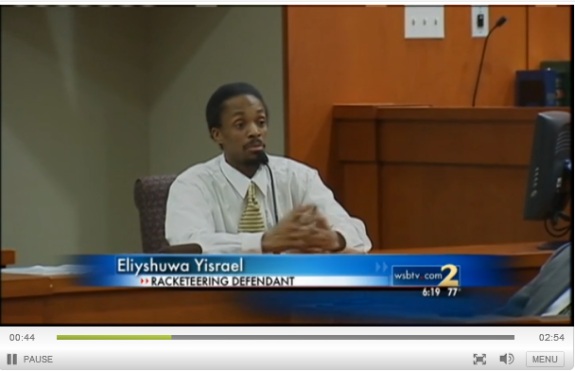
  • STRANGE EVENTS IN GEORGIA: Purported ‘Sovereign Citizen’ Reportedly Denies There Are ‘Victims’ — Even After He Allegedly Stole $13 Million Shopping Center In Fake-Deeds Caper; [UPDATED WITH NEWS OF ACQUITTAL]; Meanwhile, Craigslist Ad Reportedly Leads To Stripping Of Foreclosed Home

    From WSBTV.com

    UPDATED 3:37 P.M. AND 3:49 P.M. EDT (OCT. 25, USA)

    3:37 P.M. UPDATE: The Atlanta Journal Constitution is reporting that Eliyshuwa Yisrael and two other purported “sovereign citizens” were acquitted today. 3:49 P.M. UPDATE: WSBTV.com also is reporting today’s acquittal.

    Our earlier story is below . . .

    ** _________________________________ **

    In some areas of the United States, including Greater Atlanta, purported “sovereign citizens” allegedly have engaged in deed swindles and have become squatters in properties they don’t own.

    Action News 2 (WSBTV.com) is reporting that purported “sovereign citizen” Eliyshuwa Yisrael claims he created no victims when he allegedly took possession of a $13 million shopping mall.

    See the story here.

    Separately, 11Alive.com is reporting that a Craigslist ad led to a foreclosed Georgia home being “ransacked, ravaged, raked over.”

    A family that placed the ad wanted to give away items outside, the station reported. But the wording of the ad apparently triggered confusion, and people broke into the home before the giveaway started and removed clothes, shoes and family keepsakes.

    See the 11Alive story.

  • TIMES OF INDIA: Accused Ponzi Schemer Allegedly Became Target Of Kidnapping Plot And Was Held By ‘Armed Men’

    The Times of India is reporting that accused Ponzi schemer Imtiyaz Hussain Saiyad allegedly was kidnapped by three people who wanted their money back and “held for over a week” by “armed men” before being rescued by police.

    Such schemes are not unprecedented in scam land. The PP Blog reported in February 2010 that three Americans implicated in a bid to shake down the operators of a hedge fund associated with the alleged Equity Investment Management and Training Inc. (EIMT) Ponzi scheme pleaded guilty to criminal charges.

    In the U.S. case, the shakedown bid “occurred after a fake meeting was arranged in March 2009 under the guise that a wealthy investor wanted to meet figures associated with EIMT,” the PP Blog reported.

    Similar allegations are unfolding in the alleged kidnapping attempt in India.

    From the Times (italics added):

    The [accused] trio, Asif Hussain Siddique, Ayub Siddique, residents of Machipith and Iqbal Sheikh of Ajwa Road, told Saiyad that they had found a Lucknow-based investor who was ready to invest Rs 10 crore in his firm. The trio told him that he would have to meet the investor in Lucknow.

    Read the story in the Times Of India.

  • Ohio Man Who Swindled Investors In High-Yield T-Bill Scam Found Guilty Of 11 Felonies; Sentencing For Isaac J. Castile III Set For Nov. 19

    UPDATED 3:15 P.M. EDT (U.S.A.) Isaac J. Castile III of Reynoldsburg, Ohio, has been found guilty of 11 felonies in a securities swindle that promised annual returns of 100 percent, the Ohio Department of Commerce Division of Securities announced today.

    A Franklin County jury returned the verdicts after a four-day trial, the agency said.

    Castile, chairman and CEO of Columbus-based Metropolitan Enhancement Corp., was taken into custody immediately after the verdicts were returned, the agency said.

    The prosecution was handled by the office of Franklin County Prosecuting Attorney Ron O’Brien, the agency said.

    From the agency (italics added):

    Castile told investors that he would invest their funds in U.S. Treasury bills and promised annual
    returns of 50 percent and 100 percent. The Treasury bills were not purchased. Castile was found
    guilty on the following charges:

    • 3 counts of securities fraud
    • 3 counts of false representations in the sale of securities
    • 3 counts of sales of unregistered securities
    • 2 counts of theft

    Of the 11 counts, six are first-degree felonies and five are third-degree felonies.

    Castile “stole approximately $255,000 in funds from two central Ohio investors,” the agency said.

    Sentencing before Judge Michael Holbrook is set for Nov. 19.

    Upon Castile’s 2011 indictment, the agency said, “Castile ignored earlier subpoenas and court orders to testify before the Division of
    Securities.”

  • 2 South Florida Sisters Charged In Alleged Ponzi Caper Reportedly Married To Foreclosure-Rescue Businesses

    Sisters Odalis Freixa (left) and Marisela Gamez have been charged in an alleged Florida Ponzi caper. Photo source: Booking photos at Miami-Dade Corrections and Rehabilitation Department.

    South Florida sisters Odalis Freixa and Marisela Gamez are listed as inmates held by the Miami-Dade Corrections and Rehabilitation Department on charges of grand theft, organized scheme to defraud and conspiracy.

    Freixa is 48, according to jail records. Gamez is 49.

    Citing Miami-Dade Police documents, NBCMiami is reporting that investigators believe the alleged scam was a Ponzi operated through foreclosure-rescue businesses.

    Freixa is the alleged mastermind, the site reported.

    From NBCMiami (italics added):

    Police say Freixa, the mastermind of the scheme, conducted community outreach seminars and wrote a book titled “The American Dream It’s Not Forgotten” in order to educate consumers of the options homeowners have in dealing with foreclosures and loan modifications.

  • ‘.44 Magnum’ Investment Scheme Was Year-Long Fraud That Fetched $5.77 Million, SEC Says; Defendant Blames It On ‘One-Eyed Man’; ‘Call Girls’ Purportedly Received 848K; 3 Charged In Alleged Swindle That May Set New Standard For The Bizarre

    EDITOR’S NOTE: Would such a tale as summarized in the headline above and story below even sell as fiction in the bookstores and movie houses?

    Whether your answer is yes or no, the practical reality is that it apparently has become possible in America to gather millions of dollars from at least 70 domestic and international investors (greedy suckers?) in a year by:

    1.) Cherry-picking the name of a real-life German bank.

    2.) Finding at least two post-Madoff Americans willing to sell anything and paying them more than $650,000 to turn a blind eye to everything as they positioned the “program” as one in which absurd returns were “100 percent guaranteed.”

    3.) Taking the name of the German bank and tying it to popular fiction and a “program” named after a famous American handgun, the .44 magnum.

    4.) Firing up a website that used the German bank’s name and waiting for the money to stream in — before ultimately doling out $848,500 to three Las Vegas “call girls” and another $1 million to an apparent Ponzi insider.

    But what to do if you get caught? New court filings by the SEC show that you can at least try to claim you’re a victim of a real-life extortionist whose key physical characteristic is that he has only one eye — rather like a celluloid character from the world of popular fiction who had only one arm.

    ** _____________________________________ **

    As things stand, elements of the SEC’s case against Geoffrey H. Lunn and his alleged fraud colleagues Darlene A. Bishop and Vincent G. Curry read as though the defendants came straight out of Central Casting.

    The scheme itself evokes images of popular fiction, including the “Dirty Harry” movie series and “The Fugitive” television series and movie reboot. What’s more, because the scheme is alleged to have used a name that could conjure images of a German bank famous in real life, it inevitably evokes images of some downright ugly nonfiction. (The bank once was associated with infamy, given that it came under the influence of Nazis in Hitler’s Germany.)

    Despite the bizarre backstory and the penetrating brightness of the red flags, Lunn’s “.44 Magnum” investors apparently displayed no qualities of discernment and allegedly bought into a scheme based upon representations that $44,000 would turn “into $2 million within 10 to 12 banking days.”

    Lunn, of Sheridan, Colo., has admitted the $5.77 million “.44 Magnum Leveraged Financing Program” he is charged with orchestrating between February 2010 and February 2011 “was a con, basically,” the SEC says.

    The scheme, the SEC said, married the .44 Magnum theme to the name of Dresdner Financial, a “fictitious business” with a name similar to the name of Dresdner Bank, formerly one of Germany’s largest financial institutions. It is not unusual for a scammer to trade on the name of a well-known company to pull off a con.

    But Lunn, 56, claimed he could not abandon the purported Dresdner/.44 Magnum program because he was acting under the influence of an extortionist who “threatened to kill him and his family,” the SEC said.

    Lunn, according to the SEC, described the purported extortionist as a “one-eyed man” who used “the alias Robert Perello.” He further claimed “he did not know Perello’s true identify or current whereabouts” and that he “was acting at Perello’s direction when he participated in the fraud.”

    The alleged narrative of Lunn resembles the storyline of “The Fugitive,” a 1960s television series starring David Janssen that inspired a 1993 movie starring Harrison Ford. Both Janssen and Ford played the fictitious character Dr. Richard Kimble, accused of murdering his wife.

    Kimble insisted the real killer was a “one-armed man.”

    Lunn’s story also evokes images of the “Dirty Harry” movie franchise starring Clint Eastwood as fictional detective “Inspector Harry Callahan,” who armed himself with a .44 magnum handgun while battling San Francisco’s worst criminals and giving by-the-book cops, prosecutors and judges fits.

    How much of Lunn’s tale was borrowed from Hollywood and the history books remains unclear. What is clear is that yet another bizarre securities caper allegedly was hatched in the United States.

    “Lunn, Bishop, and Curry created an aura of credibility by inventing a fictitious firm with a name similar to a legitimate company,” said Robert J. Burson, associate regional director of the SEC’s Chicago Regional Office. “But their 100 percent guaranteed investment program and the astronomical returns they promised were nothing more than an elaborate hoax.”

    Bishop, 40, resides in Odessa, Texas, and Curry, 42, resides in Las Vegas, the SEC said.

    Bishop’s problems are not limited to her alleged role as a Lunn pitchwoman, according to records. In April, she was indicted in the Western District of Texas on charges of wire fraud and money laundering, amid allegations she sold purported “Proof of Fund” letters.

    This is one of the allegations in the Texas indictment against Bishop (italics added):

    Bishop convinced clients to wire tens of thousands of dollars to her in exchange for a POF letter that showed that they had tens of millions (sometimes hundreds of millions) of dollars in a bank account.

    The Bishop clients “could then use this appearance of wealth to negotiate other
    business deals or obtain money from other investors,” according to the indictment.

    From the SEC’s complaint filed yesterday in Colorado (italics added):

    Lunn did not use any of the investors’ money as promised. Instead, Lunn used the money for non-investment purposes, including withdrawing more than $1 million in cash and Western Union transfers, giving $848,500 to three Las Vegas call girls, paying $1.3 million to individuals who helped market the scheme (including over $650,000 to Bishop and Curry), giving $1 million in a Ponzi-like payment to a favored investor, and using the remaining funds to pay for Lunn’s personal and business expenses.

    To date, “the Commission has not been able to identify or locate Perello,” the SEC said. “Regardless of whether Perello exists or had any role in the fraudulent scheme, Lunn is liable for his own conduct.”

    And so, too, are the hucksters who advanced the Dresdner/.44 Magnum scheme, according to the SEC.

    Read the SEC complaint against Lunn, Bishop and Curry.