Blog

  • BULLETIN: SEC Says Missing Man Was Mastermind Of $40 Million Fraud In Georgia In Which ‘Substantially All’ Of A Bank’s Reserves Were Misappropriated And Lost In Trading; Persons With Info Asked To Call FBI Or Lowndes County Sheriff’s Office

    BULLETIN: The SEC has gone to federal court in Atlanta, alleging that Aubrey Lee Price masterminded a $40 million investment fraud and that Price might have misappropriated millions of dollars from a “failing” bank in southern Georgia after a company he controlled bought a stake in the bank in 2010.

    The alleged misappropriation involved “substantially all” of the bank’s reserves, which were lost in trading, the SEC said.

    In June, some investors received a 22-page letter attributed to Price in which Price allegedly “admits that he ‘falsified statements with false returns’ in order to conceal between $20-23 million dollars in investor losses,” the SEC said.

    Price, 46, was believed to be living in Lowndes County, Ga., after moving there from Manatee County, Fla. But Price has gone missing, the SEC said.

    “Price raised nearly $40 million from investors and made woeful financial transactions that he hid from them,” said William P. Hicks, associate director of the SEC’s Atlanta Regional Office. “Now both the money and Price are missing.”

    Price managed an unregistered investment fund that went by the name of PFG LLC of McDonough, Ga., the SEC said.

    U.S. District Judge Timothy C. Batten Sr. has issued an asset freeze and temporary restraining order, the SEC said.

    The scheme began in 2008 and affected at least 100 investors in Georgia and Florida, the SEC said.

    “Price purported to invest fund assets in traditional marketable securities, but he also made illiquid investments in South America real estate and a troubled South Georgia bank,” the SEC said. “In order to conceal mounting losses of investor funds, Price created bogus account statements with false account balances and returns that were provided to investors and bank regulators.”

    Price also was associated with an entity known as PFGBI through which the banking investment was made, the SEC said.

    But the “investment in the bank is substantially worthless, as the bank’s cash assets have been substantially depleted and substantially all of the bank’s reserves (including U.S. treasuries and other liquid assets) were misappropriated by Price and lost in trading,” the SEC charged.

    “Goldman Sach’s records document at least $10 million in unexplained funds being transferred by Price from the bank to a trading account at Goldman Sachs,” the SEC said.

    Persons with information on his whereabouts should contact the Atlanta office of the FBI at 404-679-9000 or the Lowndes County Sheriff’s Office at 229-671-2985, the SEC said.


  • BULLETIN: Purported JSSTripler/JustBeenPaid Operator Frederick Mann Confirms For SECOND Time That ‘Program’ Pays Members With Funds From New Members; He Adds That ALL Payments Come From Members In Closed System

    Frederick Mann

    BULLETIN: Frederick Mann, the purported operator of the JSS Tripler/JustBeenPaid HYIP “program,” has acknowledged once again — this time by implication — that JSS/JBP pays members from funds received from new members. And Mann, who said the “program” had about a million members and acknowledged that nonmembers could not make purchases, has gone a step farther, saying that all payouts to members came from the funds of other members.

    Mann initially acknowledged in a March 15 conference call that JSS/JBP members were getting paid with money from “new members.” The recording of the call later was removed from the JSS/JBP website.

    During the June 28 JSS/JBP call, however, Mann again returned to the claim that members were getting paid by other members.

    “I was just curious about . . . those million members,” a caller on the June 28 JSS/JBP conference call asked Mann. “So, those payments coming in from the million members right now are just being redistributed to . . . the group of the million members. None of the money is coming into the program from other nonmembers and none of the money is going out of the program to other companies? It’s just circulating in the program. Is that right?”

    Mann replied, “That’s essentially right, yes.”

    Paying “old” members with funds from “new” members is the central element of a Ponzi scheme.

    But Ponzi schemes often also exist within systems in which a “program” effectively pools the funds of all members and then makes disbursements from the common pool to members who qualify for disbursements. Prosecutors and regulators may describe such an “opportunity” as a money-cycling scheme. Such schemes typically feature either the “classic” Ponzi stucture (money flow from “new” to “old” members) or a structure that is less-than-classic but still is a Ponzi (money from “all” to “all” members) — with the money coming from common contributors of an enterprise that has no meaningful income streams (or, indeed, no income streams at all) beyond what members contribute.

    AdSurfDaily, which became engulfed in Ponzi litigation in 2008 that led to a plea of guilty to wire fraud in May 2012 by ASD President Andy Bowdoin, had elements of both “new to old” and “all to all.” ASD had income streams external to the Ponzi, but they were insignificant. Court records show that ASD had no underlying, profitable business to sustain its advertised payout rate of 1 percent a day. Like JSS/JBP, ASD operated a closed system — and JSS/JBP purports to pay a daily return double that of ASD’s while also advertising an ASD-like commission structure.

    JSS/JBP announced on its website last week that it had hired a law firm in Utah.

    That announcement followed on the heels of a statement by Mann last month that JSS/JBP members perhaps should avoid words such as “compound” when presenting the “program.” Despite Mann’s suggestion, JSS/JBP features a video on its website that — within the first 11 seconds — advertises, “Daily Compounding to give yourself an Automatic Pay Raise!”

    Internal inconsistencies are one of the hallmarks of HYIP fraud schemes.


  • [DONATION POST]: Blog’s Editorial Well Has Grown To 1,681 Stories — And Thousands Of Other Links

    Dear readers,

    I’ve delayed putting up this month’s donation post as long as I could, but we’re at the edge of July and have a new round of bills to pay. This month’s need is on the order of $550. Please give if you’re able. By giving last month, a small handful of readers were responsible for each story you’ve read this month and for keeping our entire archive of 1,681 stories, 6,975 tags and more than 12,000 other links online.

    Thank you.

    Patrick

  • URGENT >> BULLETIN >> MOVING: Peter Madoff Charged Criminally, Civilly; Bernard Madoff’s Brother ‘Enabled The Largest Fraud In Human History’ And Gained Millions Of Dollars, U.S. Attorney Preet Bharara Says

    URGENT >> BULLETIN >> MOVING: Peter Madoff, the brother of Ponzi schemer Bernard Madoff, has pleaded guilty in New York to a two-count superseding information charging him with conspiracy to commit securities fraud, tax fraud, mail fraud, ERISA fraud and falsifying records of an investment adviser.

    The government is seeking a staggering forfeiture order of $143.1 billion, “including all of [Peter Madoff’s] real and personal property.”

    Peter Madoff began conspiring with his brother in 1996, and the sought-after forfeiture amount “represents all of the investor funds paid” into Bernard L. Madoff Investment Securities LLC from 1996 to the Ponzi collapse in December 2008, prosecutors said.

    Peter Madoff has agreed to the forfeiture amount, prosecutors said.

    Peter Madoff, 66, also was charged by the SEC today. He was the chief compliance officer and senior managing director of Bernard L. Madoff Investment Securities.

    “Peter Madoff enabled the largest fraud in human history,” said Preet Bharara, U.S. Attorney for the Southern District of New York. “He will now be jailed well into old age, and he will forfeit virtually every penny he has.  We are not yet finished calling to account everyone responsible for the epic fraud of Bernard Madoff and the epic pain of his many victims.”

    “Peter Madoff helped Bernie Madoff create the image of a functioning compliance program purportedly overseen by sophisticated financial professionals,” said Robert Khuzami, director of the SEC’s Division of Enforcement. “Tragically, the image was merely an illusion supported by Peter’s sham paperwork and false filings for which he was rewarded with tens of millions of dollars in stolen investor funds.”

    Read the SEC’s statement.


  • RECOMMENDED READING: 66-Year-Old Woman Booked Into Florida Jail Last Month After Traffic Stop May Be ‘Sovereign Citizen’; Police Encounter Yet Another Bizarre Circumstance

    "Linda Louise." From May 2012 records at Charlotte County Sheriff's Office.

    UPDATED 9:43 a.m. EDT (JULY 1, U.S.A.) Police in Punta Gorda, Fla., arrested a woman last month during a traffic stop. The events on the day of the arrest strongly suggest the woman is an adherent to “sovereign citizen” beliefs.

    “Sovereign citizens” may express an irrational belief that laws do not apply to them and that courts have no jurisdiction over them. Case after case has demonstrated the fallaciousness of the claims, many of which spread on the Internet.

    Arrest records in Charlotte County, Fla., list the woman’s name as Linda Louise. Her age is listed as 66; her residency is listed as “unknown.”

    ABC 7 — WZVN — is reporting that police said the woman’s license tag read, “America DOT 1890262 Exempt.”

    Moreover, according to the station’s report, Louise said she was not driving. Rather, she was “traveling.” And she produced documents that purported her name was “Linda Louise Suae Potestate Esse.”

    “Suae Potestate Esse” is a phrase that has appeared on websites associated with the so-called “sovereign citizens” movement.

    (Visit Latin-Dictionary.org to learn the meaning of the phrase.)

    It sometimes proves to be the case that “sovereign citizens” introduce unknowing individuals to schemes and expose the individuals who adopt the schemes to severe legal or economic jeopardy.

    Read the ABC 7 story.

  • Purported ‘Secret’ Computer Program And ‘Proprietary Computer Algorithm’ Were Launching Ground For Forex Swindle, Feds Say; George Sepero Charged Amid Allegations He Also Defrauded Elderly Widow With Serious Medical Problems Out Of Her Life Savings In Separate Scam

    UPDATED OCT. 19, 2013. George Sepero has been sentenced to 100 months in federal prison. Our earlier story is below and has been edited to correct spelling.

    The word “proprietary” has been used again to mask a large financial swindle, federal prosecutors said.

    George Sepero, 39, of Glen Rock, N.J., has been indicted on charges he was running a hedge-fund scam and a separate scam designed to steal the life savings of an elderly New Jersey woman with serious medical problems.

    Sepero now has been charged in a 17-count indictment with 16 counts of wire fraud and one count of conspiring to commit wire fraud.

    The caper involved Pelt Capital, Caxton Capital Management, SP Investors Inc. and CCP Pro Consulting Inc., prosecutors said.

    As part of the hedge-fund scam, Sepero and co-conspirators “claimed they owned and controlled a proprietary computer algorithm for trading foreign currencies, that they had used the algorithm to achieve returns of more than 170 percent in the prior two years, and that any investment funds would be highly liquid and could be withdrawn on days’ notice,” the office of U.S. Attorney Paul J. Fishman of the District of New Jersey said.

    In reality, “Sepero and others invested little money in foreign currency or any other investment vehicle, instead diverting the vast majority of victims’ investments to pay prior victims in Ponzi-scheme style and to finance extravagant personal expenditures,” Fishman’s office said.

    Any number of scammers have used the word “proprietary” as a part of explanations designed to cover up an underlying fraud, discourage investors from asking questions or to make an opportunity appear to be unique. Such explanations often also include the words “secret” or “algorithm.”

    The Sepero scam gleaned more than $4 million, and Sepero and others spent investor money on credit card bills averaging about $25,000 per month, prosecutors said.

    Here is how other  money was spent, prosecutors said.

    • Bar tabs of approximately $18,241,  including a $4,000 tip at Drai’s Hollywood nightclub in Los Angeles.
    • Luxury hotel rooms for tens of thousands of dollars, including suites costing more than $4,000 at W Hotels in New York.
    • Flights to Paris, Los Angeles, Chicago and elsewhere.
    • A customized Ford F-350 “Harley-Davidson Edition” pickup truck costing more than $80,000.
    • A Mini Cooper automobile.
    • A leased a BMW.

    “Sepero also spent victims’ money on other personal expenditures, including mortgage payments, home improvements, meals at high-end restaurants, jewelry and limousines,” prosecutors said.

    The hedge-fund scam also included the mailing of false statement to customers and emails sent by “Mel Tannenbaum,” whom prosecutors described as “a fictional character of the conspirators’ invention.”

    And bogus “screen shots” also were used to dupe investors, prosecutors said.

    “Sepero and others also emailed to several investors ‘screen shots’ of a computer-based trading program, which they claimed represented the investors’ funds being traded in the currency markets,” prosecutors said.  “In reality, the shots reflected trading in fictional accounts set up by the co-conspirators to dupe investors.”

    In the scam targeting the senior citizen in poor health, Sepero took charge of her annuity account” and drained it down to less than $17 while making the woman’s family believe the account contained more than $750,000.

    The woman was a widow, and Sepero “convinced her to write checks to entities that Sepero controlled,” prosecutors said. “Sepero promised to add the money to the annuity account, but instead spent hundreds of thousands of dollars for his personal use.”


  • BULLETIN: Federal Judge Denies Motion By ASD Figures Dwight Owen Schweitzer And Todd Disner For Government To Produce Names Of Potentially Thousands Of ASD Members Who Filed For Remissions

    BULLETIN: (UPDATED 8:06 P.M. EDT U.S.A.) A federal judge in Florida has denied a motion by AdSurfDaily figures Todd Disner and Dwight Owen Schweitzer that, if granted, could have made the duo privy to information on the identities of any ASD participant who filed a claim for remissions in the ASD Ponzi case, their financial stake in ASD and how much money was returned to them by the government through the remissions claims process.

    U.S. District Judge Cecilia M. Altonaga said no today, ruling that Schweitzer and Disner had not shown why they were entitled to the information and that the government was not compelled to produce it.

    The flap started when Disner and Schweitzer asserted earlier this month that a certificate of interested parties filed by the government in the Disner/Schweitzer lawsuit was “inadequate as a matter of law” because it didn’t include the information on individuals who filed remissions claims. Court records show that about 11,000 ASD members filed claims in the case.

    The government countered by arguing that Disner and Schweitzer were confusing the ASD forfeiture case filed in the District of Columbia with their own lawsuit filed in Florida.

    Altonaga sided with the government today, ruling that the government certificate as it stands “is not necessarily incomplete for failing to list those who have a financial interest in other forfeiture proceedings.”

    “Plaintiffs fail to explain in their Motion why unnamed parties who may have a financial interest in other forfeiture proceedings also have an interest in Plaintiffs’ declaratory judgment action,” Altonaga ruled.

    And the judge further pointed out that Disner and Schweitzer had not complied with her order to file their own certificates in the case. She now has given them until July 6 to do so, warning that “[f]ailure to comply will result in the entry of an order of dismissal without prejudice without further notice.”

  • UPDATE: AdSurfDaily-Like Weirdness Increasingly Creeps Into Lawsuit Against United States By ASD Pitchmen Dwight Owen Schweitzer And Todd Disner, Who Now Are Promoting Zeek Rewards

    Federal prosecutors went to court in the Southern District of Florida today, saying AdSurfDaily figures Todd Disner and Dwight Owen Schweitzer were confusing their November 2011 lawsuit against the government with two forfeiture actions filed in the District of Columbia by federal prosecutors and the U.S. Secret Service in the ASD Ponzi case.

    An assistant U.S. Attorney serving under U.S. Attorney Wifredo A. Ferrer of the Southern District of Florida is serving as the attorney for the United States in the case because Disner and Schweitzer sued the government. Although the ASD Ponzi case was brought in the District of Columbia, Disner and Schweitzer sued the government in Florida. They later claimed that prosecutors had gone forum shopping in Washington to bring the Ponzi forfeiture case.

    Among other things, Disner and Schweitzer claim that undercover agents who joined ASD had a duty to identify themselves to ASD management and that the ASD Ponzi case is a “house of cards” despite ASD President Andy Bowdoin’s guilty plea and public acknowledgment he presided over a Ponzi scheme.

    In a puzzling motion stamped June 20 and entered on the docket of U.S. District Judge Cecilia M. Altonaga on June 21, Schweitzer and Disner claimed they had personally determined that a certificate of interested parties filed by the government in response to an order was “inadequate as a matter of law.”

    Disner and Schweitzer, according to Disner and Schweitzer, had a right to know the identities of any ASD participant who filed a claim for remissions in the ASD Ponzi case, how much money they put into ASD and how much was returned to them by the government through the remission claims process.

    Nonsense, the government said today.

    “The plaintiffs misapprehend the purpose and spirit of the court’s order requiring a certificate of interested parties,” the government said in its response to the Disner/Schweitzer motion. “The instant case is not a forfeiture case as the two forfeiture cases involving AdSurfDaily have already been resolved in the District of Columbia.

    “The certificate of interested parties is not some kind of alternative discovery vehicle collateral to the discovery provisions in the Federal Rules of Civil Procedure,” the government continued. “Rather, the certificate of interested parties in both the federal district and appellate courts is designed ‘to assist judges in making a determination of whether they have any interests in any of a party’s related corporate entities that would disqualify the judges from hearing the [appeal].’”

    Moreover, the government argued, Disner and Schweitzer “did not confer with the defense” as required by the local rules in the Southern District of Florida prior to filing the motion.

    As many as 11,000 parties filed remissions claims in the ASD case, according to federal court records.

    Disner and Schweitzer apparently want to know who all of them are and to ascertain “the financial interest of each[,] including those individuals, separately identified, who applied for remission and, as to each, stating whether the request was approved, approved in part, or denied.”

    The government, however, advised Altonaga that neither Disner nor Schweitzer have filed their own certificates of interested parties in the case.

    Separately, Altonaga today granted the government’s June 4 motion by default to stay discovery in the case, explaining that Disner and Schweitzer have “not filed an opposing memorandum of law to the Motion, nor have they sought an extension of time to do so.”

    Disner is a co-founder of the Quiznos sandwich franchise. Schweitzer is a former attorney now living in Miami whose license was suspended in Connecticut.

    Both men later became pitchmen for Zeek Rewards, an MLM firm whose business model closely resembles the ASD business model that ASD’s Bowdoin admitted was a Ponzi scheme. Bowdoin is jailed in the District of Columbia. A federal judge revoked his bond June 12 after prosecutors proffered evidence that he continued to promote fraud schemes after the U.S. Secret Service seized tens of millions of dollars in the ASD Ponzi case and after Bowdoin was arrested on Ponzi-scheme charges in December 2010.

    Bowdoin pleaded guilty in May to wire fraud in the ASD Ponzi case. His formal sentencing is set for August. He has been banned from multilevel marketing, Internet programs and mass marketing.

    Other ASD-Related News From The OneX Fraud Wing

    In other ASD-related news, a conference call cheerleading session for the purported “OneX” program was canceled tonight after a rah-rah session that had been scheduled for last Thursday also was canceled.

    Tonight’s cheerleading session was to be sponsored by a downline with ASD ties and was contemplated to be one that would build on the purportedly exciting announcement OneX said would be made last week to identify its new payment processor, a source told the PP Blog.

    But OneX apparently canceled the Thursday conference call and never identified a new payment processor, so there was nothing for the OneX downline with ASD ties to cheer about tonight.

    “It is not possible to move forward without the processor being in place,” the ASD downline group said, according to the source.

    But the group held out hope that OneX would announce its new payment processor tomorrow, according to the source.

    In April, federal prosecutors said OneX was a “fraudulent scheme” and “pyramid” that was operating in ASD-like fashion.

  • BULLETIN: JSS Tripler/JustBeenPaid Announces New Scam; Meanwhile, New Guidance From Frederick Mann Suggests Members Should Avoid The Word ‘Compound’

    “‘Compound’ . . . is really a word which [members] probably shouldn’t use.”Frederick Mann, purported operator of JSS Tripler/JustBeenPaid, from conference call-recording dated June 14, 2012

    “‘Repurchase’ is a great one.”“Dale,” JSS Tripler/JustBeenPaid conference-call host, in response to Frederick Mann comment noted above, June 14, 2012

    Frederick Mann

    BULLETIN: (UPDATED 8:44 P.M. EDT U.S.A.) The JSS Tripler/JustBeenPaid HYIP Ponzi scheme that advertises a return of 60 percent a month and is soliciting $20,000 “purchases” announced during its June 14 conference call that it was adding an autosurf to its stable. The precise date upon which the autosurf would be introduced was not announced.

    The announcement about JSS/JBP’s autosurf was made only two days after AdSurfDaily autosurf operator Andy Bowdoin was jailed in the District of Columbia. U.S. District Judge Rosemary Collyer revoked Bowdoin’s bail after federal prosecutors proffered evidence that Bowdoin had been involved in AdViewGlobal, an autosurf that launched after the seizure of more than $80 million in the ASD Ponzi case by the U.S. Secret Service in August 2008.

    Meanwhile, purported JSS/JBP operator Frederick Mann appears to have backed away from his March 15 guidance to members that it was OK to use the language of investments when pitching the “program” to others.

    Like Zeek Rewards, an MLM “program” that plants the seed it provides a return of between 1 percent and 2 percent a day without being an investment program, guides members not to use certain words and brags about its purported “compliance” arm, Mann now is suggesting JSS/JBP members should avoid the term “compound” when describing the JSS/JBP program.

    Mann, according to 2008 promos, was a pitchman for ASD, the same autosurf that led to Ponzi charges against the now-jailed Bowdoin. In court filings, the U.S. Secret Service and federal prosecutors described ASD as an enterprise that engaged in linguistic sleight-of-hand in an ill-fated bid to skirt securities regulations.

    ASD had links to the so-called “sovereign citizens” movement. JSS/JBP also may have such links.

    Prior to the 2008 Secret Service seizure of tens of millions of dollars in the ASD Ponzi case, ASD advised members not to use the language of investments. AdViewGlobal launched after the Secret Service seizure and, like ASD, advised members not to use the language of investments.

    AdViewGlobal disappeared mysteriously in the summer of 2009. During the spring of 2009, the ‘surf announced it was having banking troubles.

    Zeek announced on Memorial Day that it, too, was having banking troubles.

    ASD, AdViewGlobal, JSS/JBP and Zeek all use offshore payment processors. All four enterprises have (or had) promoters in common, and all four enterprises are (or were) being promoted on notorious Ponzi scheme forums such as TalkGold and MoneyMakerGroup.

    On May 4, 2009 — the same date the President of the United States announced a crackdown on offshore scams — AdViewGlobal announced it had secured a new deal with an offshore wire facilitator. The ‘surf appears to have collapsed less than two months later.


  • JSS Tripler/JustBeenPaid Now Soliciting $20,000 ‘Purchase’ Amid Claim Of $400-Per-Day Payout

    EDITOR’S NOTE: The JSS Tripler/JustBeenPaid “program” may have links to the “sovereign citizens” movement. Potentially signaling a change in the “program’s” status quo, JSS/JBP has not posted a recording of its weekly conference call since June 7. As the screen shot below shows, JSS/JBP also now is soliciting “purchases” ranging from $1,000 to $20,000, suggesting the $20,000 purchase will produce a return of $400 a day.

    The PP Blog accessed the JSS/JBP website (and the ad captured in the screen shot below) today through an ad on a site known as “ADsactly.com.” An ad for the purported Zeek Rewards MLM “program” also was featured on ADsactly.

    Zeek and JSS/JBP are using at least two of the same offshore payment processors: SolidTrustPay and AlertPay (now Payza).

    JSS

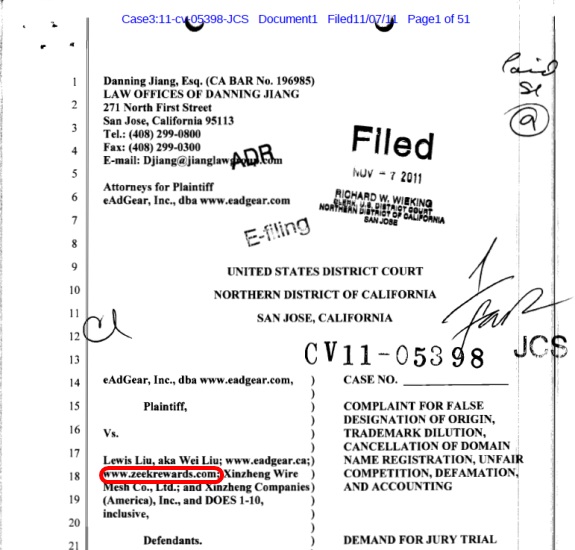
  • DEVELOPING STORY: New Mystery Emerges: North Carolina/Nevada Entity ZeekRewards.com Was Served With California Cyberpiracy, Infringement And Unfair Competition Lawsuit In Flushing, N.Y.

    Screen shot of page from November 2011 lawsuit that named ZeekRewards.com a defendant. (Red highlight by PP Blog.)

    ZeekRewards.com was accused of cyberpiracy, unfair competition and benefiting from copyright infringement in a trademark-dilution and defamation lawsuit filed in U.S. District Court for the Northern District of California on Nov. 7, 2011. The action demands an accounting, disgorgement of alleged ill-gotten gains and treble damages.

    The PP Blog was unable to reach Zeek immediately by phone this morning for comment on the lawsuit, which may involve the actions of a Zeek affiliate. The Blog followed up with an email and is awaiting a response.

    The docket of the case shows a summons was issued to ZeekRewards.com and several co-defendants on Nov. 7, the same date the lawsuit was filed.

    A process server served the complaint on ZeekRewards.com at 136-20 38th Street, Suite 9H3, Flushing, N.Y., 11354, on Nov. 21, 2011, at 7:28 p.m., according to court filings.

    An individual who accepted process for ZeekRewards.com at the Flushing address stated “they are authorized” to do so, according to court filings.

    But Zeek says it is an arm of Rex Venture Group LLC, an entity registered in both Nevada and North Carolina. In North Carolina records, Paul Ray Burks is listed at the registered agent of Rex Venture at an address in Lexington, N.C. In Nevada records, meanwhile, Nevada Corporate Planners Inc. of Las Vegas is listed as the registered agent of Rex Venture.

    The docket of the case strongly suggests that neither ZeekRewards.com nor any of the other defendants has entered a defense to the claims and that an attorney for the plaintiff has moved the court for a default judgment to be entered. No attorney appears to have filed an appearance notice for ZeekRewards.com or any of the other defendants. On Jan. 26, 2012, the clerk of courts recorded an “ENTRY OF DEFAULT” against all of the defendants.

    Here are the named defendants: Lewis Liu, also known as Wei Liu; www.eadgear.ca; www.zeekrewards.com; Xinzheng Wire Mesh Co. Ltd.; Xinzheng Companies (America) Inc.; and “DOES 1-10, inclusive.”

    The plaintiff is eAdGear Inc., which does business as www.eadgear.com.

    eAdGear contends that Liu, a former eAdGear affiliate, copied eAdGear’s .com website to a top-level domain in Canada and used the site to promote ZeekRewards.com and to defame eAdGear.

    “In early October 2011, [Liu] published written defamatory statements on ‘www.eadgear.ca,’” the plaintiff alleged. “As shown in Ex. 3, [Liu] stated that plaintiff was not an accredited business by [the Better Business Bureau] and that BBB would soon publish an extremely low rating on Plaintiff. [Liu] further asserted that Plaintiff’s holding company in Hong Kong had never existed. All [Liu’s] statements are false. [Liu] started to use ‘www.eadgear.ca’ to promote his own online advertising business ‘www.zeekrewards.com.’ He asked all his customers under his Plaintiff account (eAdGear ID #127264) to transfer business to ‘www.zeekrewards.com.’ He promised with a low monthly service fee and other incentives to customers who were willing to transfer to ‘www.zeekrewards.com.’”

    The PP Blog also sought comment from Zeek today on why auctions for sums of U.S. cash appear to have been removed from Zeekler.com, the penny-auction arm of Zeek. Zeek Rewards is the MLM arm.

    Zeek Rewards plants the seed that a return of between 1 percent and 2 percent a day is possible, although it claims it is not offering an investment program and has preemptively denied it is a pyramid scheme.