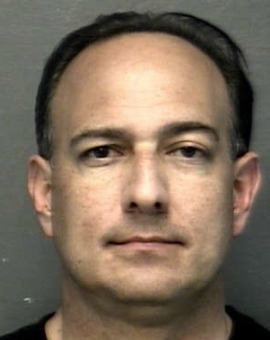
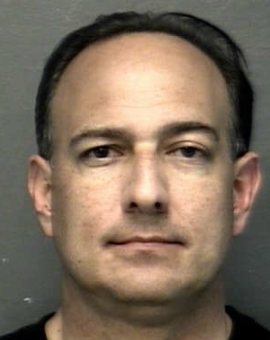
Attorney Michael Kwasnik's booking photo in Alabama. State and federal authorities now say he was involved in multiple scams: theft from an elderly client, a New Jersey Ponzi scheme and a mortage-reduction caper targeting financially strapped homeowners.
BULLETIN: The Philadelphia attorney with an office in New Jersey who was arrested in Alabama last week on a fugitive warrant amid allegations he had stolen more than $1 million from an elderly woman in a trust scam was on the Federal Trade Commission’s radar screen for an alleged mortgage-relief scam, the PP Blog has learned.
The FTC began a civil prosecution of attorney Michael Kwasnik in September 2009. That case, which alleged Kwasnik and others targeted financially strapped homeowners while planting the seed that the purported mortgage-reduction program had been endorsed by the government, culminated today with an announcement by the FTC that it had settled the case with Kwasnik and the others and forced them to “return ill-gotten gains to consumers.”
New Jersey officials said last week that Kwasnik, in addition to stealing from the elderly woman, also was part of an $8.5 million Ponzi and fraud scheme targeting senior citizens.
Kwasnik was part of a law firm known as Kwasnik, Rodio, Kanowitz & Buckley, according to the FTC. The firm rated an “F,” the worse possible score, according to the Better Business Bureau.
Among the allegations in the FTC case was that Kwasnik and the firm were part of a scheme that used the name “Hope Now Modifications” and “falsely claimed to be part of HOPE NOW Alliance, a non-profit, government-endorsed mortgage assistance network.”
Other records show that Kwasnik has been under scrutiny by the New Jersey State Bar Association.
In this Nov. 13 post, the PP Blog published a list of red flags concerning online promos for Text Cash Network (TCN), purportedly an emerging business “opportunity” involving text advertising and cell phones. A promo for TCN appeared — and then vanished — from a website linked to huckster Phil Piccolo, known online as “the one-man Internet crime wave.” Piccolo has been associated with other schemes that involved cell phones, namely Data Network Affiliates (DNA).
This post raises another red flag — and once again, the issue is about Piccolo’s potential TCN involvement or the involvement of Piccolo associates. In the DNA scam, the purported firm used generic YouTube videos to drive traffic to its purported opportunity. In 2010, for example, DNA incongruously posted a YouTube video known as “JK Wedding Entrance Dance” to its website, using the video to promote DNA.
The “JK Wedding Entrance Dance” video — a You Tube smash — had absolutely nothing to to with DNA. The video was designed in part to create awareness about domestic violence and to publicize the Sheila Wellstone Institute.
Sheila Wellstone was a human-rights advocate. She and her husband, Sen. Paul Wellstone, D-Minn., were killed in a plane crash in 2002. Their daughter, Marcia, died in the same crash.
After conducting a “prelaunch” event with much fanfare on Nov. 11 — Veterans Day in the United States — TCN now has added a You Tube video to its website. An all-caps line of “OFFICIAL LAUNCH 12/12/2011” appears below the video, which plays in miniature on TCN’s site.
But the video also is playing in full size on YouTube’s site. Text on the YouTube site dubs it “THE OFFICAL TEXT CASH NETWORK (TCN) – RIGHT HERE – RIGHT NOW” site. The upload date of the video is listed as Nov. 15, 2011: yesterday.
The same video, however, appears elsewhere on YouTube — and its upload date is listed as Jan. 26, 2009, nearly three years ago. Despite the upload date, the video also is promoting TCN, whose website appears to have been registered just last month.
Both videos raise questions about whether YouTube is being gamed by TCN and affiliates. Meanwhile, the videos use the same soundtrack by Fat Boy Slim: “Right here, right now.”
Among other things, Piccolo is known to use all-caps presentations and to hype “prelaunches” and “launches” for weeks. He also is known to hype launches by publishing the names of top promoters — something TCN is doing — and to try to stay in the background of “opportunities,” as opposed to becoming the public face of them.
Joe Reid, a known Piccolo associate, has served as a conference-call host for TCN. Reid also hosted conference calls for DNA, which was linked to Piccolo last year and served up Theatre of the Absurd and a sea of incongruities.
DNA, for example, misspelled the name of its own CEO — and didn’t advise members that the CEO had left the company for nearly a week. The former CEO told the PP Blog last year that the firm was engaging in “bizarre” conduct and a campaign of “misinformation and lies.”
After the former CEO agreed to an interview with the PP Blog, a PR handler who described himself as a conflict-management strategist” sought to intervene. As the year proceeded, DNA appeared to have both entered and exited the cell-phone business in a matter of weeks — while planting the seed that it would pay enormous rates of return to customers who provided it money, even as it purportedly entered businesses such as mortgage writedowns and offshore “resorts” after apparently abandoning its purported core business of helping police recover kidnapped children.
At one point, DNA was urging members to record the license-plate numbers of cars in a purported bid to assist the AMBER Alert program — while it was selling a purported “protective spray” that would make it impossible for cameras placed by police at intersections to snap usable photographs of the plates.
In 2009, another purported “advertising” opportunity known as Biz Ad Splash (BAS) used the same Fat Boy Slim soundtrack. Walter Clarence Busby Jr., the purported operator of BAS, is a figure in the alleged AdSurfDaily Ponzi scheme and is the former operator of Golden Panda Ad Builder. Golden Panda surrendered more than $14 million in the ASD Ponzi case, and the SEC said that Busby was involved in three prime-bank schemes in the 1990s.
The SEC has not responded to requests for comment on the emerging TCN “opportunity.”
As of now, it can be said that two “advertising” schemes — BAS and TCN — are using the same music in what appears to be largely generic promos for business “opportunities.”
It also can be said that DNA, one of the “businesses” associated with Piccolo, also used generic videos and caused them to play in miniature on “prelaunch” and “launch” sites for “opportunities.”
It also seems possible — if not likely — that certain MLM promoters have found a way to edit YouTube sites to make the content appear “current” or to store generic videos and use them for multiple “opportunities.”
Questions
Why does one video for TCN show an upload date of January 2009 while the “official” site shows a video upload date of yesterday — when it is the same video and TCN purportedly is a “new” opportunity?
Did TCN exist in an earlier form as far back as 2009? If so, what happened back then — and why is it reemerging now?
Are certain MLMers simply using generic videos they uploaded earlier to YouTube — and then editing the YouTube sites when a new “opportunity” comes along, thus potentially maintaining a search-engine advantage no matter what “opportunity” comes along?
Why would a company that purports to be a market and technology leader use what appears to be a generic video as its “official” video?
Why did a promo for TCN that appeared on the website of OWOW — a site linked to Piccolo — suddenly go missing last week?
Why does TCN appear to be closely following “prelaunch” and “launch” strategies associated with purported Piccolo “opportunities?
Screen Shot 1
This YouTube video for Text Cash Network bears an upload date of Jan. 26, 2009, even though TCN claims it is a new company proceeding from a "prelaunch" in recent days to "launch." The video is a duplicate of a video dated Nov. 15, 2011 that claims to be TCN's "official" video.
Screen Shot 2
This YouTube video for Text Cash Network bears an upload date of Nov. 15, 2011, even though the same video for the purported TCN opportunity appears elsewhere on YouTube and bears an upload date of Jan. 26, 2009, nearly three years ago. TCN claims it is a new company proceeding from "prelaunch" to "launch." TCN claims the Nov. 15, 2011 video is its "official" one. Both video sites feature all-caps when addressing prospects and content that is virtually the same.
Screen Shot 3
This 2009 YouTube video for the purported Biz AdSplash "advertising" program used the music of Fat Boy Slim. An emerging "advertising" opportunity known as Text Cash Network is using the same Fat Boy Slim music: "Right here, right now." While BAS purported to deliver "advertising" to computers, TCN purports to deliver it to cell phones.
Fortune High-Tech Marketing Inc. (FHTM), the Kentucky-based MLM firm that has caught the attention of multiple state regulators, has agreed to pay Texas customers up to $1.3 million in refunds, the office of Texas Attorney General Greg Abbott said.
But do not tarry if you’re a Texas resident and believe you were ripped off by the firm. Although Abbott’s office formally announced the refund program yesterday, the deadline for filing a claim is Nov. 28 — only 12 days from now.
Here is a PDF the claim form, which Abbott’s office says must be submitted to FHTM. In an “Assurance of Voluntary Compliance” between FHTM and Texas (signed in July), the address for the firm is listed as 880 Corporate Drive, Suite 300, Lexington, Kentucky 40503.
FHTM, according to the agreement, also consented to pay the attorney general’s investigative costs of $200,000.
The firm and its operators “deny that they have done anything wrong and insist that they have not violated any law,” according to the agreement.
Among the terms of the agreement was that FHTM shall “remove all references to FHTM ‘University’ from its marketing materials and website.”
FHTM has contacted Texas customers by email to let them know they might be eligible for refunds, Abbott’s office said. The most recent email was sent on Oct. 28, according to investigators.
“Fortune Hi-Tech’s customers complained that the defendant falsely represented the earnings they would achieve if they became one of the defendant’s independent representatives,” Abbott’s office said.
The settlement agreement announced yesterday “prohibits Fortune Hi-Tech from engaging in deceptive trade practices in the future and requires the defendant to refund up to $299 to each qualified Texas customer, up to a total of $1.3 million,” Abbott’s office said.
UPDATED 11:54 A.M. ET (U.S.A.) Curtis Richmond claimed the federal judge overseeing the AdSurfDaily civil-forfeiture case in the District of Columbia was among a group of “Co-Conspirators” that included two federal prosecutors and a court clerk.
The judge, Richmond claimed, was violating her oath and conspiring with another judge to deny ASD members justice. Prosecutors, meanwhile, were helping the judge interfere with commerce, according to Richmond. The judge rejected Richmond’s arguments — but it didn’t stop other ASD pro se litigants from advancing similar arguments.
For his bid to intervene in the ASD Ponzi case, Richmond was labeled a “hero” on both the pro-AdSurfDaily “Surf’s Up” forum (now defunct) and on a forum that championed the AdViewGlobal autosurf (now defunct). Among Richmond’s boosters was “Professor” Patrick Moriarty, a Missouri man who once started a purported nonprofit in the name of a man accused of murdering a woman in cold blood and shooting a police officer.
Moriarty later was indicted for tax fraud. He pleaded guilty after prosecutors said they had “casino” records and intended to use them in the case against Moriarty, who advertised that he sold fake academic degrees on e-Bay as “gag gifts.”
Prior to Moriarty’s indictment, members of the Surf’s Up forum joined with him in forming a purported Missouri nonprofit known as ASD Members International (ASDMI). ASDMI’s stated mission was to litigate against the government for its role in the ASD Ponzi case.
Utah resident and ASD figure Christian Oesch — later to join with Washington state resident and ASD figure Kenneth Wayne Leaming in a failed 2010 bid to sue the United States for more than twice the U.S. Gross Domestic Product in 2009 — filed pro se pleadings in the ASD case that championed Richmond’s take on the law.
But Curtis Richmond’s court forays now have been cited by various judges in various jurisdictions as reasons to reject tortured legal constructions. A federal judge in North Dakota, for example, cited this Utah case involving Richmond as a reason to reject tortured arguments advanced by Michael Howard Reed, a so-called “sovereign citizen” now serving two prison sentences for federal crimes.
Richmond, a Californian who advanced the notion in the 2006 Utah case that he enjoyed diplomatic immunity that extended to him from an “Indian” tribe, became a figure in the ASD case in 2008. The “tribe,” which a federal judge ruled a “sham,” came to be known derisively as the “Arby’s Indians” because it once conducted a meeting at an Arby’s restaurant.
Reed, whose name surfaced in the 2008 SEC Ponzi case against Gold Quest International after he claimed to be the “attorney general” of an unrecognized tribe and asserted a claim against the agency for $1.7 trillion, asserted in a separate case that the government could not prosecute him because he was immune to U.S. law and had trademarked his name.
Here is a verbatim section from one of Reed’s nonsensical pleadings in federal court in North Dakota. (Italics/identation added):
Richmond’s Utah case was cited in the North Dakota case as a reason to reject Reed’s bizarre arguments.
It also was cited in this Colorado case in which a U.S. Magistrate Judge rejected the tortured legal constructions of Christopher Douglas Wise. Among other things, Wise, a prisoner in the Colorado state system, asserted that he was a “secured party creditor” who’d never lived in the “District of Columbia” — and that somehow this alleged fact set destroyed the jurisdiction of the Adams County District Court in which he was convicted of a crime.
In a separate case in Florida, a federal magistrate judge pointed to Richmond’s Utah “Indian” pleadings as a reason to reject arguments advanced by Timothy Black, who was serving two life sentences for sex crimes involving children and tried to overturn his conviction in part by claiming he had copyrighted his name and by arguing he was not subject to Florida law.
“Petitioner was found guilty by a jury and convicted of two counts of sexual battery on a person less than twelve years of age, and one count of lewd or lascivious molestation on a person less than twelve years of age, and sentenced to two terms of life and one term of thirty years, to be served concurrently,” the judge noted.
Here is a verbatim section from Black’s court claims. (Italics added):
Until four days ago, the OWOW website associated with Florida-based huckster Phil Piccolo shared this message about Text Cash Network (TCN) with visitors. Joe Reid, a Piccolo associate, is leading conference call-cheerleading for TCN. Reid previously led cheers for Data Network Affiliates, another business linked to Piccolo.
EDITOR’S NOTE: A “program” known as Text Cash Network (TCN) that purports to share “advertising” revenue from text messages is spreading virally on the Internet. This column includes information prospective TCN members might want to consider before joining and asking others to join. There are red flags galore. Last week, the PP Blog compiled some research and sought comment from the SEC about the emerging program because the name of Brett Hudson, billed in TCN promos as the firm’s “president,” appears in a 2005 “press release” that quotes Hudson and Richard A. Altomare. The SEC acknowledged receipt of the Blog’s inquiries, but did not comment.
Altomare, of Boca Raton, Fla., was sued in this 2004 SEC action amid allegations of penny-stock fraud coupled with bogus press releases. The case, which involved an Altomare company known as Universal Express Inc., evolved to become an exceptionally ugly one. Altomare ultimately was found in contempt of court for flouting judicial orders and ordered jailed in New York. The court-appointed receiver in the case allegedly received threatening emails from individuals unhappy about the SEC’s action and follow-up events.
Here are quotes from two of the threatening emails, which allegedly were sent by investors. The quotes appear in an exhibit filed in federal court in the Southern District of New York:
1.) ” . . . you are going to be hit with a shit load of lawsuits, and if justice doesn’t prevail the good old American way then I will make it my personal duty to enforce the justice and I along with others will come and beat your ass to a bloody pulp, along with Judge (jackass) Lynch . . .”
2.) . . . you fu[!!!!!] slut . . . don’t get smart . . . you have no idea what could happen to you . . .”
Hudson, who has not been accused of wrongdoing, was not named a defendant in the SEC case. TCN promoters have identified him as president of Universal Cash Express, a company with a name similar to Altomare’s Universal Express Inc. entity. The 2005 “press release” that quotes Hudson and Altomare also identifies Hudson as the president of Universal Cash Express. Altomare’s title was not listed in the 2005 release, but the document was issued under the name of Altomare’s Universal Express entity ensnared in the SEC probe.
Until a few days ago, TCN was prominently featured on the website of OWOW (OneWorld, One Website), a site linked to Data Network Affiliates (DNA) and serial MLM scammer Phil Piccolo. Piccolo is known online as the “one-man Internet crime wave.”
Like Altomare’s Universal Express Inc. entity, DNA was registered as a Nevada company. DNA, like Universal Express Inc., also conducted business from Boca Raton. (See the Better Business Bureau listing for DNA, which purported to be in the business of helping the AMBER Alert program rescue abducted children — while also purporting to be in the cell-phone, mortgage-reduction and “resorts” businesses. Although DNA appears to be defunct, it maintains a website — one that once redirected to the OWOW website. While actively conducting its purported business, DNA made bizarre claims about “going public.” Such claims have been associated with penny-stock scams and securities fraud.)
Joe Reid, a Piccolo business associate who helped DNA flog its mind-numbing mess to the international masses, was one of the speakers on a Nov. 11 TCN conference call. TCN is proceeding out of the gate in largely the same fashion DNA came out of the gate: conference calls featuring Reid, claims of rapid expansion involving tens of thousands of new recruits in days, a launch-countdown timer (now removed), suggestions of incredible earnings potential 10 levels deep, Blog and website posts, YouTube videos.
Here, now, a list of additional red flags and some additional background . . .
RED FLAG: Piccolo has a history of threatening to sue critics and of planting the seed that, if lawsuits do not work, he knows people who can cause critics to experience physical pain. He is known to operate in the area of Boca Raton, although Piccolo also has been known to operate in California.
RED FLAG: DNA promos in 2010 referenced a purported texting and data expert by the name of Anthony Sasso. Sasso, a convicted felon arrested in a 2005 racketeering case in Broward County, Fla., was described in DNA promos as “The King Of Data For Dollars” and was said to be the “owner of the largest database of text numbers in the world.” Although Sasso appears not to have been referenced in the context of TCN, both DNA and TCN purport to be in businesses that involve texting.
RED FLAG: Early affiliates of TCN have identified Brett Hudson as the president of Text Cash Network Inc. Records in Wyoming show a company by that name was registered in the state on Nov. 8, 2011 — just days ago. Affiliates also have vaguely described Text Cash Network Inc. as “a new division of a five year old communications company owned 100% by The Johnson Group.” No state of registration was listed in promos that referenced The Johnson Group, and the “communications company” and the “division” under which Text Cash Network Inc. purportedly operates are far from clear.
Wyoming records show a company by the name of The Johnson Group Inc., but it is unclear if it is the same company referenced by TCN affiliates. The Wyoming records of The Johnson Group entity contain this notation: “Standing – Tax: Delinquent.” The firm appears to have used a residential dwelling in New Jersey as the address of its corporate headquarters.
RED FLAG: TCN’s website design and “prelaunch” approach are similar in a number of key ways to the tactics employed by DNA, which planted the seed last year that it could help the AMBER Alert program rescue abducted children by paying DNA members to record the license-plate numbers of automobiles for entry in a purported database. (Some of these commonalities are referenced lower in this story.)
Until four days ago, a promo for TCN appeared on the website of OWOW, a site linked to Piccolo. (Referenced in Editor’s Note above.) The TCN promo then vanished mysteriously, possibly because Ponzi forum posters were questioning whether Piccolo was involved with TCN. The OWOW website previously was linked to the DNA scam, and also was linked to purported cancer cures.
DNA — as is a Piccolo signature — sold the purported tax benefits of joining the DNA “program,” which traded on the names of Oprah Winfrey and Donald Trump and also purported to offer a “free” cell phone with “unlimited” talk and text for $10 a month. The purported cell-phone “program” used the intellectual property of Apple Inc., claiming that DNA had a “branding” relationship with the company led by the late Steve Jobs. No DNA cell phone appears to have emerged in the marketplace. No branding deal with Apple appears to have existed.
RED FLAG: On its pitch page, TCN currently is publishing the logos of Groupon, Google Offers and Bing Shopping, among others. Last year — in addition to using the intellectual property of Apple and the images of Winfrey and Trump — DNA used email pitches to compare itself to “FACEBOOK, GOOGLE & WALMART…” It is common for hucksters to tie an upstart business to an established business as a means of creating the appearance of legitimacy. Brand leeching is common in the worlds of MLM scams and securities swindles.
RED FLAG: Joe Reid, the Piccolo business associate, has led the conference-call hype for TCN and has suggested TCN is the next Groupon, which recently conducted an IPO. Reid also led the conference-call cheerleading last year for DNA, which purported to be “going public” while making a bizarre reference to Martha Stewart. DNA appears never to have gone “public.” Some members said the firm never paid them, but continued to charge them — and at least one website is claiming that Piccolo (aka “Mr. P.”) stiffed it on orders for bottled water in the OWOW program.
Things got so strange at DNA that the firm asked members to imagine that an earlier “launch” (March 2010) had not occurred and to reimagine a relaunch that occurred last summer (July 2010) as the only time the company had launched.
DNA members were told it was the “MORAL OBLIGATION” of churches to pitch the firm’s purported “program.” Some DNA promos accented DNA commissions purportedly paid 10 levels deep. TCN also is accenting a 10-level payment plan.
RED FLAG: Like DNA, TCN also is being promoted on Ponzi scheme forums such as MoneyMakerGroup.
When things went south at DNA last year, the DNA site began to redirect to the OWOW site, which was hawking products linked to Piccolo, including a purported “magnetic” product that prevented leg amputations while also helping garden vegetables grow to twice their normal size.. The DNA site then mysteriously stopped redirecting to the OWOW site — on a date uncertain, but after Piccolo started promoting OWOW products as cancer cures or treatments. At least one OWOW affiliate was trading on the name of the National Institutes of Health.
RED FLAG: Both the TCN site and the DNA site are using Alexa charts that provide viewers the same sort of fundamentally meaningless comparisons — while the sites accent the word “free.”
RED FLAG: Like the DNA site, there is no obvious way on the TCN site for prospects to contact Support.
RED FLAG: Like the DNA site, the TCN site is using Google Translate. The use of the Google service — along with other commonalities on both sites — leads to questions about whether TCN and DNA are using the same designer.
DNA, like TCN, is using an Alexa chart. Both sites use Google Translate software.TCN, like DNA, is using an Alexa chart. Both sites use Google Translate software.
Patricio E. Sanchez: Photo from Volusia County contempt-of-court case.
Patricio E. Sanchez, a reputed “sovereign citizen” who is listed in state and national databases as a registered sex offender in a case involving a child under the age of 16, has been jailed in Florida for filing a bogus lien against a judge and litigation opponents in a foreclosure case.
The story first was reported by the Daytona Beach News Journal. The PP Blog confirmed details about Sanchez through public database searches and court records in Florida.
Sanchez is listed as an inmate at a Volusia County detention facility. He is being held after he was found in contempt of court for filing the lien against the judge and two attorneys. His path to jail began in January 2009, when a lender filed a foreclosure lawsuit. The lender ultimately prevailed, but Sanchez filed bogus liens and was found in contempt of court last month, according to court records.
The sexual-offender registration for Sanchez shows a 1997 charge of “Lewd or Lascivious” conduct against a child under the age of 16.
Separately, the docket in the foreclosure case features Sanchez-related pleadings that use phrases such as “oath of loyalty for Judges” and “Common Law” and “Uniform Commercial Code.”
Such pleadings and case stylings have surfaced in various types of cases involving so-called “sovereign citizens.”
Florida also has been confronting a situation involving so-called “wild deeds” that are filed to cloud property titles.
Booking photo: Michael W. Kwasnik. Courtesy of Dothan, Ala., Police Department.
UPDATE: Police officers in Dothan, Ala., arrested Philadelphia lawyer and accused New Jersey thief and Ponzi schemer Michael W. Kwasnik yesterday at the Greyhound bus station in Dothan, according to a statement issued by Dothan police Chief Gregory J. Benton.
Kwasnik was found in possession of “items essential for out of country travel such as passports and maps,” Dothan police said.
Police said Kwasnik came to their attention at the bus station after officers received an “anonymous tip” that two persons “may be attempting to transport narcotics.”
When officers arrived, they found no narcotics — but discovered Kwasnik was wanted in New Jersey on charges filed earlier this week.
Kwasnik is being held for New Jersey authorities, Dothan police said, noting that Kwasnik “stated he had no intentions of fleeing and desired to return home to face charges of which he maintains innocence.”
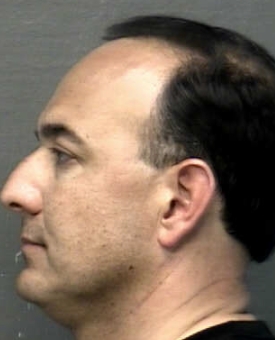
Profile booking photo: Michael W. Kwasnik. Courtesy of Dothan, Ala., Police Department.
Kwasnik will be held in Alabama until “extradition is arranged as a Fugitive from Justice,” Dothan police said. He was charged criminally and sued civilly earlier this week by New Jersey Attorney General Paula T. Dow.
Kwasnik was accused criminally of stealing more than $1 million from an elderly woman for whom he was performing trust services.
Separately, he was sued civilly amid charges he was part of an $8.5 million Ponzi scheme that targeted senior citizens.
Stephen J. Taylor, New Jersey’s director of criminal justice, said Monday that Kwasnik was a “cheat and a thief who betrayed his oath as an attorney to uphold the law. We are continuing to investigate his various financial schemes, and we urge anyone with relevant information to contact us.”
Dothan police did just that after finding Kwasnik in the Alabama city.
EDITOR’S NOTE: Although not reflected in the headline above, one of the alleged scammers referenced in a new case below — Nicholas Trimble of Colorado — is alleged to have targeted an alleged scammer in a months-old case: Jeffery Groendyke of Michigan. Details below.)
URGENT >> BULLETIN >> MOVING: In Colorado, U.S. District Judge Philip A. Brimmer has frozen the assets of Nicholas Trimble, Capstone FX Quantitative Analysis Inc. and Beekeepers Fund Capital Management LLC amid allegations they were conducting a Forex fraud involving a purported “automated forex robot trading system” known as the “Gladiator system.”
Separately, U.S. District Judge Barbara M. G. Lynn of the Northern District of Texas has frozen the assets of Rodney Wagner, Roger Wagner and GID Group Inc. amid allegations they were running a $5.5 million Forex Ponzi scheme. The Wagners live in Grand Prairie, Texas, and are brothers.
Both the Texas and the Colorado cases were brought by the CFTC. Like many recent fraud cases, the allegations are alarming.
In the Colorado case, for instance, it is alleged that Trimble buffaloed investors by telling them his miracle system had been created by a former NASA computer programmer, was a “machine that prints money” and would create a “billion dollar fund” — and had fetched a purchase offer of $20 million.
Trimble told investors he rejected the offer “because the system was too valuable,” the CFTC said.
But that was just one series of lies, the agency said. In reality, Trimble, 29, of Denver, was spending investors’ money at Las Vegas casinos, making large cash withdrawals and giving money to his wife and a lawyer.
Meanwhile, he scammed accused Forex scammer Jeffery Groendyke of Michigan out of at least $407,000, according to court filings. (In the Groendyke case, which was filed in Michigan in May, Groendyke was accused of targeting people of faith in his scam.)
As part of Trimble’s fraud, Trimble fabricated a Utah office and told an investor that miracle programmers worked at the Utah office. When the investor wanted to see the office, Trimble arranged a “webinar” instead, the CFTC charged.
During the webinar, someone using the name of “Josh Christensen” is alleged to have “pretended to be the head technology person at Capstone’s office in Utah.”
In the Texas case, the Wagner brothers and GID Group are accused of targeting people of faith in a virtually pure Ponzi in which at least $5.5 million was collected from 99 people.
“[T]he Wagner brothers concealed and/or perpetuated their fraud by making weekly payouts of ‘returns’ knowing that in fact GID had obtained no profits through forex trading,” the CFTC charged.
Among other things, the CFTC charged, the offering materials claimed “Time is of the essence (sic) by signing this document first party agrees to wire funds within twenty four hrs so funds may be invested as soon as possible to insure maximum returns.”
The “payout schedules that each the Wagner brothers delivered to prospective customers promised at least a 200% return on their principal, to be paid over 15, 20, or 40 weeks,” the CFTC charged. “The agreement stated that ‘All amounts are based on five days of trading.’ Both Wagner brothers delivered the agreements, with attachments, to actual and prospective customers via email.”
EDITOR’S NOTE: Although this story largely is about Kenneth Marsh and victims of his massive fraud scheme, the PP Blog hopes readers will visit Leagle.com (link below) to read an updated sentencing memo in the Marsh/Gryphon Holdings case. In many ways, the document tells the terrible story of our times . . .
So, you’re running a fraud scheme and paying commissioned salespeople to pass on your lies — and you want to sanitize your scheme by using fancy phrases such as “holdings company” and making investors believe that say, a billionaire or famous institution, are on board?
That’s what Kenneth Marsh pulled. It didn’t work in the long term — not for him, not for the pitchmen. In the short-term, though, it worked well enough to destroy lives and alter futures — while Marsh and some of his criminal pitchmen cackled about their brilliance.
Marsh, now a convicted felon, was the ringleader of the Gryphon Holdings Inc. scam in New York that falsely traded on the names of billionaire investor George Soros and academic institutions such as Harvard and Oxford. He was sentenced in September to eight years in federal prison. Prosecutors say he ran the scam from a strip mall on Staten Island while making investors believe he was a fixture on Wall Street with a top academic pedigree and marquee business connections.
The government wanted more prison time, and Marsh wanted less. Marsh, 44, ultimately received a middle-range sentence — with U.S. District Judge Jack B. Weinstein explaining that the Marsh sentence was a harsh one that would jail him for nearly a decade, but later would free him under close supervision to get a job so he could address making restitution to victims.
No Plausible Deniability For Fraud Pitchmen
Seventeen pitchmen or Marsh associates were charged criminally in the case and sentenced to jail sentences ranging from three months to two years and a month. The defendants also were sentenced to long terms of supervised release. More than 5,000 victims were identified. The life-shattering case is mindful of many of the fraud schemes pitched on Ponzi forums such as TalkGold and MoneyMakerGroup — with the hucksters gleaning commissions while trying to shroud themselves in the cloaks of plausible deniability. (Emphasis added.)
“Defendants were attracted into the conspiracy by the promise of an easy dollar,” wrote Weinstein. “They had to know almost immediately that they were engaged in criminal fraud. Nonetheless, they continued to participate because of the large sums they were earning.”
It was a case of garbage in, garbage out., with some of the pitchmen later playing dumb and claiming they only were repeating what they were told by the company — including an assertion the enterprise was “entirely legal” and had been vetted by an “attorney.”
But is was a sham, the judge ruled. (Emphasis added.)
“Defendants made gross misrepresentations about almost every aspect of the business,” Weinstein found. “Promotional materials painted the picture of an established, multi-national operation, replete with endorsements from people like George Soros. In reality, the company’s history, international locations, testimonials, purported in-house hedge fund, and research facilities were entirely fabricated.”
And Weinstein’s memo also destroyed the notion of plausible deniability on the parts of the pitchmen and business associates. (Emphasis added.)
“Many of the smaller players in the fraud contend that they did not know that what they were doing was wrong,” Weinstein wrote. “If these defendants acted out of ignorance, they willfully rendered themselves blind.”
And, the judge noted (emphasis added), “Those who cross the line from legal occupation to illegal acts are rarely shielded from criminal liability because they acted in conformance with the instructions of supervisors or the advice of legal counsel. This is particularly so in the high-risk, highly regulated financial industry. Puffery of the sort that may be winked at when utilized by a used car salesperson can constitute a serious crime when made in connection with the sale of securities.”
Information about the victims and their statements that appears below is taken from an updated sentencing memo issued Monday. The document is a painful read, one that speaks to a disgusting enterprise that targeted vulnerable populations and pilfered retirement and college savings while causing bankruptcies and divorces and destroying family relationships. It also speaks to what Weinstein described as the greed of Marsh’s fellow pitchmen.
Victims’ Statements (Abridged)
Here is how several of the victims of the $20 million fraud described how their lives were altered. (Please note that some of the statements are direct quotes from victims; others are summaries of their experiences taken from quoted material in court files.)
“[Gryphon] took my retirement money and I have serious doubts now that I will ever be able to retire. I am 59 years old and I don’t have enough time to make this money loss up . . . I fear for my family’s well-being and future.”
“Prior to the crime, my financial house was in order and I had saved plenty of money for retirement. Now, I have to ‘start over.’”
“I informed [pitchman] Mr. Leveir [sic] that I was going to use my daughters’ college tuition money and asked him to please not be scamming me as a loss of this money was detrimental to me.” (NOTE: The judge found that James Levier, 36, earned $20,000 a month as a fraud pitchman, after previously earning $35,000 a year as an assistant manager at Burger King. Levier created “at least” 250 victims as a Gryphon pitchman. Levier cooperated with prosecutors and has medical problems. The judge sentenced him to three months in prison, three years’ supervised release — and ordered him to forfeit $516,000 and be “jointly and severally liable” for more than $10.5 million in restitution.)
“My children were saddled with college loans they should never [have] had to take out because their father was stupid enough to fall for all the misleading advertising they sent out via e-mail. Getting involved with these crooks was the stupidest and most financially devastating thing I have ever done.”
“[The fraud] left us in bankruptcy for our credit cards, our savings, were no more. We had to give up [our] dreams, to remodel our home, to give money to our sons so they could get a good start at life. After my husband died it [left us] almost destitute.”
“These people completely stole my dignity and my self-worth as I just had to keep going to try and get my money back. I was totally desperate. I have never been treated for depression until this affair with Gryphon happened to me.”
Another victim said he “became so depress[ed] that [he] stayed in bed for days at a time. Now [he] do[es] not trust anybody.”
Yet another “developed a sleeping disorder and was suffering with stomach issues due to the stress.” Still another “is addicted to sleeping pills now and [has] to take two a night to sleep.” A third “accumulated several thousand dollars of medical bills as a result of the fraud.”
One victim stated “that his wife of twenty-eight years left him soon after he admitted that defendants’ scheme had caused him to go $125,000 into debt, $100,000 of which resulted from fees and failed trades. “I’ll never forget her look of disgust with me. For what I have done with Gryphon Financial,” the man said.
Another victim put it this way: “I have also lost my marriage of 28 years due to solely the loss of over 33 thousand dollars of my wife’s and my retirement account. She has called me an idiot for good reason and this has been the hardest part. I truly let her down and it now has caused our separation. She still thinks I am a complete moron. I can’t even look her in the eye due to extreme embarrassment.”
In some cases, “when victims’ marriages survived the terrible losses, they did so in a weakened state.” One victim “stated that his wife prevented him from having a nervous breakdown when he discovered that they had been defrauded . . . However, she no longer trusts him, especially with regard to financial decisions.”
Another victim put it this way: “My wife and I rarely speak. Before this, we ran several businesses as a couple. We now have the business (bar and grill), but work different shifts so we don’t argue. Yes, our marital relations have also suffered. I guess that’s called loss of consortium.”
Still another — a wife of a Marsh target whose husband “suffers from progressive dementia and Alzheimer’s” — put it this way: “I was involved in the traumatic events as I tried to recover the funds from Gryphon Financial after discovering that [my husband] paid $25,000 for investment consulting services we did not want or need. When we attempted to cancel the services, even explaining my husband had dementia and was not of the capacity to understand fully what he was purchasing . . . we were told the funds were non-refundable and then we were threatened with legal action from attorneys.”
Meanwhile, a different woman put it this way: “I’m 80 years old, a widow, living with . . . part time care workers. My soc. security, and small widow pensions etc. are my current situation. I’m in a wheelchair. They were well informed of my health and age.”
Yet another victim was described as “a quadriplegic who was saddled with large medical bills.”
Still another victim — a husband, father and grandfather — put it this way: “At the time this unfolded my only daughter was killed in a car accident not of her fault and we were left with two beautiful twin boys aged three. My wife and I are in our mid-sixties. I informed [fictitious pitchman] John Stevens of this happening and that I wanted to be left alone but they continued to press me and I folded. . . . I hoped to help the family but obviously I did not.”
“Defendants used victims’ vulnerabilities to their own advantage,” according to the Judge Weinstein’s memo.
“What is particularly striking about the case is [this,]”, the judge wrote: “First, how many people earning decent livings were so easily induced to become members of this corrosive criminal conspiracy, and how cruelly they acted towards the customers they dealt with.
“Second, how naïve were many of the victims and how easily they were suckered into turning over their fortunes to unknown, bodiless voices and emails.”
Michael W. Kwasnik: Philadelphia attorney accused of stealing from elderly client and benefiting with his 70-year-old father and others from a Ponzi and fraud scheme that bilked about $8.5 million.
A Philadelphia attorney with an office in New Jersey stole more than $1 million from an “elderly” client and also was part of a Ponzi scheme that targeted retirees, New Jersey Attorney General Paula T. Dow said.
For stealing from his client, attorney Michael W. Kwasnik, 42, was indicted for theft by failure to make required disposition of property received, misapplication of entrusted property, theft by unlawful taking and financial facilitation of criminal activity. The facilitation charge is a money-laundering offense.
Building on an earlier civil case, New Jersey regulators and Dow’s office now say Kwasnik and four others were part of a separate Ponzi scheme that gathered about $8.5 million.
In the criminal case, Kwasnik is alleged to have used his purported legal talent for estate planning to bilk the elderly client and the estate of her deceased sister.
“We charge in our criminal case that Kwasnik exploited an elderly client, misappropriating more than $1 million she intended to give to her children,” said Dow. “Just as we allege in our lawsuit that Kwasnik preyed on elderly investors, we charge in the indictment that he took advantage of the frailty of this client and the trust she placed in him in order to deceive and steal. We will aggressively prosecute criminals who prey on this vulnerable segment of our population.”
Stephen J. Taylor, New Jersey’s director of criminal justice, used even starker language.
Kwasnik, Taylor said, is a “cheat and a thief who betrayed his oath as an attorney to uphold the law. We are continuing to investigate his various financial schemes, and we urge anyone with relevant information to contact us.”
Among the allegations against Kwasnik was that he neither held nor invested his elderly client’s trust funds. Instead, he “withdrew the funds from that account within a few months, stealing more than $1 million.”
Kwasnik “misappropriated the funds for his own benefit and for other purposes unrelated to the administration of the estate, including paying other clients and paying the operating expenses of his law firm,” prosecutors charged.
On the civil side of things, the state initially sued entities known as Liberty State Financial Holdings Corp. and Liberty State Benefits of Pennsylvania Inc. in March.
Authorities now say Kwasnik and his 70-year-old father, William Kwasnik of Marlton, N.J., were siphoning proceeds from the sale of unregistered securities as part of a Ponzi scheme involving the firms.
William P. Leonard, 83, of Cherry Hill, N.J., also was named a civil defendant, as were Joseph Anthony Schifano, 45, of Brick, N.J., and Daniel Francis McCorry, 55, of Ventnor, N.J. Schifano and McCorry were described by the state as recidivist hucksters enjoined in 2005 from breaking securities laws.
The $8.5 million scam drew at least 73 investors, “many of whom were elderly and retired,” prosecutors said.
“We allege that these investors sought secure investments but instead, fell victims to a scam by individuals looking to unjustly enrich themselves,” Dow said.
UPDATED 11:27 P.M. ET (U.S.A.) In May, an email attributed to AdSurfDaily member Todd Disner declared, “Let the games begin!” The remark was in the context of a lawsuit Disner and fellow ASD member Dwight Owen Schweitzer intended to file against the United States once ASD members chipped in enough money to fund the complaint.
Those games apparently have begun with the filing today of a pro se “complaint for declaratory relief” by Disner and Schweitzer in the Southern District of Florida against the United States and Rust Consulting Inc., the government-approved claims administrator in the civil-forfeiture portion of the ASD Ponzi case.
The lawsuit asks a federal judge in Florida to find that the seizure of assets and business records belonging to Disner and Schweitzer was “illegal and void” and demands their return. It also asks the judge to order Rust to “disclose all information in its possession or available to it pertaining to” Disner and Schweitzer.
Among the claims in the lawsuit are that undercover agents from a U.S. Secret Service/IRS Task Force who joined ASD prior to the seizure of tens of millions of dollars from the bank accounts of ASD President Andy Bowdoin violated ASD’s Terms of Service and had a duty to report their alleged TOS violations, including the insertion of an agent’s undercover “MySpace” page in ASD’s advertising rotator, to the company.
Rust is headquartered in Minnesota. Although the complaint named the United States a defendant alongside Rust, the address listed for the United States by Disner and Schweitzer was the address of the office of U.S. Attorney Ronald C. Machen Jr. in the District of Columbia.
Disner, an unsuccessful pro se litigant in the ASD civil case brought by the government, is a co-founder of the Quiznos sandwich franchise. He lives in Miami. Schweitzer, a former attorney, also lives in Miami. The government’s case against ASD-related assets was filed in the District of Columbia in August 2008. Disner was denied standing in the District of Columbia on Aug. 31, 2009, more than two years ago.
Among other things, Disner and Schweitzer claim their private records as contained in ASD’s database were confiscated illegally by the government. They also claimed an affidavit filed in the forfeiture case by the U.S. Secret Service was flawed and that the government hired Rust to implement a remissions program “designed to collect evidence and coerced admissions from the plaintiffs to be used by the government” at the criminal trial of ASD President Andy Bowdoin.
Federal prosecutors in the District of Columbia — the venue in which both the criminal and the civil cases against Bowdoin and ASD-connected assets were filed — had a different take.
“The funds in this case were seized under properly issued judicial warrants,” Machen’s office said today. “Beyond that, the U.S. Attorney’s Office has no comment on the matter at this time. ”
Puzzlingly, the complaint filed by Disner and Schweitzer and recorded on the docket of U.S. District Judge Cecilia M. Altonaga today makes the assertion that “To date the plaintiffs are unaware of any remission payments having been made and specifically the plaintiffs were unable to get the information required for their submissions, all of which are still in the possession of the government.”
On Sept. 22 — more than six weeks ago — the PP Blog reported that thousands of ASD members who filed approved remissions claims would receive back 100 cents on the dollar. Members reported that the money was deposited electronically into their bank accounts beginning on Sept. 23. On Sept. 26, the government announced that $55 million was being returned, with the Secret Service describing ASD as a “criminal enterprise” and the Department of Justice describing the ASD scheme as “insidious.”
In a Sept. 28 email, even Bowdoin acknowledged that he was aware the government had returned money to members through the remissions process. Among other things, the ASD patriarch claimed the government had forced members to lie to receive compensation.
Disner and Schweitzer not only claim in their complaint that they are “unaware” of any money being returned, they also claim the remissions program was designed to “prevent, hamper and forestall the return” of funds.
Meanwhile, Disner and Schweitzer claim that ASD was a profitable venture, in stark contrast to assertions by the government that ASD was insolvent because it created a liability of $1.25 for each dollar it took in through the sale of purported “advertising.”
Disner and Schweitzer also took issue with government agents joining ASD and allegedly violating the ASD membership agreement, including an undercover agent who placed his undercover “MySpace” page in ASD’s advertising rotator. In August 2008, the government alleged that “ASD did not require, or even verify that the agent “had any product or service to sell.”
Had the agents “lived up to the obligations they took on by becoming members of ASD they should have reported their own violations of the ASD terms of service with the result that the sites they foisted upon ASD would have been removed and the benefits to them as advertisers’ would be forfeited as the ASD rules mandated,” Disner and Schweitzer argued.