Blog

  • Jon Jason Greco Pleads Guilty To Making False Statement In Trevor Cook Ponzi Case

    Jon Jason Greco, 40, of Minneapolis, has pleaded guilty to making a false and material statement in the Trevor Cook Ponzi scheme. He faces up to five years in federal prison. A sentencing date has not been scheduled.

    Greco came into possession of loot from the scheme after its 2009 collapse, stashing it in a locker at the Mall of America. When questioned, he lied to investigators, telling them that the property found at the mall belonged to him and was given to him by his uncle, prosecutors said.

    Investors were wiped out in Cook’s $194 million scheme. He is serving a 25-year sentence in federal prison.

    “Because of Greco’s false statements, the U.S. failed to recover approximately $6,000 of
    the assets,” prosecutors said.

    Investigators recovered foreign currency and coins at the mall.

    The case against Greco was bolstered when an exotic dancer told an IRS criminal investigator who was following leads that Greco, believed to have been unemployed for months, suddenly began to spend generously at a Minneapolis strip club and to plow $100 bills into slot machines at a gambling emporium.

  • BULLETIN: Mark D. Leitner Faces Up To 13 More Years In Federal Prison After Pleading Guilty To Filing False Liens For Tens Of Billions Of Dollars Against Public Officials

    Already a federal prisoner in a tax case, Mark D. Leitner has pleaded guilty in federal court in Florida to charges he filed bogus “maritime” liens for tens of billions of dollars against a former U.S. Attorney, “numerous” Assistant U.S. Attorneys, a former court clerk and a criminal investigator for the IRS.

    Leitner sought $48.489 billion from each of the officials and exposed private information about five of them, federal prosecutors said.

    In addition to the guilty plea on the false-liens charges, he pleaded guilty to impeding the IRS, prosecutors said.

    Prosecutors said Leitner also “filed and mailed numerous harassing and frivolous documents to the courts and personnel involved in this case.”

    Leitner was sentenced to a five-year term last year in a tax case. He retaliated against officials both during and after the trial by filing bogus liens, prosecutors said.

  • BULLETIN: Vincent McCrudden Pleads Guilty To Threatening Regulators, Government Officials

    BULLETIN: Vincent McCrudden, who was arrested in January amid allegations he threatened to kill 47 regulators and government officials, has pleaded guilty to two counts of transmitting threats to kill.

    McCrudden, 50, faces up to 10 years in prison. He has been jailed since his arrest in New Jersey.

    “Mr. McCrudden made bone-chilling and graphic threats against dozens of public officials,” said Assistant Attorney General Lanny Breuer. “As this prosecution reflects, the Department of Justice will act swiftly to identify and prosecute anyone who attempts to retaliate against public officials. Public servants must be able to carry out their duties without fear of being targeted.”

    On Sept. 30, prosecutors said, McCrudden sent an email to an employee of the National Futures Association (NFA) that made a death threat.

    “[I]t wasn’t ever a question of ‘if’ I was going to kill you, it was just a question of when,” the email read, prosecutors said. “And now, that question has been answered. You are going to die a painful death.”

    McCrudden also published an “Execution List” on his website. The list included the names of 47 current and former officials of the SEC, FINRA, NFA, and CFTC.  Included on the list were the names of the “the Chairperson of the SEC, the Chairman of the CFTC, a former Acting Chairman and Commissioner of the CFTC, the Chairman and CEO of FINRA, the former chief of Enforcement at FINRA, and other employees of the NFA and CFTC,” prosecutors said.

    “[T]hese people have got to go,” McCrudden wrote, prosecutors said. “And I need your help, there are just too many for me alone.”

    And McCrudden “posted a $100,000 reward on his website for personal information of several government officials and proof that those officials were punished,” prosecutors charged.

    On Dec. 16, according to the complaint, McCrudden sent a CFTC official an email with a subject line of, “You corrupt mother[*!&$$%]!”

    A top FBI official said such behavior would not be tolerated.

    “The conduct of McCrudden was way beyond mere speech,” said Janice K. Fedarcyk, assistant director in charge of the agency’s New York office. “By his admission, he not only directly threatened to kill government and regulatory officials, but he also listed dozens of officials and offered a reward to others to kill them. This outrageous conduct is not only dangerous, but an affront to civil society.”

    Fedarcyk was backed by U.S. Attorney Loretta E. Lynch of the Eastern District of New York.

    “This defendant crossed the line when he directly threatened to kill public officials who were working to keep our financial markets fair and open, and invited others to join him,” Lynch said. “He thought he could hide in the shadows of the Internet and disseminate his threats and instructions. He was wrong. This office will not tolerate, and will vigorously prosecute, those who threaten to kill men and women who dedicate their lives to public service.”

  • Effort To Raise Funds To Stone ‘Goliath’ With $50 ‘Rocks’ In Federal Court Apparently Delayed Owing To Need To Perform More ‘Testing’

    Andy Bowdoin has been positioned as "David" in a courtroom clash with "Goliath."

    “David” apparently needs five more days of “testing” before he can equip himself properly to stone “Goliath” with $50 “rocks” in federal court.

    A fundraising website for accused felon and MLM huckster Thomas A. “Andy” Bowdoin missed its advertised launch date Friday. Bowdoin, 76, was positioned as “David” on a “temporary” site that advertised his purported need to start an “official” site to raise a “minimum” of $500,000 to do battle with the government, which was positioned as “Goliath.”

    The “temporary” site now has announced that the launch date of the “official” site has been “revised.” Bowdoin won’t begin collecting cash for $50 “rocks” until July 20, five days later than advertised.

    Bowdoin, the head of Florida-based AdSurfDaily, was accused in December 2010 by federal prosecutors in the District of Columbia of wire fraud, securities fraud and selling unregistered securities.

    ASD was a Ponzi scheme that had gathered at least $110 million, prosecutors said.

    “As of today, July 15th, the launching of the Official Website for Andy’s Fundraising Army is in it’s (sic) final stages of creation & systems testing, and the new launch date is on target for this coming Wednesday, July 20th. (sic) only 5 days from now.”

    Bowdoin has been described in federal court filings as being “tardy” on certain pleadings. The fundraising website also appears to be tardy.

    ASD never told members that Bowdoin was involved in a previous securities swindle before he launched ASD in 2006, according to federal prosecutors.

    And he never told incoming members that the original iteration of ASD collapsed under the weight of a Ponzi scheme in 2007 and that new members were paying his original set of victims when ASD later relaunched under a different name, prosecutors said.

    Prior to a U.S. Secret Service raid on ASD in August 2008, the firm’s website was inaccessible for days at a time, according to members.

  • URGENT >> BULLETIN >> MOVING: KABOOM! Feds, SEC, CFTC Move Against Alleged U.S. Huckster Who Ran Forex Ponzi Scheme From Panama And Fled To Peru; Self-Styled ‘Christian’ Jeffery A. Lowrance Registered Business In New Zealand And Routed Ponzi Payments To And From The Netherlands, Officials Say

    URGENT >> BULLETIN >> MOVING: A U.S. citizen who told investors he was a “Christian” who shared their political philosophy of “limited government” ripped off hundreds of people in a $21 million Forex Ponzi scheme involving “fictitious trading,” used some of the cash to start an alternative newspaper, preyed on followers of U.S. Rep. Ron Paul and fled to Peru when his Panama-based scheme collapsed, U.S. officials said today.

    Jeffery A. Lowrance, 50, was arrested in Lima earlier this year. He was extradited to the United States yesterday and arraigned today on criminal charges filed in the Northern District of Illinois, federal prosecutors said. Separately, the SEC charged Lowrance with fraud in a civil complaint, as did the CFTC.

    The office of U.S. Attorney Patrick J. Fitzgerald of the Northern District of Illinois said this afternoon that Lowrance operated his Forex swindle from Panama, involving as many as 400 investors and causing losses of at least $5 million.

    Fitzgerald is perhaps the most famous prosecutor in the United States, and has served during both Republican and Democratic administrations in Washington. Lowrance was jailed in the United States today after his arraignment in Chicago on charges of wire fraud and money laundering.

    In bringing the case, government officials described Lowrance’s alleged crimes as a form of affinity fraud targeted at Christian voters with a keen interest in politics. Investigators have fretted that certain types of schemes have been designed deliberately to trade on sentiment against big government and that scammers have lined up to take advantage of the sentiment while leaving investors holding the bag.

    Investors in 26 states, including California, Oregon, Illinois and Utah, were targeted in the scam, the SEC said.

    Paul, R.-Texas, is an advocate for limited government and is a candidate in a crowded GOP field for next year’s Presidential nomination.

    During the 2008 U.S. election cycle, Lowrance showed up at a Paul political rally in Minnesota, placing a copy of a newspaper Lowrance produced with investor funds he had “secretly” diverted “on every seat at the rally,” the SEC charged.

    Even as he was touting his newspaper and his investment program at the Paul rally, the Ponzi scheme already was in a state of collapse, the SEC charged.

    And, the SEC added, Lowrance’s purported investment firm — First Capital Savings & Loan Ltd. — actually was registered in New Zealand. Investors were instructed to send money to a “money converter” in Maryland, where it was whisked overseas to the Netherlands.

    Ponzi payments were made from the Netherlands, the SEC alleged.

    A Lowrance predecessor entity known as Mentor Investing Group had been ordered by the state of California in 2006 to “cease and refrain” from selling commodities and Forex contracts, according to records.

    “[Lowrance]  used a significant portion of the money he raised from investors to fund the creation of his alternative newspaper, USA Tomorrow, which claimed to promote ‘truth in journalism’ and contained articles and advertisements advocating a limited government ideology,” the SEC charged. “He then included in at least one edition of USA Tomorrow a flyer advertising the First Capital investment opportunity which he distributed at the September 2008 Ron Paul Rally for the Republic in Minneapolis, Minnesota. USA Tomorrow was placed on every seat at the rally,” the SEC charged.

    Lowrance specifically targeted Christians and inexperienced investors in his sales pitches, the SEC charged.

    Along the way to ruin, “Lowrance and First Capital knowingly and/or recklessly made the materially false claim that First Capital used investor money to trade foreign currency and in return, pay them a high,  fixed, monthly rate of return,” the SEC charged.

    “Before February 2008, First Capital offered monthly rates of return ranging from 4% to 7.15% (resulting in annual rates of return up to 85.8%),” the SEC charged. “It also offered to pay referral fees for new investors ranging from 5% to 6% of the amount invested. As of July 2010, First Capital’s website offered monthly rates of return ranging from 1.104% to 1.558% (resulting in annual rates of up to 18.7%) and referral fees ranging from 1 % to 2%.”

    Like other investment scams, the Lowrance Forex Ponzi used “a chart and spreadsheet purporting to show its multi-year history of profitable trades,” the SEC alleged.

    But “First Capital never entered into the trades detailed on First Capital’s website,” the SEC charged. “Moreover, First Capital never was profitable.”

    Even after the scheme collapsed, Lowrance continued to solicit funds, telling some investors in early 2009 that “the millions lost [did] not shake [him],” the SEC charged.

    He urged investors that he had just acknowledged swindling to continue to have faith in him and said that he would trade foreign currency “to pay them back,” the SEC charged.

    When some of his investors told others that Lowrance had swindled them, Lowrance sent “purported updates to other investors disparaging the character of those persons who circulated his earlier admissions and disparaging the character of anyone who questioned L[o]wrance’s integrity,” the SEC charged.

    What he did not do was stop soliciting prospects for money and take his website offline. The site remained active until “at least” July 2010, despite the scheme’s 2008 collapse, the SEC charged.

    On March 5, 2009, a month after Lowrance acknowledged that investors had lost their money, the Netherlands bank account contained $121, the SEC charged.

    “In addition to failing to disclose First Capital’s true financial condition and operations to investors solicited between June 2008 and February 2009, Lowrance did not use any new investor money to trade foreign currency,” the SEC charged. “Rather, he used new investor money to pay himself, pay some 6 investors’ returns, and to pay for expenses associated with his start-up newspaper.”

    Also involved in the probe are the FBI and the IRS. Elements of the investigation were assembled by member agencies of the interagency Financial Fraud Enforcement Task Force created by President Obama in 2009.

  • Tax Lien Was Filed Against Golden Panda’s Clarence Busby Prior To Lawsuit Autosurf Operator Filed Against Bank; Separately, Georgia Has Dissolved 2 Busby Firms And Says Biz Ad Splash ‘Surf Company In State Of Noncompliance

    EDITOR’S NOTE: Clarence Busby Jr., a figure associated with at least four autosurfs — AdSurfDaily, Golden Panda Ad Builder, LaFuenteDinero and BizAdSplash — has encountered a recent string of troubles, including a mortgage foreclosure and tax liens. Owing to his association with ASD President Andy Bowdoin, who operated ASD and LaFuenteDinero and once had a partnership with Busby in Golden Panda, Busby also was forced to spend an unknown sum on legal fees after the seizure of ASD- and Golden Panda-connected assets in 2008.

    Bowdoin said in September 2009 that he’d spent more than $1 million on legal fees in the first 13 months of ASD-related litigation. He was arrested on federal charges on Dec. 1, 2010, and had to arrange a bond of $350,000.  Sixteen days later — on December 17, 2010 — federal prosecutors filed yet another (the third) civil-forfeiture complaint against Bowdoin-connected assets. Bowdoin filed appeals in the first two forfeiture cases, losing both and driving up his legal costs.

    Despite the costly troubles encountered by both Bowdoin and Busby — and the remarkable staying power of those troubles, which next month will enter their fourth year — promoters on TalkGold, MoneyMakerGroup and other Ponzi forums still are pushing autosurfs and HYIPs.

    They’re pushing them even though Bowdoin and others potentially face long prison sentences and have lost significant dollar sums and property as a result of their infatuation with what prosecutors have described as serial lawlessness.

    On July 6, a federal judge ordered Gregory N. McKnight, the operator of the Legisi HYIP Ponzi scheme, to pay more than $6.81 million in disgorgement and penalties. Like ASD and countless schemes, Legisi was promoted on TalkGold and MoneyMakerGroup — and court filings in the Legisi case specifically reference MoneyMakerGroup.

    Still pushing ‘surfs and HYIPs?

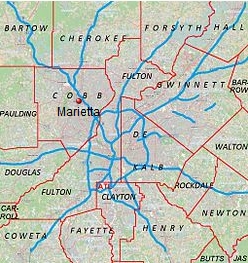
    Apparently using a fill-in-the-blank litigation template, Clarence Busby Jr. sought foreclosure relief on a central Cobb County property in Marietta, Ga. Busby's filing also placed the property in Gwinnett County, which does not border Cobb County. (Graphic from Wikipedia.)

    When former autosurf operator Clarence Busby Jr. filed a lawsuit last year last seeking relief from from a bank and other parties involved in a mortgage foreclosure against him, he’d already been put on notice by the Internal Revenue Service that the agency intended to collect thousands of dollars in back taxes from him, according to records in Cobb County, Ga.

    The taxes were from 2009, according to records. During the same year, Busby launched an autosurf known as Biz Ad Splash — but the tax bill was for a different Busby entity.

    On Aug. 11, 2010, the IRS prepared a federal tax lien against Busby and a company known as Freedom Achievement LLC for $15,481. The lien was formally recorded on Aug. 26, 2010. A note on the lien described Busby as “SOLE MBR” of Freedom Achievement, whose business purpose was not immediately clear.

    About four months later — in December 2010 — Busby filed a pro se lawsuit demanding relief from Quicken Loans, OneWest Bank, MERSCorp and 1,000 “Doe” defendants in Cobb County Superior Court.

    OneWest and MERS responded in January 2011 by moving to have Busby’s case transferred to federal court in the Northern District of Georgia because the lawsuit named defendants in multiple states and involved a controversy that exceeded the sum of $75,000.

    Busby’s case was assigned to Senior U.S. District Judge Robert L. Vining Jr., who dismissed it for failure to state a claim. Beyond dismissing the lawsuit for failure to state a claim, Vining agreed with the defendants that Busby’s arguments had no legal merit. Busby’s pro se pleadings appeared to have come from a fill-in-the-blank legal kit.

    These words appeared on the first page of Busby’s complaint: “COMES NOW, name here, as plaintiff” — and Busby did not insert his name in the “name here” space.

    By contrast, some filings in the ASD/Golden Panda forfeiture case begin with these words, “COMES NOW, plaintiff United States of America, by and through its attorney.”

    The Busby complaint also claims the Busby property in dispute is located in “Gwinnett County.” The document claimed elsewhere that the property was located in the city of Marietta in “Cobb County,” the venue in which Busby sued.

    Marietta is situated in central Cobb County. Cobb County and Gwinnett County do not border one another. and the property is listed in Cobb County courthouse records, meaning it is possible that Busby used an existing legal template and never swapped out an existing reference to Gwinnett County — in the same manner in which he did not insert his name in the “name here” space.

    Whether Busby’s apparent fill-in-the-blank oversights added to the defendants’ costs in successfully defending against the lawsuit is unclear. What is clear is that Busby came out on the losing end and that the defendants referenced the IRS tax lien against Busby in Cobb County in their response to his complaint.

    Separately, the state of Georgia dissolved a Busby company known as Homeshare Investment Club Corp. The dissolution occurred on Sept. 13, 2010, less than a month after the IRS tax lien was filed against Freedom Achievement LLC, according to records.

    Records pertaining to Homeshare Investment Club show that it used the same address used by Busby in the formation of Biz Ad Splash NA LLC.

    BizAdSplash, or BAS, was an autosurf that ceased operating in January 2010. BAS launched in the aftermath of the ASD- and Golden Panda-related asset seizures. A separate address associated with the BAS filing in Georgia is the address of a maildrop in Kennesaw.

    BAS purported to operate offshore. Its apparent U.S. domestic brand is listed in noncompliance by the office of Georgia Secretary of State Brian P. Kemp.

    Members of BAS have complained to the PP Blog about not getting refunds from the autosurf. How much money the surf collected is unclear.

    At the same time the state of Georgia was dissolving Homeshare Investment Club, it also was dissolving another Busby enterprise: Ocean View Enterprises Inc.  Meanwhile, yet another Busby firm — Legacy Premier Properties Inc. — is listed in a state of noncompliance.

  • AdSurfDaily/Golden Panda Figure Clarence Busby Jr. Filed Pro Se Lawsuit Against Bank, 1,000 ‘Does’; ‘Plaintiff Has No Knowledge Of The True Names And Identities Of Any Or All Of The Real Lenders’

    Even as bank failures and  foreclosures were piling up in Georgia last year, a man associated with at least four failed autosurf companies was filing lawsuits against mortgage companies and 1,000 “Doe” defendants amid claims he did not know the “true names” of the “real lenders.”



    Clarence Busby Jr. of Acworth, Ga., advised a Cobb County judge that it was “long standing black letter Mortgage law” from the 19th century that he should receive foreclosure relief from Quicken Loans, OneWest Bank, a service company and the “Does.”

    In January 2011, the defendants moved to have the cases removed to federal court in Northern Georgia and filed for dismissal. The dismissal was granted in March.

    A street address for Busby that appeared in both the county and federal filings corresponds with an address used by Biz Ad Splash NA LLC (BAS) in Georgia corporate filings dated May 13, 2009. BAS was an autosurf associated with Busby that went missing last year. Busby also was the president of Golden Panda Ad Builder, yet another autosurf, and a onetime business partner of Thomas A. “Andy” Bowdoin, the operator of the Florida-based AdSurfDaily autosurf.

    The address BAS used in the Georgia filings was a mail drop, according to records.

    Bowdoin was arrested in December 2010. The U.S. Secret Service said he had presided over an international Ponzi scheme that had gathered at least $110 million. Assets tied to both Bowdoin and Busby were seized as part of the ASD/Golden Panda probe, which also involved an autosurf known as LaFuenteDinero.

    Busby was implicated in three prime-bank schemes by the SEC in the 1990s and was enjoined from violating securities laws by a federal judge. An FDIC-insured bank that once held Golden Panda funds failed in April 2011.

    Georgia leads the United States in bank failures, with Florida nipping on its heels. Both states also are high on the list of mortgage foreclosures. Foreclosures tend to lower the value of surrounding properties.

    Busby has described himself in court filings as a minister and real-estate professional. The actions in Cobb County that were removed to federal court were filed pro se, meaning Busby acted as his own attorney.

    The defendants in the cases claimed Busby was seeking to “invalidate and/or void” in its “entirety” a $120,000 security instrument held on a property in Marietta, Ga.

    Records suggest the property has been bought and sold twice in recent months for wildly different prices.

    Among Busby’s claims in the Cobb County lawsuit was that the “true names and identities of any or all” of the “real” lenders, investors and others involved in his mortgage “were hidden from the plaintiff.”

    BAS, which purported to be headquartered offshore, entered the autosurf world in January 2009 — after the ASD, Golden Panda and LaFuenteDinero-related asset seizures.

    The entry of BAS began with the stern bang of a drum and a dire message in a promotional video: “The World Is In Crisis,” the video warned. “Turn On The News, And You’ll See. The Stock Market Is At A Record Low. Foreclosures Are At An All-Time High. Thousand’s (sic) Are Losing Their Jobs. Banks Are Closing. There Has To Be A Solution!”

    The dire bang of the drum faded, replaced by a riff from an organ. The riff grew frantic, building toward a crescendo. The video never said the tones were from a 1999 work by Fatboy Slim: “Right Here, Right Now.”

    Messages flashed in front of viewers’ eyes for more than a minute before the video announced the company’s name — BizAdSplash — and positioned the surf as the cure for all the economic misery in the world.

    “Biz Ad Splash Has The Answer,” it said. “The Plan Is Simple. Advertise Your Business, A Product Or Service, Introduce Others To The Value Of Advertising. View A Few Ads For A Few Minutes A Day. Earn Profits. It’s That Simple!”

  • BULLETIN: ASDCashGenerator Website Is Active Again; Is A New ‘Program’ In The Offing? Page Is Accessible Through Old ASD Ad That Features Image Of Purported Club Asteria Owner; No Comment From Investigators

    This old ad for AdSurfDaily features an image of Hank Needham, the purported owner of Club Asteria. An ASD affiliate link in the ad summons ASD’s old ASDCashGenerator.com URL, which went dormant after the federal raid on ASD’s Florida headquarters in August 2008. In recent hours, however, the old ASDCashGenerator URL began to resolve to an apparent new business opportunity known as Ad Sales Daily International. Needham’s one-time tie to ASD leads to questions about whether Virginia-based Club Asteria, through Needham or ASD downline members, could have benefited from ASD cash prior to the federal seizure of tens of millions of dollars from the personal bank accounts of ASD President Andy Bowdoin nearly three years ago. The Club-Asteria domain name was registered in June 2009, the same month an autosurf with ASD connections known as AdViewGlobal collapsed. Club Asteria’s domain now is registered behind a proxy, but once was registered to Needham, according to web records.

    BULLETIN: (UPDATED 9:36 P.M. EDT (U.S.A.) A website identified in a 2008 forfeiture complaint as the site of a major financial crime allegedly engineered by AdSurfDaily President Andy Bowdoin and unidentified co-conspirators is active again and appears to be redirecting traffic to an entity named “Ad Sales Daily International” (ASDI) and a second entity known as ASD2Day.

    “Make $10 per direct referral & $5 for every 2nd level indirect!” the site exclaims. “Recieve (sic) $2000 Account Initiation Credits! Hurry, while we are in pre-launch.”

    A spokesman for U.S. Attorney Ronald C. Machen Jr. in the District of Columbia declined to comment on the development, saying that ASD is part of an active investigation.

    The ASDI site is accessible through an affiliate link to Bowdoin’s old ASDCashGenerator.com site, which appears to have been re-registered in the name of Barbara Cruz, whose name previously has appeared in the context of ASD. The PP Blog accessed the ASDI site by clicking on an old ASDCashGenerator affiliate link . The link was within an ASD ad from 2008 that featured an image of Club Asteria’s purported owner Hank Needham.

    The ASD ad with Needham’s image positioned ASD as a “Perfectly Credible Business” and included a contact email address that used the characters “ptigold.” The ASD ad, however, does not load Needham’s name as an ASDI affiliate when the link is clicked. Instead, it loads the name of another individual. The reason was not immediately clear.

    This page for ASDI, an apparent upstart, is accessible when a link is clicked in an old ad for Andy Bowdoin's ASD Cash Generator program. The old ASD ad features a photo of Hank Needham, the purported owner of Club Asteria, but the ad does not load Needham's name as an ASDI affiliate when the link is clicked. Instead, the ad loads the name of another person. The reason was not immediately clear. Bowdoin is under federal indictment for wire fraud, securities fraud and selling unregistered securities. Questions have been raised about whether Club Asteria also was selling unregistered securities as part of a purported "passive" investment program.

    A separate link within the ad with Needham’s image forwards to a page that displays pornography ads.

    All or part of the old ASDCashGenerator site appears to be redirecting to the domain name of ASD2Day.com. In 2009, the ASD2Day site was registered with Cruz listed as the contact person at an address in Florida that state investigators had tied to a major insurance scam. Although Cruz now is listed as the registrant of the ASDCashGenerator site, the ASD2Day site is registered in the name of another individual.

    In October 2009, the PP Blog published a story about the ASD2Day site, which was making odd claims about the state of the ASD litigation a year after the federal seizure of Bowdoin’s assets and assets linked to Golden Panda Ad Builder, an autosurf implicated by the U.S. Secret Service in the ASD probe.

    ASD2Day.com claimed, among other things, that ASD could not be a Ponzi scheme because the script employed by the autosurfing firm could not be programmed to permit a Ponzi scheme to occur. It also made a puzzling claim that U.S. District Judge Rosemary Collyer was on an Aug. 28, 2009, deadline “to determine if the US Attorney General’s case against ASD should move forward.” (Also see this story and comments thread.)

    Collyer was on no such deadline. In January 2010, Collyer issued a forfeiture order that awarded $65.8 million seized from Bowdoin’s bank accounts to the U.S. government, which is using the seized money to compensate victims of ASD. In July 2009, Collyer issued a forfeiture order for more than $14 million linked to Golden Panda, ASD’s one-time purported “Chinese” option.

    The ASD ad that featured Needham’s image also made a veiled reference to Golden Panda.

    A section of the ad read, “OPENING IN CHINA[:] July 2008.”

    Undercover agents from a Secret Service/IRS task force began to investigate ASD and Golden Panda on July 3, 2008, according to court filings. The court process of seizing cash linked to both entities began on Aug. 1, 2008, with the issuance of seizure warrants.

    It appears to be the case that all old ASD Cash Generator affiliate links, including the links in the ad that featured Needham’s photograph, now load the new ASDI webpage at the old ASD Cash Generator URL.

    Claims made about Club Asteria are under investigation by Italian authorities. Club Asteria first slashed payouts to members then reportedly suspended them for 60 days. The firm also reportedly has had its PayPal account frozen.

    Like ASD, Club Asteria was promoted on Ponzi scheme forums such as TalkGold and MoneyMakerGroup.

    In a video dated July 8, a Club Asteria executive claimed the firm had “a philanthropic foundation both domestically and internationally where we help causes all over the world.”

    Among the claims in the video, which appeared online after Club Asteria reportedly suspended payouts, was this one:

    “We donate cows and pigs and water buffaloes and camels to help families all over the world.”

    Virginia-based Club Asteria trades on the name of the World Bank. Members said payments came from an entity known as Asteria Holdings Limited (Hong Kong) — before the payments stopped.

    One of Club Asteria’s principal concerns, according to a new video, is children.

    Investigators long have fretted that some promoters of online business “opportunities” simply race from fraud scheme to fraud scheme, collecting commissions for introducing others to “programs” that prove to be scams.

    Like the now-collapsed AdViewGlobal (AVG) autosurf, Club Asteria has blamed its reported problems on members. AVG had promoters and members in common with Bowdoin’s ASD, which the Secret Service described as a massive international Ponzi scheme.

    Among other things, AVG plucked the heartstrings of members by telling them that the company was interested in saving the rain forest.

  • International MLM Huckster Who Laundered Money For Colombian Narcotics Operation Sentenced To 9 Years In U.S. Prison; David Murcia Also Faces 30-Year Term Behind Bars In South America Upon Release

    David Murcia in 2010.

    David Eduardo Helmut Murcia Guzman (David Murcia), the MLM huckster whose pyramid scheme targeted the poor in Latin America and laundered money for a Colombian narcotics operation, has been sentenced to nine years in a U.S. federal prison.

    Murcia, 30, also faces a 30-year prison sentence in Colombia after his release from a U.S. jail.

    “Murcia Guzman wove an intricate web of deception across continents to disguise his dirty drug money and support his lavish lifestyle,” said U.S. Attorney Preet Bharara of the Southern District of New York. “But his web has been untangled and his lifestyle dramatically curtailed by this sentence.”

    Murcia was at the helm of a Colombian MLM scheme known as D.M.G. Group, which collapsed in 2008 after luring customers by offering prepaid debit cards that purportedly would elevate their standard of living. Along with five co-conspirators, Murcia laundered drug money through the MLM company and other entities, prosecutors said.

    In January 2010, the U.S. Drug Enforcement Administration (DEA) brought Murcia from Colombia to the United States to face trial. Murcia, wearing a bulletproof jacket, was whisked under heavy guard from his prison cell in Bogota to a waiting DEA aircraft.

    Although it is common for online criminals to promote fraud schemes by saying the operations are outside the reach of U.S. regulators and law enforcement, such claims are a myth.

    Finding the United States an unfriendly environment, the so called autosurf and HYIP “industries” increasingly are relying on offshore money-exchange businesses and debit cards to entice participants, sometimes advising them that the offshore locations are “safe” havens that “shelter” U.S. residents from regulators and law-enforcement agencies.


  • Millions Of Dollars In Payments To Accountant, 73, Provided Him ‘Powerful Incentive’ To Look The Other Way As Joseph Forte Pulled Off $75 Million Ponzi Scheme, SEC Says

    Joseph S. Forte, one of the earliest of the so-called mini-Madoffs, was sentenced in November 2009 to 15 years in federal prison — slightly more than a year in jail for each year his 13-year scheme operated. The SEC now says he had help from an accountant who looked the other way because Forte, a failed computer salesman, became a cash cow when he reimagined himself as an investment strategist in 1995.

    John N. Irwin, 73, of Villanova, Pa., presided over a consulting firm known as Jacklin Associates Inc. , the SEC said.

    Both Irwin and the firm solicited business for Forte, and Irwin racked up more than $5 million in ill-gotten gains after performing no “due diligence” and relying “exclusively on Forte’s misrepresentations about Forte LP’s stellar performance,” the SEC said.

    Forte had been running a Ponzi scheme between 1996 and 2008, according to the U.S. Postal Inspection Service. The scheme ultimately gathered more than $75 million, and Forte simply made up profitability numbers to hoodwink investors.

    Just prior to the collapse of the scheme in late 2008, according to postal inspectors, Forte told investors his fund had a total value of more than $154 million, but the fund’s actual value was $150,000 — and Forte kept collecting money from customers.

    In a settlement with the SEC, Irwin and Jacklin neither admitted nor denied the allegations. The financial aspects of the settlement, which requires judicial approval, will be determined later, the SEC said.

    Irwin has been suspended from appearing before the SEC as an accountant.

    “In communicating the fraudulent information to investors, Irwin disregarded red flags that should have alerted him that the information that he was passing on was false,” the SEC said.

    “Irwin had a powerful incentive to disregard those red flags,” the SEC charged, “because Forte paid him and Jacklin millions of dollars in the form of purported trading profits and fees.”

    During the course of the Forte scheme Irwin was both an investor in Forte’s limited partnership and a provider of accounting services to Forte, the SEC said.

    What red flags were missed?

    “[F]or approximately four and a half years, between October 2002 and February 2007, Forte did not deposit any investor funds into the trading account of Forte LP, and from October 2004 through July 2007, Forte conducted minimal trading in the account,” the SEC charged.

    “Rather, Forte diverted most of investor funds to meet redemption requests of other investors in Forte LP, to pay fees to himself and Jacklin, for personal use and the use of his family and friends, and to various third parties as donations or otherwise.”

    Irwin also overlooked red flags pertaining to Forte’s treatment of tax matters, the SEC alleged.

    “[F]rom 1995 through 2002, Forte provided Irwin with false investment account documents that purported to be 1099 forms from Forte LP’ s brokerage firm,” the SEC charged. “Each of the forms appeared on its face to have been altered or fabricated. In 2003, Forte stopped sending Irwin the 1099 forms as year-end support for the numbers he was reporting. However, despite Irwin’s considerable accounting experience, he failed to request the documents from the institutions themselves.”

    Forte’s “exclusive control” over the firm’s brokerage and bank accounts and the “consistently large gains reported by Forte every year” also sent up red flags that Irwin ignored, the SEC charged.

    Forte became a CPA in 1961, the same year President Obama was born.

    “Given Irwin’s significant experience as an accountant, investor, and businessman, and his active role in Forte LP, he should have been skeptical of Forte’s reports of consistently large trading profits in the trading of futures over a period of thirteen years, and should have independently verified the same before communicating with investors,” the SEC charged.

  • Ex-Attorney, 72, Indicted In Alleged Ponzi Scheme; Robert G. Tunnell Jr. Charged With 13 Counts Of Wire Fraud, 7 Counts Of Mail Fraud, 1 Count Of Money-Laundering

    A former San Francisco attorney who resigned from the bar a decade ago while under investigation for stealing $300,000 from his law firm now has been indicted on charges of running a five-year Ponzi scheme that gathered about $10 million.

    Robert G. Tunnell Jr., 72, had been a member of the California Bar for 30 years when he resigned under fire in 2001, according to records. Tunnell has an Ivy League pedigree, graduating from Dartmouth and Harvard Law.

    Federal prosecutors now say that, after Tunnell left the practice of law, he held himself out as a “highly successful investor.”

    In reality, the office of U.S. Attorney Melinda Haag of the Northern District of California said, Tunnell operated a Ponzi scheme from “at least” between January 2006 and June 23, 2011.

    Tunnell’s investment clients consisted “mostly” of friends and family members, who plowed about $10 million into the scheme — only to see Tunnell lose about $7 million of it after he had promised a “safe” and “conservative” approach with “substantial returns,” prosecutors said.

    Some investors received Ponzi payouts from the remaining $3 million, and a bank to which Tunnell owed money also was paid in Ponzi proceeds, prosecutors said.

    Tunnell was indicted on 13 counts of wire fraud, seven counts of mail fraud and one count of money laundering.

    The former attorney “consistently and falsely reported gains to his investors, and even created false documents grossly overstating his assets and net worth,” prosecutors said.