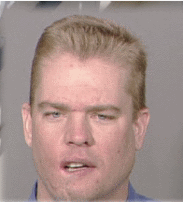
BULLETIN: Christopher Pettengill, a figure in the $194 million Trevor Cook Ponzi scheme, has pleaded guilty in Minneapolis to securities fraud, money-laundering and conspiracy, the FBI said.
Read Breaking News coverage in the Star Tribune, which is reporting that Pettengill says he has been cooperating with federal investigators since January.
Pettengill, 54, of Plymouth, Minn., was charged criminally on June 13. He potentially faces up to 20 years in federal prison.
Cook is serving a 25-year sentence. Pettengill conceivably could be sentenced to a prison term shorter than 20 years, depending on his level of cooperation and his ability to persuade a federal judge that he deserves less time behind bars.
Part of the Cook scheme traded on the acronymn UBS, a famous financial company, according to court records.
It is common in the fraud universe for hucksters and criminals to leech off the brands of famous companies and to use famous names to sanitize fraud schemes.
The Cook scheme also traded on the name “Oxford.” Some of the money ended up in a company known as Crown Forex, which had a regal theme.
Cook, former radio host Pat Kiley, and Jason Bo-Alan Beckman have been sued by the SEC. Cook and Kiley also confront a lawsuit from the CFTC.
Jon Jason Greco, 40, of Minneapolis, was charged criminally in March with making false statements to federal agents. Greco was accused of hiding loot from the scheme.
BULLETIN: A Delaware company accused by the CFTC in January of illegally hawking Forex offers has been hit with a $280,000 penalty and ordered to remove its Forex solicitation pages from the Internet.
U.S. District Judge James B. Zagel of the Northern District of Illinois entered the order against ForInvest Group of Delaware. ForInvest also is known as ForInvests Group LLC.
ForInvest also was banned permanently “from engaging in any commodity-related activity, including trading, and from registering or seeking exemption from registration with the CFTC,” the CFTC said.
The company was one of 14 Forex outfits sued by the CFTC in what was described as a nationwide sweep of unregistered firms illegally targeting U.S. residents.
ForInvest advertised that it accepted payments via Perfect Money, a murky firm purportedly based in Panama that allegedly was used by a company that defrauded thousands of deaf investors in a scheme known as Imperia Invest IBC. The SEC said in October 2010 that Imperia Invest had stolen millions of dollars from investors.
In the same CFTC sweep, the agency also sued InstaTrade Corp., doing business as InstaForex. InstaForex is an advertiser on the TalkGold Ponzi scheme and criminals forum, and research showed that InstaForex — like Imperia Invest and ForInvest — also used Perfect Money.
Imperia Invest and InstaForex also were promoted on TalkGold and other Ponzi forums, according to records.
Zagel ordered “[a]ny person or entity providing web-hosting or domain name registration services” for ForInvest to preserve documents and “[a]ny person or entity providing web-hosting or domain name registration services to “remove or cause to be removed from the Internet all webpages within their control . . .”
Two weeks after a purported “sovereign citizen” allegedly opened fire with an AK-47 on a Pensacola seafood store because it was out of crawfish, Floridians may be confronting yet-another bizarre and disturbing drama.
Indeed, members of Quincy-based AdSurfDaily appear to be circulating an email call to raise defense funds for ASD President Andy Bowdoin, accused criminally in December 2010 by federal prosecutors and the U.S. Secret Service of operating an international Ponzi scheme involving at least $110 million.
After earlier evoking the image of the President of the United States to sanitize the ASD scheme, Bowdoin’s apologists now are evoking the image of famed golfer Arnold Palmer and his famed “Arnie’s Army.”
“So now we have a strong chance to build ‘Andy’s Army’ made up of many tens of thousands of caring ASD members and other Freedom Fighters across America who are all joining together in this extremely important fight for Truth and Justice,” the email read in part.
It went on to describe the U.S. government as a “giant common enemy that destroyed Andy’s life and reputation.” The email further accused the Secret Service of seizing “all the ASD member’s advertising money from their accounts” and keeping it.
Curiously, though, the email did not explain that Bowdoin — in 2008 — agreed with the government that money seized by the Secret Service belonged to him, not individual ASD members. Nor did the email explain how the government, which has described Bowdoin as a recidivist felon involved in at least five bids over the years to fleece investors, had “destroyed” Bowdoin’s life and reputation.
After not explaining those two things, the email went on not to explain that the government announced more than two years ago that it was establishing a restitution program through a remissions administrator appointed by the Justice Department and the Secret Service — and that scammed ASD investors would be compensated from cash seized from Bowdoin’s bank accounts.
Three of Bowdoin’s bids to scam investors over the years occurred while he was operating ASD between 2006 and 2008, renaming the company to launch a new Ponzi scheme under a new brand — and coming up with two other autosurfs to scam investors, according to the government. Two previous Bowdoin efforts to defraud investors occurred more than a decade ago, according to court filings.
Instead of telling investors about his true history, he falsely led them to believe he was a highly successful businessman who’d earned a nod for business achievement from the President of the United States. Donations Bowdoin provided the National Republican Congressional Committee were funded with Ponzi proceeds, according to the government.
In September 2009, federal prosecutors described Bowdoin, now 76, as “delusional.” The assertion was made just days after Bowdoin — in a conference call with members — claimed his fight against the government was inspired by a former Miss America.
Crucially, prosecutors alleged nearly two years ago, Bowdoin had told members the seized money belonged to them. But he had told a federal judge that the money belonged to him.
“[T]his con man cannot manage to keep his stories straight,” prosecutors said.
But what the government described as an autosurf Ponzi scheme with at least two other autosurf Ponzi schemes feeding it now is being described by Bowdoin’s apologists as a “wonderful” opportunity.
And the U.S. government, which stopped an alleged Ponzi scheme in its tracks before it could further mushroom, is being described as the “enemy.”
“This same enemy destroyed and stopped the wonderful ASD business that Andy and his staff had continually created for 2 years that was making ASD member’s dreams of Financial Freedom come true,” the email continued.
Although ASD has not been associated with acts of violence, the company is known to have within its membership ranks people who define themselves as “sovereign” beings. In 2008, after the Secret Service seized 10 of Bowdoin’s personal bank accounts amid allegations he disguised a securities business as an “advertising” business and was falsely trading on the name of President George W. Bush to sanitize his scheme, Bowdoin claimed the seizures were the work of “Satan.” For good measure, he said the government’s acts against his company were comparable to the 9/11 terrorist attacks, which killed nearly 3,000 people. When reporters called ASD’s office, they were greeted by Bowdoin’s voice on an answering machine.
Bowdoin assured callers that God was on the company’s side.
Now, nearly three years later — with Bowdoin facing serious felony charges and having lost two federal appeals for more than $65.8 million seized through civil forfeiture while confronting at least one more civil-forfeiture case and a racketeering lawsuit filed by three of his members — Bowdoin says he is out of money, according to ASD members.
The remedy for Bowdoin’s purported lack of funds, according to his apologists, is for ASD members to provide cash $20 and $50 at a time. The money will go into a legal war chest from which Bowdoin, positioned as “David,” can draw funds to stone his enemy in court, with the government positioned as “Goliath.”
We presume the David-and-Goliath reference in the email is figurative, but the language employed by the apologists is disturbing even if no actual rocks will be thrown at the people who prosecute criminal cases and protect the life of the President of the United States while guarding the U.S. financial infrastructure.
“In the Biblical Story of David & Goliath, little David, all alone, threw only one rock with a strong force and deadly aim and killed Goliath with a sharp powerful blow to the forehead,” the email read. “And now each member of Andy’s Army can throw one rock (one contribution of up to $50), and when combined all together will become tens of thousands of these financial ‘rocks’ that are each propelled by the powerful force of Truth, and these ‘rocks’ will strike the common enemy by giving Andy’s Legal Defense Team the massive funds they need to fight and win this giant case for Andy, for ASD and for each of you. Together the combined financial force of Andy’s Army can destroy this giant nightmare and make that wonderful dream described above come true for everyone.”
The new bid to raise funds for Bowdoin follows on the heels of a bid by some Florida members of ASD to raise funds for themselves — reportedly $10,000 to sue the United States in Florida’s federal courts. Dozens of ASD members previously had failed in their pro se bids to derail the forfeiture cases against Bowdoin’s money in federal court in the District of Columbia.
Prior to the failed bids in the District of Columbia, a federal judge was described as “brain dead” if she ruled against ASD. One ASD member called for other members to form a “militia” and storm Washington with guns. Another opined that a federal prosecutor should be placed in a torture rack — with ASD members drawing straws to see who got the honor of turning the wheel.
ASD critics were described as “rats,” “maggots” and “cockroaches” — and these things happened after Bowdoin advised the troops that “Satan” was on the prowl and that God was on ASD’s side.
This madness is hardly limited to Florida.
About the only things for certain is that Andy Bowdoin is no Arnold Palmer, and ASD was no “wonderful” company.
What is was was a criminal mirage that triggered a mass delusion.
BULLETIN: The court-appointed receiver in the Trevor Cook Ponzi scheme has recovered more than $1.1 million that had been tied up in Switzerland.
Receiver R.J. Zayed says that $1,127,495 has been deposited in a U.S. Court account.
“[T]he Receiver has now accomplished the goal of repatriating the Swiss funds so that money can be returned to investors,” Zayed said in a court filing dated yesterday.
The development is good news to Cook’s swindled investors — but it was not without costs and legal drama.
An individual U.S. investor in the Cook Ponzi scheme filed a criminal complaint in Switzerland to give himself priority to the funds, putting himself ahead of hundreds of other swindled investors and violating a U.S. court order, Zayed said.
Records show that the U.S. investor who filed the claim lost at least $598,921 in the swindle.
A Swiss prosecutor would not release the Cook cash to U.S. investors as a whole while the individual complaint was pending, and Zayed filed a contempt motion in the United States against the individual Cook investor, accusing him of being an impediment to the receivership’s efforts to claim the sum for all defrauded investors.
The Swiss complaint filed by the U.S. investor was withdrawn on May 24, Zayed said.
With the impediment of the U.S. investor’s complaint removed, “the Swiss prosecutor was able to lift the freeze on the Receiver’s UBS account and clear the way for the money to be returned to the United States and the victims of this fraud,” Zayed said.
Zayed said the U.S. investor likely did not have the resources to pay back the receivership estate for the money it expended trying to prevent a single investor from gaining an unfair share of the Swiss proceeds, so the receivership — with the Swiss sum safely returned to the United States for the benefit of all investors — dropped the contempt complaint.
Jason Bo-Allan Beckman helped finance the U.S. investor’s Swiss action in December 2009 — more than a month after Cook’s assets were frozen and investors were prohibited by court order from engaging in self-help to recover stolen funds, according to court filings.
Beckman later emerged as a defendant in an action filed by the SEC that accused him of being a leading figure in the $194 million Ponzi and Forex caper.
BULLETIN: The Autorité des marchés financiers (AMF) has obtained freeze and cease-trade orders against three Quebec residents and two business entities — and has shut down at least one website amid allegations that an international marketing scam was under way.
At least two of the programs referenced in AMF’s action were promoted on the TalkGold and MoneyMakerGroup Ponzi forums: Cherryshares, an HYIP darling that collapsed last year, and Mega Pension Plan.
Cherryshares was a paid advertiser on the Ponzi forums. It vanished under mysterious circumstances in December.
AMF described the scams as insidious because the promoters didn’t ask for big money from individual investors, instead relying on relatively small sums to add up to a larger sum.
“These seemingly modest amounts add up to anything but,” according to an AMF news release.
Named in the AMF action are Warren English of Laval, and Alain-André Desarzens and Michèle Amiot of Rimouski. Desarzens and Amiot are married, AMF said.
“Messrs. English and Desarzens had issued a mass e-mailing to thousands of potential investors with promises of pocketing a lot of money fast,” AMF said.
Using different email addresses, English and Desarzens promoted “numerous investments,” including Cherryshares and Mega Pension Plan, AMF alleged.
“They offered thousands of investors around the world, including two Quebeckers, the opportunity to generate possible returns ranging from U.S.$1,000 to $90,000 on a minimum investment of between U.S.$10 and $300,” AMF alleged.
Even as he was soliciting new prospects, English was under a cease-trade order issued by the Ontario Securities Commission in 2003, AMF said.
Desarzens, meanwhile, was under a cease-trade order issued by the Pennsylvania Securities Commission in 1999, AMF said.
English used some of the funds from the Mega Pension Plan scam to acquire a “luxury condominium” in Laval, AMF said.
“Based on the data gathered by the AMF, Mr. English moved nearly $525,000 between his accounts and those of his company, Méga International Business,” AMF said.
All in all, Desarzens allegedly acquired $875,000 as a result of scamming.
No breakdown of which scam was more profitable was provided, but some of the cash ended up with Desarzens’ spouse — and some of it ended up with a Desarzens-controlled entity known as Institut des médecines universelles, AMF said.
A website linked to Desarzens — www.myleads.8k.com — was ordered shut down.
A Minnesota man has become the second person with ties to convicted Ponzi schemer Trevor Cook’s Forex scam to be charged criminally.
Christopher Pettengill, 54, of Plymouth, “knowingly concealed information from investors concerning the foreign currency program sold by Pettengill, Cook, and others,” federal prosecutors said.
He has been charged with securities fraud, money-laundering and conspiracy to commit wire fraud, the office of U.S. Attorney B. Todd Jones of the District of Minnesota said.
Cook pleaded guilty in the $194 million caper last year and was sentenced to 25 years in federal prison.
Jon Jason Greco, 40, of Minneapolis, was charged in March with making false statements to federal agents. Greco was accused of hiding loot from the scheme.
Pettengill was accused of lending credibility to the scam and encouraging people to invest money.
“Pettengill allegedly conducted numerous wire transfers during the course of the conspiracy, and on September 3, 2008, he allegedly made a credit card payment of $11,369.19, which was derived from the proceeds of the securities fraud,” prosecutors said.
He faces up to 20 years in prison, if convicted on all counts.
The SEC and CFTC sued Cook and former radio personality Pat Kiley in November 2009. Earlier this year, the SEC filed suit against Jason Bo-Alan Beckman, another alleged promoter of the scam.
Screen shot from a PowerPoint presentation on Club Asteria. The presentation is attributed to Andrea Lucas and is accessible online. (White highlights in screen shot added by PP Blog.)
UPDATED 9:09 A.M. EDT (June 14, U.S.A.) A PowerPoint pitch titled “Asteria Corporation” raises serious questions about the nature of the business “opportunity” and may undermine Club Asteria’s own claims that members alone are to blame for the company’s apparent troubles.
The document is slugged “[ClubAsteriaPresentation]” and attributed to Asteria Corp. and Andrea Lucas. It describes the “program” as one that enables “passive” income and provides a “25% Matching Bonus” — and claims Gold and Silver members are “100% GUARANTEED to Make Money.”
Screen shot: The "Properties" of this Club Asteria PowerPoint pitch identifies Andrea R. Lucas as the author.
The PowerPoint presentation leads to questions about whether Club Asteria is selling unregistered securities as investment contracts. Meanwhile, it casts doubt on Club Asteria’s claim that members are uniquely responsible for positioning the program as a passive investment opportunity with guaranteed earnings.
Virginia-based Club Asteria identifies Andrea Lucas as its managing director. The program, which members say has slashed payouts and sends money via wire from a Hong Kong company known as Asteria Holdings Limited, is being investigated by Italian authorities. Club Asteria acknowledged last month that its access to PayPal had been blocked, blaming the development on misrepresentations made by members. Member payouts plunged after the PayPal development.
Promoters of Club Asteria routinely trade on the name of the World Bank.
Separately, promoter “Ken Russo” — posting on the TalkGold Ponzi scheme and criminals’ forum as “DRdave” weeks after the PayPal freeze and the developments in Italy — noted he has received by wire $1,632 from Club Asteria since June 2. In separate posts, “Ken Russo” claimed to have received $1,311 on June 2 and $321 on June 12. Both payments came from “Asteria Holdings Limited (Hong Kong),” according to the posts.
Other Ponzi-forum posters claim they were less fortunate than “Ken Russo.” A poster on MoneyMakerGroup, for example, lamented a payment this week of only 30 cents.
“my astrios (sic) stand at almost 1000 and you will be shocked to know that i earned only 30 cents this week, thats (sic) like 4 cents per day for an investment of $1000,” the poster complained.
Another MoneyMakerGroup poster said this: “I made 80 cents from my 2,500 asterios.”
Even TalkGold, which provides the cyberspace criminals and hucksters use to fleece hundreds of thousands of people globally in one Ponzi or fraud scheme after another, is questioning why Russo appears to be doing so well while others have been left holding the bag.
“Something unreal compare[d] to others cashouts amount (sic),” a TalkGold Mod wrote on June 10 about “Ken Russo’s” June 2 claim of a $1,311 Club Asteria payout.
Other forum posters say they plan to retaliate against Club Asteria by filing disputes with Alert Pay, an offshore processor used by Club Asteria.
“This worked for me with genius funds,” wrote one TalkGold promoter, referring to Genius Funds, an international scam promoted on the Ponzi boards that the Financial Industry Regulatory Authority (FINRA) said last year stole $400 million.
And the TalkGold poster who’d previously been ripped off in the Genius Funds scam and filed an Alert Pay dispute said he’d do the same thing with Club Asteria — and encouraged others to do the same.
“Yesterday I filed 3 complaints for myself and family and if enough people do it, maybe they will block their alertpay account and share it out to us,” the poster claimed.
He found a receptive audience, and a TalkGold poster who responded to his plea to contact Alert Pay suggested Andrea Lucas was trying to stop members from filing disputes.
“I have contacted to Alertpay too just some days ago,” the TalkGold poster wrote. “Andrea Lucas contacted to me and started whine. Whaiting (sic) message from Alertpay.
“I think their PayPal account was blocked in the same way as it’s going to be with their Alertpay account,” the poster wrote. “Some smart guys did it before us.”
Some Club Asteria members have offered inducements for prospects to join the program, including partial reimbursements of monthly fees. Such members now potentially find themselves in the position of having locked in their own losses by bribing prospects up front and expecting to recapture the expense as the program expanded.
In 2010, “Ken Russo” — while promoting the MPB Today “grocery” program on the Ponzi boards — said one of his downline members was offering up-front payments to incoming prospects to drive business to MPB Today.
UPDATED 1:46 P.M. EDT (U.S.A.) AdSurfDaily “paid out millions of dollars to operators and insiders,” according to a U.S. Secret Service affidavit originally filed under seal in February 2009.
But ASD President Andy Bowdoin changed the subject when people told him that what Florida-based ASD was doing not only was illegal, but also was “not mathematically possible,” according to the affidavit.
What he was trying to do, according to court filings, was establish at least three autosurfs that would generate Ponzi-extending cash while Bowdoin positioned them as legitimate “advertising” businesses.
And Bowdoin also wanted to persuade members that he had discovered a formula that purportedly made it possible for ASD to set aside 50 percent of its daily revenue and pay participants 125 percent of what they paid in — all while planting the seed that members could expect a return of 8 percent a day on some days.
Investigators saw things a different way, saying ASD was creating a minimum liability of $1.25 for every dollar it took in.
“Try it — it works,” Bowdoin simply told the doubters, changing the subject instead of addressing the mathematical realities, according to the Secret Service.
There was too little profit in operating legitimately, Bowdoin told a consultant, according to the Secret Service.
As ASD was facing a Ponzi abyss, a consultant told Bowdoin there was a way for ASD to clean up its act, according to the Secret Service.
“Bowdoin, however, was dissatisfied with the consultant’s revenue sharing proposal and with the limited revenue a legitimate business would produce,” the Secret Service alleged in the February 2009 affidavit. “Bowdoin rejected the consultant’s plan and terminated his relationship with the consultant.”
Bowdoin had arrived at his 50-in/125-out formula after an earlier formula in which ASD purportedly had set aside 60 percent of its revenue to pay participants 150 percent of what they paid in had brought on a Ponzi collapse that caused the company to cease operations and leave investors in limbo for weeks in 2007, according to the Secret Service.
ASD’s original formula was concocted by Bowdoin and his “silent partner,” a man who recruited Bowdoin into the 12DailyPro autosurf Ponzi scheme, according to the Secret Service.
Both of ASD’s formulas were just a means of hiding ASD’s true nature as a financial beast with a fatal disease, according to court filings.
Despite the spectacular collapse of 12DailyPro amid Ponzi allegations filed by the SEC in early 2006, Bowdoin and his silent partner ruminated that 12DailyPro simply had promised to pay out too much money on a daily basis, according to the Secret Service.
Upstart ASD, Bowdoin and his silent partner speculated, could take regulators out of play and avoid the Ponzi fate of 12DailyPro by telling investors that the firm would pay out less money and by introducing verbal sleight-of-hand to disguise the true nature of the business, according to the Secret Service.
ASD also speculated that it could circumvent the Ponzi problem and law-enforcement scrutiny by suggesting that ASD’s payouts, which the firm called “rebates,” were not “guaranteed,” according to the Secret Service.
Despite telling members to “Try it — it works,” Bowdoin had no confidence in his business model and knew it was still a Ponzi despite the post-12DailyPro tweaking. In the end, according to court documents and other records, ASD still was telling investors they’d get back more than they paid in and, on a yearly basis, would receive a return of 365 percent at a “rebate” rate of 1 percent a day.
Even as ASD was playing in the post-12DailyPro fields and grew eventually to suck in tens of millions of dollars a week, less than 2 percent of its revenue came from external sources. More than 98 percent came from members and was simply being recycled to other members to keep the Ponzi afloat, according federal prosecutors.
At a certain point in time, Bowdoin did away with unlimited purchases and limited the amount investors could pay ASD to $12,000 “because he did not want members to lo[]se too much money should ASD collapse,” according to the February 2009 Secret Service affidavit.
The import of the claim is that prosecutors can argue to a jury that Bowdoin himself was worried about the imminent demise of ASD — a demise Bowdoin brought on through the use of various mathematical concoctions, linguistic fantasies and fabrications designed to separate people from their money to keep the Ponzi afloat.
Meanwhile, the claim sets the stage for prosecutors to tell a jury that Bowdoin anticipated a catastrophe and sought to insulate himself from prosecution by suggesting that ASD did not guarantee rebates and that customers were purchasing “advertising,” as opposed to entering into an investment contract with ASD.
“[T]o ensure that no individual investor monopolized the rebate pool, and to reduce the
likelihood that any individual investor would suffer a catastrophic loss, Bowdoin placed a limit on the amount of ‘advertising’ members could purchase,” the Secret Service said. “Of course, it would have made no sense to impose such limitations if ASD was actually selling, and members actually were purchasing, Internet advertising.”
Bowdoin’s various stories were at odds with themselves, the Secret service alleged. Even as Bowdoin was telling members ASD was not in the investment business and instead was a provider of advertising “rebates,” ASD’s computer systems described member payouts as “ROI” — for Return on Investment.
And even as he positioned himself as a Christian “money magnet” and merchant who’d been recognized by the President of the United States — and even as he purportedly was enforcing a $12,000 purchase ceiling to minimize the chance an individual investor would become engulfed in a calamity — Bowdoin told attendees of company “rallies” in U.S. cities that ASD would match the money they plowed into the firm 50 cents on the dollar.
“At the rallies, to raise more money, Bowdoin concocted the idea of running ‘rally-only promotions,’” the Secret Service alleged. “New members were told they would receive a 50% bonus for joining at the rally. For example, if a new member purchased $500 in ‘ad packages’ as a bonus she would be credited $750 to her account. Representatives of ASD stated this was a ‘World Wide Wealth’ program that was available to anyone with Internet access.”
In early 2008, Bowdoin became a participant in a scheme with a “North Carolina” attorney to assure prospects that ASD had been vetted and was operating lawfully. ASD’s 26-minute legality video and the rallies caused tens of millions of dollars suddenly to flow into the firm, according to the Secret Service.
Just a year earlier, the company suspended operations because it was starved for cash flow and faced a collapsed Ponzi, according to the Secret Service. ASD’s response to the collapse was to launch a new autosurf Ponzi under a new name — and to port the accounts of its original set of victims into the new scheme, where the payouts early loyalists had expected would be funded by incoming participants who did not know their money was being distributed to Bowdoin’s orginal victims.
Later in 2008, as spring and summer warmth returned to northern climes, ASD found people throwing money at it. Some of the people who threw money at ASD did so at rallies in Iowa, according to the Secret Service.
Affidavit For Seizure Targeted At At Least 7 Iowa Bank Accounts
The PP Blog reported in December 2010 that funds traced to Bowdoin and two other ASD members had been targeted in yet-another forfeiture action in the District of Columbia. The action was filed less than three weeks after Bowdoin’s Dec. 1 arrest by federal agents in Florida on Ponzi-related charges of wire fraud, securities fraud and selling unregistered securities.
Prosecutors’ December civil-forfeiture action was at least the third targeted at assets owned by Bowdoin. Assets of two other ASD members — Erma “Web Room Lady” Seabaugh and Robyn Lynn Stevenson (also: Robyn Lynn) of Florida — also were targeted.
The civil case against Bowdoin’s assets is on hold because of the criminal allegations against him. But the cases against the assets of Seabaugh and Lynn remain active. Neither Seabaugh nor Lynn had filed a claim for the money as of Friday.
In the case against Seabaugh’s assets, the government was authorized to seize $213,693 from a bank account, but found only $153,097 in the account. The Secret Service seized $96,525 from two bank accounts linked to Lynn.
Some of the money Seabaugh plowed into ASD originated at E-Bullion, a shuttered California money-services business operated by convicted murderer James Fayed, who ordered the execution of his estranged wife in 2008.
Pamela Fayed, a potential witness against her husband on matters pertaining to E-Bullion and an associated business known as Goldfinger Coin & Bullion, was slashed to death in a Los Angeles-area parking garage on July 28, 2008.
On Aug. 1, 2008, the Secret Service seized tens of millions of dollars from Bowdoin’s bank accounts. The December 2010 claim by federal prosecutors that Seabaugh had used E-Bullion to fund one of her ASD accounts was the first public tie between ASD and E-Bullion, which has been linked to multiple Ponzi schemes.
Seabaugh had multiple ASD accounts with multiple email addresses — and appeared to be “selling her own investment ‘ad packs’ to clients and representing herself as ASD,” the Secret Service alleged.
The PP Blog learned on June 10 that the Secret Service, in February 2009, also targeted proceeds in seven bank accounts belonging to ASD members in Iowa for forfeiture. In an affidavit, the agency said the accounts contained at least $413,018.
How the cases are evolving was not immediately clear. The Secret Service, according to the affidavit, identified the assets as proceeds of an ASD-related wire-fraud scheme.
Acting as pro se pleaders and using a litigation template associated with ASD participant Curtis Richmond, one of the so-called Arby’s Indians, two of the individuals associated with the Iowa accounts cited by the Secret Service in the February 2009 affidavit later attempted unsuccessfully to intervene in the main civil-forfeiture case against Bowdoin’s assets.
The February 2009 Secret Service affidavit identifies the individuals as Joyce and Michael Haws.
“Joyce Haws was an active participant in and large promoter of the ASD wire fraud
scheme,” the Secret Service alleged in the affidavit. “Ms. Haws was one of several people who requested and facilitated one of the first rallies within ASD, in Ankeny, Iowa, on about March 15th, 2008.”
Haws recruited her mother and others into the scheme, according to the affidavit.
Walter Clarence Busby Jr., a Georgia minister and Bowdoin’s alleged business partner in Golden Panda Ad Builder, identified Joyce Haws and her “spouse” in 2008 as “founders” of Golden Panda.
In the same Busby affidavit, filed on Aug. 29, 2008, Busby identified Robyn Lynn as the person who introduced him to ASD.
Curtis Richmond was an early mainstay in the ASD story. He has a contempt-of-court conviction for threatening federal judges, has been banned from the practice of law in Colorado even though he is not an attorney and has been sued successfully under the federal racketeering statute for harassing public officials and participating in schemes to place bogus financial judgments against them.
Richmond, who proclaimed himself a sovereign being answerable only to God, was a member of a Utah “Indian” tribe a federal judge ruled a “sham.” The “tribe” got its derisive name — the Arby’s Indians — because it once held a meeting in an Arby’s restaurant.
The “tribe” also used the address of a Utah doughnut shop as the address of its “Supreme Court,” while threatening public officials with arrest and detention for carrying out their official duties.
EDITOR’S NOTE:First of two parts. Part Two will be published later tonight or tomorrow.
Even as AdSurfDaily President Andy Bowdoin was venturing to Washington in June 2008 to receive what his members and prospects were told was the “Medal of Distinction” from the President of the United States, he was harboring terrible secrets and knew full well his autosurf business was a Ponzi scheme that could collapse at any second and lay waste to thousands of investors, according to court records and an affidavit originally filed under seal by the U.S. Secret Service.
Much of the information from the affidavit, which was filed in February 2009, is being published today for the first time. Companion court documents in ASD-related litigation show that part of a third civil-forfeiture case brought in December 2010 against assets alleged to be owned by ASD and Bowdoin has been put on hold while Bowdoin is battling criminal allegations — and that some individual ASD members whose assets were targeted for forfeiture in the same case have not filed claims for money seized from their bank accounts. Although the forfeiture action against Bowdoin has been suspended, the cases against the assets of the individual ASD members remain active.
Just two months prior to his June 2008 Washington jaunt — in April 2008 — Bowdoin had flown at the prompting of a “North Carolina lawyer” to Panama and Costa Rica with his wife and the lawyer. The purpose of the trip, according to the affidavit, was to incorporate ASD Cash Generator and an entity known known as La Sorta Trading outside of U.S. jurisdiction to create wiggle room if U.S. regulators came knocking.
ASD Cash Generator was the replacement name for the original ASD autosurf business, which was known simply as AdSurfDaily. The first scheme collapsed in 2007, leaving Bowdoin’s first set of investors holding the bag, according to the affidavit. Bowdoin’s later investors were not told about the firm’s dubious history.
La Sorta Trading, whose purpose was not immediately clear, never before has been referenced in the ASD case. La Sorta is the name of a city in Honduras, another country in Central America. It is not known if the firm was named after the city.
Bowdoin also was exploring the possibility that he and his wife would move from the small town of Quincy, Fla., to Costa Rica, the Secret Service advised U.S. District Judge Rosemary Collyer.
“Bowdoin’s wife did not like Costa Rica, however, and his plans to move ASD’s operations off shore were shelved,” according to the affidavit.
The February 2009 affidavit paints Bowdoin, now 76, as a man experiencing pressure from multiple points of contact — and as a man who made one disastrous decision after another. One of the things allegedly pressuring Bowdoin was fear that the Ponzi could come tumbling down before enough new members were recruited to keep cash churning and the facade of a successful and lawful business in place. Yet-another was fear that insiders, ordinary members and even employees could turn on him. Still-another was fear that a government intervention could occur at any time, according to the affidavit.
Of the millions of dollars that had flowed into ASD, “less tha[n] $25,000 was derived from independent revenue,” according to the affidavit. The rest had come from members and was being recycled in classic Ponzi scheme fashion, with Bowdoin initially empowering himself and a “silent partner” to rake 10 percent of ASD’s “gross sales” and split it evenly: 5 percent each.
But even as he was in Washington in June 2008 to receive an award he positioned as a Presidential acknowledgment of his business acumen, Bowdoin knew that his silent partner posed a risk to him, according to the affidavit.
That silent partner, according to the affidavit, was Bowdoin’s “sponsor” in 12DailyPro, an autosurf the SEC accused of running a massive Ponzi scheme more than two years earlier.
Through his sponsor, Bowdoin had invested $100 in 12DailyPro. The money was lost quickly because the SEC shut down 12DailyPro soon after Bowdoin joined. But Neither Bowdoin nor his silent partner took the clue from the SEC’s action, according to the affidavit. Instead, they worked on ways to channel 12DailyPro-like revenue to themselves and disguise what they were doing.
“Based on his experience with 12daily Pro, and his review of the SEC’s filings against it, Bowdoin knew that a paid auto-surf program that promised returns of that magnitude and recycled member funds was a business model that was both unsustainable and illegal. He also knew that selling an unregistered investment opportunity to thousands of investors was illegal. Nevertheless, after the collapse of 12daily Pro, Bowdoin agreed with his 12daily Pro sponsor to start a similar autosurf program. Both individuals were aware that, before its collapse, 12daily Pro had taken in millions of dollars from its members.”
Under Bowdoin’s agreement with his silent partner, Bowdoin was responsible for managing ASD’s operations. The partner, meanwhile, was responsible for marketing ASD.
In December 2006, about a year and a half prior to Bowdoin’s June 2008 trip to Washington amid claims he was receiving a Presidential award for business smarts, Bowdoin arbitrarily slashed the silent partner’s cut of the upstart ASD business from 5 percent of the gross to 1 percent, according to the affidavit.
Despite the fact Bowdoin had been a 12DailyPro member recruited into that SEC-smashed Ponzi scheme by the same person who’d later emerge as his silent partner in ASD, Bowdoin explained to the silent partner that he — meaning Bowdoin — “was performing most of the work, and bearing most of the risk in operating ASD,” according to the affidavit.
With those words, Bowdoin imposed a pay cut on the silent partner, who later asserted Bowdoin had ripped him off, according to the affidavit.
In August 2008, during a search of Bowdoin’s home in Quincy less than two months after the Washington jaunt and the Presidential claims, the Secret Service found Bowdoin’s handwritten notes from December 2006 that “show his and his silent partner’s awareness of the risks of the auto-surf program they were conducting,” the Secret Service said in the affidavit.
“Bowdoin’s notes indicate that he told his silent partner that the partner should have made him better aware of those risks ‘knowing regulators were on the prowl for surfing sites,’” the Secret Service alleged.
It is known from other documents that the Secret Service opened the ASD probe after becoming aware of the company on July 3, 2008, about 17 days after Bowdoin had ventured to Washington amid claims he’d be be receiving a Presidential award and dining with President George W. Bush and Vice President Dick Cheney.
One of the documents is a 57-page evidence exhibit that includes surveillance photos taken in Quincy prior to the seizure of tens of millions of dollars from Bowdoin’s 10 personal bank accounts, one of which allegedly contained more than $31.6 million. The Secret Service was alarmed as it began the process of peeling back layers of the onion, according to court records
Before July had come to a close, the agency — confronted with a murky fact set and trying to figure out how a man who claimed to have had a remarkable business career that had captured the attention of the President of the United States — had assigned multiple undercover agents to the ASD case.
One of the earliest puzzles to solve, according to court documents, was that Bowdoin had left behind a string of dissolved companies in Florida and professed to be wealthy — but had “earned no significant income from legal employment in the twenty years prior to his commencement of ASD’s operation.”
As the investigation progressed, according to court documents and the February 2009 affidavit, agents discovered that ASD had “special” members who provided Bowdoin start-up capital to varying degrees. These “special” members were grouped as members of ASD’s “President’s Circle,” “President’s Advisory Board” and “President’s Advisory Counsel,” and also knew about the 12Daily Pro Ponzi.
At least “some” of them, according to the affidavit, counseled Bowdoin not to use the name he initially contemplated in 2006 for the upstart enterprise: DailyProSurf.
Some of the special members, who were entitled to higher compensation than ordinary members, “complained” that DailyProSurf sounded too much like 12DailyPro. In response to the concerns, the enterprise abandoned the DailyProSurf name and used the name AdSurfDaily as a means of avoiding “law enforcement scrutiny,” according to the February 2009 affidavit.
The document did not name the “special” members. It was filed under seal on Feb. 26, 2009, during a period in which an autosurf known as AdViewGlobal (AVG) was launching. AVG may represent the fourth iteration of ASD, one launched months after the seizure of Bowdoin’s bank accounts by the Secret Service in August 2008.
AVG’s name is not referenced in the February 2009 affidavit. In June 2009, however, AVG’s name surfaced in a racketeering lawsuit brought against Bowdoin and North Carolina attorney Robert Garner. In September 2009, the government made a veiled reference to AVG in court filings.
Lawyers Referenced In Secret Service Affidavit As Bowdoin’s Partners In LaFuenteDinero, The ‘Spanish’ ASD
NOTE: The PP Blog became aware in 2010 that the government had subpoenaed at least three North Carolina attorneys, including Robert Garner, in the ASD case. The other two attorneys were husband and wife. The husband, who was sentenced to a year in federal prison in 2006 for lying to the FBI in a real-estate case, was disbarred in 2009. Bowdoin challenged the subpoenas, arguing that his communications with the lawyers were privileged. A federal judge ruled that the attorneys had to testify.
The Blog, which previously has published stories that reference Garner, is doing so again today. Garner is listed in Nevada records as a “director” of AdSurfDaily Inc., with Bowdoin as the president, secretary and treasurer. However, the Blog is choosing today not to publish the names of the husband-and-wife attorneys, but reserves its right to do so in the future.
Moving on . . .
One of the most stunning allegations in the February 2009 Secret Service affidavit, which became a public record when the seal was lifted in May 2009 and which the PP Blog is reporting on for the first time today, was that two of the North Carolina lawyers were proposed as Bowdoin’s business partners in LaFuenteDinero (LFD). LFD was ASD’s so-called Spanish autosurf. The proposal was made by one of the lawyers, who described the other lawyer as his “law partner.”
The section below is verbatim from the February 2009 Secret Service affidavit:
“In approximately September or October 2007, ASD’s North Carolina lawyer suggested to Bowdoin that they should start a new site that was in Spanish. In addition, the North Carolina lawyer suggested that the company associated with this site should be set up off shore because when these type of companies raise too much money the government comes in and shuts them down. The North Carolina lawyer recommended that he, his ‘law partner’ and Bowdoin would each share ownership of the Spanish site (as 1/3 share partners). In return for the others’ ownership interests, the North Carolina lawyer and his associate would handle the incorporation work and all of the work needed to move operations offshore.”
By early 2008, with nearly a year and a half of troubled operation under its belt and a Ponzi collapse that had caused ASD to cease operations for weeks in 2007 as it tooled up for a second try under the ASD Cash Generator brand, Bowdoin was growing “suspicious” of at least one of the North Carolina lawyers, according to the affidavit.
“In February 2008, Bowdoin, the North Carolina lawyer and an ‘Internet marketer’ discussed expanding ASD by beginning a new site in Chinese, which would be called Golden Panda Ad Builder,” according to the affidavit. “The North Carolina lawyer suggested a person that would be well suited to run the site offshore, but Bowdoin was beginning to get suspicious of the lawyer. Bowdoin decided, instead, to split the Chinese site with the Georgia minister. Bowdoin told the Georgia minister that ASD had no outside income sources and that ASD’s survival was depend[e]nt on an ever growing base of new contributors. The Georgia minister began working on developing the Chinese auto-surf site.”
‘Georgia Minister’ Allegedly Caught Stealing By ASD Employees; Bowdoin Allegedly Stays Silent About Theft
Bowdoin, according to the affidavit, confronted trouble from any number of fronts. One of his colleagues — the “silent partner” who had been Bowdoin’s 12DailyPro sponsor whose rake Bowdoin allegedly had slashed after they started ASD — told Bowdoin he believed he was owed $20,000 and threatened to expose ASD’s new operation.
“Bowdoin agreed to compensate the sponsor” after initially balking, according to the affidavit.
And Bowdoin also was under pressure from the “North Carolina lawyer” to move the ASD operation offshore — counsel Bowdoin earlier had resisted but agreed to explore in April 2008, despite his suspicions about the lawyer, according to the affidavit.
During the first half of 2008, with Golden Panda still not off the ground during a period in which the “Georgia minister” had access to ASD’s computer system, ASD employees began to complain that the minister was “padding” his ASD account by “secretly using his access to the computer system to increase his/relatives’ number of ad packages,” according to the affidavit.
Bowdoin personally investigated the complaints, comparing the “Georgia minister’s” account with banking records.
Bowdoin “confirmed for himself that the Georgia minister was in fact stealing money from ASD by creating free ad packages,” according to the affidavit. “When confronted, the Georgia minister denied the allegations and asserted that he had proof that the ad packages he created flowed from legitimate deposits of funds into ASD’s bank accounts. The Georgia minister never showed Bowdoin this proof, however, and each time Bowdoin or someone else inquired about the evidence of deposits, the Georgia minister created an excuse to explain why he did not then have it.”
Instead of firing the Georgia minister and ending the relationship, “Bowdoin did not pursue the matter,” according to the affidavit.
Things took a dramatic turn “in about June 2008,” when ASD employees discovered that “the Georgia minister had been permanently enjoined by a court from committing violations of the federal securities laws.
“When ASD employees disclosed this information to Bowdoin, they told him that ASD needed to distance itself from the minister,” according to the affidavit. “Bowdoin agreed to severe his ties to the Golden Panda operation after several ASD employees indicated that they were unwilling to work with the Georgia minister.”
Walter Clarence Busby Jr. of Acworth, Georgia, has been identified by the government in other court filings as Bowdoin’s Golden Panda partner. Separate court documents describe Busby as a minister and real-estate professional, and the SEC described Busby in 1997 as a prime-bank swindler.
In court filings in the ASD case, Busby advised Collyer that he had prevailed upon another minister to assist him in arranging a relaxing day of fishing with Bowdoin in April 2008. During that same month, according to the February 2009 Secret Service affidavit, Bowdoin ventured to Central America with his wife and a “North Carolina lawyer.”
The fishing excursion took place in Brunswick, Georgia, on April 11, 2008, according to court filings by Busby. Five days later, according to the February 2009 Secret Service affidavit, Bowdoin was in Panama and Costa Rica, discussing ASD business and the formation of the La Sorta Trading firm.
Coming later: Government moves against money in ASD-related bank accounts in Iowa and other states.
NOTE TO READERS: Some of the evidence federal prosecutors have in the Ponzi scheme case against AdSurfDaily President Andy Bowdoin is coming into clearer focus. The PP Blog expects to publish a report within the next couple of hours.
Our report is based on an affidavit originally filed under seal by the U.S. Secret Service in February 2009, during a time in which some ASD members were promoting a purported “offshore” autosurf known as AdViewGlobal — even after the August 2008 seizure of tens of millions of dollars from Bowdoin’s bank accounts amid wire-fraud and securities allegations.
The affidavit builds on earlier affidavits and paints a picture of a worried Bowdoin at the helm of ASD — and of astonishing corruption and deceit within ASD leading up to the summertime seizure nearly three years ago.
Instead of pulling the plug on his crime before investors were ruined, Bowdoin ramped up the criminality and sought to sanitize it, going so far as to trade falsely on the name of the President of the United States and permit others to do so, according to the Secret Service affidavit.
Much of the information in the affidavit never before has been published, although it was previously known that Bowdoin allegedly tried to tie ASD to the White House to disarm skeptical investors and keep the firm’s money wheel greased.
Here is a verbatim snippet from the affidavit:
“Hand-written notes that Bowdoin prepared in about December 2006 (which were recovered in August 2008, during a search warrant at Bowdoin’s home) show his and his silent partner’s awareness of the risks of the auto-surf program they were conducting. Bowdoin’s notes indicate that he told his silent partner that the partner should have made him better aware of those risks ‘knowing regulators were on the prowl for surfing sites.’”
Translation: Bowdoin knew at least 18 months prior to his June 2008 trip to Washington to receive the “Medal of Distinction” that ASD was playing with fire.
The “medal” was not a presidential acknowledgment of Bowdoin’s business acumen. Rather, it was a “marketing” memento from the National Republican Congressional Committee, according to the affidavit.
And the affidavit also spells out other things Bowdoin allegedly knew while he was touting Presidential recognition of his business career. (We’ll write about those things in the upcoming story.)
The February 2009 affidavit was prepared in part to seize more than $413,000 held in the bank accounts of certain ASD members from Iowa — and also to seize more than $310,000 in the bank accounts of two other ASD members: one from Florida, the other from Missouri.
At least $10,510 of the amount the government moved to seize was traceable to E-Bullion, according to the affidavit.
E-Bullion is a shuttered California money-services business whose operator, James Fayed, was convicted last month of ordering the murder of his estranged wife, Pamela Fayed, a potential witness against him.
Fayed faces the prospect of execution for the murder. The jury recommended the death penalty earlier this month. Formal sentencing is scheduled for September.
Get ready for some prosecutorial bombshells in the ASD case . . .
BULLETIN: The SEC has gone to federal court in Utah to seek penalties against a precious metals company and associated firms and individuals, amid spectacular allegations that a PR firm sold the unregistered securities of its own corrupt penny-stock client and a disbarred attorney enabled the scam by issuing a bogus opinion letter.
Utah has been identified by the interagency Financial Fraud Enforcement Task Force as a hotbed of fraud, and the SEC’s allegations against Copper King Mining Corp. and its co-defendants read like a work of fiction — but the agency says they are true.
Charged along with the company was its former President and Chief Executive Officer Mark D. Dotson, 52, of Milford. Also charged were Alexander Lindale LLC, a Salty Lake City PR firm; PR executive Wilford R. Blum, 58, of Salt Lake City, and Stephen G. Bennett, 52, of of Merrimack, New Hampshire.
Bennett formerly was licensed to practice law in Utah, but was disbarred in November 2001 for commingling clients’ money with his personal bank accounts, the SEC said.
Blum is the general manager of Alexander Lindale, the PR firm.
Despite Bennett’s disbarment, he provided “stock tradability opinion letters to Copper King which stated Alexander Lindale could have unrestricted Rule 504 stock issued to it pursuant to a purported transactional exemption provided under Minnesota state securities law,” the SEC charged.
Because of Bennett’s bogus opinion letter and manipulations by Dotson and Blum, the PR firm sold unregistered securities issued by Copper King and profited handsomely, the SEC charged.
“Bennett’s stock tradability opinion letters were used as the legal authority that enabled Copper King’s stock transfer agent to issue and distribute the company’s stock pursuant to Blum’s instructions,” the SEC said.
All in all, the SEC said, the PR firm and Blum raised more than $12.2 million in proceeds from Blum’s improper sales of Copper King stock from 2008 through 2010.
Meeanwhile, “Blum provided Copper King with approximately $9,063,567 in cash or services while Alexander Lindale received approximately $3,291,352 from Blum’s sales of Copper King stock,” the SEC said.
Among other things, the PR firm is accused by the SEC of improperly paying contractors with unrestricted Copper King stock and hiring “television celebrities to appear on radio talk shows and in infomercials endorsing and touting the merits of investing in the company.”
The firm and Blum also “arranged for Copper King to be publicized on billboards throughout various Western states and to author and issue press releases that emphasized the purported value and quantity of precious metals that could be extracted and processed from Copper King’s mining and milling operations,” the SEC charged.
Dotson was accused of posting “false and misleading” information on the copper company’s website and of providing false information to the PR firm, which allegedly regurgitated Dotson’s lies and made millions of dollars by hyping the company and selling its stock .
Investors were misled by Dotson into believing the copper firm would be capable within five years of processing 2,500 tons of ore per day and extracting $1.21 billion in precious metal, including 230 million pounds of copper, 11.5 million ounces of silver and 115,100 ounces of gold, the SEC charged.
As president and CEO, the SEC said, Dotson “knew that the mill had no operational history or process to extract copper, gold, and silver from the ore.
“As a result, Dotson knew that it was misleading to assign recovery amounts and market values to these supposed recoveries,” the SEC charged. “In addition, Dotson knew the mill could not process 2,500 tons of ore per day as the mill did not have, among other things, a sufficient water supply to process the ore through the milling cycle.”
Meanwhile, the SEC charged, Dotson also knew that “Copper King was permitted to mine only a single twenty acre parcel and that the productive life of the mine site was only two years, not ten as stated on the company’s Internet website.”
Among the allegations against the PR company is that it issued issued false press releases, including one in which it was claimed that Copper King had found a single customer to purchase “all metals produced at the mine” for the life of the mine.
 BULLETIN: Christopher Pettengill, a figure in the $194 million Trevor Cook Ponzi scheme, has pleaded guilty in Minneapolis to securities fraud, money-laundering and conspiracy, the FBI said.
 BULLETIN: A Delaware company accused by the CFTC in January of illegally hawking Forex offers has been hit with a $280,000 penalty and ordered to remove its Forex solicitation pages from the Internet.