Kudos to the Salt Lake Tribune for expanding on its earlier series on multilevel marketing, which we referenced here. On May 27, the newspaper published two more stories — and one of them features a photograph of a Rolls-Royce with the words “mona vie” emblazoned on its side.
The expensive car is one of the possessions of evangelical Christian Brig Hart, a top-of-the heap MonaVie distributor who openly told the Trib he mixes religion and business. Hart lives in a Florida mansion, and also has a Lamborghini, the newspaper reported.
Hart has made questionable health claims about the benefits of MonaVie’s juice product, the Trib reported.
In a separate story, the Trib reported on local MLM participants who had given up on the dream.
Both stories have accompanying comments threads in which readers both defend and criticize MLM. As always, the PP Blog views the comments from the defenders as the most instructive. People who complain about MLM are “victim mentality people,” one reader observed. “End of story!”
An MLM critic, meanwhile, opined that the trade was “morally repugnant.” Another quoted scripture and wrote that he believed the “big guy might have had something different in mind than rolls royces and armani for his followers.”
Exotic FX, an HYIP promoted on the Ponzi scheme and criminals’ forums by members of the Club Asteria HYIP, has collapsed. Exotic billed itself a “PRIVATE ASSET HAVEN.” The dollar value of member losses is unclear, and the firm’s website no longer loads.
Chatter on Ponzi boards such as TalkGold and MoneyMakerGroup also suggests that ClubAsteria is in a free-fall, although the Virginia-based firm continues to wax on about its “deep philosophical commitment.” Some Club Asteria members have claimed a $19.95 monthly payment to the firm returns $400 a week.
Club Asteria lists its managing director as Andrea Lucas, “former Director of the World Bank.”
The news of the Exotic FX collapse comes on the heels of news that H. David Kotz, the inspector general for the Securities and Exchange Commission, opened a probe earlier this year into the actions of an SEC employee who was a member of Imperia Invest IBC, yet another fraud scheme promoted on TalkGold and MoneyMakerGroup.
Imperia stole millions of dollars from thousands of deaf investors, the SEC charged last year.
In October, the PP Blog published a story about the dramatic, emergency action the SEC filed against Imperia. Some Imperia supporters came to the Blog to defend the firm and insist the SEC had no jurisdiction.
One of Imperia’s supporters claimed a “retireed (sic) exec of the World Bank” had vetted Imperia. The supporter did not identify the retired World Bank executive.
In the murky world of HYIPs, there often is connectivity among scams. Promoters race from scheme to scheme to scheme, injecting fraud proceeds from one scam into another scam. Because the scams “pay” in their early stages to build credibility — and because money from the scams get deposited into banks — the banks come into possession of fraud proceeds.
See Oct. 7, 2010, story on the SEC’s action against Imperia Invest. (Make sure you read the comments thread below the story.)
This post begins with background because the autosurf world, which is dominated by serial scammers, financial fraudsters and shadowy criminals, is about as murky as it gets.
On Aug. 1, 2008, tens of millions of dollars in the bank accounts of AdSurfDaily President Andy Bowdoin were seized. Federal prosecutors went on to say that Bowdoin, a recidivist swindler in his seventies, was conducting an international Ponzi scheme involving at least $110 million from the small town of Quincy, Fla.
ASD allegedly had more than 100,000 members.
Bowdoin was running the massive scheme through his 10 personal bank accounts and trading on the name of the President of the United States to sanitize the fraud, prosecutors said in a forfeiture complaint.
A federal magistrate judge in the District of Columbia, the nation’s capital and center of power, ordered the money seized by the U.S. Department of Homeland Security after reviewing a 37-page affidavit by the U.S. Secret Service and a 57-page evidence exhibit. Incredibly, though, some ASD members didn’t take the strong clues that the U.S. government had come to view ASD and others like it as a threat to to the nation.
The government made sure that the allegations and certain information about Bowdoin, including the fact that ASD was not his first brush with securities felonies and that he was partnered with a man implicated by the SEC in the 1990s in three prime-bank schemes, were available for wide distribution. The forfeiture complaint was published on the Internet in multiple places and was made available at no charge by the government.
Bowdoin reacted to the seizure by describing it as an act of “Satan” and comparing it to the 9/11 terrorist attacks. A message from Bowdoin on ASD’s answering machine claimed God was on the company’s side. Within days of the breathtaking seizure and a follow-up raid of company headquarters caught on camera by a local TV station, ASD members started pitching other fraud schemes, positioning them as ways to make up for ASD losses. The disconnect of ASD members was stunning.
They hawked cash-gifting schemes, HYIP schemes, cycler matrices and other autosurf schemes — often using an appeal to religion in their pitches and claiming the “programs,” unlike ASD, operated outside U.S. jurisdiction and thus insulated the players from prosecution. They made the claims despite the fact the “programs” were targeted at U.S. citizens and players were paid in U.S. dollars after using U.S. dollars to join the “programs.”
On Nov. 19, 2008, ASD lost a key court battle. A federal judge ruled that ASD, which had requested an evidentiary hearing, had not demonstrated it was a lawful business and not a Ponzi scheme. Instead of exiting the autosurf Ponzi “industy,” some ASD members next turned their attentions to an upstart “offshore” surf known as AdViewGlobal.
Which brings us to the reason for this post . . .
A woman who said she believed she was an AdSurfDaily investor entitled to restitution through the government remissions program administered by Rust Consulting Inc. told the PP Blog yesterday that she gave $5,000 to her sponsor, who converted the sum to cashiers’ checks made payable to a murky enterprise known as TMS Association.
The PP Blog referred the woman to the office of U.S. Attorney Ronald C. Machen Jr. in the District of Columbia.
But her transaction, according to the woman, occurred in April 2009 — eight months after the August 2008 seizure of tens of millions of dollars by the Secret Service in the ASD Ponzi case. ASD ceased operations after the seizure.
Although the woman apparently believed she was investing in ASD, her story strongly suggests that she actually was investing in AdViewGlobal (AVG), one of the so-called ASD “clones” that launched in the aftermath of the ASD seizure. TMS Association was a murky Arizona business linked to eWalletPlus, which reportedly was the in-house payment processor for AVG.
The woman, saying she believed she was an ASD victim, also said she believed she was entitled to restitution through the remissions program set up for ASD victims through Rust. Her remissions claim, however, appears to have been rejected because the program is for victims of ASD, LaFuenteDinero and Golden Panda Ad Builder, not victims of AVG.
“I am having troubles with the Ad Surf Daily Remission Administrator on getting the information that my checks I sent in that were endorsed to TMS Association were ‘linked’ to the Ad Surf fraud suit that is going on,” the woman asserted.
Facts surrounding TMS, eWallet Plus and AVG are exceptionally murky, and there is no remissions program for victims. It is believed that the U.S. government has opened a probe into the companies, and AVG was referenced as an extension of ASD in a 2009 racketeering lawsuit filed against Bowdoin by a group of ASD members seeking class-action certification.
At least three companies, including a penny-stock firm known as Vana Blue, have claimed to own eWallet Plus, which AVG also claimed to own. Also adding confusion are the presence of company names such as TMS Corp. USA LLC, TMS Corp., Karveck International and Karveck Corp. — all of which haven been referenced in the context of AVG.
The woman said she contacted the PP Blog because of its reporting on TMS Association.
AVG, which had close ASD ties, announced it was suspending cashouts two years ago this month. The surf was positioned as a remedy for ASD losses, amid claims it operated in Uruguay outside of U.S. jurisdiction. Its servers resolved to Panama, as did the servers for eWallet Plus.
One promo for AVG claimed that $5,000 turned into $15,000 “instantly.” Some ASD members have claimed Bowdoin was a silent partner in AVG and fronted the money to purchase eWallet Plus.
Although AVG purported to have no ties to ASD, it listed George and Judy Harris as its owners. George Harris is Bowdoin’s stepson. The AVG incongruities did not end there. Indeed, AVG’s graphics once appeared on an ASD-controlled website, an event that was bizarrely explained away as an “operational coincidence.”
Even as AVG was disclaiming ASD ties in early 2009, the person disclaiming the ties was a former ASD employee, Chuck Osmin, who testified on ASD’s behalf at an evidentiary hearing in 2008. Despite the claims, AVG listed its first chief executive officer as Gary Talbert, a former ASD executive who filed a sworn court affidavit on ASD’s behalf in 2008.
The woman’s claims, however, lead to questions about whether some AVG members are trying to use the ASD remissions program to cover losses in AVG, perhaps with encouragement of their upline sponsors
Among other questions raised by the woman’s claims is whether ASD sponsors who promoted for AVG despite the ASD seizure told the truth about ASD to their recruits or shielded them from the news, thus denying recruits information they needed to make an informed decision about joining AVG.
At the same time, the woman’s story leads to questions about whether AVG recruits denied the facts by their sponsors about the ASD prosecution tried to pressure their AVG sponsors for refunds when the truth became known — and whether the AVG sponsors are trying to cover their tracks by pointing their recruits to the ASD remissions program without disclosing that it is reserved for ASD, LaFuenteDinero and GoldenPandaAdBuilder victims only.
It is likely that any bids to mask AVG losses as ASD losses will fail because the government requires ASD members to certify themselves as crime victims and provide paperwork as proof of investment.
Based on the woman’s claims, it also seems possible that some AVG members may have been serving as unlicensed brokers and investment advisers by collecting cash or negotiable instruments from recruits, converting the money to cashiers’ checks and then sending the money to AVG.
If transactions such as that occurred, it leads to questions about whether AVG investors ever could prove they’d actually joined the program. If the accounts were not opened in their names and instead were opened in the names of sponsors who collected their money, there may be no proof at all that the recruit was the source of the funding.
Even if the AVG accounts were opened in the names of the recruits, it may be hard for a recruit to prove they provided the funds if the money was converted to cashiers’ checks and submitted to AVG by the sponsors
The extent to which AVG sponsors may be trying to game the remissions system is unclear. What is clear is that the woman’s story is yet another reminder that the universe in which ASD and other autosurfs operated was dark and dangerous to the purse strings.
BULLETIN: An employee of the SEC at its Washington headquarters was a member of a fraud scheme under investigation by the agency and shared misleading information about its ongoing probe with other investors, according to a report to Congress by SEC Inspector General H. David Kotz.
The document does not reveal the employee’s name or his job title. Nor does it identify the scheme by name.
But a date cited in the document matches the date of a dramatic action the SEC’s regional office in Utah filed in October 2010 against Imperia Invest IBC, an extremely murky firm that used “fake” offshore addresses, targeted thousands of deaf investors and stole millions of dollars without returning “a single penny,” according to records. A second date cited in the Kotz document matches the date the SEC obtained a judgment against Imperia.
The Imperia case has been discussed in Washington’s highest power corridors. It was specifically referenced by President Obama’s Financial Fraud Enforcement Task Force in December 2010 as a firm targeted in Operation Broken Trust, a government action aimed at a broad array of investment-fraud schemes that had drained the U.S. economy of billions of dollars.
Kotz opened a probe into the matter after receiving information from “a regional office senior official that an employee at SEC headquarters was providing false, misleading, and nonpublic information to investors about an active enforcement investigation and litigation from as early as October 2010 to February 2011,” according to Kotz’s semiannual report to Congress made public yesterday.
“The regional office senior official was concerned that the employee’s actions not only threatened to jeopardize the ongoing investigation, but also misled several investors into believing that the purported company was legitimate,” according to the Kotz report. “Moreover, some or all of the investors knew that the employee worked at the SEC and, therefore, believed incorrectly that he had first-hand knowledge of the SEC’s investigation and that his representations were credible. After the regional office senior official e-mailed the employee and inquired as to whether he was communicating with investors about the investigation, the employee was placed on administrative leave.”
Kotz’s office reviewed “nearly 10,000 e-mails” as part of the probe and “took the employee’s sworn testimony,” according to the report. Internet postings also were reviewed, along with transcripts, court records and “other relevant information.”
“The [Office of Inspector General] found that the employee, by his own admission, communicated with several investors during the SEC’s investigation of, and litigation against, the purported company,” according to the report. “In so doing, the employee shared nonpublic, false, and misleading information with investors.
“As a result, the OIG found that his conduct not only confused certain investors and gave them a false sense of hope, but it also had the potential to adversely affect an ongoing enforcement investigation,” according to the report.
Imperia Invest was accused by the SEC of siphoning the money into offshore accounts.
BULLETIN: The jury that returned the guilty verdict against James Fayed for the murder of his estranged wife in July 2008 has recommended the death penalty.
James Fayed, 48, was found guilty May 19 in the murder-for-hire slaying of Pamela Fayed. On May 20, the penalty phase of the case began — and the jury returned the death recommendation today.
Pamela Fayed, 44, was slashed to death in a California parking garage on July 28, 2008.
James Fayed, the operator of E-Bullion and an emerging figure in the AdSurfDaily Ponzi case, paid $25,000 to have his wife killed and then plotted to kill the hit men, prosecutors said.
Pamela Fayed was a potential witness against her husband over financial matters. Court records show that E-Bullion had been linked to multiple Ponzi schemes.
Sentencing for James Fayed is scheduled for Sept. 22.
Three other men have been charged with Pamela Fayed’s killing.
Steven Vicente Simmons, 22, stabbed her, prosecutors said.
Jose Luis Moya, 50, a Fayed employee, was paid $25,000 to arrange the murder, and Gabriel Jay Marquez, 46, acted as lookout, prosecutors said.
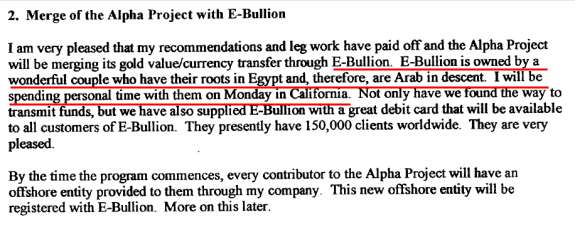
E-Bullion is referenced in court or regulatory documents in the ASD Ponzi case, the Legisi Ponzi case, the Gold Quest International Ponzi case and the FEDI fraud scheme. A mysterious enterprise known as the “Alpha Project”also is referenced along with FEDI in filings in Canada.
This chilling document from the Ontario Securities Commission references both FEDI and the Alpha Project — and appears to make a veiled reference to Pamela Fayed.
From a 2003 filing by the Ontario Securities Commission. Click on link above to read entire document.
Just prior to Christmas last year, seven Michigan women were charged with felonies in an alleged cash-gifting pyramid scheme that targeted women.
Now, just prior to Memorial Day, eight more women have been charged, bringing the total number of women charged to date to 15. The Michigan State Police said last year that gifting schemes were sweeping across the state.
The Muskegon Chronicle was among the first newspapers to report on the new defendants.
Separately, the BBB has added a video on cash-gifting scams and added to its previous warning about “thousands” of such schemes using YouTube and the Internet to proliferate.
In August 2008, after the U.S. Secret Service seized tens of millions of dollars in the AdSurfDaily autosurf probe, some ASD members immediately turned to cash-gifting, positioning it as a way for ASD members to make up their losses. Gifting scams typically pluck heartstrings, targeting people of faith, people down on their luck and people who can ill afford to lose a single dollar, let alone hundreds or thousands at a time.
“Cash gifting is a pyramid scheme — pure and simple,” the BBB says. “There are thousands of YouTube videos and websites out there touting cash gifting as an empowerment program or a way to make easy money from the security of your home.”
In a criminal case that flowed from an SEC civil action, an Illinois man has been indicted on mail-fraud and money-laundering charges in a case that alleges he stole from elderly clients and the local Veterans of Foreign Wars Post.
Edward L. Moskop, 63, of Belleville, originally was charged in November 2010 by the SEC, which alleged he ripped off an 88-year-old man and the man’s 84-year old wife. At the SEC’s behest, a federal judge issued an asset freeze while the probe moved forward.
Federal prosecutors now say the scheme gathered at least $2.4 million over 20 years, with Moskop also ripping off friends, relatives, insurance clients, people referred to the scheme by attorneys and the VFW.
Moskop was a recidivist, prosecutors and regulators say. Records show he was banned from associating with National Association of Securities Dealers (NASD) reps for ripping off clients more than 20 years ago. NASD was the predecessor agency to FINRA, the Financial Industry Regulatory Authority.
Regardless, Moskop continued to do business with other people’s money.
“Moskop had been barred from association with any member of the NASD and was no longer registered to act as a broker in the securities industry,” the FBI said. “It is alleged that from 1991 to 2010, Moskop persuaded customers to provide him with funds for investment, but instead of making the investment, he kept the funds for his own use.”
Moskop called the elderly couple he was ripping off his “premium clients,” and he was “siphoning away” their wealth and giving them “forged” documents, the SEC charged last year.
All in all, the SEC said, Moskop stole nearly $300,000 from the couple by making them believe they had accumulated nearly $600,000 in 16 different investments.
For 20 years, the couple never cashed out any of their holdings, choosing instead to let their profits roll over and believing their money not only was safe, but also was growing, the SEC said.
In September 2010, however, the couple noticed a renewal discrepancy — and contacted an investment company at which they believed they had holdings through Moskop. The company told them there were no accounts — and that the firm did not even handle the type of investment product the couple believed they had: certificates of deposit.
Alarmed, the couple contacted their daughter, who went to work unmasking the scheme. Moskop then manufactured stories on the fly, but the daughter demanded the money be returned to her parents.
Eventually Moskop sent checks for a small portion of the overall investments, but the checks bounced, the SEC said.
Alarmed again, the daughter did some more digging and found out that Moskop had ripped off her parents in other investments for even greater sums, the SEC said.
Moskop operated a firm known as Financial Services Moskop and Associates Inc
BULLETIN: Four associates of jailed Ponzi schemer and disbarred attorney Scott Rothstein have been charged criminally by federal prosecutors in Florida with conspiracy to commit wire fraud. The new defendants include an attorney at Rothstein’s defunct Fort Lauderdale law firm, two IT employees of the firm and a Rothstein associate in the nightclub business.
The charges came in the form of a criminal information, which suggests the defendants are cooperating in the probe and ultimately may plead guilty to avoid the risk of indictment on other charges.
As has been the case with other Ponzi probes, the details emerging in the Rothstein case read like an impossible work of fiction — but prosecutors say the allegations are true.
Among the mind-blowing claims:
Two IT employees — William Corte, 38, of Plantation, and Curtis Renie, 38, of Ft. Lauderdale — created a bogus web page by copying the legitimate page of TD Bank. “False account balances” were posted on the fraudulent page to make it appear as though Rothstein’s law firm, Rothstein Rosenfeldt and Adler (RRA), had between $300 million and $1.1 billion on deposit at the bank. “[N]o such funds were in the accounts. The false account balances were shown to investors to induce them to invest into the fraudulent investment scheme,” prosecutors said.
RRA attorney Howard Kusnick, 58, of Tamarac, wrote a bogus letter that claimed a case had been settled in favor of clients. In reality, prosecutors said, the clients’ funds had been used to prop up the scheme and make Ponzi payments to investors. “[N]o such litigation had been instituted and no such settlement existed,” prosecutors said.
Stephen Caputi, 53, of Lauderhill, sometimes posed as a “banker” in meetings with Rothstein clients, and also posed as a “plaintiff” in bogus cases if the need surfaced. Caputi, prosecutors said, posed as a TD Bank employee and handed out false information on account balances to dupes. In a separate meeting with separate dupes, he posed as the the beneficiary of a $10 million settlement agreement to raise “investors’ confidence” in a deal, prosecutors said. Caputi was Rothstein’s partner in a nightclub.
“The house of cards supporting Scott Rothstein’s elaborate Ponzi scheme continues to crumble,” said U.S. Attorney Wifredo A. Ferrer of the Southern District of Florida. “As today’s charges confirm, we will follow all leads and continue to bring to justice those who helped Rothstein execute this billion dollar fraud and any other crimes that may have been committed through RAA. The investigation continues.”
We’ve previously noted that the Financial Industry Regulatory Authority (FINRA) has described the HYIP sphere as a “bizarre substratum of the Internet.”
That substratum now is getting crazier yet.
Three weeks ago, Club Asteria was a great darling of the Ponzi boards. But weekly payout rates that purportedly have been slashed — coupled with a purported freeze of Club Asteria’s PayPal account — appear to have put the “program” in a death spiral.
Club Asteria stopped short of announcing it had placed a call to the coroner, but did announce a “downward spiral,” according to a post on the MoneyMakerGroup Ponzi scheme and criminals’ forum.
Not to worry, though: Some Club Asteria promoters on the Ponzi forums have turned their attentions to JSS Tripler, whose site appears to be accessible through multiple domains, including a site known as JustBeenPaid (JBP).
JBP appears to be tied to something called Synergy Surf, which appears to be another darling of the Ponzi boards.
“I buyed (sic) new 8 positions for that,” a MoneyMakerGroup poster announced.
JPB encouraged enrollees to “[s]et up your AlertPay account and fund it, or link your credit card to it,” according to web records.
These instructions also were provided.
Upgrade in JBP by making your $10 or $20 payments.
Enter your AlertPay email address in the JBP Member Area.
Buy and/or sponsor downline members.
Study and apply ‘Upgrade Your Brain’ and the ‘Big Success Breakthrough’ — see ‘Access Our Products’ in your JBP member area.
Make JBP’s Synergy Surf (JSS) your primary moneymaker.
In the spring of 2009 — as the AdViewGlobal (AVG) autosurf was in its death throes before a fatal gurgle — the AVG braintrust pointed the finger of blame at the membership.
Other surfs that launched in the aftermath of the seizure of tens of millions of dollars from Florida-based AdSurfDaily did the same thing. These included AdGateWorld, which once referenced ASD in what appeared to be a copy-and-paste lift from ASD’s Terms of Service, and BizAdSplash, whose purported “chief consultant” was ASD/Golden Panda Ad Builder figure Clarence Busby.
Fast forward two years, and Club Asteria, which lists Andrea Lucas as managing director, appears to be doing the same thing — along with serving up some Busby-like syrup for the soul:
“Greed is a very powerful motivation, but the kindness, generosity and goodness in all of us all are even more powerful,” Club Asteria is reported on MoneyMakerGroup to have intoned.
“The challenges that we are facing recently have been caused by a small percentage of our members misusing their membership privileges,” Club Asteria is reported to have told members. “As any good company would have done to protect their members and future members, we had to reinforce our Code of Ethics and Conduct, to ensure that our message of a better life for all of us is presented honestly and accurately.
“We are working very hard to make sure that any benefit from Club Asteria and all of our products and services are accurately represented. Any company, no matter how good their products and services are, can be destroyed with misleading information, bad publicity, false rumors and inactivity of their members/customers.”
Two years ago, AVG’s death spiral began as the ASD grand jury was meeting in the District of Columbia. The surf first slashed payouts — something Club Asteria reportedly is doing right now — and then eliminated them altogether, while at once announcing an 80/20 program would become mandatory after AVG completed an audit of itself.
One of the issues complicating matters for AVG was the purported misuse of a member-to-member cash button. Club Asteria members also purportedly misused a money-transfer facility.
“Bizarre substratum of the Internet” just about covers it — except for the heartache and myriad nightmares created by the various HYIP darlings, of course.
Thinking Outside The Box
Our friends at RealScam.com report another nightmare in the making. It’s bizarrely called Insectrio — and it bizarrely has an “Egg” plan purported to pay 103 percent after one day, a “Larva” plan purported to pay 120 percent after five days and other plans advertised to pay even more.
The sales pitch for Insectrio, apparently an emerging HYIP, touts MoneyMakerGroup, TalkGold and DreamTeamMoney.
Given JBP’s prompt for enrollees to “upgrade” their brains — which we view as a prompt to think outside the box — the PP Blog concludes this post by providing readers an outside-the-box way to look at the Insectrio offer:
InSECtrio.
Indeed, the three letters centering the HYIP’s name are real attention-getters.
URGENT >> BULLETIN >> MOVING: A former managing director of the NASDAQ stock exchange has been charged by both the SEC and federal prosecutors in an insider-trading case.
Donald L. Johnson, 56, of Ashburn, Va., already has pleaded guilty on the criminal side of things, the Justice Department said.
For its part, the SEC said Johnson abused his position, made trades from his work computer and racked up $755,000 dollars in illegal profits over three years.
Johnson, the SEC said, cherry-picked information on corporate leadership changes, earnings reports, earnings forecasts and regulatory approvals of new pharmaceutical products.
“This case is the insider trading version of the fox guarding the henhouse,” said Robert Khuzami, director of the SEC’s Division of Enforcement. “Instead of protecting NASDAQ client confidences, Johnson secretly traded on client information for personal gain, even using his NASDAQ office computer to make the trades.”
Federal prosecutors also used the fox-and-henhouse analogy.
“Insider trading by a gatekeeper on a securities exchange is a shocking abuse of trust, and must be punished,” said Assistant Attorney General Lanny Breuer, head of the Justice Department’s Criminal Division.
Meanwhile, U.S. Attorney Neil H. MacBride of the Eastern District of Virginia said Johnson padded his retirement by cheating.
“He thought he could get away with it by using his wife’s account and inside information to make relatively small trades just a few times a year,” MacBride said. “But he learned what every other trader on Wall Street must now realize: We’re watching.”
Prosecutors gave the U.S. Postal Inspection Service credit for the criminal bust.
Johnson was a managing director on NASDAQ’s market intelligence desk in New York between 2006 and September 2009, prosecutors said.
“Johnson brazenly stole nonpublic information from NASDAQ and its listed companies in breach of his duties of confidentiality to his employer and clients,” said Antonia Chion, associate director of the SEC’s Division of Enforcement.
Criminal securities fraud carries a maximum penalty of 20 years in federal prison and a maximum fine of $5 million.
Trevor Cook (pictured) employed a "sick" web designer who declared himself "Trevor's bitch," according to former radio host Pat Kiley. Kiley says he also employed the designer, but fired him after determining he had a high "sleaze factor." Kiley compared Cook to Pontius Pilate.
In pro se court filings, accused Minnesota schemer Pat Kiley says recordings of his radio show presented on CD for his examination and verification by the SEC in the civil case against him are unreliable. Meanwhile, Kiley described his civil co-defendant Trevor Cook as acting “like Pontius Pilate,” the Roman prefect many Christians believe authorized the crucifixion of Jesus.
Kiley, 72, was accused by the SEC in 2009 of hawking the scam on his radio show, “Follow The Money.” The same phrase became part of the American lexicon during the Watergate-era administration of President Richard Nixon, when it was uttered by “Deep Throat,” a then-unidentified source used by Washington Post reporter Bob Woodward. The Watergate scandal also featured recordings — and those recordings led to Nixon’s downfall.
The SEC recordings of his radio show are not fair and accurate, Kiley advised a federal judge, because of dozens of “distortions” in the recordings.
“There seems to be some distortions,” Kiley said repeatedly, referring to recordings of his radio programs in January, February, March, April, May and June of 2009.
And because of those distortions, which occurred at various times in the recordings, “Kiley denies that the file . . . is fair and accurate,” Kiley said.
Cook, who was charged criminally, is serving a 25-year sentence in federal prison. Both Cook and Kiley were sued by the SEC and CFTC, and the civil portion of the case has taken a turn toward the bizarre.
On May 19, Kiley asked a federal judge to sanction a CFTC attorney $1,000 and make the penalty payable to Kiley. Kiley asserts the CFTC lawyer filed an “offensive” pleading.
Yesterday, in filings in the SEC case, Kiley raised the issues of the purported distortions in the recordings and compared Cook to Pilate. The Pilate comparison occurred after the SEC asked Kiley to admit he was responsible for the content of the PatKiley.com website.
“Kiley denies any responsibility for the content of the website at www.patkiley.com,” he advised the judge. “Kiley not only had to contend with Cook’s control of the website but also had to contend with another of Cook’s ‘cast of characters’ . . . ”
A member of that cast was a web designer, Kiley said.
Kiley said he had hired the designer, but fired him “after about a month or so” because of his high “sleaze factor.”
Kiley did not say precisely how he calculated sleaze factors when making personnel decisions. But he claimed that he “caught” the designer saying things to prospective clients that “were not accurate” and causing problems on the website.
After Kiley fired the designer for his purportedly high sleaze factor, the designer went to work for Cook, Kiley claimed.
Kiley further became alienated with the designer after the designer described himself as “Trevor’s bitch,” Kiley claimed.
The “bitch” remark, Kiley said, “was a very ‘sick’ comment for any human being to make about themselves.”
“By this time Kiley was totally fed up with the website because it had become nothing more than a ‘literary bordello,’” Kiley informed the judge.
Kiley concluded his answer to the SEC by giving it advice on how to conduct itself in court.
“Kiley is wondering if the SEC uses ‘confusion’ as a strategy and if so, then Kiley recommends that they change direction,” he said in yesterday’s filing.
 Kudos to the Salt Lake Tribune for expanding on its earlier series on multilevel marketing, which we referenced here. On May 27, the newspaper published two more stories — and one of them features a photograph of a Rolls-Royce with the words “mona vie” emblazoned on its side.