Blog

  • Robert Miracle, One Of First Criminal Ponzi Defendants In Post-Madoff Era, Sentenced To 13 Years In Prison For Oil-And-Gas Scheme; Co-Defendants International Fugitives Wanted By INTERPOL

    Fahimi Fisal (left) and Mukhtar Kechik. Source: INTERPOL.

    Ponzi schemer Robert Miracle, who scammed investors in a $65.3 million oil-and-gas fraud operating in the Seattle area, knows he’ll bed down tonight in custody at the SeaTac Federal Detention Center in Washington state.

    His co-defendants, though, are less certain of their sleeping spots — and still have to worry about knocks at doors in the middle of the night.

    Fahimi Fisal and Mukhtar Kechik — both Malaysian nationals of middle age — are international fugitives wanted by INTERPOL. Fisal is 40; Kechik is 54. There are “Wanted” posters in each of their names.

    Miracle, 50, Bellevue, Wash., was sentenced this week to 13 years in federal prison, but he already was in custody. While awaiting trial in May 2009, his bail was revoked for not complying with the conditions of his release.

    In February 2009 — just two months after the $65 billion Bernard Madoff caper came to the fore and the word Ponzi became a daily part of the national and international dialogue — Miracle, Fisal and Kechik were charged in in a 23- count indictment alleging conspiracy, mail fraud, wire fraud, money-laundering and tax evasion. The criminal case against Miracle and his co-defendants was one of the first major prosecutions of the post-Madoff era.

    Many towns across the United States now have their own individual “mini-Madoffs,” and the alleged schemers are accused of consuming individual and family wealth on a local, regional, national or international scale, taking wrecking balls to churches, charities and endowments — and leaving Ponzi pain on the doorsteps of hundreds of thousands of people.

    The Miracle scheme “ruined people’s lives,” prosecutors said, quoting U.S. District Judge James L. Robart, who sentenced Miracle. Miracle pleaded guilty to mail fraud and tax evasion.

    Prosecutors said he operated companies purportedly involved in oil development in Indonesia, and sold “shares” in ventures known as Laramie Petroleum Inc., MCube Petroleum Inc., Diski Limited Liability Co., Basilam Limited Liability Co. and Halmahera-Rembang Limited Liability Co.

    “Miracle and his co-defendants represented to investors that various companies were making money from oil field development and services on oil and gas fields in Indonesia,” prosecutors said. “In fact, the proceeds of later investors were used to pay off the investments of earlier investors in the form of a ‘ponzi’ scheme.”

  • KABOOM! Is It Real — Or Is It The Feds? Agents Created ‘Payment Processor’ As Part Of Undercover Sting Designed To Infiltrate Corrupt Companies; 11 Bank Accounts And 10 Domain Names Seized; 3 Individuals, 2 Firms Indicted

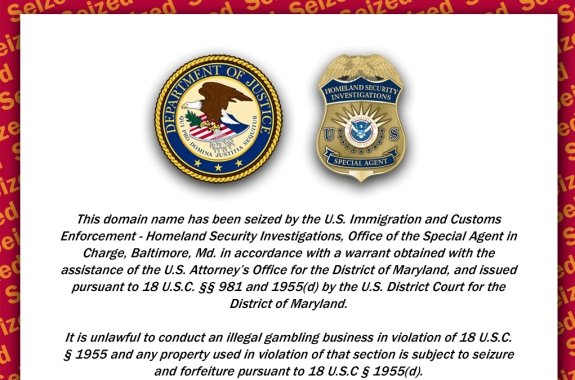
    One of the domain name seizure notices in a federal sting operation in which agents created a "payment processor" to infiltrate operations alleged to be corrupt.

    Kaboom! In a move that may send shockwaves across the fraudulent HYIP, autosurf, sports-betting and “arbitrage” universes domestically and offshore, Maryland’s top federal prosecutor has released details of a two-year long undercover sting in which federal agents created a “payment processor” to infiltrate illegal gambling operations.

    Using methods straight out of the scammer’s playbook and turning the playbook back on the alleged scammers themselves, the federal operation resulted in the seizure of 11 bank accounts in the United States, Guam, Panama, Malta, Portugal and the Netherlands, prosecutors said.

    Ten domain names associated with illegal gambling sites also were seized.

    “It is illegal for internet gambling enterprises to do business in Maryland, regardless of where the website operator is located,” said U.S. Attorney Rod J. Rosenstein. “We cannot allow foreign website operators to flout the law simply because their headquarters are based outside the country.”

    The name of the Feds’ “payment processor” was Linwood Payment Solutions — and its website now serves this message:

    “Linwood Payment Solutions is a Department of Homeland Security Undercover Business set up to identify and prosecute companies accepting and paying out funds for U.S. customers who gamble online illegally.

    “If you have questions regarding funds withdrawn from your bank account for gambling purposes contact the online gambling company you provided your banking information to.”

    As part of the sting, the U.S. Department of Homeland Security (Homeland Security Investigations or HSI) “obtained a business address near Atlantic City, New Jersey,” according to court records.

    HSI then created a website for the “payment processor,” opened bank accounts, set up a “payment processing plant” and staffed it until it could process “thousands” of transactions daily.

    Undercover operatives then began to mix with “top managers of gambling organizations,” discussing fees and contracts. Having established ties to the alleged scammers, Linwood began to process payments — in excess of $33 million in all, involving more than 300,000 transactions, according to court records.

    Seized domain names include:

    • Bookmaker.com
    • 2Betsdi.com
    • Funtimebingo.com
    • Goldenarchcasino.com
    • Truepoker.com
    • Betmaker.com
    • Betgrandesports.com
    • Doylesroom.com
    • Betehorse.com
    • Beted.com

    Seizure notices now adorn the websites.

    Indicted were ThrillX Systems Ltd., d/b/a BetEd; Darren Wright and David Parchomchuk of British Columbia, Canada;  K23 Group Financial Services, d/b/a BMX Entertainment; and Ann Marie Puig, 35, of San Jose, Costa Rica.

    “The proceeds from illegal Internet gambling are often used to fuel organized crime and support criminal activity,” said William Winter, special agent in charge of ICE’s HSI unit.

  • BULLETIN: Data Network Affiliates’ ‘Expert’ Was Convicted Felon Charged In Racketeering Case; New Flap Involving Anthony Sasso Emerging In Florida

    Anthony Sasso's mugshot from his 2005 arrest in Broward County.

    BULLETIN: A man described as the data expert for an online MLM program that purported to pay participants for recording license-plate numbers to help the AMBER Alert program recover abducted children is a convicted felon who was arrested in a racketeering case brought by the Broward Sheriff’s Office as part of a sting operation in 2005, the PP Blog has learned.

    Anthony Sasso is referenced as a “special board consultant” in numerous online promos for Data Network Affiliates (DNA), which now appears to be doing business as “One World, One Website” or OWOW. It was not immediately clear if Sasso continues to be affiliated with the firms.

    Also unclear was whether the sheriff’s office would open a probe into DNA. The agency had no immediate comment today.

    DNA, a company associated with one bizarre claim after another, had no affiliation with AMBER Alert. It remains far from clear whether DNA, which misspelled the name of its own departing chief executive officer last year after withholding the news of the resignation for nearly a week, had the capacity to help AMBER Alert do anything.

    The firm also claimed it delivered free cell phones with unlimited talk and text for $10 a month, while at once claiming it was the “MORAL OBLIGATION” of churches to sell a purported MLM mortgage-reduction program to people facing foreclosure. The firm, which touted Christianity in its sales pitches, also claimed to be in the offshore “resorts” business.

    The 2005 sting that led to Sasso’s arrest was known as “Operation Money Car.” It targeted a “cloning ring” involving stolen automobiles, according to records at the sheriff’s office.

    DNA was associated with Phil Picollo, described online as the “one-man Internet crime wave.” The firm, which used addresses in Nevada and Boca Raton and conducted business behind a domain that listed a Cayman Islands address, emerged early last year in part by trading on the names of Donald Trump and Oprah Winfrey. The firm scored an “F” from the Better Business Bureau for not responding to customer complaints.

    Trump and Winfrey are believed to have no ties to DNA. In a radio interview last year arranged after Piccolo threatened to sue the host, Piccolo positioned himself as a man of God — but later said he knew people who could cause physical harm to come to critics.

    By the time 2010 had come to a close, the DNA website was redirecting to the OWOW website. One OWOW promo traded on the name of the National Institutes of Health, positioning an OWOW bottled-water product as a cancer-fighter. Meanwhile, Piccolo claimed OWOW offered a “magnetic” product that not only had prevented a leg amputation, but also had helped gardeners grow tomatoes twice the size of ordinary tomatoes while helping dairy cows produce more milk.

    Sasso also was part of a Boca Raton company known as Phone Guard, which markets an application that prevents texting while driving. Phone Guard was endorsed by teen sensation Justin Bieber, according to promos for the firm.

    The Broward-Palm Beach NewTimes carried a story this morning on PhoneGuard and the Bieber promotion. The publication reported that Sasso had been asked to resign.

    Options Media, the holding company that markets Phone Guard, had no immediate comment on Sasso when contacted by the PP Blog late this afternoon. The Blog left a message for Scott Frohman, the chief executive officer of Options Media. Frohman was said to be at a meeting.

    Sasso was described in DNA promos as “The King Of Data For Dollars” and was said to be the “owner of the largest database of text numbers in the world.”

    Another oddity associated with DNA was a claim the company was about to go “public.”

    “A publicly traded company has to answer to the SEC,” the firm said in an email to promoters. “No messing with them. Ask Martha Stewart.”

  • DEVELOPING STORY: Purported Belgian Financial Firm That Used Acronym ‘LOFL’ May Be At Center Of International Mystery; Website Vanishes Amid Bizarre Circumstances After Flurry Of News Releases

    From Google cache: A company known as Landen Options and Futures uses the acronym LOFL. The same acronym is web shorthand for "Laughing Out Freaking Loud." Belgium authorities say the firm is not registered to conduct business in investments and that no such firm is located at the listed address in Brussels. Meanwhile, the firm's website has gone missing.

    DEVELOPING STORY: A financial firm purportedly headquartered in Belgium quickly may become a source of international intrigue as regulators seek to piece together clues to solve what appears to be an evolving mystery.

    For starters, the company — Landen Options and Futures — used the acronym LOFL on its website, according to search results accessible in Google cache. The site itself now is returning a “Server not found”  error.

    It was not immediately clear if the firm has gathered money from investors.

    Although LOFL could be an actual, legitimate acronym a company might choose for itself, it also is web shorthand for “Laughing Out [Freaking] Loud” and “Lots of [Freaking] Luck.”

    On May 20, the Financial Services and Markets Authority of Belgium (FSMA) issued a warning about the purported firm.

    FSMA said the firm “claims to offer investment services from premises at Avenue Louise/Louizalaan 149, 1050 Brussels.”

    But Landen Options and Futures “does not have the authorization in Belgium necessary to offer investment services in or from Belgium,” FSMA said. “Moreover, it is not situated at the address provided.”

    FSMA “thus advises the public against responding to any offers of investment services made in the name of Landen Options and Futures and against transferring money to any account number they might mention,” the agency said.

    Web cache also reveals that a copyright notice on the firm’s website purported to date back to 1990:

    “Copyright © 1990 – 2011, Landen Options and Futures,” the notice read.

    Records, however, show that the domain, which is behind a privacy proxy, was not registered until Jan. 3, 2011.

    Other records show that the purported firm issued bizarre, awkwardly worded news releases through online PR sites to drive traffic. The news releases also speak to Forex trading.

    One vague, poorly worded release claims the firm is establishing a Forex platform in “some part” of the United Kingdom.

    “Landen Options and Futures, a prominent independent brokerage firm with main office located at Brussels Belgium, and has been providing brokerage trading services to international traders and investors, recently announced that it will soon commence its brokerage trading operations in some part of the United Kingdom,” the Feb. 16 release on PR.com read in part.

    The release further claimed the company “has built two new branch offices in London and Scotland ” and “will provide foreign Exchange and futures trading services to traders and investors in UK with service highlights on online trading capabilities.”

    Meanwhile, the release claims that the UK venture “recently received regulatory approval from UK Financial Services Authority.”

    It quoted a person identified as “Mr. Harvey Davies,” purportedly the firm’s chairman and chief executive officer.

    “In (sic) behalf of the entire company, we are glad to announce the commencement of our brokerage trading services in some part of United Kingdom,” the release referencing Davies read in part.

    A Feb. 19 release quoted a person identified as Nathan Wauters, the firm’s purported “Managing Director.”

    On Jan. 21, nearly a month prior, Wauters was quoted in a news release speaking about something called “The Algorithmics.”

    The PP Blog confirmed this morning that the U.S. Commodity Futures Trading Commission is seeking information on the purported firm.

  • OBTAINED: Draft Of Complaint Some AdSurfDaily Members Say They’ll File Against D.C. Prosecutors In Florida; ‘Let The Games Begin!’ Declares Prospective Pro Se Litigant. Document Leads To Questions About Whether ASD Had A Special Class Of Members

    Dear Readers,

    We are plugging our nose as we publish this document (link at bottom of post). You should know up front that we converted the document to PDF format after receiving it in Microsoft Word format. We did so based on the belief that many readers may not own Word but likely have a free PDF reader among the programs on their computers.

    We obtained the document from a source. An email introducing the document prompted recipients to “Please forward this to as many of our people as you can.”

    The PDF conversion altered the format of the original document, causing certain typesetting errors to appear — but the text content of the body of the document is unchanged. We did not edit the body text in any way.  For the sake of convenience, we named the PDF file declaratoryreliefdraft.

    The Word original is titled “T&D v USA UNITED STATES DISTRICT COURT.” It purports to be a draft of a “Complaint for Declaratory Relief” some AdSurfDaily members say they intend to file in U.S. District Court for the Southern District of Florida. The document lists ASD members Todd Disner and Dwight Owen Schweitzer as pro se plaintiffs.

    It is unclear if other plaintiffs will emerge. Previous ASD pro se litigants appeared to have shared  a do-it-yourself litigation template. U.S. District Court for the District of Columbia was inundated with ASD-related, pro se filings in 2009.

    No other plaintiffs are listed in the caption of the draft. The defendant is listed as:

    THE UNITED STATES OF AMERICA
    c/o United States Attorney’s Office
    555 Fourth Street N.W.,
    Washington, DC 20530

    The address is the office of U.S. Attorney Ronald C. Machen Jr. No individual defendants are named. The document, which references U.S. District Judge Rosemary Collyer of the District of Columbia, misspells her name as “Collier.”

    Disner lost a pro se round in the civil forfeiture complaint against Andy Bowdoin’s assets filed in the District of Columbia in August 2008. His petition — and the petitions of dozens of other ASD pro se filers who sought to intervene in the case amid claims the government “confiscated” their assets “wrongfully” — was denied for lack of standing.

    In the original set of pro se pleadings in Collyer’s D.C. court, former Assistant U.S. Attorney William Cowden’s last name was misspelled as “Crowden.”

    ASD President Andy Bowdoin advised Collyer in a sworn affidavit nearly three years ago that the seized assets in the U.S. Secret Service probe belonged to him or ASD, not individual members. In short, Bowdoin agreed with the prosecution’s view of the case with respect to the ownership of the seized assets.

    In its current form, the draft appears to advance the notion that individual ASD members can gain standing in Florida after having been denied in the District of Columbia, get a judgment against the government and undo the government’s remissions program organized by the Secret Service and federal prosecutors in the District of Columbia. Prosecutors have said the ASD Ponzi scheme case may have 40,000 or more victims.

    Among other things, the draft asks a Florida federal judge to declare that the government conducted an “illegal search and seizure in that it failed to meet the requirements of the fourth amendment to the United States Constitution and that therefore the search and seizure of their assets was illegal and void.”

    At the same time, the draft appears to suggest ASD had a subset of members who should have been treated differently than ordinary members whose lives were altered by the alleged Ponzi scheme. Meanwhile, the draft makes a puzzling argument that ASD’s Terms of Service superseded federal law.

    (In this snippet from the draft, the PP Blog added the emphasis to this Blog post.)

    “Among the items seized were the accounts, funds and records specifically identified as belonging to the plaintiffs which were separately accounted for on the computer programs and data seized as they were members of ASD, having bought ad packages as specified in the rules and regulations of the ASD business model,” a section of the draft complaint reads.

    “Consistent with the rules and regulations applicable to the plaintiffs’ their information was confidential and could only be accessed by them through the use of their password protected account with ASD and their accounts were separate and distinct from any other individuals or businesses who were participants in the ASD advertising program,” the section claimed.

    If the document does get filed in a final form — and if the U.S. Attorney’s Office in D.C. gets served and files a response — we sincerely hope the government moves instantly to protect ASD victims at large from further restitution delays caused by pro se sideshows.

    Make no mistake: This is gamesmanship.

    An email currently circulating among ASD members and attributed to Disner even describes it as such.

    “Let the games begin!” the email declares.

    It’s as though the first round of games were not enough for some ASD members.

    “Here is a draft of the complaint Dwight finished today,” the email, which is dated today, reads.

    “I think you will be impressed.

    “We will schedule another conference call to field any “feed back” to this motion.
    “Please forward this to as many of our people as you can. (As I know you will)
    “BEST OF LUCK TO US ALL!!”
    _________________________________________________________________________
    Click here to read the PDF, which was converted from Word by the PP Blog.

    Patrick
  • ‘Offensive’ Claim Prompts Accused Schemer Pat Kiley To Ask Judge To Sanction Government Attorney And Award Cash To, Well . . . Pat Kiley

    The civil litigation in the $194 million Trevor Cook Ponzi and Forex caper has taken a strange turn.

    Former radio host Pat Kiley, a Cook co-defendant in civil cases brought by the SEC and CFTC, has filed a pro se pleading asking Chief U.S. District Judge Michael J. Davis to order David Slovick, an attorney for the CFTC, to pay Kiley $1,000 for making Kiley respond to an “offensive” government motion to strike his answer to the CFTC’s complaint.

    Kiley has denied wrongdoing.

    But the government, according to Kiley, is trying “to ‘get Pat Kiley’ at all costs.” Kiley was sued in 2009 by both the SEC and the CFTC.

    Kiley contends Slovick filed an “un-researched and frivolous pleading” filled with “wild and silly allegations” that Kiley was manipulating the legal system.

    Davis should impose a penalty of $1,000 against Slovick and arrange for the money “to be paid to Pat Kiley,” Kiley advised the judge.

    Nonsense, the CFTC said.

    And the agency further claimed that Kiley was not really a pro se litigant — and thus should be held to a higher pleading standard — because a professional attorney was helping Kiley and not signing the pleadings.

    Attorney H. Nasif Mahmoud of Illinois and Gary, Ind., is assisting Kiley, the CFTC said.

    Mahmoud has not filed a required appearance notice on Kiley’s behalf, according to the CFTC.

    In court filings, the CFTC quoted a May 10 email from Mahmoud to the agency.

    “What I do in my private time to assist an innocent man whom you have falsely accused of wrong doing is my business,” the email read in part.

    The CFTC engaged in “illegal” conduct when it suggested Mahmoud was acquired to file an appearance notice, according to the email.

    Screen shot of part of CFTC's "Exhibit A," an email attributed to attorney H. Nasif Mahmoud. The agency claims that Pat Kiley is benefiting from a liberal pleading standard by purporting to be pro se litigant. Kiley, though, is receiving assistance from Mahmoud, who is not signing the pleadings, according to the CFTC. In this section of the CFTC exhibit, Mahmoud asserts that the CFTC is engaging in illegal conduct and that what he does to assist Kiley is his own business. The CFTC "can not prevent that," according to the email attributed to Mahmoud. (NOTE: PP Blog masked the email address.)
  • FLASH: Missouri Regulators Say Pet-Food Firm Sold Unregistered Securities In State And Now Is Raising Funds In California Under Different Name To Pay Back Investors

    FLASH: In a complicated case unfolding in Missouri, regulators say pet-food firms operated by Frank Renick sold unregistered securities in the state under one set of names and that Renick is raising funds under a different corporate name through a California “cloud” office to pay back investors.

    Renick’s actual presence in California was a virtual office that provided voicemail service, a California phone number and a California street address from which mail was forwarded to Renick in Missouri, investigators said.

    Missouri has issued a cease-and-desist order through the the state’s Securities Division against Spectrum Pet Care Inc., Spectrum Pet Foods Inc. and SPC Brands Inc., amid claims that the firms have sold more than $6 million in “unregistered stocks and bonds” in part by trading on the names of famous companies.

    The announcement was made by Missouri Secretary of State Robin Carnahan, who oversees the Securities Division.

    “My office will continue to go after everyone who misleads Missourians into investing with them,” Carnahan said.

    Regulators increasingly have been confronting securities schemes in which unregistered firms and individuals assert ties to famous brands to establish the veneer of success and lull investors into a false sense of security. Renick’s ties with certain famous companies were theoretical, minor or nonexistent, according to records.

    Over time, according to investigators, the scheme got ported to California, and newspaper ads promoting a “guaranteed annual dividend” of 8.75 percent appeared as recently as last month.

    Robin Carnahan, Missouri Secretary of State.

    “The order alleges that Renick is currently attempting to raise funds in the State of California under the business name Consolidated Food Group, Inc., in order to pay back those individuals who invested in Spectrum,” Carnahan’s office said.

    Consolidated Food Group, which organized in California for business on Dec. 30, 2010, with Renick as its president,  used an address in Carlsbad, according to records. Renick’s address is in New Florence, Mo., and the Spectrum entities use an address in Montgomery City, Mo.

    Spectrum asserted it was “going public” and that its stock value would “double,” but Renick did not “disclose to investors that Spectrum had little revenue,” investigators said.

    “Renick also allegedly used his investors’ funds to pay off previous investors and to pay personal expenses,” investigators said.

    Among the victims is a 74-year-old resident of Kansas City who gave Renick $20,000 after seeing a newspaper ad and listening to a Rennick pitch, investigators said.

    Separately, a 62-year-old St. Louis resident gave Renick $45,000, investigators said.

    “Renick told the investor that Spectrum was going to merge with an international pet food and candy manufacturer, that he had meetings set up with a billion-dollar agriculture and home improvement retailer, and a worldwide convenience store chain contacted Renick about putting Spectrum products in 3,300 stores,” investigators said.  “Securities Division investigators contacted the agriculture retailer, which said Renick scheduled a meeting but didn’t show up, and the convenience store chain, which said that the company hadn’t placed Spectrum products in its stores and never agreed to do so.”

    Read the cease-and-desist order.

  • PROSECUTORS: California Man Hatched Ponzi Scheme And ‘Trust’ Scams — And Ripped Off His Elderly Mother’s Social Security Benefits After She Went Missing

    A California man has pleaded guilty to hatching a real-estate Ponzi scheme, transferring a property acquired in the scheme to two “trust” accounts and cherry-picking his 82-year-old mother’s Social Security benefits after she went missing in January 2009.

    William Warren Baker, 59, of Laguna Nigel, now faces up to 10 years in state prison, prosecutors said.

    The Ponzi, which raised more than $900,000 and targeted people of faith, was discovered by the Orange County Sheriff’s Department after Baker’s mother vanished, the office of Orange County District Attorney Tony Rackauckas said.

    Sara Jo Mowery, Baker’s mother, still hasn’t been found. Prosecutors said that, under federal law, Social Security benefits “are to cease being provided to any beneficiary until the missing person is found or pronounced deceased.”

    Baker was accused of “stealing” the Social Security funds. How they were distributed was not immediately clear.

    During the Ponzi probe, sheriff’s investigators discovered Baker “had set up a previously undiscovered joint bank account” into which Mowery’s Social Security benefits were deposited.

    “After his mother’s disappearance, Baker began illegally withdrawing the funds from that account, stealing $6,100 in all,” prosecutors said.

    All in all, Baker pleaded guilty to 13 felony counts of using untrue statements in the purchase or sale of securities and one felony count of grand theft from the Social Security Administration. Special sentencing enhancements are in effect because of the size of the overall theft, which is considered an “aggravated white collar crime.”

    Baker recruited investors by telling them he’d buy, refurbish and flip real estate at a profit, prosecutors said.

    But it was just a lie designed to separate church friends and others from their money, prosecutors said.

    Indeed, prosecutors said, Baker “failed to purchase a property to be renovated and flipped as promised to his investors.

    “Baker instead purchased a property for himself and transferred the property into a trust belonging to his son,” prosecutors continued. “He later transferred the property into a trust belonging to his wife. Baker used investor money for personal expenses or to pay back old investors from previous ventures.”

    Any person with information about the whereabouts of Mowery, who went missing more than two years ago and now would be 84, is asked to contact the Orange County (Calif.) Sheriff’s Department or their local police department.

  • URGENT >> BULLETIN >> MOVING: James Fayed, E-Bullion Operator And Emerging Figure In AdSurfDaily Ponzi Case, Found Guilty In California Murder-For-Hire Plot That Led To Brutal Stabbing Death Of His Estranged Wife

    URGENT >> BULLETIN >> MOVING: (UPDATED 10:37 P.M. EDT (U.S.A.) James Fayed has been found guilty of first-degree murder and conspiracy in the death of his wife, Pamela Fayed.

    Fayed, 48, now potentially faces the death penalty. The penalty phase of the case is scheduled to get under way tomorrow at 10:30 a.m. (PDT).

    A jury returned the verdict late this morning on the West Coast. Deliberations began Tuesday, and the jury found “the special circumstances of murder for financial gain and lying in wait to be true,” which brought the death penalty into play.

    James Fayed was the operator of the now-shuttered E-Bullion payment processor. Federal prosecutors revealed in December that AdSurfDaily, a Florida company accused of operating a $110 million Ponzi scheme, used the services of E-Bullion.

    Investigators have linked E-Bullion to multiple Ponzi schemes.

    Prosecutors in Los Angeles said Pamela Fayed was a potential witness against her husband.

    “Pamela Fayed was stabbed 13 times near her SUV parked in a garage at Watt Tower on July 28, 2008,” prosecutors said in a statement moments ago.

    James Fayed paid $25,000 to arrange his wife’s murder, according to court documents. Three others have been charged in the plot and await trial.

    Steven Vicente Simmons, 22, is accused of fatally stabbing Pamela Fayed; Gabriel Jay Marquez, 46, allegedly acted as a lookout.

    Jose Luis Moya, 50,  a Fayed employee, accepted the $25,000 to arrange the murder, prosecutors said.

  • BULLETIN: Feds Make Criminal Bust In Alleged Forex Fraud; Nicholas Cox Of Integra Capital Management LLC Arrested In North Carolina; Allegations In Companion Civil Case Destroy Myth That Companies That Issue 1099s Could Not Possibly Be Operating Scams

    A North Carolina man sued by the CFTC last year in an alleged $3 million Forex and commodities Ponzi scheme now has been arrested by federal agents on criminal charges.

    The allegations in the case destroy a myth advanced by financial hucksters and shills that a company that issues 1099 tax forms could not possibly be operating a scam.

    Nicholas Cox, 34, was indicted by a federal grand jury on Tuesday. He is charged with seven counts of mail fraud, one count of conspiracy to commit mail fraud and one count of conspiracy to commit money laundering, federal prosecutors said.

    The announcement of the arrest was made in Washington by Assistant Attorney General Lanny A. Breuer and U.S. Attorney Anne M. Tompkins of the Western District of North Carolina.

    Breuer is the head of the Justice Department’s Criminal Division, and the case was brought by elements of the interagency Financial Fraud Enforcement Task Force created by President Obama in 2009, officials said.

    Cox, who was arrested in Denton, N.C., was one of the principals of Integra Capital Management LLC. An alleged Integra co-conspirator, Rodney Whitney, also was charged criminally, and already has pleaded guilty to conspiracy to commit mail fraud, wire fraud and money-laundering, prosecutors said.

    Whitney also is a defendant in the CFTC action.

    Integra’s scheme operated between September 2006 and January 2009, luring investors with tales about handsome “dividends,” prosecutors charged.

    Cox and Whitney “provided false and fraudulent information, including prospectuses, contracts, tax forms, account statements and other documents, to current and prospective investors to obtain and misappropriate more than $3.29 million in investor funds,” prosecutors said.

    They also lied about their experience and credentials, prosecutors said.

    In September 2010, the CFTC said Whitney “distributed false account statements and false 1099 tax forms to Integra Capital’s customers, showing that their investments were profitable.

    “Instead,’ the CFTC charged, “the defendants’ trading accounts consistently lost money.”

    It is common for Forex fraudsters to claim that a company that issues 1099s could not possibly be operating a fraud. Similar claims are made in the universes of HYIP and autosurf fraudsters.

    If the allegations in the Integra case are true, it means that, not only did a corrupt company issue 1099s, it also issued fraudulent 1099s that reflected gains that did not exist, thus potentially causing participants to pay taxes on phantom profits.

    “At least” four of Integra’s customers received bogus 1099s, the CFTC said last year.

    One of the 1099s showed a bogus gain of more than $226,000, the CFTC said. Another showed a bogus gain of $81,500. Still others showed bogus gains of more than $48,000 and more than $5,000.

  • KABOOM! CFTC/FTC Cases Against American Precious Metals LLC Were Part Of Broader Effort By New Task Force Operating In South Florida; Feds, State Throw Down Gauntlet Against Scammers

    Kaboom! It turns out that the cases announced this week against American Precious Metals LLC (APM)  by the CFTC and FTC were part of a geographically localized law-enforcement initiative that sprouted from “Operation Broken Trust,” a major national initiative undertaken last year by the U.S. Department of Justice and partner agencies as part of the interagency Financial Fraud Enforcement Task Force.

    The localized initiative that led to both the CFTC and FTC bringing actions against APM is known as the South Florida Securities and Investment Fraud Initiative. It was created in December 2010 by U.S. Attorney Wifredo Ferrer, the top federal prosecutor in the Miami region.

    The CFTC accused APM of running a precious-metals scam. Meanwhile, the FTC opened up a second legal front by charging the company with operating a telemarketing fraud scheme from a boiler room. The effect of the approach is that APM, which both agencies accused of running frauds that had gathered tens of millions of dollars, now has to square off against litigation coming from two different directions.

    Ferrer has warned for months that white-collar fraudsters operating in the region had no safe haven either onshore or offshore.

    In addition to Ferrer’s office, the CFTC and FTC, members of the South Florida Task Force include the FBI, the IRS, the U.S. Secret Service, the U.S. Postal Inspection Service, the SEC, the FDIC, the Florida Office of Financial Regulation and ICE Homeland Investigations.

    ICE is a division of the U.S. Department of Homeland Security.

    “Investors lose billions of dollars annually to fraudulent schemes,” Ferrer said in December, when introducing the new task force. “Some victims — the luckier ones — lose only thousands of dollars. Others lose their entire lives’ savings. While the victims of fraud are financially ruined, the fraudsters live a life of luxury. Together with our law enforcement and regulatory partners, we hope to help put an end to this type of fraud.”