William L. Waters: Charged by state prosecutors in Colorado, extradited from Argentina by the FBI, prosecuted in Douglas County District Court — and sentenced to 40 years in state prison.
BULLETIN: A Ponzi schemer who fled the United States and was extradited from Argentina has been sentenced to 40 years in state prison, Colorado Attorney General John Suthers announced.
William L. Walters, 46, was brought back to the United States by the FBI, which worked closely with Colorado authorities to bring him to justice, officials said.
“This sentence underlines our commitment to vigorously pursue and prosecute cases of financial fraud that victimize Coloradans,” Suthers said. “Our thanks to the FBI for helping us to ensure that justice delayed did not result in justice denied for Mr. Walters’ victims.”
Walters was caught after the FBI “tracked” him and INTERPOL “flagged” his passport, investigators said. An Argentinean court approved Walters’ extradition last year.
Victims of the scheme, which gathered $23 million, hailed from nine U.S. states.
The Walters’ case destroyed a common myth that “offshore” landing spots shelter Ponzi schemers from prosecution. The Colorado Division of Securities assisted in the probe.
Walters also was ordered to pay $9.5 million in restitution. His next landing spot is the Colorado Department of Corrections.
BULLETIN: UPDATED 3:07 P.M. EDT (U.S.A.) The SEC has gone to federal court in Dallas to halt the operations of what it described as a highly complex fraud and Ponzi scheme involving a purported VOIP/telecommunications firm and more than 40 individuals and companies.
A federal judge has frozen the assets of China Voice Holding Corp., and the SEC described the case as a “complicated web” of deceit engineered by David Ronald Allen and others associated with the firm, which is headquartered in Boca Raton, Fla.
Allen, 60, resides in Dallas. Also named defendants were former China Voice executive William F. Burbank IV, 52, of Delray Beach, Fla.; Alex Dowlatshahi, 36, of Dallas; Ilya Drapkin, 64, of Dallas; Christopher Mills, 34, of McKinney, Texas; Gerald Patera, 69, of Pinehurst, N.C.; and Robert Wilson, 42, of Dallas.
Dowlatshahi was described by the SEC as a recidivist securities offender who was part of a 2006 offering fraud in California.
Dozens of companies were part of the China Voice fraud, the SEC alleged.
Investors were told they’d earn returns of “at least” 25 percent, but an $8.6 million Ponzi scheme was under way, the SEC charged.
“These promoters falsely touted what they claimed to be a prudent investment with reliable returns through loans made to carefully selected businesses,” said Stephen L. Cohen, associate director of the SEC’s Division of Enforcement. “This fraud illustrates that when extraordinarily high returns are promised in a supposedly low-risk investment, that’s a tell-tale sign that something likely is amiss.”
China Voice, Allen and Burbank were accused of issuing a “series of fraudulent company statements about its financial condition and business prospects,” the SEC said.
Patera and Drapkin helped China Voice “finance stock promotion campaigns to pump up the company’s stock price,” the SEC charged,
Meanwhile, Wilson orchestrated a “a blast fax campaign,” the SEC charged.
“The spam faxes were sent to thousands of people at once and contained false and misleading statements about China Voice and who was paying for the faxes,” the SEC alleged. “At the same time they were spending more than a million dollars on stock promotion, Patera and Drapkin dumped millions of shares of the company into the market.”
So many individuals and companies were involved in the alleged fraud that the recitation of the names of the defendants and relief defendants in the 50-page complaint took up all or parts of seven pages.
The facts as outlined by the SEC did not begin until the tenth page of the complaint. Regulators at virtually all levels have been encountering increasingly complex financial capers that involve dozens of corporations and shell companies.
A case filed in Nevada by the FTC in December alleged that 10 corporations and 52 shell companies were part of a colossal fraud that had gathered hundreds of millions of dollars.
BULLETIN: Federal prosecutors say the collapsed Forex Ponzi scheme operated by Keith Franklin Simmons put an undercapitalized North Carolina bank with 45 offices in 38 communities in harm’s way.
In a dramatic announcement, Justice Department officials said CommunityONE Bank N.A of Asheboro, N.C., turned a blind eye to Simmons and did not file a single Suspicious Activity Report despite the fact the scheme sent out red flags for more than two and a half years.
CommunityONE lost 16 percent of its value because of the scheme, the Justice Department said. Had the bank collapsed, it would have cost the FDIC insurance fund $500 million, prosecutors added.
In a deferred prosecution agreement, the bank has been charged criminally with failing to maintain an effective anti-money laundering program. The agreement, officials said, would enable the bank to recapitalize and execute a merger plan while providing $400,000 to help the Ponzi victims recover.
“Banks asleep at the switch need to wake up,” said U.S. Attorney Anne Tompkins of the Western District of North Carolina. “Federal law requires banks to implement a robust and proactive anti-money laundering program to detect fraud and protect the public from harm. This bank’s failure to detect and report a Ponzi scheme cost it 16 percent of its value. Other financial institutions should heed this warning: the Bank Secrecy Act applies to more than just drug and terrorist financing.”
Simmons, prosecutors said, operated his massive scam “almost entirely through an account at the bank.”
Between April 2007 and September 2009, prosecutors said, Simmons used CommunityONE to deposit more than $35 million in investor funds and withdraw at least the same amount.
Even though “hundreds” of suspicious transactions occurred, the bank chose to be willfully blind, the Justice Department said.
“CommunityONE Bank turned a blind eye to criminal conduct occurring under its nose,” said Assistant Attorney General Lanny Breuer.
The Justice Department made the announcement from Washington, and Breuer said the bank was implementing a new program and beginning the process of “righting its wrongs.” The charges will be dismissed in two years if the bank complies with its agreement.
Records at CommunityONE, prosecutors said, showed that Simmons diverted more than $2 million to other accounts at the bank “to operate his other businesses.”
Meanwhile, he “diverted nearly $800,000 in cash withdrawals, gift cards and transfers to his personal account with the bank” and “diverted numerous payments to support his luxurious lifestyle, including payments for private jets, vehicles and gifts,” prosecutors said.
Simmons, who was convicted of securities fraud, wire fraud and money laundering last year, operated a company known as Black Diamond Capital Solutions LLC. He faces a maximum sentence of 80 years in federal prison. Read more about Black Diamond here.
The action against CommunityONE was brought by elements of the interagency Financial Fraud Enforcement Task Force created by President Obama in November 2009.
A Texas jury has found that a debt-repair company with an MLM component engaged in deceptive trade practices and committed more than 1,400 violations of state law. The jury returned a verdict of $13.8 million.
BULLETIN:
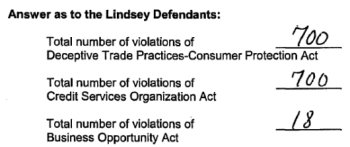
UPDATED 10:03 P.M. EDT (U.S.A.) A jury in Harris County, Texas, has thrown down the gauntlet to hucksters targeting financially strapped consumers by finding more than 1,400 violations and returning a spectacular verdict of $13.8 million against a purported “debt repair” firm that had a multilevel-marketing component.
The jury, which found that the accused firms engaged in deceptive trade practices and were required to register under the Business Opportunity Act but did not do so, assessed a penalty averaging $9,732 for each of 1,418 violations it found, bringing the total to $13.8 million.
In announcing the verdict, the office of Texas Attorney General Greg Abbott published the jury’s actual findings that outlined the violations and the spectacular financial penalties against the defendants. The jury not only awarded the state $342,590 to handle the cost of bringing the prosecution, but also awarded $38,880 to apply to the state’s costs if the verdict was challenged in the Court of Appeals or the Texas Supreme Court.
As part of the verdict, the panel specifically found that Jubilee Financial Solutions LP, Jubilee Financial Management LLC and Robert M. Lindsey did not register the purported “business opportunity” with the Texas Secretary of State as required when the “initial consideration” involves more than $500 and customers believe they will earn or likely will earn a profit by paying the fee.
Jubilee Financial Solutions did business as The Credit Card Solution (TCCS).
Prosecutors said Lindsey and the companies — along with another entity known as the Freedom from Debt Alliance — “used illegal ‘debt invalidation’ schemes that purported to help financially struggling Texans.”
More than 700 people paid an “average” of $3,000 for the fraudulent services, and emerged “worse off financially after paying TCCS,” prosecutors said.
“Under state law, multilevel marketers must register with the Texas Secretary of State and obtain surety bonds in order to lawfully operate in the state, but the defendants failed to do so,” prosecutors said.
Read more about the Texas Business Opportunity Act and registration requirements here.
BULLETIN: A man who spent time in federal prison for bank robbery and is believed to have left a pipe bomb and two propane tanks at a Colorado shopping mall last week has been captured by the Boulder Police Department at a grocery store, the FBI said.
Earl Albert Moore, 65, had become the subject of a nationwide manhunt. Records show that Moore was released from federal prison only 13 days ago. The FBI described him prior to his capture as “armed and dangerous” with “an extensive criminal background.”
The bomb was found at Southwest Plaza Mall in Jefferson County on April 20, a week after Moore was released from prison. Because the date the bomb was found coincided with the anniversary date of the 1999 massacre at nearby Columbine High School, the public initially feared the two events may be linked.
In a brief announcement today, the FBI did not comment on any motive for the mall incident. Officials have described the case as one that involved the attempted placing of a “destructive device.”
The FBI provided updates over the weekend, including Easter Sunday. The agency said yesterday that “there has been no discovery, at this point, of any connection between the Southwest Plaza Mall” and the Columbine case.
Twelve students and one teacher were killed at Columbine on April 20, 1999. At least two dozen people were injured in the attacks by students Eric Harris and Dylan Klebold, who placed propane bombs in the school and armed themselves with guns.
Harris and Klebold committed suicide after carrying out the attacks.
Although the FBI — as of the time of this post — has not spoken to Moore’s motive, it is a virtual certainty that his prison record will be studied for any clues about the mall incident. He has used several aliases, including John Lindzy, Earl Buchanan, Morelli Buchanon, Donald Morelli and Gary Steele, the FBI said.
It is not unusual for senior citizens to operate Ponzi schemes — and here is another alleged example.
Gerald J. “Jerry” Berke, 79, is wanted by the FBI for an alleged Ponzi caper in the Los Angeles area that fleeced about 500 investors out of more than $81 million, the agency said.
Berke will turn 80 in September.
The FBI has published a “Wanted” poster that includes three photos of Berke: one taken in 2008, one taken in 2009 and one taken in 2011. A federal judge issued an arrest warrant for Berke in January.
Berke ran a purported “factoring” business in which investors believed they were financing accounts receivable and making loans to businesses. The business of GJB Enterprises was a “pretense,” the FBI said.
Berke, a Canadian national, “is believed to have fled from the United States to Canada,” the FBI said. “He has been residing in the Vancouver area (British Columbia).”
Investors were lured by the promise of high returns, the FBI said.
From left to right: Berke in 2008, 2009 and 2011: Source: FBI.
“Investors allegedly were told that factoring business does better in a bad economy and were promised an 18% return on investments,” the FBI said. “However, Berke allegedly used investors’ money to make payments to earlier investors and eventually stopped. Also, Berke is alleged to have paid for personal and business expenses using investors’ money.”
The FBI is asking members of the public who have information on Berke to contact the agency or the nearest U.S. Embassy or Consulate.
Filings by the court-appointed receiver in the case suggest Berke fled to Canada in July 2010. Shortly thereafter, he allegedly withdrew $22,000 from a bank account in Canada.
In October 2010, a California state judge found Berke guilty of contempt of court for violating court orders.
BULLETIN: Walmart said today that it was testing a grocery home-delivery concept known as “Walmart To Go” in the San Jose, Calif., market. Walmart.com visitors can test the availability of home delivery in their area by entering their address and Zip code into a form at the Walmart.com website. (Link at bottom of story.)
The news may cause an uproar among affiliates of a Florida-based MLM company known as MPB Today, which charges recruits $200 to become MLM affiliates, assesses a website fee, does not deliver perishable items and charges a shipping and handling fee that could cause the price of $200 worth of “dry goods” groceries to soar to $300 or more.
MPB Today affiliates say the company dispenses $200 Walmart gift cards to enrollees. If Walmart’s own home-delivery business takes off, it could destroy any incentive for MPB Today prospects ever to do business with the MLM because the Walmart program eliminates the middleman and has features that MPB Today cannot touch, including the delivery of fresh food at a far lower cost.
A current promo for Walmart To Go” shows that the company is charging a delivery fee of as little as $5, offering a “Freshness Guarantee” and making items such a frozen foods and fresh produce available. One product viewed by the PP Blog was a 6-oz. package of Foster Farms Grilled Chicken Breast Strips for $2.50.
The website outlined the nutritional content of the product and included a label titled “Nutrition Facts.” As an opening offer, the company published a coupon good for free delivery on a customer’s first grocery order of $49 or more. A photograph of a fresh tomato adorned the offer, and Walmart also said that items such as eggs, dairy products, fresh produce, meat and over-the-counter pharmacy items were available.
Details about how Walmart would roll out the new venture were not immediately clear.
Walmart created a logo for Walmart To Go. The logo features an artsy depiction of a shopping cart. “Need some inspiration?” the company asked. “Start with one of our quick lists.”
The “quick lists” reference included a link that opened a browser window that showed customers a gateway to ordering fresh food for themselves in multiple categories. The page also featured a tab through which customers also could order pet food and items such as laundry detergent.
Many MPB Today members have told prospects that the MLM company was part of a partnership with Walmart. Walmart did not confirm those claims, and today has launched its own home-delivery venture.
MPB Today affiliates have been the source of bizarre claims and sales presentations, including one that depicted President Obama and Secretary of State Hillary Clinton as Nazis. First Lady Michelle Obama was depicted in the MPB Today promo as having experienced an embarrassing gas attack in the Oval Office after sampling “beans” at a Sam’s Club Store.
Other MPB Today affiliates have claimed there are liars and thieves in the organization, and it was important for prospects to register for the “program” under an affiliate who would not misrepresent the truth in order to gain a downline commission.
MPB Today itself said it was possible for an affiliate who made a “one-time” $200 purchase to receive free groceries for life. Critics immediately scoffed at the claims.
James Clark Howard: Source: Boca Raton Police Department
UPDATED 2:25 P.M. EDT (U.S.A.) In a complex case unfolding in Florida, the SEC has filed fraud charges against two companies that allegedly sold unregistered securities and conducted a $27.5 million “investment scheme” involving “purported commodities contracts.” A receiver has been appointed to marshal the assets of the murky businesses, which are known as Commodities Online LLC and Commodities Online Management LLC.
Millions of dollars generated in the scheme were moved to Mexico and the Netherlands even as the SEC was issuing subpoenas in the case last month, according to court filings. The agency described the transactions as “extremely suspicious.”
Although the SEC successfully halted the alleged Commodities Online scheme on April 1, the only defendants named to date are the companies themselves. The agency described the individuals presiding over the scheme — a former managing member and a vice president — as convicted criminals.
One of the individuals, according to the SEC, was a “convicted felon who was, in March 2010, charged with grand theft and organized scheme to defraud in conjunction with an unrelated Ponzi investment scheme.”
The other, according to the SEC, was an individual who “pled guilty to bank fraud and narcotics charges in 2005 and to transmitting a threat to injure charge in 2007.”
The PP Blog confirmed that, on March 5, 2010, the Boca Raton Police Department arrested James Clark Howard, who is listed as a “managing member” of Commodities Online LLC in documents filed with the Florida Department of State on Jan. 26, 2010.
Howard was charged with grand theft and organized scheme to defraud in a Ponzi case that may involve as many as five companies and their associates acting in concert to scam investors. Boca Raton authorities said the Florida Office of Financial Regulation also was conducting an investigation.
On Feb. 11, 2011, Louis Gallo was identified as a manager of Commodities Online Management LLC in records filed with the Florida Department of State. The Sun Sentinel newspaper reported that Gallo is “on probation for bank fraud and a cocaine charge out of New Jersey federal court.”
AdSurfDaily Member And Surf’s Up Mod Emerges As Figure In New Florida Flap
Other records show that, on Sept. 15, 2010, a Nevada-based company that listed former AdSurfDaily member and Surf’s Up moderator Terralynn Hoy as a “director” sued Howard and others in federal court in Fort Lauderdale. The Nevada company — SSH2 Acquisitions Inc. — alleged that Howard and the others were running a Ponzi scheme into which SSH2 had plowed $39 million.
Hoy, who has not been accused of wrongdoing, was a member of Florida-based AdSurfDaily, which the U.S. Secret Service said in August 2008 was conducting an international Ponzi scheme involving tens of millions of dollars. After the ASD seizure, Hoy became a moderator at the pro-ASD “Surf’s Up” forum, which mysteriously vanished in January 2010 after cheerleading nonstop for ASD President Andy Bowdoin for more than a year.
Bowdoin was the target of a federal criminal probe the entire time Surf’s Up operated, according to court filings. In November 2008, just days after a key court ruling went against ASD, the firm endorsed Surf’s Up as its mouthpiece.
By February 2009, Hoy became a conference-call host and moderator of a now-defunct forum that promoted the now-defunct AdViewGlobal (AVG) autosurf. AVG, which had close ties to ASD, launched in the aftermath of the federal seizure of more than $80 million in ASD-related assets, the filing of two forfeiture complaints against ASD-related assets and the filing of a civil racketeering lawsuit against Bowdoin.
On June 30, 2009 — one day after Bernard Madoff was sentenced to 150 years in federal prison for his colossal Ponzi scheme — lawyers suing Bowdoin for racketeering alleged that AVG was an extension of ASD. In September 2009, federal prosecutors made a veiled reference to AVG in court filings in the ASD case.
AVG disappeared in June 2009, about a month after the grand jury that ultimately indicted Bowdoin for wire fraud, securities fraud and selling unregistered securities as investment contracts began to meet. The indictment against Bowdoin was unsealed in November 2010, and Bowdoin was arrested in Florida on Dec. 1, 2010.
Surf’s Up was known for unapologetic, unabashed cheerleading for Bowdoin, whom prosecutors said had swindled investors in Alabama in a previous securities caper during the 1990s. Clarence Busby, an alleged business partner of Bowdoin and the operator of the Golden Panda Ad Builder autosurf, swindled investors in three prime-bank schemes in the 1990s, according to the SEC.
More than $14 million linked to Golden Panda was seized as part of the ASD case — and yet the cheerleading for Bowdoin continued on Surf’s Up. The forum labeled ASD pro-se litigant Curtis Richmond a “hero” after he accused the judge and prosecutors of crimes in 2009.
Richmond was associated with a Utah “Indian” tribe a federal judge in a separate case ruled a “complete sham” after it filed enormous judgments against public officials in performance of their duties. Regardless, the cheerleading on Surf’s Up continued — even after it was revealed that Richmond had a contempt-of-court conviction for threatening federal judges and had been sued successfully under the federal racketeering statute by the Utah public officials and was ordered to pay nearly $110,000 in penalties and damages.
Federal prosecutors now say they have linked ASD to E-Bullion, a shuttered California payment processor whose operator — James Fayed — is accused of arranging the contract murder of his wife, a potential witness against him in a fraud case. E-Bullion has been linked by investigators in the United States and Canada to multiple Ponzi schemes.
SSH2, the company that listed Hoy as a director, alleged in September 2010 that Howard was part of a Ponzi scheme that also involved Patricia Saa, Sutton Capital LLC and Rapallo Investment Group LLC.
Howard had been arrested by the Boca Raton Police Department in March 2010, about six months before SSH2 accused him in the September 2010 lawsuit of operating a Ponzi scheme. In the lawsuit, SSH2 said it had conducted business with the defendants from “early 2009 through March 2010,” and ultimately turned over $39 million.
Howard and the defendants, according to the lawsuit, told SSH2 it was trading in commodities and “would produce profits of 40% per month or more, while not risking any of the invested funds.”
SSH2 did not say in the complaint how it had come to believe that a return of 40 percent a month with no risk was possible. Nor did the company describe its efforts to conduct due diligence on Howard and the other defendants.
Of the $39 million directed at Howard and the other defendants, SSH2 received back approximately $19 million in “fake and fraudulent ‘profits,’” according to the lawsuit.
If SSH2’s assertions that it conducted business with Howard and the others beginning in “early 2009” and expected a return of 40 percent a month are true, it means that the business was being conducted in a period after which both the Bernard Madoff Ponzi scheme and the alleged AdSurfDaily Ponzi schemes were exposed.
Both Madoff and ASD bragged about returns that were far less than the monthly returns allegedly offered by Howard and the other lawsuit defendants.
Madoff’s fraud was exposed in December 2008, about four months after ASD’s alleged fraud was exposed.
And if SSH2’s assertions against Howard and the others are true, it also means the transactions occurred during a period in which Hoy, later to emerge as an SSH2 director, also was moderating forums for ASD and AVG and also was serving as a conference-call host for AVG, which purported to operate from Uruguay and enjoy protection from U.S. regulators because of its purported “private association” structure.
ASD’s Bowdoin initially ceded the money seized by the Secret Service in January 2009, dropping his claims to the cash “with prejudice.” By the end of February 2009, however, Bowdoin sought to reenter the case as a pro se litigant and renew his claim to the money, which totaled about $65.8 million.
Bowdoin’s sudden reappearance in a case he had abandoned coincided with a meeting AVG reportedly conducted with Karl Dahlstrom, a convicted felon. In March 2009 — in a letter posted on Surf’s Up — Bowdoin claimed he had decided to reenter the case after consulting with a “group” of ASD members. Bowdoin did not name the members, but chided federal prosecutors in his letter, writing that his pro se pleadings should “really get their attention.”
For the balance of 2009, Surf’s Up continued to cheerlead for Bowdoin, despite the fact he never told the membership at large about a second forfeiture complaint that had been filed against ASD-connected assets in December 2008. Bowdoin also did not inform ASD members that he had been sued for racketeering and had signed a proffer letter in late 2008 or early 2009 and acknowledged that prosecutors’ material allegations against ASD were all true.
Surf’s Up continued to operate even after prosecutors revealed the existence of the proffer letter. In Bowdoin’s own court pleadings, he had acknowledged he had given information against his interests to prosecutors. Bowdoin said he hoped to work out a deal by which he could avoid prison time, despite the fact prosecutors had alleged he was at the helm of a massive Ponzi scheme.
In October 2008 — at the conclusion of an evidentiary hearing ASD had requested — Surf’s Up conducted an online party for ASD members, complete with images of champagne and fireworks. Members were fed one-sided accounts of what had happened at the hearing, and a federal prosecutor was described derisively as “Gomer Pyle.” ASD’s lawyers were described as the “Perry Mason” team.
A month later — in November 2008 — U.S. District Judge Rosemary Collyer ruled at ASD had not demonstrated at the hearing that it was a lawful business and not a Ponzi scheme. The AVG forum led by some of the Surf’s Up mods, including Hoy, launched shortly thereafter, and the Surf’s Up forum soldiered on.
AVG was positioned as a way for members to make up their losses in the alleged ASD Ponzi scheme.
Surf’s Up became infamous for deleting comments and information unflattering to Bowdoin. The forum also was used to hatch a rumor that the prosecution secretly had admitted ASD was not a Ponzi scheme but was clinging to the case in a bid to save face.
As time progressed, dozens of pro se litigants attempted to intervene in the ASD case, claiming the government had no “EVIDENCE.” These filings occurred despite the fact that some of the evidence had been a matter of public record since August 2008.
Critics referred to Surf’s Up, whose formal name was the ASD Member Advocates Forum, as the AS[Delusional] forum. Various tortured explanations for Bowdoin’s conduct appeared on the forum, and there were calls for a “militia” to storm Washington, D.C., and for a prosecutor to be placed in a medieval torture rack. Prosecutors and federal agents were derided as “goons” and “Nazis,” and critics were derided as “maggots.”
The SEC’s Case Against Commodities Online
On April 1, the SEC filed an action against Commodities Online that alleged it was selling unregistered securities and operating a commodities fraud that had absorbed at least $27.5 million. Florida attorney David S. Mandel was appointed receiver.
“In connection with the unregistered securities offerings, the Defendants made numerous material misrepresentations and omissions regarding the nature of Commodities Online’s business model and operations, the risks and earnings associated with investing in its securities, and the background of its co-founder and vice-president,” the SEC charged.
“On December 15, 2010, Commodities Online announced on its website that ‘[t]o date, we have 32 contract offerings that have been completed for which our steadfast subscribers have been paid. The dollar total of these contracts is approximately $7.5 million and the payout was in excess of $8.5 million, producing an average earning of over 14.5%.’
“That statement was untrue,” the SEC charged. “There is no evidence to support this amount of investor return. In fact, Commodities Online’s bank records show a net loss for the companies associated with these promised contracts. Further, the company’s records show a net outflow of cash for each of these associated companies.”
By March 14, 2011, the SEC charged, Commodities Online had upped its number of purported successful contracts to 48. That claim also was untrue, the agency charged.
Referring to Howard but not naming him, the SEC said that the company “failed to disclose that in 1997, he was convicted of federal narcotics and firearms felonies and sentenced to 57 months in prison. The Defendants never disclosed his past criminal background to investors either through the Commodities Online website or any other company communication to investors.”
Referring to Gallo but not naming him, the SEC said that, in 2005, he “pled guilty in the United States District Court for the District of New Jersey to bank fraud and narcotics charges.
“In 2007, in the same court, he pled guilty to transmitting a threat to injure,” the SEC continued. “He is currently serving a three-year term of supervised release, which expires in July 2011.”
In a separate filing accompanying the complaint filed on April 1, the SEC said that Commodities Online “recently sent approximately $3.8 million to entities and individuals in Mexico and the Netherlands.”
Investigators deemed the transactions “extremely suspicious,” given that the transactions allegedly occurred between March 15, 2001, and March 25, 2011. The SEC said it issued subpoenas to the defendants on March 15, the same day the international transactions began to occur.
BULLETIN: A trader and TV analyst declared a “fugitive” in February by Manhattan District Attorney Cyrus R. Vance Jr. now faces a restitution order and penalties totaling more than $12.5 million in a lawsuit filed by the CFTC.
Brian Kim, 35, the operator of a hedge fund known as Liquid Capital Management LLC, appeared on CNBC at least three times in 2009. While reporters were asking Kim to analyze marketplace developments and share his thoughts with the TV audience, he was at the helm of a complex, ongoing Ponzi and fraud scheme and presiding over a cover-up, according to court filings.
U.S. District Judge Denise L. Cote entered an order against Kim April 15 that requires him to pay more than $3.1 million to customers he defrauded and a trebled financial penalty of nearly $9.4 million.
“The order finds Kim and LCM liable as to all violations alleged in the CFTC’s complaint,” the agency said.
Kim’s whereabouts was not immediately clear.
In February, investigators said Kim’s fraud was occurring even as he was holding forth on TV on issues such as the Dubai debt crisis, derivatives trading in Asia and so-called “dark pools” that provide institutional investors outlets to trade anonymously in murky conditions.
“The defendant induced his clients to make risky and speculative investments by portraying himself as an accomplished trader and money manager,” Vance said in February. He added that a bench warrant had been issued for Kim’s arrest.
The Coloradoan, citing an arrest affidavit, is reporting that Richard Horace Mayfield, 72, has been charged with ripping off 22 people in a Ponzi scheme. One of the alleged victims is a 100-year-old man.
“Most” of the victims were senior citizens, the newspaper reported.
Website visitors were told that “Jesus” was the answer to overcoming “sales-call reluctance,” the newspaper reported.
BULLETIN: A federal jury in Virginia has returned guilty verdicts on more than a dozen counts filed against Lee Bentley Farkas, the former chairman of Taylor, Bean & Whitaker (TBW). A federal judge ordered Farkas, 58, taken into custody immediately.
Farkas, accused of contributing to the U.S. mortgage meltdown and the failures of both TBW and Colonial Bank by engaging with co-conspirators in a long-running, $2.9 billion fraud scheme, once bragged he could “rob a bank with a pencil,” prosecutors said.
“[H]e did just that,” said U.S. Attorney Neil H. MacBride of the Eastern District of Virginia.
The Farkas case is perhaps the signature case brought by elements of the interagency Financial Fraud Enforcement Task Force created by President Obama in November 2009. Colonial Bank, one of the 25 largest banks in the United States, collapsed in 2009. TBW was one of America’s largest, privately held mortgage companies.
Six others pleaded guilty for their roles in the fraud. Assistant Attorney General Lanny Breuer, head of the Justice Department’s Criminal Division, said Farkas “masterminded” the scheme, which was one of the largest in U.S. history.
“Mr. Farkas may have thought he could steal nearly $3 billion from investors and taxpayers and sail into the sunset,” Breuer said. “But now a jury has told him otherwise, and he must face the severe consequences.”
Formal sentencing for Farkas is scheduled July 1. He potentially faces what would amount to a life sentence, given his age. He was convicted of one count of conspiracy to commit bank, wire and securities fraud; six counts of bank fraud; four counts of wire fraud; and three counts of securities fraud.