Blog

  • EDITORIAL: Why The Internet Marketing ‘Syndicate’ Product-Launch Model MUST And WILL Fail — And Why The Trade Should Reject The Mind-Numbing Babble Of Frank Kern

    “[A]nd the poets down here don’t write nothing at all, they just stand back and let it all be.”“Jungleland,” Bruce Springsteen

    There is no delicate way to put it: Frank Kern is among a core group of well-known Internet Marketers who are playing a dangerous and destructive game. If you’ve absently become one of his product-launch automatons and your gradually dulling brain is slow to signal the gag reflex when Kern says things such as “syndicate” is just another word for “trade union,” you may be on the verge of losing your marketing soul.

    Frank Kern and his serial excuse-makers are selling a one-way ticket to the junk heaps of IM history and exposing the entire industry to well-deserved, intense scorn. The only real question that remains is whether that scorn will translate into government scrutiny — and it’s not as though the FTC isn’t well-versed on the subject of Irwin F. “Frank” Kern IV.

    Kern is an advocate for what has become known as the “Syndicate” model of selling products online. Under the Syndicate model, competitors at all levels bizarrely reimagine themselves as strategic partners and divine a construction by which they’re no longer competitors. They agree formally or informally to product-launch schedules and pricing, positioning their ruinous conduct as genuine wisdom. Plenty of people extol the faux virtues of the Syndicate. The most cloddish among them even may suggest you should be executed by shotgun blast for seeing things a different way.

    In spreading the cultish feel and wink-nod idiocy of Syndicate gospel and positioning himself as a control expert, Kern potentially has put the industry on the radar screens of U.S. regulators and law-enforcement agencies while vainly creating a monstrous PR problem. Like Andy Bowdoin of AdSurfDaily infamy, Kern has a never-ending supply of Stepfordian apologists who claim the critics don’t “get it” and are motivated by jealously and hatred.

    What the critics don’t understand, according to the apologists, is that Frank Kern is a genius who is being unfairly labeled a huckster, particularly by the Salty Droid Blog. The people and companies joining Kern . . . well, they’re geniuses, too.

    To imagine the breathtaking gall and sheer lunacy of the “Syndicate” model, imagine a scheme by which 10 top competitors in any product-creation niche would form a sales wedge and magically redefine themselves as strategic partners. These sudden partners then would agree to a product-launch schedule, agree to sell the products of companies or people who just the day before were rivals, agree to sell at a predetermined, premium price point of, say, $2,000, agree to take a turn as the featured seller and thus get most of the proceeds from an individual launch, agree to limit the sales ceiling to just 500 units to create precisely $1 million in sales volume before closing up shop, agree to describe the products as innovative and even life-changing despite the arbitrarily imposed ceiling of 500 sales, agree to reopen sales if order cancellations or chargebacks caused the sales number to fall below 500 — and also agree to create populist fervor by inviting all the freelance salespeople for all of the Syndicate purveyors to become partners in the scheme.

    Or simply imagine Bruce Springsteen selling out both his artistic integrity and his legions of fans by getting Paul McCartney on the phone and telling him there is a way that 10 hand-selected, A-List rockers can split the lion’s share of multiple $1 million pots repeatedly over the course of a year by simply chatting each other up and emailing their fans to invite them to join the scheme. The rockers wouldn’t even have to leave home to do it, wouldn’t have to do a critical assessment of their colleagues’ music, wouldn’t have to purchase the music to determine if it was praiseworthy, wouldn’t have to listen to the music — and could split millions of dollars by simply stating that the most recent $2,000 digital album in the marketplace had come from a legend (and new strategic business partner), so it must be good.

    Nor would they have to burden themselves with thoughts of creating a hit song or doing anything musically innovative or interesting. Meanwhile, they wouldn’t have to hire roadies to haul the equipment and stage from city to city, and wouldn’t have to hire a single new employee or expand the support operation to accommodate a hit song. The person or persons currently employed to answer the phone and take notes would do just fine.

    All the A-List rockers would have to do was digitize a recording, claim it was unique, claim it was worth $2,000, sell it online, limit sales to precisely 500 units, take one turn in the catbird seat, agree to tell their fans to visit the sites of the other nine rockers when it was their turn to sit in the million-dollar catbird seat — and instruct their fans that, they, too, would have the high honor of participating in the new profit-sharing model. A single sale by a fan of a $2,000 recording would net the fan $1,000 — a commission of 50 percent.

    The fans, who  have become a source of free labor, would get to collect the cash so long as an aggrieved customer didn’t charge it back or cancel the order after reflecting on the wisdom of putting $2,000 on a credit card to listen to an acoustic recording of, say, “Thunder Road” or “Let it Be” and sift through hundreds of pages of “special” liner notes and high thoughts from the legends on DVD.

    Springsteen and McCartney, of course, wouldn’t even think of involving themselves in such a harebrained scheme, particularly a harebrained scheme bizarrely mapped out on a whiteboard with a camera capturing it all, a harebrained scheme openly called the “Syndicate” model with the word “GODFATHER” neatly drawn on the whiteboard, and a harebrained scheme positioned in the marketplace as the byproduct of genius.

    Beyond that, they certainly wouldn’t insult their fans by describing them as the B-Team underlings who make the A-Team profits possible, as Kern does.

    The scandal such a harebrained scheme would cause in the recording industry if it gained so much as a day’s worth of traction among established musicians and up-and-comers would bring the business to its knees. There would be front-page stories in the New York Times, even as the National Enquirer rushed special editions to the news stands and members of various Congressional committees were barking orders to their attorneys and staffers to start issuing subpoenas pronto — like right now.

    The Attorney General or maybe even the President of the United States might feel compelled to chime in. No responsible capitalist would tolerate this behavior, and no responsible individual or company would participate in it. In Kern’s world, Jif would be selling peanut butter for Skippy (and others); McDonald’s would be selling hamburgers for Burger King (and others); Apple would be selling tablet computers for Motorola (and others); HP would be selling laptops for Sony (and others); Comcast would be selling satellite subscriptions for DIRECTV (and others); Verizon would be selling cell-phone subscriptions for AT&T (and others); the New York Times would be selling subscriptions for the Wall Street Journal (and others); CNN would be selling ad space for Fox News (and others); and Madonna would be selling old recordings for the estate of Perry Como (and others). The initial beneficiaries later would reciprocate — for all of the “others” on a predetermined schedule.

    Pricing, R&D,  innovation and hiring to accommodate demand would become instant casualties, and the marketplace would be dominated by interchangeable wolves who put up a “Sold Out” sign after artificially constraining the supply not only of their products and services, but also the products and services of their strategic partners. The star-struck fans of the individual brands would become “B-Team” purveyors of the madness, hoping against hope to wrest a commission check in a universe in which the major product-makers all were selling against them and closing up shop within days, if not hours.

    That’s how harebrained Frank Kern’s Syndicate scheme is.

    And yet Kern is accorded the description of genius in the IM sphere, a sphere outside of which such thoughts would be abandoned instantly if formed. The madness and impossibility are obvious to most people outside of the sphere, but somehow get packaged (and pass) as genuine wisdom inside the sphere. Some of the people helping popularize his myth are the very people he’s leading down the primrose path. He calls fans thirsty to make a $1,000 commission the “B-Team.” IM rockstars with big lists who dominate the market and actually are selling against the fans are the “A-Team” in the Syndicate model.

    Even if the U.S. government does not intervene — and  even if the New York Times and National Enquirer never publish a story on the Syndicate and the model doesn’t cause a single blip to appear on the Congressional radar screens — the Syndicate model will fail. It will fail because it must fail.

    And the reason it must fail is that it is a system that requires a fantastical construction and complete suspension of disbelief to thrive. The Syndicate model has nothing to do with genuine innovation and everything to do with avoidance of the responsibilities of success. It is designed to reward men who behave badly before reporting to the site of the next scheme to be rewarded again for behaving badly.

    It is deviously simple. One of its aims is to stay under the radar of the credit-card chargeback monitors by minimizing the universe of possible complainers during any given launch. Another is to keep seats unfilled at the support desk.  The money gets counted and divided off-stage, and the A-Listers move to the scene of the next scheduled hack job — and the process repeats itself.

    There isn’t even the pretense of trying to create a hit. Indeed, the strategy is to quickly siphon $1 million from a collection of 500 suckers authorized by their credit-card companies to charge at least $2,000, close up shop, declare a win and start rehearsing the noise that will attract the next group of 500 suckers who can put at least $2,000 on their individual cards.

    Nothing about the Syndicate model is consistent with a commitment to quality, innovation and  excellence. Simply put, it is the ravenous A-Team vultures leading the hungry B-Team crows to the kill site with the suggestion that some chunks of choice $2,000 flesh will remain after the principal gorging and gluttony end.

    The Syndicate method is an Internet Marketing abomination advanced by a collection of fools who’ve reimagined themselves as coaches, leaders, trainers and deep thinkers. This asinine business approach is utterly ruinous. The stain it leaves behind is indelible, the stench permanent.

    Kern’s Syndicate avoids the challenges business leaders and entrepreneurs with genuine vision embrace: how to put the biggest number of fannies in the biggest number of seats, how to create hits and deliver them to the widest possible audience, how to scale distribution systems to accommodate demand instead of putting artificial constraints on supply, how to instill brand loyalty, how to sell nobly, capably and proudly instead of poisoning the marketplace with gimmickry.

    The Syndicate model is all about avoidance of worthy aims. It is something to be jeered, not embraced — and certainly not emulated. It is the byproduct of vanity and greed run amok, not genius. And it is delivered to your inbox — on cue — by a group of professional hacks. They do it because it works, not because it is good. Period.

    Unlike Bruce Springsteen, the people delivering it to you are poets of the most awful kind: They just stand back and let it all be. What’s worse, they do it by design.

    Make no mistake: No savior graces these miserable Internet Marketing streets, which are dominated by hacks who are pretenders to the title of genius.

    “You can hide ‘neath your covers
    And study your pain
    Make crosses from your lovers
    Throw roses in the rain
    Waste your summer praying in vain
    For a savior to rise from these streets,” “Thunder Road,” Bruce Springsteen

  • Florida Ponzi Property Of Accused Minnesota Fraudster Bo Beckman Will Drain Cash, Receiver Says; Home With 5 Bathrooms Is ‘Under Water’ And Should Be Beckman’s Problem To Solve

    This 10-room home with five baths and a garage of nearly 1,100 sq. ft. in Florida is "under water" on its mortgage and could create a drain on the receivership estate in the Bo Beckman fraud case, according to the court-appointed receiver.

    Accused Minnesota fraudster Jason Bo-Alan Beckman’s 5,097-sq.-ft.-home with five bedrooms, five bathrooms and a roomy garage of nearly 1,100 sq. ft. in Palm City, Fla., is seriously “under water” on its mortgage and thus creates a drain on assets that are best used to compensate victims, the court-appointed receiver has advised a federal judge.

    Receiver R.J. Zayed has asked Chief U.S. District Judge Michael J. Davis for an order that would return control of the property to Beckman and his wife on the theory it is “imprudent to diminish the Receivership’s severely limited resources to continue efforts to market and/or maintain the Property.”

    The Beckmans, whose home in Minnesota is in foreclosure, owe “at least” $207,000 more than the Florida property is worth, Zayed advised Davis. The receiver noted that the mortgage has a balance of more than $707,301 and that the home may not even fetch $500,000 if sold.

    The “negative equity” should be the Beckmans’ problem, not the problem of the victims of his alleged fraud, which is part of the Trevor Cook Ponzi scheme case, Zayed argued. The SEC sued Bo Beckman earlier this month, alleging that he was a “leading” figure in Cook’s fraud and had “guaranteed” annual returns of 12 percent or greater in an international Forex scheme.

    Cook is serving a 25-year sentence in federal prison.

    Bo Beckman, according to the SEC, purchased luxury homes in three states and assembled a fleet of luxury cars. He essentially is accused of being a rainmaker for Cook by driving nearly $50 million to the $190 million fraud.

    “[T]he Receiver is not seeking to abandon the [Florida] property, but rather have the Court confirm the return the property to the Beckmans’ custody, control and possession, thereby placing at least some of the burden of unwinding the fraud on its perpetrators,” Zayed advised Davis.

  • URGENT >> BULLETIN >> MOVING: German Cardona Soler, Figure Associated With International Forex Scam Pushed On TalkGold And MoneyMakerGroup, Arrested By Spanish National Police; Agency Alleges $300 Million Ponzi

    BULLETIN: Spanish National Police have arrested German Cardona Soler in a case that alleges a spectacular Ponzi and fraud scheme involving more than $300 million. Two others also were arrested, and police “locked” 12 bank accounts. Although early details are unclear, it appears as though police have charged at least seven people in the alleged international caper.

    Cardona Soler, also known simply as German Cardona, is referenced in U.S. court documents in the EMG/Finanzas Forex case. Federal prosecutors traced money seized in the case to the narcotics trade, according to U.S. court filings. The scheme was promoted on TalkGold, MoneyMakerGroup and other Ponzi and criminals’ forums.

    Cardona also is referenced in other Ponzi cases, including the George Theodule Ponzi in Florida.

    Spanish police described the alleged caper as a “mini-Madoff” scheme, saying it affected more than 100,000 people in 110 countries.

  • BULLETIN: Barry Minkow, Ponzi Fraudster Turned Pastor And Investigator After 7 Years In Slammer, Charged Criminally In Stock-Manipulation Scheme

    Barry Minkow, who presided over a colossal Ponzi scheme as a young man, spent seven years in federal prison and emerged to become a church pastor and tell the world he no longer was a criminal, has been charged criminally in Florida in a stock-manipulation scheme.

    Minkow, 44, allegedly induced law enforcement to open a probe into Lennar Corp., a homebuilder, by lying and then putting himself into position to profit from his lies by “trading Lennar securities for his own personal benefit,” federal prosecutors said.

    He was charged with conspiracy to commit securities fraud that involved his misuse of “material nonpublic information,” prosecutors said, saying Minkow had advanced a “shared unlawful plan” to hurt Lennar.

    Minkow is expected to plead guilty. He faces a maximum of five years in prison.

    After being convicted of operating the ZZZZ Best Ponzi scheme, one of the most notorious fraud cases of the 1980s, Minkow entered prison. He turned to the ministry after his release, and also founded the Fraud Discovery Institute in San Diego.

    Cultivating relationships with both the media and law enforcement, he told the world he now was wearing the hat of the fraud-busters, not the hucksters.

    Court documents identify him as a confidential FBI informant. But prosecutors now say he orchestrated a slime campaign against Lennar in 2009 with the intent of helping a co-conspirator who claimed he was owed money squeeze cash and stock out of the company.

    “When false statements are disseminated to deceive the investing public, whether they’re designed to prop up a company or tear it down, the FBI will dedicate all available resources to bring disseminators of such falsehoods to justice,” said William J. Maddalena, acting special agent in charge of the FBI’s Miami office

    As part of the plan, Minkow authored “false and misleading statements” about Lennar, creating news releases, emails and YouTube videos to allege “widespread improprieties in Lennar’s financial reporting and business structure,” prosecutors said.

    The false reports artificially depressed Lennar’s stock price, prosecutors said.

    Minkow, according to prosecutors, contacted the FBI, the SEC and the IRS in January 2009 with allegations of Lennar’s purported fraud. His acts induced the government to open an investigation.

    On March 13, 2009, Minkow contacted the FBI and IRS, confirming to agents that he knew he was “precluded . . . from shorting Lennar stock,” according to the federal complaint, which was filed in the form of an information.

    Three days later,  Minkow “misappropriated material nonpublic information” about Lennar and used it to purchase Lennar options through a nominee trading account, prosecutors said.

  • BULLETIN: Feds Charge Minneapolis Man Amid Suspicions He Used Loot From Trevor Cook Ponzi Scheme To Party And Gamble With Strippers While Victims Suffered

    BULLETIN: Five days after Ponzi swindler Trevor Cook pleaded guilty to defrauding victims in an elaborate international scam that reduced investors to ruin, a Minneapolis man hid proceeds from the caper from law enforcement and the court-appointed receiver, federal prosecutors said.

    Victims of the Cook scheme — many of whom were people of faith — were defrauded of tens of millions of dollars. Court records strongly suggest that some of the recoverable money was spent on booze, exotic dancers and gambling — after the scheme was exposed by the SEC and CFTC in November 2009 and Cook’s assets were frozen.

    Jon Jason Greco, 40, now has been charged with making false statements to federal agents. The case was filed under seal Tuesday, and the seal was lifted yesterday.

    Cook, 38, pleaded guilty on April 13, 2010, and is serving a term of 25 years in federal prison. His plea agreement in the $190 million swindle required him to disclose the whereabouts of assets and cooperate with investigators. Investors immediately expressed fears that money that could be used to help them recover from the devastating scam had been hidden and that Cook could not be trusted in any context.

    Some of the hidden loot was found months after the plea and cooperation agreement. Part of it had been concealed behind a toilet-paper dispenser and in air ducts in an apartment occupied by Cook’s brother, Graham Cook. Loot also was found in a storage locker at the Mall of America.

    Although the recovered loot made up only a tiny percentage of the $190 million scam, victims said every dime was needed and that justice demanded that no third party should be permitted to profit from Cook’s colossal fraud.

    Prosecutors now say that Greco came into possession of some of the loot on April 18, 2010 — five days after the Cook guilty plea. Greco helped hide the loot and lied about it when questioned by investigators, according to prosecutors.

    Court records suggest investigators established links among Cook, Graham Cook and Greco, who once worked briefly for Trevor Cook as a purported security guard at the Van Dusen mansion in Minneapolis. The big break in the case appears to have occurred in July 2010, when Greco’s roommate told federal agents that Greco was “holding assets” for the Cook brothers and impeding a federal investigation.

    Investigators had believed since at least June 2010 that Greco had stashed money from the caper, according to court filings.

    The case against Greco was bolstered when an exotic dancer told an IRS criminal investigator who was following leads that Greco, believed to have been unemployed for months, suddenly began to spend generously at a Minneapolis strip club and to plow $100 bills into slot machines at a gambling emporium.

    “Greco placed some of the assets in his possession in a locker at the Mall of America,” prosecutors charged. “On July 24, 2010, law enforcement seized the assets, valued at approximately $150,000. Subsequently, Greco allegedly claimed to investigators that the seized assets belonged to him.”

    But the assets were from the Ponzi caper, prosecutors charged.

    Greco faces up to 10 years in federal prison if convicted on two counts of making false statements.

    When interviewed last summer, Greco told agents that he had no knowledge of concealed assets belonging to Cook, when, in fact, he did,” prosecutors said.

  • ‘Churning’ Scammer Fleeced 9/11 Widow, Disabled Daughter; Victim’s Husband Was Naval Officer Killed In Pentagon Attack, Authorities Say

    A Massachusetts man entrusted with $3.7 million from a widow whose husband was a Naval officer killed in the 9/11 terrorist attack on the Pentagon has been charged by state and federal authorities in a “churning” case.

    James J. Konaxis, 52, of Beverly, pocketed more than half a million dollars in commissions by making a “multitude” of unauthorized trades in the widow’s accounts, including custodial accounts she opened for her disabled teenage daughter and two other children who were minors, the SEC charged.

    An “annual turnover rate” of six is considered “excessive” if the trades do not reflect a customer’s investment aims, the SEC said. In April 2010, after Konaxis had been managing the family’s 9/11 compensation for two years, the turnover rate in one of the accounts was 16. The rate in another was nine, according to court filings.

    Massachusetts Secretary of State William Galvin now has banned Konaxis from the state’s securities industry. Investigators discovered that accounts opened by the widow accounted for 75 percent of the commissions Konaxis earned over a two-year period and that the value of the accounts had plunged by more than $2 million.

    The nondiscretionary accounts were opened with funds received from the September 11th Victim Compensation Fund, the SEC said. Konaxis traded in the accounts without the authority of the widow, who is described in court documents only as “S.T.”

    “A non-discretionary account is an account that does not empower a broker to buy and sell securities without the client’s prior knowledge and consent,” the SEC said. “Churning occurs when a registered representative controls the trading in a customer’s account and excessively trades the Customer’s funds in light of the Customer’s investment objectives while knowingly or recklessly disregarding the Customer’s interests.”

    When Konaxis’s employer approached him last year about the commissions coming from the widow’s account, he began to trade “heavily” in the account of her disabled daughter, the SEC said.

    Konaxis, who allegedly plowed some of the woman’s money into penny stocks, tried to make her feel better by telling her that she was hardly alone in experiencing a reversal of fortune in the market downturn and that her losses were “were not as great as those suffered by other investors,” the SEC charged.

    But when investigators reverse-engineered the transactions, they discovered that the lion’s share of Konaxis’s commissions had come from the widow’s accounts and that he had pocketed about $550,000.

    Meanwhile, the value of the widow’s accounts had plunged from $3.7 million to $1.6 million, according to court filings.

    Konaxis “knowingly disregarded” the interests of the family when he churned the widow’s accounts “for his own interests because of the significant commissions he earned,” the SEC charged.

  • ‘TWO FOR ONE’ CASE UPDATE: New Charges Lodged Against Alaskans Accused In Plot To Murder Judge, State Troopers; IRS Employee Also Was Targeted, Feds Say

    A federal grand jury has returned a superseding  indictment against an Alaska man accused earlier this month of threatening to kill a federal judge. The grand jury lodged additional charges against Lonnie G. Vernon, while also indicting Vernon’s wife, Karen L. Vernon, along with Francis Schaeffer Cox and Coleman L. Barney.

    Each of the defendants has purported ties to the so-called “sovereign citizen” and “militia” movements. Karen Vernon, Cox and Coleman initially were charged only under state law in a case that alleged a state judge and state troopers were targeted for murder or kidnapping.

    In addition to accusations that he plotted the murder of U.S. District Judge Ralph R. Beistline, Lonnie Vernon, 55, of Salcha, now also is accused of plotting the murder of an IRS employee.

    Beistline, Alaska’s chief federal judge, was presiding over a civil tax case involving the Vernons, according to court records. Like her husband, Karen Vernon also now has been indicted on charges of plotting the murder of Beistline and an IRS employee.

    In addition, the Vernons are charged with threatening to murder Beistline and his family, and conspiracy to possess an unregistered firearm silencer and grenades.

    On March 10, according to the indictment, the Vernons “purchased and received a pistol equipped with a silencer.” They also bought three hand grenades “not knowing at the time that they were inert.”

    Lonnie Vernon also is charged with illegally possessing a machine gun and possessing a firearm equipped with a silencer in furtherance of a federal crime of violence.

    Francis Schaeffer Cox: The Feds now say he possessed a siliencer and a machine gun.

    Cox, 27, of Fairbanks, initially was charged only under state law. He now has been indicted under federal law for conspiracy to possess unregistered destructive devices and possession of unregistered destructive devices. Four additional federal firearms charges were lodged against Cox, including “the illegal manufacture and possession of a silencer and the illegal possession of a Sten machine gun,” prosecutors said.

    Barney, 36, of North Pole, was indicted on federal charges of conspiracy to possess unregistered destructive devices and possession of unregistered destructive devices.

    He initially faced only state charges.

    Lonnie Vernon, Cox and Barney acquired weapons because they believed “at some undetermined point in the future they would have to take up arms against the government,” according to the federal indictment.

    In February, according to the indictment, Cox instructed Lonnie Vernon to go to “Anchorage to acquire hand grenades” and “obtain C-4 explosive.”

    On March 10, according to the indictment, Cox and Barney “met with the person with whom they had placed their order for a pistol equipped with a silencer and grenades so that they could purchase these items.”

    Cox and Barney “each received a pistol with a silencer,” according to the indictment. “They also received four hand grenades, not knowing that the grenades were inert. Barney carried $6,000 in cash on his person for the purpose of purchasing additional guns and destructive devices.”

    See earlier story.

  • PRIMING THE PUMP: TalkGold, MoneyMakerGroup Publish String Of ‘I Got Paid’ Posts From Club Asteria Members; ‘It’s No Scam Now,’ Poster Declares

    Two forums listed in federal court documents as places from which Ponzi schemes are promoted have published a series of “I got paid” posts from commentators who say they are members of Club Asteria (CA).

    The “I got paid” posts on MoneyMakerGroup and TalkGold appeared after CA members had complained publicly about not getting paid and fretted about the firm’s slow-loading website.

    Both the complaints and the “I got paid” posts lead to questions about whether CA’s revenue stream is polluted by Ponzi proceeds.

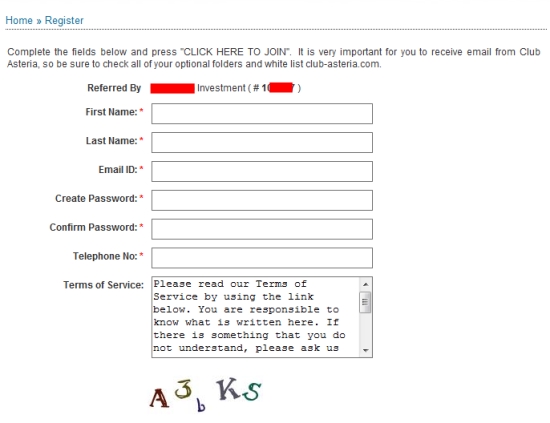
    “It’s no scam now,” a poster on MoneyMakerGroup confidently opined after the “I got paid” posts began to appear. A link under the comment led to the affiliate’s CA registration page,  which implied prospects were receiving guidance from an “Investment” company or professional financial adviser.

    This Club Asteria affiliate's sign-up page is accessible from a link on the MoneyMakerGroup Ponzi forum. The registration page implies that CA prospects are receiving guidance from a professional "Investment" company or adviser. In May 2010, the U.S. Postal Inspection Service identified MoneyMaker group as a site from which the alleged Pathway To Prosperity Ponzi scheme was pushed. Pathway To Prosperity gathered more than $70 million, creating about 40,000 victims from "all of the permanently inhabited continents of the world," according to federal court filings in the Southern District of Illinois.

    Separately on MoneyMakerGroup, another CA poster declared, “I am in over 35 forums and everyone is posting paid.”

    In July 2010, the Financial Industry Regulatory Authority (FINRA) issued an alert about investment scams and how they spread on the Internet.  Separately, court filings from May 2008 in the SEC’s case against an alleged $70 million Ponzi scheme known as Legisi include a handwritten note from a Legisi enrollee.

    “Money Maker Group.com,” the note read in part. The note was part of a 267-page evidence exhibit the SEC presented a federal judge. The SEC alleged that Legisi created thousands of victims.

    On both MoneyMakerGroup and TalkGold, posters have repeatedly noted that CA payments come from “Asteria Holdings Limited (Hong Kong).”

    CA says it accepts money through SolidTrustPay and AlertPay, both of which are Canada-based payment processors. Both companies are referenced in federal court filings in the alleged AdSurfDaily Ponzi scheme, which the U.S. Secret Service said gathered at least $110 million and created as many as 40,000 victims.

    ASD also was promoted on MoneyMakerGroup and TalkGold. Solid Trust Pay and AlertPay also are referenced in court filings in the Pathway To Prosperity Ponzi case.

    CA also notes that it conducts business with CashX, another Canadian firm. When the ASAMonitor Ponzi scheme and criminals’ forum mysteriously vanished in October 2010, the site’s landing page initially redirected to CashX.

    Some CA members are selling the “program” by describing what it is not. It is not a Ponzi scheme, and it is not an investment, they claim.

  • STATEMENT: Unusual Event At PP Blog

    At approximately 1:05 a.m. (EDT) today, the PP Blog began to experience unusually high traffic volume and a highly unusual traffic pattern. The source of the traffic is unclear. What is clear is that IPs from all over the world suddenly began to pull “old” stories, meaning that the URLs being pulled existed in the Blog’s archives — not in its current, front-page editorial well.

    The pattern strongly suggests the event was engineered robotically. It does not appear likely that the visitors were actual readers. Along with URLs for individual “old” stories, the URLs of archived files for certain dates in 2009 and 2010 were pulled. There appears to have been no follow-up clicks to the archived files, which strongly suggests the visitors did not intend to engage in any actual reading. No spam was received during the period, which suggests the visitors had a purpose other than spamming.

    Most of the visitors (the vast, vast majority, meaning on the order of 95 percent) displayed non-U.S. IPs. Dozens of international IPs making their first visit to the Blog sought virtually simultaneously to pull dozens of story links and links to archives.  Logs suggest that most of the IPs  had not been at the PP Blog prior to this morning’s event.

    The event appears to have reached its peak at 2:08 a.m.  Traffic to the Blog during the unusual event is preliminarily estimated at 10 to 20 times the normal volume.

    A similar event occurred at the Blog on March 9, although this morning’s event was much broader in scope. The March 9 incident involved about nine IPs;  today’s event involved dozens and dozens, with unusually large traffic volume from Europe, Asia, the South Pacific, Africa and South America. The Blog also recorded first-time visits from IPs in the Middle East.

    A server snapshot taken at 1:20 a.m. shows 17 “live” IPs pulling stories or archives exclusively from 2009 and 2010. Only one U.S. IP is present in the snapshot, and the U.S. IP was making its first visit to the Blog. The PP Blog is published in the United States. Most of its traffic originates in the United States.

    One of several maps that show a sudden burst of international traffic at the PP Blog on March 22, 2011. The pattern developed shortly after 1 a.m. (EDT) in the United States.
  • FTC Warns That Scammers Are Trading On Radiation Fears To Hawk Potassium Iodide Treatment In Aftermath Of Events In Japan; Be Cautious And Selective, Agency Advises

    Fraudsters are following the headlines about radiation fears in Japan and designing sales pitches to scare U.S. consumers into buying potassium-iodide treatments, the FTC warned today.

    Last week, the agency warned against charity scams that may emerge to mine illicit profits from the devastating earthquake and tsunami.

    “Potassium iodide, or KI, can help prevent thyroid cancer, which is one of the biggest risks from contamination with radioactive iodine,” the FTC said.  “However, public health experts agree that U.S. residents should not buy or take potassium iodide unless specifically notified or instructed by public health officials.”

    And, the FTC added, “If you decide to buy potassium iodide, buy it only from a reputable source. Iosat, ThyroSafe, and ThyroShield are the only potassium iodide products that are FDA-approved and can be legally marketed and sold in the United States.”

    Read the FTC’s warning on potassium-iodide treatment scams.

    Read the FTC’s warning on charity scams trading on events in Japan.

    Get more information on U.S. health policy from the Food and Drug Administration (FDA).

  • UPDATE: Club Asteria Members Use TalkGold Ponzi Forum To Announce That Firm Now Has More Than 200,000 Members; Separately, Some Members Grumble About Missing Payouts

    EDITOR’S NOTE: The adjective-inspiring story below is made possible by the incongruous behavior of online pitchmen who operate in an environment the Financial Industry Regulatory Authority (FINRA) described last year as a “bizarre substratum of the Internet.”

    Two promoters of Club Asteria, a business “opportunity” purportedly operated by a woman variously described as a former “Chairman,” former “Director” and former “Vice president” of the World Bank, have announced on the TalkGold Ponzi scheme forum that they’ve enrolled new recruits and that Club Asteria now has more than 200,000 members.

    “Ken Russo” advised TalkGold members that he had enrolled Club Asteria (CA) member No. 198920. A short time later, TalkGold member “manolo” announced he had enrolled CA member “200,600+”

    “It’s Official,” “manolo” declared. “Club-Asteria has over 200,000 Member!” (sic)

    The World Bank said last week that it once employed a woman named Andrea Lucas as director of the management systems and account department. The bank described the position as a staff job, and said Lucas worked in Washington, D.C.

    In this promo, Club Asteria is said to have been founded by a "former world bank Chairman." In a separate promo, Club Asteria is described as a site of "World Bank's former Vice president Andrea Lucas." The claim is made in a bold headline that features 24-point type.

    In MLM-style promotions, scores and scores of Club Asteria members globally have implied Lucas was a member of the World Bank’s board of directors. The World Bank, though, said that Lucas never was on the board of directors and had left her job at the bank in December 1986, nearly 25 years ago.

    Other Club Asteria members have described Lucas as a former chairman and vice president of the World Bank. At least one online promo for Club Asteria implies that Lucas is a current director of the bank.

    Get a “life time income wth (sic) help of world bank director,” the promo prompts viewers.

    On the MoneyMakerGroup Ponzi board today, Club Asteria members are complaining about cashout requests that have not been honored, slow or absent customer support and server troubles.

    Last week, Club Asteria asked members to put “a little extra effort into your Club-Asteria business over the next 15 days. We are asking you now to just use one extra hour each day to focus on the things that generate additional revenue, such as product and service sales as well as memberships.”

    The request was part of a promo on “HOW WE CAN HELP THE PEOPLE OF JAPAN” after the devastating earthquake and tsunami.

    Read a July 2010 story about an alert issued by FINRA.