Blog

  • Yet-Another Website With MPB Today Promo Uses Walmart’s Name In Domain Name; Site Targets Spanish-Speakers; Waves Check, Gift Card; Displays Images Of Buffet, Trump, Walmart

    A website that promotes the MPB Today “grocery” program is targeted at Spanish-speaking prospects and uses Walmart’s name in its domain name.

    Like at least three other websites linked to Florida-based MPB Today’s 2×2 matrix cycler, it is unclear if the site’s operator has Walmart’s permission to use its name in a domain name. The site, which implies Walmart distributes cash, is not registered in the retail giant’s name.

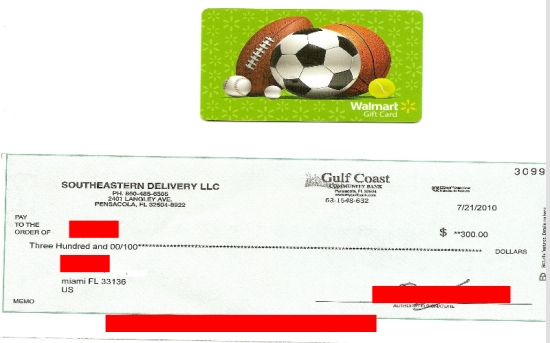
    An English headline on the site urges viewers to “Eliminate Your Grocery Bills . . . Forever” by joining the MLM. The site then presents Spanish content, while linking to a video that uses images of business titans Warren Buffet and Donald Trump. A check drawn on the account of Southeastern Delivery is reproduced on the site, as are images of a Walmart gift card, a Walmart store and a Sam’s Club store.

    MPB Today removed images of Buffet, Trump and Walmart from the homepage of its website last month. Regardless, multiple MPB Today affiliates continue to use the images. Southeastern Delivery is MPB Today’s purported parent company.

    It is common for MLM participants to imply a “program” is endorsed by celebrities and famous companies.

    ____________________________________________________________________

    The check reproduced on the website is drawn on a bank that has been operating under a consent agreement with the FDIC since January. Walmart and the FDIC have not responded to a request for comment from the PP Blog on the MPB Today program. Neither has the bank upon which the check is shown to be drawn.

    Multiple MPB Today affiliates have produced check- and card-waving videos and websites to recruit prospects. Some of them have been online for months.

    MPB Today has been advertised on forums that promote Ponzi schemes, including the now-defunct ASA Monitor forum. Some MPB Today affiliates have claimed publicly that there are liars, thieves and scammers in the organization.

  • BULLETIN: Sean Mueller Charged With Racketeering In Colorado Ponzi Probe; Secret Service, State Securities Division Assisted Denver DA In Unraveling Alleged $71 Million Scheme

    BULLETIN: In yet-another alleged case of massive Ponzi fraud, Sean Mueller has been charged with violating the Colorado Organized Crime Control Act (racketeering).

    Mueller, 42, also has been charged with securities fraud and theft. The prosecution was brought by the office of Denver District Attorney Mitch Morrissey, who credited the U.S. Secret Service and the Colorado Division of Securities for assisting in the Ponzi probe.

    “This is an important example of how agencies can work together to protect investors in Colorado,” said Fred Joseph, commissioner of the Colorado Division of Securities.

    Mueller, who is believed to be cooperating with authorities, is expected to surrender by Friday. Bond has been set at $2 million cash.

    Among the victims of the $71 million Ponzi scheme was John Elway, the former quarterback of the Denver Broncos and a member of the Pro Football Hall of Fame, prosecutors said.

    Prosecutors at both the state and federal levels have used racketeering statutes to bring down Ponzi schemers in recent months, according to court filings.

    Mueller was operating a bogus hedge fund, prosecutors said. At least 65 victims entrusted Mueller with their money, which he spent to live a luxurious lifestyle and to buy tony homes, expensive cars and country-club memberships.

    It was a “classic” Ponzi scheme in which Mueller was upside down on his obligations to investors by a factor of nearly five-to-one, owing about $45 million but having less than $9.5 million to cover redemption requests, prosecutors said.

    The scheme was exposed in April, when Mueller threatened to jump off a parking garage in Greenwood Village, Colo., according to court filings.

  • BULLETIN: ASA Monitor Ponzi And Criminals’ Forum Says It Is Closing; Threads Go Missing En Masse; Closure Coincides With Undercover Operations By Law Enforcement And USDA Probe Of MPB Today

    BULLETIN: UPDATED 7:37 P.M. EDT (U.S.A.): The ASAMonitor Ponzi and criminals’ forum — the forum from which the purported MPB Today “grocery” program was being promoted and countless other fraud schemes were being promoted — suddenly has announced that the forum is closing.

    The announcement, which appeared today in red type, was made by “Wanrou,” whose ID says he is “ASA Administrator.” Content from the forum appears to have been deleted or hidden en masse.

    “ASA forum has been a place where members can get information, discuss, share, debate, to educate and be educate about possibilities and risks of online money making programs for the last few years,” the Wanrou post said.

    “Sadly we can no longer keep it online as a free discussion forum because of time consuming and financial reasons,” the post continued.

    “Thanks you all for your long time support and best wishes to your present and future online endeavors.”

    The forum’s sudden closure coincided with reports in recent months that U.S.-based law-enforcement agencies were conducting undercover stings both online and offline and using informants to bring both criminal and civil charges against financial fraudsters.

    It was not immediately clear if ASAMonitor would seek to reopen as a so-called “private” forum. Court records show that undercover operations also have infiltrated “private” forums and that members of the forums who had been scammed have provided helpful information to investigators.

    The sudden closure of ASAMonitor also coincided with yet-another flap in the MPB Today thread. An antiscam poster was specifically warned by a moderator yesterday to refrain from his efforts to inform ASA members about developments in the MPB Today story and his reading of events at MPB Today.

    Specific claims about MPB Today are being investigated by the U.S. Department of Agriculture. The program has been pitched to Food Stamp recipients, people of faith, Ponzi scheme victims, people of color, senior citizens, college students and opponents of President Obama, among others.

    Obama created an entity known as the Financial Fraud Enforcement Task Force in November 2009 to do battle with fraudsters. In January, U.S. Attorney General Eric Holder warned in Florida that the U.S. government was serious about putting scammers in prison.

    ASAMonitor previously closed the MPB Today thread after warning an antiscam poster to back off from challenging “Ken Russo,” a poster promoting the MPB Today program. The thread later was opened after what a Mod described as a “cooling off period” had passed. In an earlier closure of the thread, links to the PP Blog’s coverage of the MPB Today story were deleted from the forum and later restored.

  • KABOOM! More Bad News For Fraudsters: ‘FBI Undercover Operation’ Leads To Florida Fraud Busts; 20 Charged In Alleged Schemes, Including ‘CHiPs’ Actor

    An undercover sting conducted by the FBI has resulted in fraud charges being filed against 20 individuals or companies. The sting was centered in southern Florida. Among those charged was Larry Wilcox, one of the stars of the long-running television program “CHiPs” in which Wilcox played the role of a California police officer, the SEC said.

    Records suggest Wilcox agreed to become a government informant after becoming implicated in the probe.

    Wilcox, 63, of West Hills, Calif., was among a group charged both civilly and criminally. The case was brought after the FBI conducted an undercover probe into penny-stock schemes.

    “Securities fraud is an equal opportunity crime — it runs the gamut from very large to very small publicly traded companies,” said U.S. Attorney Wifredo A. Ferrer of the Southern District of Florida.

    Ferrer noted that “even microcap companies are plagued by fraudsters who seek to manipulate the stock market to line their own pockets.”

    Separately, the SEC said the sting was conducted “in such a way that no investors suffered harm” — an announcement that could send shockwaves across the fraud universe because it demonstrates that investigators are infiltrating schemes and relying on informants to unmask the schemers.

    Wilcox, for example, believed he was doing business with a “corrupt trustee,” according to court filings. Records suggest that Wilcox entered a deal with the government in July in which he would cooperate in an ongoing probe.

    “These corrupt promoters meticulously planned their schemes down to the last detail, except for the possibility that they were walking into an undercover operation,” said Robert Khuzami, director of the SEC’s Division of Enforcement. “This joint law enforcement effort is a stark warning to those who embark on securities fraud schemes that we may be listening and we may be watching.”

    Whether the SEC and FBI were performing similar stings in the corrupt worlds of HYIPs, autosurfs and 2×2 matrix cyclers as promoted on Ponzi forums was not immediately clear. The Justice Department, however, has made it clear in court filings that it is infiltrating criminal forums and is using undercover operatives.

    The U.S. Secret Service also has made it clear that it is using undercover operatives in its investigations of corrupt enterprises such as HYIPs, autosurfs and 2×2 matrix cyclers.

    Read the SEC’s statement:

    Read the statement of U.S. Attorney Ferrer and remarks from the FBI:

    Read a story about a Secret Service probe in which undercover operatives were used to infiltrate criminal forums:

  • Another MPB Today Site Uses Walmart’s Name In Domain Name; Positions ‘Grocery’ Biz As ‘Freedom Club’ In Domain Hidden Behind Proxy; Uses Images Of Buffet, Trump And Late Sam Walton

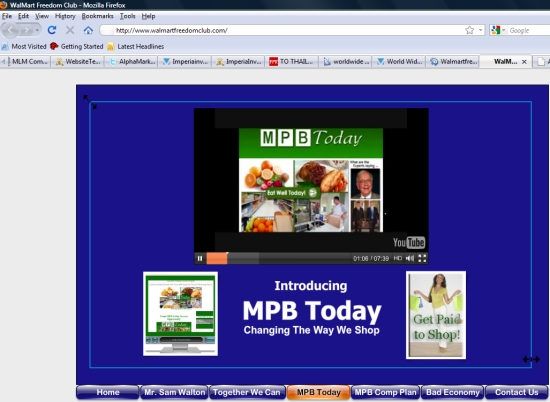
    This pitch for MPB Today positions it as the Walmart Freedom Club. The pitch misspells the word "prosper" as "prospour." The website registration is hidden behind a proxy, and uses Walmart's name in the domain name. It is unclear if Walmart authorized the domain name or the use of its intellectual property in the MPB Today promo.

    Yet-another domain linked to the purported MPB Today “grocery” program is using Walmart’s name in its domain name. The domain name is registered behind a proxy and uses images of Warren Buffet, Donald Trump and Sam Walton to position the opportunity as a “Freedom Club.”

    Sam Walton is the late founder of Walmart. It is unclear if the owners of the website have Walmart’s permission to use its name and the likeness of Sam Walton in a pitch for the MPB Today program. Also unclear is whether the website owners have the permission of Trump and Buffet to use their images in promos for MPB Today.

    Separately, yet another pitch for MPB Today features a narrator who notes that food is necessary to stay “alive” and laments, “I wish we could sell air too.” The “air” video is on a restricted YouTube site maked as “unlisted.” An unlisted video “means that only people who know the link to the video can view it (such as friends or family to whom you send the link,” according to YouTube.

    MPB Today is a multilevel-marketing (MLM) program based in Pensacola, Fla. The “opportunity” is tied to a grocery business in Pensacola known as Southeastern Delivery. Both companies are linked to Gary Calhoun, who has a poor track record with the Better Business Bureau and was the recipient of a warning letter from the Food and Drug Administration for his marketing of a product that purported to be a treatment for Lou Gehrig’s disease, Herpes and Alzheimer’s, among others.

    The new domain that uses Walmart’s name is at least the third linked to the MPB Today program — and the second to position MPB Today as a “club” tied to Walmart.  The domain was registered Sept. 9, after MPB Today itself removed images of Walmart, Buffet and Trump from the homepage of its website.

    Other MPB Today-linked websites branded with Walmart’s name imply the retail giant offers free groceries or that Walmart is partnered with MPB Today.

    Meanwhile, still-other websites linked to the MPB Today program position it as a “Grocery Assistance” program and a program linked to the Food Stamp program administered by the U.S. Department of Agriculture. MPB Today also is being pitched from known Ponzi and criminals’ forums such as ASA Monitor, TalkGold and MoneyMakerGroup.

    On Wednesday, the SEC filed an emergency action in federal court in Utah to stop a program known as Imperia Invest IBC dead in its tracks, amid allegations it had fleeced millions of dollars from thousands of Americans with hearing impairments. Like MPB Today, Imperia was promoted on the Ponzi forums.

    Among the allegations in the Imperia case were that the operators were using trademarks and the intellectual property of a major company — Visa Inc. — without the company’s authorization. All in all, more than 14,000 Imperia investors were fleeced, the SEC said.

    In this separate promo for MPB Today, a narrator notes that food is necessary to stay "alive" and laments that he wishes members also could sell "air" through the MPB Today MLM program.

  • BULLETIN: SEC Gains Asset Freeze, Seeks Shutdown Of Imperia Invest In Emergency Action; Program Pitched On Same Ponzi Forums Promoting MPB Today; Agency Says Imperia Defrauded Thousands Of Deaf Americans

    BULLETIN UPDATED 5:02 P.M. EDT (U.S.A.): The SEC has gone to federal court in Utah to halt the operations of Imperia Invest IBC, alleging a spectacular fraud that fleeced money from thousands of Americans with hearing impairments.

    Imperia was promoted from the MoneyMakerGroup Ponzi forum — one of the Ponzi forums promoting the MPB Today “grocery” MLM. Imperia also was the topic of discussion and defenses on TalkGold and ASAMonitor, two other forums that are pitching MPB Today.

    The SEC’s allegations against Imperia are stunning. More than 14,000 investors were defrauded worldwide, the agency said.

    Among the victims were thousands of deaf investors in the United States, the SEC said.

    Imperia gathered relatively small sums from thousands of people, the SEC charged, noting that “no evidence has been found that any of the investors have received a single payment.”

    “Imperia Invest IBC is a web-based entity that claimed, until late 2009, to be located in the Bahamas,” the SEC charged. “The Bahamian address listed by Imperia is fictitious. Imperia now claims to be located in Vanuatu. However, Imperia is not registered to do business in Vanuatu and the address listed on its website appears also to be fictitious. Neither Imperia nor its securities are registered with the Securities and Exchange Commission. Imperia is not licensed or registered with the Commission, with any state, or with any Self Regulatory Organization.”

    Categorically absurd representations of earnings and the program’s potential were made to investors, the SEC said.

    “Investors were promised eye-popping amounts of money in return for a simple $50 or $100 investment, and Imperia has made numerous excuses on its website about why these returns haven’t been paid,” said Ken Israel, director of the SEC’s Salt Lake Regional office.

    “The Imperia website shows an example of such earnings in which a $50 investment will return $134,000 to the investor in six months,” the SEC charged. At the same time, the agency said some investors were told that spectacular sums were due them for doing business with Imperia.

    “Imperia represented to one investor who invested $150.00 with Imperia that Imperia owed him $36,610,755.20 within a two year time frame,” the SEC charged. “Another individual’s account statement who invested $500 in July 2007 showed he is owed $43,907,652.20 as of May 2010.”

    It was not immediately clear how so many deaf investors became involved in Imperia. A federal judge has approved an asset freeze.

    Imperia called its product Traded Endowment Policies (TEP), which the SEC described as “the British term for viatical settlements.”

    “A TEP or viatical settlement involves the sale of an insurance policy by the policy owner before the policy matures, and policies are sold at a discount from face value in an amount greater than the current cash surrender value,” the SEC said.

    “There are at least 14,000 [Imperia] investors worldwide with a total investment exceeding $7 million,” the SEC said. “In the United States, there appear to be approximately 6,000 investors, most of whom belong the hearing impaired community, who have invested in excess of $4 million with Imperia.”

    Imperia used offshore payment processors such as “Liberty Reserve, located in Costa Rica; Perfect Money, located in Panama; and Procurrex, located in the British Virgin Islands,” the SEC charged. “Once Imperia received funds from Investors, it appears that Imperia then transferred amounts from these accounts to foreign bank accounts, including but not limited to accounts located in Cyprus and New Zealand.”

    Even as Imperia was ripping off investors, it also was infringing trademarks and the intellectual property of Visa, the credit-card service, the SEC charged..

    “Imperia also requires that investors purchase a Visa debit card to access their investment proceeds,” the SEC said. “Imperia charges customers a fee to purchase the Visa debit card ranging from $145 to $450.

    “Visa has not authorized Imperia to use its name or trademarks and has sent Imperia a cease-and-desist letter to halt its unauthorized use of the Visa name and logo,” the SEC said. “There is no evidence that any investor who has ordered a Visa debit card from Imperia has actually received such a card.”

    One poster on the MoneyMakerGroup forum advised prospects that he would keep an “open mind” about Imperia, according to web records.

    “Anyway, in the final analysis each person must make their own decision,” the poster said in 2007.

    While the MoneyMakerGroup poster was holding forth about keeping an “open mind,” Imperia was cloaking itself to siphon millions of dollars, according to web records and court records.

    “Imperia took proactive steps to conceal the identity of its control persons by using an anonymous browser to host its website, by communicating with all investors via email without disclosing the identity of any control persons and by establishing off-shore Paypal-style bank accounts to conceal the recipient of the investment proceeds,” the SEC charged.

    In July, the Financial Industry Regulatory Authority issued a warning about HYIP schemes pitched online. In May, the U.S. Postal Inspection Service accused an HYIP known as Pathway To Prosperity of defrauding more than 40,000 people in a scheme that took in about $70 million.

    Pathway To Prosperity also was promoted on the Ponzi and criminals’ forums. ASAMonitor, TalkGold and MoneyMakerGroup are specifically referenced in court filings in the Pathway to Prosperity case.

    MoneyMakerGroup is specifically referenced in court documents in the alleged Legisi HYIP and Ponzi scheme, a fraud that allegedly gathered more than $70 million.

    Read the SEC complaint against Imperia.

  • EDITORIAL: Prized Magazine ‘Newsweek’ Acquired For $1; Publishing Continues To Bleed — Even As Autosurf Cheerleaders Say They Have The Answer To Lagging Ad Sales

    The Associated Press reported yesterday that the Washington Post sold Newsweek magazine — an American treasure — for $1. The Post also absorbed $10 million in debt for Newsweek, which lost nearly $30 million last year.

    How much is $30 million? Well, it’s about $1.6 million less than AdSurfDaily President Andy Bowdoin had in a single bank account from his alleged “advertising” Ponzi scheme. It’s also less than one-half the total sum ($65.8 million) the U.S. Secret Service seized from 10 Bowdoin bank accounts.

    This is painful to watch on a couple of levels: First, American publishing companies continue to bleed profusely, leading to a situation in which American treasures are being sold for $1 and skilled administrative, management, editorial, production, sales and advertising professionals are losing their jobs or working for far less money.

    Second, problems in the U.S. economy in general are providing a launching ground for hucksters who would have you believe that Newsweek, the Seattle Post-Intelligencer and many other cherished publications could have saved themselves a lot of heartache by turning to the “autosurf” business model.

    In the autosurf business model as practiced by ASD, a company such as Microsoft that perhaps had relied on Newsweek  to advertise in print could have paid ASD $1 million to advertise online. ASD would have placed Microsoft’s ad in its magical advertising rotator. From that $1 million, Microsoft would have “earned” $10,000 a day more or less for the next 125 days, thus not only “earning” back the full $1 million, but also fetching a “profit” in the neighborhood of $250,000 on top of it.

    And Microsoft also would have sold a bunch of software by advertising on ASD, which purported to have a “captive” audience consisting of advertisers it was paying to view the ads of their fellow ASD advertisers. With Microsoft as a theoretical ASD advertiser, it could have boosted its bottom line by watching ads from a theoretical Apple, for example. The “rebates” Microsoft earned — coupled with the profits from the sale of software products displayed in ASD’s rotator — would have made both Microsoft and America happy, according to ASD’s devoted flock of commission-based, MLM salespeople.

    ASD, its fans said, had the perfect solution: Microsoft would have been paid more money than it spent, meaning it would have emerged in a better cash position within 125 days of doing business with ASD.  The ASD salesperson who recruited Microsoft also would have been paid — $100,000 for the $1 million sale alone. ASD would have made money. The U.S. economy would have continued to gain steam.

    Except it was not perfect, of course. In fact, is was all a colossal lie, according to the U.S. Secret Service, which accused ASD in August 2008 of operating a massive Ponzi scheme. Any money that ASD advertisers received from ASD came from other advertisers.

    So, it is plain to see that ASD was not a good deal for “advertisers” — theoretical or otherwise. ASD could have killed off Microsoft had its management been uninformed enough or desperate enough to trust a single word ASD ever said. Horror of horrors: Why would Microsoft want to limit its ASD ad spend to $1 million? Why not $10 million or $100 million — or more? Why not plow its “profits” right back into ASD, which advertised dramatically higher profits than, say, Bernard Madoff?

    After ASD killed off Microsoft, it would have killed off that MLM salesperson, the one who was paid $100,000 for Microsoft’s $1 million in business while Microsoft itself was paid $1.25 million more or less.

    Indeed, like Microsoft, the ASD MLM salesperson pitching ASD’s cancer would have had to return the “profit” he was paid from the proceeds of a criminal enterprise, even if it meant selling his home to raise the cash.

    But how to sell a home in this economic environment — you know, with all the foreclosures and such, all the bank failures and such — and all of the falling prices of real estate and such because of all the foreclosures and such?

    Want to add an extra layer to the ASD madness? Some ASD promoters who declared themselves committed, free-market Capitalists insisted that companies such as Microsoft would not be interested in profits, that they’d be happy enough just to display their ads and not get paid.

    The corporate benevolence of companies such as Microsoft would have resulted in ASD profits that were redistributed to smaller companies and Mom-and-Pop advertisers, thus creating wealth across the social spectrum. Some of the very same Capitalists who made these claims later complained about what they described as the Socialist redistribution schemes of the U.S. government.

    It also seemed not to occur to the autosurfing Capitalists who were rooting for a Socialist redistribution scheme — a scheme whereby big companies such as Microsoft would finance the profits of smaller players — that companies such as Microsoft could have started an autosurf at any time they wanted and crushed ASD like a bug.

    It’s a pretty safe bet that Microsoft, unlike ASD, could have kept its autosurfing site from going offine and could have produced a site that didn’t look as though it had been assembled by amateurs using a script kit. Meanwhile, it’s also a pretty safe bet that Microsoft wouldn’t have been looking for ways, say, to peel off cash to put Bill Gates in a new Lincoln or a relative of Bill Gates in a sporty, new Honda.

    Along those lines, it’s also a pretty safe bet that Microsoft would not have been seeking ways, say, to route millions of dollars offshore so it could be retrieved later by “management” who suddenly found themselves cash poor and without a country.

    Ay, just another day in Ponzi America, a country that has more than a few people who believe the business cure for what ails America is an ASD-like scheme that runs 24/7/365. You can read all about such schemes on the Ponzi boards — and you can induce people into the schemes and get paid a commission, which you can deposit into your FDIC-insured bank.

    Newsweek, like the Post Intelligencer, didn’t go the autosurf route, despite the fact it could have done exactly what ASD did: Lied to its advertisers by telling them that NewsweekDailyProSurf.com was the cure for all their ills, a cure that would have returned 125 percent more or less in 125 days more or less.

    No, Newsweek sold itself for $1 in a bid to save itself. We wish this American treasure the best as it seeks to retool.

    Finally, did you hear that the affiliate braintrust pitching the purported MPB Today “grocery” program on the ASA Monitor Ponzi and criminals’ forum is promoting an MPB Today “rebate” program?

    Read the AP story on the sale of Newsweek for $1.

  • EDITORIAL: Sundays Aren’t What They Used To Be: Is The MPB Today Matrix Stalling? Was A ‘Rebate’ Plan Advanced On Ponzi Forum A Bid To Reinvigorate It? (And Why Is The Matrix Being Plugged As A ‘Grocery Assistance’ Program On A .Org Site?)

    Sundays aren’t what they used to be.

    “Ken Russo” announced Sunday on the ASA Monitor Ponzi and criminals’ forum — a forum from which other promoters are targeting people of faith to join the MPB Today “grocery” program — that a member of his “team” is offering $50 “rebates” to entice prospects to sign up. (Read more about the “rebates” program below.)

    On the same day, known in the Christian faith as the Lord’s Day, MPB Today members who apparently were wooed by the company and its affiliates’ sales pitches came to the PP Blog to describe MPB Today critics as “roaches,” “IDIOTS,” “clowns,” “terrible” people, “misleading” people, people who have led a “sheltered life,” people who have been “chained up in a basement,” people who have “chips” on their shoulders, spewers of “hot air,” “naysayers,” “complainers,” “trouble maker[s]” and “crybabies.”

    And these remarks came from just three people in the MPB Today organization, which promoters say has 30,000 members. One of them denied on Sunday that MPB Today pays participants to recruit, something that MPB Today itself does not deny. MPB says commissions are “banked” until promoters sign up at least two other participants, and that no one cycles until a downline group becomes populated by seven members, only one of whom “cycles” and earns a matrix payout.

    For good measure, the same affiliate claimed on Sunday that she is paid for “grocery” sales, but chose not to answer a question about how many people within her organization actually bought groceries by overpaying for them through MPB Today. At the same time, she claimed MPB Today is sustainable because “[inherently] there is hard data that a certain % of people just will not get 2 people and cycle.”

    It was easy to read that as a Sunday concession that MPB Today relies on matrix “losers” to create matrix “winners.” In any event, it wasn’t much of an endorsement for the company, a company the member also described as a “blessing.” Blessings, like Sundays, aren’t what they used to be, it seems.

    Another MPB Today member claimed on Sunday that there are “[rogues]” in the organization. He did not explain whether he was being paid from rogue money or money sent in by honest affiliates.

    MPB Today members should be worried. A “rebate” program may signal that the MLM firm’s 2×2 matrix cycler is stalling and that the only effective way for average members to recruit two members who can recruit two other members in order to “earn” cycler commissions is to bribe them to join the program.

    It also may signal that promoters are trying to plant the seed that it’s time for their downlines to start spreading the word that MPB Today’s shipping costs are such a deal-killer that the only effective way for members to recruit is to tell prospects they’ll help them defray the shipping charges in the unlikely event they’re actually keen on buying overpriced groceries from a company that offers no money-saving generic products, ships dry goods “ONLY” and may charge customers who just overpaid for name-brand groceries up to $300 for $200 worth of food.

    “Ken Russo” said the “rebate” program was limited to four participants and that his “team” member would go $50 out-of-pocket for each of the four new recruits swayed by the offer. “Ken Russo” advertised that MPB Today’s shipping charges could be up to $50, a claim at odds with what MPB Today itself claims.

    Indeed, MPB Today says shipping charges may amount to up to 50 percent of the cost of a grocery order and perhaps may be even higher. MPB Today supplies only an “average” and plants the seed that perhaps customers should choose “lighter” items, as opposed to “heavy” items that are more expensive to ship. It’s even unclear how MPB Today arrived at its published “average”  of up to 50 percent, considering the company does not say how many of its purported 30,000 MLM customers actually get their groceries from the firm.

    MPB Today is operated by Gary Calhoun. Calhoun once was the subject of a warning letter from the Food and Drug Administration for hawking a product that purported to treat Lou Gehrig’s disease and, for good measure, Herpes and Alzheimer’s.

    “Ken Russo” doesn’t seem keen on telling prospects about Calhoun’s FDA experience. What he seems keen on, apparently, is talking about the “rebate” program started by someone on his “team” — and posting the news on the ASA Monitor Ponzi and criminals’ forum on a Sunday.

    If other MPB Today affiliates borrow the idea announced on a Sunday and the “rebate” program takes off and expands, it means that MPB Today sponsors who offer the “rebates” are absorbing additional costs in an enterprise that already is impossible mathematically.

    Any money MPB Today’s affiliates pay in the form of rebates inures to the benefit of the company — a company that already operates a matrix heavily weighted in its favor. Do you really want to go out-of-pocket even more for a 2×2 matrix cycler that uses a business model that came under fire by the U.S. Secret Service in the alleged Regenesis 2×2 Ponzi scheme last year?

    The U.S. Department of Agriculture is investigating specific claims about the MPB Today program, which has been targeted at Food Stamp recipients. What’s next? Recruiting America’s poor by enticing them with rebates and asking them also to offer rebates?

    Whether the “rebates” idea advanced from a Ponzi and criminals’ forum on a Sunday will go viral is unknown. Some affiliates easily could latch onto it, persuading themselves it’s better to ply prospects with rebates than take the chance MPB Today’s matrix will perform the magic itself.  Our reading of the Sunday “rebates” idea is that it is an inducement to separate people from their money on all seven days of the week on the theory that it’s better to pay $50 on top of the $200 (plus website costs) you’ve already paid to plumb a commission.

    If the MPB Today “grocery” program already is stalling, prospects may be few and far between if you’re aren’t willing to bribe them to overpay for groceries on the theory that doing it one time eliminates their grocery costs forever.

    Here is another reason for MPB Today members to worry: Because the “rebate” program purportedly exists to defray the shipping costs MPB Today charges for the home delivery of groceries, it can be construed as an acknowledgment that MPB is not actually serious about selling groceries, that it is more interested in selling the “opportunity.”

    If you’re an MPB Today member — and if you have not applied any sort of “reasonable person” standard to the program and instead have relied on hype from the company and your upline — you have made a mistake.

    Any claim that a $200, “one-time” purchase of groceries from MPB Today can result in free groceries for life is absurd. Spin it as you will. Argue that it is theoretically possible. Argue that you’re already in “profit” and can vouch that the program “works.” Argue that members of your downline can make the same claim.

    It is still absurd. No reasonable person would invest in such an argument and assign it any credibility at all. Jurors would laugh at such an argument. They shop at grocery stores. They know that a $200, one-time purchase and an accompanying claim that this relatively modest expense can result in free groceries for life is the precise sort of claim that exists only in the realm of the huckster.

    Wait until they’re told about the “catch” — i.e., that an MPB Today member must get two who can get two (or produce $1,200 in sales volume in some other combo) to set the stage for “free” groceries for life. And wait until they’re told that an MPB Today shopper perhaps has to pay up to $300 for $200 worth of groceries and that lots of the purported “grocery” money seems to have been converted to Walmart gift cards that can be used to buy big-screen TVs and laptop computers.

    And wait until they’re told that the conditions above have to be repeated, well, repeatedly, in order for members to continue to get paid.

    Speaking of Sundays: We noticed on Sunday that an MPB Today affiliate was promoting the opportunity through a .org domain. The promo shows a cart full of groceries and a bag of groceries of the sort not available through MPB Today, along with a bag of money.

    The promo on the .org site positions MPB Today as a “Grocery Assistance” program.

    “Our Grocery Assistance Program is helping thousands of families earn CASH and FREE groceries!” the page screams.

    It is not unusual for MLM participants to register a .org domain in a bid to plant the seed that prospects will be aiding a charity by enrolling in a program and paying a sign-up fee. Members of Narc That Car and Data Network Affiliates, for instance, registered .org sites and sought to link the MLMs to the national AMBER Alert program administered by the U.S. Department of Justice.

    The .org domain in the MPB Today program we noticed on Sunday — and please note that we have observed several other .org domains linked to MPB Today — hints that it is a government program by using the word “assistance” in its title.

    On a closing note, the .org domain we noticed on a Sunday also was registered on a Sunday — Sunday Aug. 22, 2010, according to records.

    So, no, Sundays aren’t what they used to be.

  • Florida Drops State-Level Pyramid Case Against AdSurfDaily; Says It Has Supplied Victims’ List To Claims Administrator For Restitution From Assets Seized By Secret Service In Federal Case

    Andy Bowdoin

    UPDATED 7:40 P.M. EDT (U.S.A.) Certain members of Florida-based AdSurfDaily began crowing last week that the office of Florida Attorney General Bill McCollum had dropped the pyramid-scheme case it had filed against ASD in August 2008.

    “The State of Florida has dropped all charges against Ad Surf Daily, Inc. This is wonderful news!” an email received by some ASD members exclaimed.

    Florida prosecutors, however, tell a different story.

    Although McCollum’s office confirmed today that the pyramid case has been dropped “without prejudice” — meaning it can be refiled — it noted that state investigators have forwarded a list of Florida victims of ASD to a federal claims administrator “for processing and reimbursement purposes.”

    Florida initially had sought restitution for victims, along with the dismantling of ASD. ASD essentially dismantled itself in September 2009 by not filing required forms with the state, which revoked its corporate registration. Less than four months later, in January 2010, the federal government was awarded title to more than $65.8 million seized in the case. The government earlier had been awarded title to more than $14 million. In March 2010, the government was awarded title to more than $600,000 that had been seized in a separate forfeiture action filed against ASD connected assets in December 2008.

    All in all, the federal government was awarded title to more than $80 million seized in the ASD case, gaining a clean sweep in the forfeiture proceedings.

    The U.S. Secret Service raided ASD on Aug. 5, 2008.  Florida followed up with a lawsuit of its own a day later, but federal prosecutors later said they intended to form a restitution pool from seized assets. That process now has begun, although ASD President Andy Bowdoin is appealing the January 2010 forfeiture order entered by U.S. District Judge Rosemary Collyer.

    In its paperwork to dismiss the pyramid case, McCollum’s office pointed to Collyer’s forfeiture order, saying ASD victims from Florida and elsewhere had been provided an opportunity for restitution by the federal government.

    On Sept. 28, 2009 — three days after Florida revoked ASD’s corporate registration and dissolved the registration of a shell company known as Bowdoin/Harris Enterprises — federal prosecutors filed a U.S. Secret Service transcript of a conference call ASD had recorded Sept. 21.

    In the call, Bowdoin told members that the government had seized their money. In his court filings, however, Bowdoin claimed the money was his.

    Federal prosecutors said the recording was evidence that Bowdoin could not keep his stories straight, arguing that he had told members one story and a federal judge another. Collyer issued the forfeiture order for more than $65.8 million less than four months later.

    Although an email some ASD members received in recent days claimed that “It looks like things are moving in the right direction” with the Florida dismissal, the email urged members to “only share this with those whom you trust.

    “Do not post on forums or blogs,” the email urged.

    Federal prosecutors noted last month that the U.S. Court of Appeals for the District of Columbia Circuit had dismissed one of two appeals Bowdoin had filed in the forfeiture cases, noting his second appeal was pending before the same court.

    The court should reject that appeal as well, prosecutors argued.

    With the federal procedure for restitution established, ASD victims now have a remedy for reimbursement, McCollum’s office advised a state judge.

    In late 2008, Bowdoin told ASD members that Florida had dropped “Ponzi scheme” allegations against the firm. McCollum’s office immediately countered with a statement that it never even had accused ASD of operating a Ponzi scheme, noting that it had alleged a pyramid scheme only.

    When Bowdoin made the 2008 claim, some ASD members raced to forums and websites to spread the news, which turned out not to be true. He later tried to sell members a VOIP telephone service, explaining the price he offered was a gift to his loyal supporters.

    Even as Bowdoin was telling members in September 2009 that he had big plans for ASD, he did not explain why he had permitted its corporate registration to lapse or explain that the state had revoked the registration.

    Instead, Bowdoin told members that the government had seized their money — a claim in opposition to his own court filings that advised a federal judge the seized money belonged to him.

  • Man Who Posed As Fraud Investigator And Blew Up His Own Mailbox Convicted In Bizarre Bid To Extort Ponzi Scheme Victims To Pay Him For Information

    A Washington state man has been convicted of nine federal felonies in a bizarre case in which he attempted to fleece Ponzi scheme victims by blowing up his own mailbox and taking guns and bomb-making components to Atlanta.

    Kevin W. Williams, 45, of Chehalis, was found guilty of three counts of wire fraud, extortion, possession of a firearm without a serial number, destruction of a letter box, making a false official statement and two counts of possession of an unregistered firearm. The unregistered firearms included a pipe bomb and a zip gun, federal prosecutors said.

    Williams’ plot began in 2007 and featured a claim that he was an investigator who knew where the loot from a $90 million Ponzi scheme in Greater Atlanta had been hidden, prosecutors said.

    In a bid to make his claims sound credible, Williams, an unemployed logger, blew up his mailbox with a homemade bomb. He apparently reasoned that Ponzi victims and attorneys involved in the case would give him money if they came to believe his information was so valuable that someone tried to maim him to make him turn silent, prosecutors said.

    Williams was slightly injured in the mailbox detonation that he arranged with an accomplice, prosecutors said. After the mailbox exploded, emergency responders were summoned to make the story more plausible.

    The trouble with the story, prosecutors said, was that the “blast was so powerful that Williams would have been badly injured if it had occurred as he described. He was checked at the hospital and released the same day having suffered only a few minor scratches on his forehead and ringing in his ears as injuries.”

    With no one willing to pay him for his purported information, Williams dialed up the scheme, prosecutors said.

    First, he sent emails “with a threatening tone,” prosecutors said.

    And then Williams traveled to Atlanta for the Ponzi trial.

    “He was arrested by law enforcement with a variety of guns, ammunition and explosive components in his car,” prosecutors said. “Following that arrest, one of Williams’ cohorts contacted law enforcement, and admitted lying to the police about Williams being the victim of the mail box bomb.

    Assisting in the probe were the U.S. Postal Inspection Service, Bureau of Alcohol, Tobacco, Firearms & Explosives (ATF) and the Lewis County Sheriff’s Department.

    The case was prosecuted by the office of U.S. Attorney Jenny A. Durkan of the Western District of Washington.

    Williams’ step-mother was a victim of the Atlanta-area scheme, prosecutors said.

  • INCREDIBLE: Florida — Again: SEC Files Complaint Against Purported ‘Gold’ Mining Operation In Miami Known As Quri Resources And Its CEO, Jaime Santiago Gomez

    BULLETIN: The SEC has gone to federal court in Florida to accuse Quri Resources Inc. and its Chief Executive Officer Jaime Santiago Gomez of operating a pump-and-dump scheme to drive up the price of Quri’s unregistered stock.

    It was the second major action in Florida today against companies and individuals who allegedly were running stock-fraud schemes. Named defendants in a separate SEC case were Atlantis Technology Group and CEO Christopher Dubeau of Weston, Fla.

    “Investors were duped into believing that Quri Resources was a successful mining company and that Atlantis Technology Group was selling cutting-edge technology services,” said Eric I. Bustillo, director of the SEC’s Miami Regional Office.

    “Both companies misled investors with exaggerated claims while their respective senior executives illegally dumped shares into the market,” Bustillo said. “We will continue to crack down on companies that promote misleading information.”

    The SEC said that Quri purported to be a “mining company headquartered in Miami, Florida, and operating in Ecuador.”

    As was the case with Atlantis and Dubeau, Quri and Gomez were accused of issuing “a series of false press releases and other misleading public statements” as part of the scheme, the SEC charged.

    From February to July 2009, Quri claimed in several press releases that, among other things:

    • It was ready to begin drilling on a mining project in Ecuador with a probable gold reserve worth over $1 billion.
    • It had signed letters of intent to acquire two valuable mining projects in Arizona.
    • It had acquired a second mining project in Ecuador and anticipated producing gold within three months.
    • It had signed a letter of intent to acquire a third valuable mining project in Ecuador.

    “[A]t the same time, Quri’s website and other public statements described Quri as having ongoing operations, employees worldwide, and an impressive management team,” the SEC charged. “The complaint alleges that these claims were grossly misleading because, among other things:

    • The exact value of the gold reserves in Ecuador could not be known without further detailed exploration.
    • Quri never acquired any mining projects in Arizona, and it acquired, at most, only one project in Ecuador.
    • Quri never developed any of its purported mining projects and was never in a financial position to do so.
    • Quri had no money, was never able to raise any funds, had no reasonable expectation of any funding, and was heavily indebted.

    The SEC said the scheme also involved the misuse of a website and a social-networking site.

    “Gomez also authored Quri’s internet website and approved its profile on the social network website LinkedIn,” the agency alleged. “These falsely described Quri as having ongoing operations, 28 employees worldwide, a geologist with a PhD on staff, and an impressive management team led by Gomez, a college graduate. None of these claims were true.”

    Gomez simply fleeced investors, the SEC charged.

    “[T]aking advantage of Quri’s artificially inflated stock price, Gomez, through an entity he controlled, dumped over half a million shares of Quri stock on the unsuspecting public, selling Quri stock in unregistered transactions, earning at least $17,500 from the sale of the stock,” the SEC charged.

    See earlier story about Atlantis.

    Read the SEC complaint against Quri.