Blog

  • Clawback Actions Begin In Trevor Cook Case; Receiver Says Millions Of Dollars Of ‘Preferential Transfers’ To Investors Occurred After SEC Paid ‘Surprise’ Visit

    EDITOR’S NOTE: R.J. Zayed, the court-appointed receiver in the Ponzi and Forex fraud case brought by the SEC and CFTC against Trevor Cook and Pat Kiley, has said many investors were made destitute by the scheme. Not all investors lost their money, however. Yesterday Zayed filed petitions to claw back millions of dollars in “preferential transfers”  made to investors as the scheme allegedly was unraveling.

    Zayed, who is seeking to make victims as whole as possible, also filed actions against two banks to recover mortgage payments made by Cook on two Minnesota properties. All in all, the clawback actions are targeted at 22 individuals or entities on the legal theory they are not entitled to benefit from proceeds that flowed from Cook’s illegal scheme. The precise number entities or people who allegedly received tainted money is not known. One of the investors named in the clawback actions was the grandmother of a Cook employee, according to court filings.

    Chief U.S. District Judge Michael J. Davis has given Zayed the authority to pursue “any third party recipient of asset transfers from Cook or any named Receivership entity,” meaning more clawback actions could be in the offing as the probe by the receivership continues.

    Here, now, the clawback story . . .

    Acknowledged Ponzi swindler Trevor Cook knew in 2008 that Crown Forex S.A., a Swiss entity in which the CFTC alleged Cook held a majority ownership stake, “was insolvent and incapable of paying its investors,” according to new petitions filed by the court-appointed receiver in the case.

    And Cook also knew that the Financial Industry Regulatory Authority (FINRA) was asking questions as early as April 2009. “No later” than May 2009, according to receiver R.J. Zayed, Cook knew Swiss regulators had placed Crown Forex S.A. in “liquidation.”

    On June 22, 2009, according to Zayed, “the SEC conducted a surprise investigation of the scheme’s headquarters and personally served Cook with a subpoena.”

    Up to six SEC attorneys and accountants were poking around in Minneapolis for five days in June 2009. The clamor surrounding the scheme set in motion a series of events in which certain investors with links to Clifford Berg, a carpet salesman and Cook’s father-in-law, suddenly began to receive back their money, according to court filings.

    Neither Berg nor the investors has been accused of wrongdoing. Events in the case demonstrate the risks that confront both investors and individuals who drive business to Ponzi schemes and other forms of investment fraud. Neither Ponzi principal nor interest is safe because the money comes at the expense of other investors, not as a result of legitimate commerce. Zayed is seeking to force Berg, his wife and the investors to return money traced to the scheme. The Bergs already have agreed to return $948,848.36.

    Clifford Berg worked as a Cook recruiter and brought investors’ money into the scheme, according to court filings. The Bergs also were investors.

    One of Cook’s investors is believed to be the husband of Berg’s dental hygienist, who learned of the purportedly profitable trading program from Berg. Other investors are believed to have known Berg from the carpet business, according to Zayed.

    On June 29, seven days after the SEC appeared unannounced in Minneapolis, the investor married to the dental hygienist received two checks totaling $916,570 from the scheme, according to court filings. The investor had placed $785,162.44 in the program and did not complete paperwork for the withdrawal.

    Some of the investors received calls from Berg. One of the investors placed $147,233 in the program. Although he did not request a withdrawal, he received a check for $360,700 on June 29, 2009, a week after the SEC appeared, according to Zayed.

    Another investor believed to be an acquaintance of Berg placed $1,519,999.51 in the program. This investor called Cook “during the last week in June 2009” to inquire about investing money for his nephew, according to court filings.

    Cook told the investor that there were problems in “another part” of the company, according to Zayed.

    On the very next day, according to Zayed, the investor called Cook and requested withdrawal of his money, but did not complete paperwork for the withdrawal.

    Regardless, Berg “delivered” a check to the investor at his place of business “[s]everal days later,” according to Zayed. The investor’s wife also was an investor and also received a check. Together the couple had placed more than $1.62 million in the program. The total paid to the couple exceeded their outlay, according to Zayed.

    Another investor believed to be a Berg acquaintance from the carpet business placed $618,000 in the program. This investor — in late June 2009 — received a call from Berg during which Berg told him that there were “problems with the company,” according to Zayed.

    “Berg also mentioned a possible investigation,” Zayed said.

    The investor then went to Berg’s house to pick up a check for $747,500, according to Zayed. The check was dated June 29, a week after the SEC came to town. The investor then received three smaller checks, including a check for $2,200 drawn on a gold and bullion business, a check for $2,100 drawn on the bank account of Cook’s brother and a check for $2,100 drawn on the account of Oxford Global Partners LLC.

    Another married couple believed to be acquaintances of Berg invested $243,500 in the program, according to Zayed. Although the husband and wife requested no withdrawals, Berg contacted them in late June 2009, telling the husband that accounts had been closed and that checks were in the mail, according to Zayed.

    This couple received a total of $280,950 in three separate checks after the SEC came to Minneapolis, Zayed said.

    On June 28, another Berg acquaintance received a call from Berg. This person had placed $375,000 in the program and did not complete paperwork for a withdrawal.

    Berg told this investor that there was going to be “some sort of investigation,” according to Zayed. The investor later received a check for $413,600. The check was dated June 29, seven days after the SEC appeared in Minneapolis.

    Yet another investor believed to know Berg from the carpet business plowed $752,134 into the program, according to Zayed.

    This investor had “received a call from Berg” and was told  “that there was some kind of investigation” and that Berg had “cashed everyone out,” according to Zayed.

    Berg then “delivered” two checks totaling $795,911.53 to the investor, according to Zayed.

    It appears as though Berg’s supervisor also was an investor, and placed $250,000 in the program, according to Zayed. The grandmother of a Cook employee also was an investor, placing $102,000 in the program.

    When the grandmother “saw a newspaper article regarding the Receivership Entities and mentioning lawsuits filed against them,” she called her grandson  “and told him to get her money out,” according to Zayed.

    Each of the investors named clawback targets “received payments preferentially over hundreds of other investors who were defrauded by Cook and unable to withdraw the money they had invested in the Trading Program,” Zayed said in court filings.

    Read the clawback petition filed by Zayed against 20 investors. Read an earlier filing against the Bergs.


  • PONZI NEWS/NOTES: Judge Says Matthew Pizzolato ‘Swindled The Salt Of The Earth’; Feds Allege New Scheme In New York; Henri Zogaib Arrested Again In Florida

    EDITOR’S NOTE: The briefs below summarize recent developments in Ponzi cases or actions in new Ponzi cases.

    Sentenced: Matthew B. Pizzolato, 26, Tickfaw, La. Ripped off senior citizens in Ponzi scheme.

    In sentencing Pizzolato to 30 years in federal prison, U. S. District Judge Lance M. Africk said Pizzolato “stole from hard working Americans” and “swindled the salt of the earth,” prosecutors noted.

    “[B]ecause of you,” the judge noted, “many must find ways to pay for their daily bread.”

    Prosecutors called the 30-year sentence “powerful.”

    “[The] powerful 30-year federal prison sentence handed down by U. S. District [Judge] Africk against convicted swindler Matthew Pizzolato will hopefully serve as a stark deterrent to those calculating predators who, like Pizzolato, may seek to prey on the trust and innocence of hard working citizens,” said U.S. Attorney Jim Letten. “The human wreckage of broken lives, dreams, and peace of mind — as well as stolen life savings — is shockingly evident in this case and in the tragedies of the victims whom Pizzolato hunted. Our hope is that these decent, trusting victims can begin to find some sense of justice and peace knowing that this criminal will not steal again.”

    A veteran FBI agent said members of the public would serve themselves well by imagining how a Ponzi scheme aimed at senior citizens could cripple entire families.

    “Mr. Pizzolato targeted senior citizens for his own gain,” said David Welker, FBI special agent in charge. “Personalizing this — what if it was your own mother, father or grandparent? Mr. Pizzolato’s actions were reprehensible and his punishment reflects the seriousness of his crime.”

    The IRS is well-equipped to peel back layers of the Ponzi onion, a criminal investigator said.

    “Special Agents of IRS Criminal Investigation are highly trained investigators who specialize in financial crimes of greed,” said Michael J. De Palma, special agent in charge of the IRS Criminal Investigation Unit. “We are committed in our efforts and will continue to work with our Law Enforcement partners and the United States Attorney’s Office to pursue evidence of criminal activity wherever it leads.”

    Postal inspectors have prioritized the investigation of crimes against senior citizens, an official said.

    “Frauds against the elderly are a priority for the Postal Inspection Service and we will continue to work closely with our partners to aggressively investigate these types of crimes,” said Keith E. Milke, U. S. postal inspector in charge.

    Accused: Laurence M. Brown, a certified public accountant in Armonk, N.Y. Brown was arrested on allegations of securities fraud, wire fraud and money-laundering. Prosecutors said he fleeced investors in a $2 million Ponzi scheme involving a purported gas pipeline in Tennessee. Brown was sued separately by the SEC.

    One need not pull off a Bernard Madoff-sized fraud to get the attention of the Feds, a top prosecutor said.

    “Laurence Brown allegedly concocted a scheme that fleeced clients and fattened his own wallet,” said U.S. Attorney Preet Bharara. “[The] charges show that you do not have to be a billion-dollar Ponzi schemer to get our attention. We are committed to rooting out financial fraud wherever it may hide.”

    Investors were duped into putting money into a company known as Infinity Reserves-
    Tennessee Inc. The SEC also charged Ronald J. Mangini in its civil case, saying he and Brown fraudulently sold securities and misappropriated the money for their own use. Mangini also is an accountant, the SEC said.

    “In fact,” the SEC said, “the securities Brown and Mangini sold were fictitious.

    “Infinity Reserves is the name of a company owned by one of their clients, and the company’s principal asset is a now defunct natural gas pipeline in Tennessee,” the agency continued. “Without the knowledge or authorization of the client, who is the sole shareholder of Infinity Reserves, Brown and Mangini have been falsely holding themselves out to investors as senior officers of Infinity Reserves with authority to sell the phony securities at issue.”

    Arrested: Former Grand Am racecar driver Henri Zogaib has been arrested again after making bail in the original case filed against him in Florida, WFTV reports.

    As the original Ponzi probe progressed, investigators discovered other victims, including NASCAR drivers, the station reported.

    Zogaib’s bail now has been upped to $2.2 million, and there may be other victims, the station reported. Bail on the original arrest was set at $100,000.

    Guilty plea: Donald Anthony Young, 38, of Palm Beach, Florida, has pleaded guilty to one count of mail fraud and one count of money laundering. Federal prosecutors charged him in a $25 million fraud scheme involving companies operating in Pennsylvania.

    “He solicited individuals to invest with him, claiming that their funds would be invested in the stocks of large stable companies,” prosecutors said. “Ultimately, Young obtained more than $95 million from his investors. Instead of investing all of these funds as promised, Young allegedly diverted more than $25 million of investor funds for his own use, purchasing, among other things, luxury homes for himself in Palm Beach, Florida, Coatesville, Pennsylvania, and Northeast Harbor, Maine.

    “When investors requested redemptions, Young was forced to liquidate other investors’ funds to make the pay outs,” prosecutors said.

    Young also tried to obstruct the SEC probe, prosecutors said.

    “When the United States Securities and Exchange Commission opened an investigation into Young’s business, Young attempted to obstruct the investigation by providing false and misleading information to the SEC and by refusing to provide the SEC documents, to which it was legally entitled.”

    Young used $1.9 million in funds stolen from investors “to purchase his luxury home in Palm Beach,” prosecutors said.

    In January, U.S. Attorney General Eric Holder ventured to the Palm Beach area, warning fraudsters they were writing their own tickets to jail.

    Young faces up to 30 years in prison when sentenced in October, prosecutors said.

  • LockInYourFreeSpot.com A ‘New DNA URL,’ Company Says: Will Members Transfer Their Prospect Lists To MLM Firm?

    Data Network Affiliates (DNA) is asking members to drive traffic to yet-another URL: LockInYourFreeSpot.com.

    LockInYourFreeSpot.com is at least the third URL DNA has featured this year in bids to recruit members into a multilevel-marketing (MLM) program that purportedly offers everything from license-plate data to cell-phone service and juices.

    Why DNA, which says it is launching Aug. 9 even though it actually launched in March, wants members to pump traffic to another website was not immediately clear.

    Such approaches have been associated with a controversial marketing practice that is a form of email harvesting — i.e., a company instructs its member database to spotlight a “free” opportunity, and then existing members email their individual databases and prospect lists, in effect transferring their lists to the company fishing for names to add to its database.

    The results can be painful:

    • Marketing lists of existing customers — whether the customers have big lists or small ones — can become less effective or rendered wholly ineffective because prospects’ names have, in effect,  been transferred to the bigger organization.
    • The bigger organization can use the names it gleaned from its own customers to sell against them or get the first “crack” at prospects when something new comes along.
    • Marketers large and small who, in effect, transfer their lists to the bigger organization by promoting its “free” opportunity can lose credibility, especially if the bigger organization pounds its ever-expanding database with offers that are not credible or if people whose names have been transferred discover that the “free” offer is worthless or that the word “free” was used to lure them into spending money.
    • Longtime relationships can become fractured when a prospect realizes a company or individual marketer with whom he or she has an existing relationship put no thought into a promotion for a “free” opportunity for a larger organization and subjected the prospects to a barrage of email from the larger organization.
    • The marketing “noise” level increases and the effectiveness of email marketing decreases — i.e., prospects lured by the “free” offer eventually realize they’ve joined yet another marketing list at the suggestion of someone who put no thought into the action of extending the invitation. Less and less email actually gets opened and read because prospects find themselves in a never-ending state of getting pitched.
    • Marketers make less money because they’ve diluted their own lists and angered prospects by effectively transferring their names to a bigger company. The bigger company then brags about the size of its list, positioning it as social proof of legitimacy even through the means of acquiring the list might have been underhanded.

    Unlike DNA’s two principal domains — DataNetworkAffiliates.com and TagEveryCar.com — the new LockInYourFreeSpot.com uses a U.S. address in its domain registration. The other domains use an address in the Cayman Islands. DNA  previously explained that the Grand Cayman domain registration was a bid to prevent management from having to put up with “stupid” calls.

    LockInYourFreeSpot.com lists an address in Fort Lauderdale, Fla. The domain name is registered to Data Network Affiliates Inc.

    At the moment, Florida records appear to show no company named Data Network Affiliates Inc. operating in the state. A company known as Data Network Affiliates LLC is registered in Nevada.

    In an email to members, DNA pointed out that its LockInYourFreeSpot.com domain is not yet working, but suggested it “should be operational in a few days . . .  if not sooner.”

    DNA suggested a number of “SIMPLE MESSAGES” its existing members could send to prospects in their individual databases. Here, in part, is one of them (italics added):

    DNA SAVE YOUR HOME PROGRAM
    DNA DEBT REDUCTION PROGRAM
    LOCK IN YOUR FREE SPOT
    LAUNCHES 08/09/2010
    100 PRODUCTS @ $19.95 EACH
    OVER $12 GOES TO 10 TIER PAYOUT
    PAYS 100% MATCHING BONUSES
    Takes Only 2 Questions & 2 Minutes
    (your username . lockinyourfreespot .com)

    In recent weeks, DNA has claimed churches had the “MORAL OBLIGATION” to pitch its purported mortgage-reduction program. It was not immediately clear if the “SAVE YOUR HOME PROGRAM” referenced in the email above was the same program as the mortgage-reduction program.

    DNA also suggested that its existing members, when emailing their databases, should tell prospects that LockInYourFreeSpot.com will “PUT 100,000 PEOPLE IN YOUR POWER LEG GUARANTEED.”

    At the same time, DNA said LockInYourFreeSpot.com can help prospects “RETIRE BY CHRISTMAS 2010.”

    Another suggestion positioned LockInYourFreeSpot.com favorably with “FACE BOOK” and
    “GOOGLE” and “WALMART,” describing it as “AMWAY ON STEROIDS.”

  • ‘Sports Arbitrage’ Betting Program Was Investment Scam, Feds Say; Yul Na Indicted For Wire Fraud, Money-Laundering; Faces Up To 890 Years In Prison

    A man has been indicted in Las Vegas for stealing nearly $1 million from investors by telling them they were participating in a “sports arbitrage” betting program and could not lose, federal prosecutors said.

    An arrest warrant has been issued for Yul Na. He was charged in a criminal indictment with 30 counts of wire fraud and 29 counts of money laundering. Na faces up to 890 years in prison if convicted on all counts.

    Prosecutors said Na used investors’ funds to do his own personal gambling in Las Vegas.

    Some of the claims Na allegedly made were similar to claims made by the now-defunct Gold Nugget Invest (GNI) HYIP, which also purported to offer sports arbitrage. GNI tanked earlier this year.

    “Na allegedly began marketing an investment opportunity to individuals involving the technique of ‘sports arbitrage’ for placing and accepting sports wagers,” prosecutors said. “Na claimed that investors would not lose money if they invested in this technique.

    “Na defined the sports arbitrage program to the investors as ‘middling,’ because it involved the combination of betting both sides of the same event, as well as the use of specific timing for the placement of the sports wagers,” prosecutors continued.  “[He] represented that opposing bets were placed at different times to capitalize on the movement in wagering lines by the sports books.  Na represented that this placing of bets at different lines or payout ratios created an opportunity for profit.”

    Part of the scheme featured a claim from Na that he had “an exclusive and binding agreement with Mandalay Bay Resort and Casino to accept large lay-off wagers” at a reduced rate of 18 percent, prosecutors said.

    A layoff wager is a wager one bookmaker makes with another to balance bets and reduce risk.

    Na told investors that, in order to minimize their risk, he had “contracted with an off-shore sports book to bet the other side of the same events for which he had accepted wagers from Mandalay Bay,” prosecutors said.

    Because the offshore bookmaker purportedly charged a 10 percent premium on all wagers, Na “claimed that regardless of the outcome of an event, his sports arbitrage program would always achieve an overall net gain of 8 percent on all lay-off wagers accepted from the Mandalay Bay sports book,” prosecutors said.

    Na’s claims were false, prosecutors said.

    “[He]  knew that he did not have in place any system to place bets for the purpose of ‘middling’ sports events and did not have any exclusive agreement with Mandalay Bay to accept lay-off wagers at a discount rate of 18 percent,” prosecutors said.

    In furtherance of the scheme, Na advised investors to transfer their money electronically to Mandalay Bay’s bank account, instructing them to add “notations for the funds to be applied to[his]  personal casino account,” prosecutors said.

    “Na told investors that the funds had to be wired to his personal account because the casino could not accept wagers from any entity other than an individual,” prosecutors said.

    Investors wired $962,350 to Na through this process, and he  “withdrew the funds and used them to gamble at Mandalay Bay instead of using them for the sports betting investment program,” prosecutors said.

    Gold Nugget Invest collapsed in January. It told members on its website that sports arbitrage was a “market phenomenon based on pure mathematics.”

    The government of Belize issued a warning on GNI in November.

    GNI’s critics were accused of suffering from “mental illness.” Detractors also were told they did not understand that the program, which advertised a return of 7.5 percent a week and later reduced the purported payout to 20 percent a month with a “No Risk Wager,” was “real.”

    After the collapse, GNI explained that its problems were caused in part by “catastrophic script failure(s)” and “potentially catastrophic hackers.”

  • Idaho Sues 4 Men Amid Allegations Of ‘Upline’ And ‘Downline’ Fraud From Scheme Within A Scheme; State Seeks Return Of More Than $2.1 Million, Alleging Sale Of Unregistered Securities

    EDITOR’S NOTE: The story below outlines civil allegations filed in Idaho against Brock Bruegeman, Brian Birch, Brandon Johnson and Sonny Jensen in which the state alleges they operated a pyramid scheme tied to what federal prosecutors have alleged was an upstream, $100 million Ponzi scheme operated in Utah by Rick Koerber. Koerber, who has denied wrongdoing, was charged with crimes such as mail fraud, money laundering, wire fraud, securities fraud and tax evasion in a 22-count, superseding indictment handed up by a federal grand jury in November 2009. He initially was charged in a three-count indictment in May 2009.

    Idaho’s lawsuit against Bruegeman, Birch, Johnson and Jensen demonstrates the perils of jumping aboard investment ships state and federal regulators say never should set sail. The men are accused of withholding crucial information from investors and of selling unregistered securities totaling more than $2.1 million — in essence, operating their own pyramid scheme to feed Koerber’s alleged Ponzi scheme.

    Here, now, the story of an alleged pyramid scheme within an alleged Ponzi scheme . . .

    Although Utah businessman Rick Koerber called it “equity milling” — a process by which investors could profit through real estate — federal prosecutors called it a $100 million Ponzi scheme.

    Now, four men have been accused in Idaho of funneling money to Koerber’s alleged Ponzi scheme by operating a pyramid scheme. Sued civilly by the state of Idaho were Brock Bruegeman, Brian Birch, Brandon Johnson and Sonny Jensen.

    The state is seeking the return of more than $2.1 million that passed through uplines and downlines, calling the sum the proceeds of a securities swindle that packaged money to be sent to Koerber’s company, Franklin Squires.

    “Investor money was sent ‘upline’ through a series of companies before it eventually arrived at Franklin Squires,” according to the Idaho lawsuit. “Franklin Squires made ‘interest’ payments ‘downline’ back through the companies.”

    The scheme, according to the lawsuit, worked this way: Franklin Squires offered a 60 percent annual return to the “layer of companies immediately ‘downline’ from it. Each succeeding layer took part of the payment — often 1 percent — “and passed the rest on to the next lower layer,” thereby making a purported profit. Idaho investors were promised an annual return of 24 percent.

    Among the problems with the scheme, according to federal prosecutors, was that Koerber advertised safe returns even though “Franklin Squires did not make a profit in 2005, 2006, and 2007 and, in fact, lost money those years, that the 1-5% paid on investors’ money came from other investors’ money, and the money invested was not safe.”

    A Koerber company known as Founders Capital also was part of the scheme, federal prosecutors charged.

    “Koerber operated Founders Capital and other related entities as a [P]onzi scheme to convince earlier investors that their funds were earning money and to convince potential investors that the program was working and earning money,” federal prosecutors said. “The [P]onzi payments created the false impression that the businesses were profitable, investments were safe, and interest was being paid. Koerber obtained approximately $100 million in investor funds and over $50 million of those investor funds were used to make [P]onzi payments.”

    Meanwhile, back in Idaho, Bruegeman, Birch, Johnson and Jensen were selling unregistered securities and duping investors by “failing to provide required material information,” the state alleged.

    “Rick Koerber and Franklin Squires paid Jensen 5% monthly,” the state alleged. “Jensen paid Johnson 3-3.5% monthly. Johnson paid Birch and Bruegeman 2.5% to 3% monthly. Birch and Bruegeman paid their investors 2% monthly.”

    Among the information withheld from investors was that Koerber was the subject of a securities action in Wyoming, that Koerber and Birch both had declared bankruptcy and that Bruegeman had unpaid money judgments.

    Investors needed that information to make informed investment decisions, the state said.

    At the same time, the state alleged that not all of the money had been sent to Franklin Squires. Some of it was used to “repay earlier investors” and for “personal purchases.”

    “Bruegeman and Birch continued to solicit new investor money” even though their “upline” payments had ceased, the state charged, adding that they “did not tell potential investors that the ‘upline’ payment stream had dried up.”

    Franklin Squires or Jensen’s company, TSS Investments LLC of Utah, ceased making payments “in or around” May 2007, Idaho securities officials alleged in the lawsuit.

    Birch, of Rigby, Idaho, conducted business as Idaho Quadrant Holdings LLC, according to the state. Bruegeman, of Idaho Falls, Idaho, conducted business as Quadrant Holdings and Development LLC and as Quadrant Holdings LLC, and Johnson, also of Idaho Falls, conducted business as Premiere Holdings Inc.

    The Idaho portion of the scheme addressed in the lawsuit began as early as August 2006 and continued through October 2007, state authorities alleged.

    Only four of the 19 investors identified by the state cooperated fully in the probe, authorities said.

    To gain favor with prospects, the Idaho defendants showed them “opulent cabins in Island Park, luxurious homes in the Idaho Falls area, expensive new cars that they were driving and and new snowmobiles and other items they had recently purchased,” Utah authorities charged.

    Read the Idaho lawsuit.

  • BULLETIN: Beau Diamond Found Guilty On All 18 Counts In Florida-Based Forex Scheme; Office Of U.S. Attorney A. Brian Albritton Is Tackling A Number Of HYIP Schemes

    BULLETIN: Beau Diamond, the Florida man accused of fleecing investors out of millions of dollars in a Forex Ponzi scheme, has been found guilty of all 18 counts against him.

    Diamond, 32, was the operator of Diamond Ventures LLC of Sarasota. He was arrested by the Pinellas County Sheriff’s Office in September 2009, after a probe by the FBI and Internal Revenue Service. The CFTC filed civil charges in the case.

    In an unusual but not unprecedented approach, a sitting U.S. Attorney actually argued elements of the criminal case against Diamond in the courtroom instead of simply supervising the government’s case.

    U.S. Attorney A. Brian Albritton is presiding over the prosecution of two highly complex HYIP schemes, including Traders International Returns Network (TIRN) and the alleged Evolution Marketing Group/FinanzasForex fraud case.

    TIRN operator David Merrick pleaded guilty in May to money laundering and conspiracy to commit wire fraud and securities fraud in the TIRN Ponzi scheme.

    In the Evolution Marketing Group/FinanzasForex case, prosecutors said investigators had tied some of the money collected in the alleged scheme to the international narcotics trade. Court filings in the case paint a picture of an incredibly elaborate maze of companies and bank accounts set up to confuse both investors and law enforcement. At least 59 bank accounts, 294 bars of gold and nine luxury vehicles have been seized in the case. One of the cars was a 2008 Lamborghini Murcielago valued at more than $430,000.

    The EMG/Finanzas allegations are explosive because they showcase the now-undeniable fact that people who promote programs such as HYIPs and autosurfs because such programs may pay “commissions” to recruit new members may be operating as fronts or conduits for international drug dealers and money-launderers.

    Albritton also is tackling the epidemic of mortgage fraud in Florida, which has one of the highest foreclosure rates in the United States and is experiencing a rash of bank failures.

    As filed by prosecutors and the CFTC, some of the allegations against Diamond read like discussions commonly seen on HYIP Ponzi forums.

    Among other things, the CFTC alleged that Diamond urged members not to call authorities when the scheme was going belly-up because involving the government only would make matters worse.

    The Diamond Ventures enterprise quit paying in December 2008, telling some members they had not received checks because it took longer for the U.S. Postal Service to deliver mail near the holidays, CFTC said.

    Other members were told Diamond had a problem with Bank of America and was transferring his accounts to JP Morgan Chase, CFTC said.

    By Jan. 7, 2009, Diamond was explaining to customers that a “serious situation” had emerged. On Jan 9, he told customers that “the funds have been lost” due to a downturn in the world economy and unprecedented volatility, CFTC said.

    What Diamond did not tell customers was that he had lost huge sums in forex trades, had sent customers bogus account statements showing they were money to the good — and blew a tremendous sum on gambling, air travel, jewelry and hotel accommodations, CFTC said.

    By Jan 22, 2009, CFTC said, Diamond was urging customers not to “initiate a federal investigation” because such an event would lead to a situation in which “no one will see a penny, and I most likely will be behind bars,” CFTC said.

    Visit the Sarasota Herald-Tribune to learn more about the Beau Diamond case.

    With today’s convictions, Diamond potentially faces decades in prison.

  • BULLETIN: Another ‘False Liens’ Case Alleged; Feds Charge Thanh Viet Jeremy Cao With Targeting Federal Judges, SEC, IRS, Secret Service And Prosecutors In Paperwork Scheme

    BULLETIN: Yet-another bizarre paperwork attack on U.S. law enforcement has occurred.

    A California man has been charged with filing “false liens” in Nevada against federal officials and employees of the SEC, the Secret Service, the IRS, four federal judges and staff members of the U.S. Attorney’s Office for the Southern District of California, federal prosecutors said.

    Thanh Viet Jeremy Cao was indicted by a federal grand jury in Las Vegas on charges of filing 22 false liens ranging from $25 million to $300 million against the officials, prosecutors said.

    He also sought $20 billion in fraudulent tax refunds, prosecutors charged.

    Cao resides in Orange County, Calif. If convicted on all counts, he faces up to 223 years in prison and a fine of up to $5.75 million.

    “Cao corruptly obstructed the administration of the federal tax laws, by, among other things, filing retaliatory false liens against IRS employees, filing and attempting to file with the IRS false Forms 1099-OID (Original Issue Discount) that claimed fictitious income tax withholdings, filing and attempting to file false tax returns that claim fraudulent refunds totaling approximately $20 billion, and preparing at least five false tax returns for third parties that claimed fraudulent income tax refunds totaling in excess of $1.1 million based upon fictitious income tax withholdings,” prosecutors said.

    In June, Ronald James Davenport of Deer Park, Wash., was charged with filing false liens against federal officials in Washington state.

    Davenport sought the spectacular sum of nearly $5.2 billion from each of the officials, including U.S. Attorney James McDevitt of the Eastern District of Washington, an assistant U.S. attorney, a court clerk and an IRS agent, according to court records.

    Prosecutors described Davenport as a “tax defier.” Davenport has described himself in court filings as a “sovereign.”

    Some members of the alleged AdSurfDaily autosurf Ponzi scheme and other HYIP schemes have been linked to tax-deniers and the so-called “sovereign” movement.

    See earlier story that references the Davenport action. (The story also provides some background on court filings and other actions by ASD members.)

    In a civil case that preceded the criminal indictment against Davenport, Senior U.S. District Judge Justin L. Quackenbush ruled in May that the liens “were filed to retaliate against the officers for their good-faith efforts to enforce the tax laws against Mr. Davenport.”

    Quackenbush struck the liens, which were filed in the form of UCC Financing Statements with the Washington State Department of Licensing, according to records. The liens not only were fraudulent, but also contained “sensitive personal information” that violated privacy laws, the judge ruled.

    Davenport also filed instruments dubbed “Notice[s] of Claim of Maritime Lien” with the Spokane County Auditor’s Office, according to records. Those, too, were struck.

    The act of filing false liens or sending “demand” letters to officials or litigation opponents in a bid to hamstring civil and criminal prosecutions has been referred to as “paper terrorism” and “mailbox arbitration.”

  • MYTH-SHATTERING CASE: Local Prosecutors Extradite Ronald Paul Shade From Thailand To Face Real-Estate Ponzi Charges; Shade Also Accused Of ‘Financial Elder Abuse’

    Ronald Paul Shade: Source: Interpol

    EDITOR’S NOTE: The PP Blog has covered a number of stories in which U.S. residents living overseas were extradited to the United States to face Ponzi charges. The case against Ronald Paul Shade is another one — and it’s one that demonstrates that an extradition can occur even if a defendant is not charged with a federal offense.

    Indeed, the warrant for Shade’s arrest was issued by a state-level Superior Court judge in California, according to Interpol. Shade’s case is instructive because it defeats some of the myths propagated on Ponzi boards such as MoneyMakerGroup, ASAMonitor, TalkGold and MyCashForums. Among the myths is that “offshore” equals “safe” for both investors and Ponzi perpetrators.

    Don’t tell that to Shade, now jailed in California after being extradited from Bangkok by local — as opposed to federal — prosecutors in California. His bail was set at $3.9 million.

    And don’t tell it to Jeffrey Lane Mowen, extradited from Panama to face federal Ponzi charges in Utah and later indicted in an alleged murder-for-hire plot. Here’s a quick side note on the Mowen case: If you like the recruitment fees paid by HYIP, autosurf and corrupt MLM or commission-based investment programs and make claims about the “due diligence” you’ve performed and try to impress prospects with your insider knowledge, your willful blindness may put you at great risk.

    Mowen had three prior convictions in Utah for securities fraud and two for theft, according to records. Despite Mowen’s criminal record and history as a fraudster, promoters still did business with him. Their faith drained millions of dollars from investors, the SEC said. Using language apt to cause unease in the Ponzi-promoting world, the SEC said at least one promoter “either knew or was reckless in not knowing that Mowen had multiple recent felony convictions involving crimes of dishonesty.”

    Indeed, the SEC said, the promoter learned in approximately late June 2007 that Mowen had been convicted of securities fraud . . . [but] “continued to solicit new investor funds for several months while failing to disclose Mowen’s criminal history to any of the Promoters or their investors.” Downstream promoters who entrusted the promoter “conducted virtually no due diligence in connection with [his] purported investment opportunities, but transferred investor money to [him] without any documentation or limitation on his use of the funds,” the SEC said.

    Perhaps the biggest myth exposed by the Ronald Paul Shade case is that going offshore takes state attorneys general and local prosecutors totally out of play. Longtime PP Blog readers will remember that the “offshore” pitch was pivotal in promotions for AdViewGlobal, AdGateWorld, MegaLido and other autosurfs that surfaced in the aftermath of the seizure of tens of millions of dollars by the U.S. Secret Service in the AdSurfDaily Ponzi scheme case. Some ads claimed that the “offshore” surfs neutralized state-level investigators.

    Shade, however, was brought back to the United States at the request of the San Bernardino County District Attorney’s Office in California to face state charges filed by local investigators.

    Still promoting investment-fraud schemes on the Ponzi boards and supplementing your pitches with myths about “safety” and how the overseas schemes are insulated from prosecution? Perhaps this story on the dramatic extradition of Colombian national David Murcia to the United States will help you snap out of your delusion that Ponzi and pyramid businesses cause no harm and represent “freedom” of choice. Perhaps this story on Robert Hodgins, who goes to bed at night knowing he’s wanted by Interpol, will help you shape your thinking.

    The cases of John and Marian Morgan, U.S. residents extradited from Sri Lanka, also are instructive.

    Finally, it’s worth noting that, after the United States charged Canadian national Nicholas Smirnow in May with operating an HYIP Ponzi scheme, a MyCashForums poster was quick to claim that “the USA has no extridition (sic) agreement ion (sic) place with the Phillipines (sic) . . . “

    The claim was false. Federal prosecutors said they are seeking Smirnow’s extradition. He was accused of operating a $70 million, international fraud known as Pathway to Prosperity (P2P).

    Here, now, the story of Ronald Paul Shade’s extradition . . .

    A California man living in Thailand was extradited to the United States to face charges he ripped off senior citizens in a real-estate Ponzi scheme, authorities said.

    Ronald Paul Shade, 39, formerly of Riverside, was arrested by local detectives Friday at Los Angeles International Airport. He was charged by investigators from the San Bernardino District Attorney’s Office with 29 felonies, including financial elder abuse, filing forged documents with the County Recorder’s Office and grand theft.

    San Bernardino County District Attorney Michael A. Ramos, who also is the president of the California District Attorneys’ Association, led the probe.

    Among the detectives involved in the Shade probe was Michael Leibrich, a senior investigator with the DA’s office.

    “From 2006 to 2008, Shade solicited money from numerous investors for his company, Orange Crest Realty,” investigators said. “Investors were promised a high rate of return for a short-term investment. Elderly victims later discovered that their life’s savings were being used to further a Ponzi scheme.”

    Shade had been living in Thailand for about two years, investigators said.

    In 2008, the California Department of Corporations issued a “desist and refrain” order against Shade and his company after alleging that they were selling unregistered securities and recruiting prospects  by urging them to “Get 18% APR Today” through the company’s “wonderful” investment.

    Shade and the company used a now-defunct website known as OCRFunding.com to pitch the purported program, authorities said.

    Among the misleading claims made to investors, according to authorities, were these:

    • That Orange Crest Realty was founded in 1993. (Authorities said Orange Crest Realty was not incorporated until June 2004.)
    • That Orange Crest Realty is a “registered investment advisor.” (Authorities said neither Shade nor the company and its associates were registered.)
    • That each investment was secured by actual title to specific existing real property. (Authorities said that “each investment was not secured by real property.”)
    • That a Deed of Trust And Assignment of Rents in the Property would be recorded with the Office of the County Assessor/Recorder and the investor would be provided with the recorded deed.  (Authorities said a deed promised an investor who sent in $50,000 was not recorded and the “investor never received a recorded deed.”)
    • That the investor would receive regular monthly interest payments. (Authorities said “payments ceased shortly after the investment was purchased.”)

    San Bernardino County investigators were assisted in the extradition by the Southwest Regional Fugitive Taskforce of the U.S. Marshals Service.

    The scheme, which allegedly gathered $14 million, also fleeced investors who responded to newspaper ads, investigators said.

  • SCAMMER’S GAMBLE BACKFIRES: Fraudster Who Chilled Customer With Lawsuit Threat Pleads Guilty To Mail Fraud; Philip Pestrichello Faces Up To 20 Years In Prison After Plea In ‘Work-At-Home’ Caper

    Source: FBI.Â

    UPDATED 4:51 P.M. EDT (U.S.A.) A convicted felon who emerged from prison and almost immediately launched a $1 million fraud scheme known as PPSN threatened to prosecute and sue a consumer who had filed an online complaint, federal prosecutors said.

    Although the threat caused the consumer to withdraw the complaint against Philip Pestrichello, Pestrichello’s bid to rattle the consumer’s nerves ultimately backfired because he included a “fake lawsuit number” in a letter to the consumer. Prosecutors used the letter and Pestrichello’s checkered past to persuade a federal judge to deny him bail. He has been jailed since his February arrest, and now faces up to 20 years behind bars after entering a guilty plea in the case.

    In the threatening letter, Pestrichello advised the complainant that “we will proceed by filing a lawsuit against you in The State of New York and you will be subject to prosecution, fines and penalties including monetary damages,” prosecutors said.

    Pestrichello also threatened “victim-consumers who lodged on-line complaints warning others that PPSN was a scam,” prosecutors said.

    The Federal Trade Commission and the U.S. Postal Inspection Service worked together in the Pestrichello case, which was brought in February as one of the undertakings of President Obama’s Financial Fraud Enforcement Task Force.

    Pestrichello was running a scam enterprise known variously as “Preferred Platinum Services Network LLC” ; “PPSN LLC”; “Home Based Associate Program”;  and the “Postcard Processing Program,” prosecutors said. They added that he had been running scams since the early 1990s and had been sentenced to three years in prison in 2003 after being convicted of mail fraud in a work-at-home scheme known as “IMXT & Co.”

    His most recent scam began in 2007 while Pestrichello was on federal probation after serving his time for the 2003 mail-fraud conviction, prosecutors said.

    “For nearly 20 years, Philip Pestrichello has preyed on the especially vulnerable — the economically disadvantaged, the unemployed, the disabled, or elderly individuals — who are trying to supplement their income by working from home,” said U.S. Attorney Preet Bharara. “Pestrichello even began committing his work-at-home scam within one year from his release from prison for a prior scam. If Pestrichello thought he was unstoppable, he was wrong.”

    Pestrichello, 38, of Bayville, N.J., now has pleaded guilty to mail fraud in the PPSN case. He faces up to 20 years in prison when sentenced by U.S. District Judge Kimba Wood on Oct. 26. A fraud case against Pestrichello’s wife, Rosalie Florie, is pending, prosecutors said.

    It is common for fraudsters to threaten to sue customers, critics and journalists. Such threats were present in the $1.2 billion Ponzi scheme case of disgraced Florida attorney Scott Rothstein, who eventually was disbarred. He repeatedly threatened to sue a reporter who questioned his business practices in the weeks leading up the the exposure of the scheme.

    Threats against customers and journalists also were part of the alleged AdSurfDaily Ponzi scheme case. ASD President Andy Bowdoin, according to August 2008 court filings, told customers that he had set aside $750,000 to sue critics.

    “These people that are making these slanderous remarks, they are going to continue these slanderous remarks in a court of law defending about a 30 to 40 million dollar slander lawsuit,” Bowdoin said, according to federal prosecutors. “Now, we’re ready to do battle with anybody. We have a legal fund set up. Right now we have about $750,000 in that legal fund. So we’re ready to get everything started and get the ball rolling.”

    Less than a month after Bowdoin allegedly issued the threat in July 2008, the U.S. Secret Service raided ASD’s Florida headquarters. Prosecutors said the company was operating a $100 million Ponzi scheme and engaging in wire fraud and money-laundering.

    Even after the raid, some ASD members continued to threaten Bowdoin’s detractors. One ASD member suggested Bowdoin’s critics would be dragged off in handcuffs for speaking out against the autosurf firm, publishing his version of lyrics from the television program “COPS” to put a chill on the purported slanderers.

    “Bad Boys, Bad Boys, Whatcha Gonna Do?” he chanted on the now-defunct AdSurfZone forum, a predecessor site to the Pro-ASD Surf’s Up forum. “Whatcha Gonna Do>WHEN<THEY COME FOR YOU ?!!!”

    In June 2009, while the AdViewGlobal (AVG) autosurf was failing, members were threatened with lawsuits for sharing information that purportedly was “copyrighted.” Members also were told that they risked losing their Internet service for questioning the firm in public. Journalists who published information about AVG were threatened with lawsuits.

    When the Pathway To Prosperity HYIP scheme was collapsing in 2008, members were threatened with “expulsion,” according to court filings.

    “When complaints were made externally to service providers or supposed payment agents,
    scathing rebukes were made to the ‘members,’” according to court filings.

    In February 2010, Hospitalera.com Blogger Sybille Yates announced she had been threatened with a lawsuit for calling the INetGlobal autosurf a “scam” in September 2009.

    On Feb. 23, the U.S. Secret Service raided INetGlobal’s Minneapolis offices. An affidavit by the U.S. Secret Service described the company as operating an international Ponzi scheme. A federal probe into INetGlobal’s business practices is ongoing.

  • CNN Covers Trevor Cook Ponzi: Strippers, Hookers, ‘Ladies Of The Evening’ And ‘Booze Runs’; ‘We Never Have Any Risk,’ Acknowledged Schemer Says

    Trevor Cook: From CNNMoney.

    He wore a suit by day, persuading prospects he was buying commodities at a lower price and selling them at a higher price so quickly that there was no exposure to loss.

    Many of Trevor Cook’s investors identify themselves as Christians. His $190 million Ponzi scheme was centered in Minneapolis/St. Paul, a U.S. heartland region known as the Twin Cities area of Minnesota.

    “We never have any exposure — OK? That’s obviously the methodology that I’m kinda driving home here,” Cook told an audience in a pitch captured on video.

    “We are never actually in the market, so we never have any risk,” Cook claimed.

    But Cook’s own recklessness, penchant for gambling and appetite for excess posed a great, unspoken risk to investors, investigators now say. At night, he traded his role as a responsible, respectable trader-in-chief  for a secret role as a free-spending player who preferred the dark alleys of life. There were “ladies of the evening” — and there were “booze runs,” according to a series of videos released by CNNMoney.com.

    CNN aired a live report on Cook during Campbell Brown’s 8 p.m. newscast on Thursday. The report was part of a package by CNNMoney’s Poppy Harlow, who joined Brown in the studio.

    Victims — some of whom have wondered if America is aware of their plight and worried that Breaking News on CNN might preempt Harlow’s report and delay the airing of their story — still are coming to grips with the magnitude of their losses. Emotions continue to run high.

    R.J. Zayed, the court-appointed receiver in the case, said many of the victims had been rendered destitute. He described the scheme as an “incredible tragedy” that has been “nothing short of devastating” to investors.

    CNNMoney now has posted eight videos from Harlow’s report on the scheme. The package is titled, “Breaking Faith: Fraud in the Heartland.”

    The PP Blog highly recommends that readers visit the CNNMoney site and take some time to view the videos. Kudos to CNN for devoting resources and putting Harlow on airplanes to return to her Twin Cities hometown and also Chicago to report on this important, gripping story.

    See videos from the CNNMoney package by Poppy Harlow on the Twin Cities-based Ponzi scheme of Trevor Cook and the alleged role of former Christian radio host Pat Kiley.

  • REMEMBER PRAEBIUS? Penny-Stock Firm ASD Claimed Would Pump $200 Million Into Its Coffers Was Flogged By California Man In ‘Fraudulent Touting’ Scheme During Month ASD Announced ‘Joint Advertising Venture,’ Records Show

    On Oct. 29, 2008, Andy Bowdoin's AdSurfDaily Inc. announced a purported $200 million joint venture with Praebius Communications. During that same month, Praebius' penny stock was part of a "Fraudulent Touting" scheme operated by Songkram Roy Sahachaisere of Huntington Beach, Calif., the SEC says.

    A California man and his company have been accused by the SEC of running a “Fraudulent Touting” scheme that pumped the penny stock of Praebius Communications, a company the alleged AdSurfDaily Ponzi scheme once claimed would generate $200 million for its coffers through a joint “advertising” venture.

    Charged by the SEC with fraud were Songkram Roy Sahachaisere and InvestSource Inc. of Huntington Beach. The Praebius stock was pumped by Sahachaisere as part of what the SEC described as a “massive” email and newsletter scam.

    “Between January 1, 2008 and March 31, 2009, InvestSource sent nearly 450 email messages to over 24 million recipients,” the SEC charged.

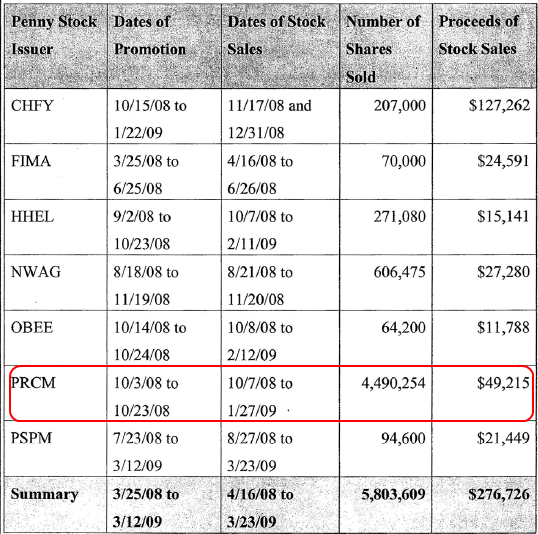
    Praebius was one of seven InvestSource clients whose stock was pumped and dumped to generate illegal profits of more than $276,000, the SEC charged.

    The timing of the alleged touting scheme, according to records, coincided with dates in October 2008 in which ASD, an autosurf company, was announcing a purportedly lucrative  joint venture with Praebius. ASD announced the prospective deal on Oct. 29, 2008. During the same time period, ASD was awaiting a key court ruling on whether it had demonstrated at an evidentiary hearing earlier in October that it was operating lawfully. Using a headline of “ASD-Praebius Venture” on its now-defunct Breaking News website while awaiting the ruling, ASD said it expected to garner revenues of about $200 million “over the first several years” from Praebius.

    Announcement of prospective $200 million deal with Praebius Communications on ASD’s Breaking News website. The announcement was removed after some members questioned it.

    The SEC now says Sahachaisere and InvestSource were pitching Praebius stock during the same month, declaring their business practices to be “Fraudulent Touting” because they “failed to disclose that they were selling the very securities they were recommending investors buy.”

    Sahachaisere and InvestSource received 4.1 million shares of Praebius stock between Oct. 2, 2008, and Nov. 25, 2008, the SEC charged.

    The scheme involving Praebius netted $49,215 for Sahachaisere and InvestSource, the SEC said.

    Five of the seven stocks — including Praebius — experienced “significant increases in trading volume during InvestSource’s promotions,” the SEC said.

    ASD’s name is not referenced in the SEC complaint, and Praebius was not listed as a defendant in the case. Praebius is referenced in the case as a client that paid InvestSource and Sahachaisere in stock “to provide investor relations services.”

    One of the issues in the ASD Ponzi case was whether the company had revenue streams adequate enough to pay “rebates” to members of 1 percent a day or 365 percent a year for viewing “advertising.” During the evidentiary hearing, ASD never produced audited, certified financial statements to prove it could sustain the rebates. Prosecutors described the company as catastrophically insolvent and reliant on revenue from new members to pay “rebates” to older members in classic Ponzi scheme fashion.

    Less than a month after an evidentiary hearing concluded on Oct. 1, 2008, ASD announced the purported joint venture with Praebius. Critics immediately questioned both the $200 million figure quoted by ASD and the timing of the announcement because Praebius did not publish verifiable financial data and ASD was described by federal prosecutors in the Ponzi scheme case as hopelessly under water.

    Although ASD purported to be a professional communications firm, its announcement of the purported $200 million deal did not quote executives of either ASD or Praebius. The announcement led to questions about why Praebius would knowingly associate its name with a company suspected of operating a massive, international Ponzi scheme while it allegedly also engaged in wire fraud and money-laundering while selling unregistered securities.

    Some ASD critics saw the announcement as a cynical means of instilling hope in ASD members that all was not lost while signaling to a federal judge that ASD had a major, new client that single-handedly could wipe away the firm’s alleged insolvency. Even as critics were voicing concerns that ASD was advancing yet-another story that was too good to be true, members of the now-defunct Pro-ASD Surf’s Up forum were cheerleading ASD’s purported revenue infusion from Praebius.

    Some ASD members sprinted to forums to announce the news, but the information could not be verified. ASD later removed the announcement from its website.

    According to the SEC’s complaint against Sahachaisere and InvestSource, nearly 4.5 million shares of Praebius traded hands between Oct. 7, 2008, and Jan. 27, 2009, generating less than $50,000 in revenue.

    ASD never explained how Praebius, which did not publish verifiable financial data, could generate the $200 million ASD cited in the announcement.

    Less than a month after ASD issued the Praebius announcement, a federal judge ruled ASD had not demonstrated at the evidentiary hearing that it was operating lawfully and was not a Ponzi scheme. By Dec. 19, 2008, federal prosecutors had filed a second forfeiture case against ASD-connected assets, again citing Ponzi allegations.

    Even as prosecutors were filing the second Ponzi complaint, Surf’s Up members were claiming that the government secretly had admitted ASD was not a Ponzi scheme.

    From the SEC "Fraudulent Touting" court case against Songkram Roy Sahachaisere and InvestSource Inc. The highlight in red shows the alleged illegal touting of Praebius stock.