Blog

  • UPDATE: Sentencing For Legisi HYIP Operator Gregory McKnight Postponed Again Pending Depositions; Now Set For May 7

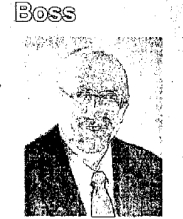
    Gregory McKnight. From PDF of federal court file.
    Gregory McKnight. From PDF of federal court file.

    Sentencing for Gregory N. McKnight, the operator of the Legisi HYIP Ponzi scheme, has been postponed until May 7. McKnight had been scheduled to be sentenced today. The postponement marks at least the fourth in the case.

    McKnight pleaded guilty to wire fraud a year ago this month. The docket of the case in federal court in the Eastern District of Michigan notes that today’s sentencing was postponed because McKnight is participating in depositions. Although federal prosecutors have asked for a 15-year sentence for McKnight, filings suggest that McKnight hopes to earn a sentencing reduction for assisting the court-appointed receiver in the case recover money for victims of the $72 million fraud.

    On Jan. 31, U.S. District Judge Mark A. Goldsmith denied a motion by McKnight to be removed from a tether. Although details were not immediately clear, tethering is a form of electronic monitoring.

    Legisi was promoted on Ponzi scheme forums such as TalkGold and MoneyMakerGroup. The SEC charged McKnight and Legisi in May 2008. A criminal charge followed.

    The U.S. Secret Service and state authorities in Michigan also were involved in the Legisi probe.

    See Nov. 28, 2012, PP Blog story.

  • Woman Sentenced To 80 Years In Texas State Prison For Felony Theft In Case That Flowed From Ponzi And Fraud Scheme

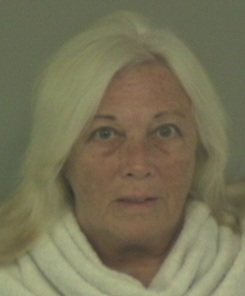
    Karen Patricia Bowie: Source: Collin County Sheriff's Office.
    Karen Patricia Bowie: Source: Collin County Sheriff’s Office.

    Karen Patricia Bowie, whom the SEC described in 2009 as a citizen of Canada who bought a house in Maine with fraud proceeds from the Titan Wealth Management LLC Ponzi scheme in Texas, has been sentenced to 80 years in Texas state prison.

    The Texas State Securities Board described Bowie, 61, as a “foreign notes scammer,” saying she “personally benefited from $2 million of investor funds.”

    Bowie was prosecuted criminally under Texas state law for felony theft by the Collin County District Attorney’s Office.

    Thomas Lester Irby II, whom the state described as a Bowie business partner, was sentenced in 2010 to 24 years in state prison. Irby was Titan Wealth’s owner. The company was based in Plano, Texas.

    Judge Benjamin N. Smith of the 380th State District court in Collin County sentenced Bowie after a week-long trial, prosecutors said.

  • URGENT >> BULLETIN >> MOVING: Gary Calhoun, MPB Today Operator, Pleads Guilty To Racketeering Charge In Florida

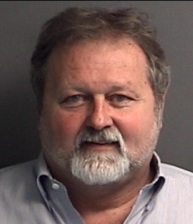
    Gary Allen Calhoun
    Gary Allen Calhoun

    URGENT >> BULLETIN >> MOVING: (UPDATED 1:06 P.M. ET U.S.A.) Gary Calhoun, the operator of the the MPB Today MLM “program” and a companion grocery-delivery business known as Southeastern Delivery, has pleaded guilty to a state-level racketeering charge in Florida. He was charged in December.

    Calhoun, 56, of Pensacola, was not immediately sentenced. But he is expected to turn in his passport to the Florida Department of Law Enforcement “within 48 hours,” according to the docket of the case in Escambia County. The docket also notes correspondence from the U.S. Attorney’s Office for the Northern District of Florida and references a “voluntary forfeiture agreement.”

    In July, federal prosecutors filed a forfeiture complaint for a property at 8812 Grow Drive, also known as Grow Road, in Pensacola. The property is the business address of Southeastern Delivery and also the address of a Calhoun-controlled entity known as WL Property Holdings LLC. The property also is the address of MPB Today.

    MPB Today was among a number of “programs” pitched on Ponzi-scheme forums such as TalkGold and MoneyMakerGroup.

    The Calhoun guilty plea represents the second time in 24 hours that the name of a “program” operator whose “opportunity” was pitched on the Ponzi boards has surfaced in the news, either as a current prison inmate or potential one.

    David Merrick, the operator of the Trader’s International Return Network (TIRN) fraud scheme that was promoted from the Ponzi boards in 2008 and 2009, was sentenced in 2012 to 97 months in federal prison and was handed additional civil sanctions and a restitution order yesterday totaling more than $22.8 million.

    MPB Today was promoted on the Ponzi boards in 2010.

    Some individual MPB Today promotions were bizarre, including one that cast President Obama and former U.S. Secretary of State Hillary Rodham Clinton as Nazis. Another MPB Today promoter videotaped himself making a deposit of his MPB Today commissions at an FDIC-insured bank. At least one of MPB Today’s banks was operating under an FDIC consent agreement.

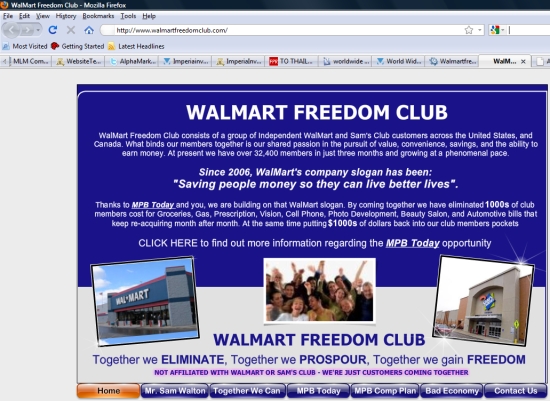
    Still other MPB Today affiliates taped commercials for the enterprise inside Walmart stores. Some promoters asserted Walmart was affiliated with MPB Today and approved by the government. One MPB Today affiliate videotaped a UPS driver making a delivery of a television set.

    The video’s narrator said the TV has been purchased “kind of, indirectly” with a Walmart gift card from MPB Today. Other MPB Today affiliates claimed a one-time purchase of $200 in groceries from Southeastern Delivery set the stage for MPB Today affiliates to receive free groceries and gasoline for life.

    Clinton once sat on Walmart’s board of directors. Why some MPB Today affiliates apparently believed it prudent to attack Democratic politicians in a bid to sign up MPB Today affiliates remains unclear.

    Promos for MPB Today were targeted at foreclosure subjects, Food Stamp recipients and the poor — and victims of the Florida-based AdSurfDaily Ponzi scheme. In 2010, Walmart declined to comment on MPB Today-related claims.

    Some MLM “opportunities” are infamous for implying in promos that they’re endorsed by famous business people or famous companies. MPB Today used images of Donald Trump and Warren Buffett in promos, and affiliates regularly implied that Walmart had endorsed MPB Today.

    From our files:

    1.

    mpbtodayobamalarge11

    2.

    mpbtodayupsdrivesmall

    3.

    mpbtodayfreedomsmall2

  • Judge Orders More Than $22.8 Million In Penalties, Restitution For Trader’s International Return Network (TIRN); ‘Program’ Was Pitched On Ponzi Boards

    breakingnews72David Merrick, the operator of Trader’s International Return Network (TIRN) fraud scheme, already is serving a TIRN-related, 97-month prison sentence for conspiracy to commit wire fraud, money laundering, and securities fraud, plus one count of money laundering.

    And now a federal judge has imposed addition sanctions, ordering Merrick and TIRN — a presence on Ponzi boards such as MoneyMakerGroup — to pay more than $22.8 million in civil penalties and restitution.

    One September 2008 post on MoneyMakerGroup declares this: “If you send money to TIRN using SolidTrustPay you will recive [sic] money on your account in a couple of hours!”

    The CFTC charged Merrick and TIRN civilly in October 2009. Though a onetime resident of Apopka, Fla, Merrick, 65, is serving his prison sentence in Minnesota, according to federal records.

    TIRN purported to operate from Panama as a “private investment club,” according to the CFTC.

    “TIRN has been soliciting U.S. residents, and directing them to deposit their funds in U.S. bank accounts,” the CFTC said in 2009.

    SolidTrustPay was among the financial vendors for Zeek Rewards, which also was promoted on the Ponzi forums. In August 2012, the SEC called Zeek a $600 million Ponzi- and pyramid fraud.

  • BULLETIN: Alabama Governor Says Killer Who Took Child Hostage After Shooting School-Bus Driver Is Dead

    BULLETIN: (UPDATED 6:05 P.M. ET U.S.A.) “Shortly after 3:00 p.m., I spoke with Colonel Hugh McCall of the Department of Public Safety and Homeland Security Director Spencer Collier,” said Alabama Gov. Robert Bentley in a statement.  “They informed me that law enforcement had breached the bunker, the child was safe and the abductor was killed.”

    From CNN (italics added):

    FBI Special Agent in Charge Steve Richardson at the scene said negotiations had broken down with the child’s abductor and the kidnapper was “observed holding a gun.”

    Believing the child to be in imminent danger, an FBI team entered the bunker at 3:12 p.m. CT (4:12 p.m. ET) and rescued the boy, Richardson said, adding that the hostage-taker is dead.

    See PP story from last week.


  • URGENT >> BULLETIN >> MOVING: Purported Charity ‘We The People Inc. Of The United States’ Was ‘Only A Front To Sell Bogus Investment Products’ To Senior Citizens, SEC Charges

    americaatrisk4URGENT >> BULLETIN >> MOVING: (UPDATED 3:14 P.M. ET U.S.A.) The SEC has gone to federal court in the Southern District of Florida, alleging that an enterprise known as “We The People Inc. of the United States” (We the People) was a “front” that covered up a fraud scheme aimed at senior citizens in multiple states.

    “We the People” are the first three words of the U.S. Constitution. Scammers have been known to trade on patriotic themes to fleece investors. Senior citizens may be particularly vulnerable to such pitches

    Separate civil complaints have been filed against Richard K. Olive, 47, and Susan L. Olive, 48, of Vero Beach, Fla.; We the People, a Massachusetts entity operating from Tallahassee, Fla; and William G. Reeves, 61, an attorney in Tallahassee.

    The scam sold an investment product described as a “charitable gift annuity” or CGA, the SEC alleged.

    In the “We the People” scam, the SEC said, investors were told told to tranfser assets and that they “would receive an income stream, penalty free withdrawals, and tax benefits.”

    And the scammers gathered at least $75 million, affecting at least 400 investors in Florida, Texas, Colorado and at least 27 others states, the SEC said.

    The Olives are accused of telling lies to lure senior citizens with limited investment experience into the scam.

    “The Olives raised millions from senior citizens by claiming that We The People’s so-called CGAs provided attractive financial benefits and were re-insured and backed by assets held in trust,” said Julie Lutz, Associate Director of the SEC’s Denver Regional Office. “Investors were not given the full story about the true value and security of their investments.”

    From the SEC (italics added):

    According to the SEC’s complaint against the Olives filed in U.S. District Court for the Southern District of Florida, investors were coaxed to transfer assets including stocks, annuities, real estate, and cash to We The People in exchange for a CGA. We The People claimed to operate as a non-profit organization while it was offering the CGAs from June 2008 to April 2012. However, We The People was not operating as a charity but instead for the primary purpose of issuing CGAs and using the proceeds to pay substantial sums to the Olives, third-party promoters, and consultants. On rare occasions when We The People did actually direct money raised toward charitable services, it was insignificant. For instance, the organization made public statements that it donated $21.8 million in relief aid to AIDS orphans in Zambia, but in fact the supplies were donated by others and We The People merely made a small payment to the third party that was shipping the supplies.

    Criminal probes into the scam have been under way since at least 2010, and Richard Olive was indicted in Tennessee last year, the SEC said.

    Reeves, the lawyer, “entered into a cooperation agreement with the SEC, and the terms of his settlement reflect his assistance in the SEC’s investigation and anticipated cooperation in its pending action against the Olives,” the agency said.

    Under the settlement, Reeves will be suspended from appearing or practicing before the SEC for at least five years. He also has consented to a judgment, with financial penalties pending, the SEC said.

    Meanwhile, the SEC said, “We The People consented to a final judgment that will enable the appointment of a receiver to protect more than $60 million of investor assets still held by the company. The final judgment also provides for disgorgement of ill-gotten gains and provides injunctive relief under the antifraud and registration provisions of the federal securities laws.”

    More from the SEC’s complaint against “We the People” (italics added):

    Investors often learned about We The People’s investment product from promoters who signed marketing agreements with We The People. We The People would provide these promoters with materials, including flyers, letters, illustrations, and even videos, to use in soliciting the investments. We The People paid these promoters significant commissions, ranging from 7-10%.

    Read SEC statement and find links to complaints here.

  • UPDATE: Suspects Still At Large In Murder Of Texas Prosecutor; Kaufman County Crime Stoppers Offers Up To $71,500 Award For Info Leading To Arrest/Indictment

    Mark Hasse, 57, was gunned down last week in Kaufman County, Texas.
    Mark Hasse, 57, was gunned down last week in Kaufman County, Texas.

    Authorities have released the identity of the Kaufman County, Texas, prosecutor shot and killed last week near the Kaufman courthouse. The victim was Mark Hasse, an assistant district attorney who once worked as a prosecutor in the Dallas County D.A.’s office.

    Hasse was 57. An intense investigation involving multiple agencies is under way.

    Here is a statement from Kaufman County Crime Stoppers:

    1/31/2013 – Kaufman County Assistant DA Murdered

    Kaufman, Texas — At approximately 8:30 am. on January 31, 2013 Assistant District Attorney Mark Hasse was walking across a Kaufman County employee parking lot on his way to work, when he was assaulted and shot multiple times.

    The Kaufman Police Department along with the Kaufman County Sheriff’s Office is asking for the public’s help in finding the suspects who fled the scene.

    Any information that you may have that will help us in this investigation, please call the Kaufman Police Department at 972-932-3094, or the Kaufman County [Sheriff’s] Office at 972-932-4337. You can also call Kaufman County Crime Stoppers at 1-877-TIPSKCC.

    Kaufman County Crime Stoppers is offering up to $71,500.00 reward for any information that will lead to the arrest and indictment of the suspects.

    Link.

  • A PRESIDENT’S PAL: ‘Barney,’ 2000-2013: America’s ‘First Dog’ During George W. Bush White House Years

    Former President George W. Bush has announced on Facebook the passing of “Barney,” America’s “First Dog” between Jan. 20, 2001, and Jan. 20, 2009. Barney was 12. During his White House years, Barney had his own website. Barney was much beloved by the Bush family.

    From President Bush on Facebook (italics added):

    Laura and I are sad to announce that our Scottish Terrier, Barney, has passed away. The little fellow had been suffering from lymphoma and after twelve and a half years of life, his body could not fight off the illness.

    Barney and I enjoyed the outdoors. He loved to accompany me when I fished for bass at the ranch. He was a fierce armadillo hunter. At Camp David, his favorite activity was chasing golf balls on the chipping green.

    Barney guarded the South Lawn entrance of the White House as if he were a Secret Service agent. He wandered the halls of the West Wing looking for treats from his many friends. He starred in Barney Cam and gave the American people Christmas tours of the White House. Barney greeted Queens, Heads of State, and Prime Ministers. He was always polite and never jumped in their laps.

    Barney was by my side during our eight years in the White House. He never discussed politics and was always a faithful friend. Laura and I will miss our pal.

    "Barney" on the White House lawn. (Facebook.)
    “Barney” on the White House lawn. (Facebook.)

    Whether Barney had any sense that he was America’s “First Dog” and that his owner was the President of the United States are, of course, imponderable questions.

    What’s not imponderable is that dogs provide a special kind of joy as they go about the business of simply being a dog.

    Barney’s official biography lists his date of birth as Sept. 30, 2000.

    His mother was “Coors,” owned by former New Jersey Gov. and EPA Director Christine Todd Whitman. Barney’s father was Kelly of “Champion Motherwell Stormwarning.”

    It’s a good thing that a President can have a dog, but it’s a better thing yet that a dog can have a President — or any other loving owner.

    The PP Blog holds President George W. Bush in the highest esteem for his service to his country. He is an eminently decent man.

    Barney was not yet one when his owner, speaking to school children in Florida, was told that an airliner had just hit the World Trade Center . . .

    America’s current “First Dog” is “Bo,” a gift to the Obamas from the late Sen. Edward M. Kennedy, a brother of President John F. Kennedy.

    Thinking of the Bush family today and of how dogs can help even Presidents caught up in extraordinary circumstances reestablish a sense of the ordinary.

    “Barney,” 2000-2013. Sense of surroundings: imponderable. Favorite toys: volleyball, golf balls. Official activities: White House holiday tours. Diplomatic relations. Outreach. (Has own IMDB listing.) Joy provided the Bush family during the President’s pressure-cooker days in the White House: inestimable. Career highlight: Called a “lump” by Karl Rove and criticized by Vladimir Putin, who opined that world leaders should own larger dogs. Loyalty to President Bush: unquestioned. (Once bit a Reuters reporter.)

  • FOR ZEEKERS: Receiver Shows Judge Preliminary Mock-Up Of Online Claims Form; Kenneth D. Bell Says He’ll Seek Court Approval For Claims Process By End Of First Quarter

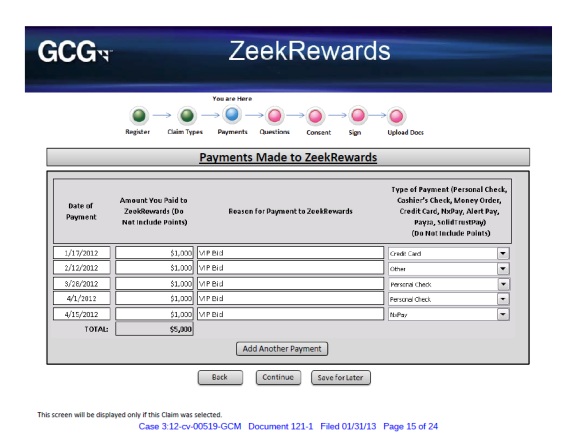
    The court-appointed receiver in the Zeek Rewards Ponzi scheme case has proposed an electronic-filing process for claims. Pictured above is one of the screens from a preliminary mock-up.
    The court-appointed receiver in the Zeek Rewards Ponzi scheme case has proposed an electronic-filing process for claims. Pictured above is one of the screens from a preliminary mock-up of the online claims submission process. The “GCG” reference above stands for The Garden City Group, the claims agent recently retained by the receiver.

    Kenneth D. Bell, the court-appointed receiver in the Zeek Rewards Ponzi-scheme case, has proposed a process by which claims would be filed online. Filers would proceed through a series of screens to enter information and would be permitted to upload information to substantiate their claims.

    The proposed filing process — still in preliminary form — would require affiliates to submit separate claims for each Zeek Rewards username. Bell has said that an untold number of Zeek affiliates had multiple usernames.

    Bell advised Senior U.S. District Judge Graham C. Mullen of the Western District of North Carolina that he “anticipates filing a motion seeking approval of the claims submission process . . . by the conclusion of the first quarter of 2013.”

    View preliminary mock-up.

    Read story by Jordan Maglich.

    Visit the ASDUpdates Blog.

    Visit the site of the Zeek receiver.

  • BULLETIN: Prosecutor Shot Dead Outside Of Texas Courthouse

    americaatrisk4BULLETIN: (UPDATED 1:36 P.M. ET U.S.A.) A prosecutor has been shot dead in an ambush outside a courthouse in Kaufman County, Texas, multiple media outlets are reporting.

    Two gunmen may be on the loose, and police are treating the shooting as an attack on the criminal-justice system, according to early reports.

    The prosecutor, an assistant district attorney, was shot five times, and one of the assailants “may have been wearing a tactical jacket or vest,” MyFoxDFW is reporting. Separately, the Dallas Morning News is reporting that authorities with “knowledge of the assistant DA’s caseload say he had been heavily involved in the investigation of members of the Aryan Brotherhood” and that investigators are seeking to determine  if the shooting could be related to that investigation.

    The FBI has described the Aryan Brotherhood as a “a violent white supremacist gang, formed within the California state prison system in the late 1960s.”

    From CBS 11 in Dallas/Fort Worth (italics added):

    Authorities believe that at least one person, possibly two, were involved in the shooting – both are still at large. State troopers have confirmed that an all points bulletin has been put out for two males, wearing all black clothing and some type of vests, possibly tactical. Chief Aulbaugh said, “We had some witnesses that saw an individual fleeing the area on foot and getting into a vehicle.” That vehicle is described as a possibly dark brown or silver-colored sedan, similar to a Ford Taurus, with no license plates.

    In October 2012, federal prosecutors said a federal judge in Texas was targeted in a murder-for-hire plot by a purported “sovereign citizen.”

  • BULLETIN: Receiver Says $12 Million In Zeek Money Located ‘In An Eastern European Country’ — But Has Not Been Returned

    breakingnews72BULLETIN: (2ND UPDATE 8:47 P.M. ET U.S.A.) The court-appointed receiver in the Zeek Rewards Ponzi-scheme case says he has located $12 million in receivership assets held in an unspecified “eastern European country” — but the funds have not been returned.

    “This account is owned and was used by a payment processor outside the United States to provide funds to a foreign e-wallet that processed payments for ZeekRewards,” receiver Kenneth D. Bell said in court filings. “The Receiver previously caused the Freeze Order to be sent to the foreign financial institution which holds this account and demanded that the funds held in that account be turned over to the Receivership Estate. The foreign payment processor who owns this account was also sent the Freeze Order and a demand notice for the turnover of the funds in this account. However, neither the financial institution nor the foreign payment processor responded to the demands sent by the Receiver. Additionally, the Receiver has worked with the foreign e-wallet to seek to have these funds returned. While cooperative, the foreign e-wallet was unable to cause their customer to provide the funds held in this account to the Receiver.”

    Bell also confirmed today that the U.S. Secret Service “continues to pursue” money related to Zeek. Meanwhile, he announced a “Final Liquidation Plan” and proposed claims process will be filed tomorrow in U.S. District Court for the Western District of North Carolina. Zeek was based in Lexington, N.C. Senior U.S. District Judge Graham C. Mullen is presiding over the Zeek case.

    Massive Paper Chase Under Way

    In August 2012, the SEC described Zeek as a $600 million Ponzi- and pyramid scheme. What has transpired since then speaks to the enormous logistical challenges law enforcement and court-appointed receivers may confront when a fraud scheme goes viral on the Internet and spreads globally.

    Bell noted today that the receivership has communicated to “over 7,000 financial institutions” on the subject of cashier’s checks sent to Zeek by affiliates. Some affiliates also sought to fund their accounts with “certified checks, personal checks, bank money orders, and personal money orders.”

    One of the earliest problems with marshaling assets was the sheer volume of instruments sent to Zeek, according to Bell’s filing.

    “As of December 31, 2012, the Receiver presented over 140,000 financial instruments for deposit,” Bell said. “Many of these items were returned and not paid for various reasons. The Receiver Team is working with financial institutions to re-present instruments that were returned in error, and it is working to identify all instruments that were improperly returned.”

    One Zeek vendor alone was in possession of 85,000 cashier’s checks and other instruments, Bell said.

    “After reviewing these instruments, reviewing the records of the Receivership Defendant, communicating with [Zeek vendor Preferred Merchant Services] and working with a forensic accounting vendor, the Receiver Team was unable to definitively ascertain which instruments had already been processed and presented for payment by PM,” Bell said. “In order to maximize recovery to the Receivership Estate, the Receiver Team elected to present all of these instruments for payment. Approximately 34,000 of these instruments worth approximately $15 million were accepted and paid. Approximately 50,000 of these PM instruments were returned, which resulted in returned check fees of approximately $450,000.”

    Bell negotiated to reduce the return charges by 25 percent, he said.

    Beyond that, Bell said, “[t]he Receiver has been receiving numerous communications from financial institutions and Affiliate-Investors regarding cashier’s checks that have never been presented for payment,” adding that he is “unaware of any additional locations where cashier’s checks payable to the Receivership Defendant might be stored.”

    The receiver “determined that he does not have rights under the Uniform Commercial Code or the Receiver Orders to claim an interest in cashier’s checks that were never received by the Receiver or the Receivership Defendant,” Bell said. “Therefore, the Receiver has taken the position that although any cashier’s check that is subsequently received by the Receiver is a Receivership Asset and will be deposited, financial institutions should consider any cashier’s check that has not been presented by the Receiver or the Receivership Defendant as having been lost, and may refund the remitters of such cashier’s checks without fear of liability to the Receiver.”

    Crunching Numbers

    Zeek’s database included 1.6 billion records, which are now being analyzed, Bell said.

    “This analysis has taken longer than initially anticipated due to several issues: problematic transactions with questionable accuracy, the validity of database records, and the lack of available documentation (including look-up tables, database dictionaries, and source code documentation which are commonly used to understand the organization and function of a database’s components). In the absence of these tools, [receivership team member FTI Consulting Inc.] has been required to perform extensive testing of the data to validate the proposed calculations and to rely on disparate third-party sources, including Paul Burks, e-wallet vendors, financial institutions, and subpoena responses, for understanding the organization and function of the database components.”

    Compounding matters, according to today’s filing, was the sheer number of Zeek participants, including participants who had multiple usernames.

    “There are approximately 2.2 million unique users (“Affiliates” or “usernames”) in ZeekRewards,” Bell said. “The number of Affiliates does not reflect the number of unique individuals who participated in ZeekRewards, as it is likely that some individuals had more than one username. Approximately 1 million Affiliates paid money into the ZeekRewards Program . . .”

    And, Bell noted today, “[a]t this time, the Receiver has identified over 800,000 net-loser usernames in the Receiver Defendant’s records.”

    Taxing Matters

    The section below is verbatim from the receiver’s filing today (italics added):

    During the fourth quarter, the Receiver Team worked to determine which federal tax filings needed to be made with respect to income taxes, payments made to service providers, and payments made to Affiliate-Investors. The efforts were focused on the latter two issues because of the earlier filing deadline (January 31, 2013). The Receiver Team, including FTI, had discussions with RVG’s outside tax and accounting advisors to ascertain what had been filed for 2011 and earlier. After analyzing the issues, consulting with these various entities, and reviewing [Zeek operator Rex Venture Group LLC] ’s records, the Receiver Team determined that it would be necessary to file and issue 1099s to certain Affiliate-Investors and began the process of compiling the data necessary to issue the 1099s.

    Since the receivership began in August, Bell said, it has been determined that “some individuals who RVG classified as ‘independent contractors,’ to whom it had issued 1099s, were misclassified pursuant to IRS regulations.

    “Accordingly,” he continued, “the Receiver Team has reclassified them as employees and is issuing them W-2s. The Receiver Team will begin the process of identifying, misclassified employees, paying back taxes, and determining whether the Receivership Estate should pay any back wages owed to such employee as a result of RVG’s misclassification.”

    Pursuing International ‘Winners’

    Offshore members of Zeek expecting a free pass from the receivership may have to think again if they are classified as “winners.”

    “The group of net-winners identified to date includes numerous individuals residing outside of the United States, with the largest foreign winners living mainly in countries with established legal systems which are signatories to the Hague Convention for international service of process,” Bell said. “While the pursuit of ‘clawback’ claims against these foreign net winners raises various service issues and other challenges, the Receiver intends to include these winners as parties to domestic litigation based on their contacts with the ZeekRewards Program in the United States so long as doing so will not delay the litigation against domestic winners. The Receiver will also pursue cost-effective foreign litigation to establish the repayment obligation and/or to collect judgments where necessary and appropriate.”

    Claims Process

    Bell said he will file with the court tomorrow “the proposed claims process” as part of a “Final Liquidation Plan.”

    From Bell’s filing today (italics added):

    The Receiver anticipates filing a motion seeking approval of the Claims Submission Process by the conclusion of the first quarter of 2013. The Claims Motion will seek (i) approval of the claims submission process, (ii) to establish the date by which claims must be filed against the Receivership Defendant (the “Bar Date”), and (iii) approval of the noticing procedures to be used in providing notice of the Bar Date and the claims submission process.