Tag: affinity fraud

  • CFTC Revokes Registrations Of 2 Texas Firms That Operated Forex Ponzi Scheme Targeted At Elderly Churchgoers And Others In At Least 4 States; Firms Used ‘Charts’ Showing Magnificent Earnings And Cherry-Picked Name Of Warren Buffett For Fraud Pitch

    SCREEN SHOT OF SECTION OF OCT. 25, 2010, FINDINGS OF FACT: M25 and M37 used a "chart" projecting magnificent earnings and encouraged investors to roll over their returns by plying them with a purported "renewal bonus." After 11 years, $100,000 would turn into $1 million, according to the firms' claims. The firms also claimed they outperformed legendary investor Warren Buffett, according to uncontested findings of fact by U.S. District Judge Barbara M. G. Lynn. It is common in online fraud schemes for pitchmen to use charts and spreadsheets that promise spectacular returns. It also is common for scammers to trade on the name of Warren Buffett or other well-known business titans as a means showing off, sanitizing fraud schemes and gaining "legitimacy" by osmosis. (Red Emphasis added by PP Blog.)

    EDITOR’S NOTE: The cases against M25 Investments Inc. (M25) and M37 Investments LLC (M37) include elements that are common in online fraud schemes. For starters, the offers were targeted at senior citizens and people of faith. Moreover, the firms relied on PowerPoint presentations and charts that wowed victims with tales of fantastic earnings. The fraud schemes also traded on the name of a celebrity — in this case, famed investor Warren Buffett.

    Much of the information in the story below comes from uncontested findings of fact by a federal judge. Taken line by line, the CFTC’s allegations upon which the judicial findings were based paint a picture of the sort of fraudulent sales pitches that occur daily on the Ponzi forums and personal websites of hucksters. Spreadsheets that show fabulous earnings projections are in common use in the universe of fraudsters, for instance. So is the use of the name of a celebrity or famous company to sanitize a scheme and disarm skeptics.

    And appeals to faith are used daily online to separate Believers from their money.

    Even as this story is being published, members of Club Asteria are doing the sorts of things that led to a two-year legal quagmire for M25 and M37, a litigation nightmare the firms brought on themselves by relying on cheerleaders to drive business, engaging in affinity fraud and then trying to cover it up, according to court filings.

    Club Asteria members, for example, are using spreadsheets and earnings charts to lure prospects. Meanwhile, they’re trading on the name of the World Bank, citing guaranteed earnings, mixing in appeals to charity and using religious imagery to drive business to the Virginia-based firm . . .

    Two Texas firms that targeted a Forex Ponzi scheme at elderly people of faith and others in at least four states have had their registrations revoked by the Commodity Futures Trading Commission.

    The revocations against M25 Investments Inc. (M25) and M37 Investments LLC (M37) of Waxahachie mean that the firms no longer are registered Commodity Trading Advisors. CFTC’s issuance of the revocations follows on the heels of an administrative action the agency filed in February. The CFTC also sued the firms in federal court two years ago, gaining restitution and penalties of more than $16 million.

    An administrative law judge found the firms “unfit for registration” last month. Neither firm contested the administrative action.

    On Oct. 25, 2010, U.S. District Judge Barbara M. G. Lynn found that the firms operated a Ponzi scheme that gained a head of steam by luring customers with promissory notes that guaranteed interest payments of 2 percent a month or 24 percent a year.

    Neither M25 nor M37 contested the findings. Both firms agreed to an issuance of a consent order with specified penalties and a demand for restitution. The firms neither admitted nor denied the allegations.

    Business was solicited online and through word-of-mouth, and clients often did not even know the difference between the two firms, Lynn ruled.

    “Some or all” of the firms’ customers were unqualified investors who did not have the required millions of dollars of assets to become an “eligible contract participant,” the judge ruled.

    Sales pitches for both firms claimed the ability to outperform famed investor Warren Buffett while making ancillary claims the companies could turn $100,000 into $1 million if customers stayed with them for 11 years and plowed their interest payments and annual renewal bonuses of 2 percent back into the companies.

    The scheme gathered about $8 million from about 213 customers, the judge ruled, noting that company “representatives” solicited business after church services and in customers’ homes.

    On March 31, 2009, according to the judge’s uncontested findings of fact, the firms owed customers $7.6 million but had only $3.9 million in total assets. Investors were shielded from the news and issued false account statements showing gains.


  • PROSECUTORS: California Man Hatched Ponzi Scheme And ‘Trust’ Scams — And Ripped Off His Elderly Mother’s Social Security Benefits After She Went Missing

    A California man has pleaded guilty to hatching a real-estate Ponzi scheme, transferring a property acquired in the scheme to two “trust” accounts and cherry-picking his 82-year-old mother’s Social Security benefits after she went missing in January 2009.

    William Warren Baker, 59, of Laguna Nigel, now faces up to 10 years in state prison, prosecutors said.

    The Ponzi, which raised more than $900,000 and targeted people of faith, was discovered by the Orange County Sheriff’s Department after Baker’s mother vanished, the office of Orange County District Attorney Tony Rackauckas said.

    Sara Jo Mowery, Baker’s mother, still hasn’t been found. Prosecutors said that, under federal law, Social Security benefits “are to cease being provided to any beneficiary until the missing person is found or pronounced deceased.”

    Baker was accused of “stealing” the Social Security funds. How they were distributed was not immediately clear.

    During the Ponzi probe, sheriff’s investigators discovered Baker “had set up a previously undiscovered joint bank account” into which Mowery’s Social Security benefits were deposited.

    “After his mother’s disappearance, Baker began illegally withdrawing the funds from that account, stealing $6,100 in all,” prosecutors said.

    All in all, Baker pleaded guilty to 13 felony counts of using untrue statements in the purchase or sale of securities and one felony count of grand theft from the Social Security Administration. Special sentencing enhancements are in effect because of the size of the overall theft, which is considered an “aggravated white collar crime.”

    Baker recruited investors by telling them he’d buy, refurbish and flip real estate at a profit, prosecutors said.

    But it was just a lie designed to separate church friends and others from their money, prosecutors said.

    Indeed, prosecutors said, Baker “failed to purchase a property to be renovated and flipped as promised to his investors.

    “Baker instead purchased a property for himself and transferred the property into a trust belonging to his son,” prosecutors continued. “He later transferred the property into a trust belonging to his wife. Baker used investor money for personal expenses or to pay back old investors from previous ventures.”

    Any person with information about the whereabouts of Mowery, who went missing more than two years ago and now would be 84, is asked to contact the Orange County (Calif.) Sheriff’s Department or their local police department.

  • CFTC: Michigan Man Sucked Church Members Into Forex Ponzi Scheme; Jeffery L. Groendyke Sued For Fraud

    A Michigan man has been sued for fraud and misappropriation in yet-another alleged Forex Ponzi scheme, the CFTC said.

    Jeffery L. Groendyke of the Grand Rapids-area community of Middleville, Mich., gathered at least $953,305 since May 2010 and ripped off at least 54 customers through his at-home business known as JG Forex Fund (JGF), the CFTC said.

    The scheme “primarily” was targeted at congregants of a Middleville church, the agency alleged.

    As the scheme progressed, some customers ended up becoming recruiters lured by commissions, the CFTC said.

    But Groendyke never was registered with the CFTC “in any capacity,” and he traded customers’ commodity-pool funds in his own personal accounts, the CFTC said.

    One account in which Groendyke allegedly traded purportedly had a balance of more than $1 million on Dec. 31, but actually had a balance of $14, the CFTC alleged.

    Another account that purportedly contained more than $458,000 had an actual balance of $49, the CFTC charged.

    Investors were given bogus information on the account balances and Groendyke’s trading prowess, the CFTC said. Filings suggest the scheme began to unravel last fall, but Groendyke continued to solicit funds

    Although Groendyke “solicited and accepted at least $953,305,” he used “no more than $366,950 of that amount to trade forex,” the CFTC said.

    “Instead of using participants’ funds to trade forex, as Groendyke represented, he transferred $461,385 of their funds to his personal bank account, used at least $26,966.14 to pay purported forex trading profits to existing participants in the manner of a Ponzi scheme, and used $124,970 to trade commodity futures for his own account,” the CFTC said.


  • FLORIDA — AGAIN: State, Local Authorities Say Marguerite Martial Jean Ripped Off Hundreds Of Haitian-Americans In Affinity-Fraud And Ponzi Caper That Targeted Churchgoers

    Marguerite Martial Jean. Source: Broward County Sheriff's Office

    Marguerite Martial Jean has been arrested in Florida on felony charges of operating a $3.4 million Ponzi scheme that targeted Haitian-Americans and churchgoers in the Sunshine State.

    Florida has been plagued by Ponzi schemes and other forms of financial fraud. The announcement of Jean’s arrest was made by Miami-Dade County State Attorney Katherine Fernandez Rundle. Joining Rundle in the announcement were Tom Cardwell of the Florida Office of Financial Regulation, and Jeff Atwater, the state’s chief financial officer.

    Jean, 38, was charged securities fraud, grand theft and organized scheme to defraud. She is being held at the Paul Rein Detention Facility. Bail was set at $300,000.

    Authorties said Jean fleeced at least 293 victims through her companies, which were known as MMJ’s Warehouse and VLM Enterprise. Among other things, Jean posed as a buyer and seller of rice from India who shared money she made on the spread with investors, authorities said.

    “Jean promoted the investment offering to members of her church congregation guaranteeing her promissory notes and made promises to pay investors as much as 22% interest,” authorities said.

    When investigators reverse-engineered the scheme, a “bank analysis revealed that investor funds went to Jean’s personal account, which she subsequently used to pay older investors and finance her lifestyle,” authorities said.

  • OH, FLORIDA! Spectacular New Allegations Raised In George Theodule Ponzi Scheme; Bank Sued For $68 Million Amid Accusation It Funneled Investors’ Cash To Fraudster Through ‘Drive-Thru’ Window

    The Miami Herald broke the story last night (see link at bottom of post) that Wells Fargo, which merged with Wachovia Bank in December 2008 and assumed its liabilities, has been sued for $68 million by the court-appointed receiver in the George Theodule Ponzi scheme in Florida. Theodule largely targeted the Haitian-American community in his scheme — in part by trading on religion, in part by routing money to the scheme through “investment clubs”  and in part by making investors believe a “regulatory agency” that later proved to be bogus was keeping their money safe.

    Allegations contained in the complaint by receiver Jonathan Perlman are both mind-numbing and stunning, perhaps especially given the fact that Wachovia was charged criminally in a separate case in March 2009 with willfully failing to establish an anti-money laundering program and opening its doors to an international cocaine cartel. Wachovia settled the criminal case by entering into a deferred prosecution agreement with the Justice Department and agreeing to pay $160 million.

    Now, with the filing of the complaint by Perlman, Wachovia’s allegedly lax standards have jumped up to bite it again.

    Among the dramatic allegations against the bank:

    • A Wachovia branch in Lake Worth, Fla., accepted Theodule’s business after Washington Mutual (WAMU), his original bank, rejected it after observing a pattern of suspicious transactions. The Wachovia branch that  opened multiple accounts for Theodule was “just down the street” from the WAMU branch — and Wachovia did not call WAMU to make any inquiries about Theodule.
    • Wachovia did not review Theodule’s website and did not verify the corporate standing of his business.
    • Wachovia initially misclassified Theodule’s business as a “Professional Service Provider with a business activity designation of ‘Money Service Business.’” The initial classification triggered an internal Wachovia review on the very same day he opened the accounts. Several days later, Wachovia determined that Theodule actually was a “financial advisor” in the “investment business” — and the bank changed the business designation to “Securities/Commodities.”
    • Wachovia’s own reclassification of Theodule’s business gave it the knowledge that Theodule owed a fiduciary duty to his clients. Regardless, Wachovia did nothing to confirm that either Theodule or his companies were properly licensed. A “simple inquiry” to licensing agencies would have shown they were not. Not even cursory Google research was performed. The Ponzi nature of the business “would have been self-evident” had even basic research been performed.
    • Wachovia missed suspicions about Theodule that had been raised online, including information that suggested he had lied about being the “finance director at several large companies” and truthful assertions that “investment clubs” were funding his operations.
    • Within five weeks of the opening of Theodule’s accounts at Wachovia, 36 “investment club” accounts suddenly were opened at Wachovia. The club accounts fed Theodule’s Ponzi scheme. During the first month alone, the club accounts fed $2.2 million to the Ponzi. Theodule’s sister, wife and the best man at his wedding all opened feeder accounts at Wachovia.
    • A large sum of cash — actual currency — from  trusting investors was deposited into the feeder accounts. Wachovia then transferred the deposits to Theodule’s business account. During the first month, Wachovia permitted Theodule to withdraw $235,000 in actual “greenbacks,” even though the bank knew the money belonged to investors.
    • Wachovia made “special accommodations for Theodule’s extraordinary cash withdrawals by agreeing to deliver large amounts of cash through the drive-thru window in order to reduce the risk of theft from having Theodule or a Creative Capital employee walk out of the branch carrying the large bags of cash Wachovia was providing.”
    • Wachovia noticed suspicious activity in a feeder account opened in the name of Wealth Builders Circle LLC, which was managed by Dorothy Delisfort, (who went on to become Theodule’s wife).  The bank froze the Wealth Builders Circle account but did not freeze Theodule’s accounts. The bank lifted the freeze on the Wealth Builders Circle account four days later — after it received a fax from a Theodule company. The fax purported to be a “business plan.” Among the assertions in the fax was that the Theodule company was following “the lessons learned by the great investing minds of our time . . . including Warren Buffet . . .”
    • Theodule and his cohorts laundered more than $10 million through Wachovia between May 9, 2008, and July 31, 2008. They withdrew from the bank nearly $5 million more than they deposited.

    Read the Miami Herald story from last night.

    (NOTE: At the moment, the complaint is available on the newspaper’s website. It is worth a full read. An exhibit from the SEC case attached to the complaint lists the names of the “investment clubs.” One of the names referenced is Crowne Gold Inc.  Many of the clubs had high-sounding names. It was not immediately clear if the Crowne Gold Inc. referenced in the Wachovia lawsuit was the same Crowne Gold Inc. referenced in court filings in the EMG/FinanzasForex case.  The alleged EMG/Finanzas scheme was yet-another scheme pitched from the ASA Monitor and TalkGold forums — and some of the money has been linked to the international narcotics trade. It also is worth noting that scammers routinely use the names of business titans such as Warren Buffet to pull off massive swindles. As noted above, the lawsuit against Wachovia in the Theodule case alleges that Buffet’s name was used to sanitize the Theodule caper.)

  • BULLETIN: Now, An Investment-Fraud Scheme Targeted At Indian-Americans And Members Of The Hindu Faith; SEC Says Amit V. Patel Of Minnesota Poses ‘Danger To The Investing Public’

    BULLETIN: The SEC has obtained an asset freeze against a Minnesota man in an alleged investment- and affinity-fraud scheme targeted at Indian-Americans and followers of the Hindu faith.

    Amit V. Patel of Shoreview raised “at least $2.5 million from at least five individuals that he met in the Indian-American community and Hindu temples in Minnesota,” the SEC charged.

    He also “received millions of dollars more from dozens of other individuals.,” the SEC said, alleging that “Patel took advantage of his cultural affinity and shared religious heritage with his victims, and exploited their trust in his standing in the community.”

    Patel was deemed “a danger to the investing public” by the SEC.

    U.S. District Judge Joan N. Ericksen of the District of Minnesota has issued a temporary restraining order against Patel and an order freezing all assets under his control.

    Patel, whom the SEC described as an unemployed engineer, employed a strategy known as Iron Condor that led to a loss of almost all of investors’ money.

    Shoreview is in Ramsey County, in the Minneapolis/St. Paul region.

    Read the SEC complaint.

  • ‘In God We Trust’ Scammer Who Fleeced Investors Sentenced To 15 Years In Prison; Byron Keith Brown Traded On God’s Name And U.S. Motto To Steal Millions From Clients Of Unlicensed Investment Business

    An affinity fraudster and financial scammer has received a 15-year prison sentence in the “In God We Trust” caper, an online Ponzi scheme that traded on religion and patriotic sentiments while gathering more than $17 million.

    Byron Keith Brown, 34, of Vienna, Va., also was ordered by U.S. District Judge William M. Nickerson of the District of Maryland to make restitution of more than $9.8 million to investors.

    Prosecutors said Brown bought at least 16 high-end cars with investors’ money. Nameplates included Bentley, Rolls-Royce and Lamborghini, among others. Brown was not licensed as a broker, dealer or investment adviser in Maryland, Virginia or the District of Columbia, the areas in which his scheme was concentrated.

    “Byron Brown used the internet to make it appear as if he were running an investment management business for wealthy investors, when in fact he was stealing millions of dollars from investors and using it to buy a fleet of luxury cars,” said U.S. Attorney Rod J. Rosenstein of the District of Maryland.

    The IRS brought the case.

    Brown, prosecutors said, filed bankruptcy in 1999 — but soon emerged with a tale of fabulous success that painted him as the head of an international firm that specialized in catering to wealthy investors from offices in Washington, D.C., Wilmington, Del., New York, and London, England.

    It was all an illusion, prosecutors said.

    The words “IN GOD WE TRUST” became the official U.S. motto by an Act of Congress in 1956, when Dwight Eisenhower was President. The words officially were added to U.S. paper currency, beginning in 1957.

    Brown operated at least three companies that used the “In God We Trust” theme, prosecutors said. Experts say scammers frequently use appeals to faith and patriotism to steal from investors or line them up to be fleeced in fraud schemes.

    See earlier story.

  • BULLETIN: National Investment-Fraud Sweep Dubbed ‘Operation Broken Trust’ Nets 532 Defendants; AG Holder Says Capers Caused More Than $10 Billion In Losses; ‘Undercover Operations’ Part of Task Force Arsenal

    U.S. Attorney General Eric Holder and members of President Obama’s Financial Fraud Enforcement Task Force said this morning that a nationwide sweep known as “Operation Broken Trust” has netted 343 criminal defendants and 189 civil defendants.

    Among the targets of the sweep were purveyors of Ponzi schemes, affinity fraud, prime bank/high-yield investment scams, foreign exchange (FOREX) frauds, business-opportunity fraud and other similar schemes, investigators said.

    Some of the defendants “filed for bankruptcy in an attempt to avoid claims by victim-investors,” investigators said.

    The combined losses in the schemes, which affected 120,000 investors, were estimated at $10.4 billion, Holder said. He was joined in the announcement by FBI Executive Assistant Director Shawn Henry; U.S. Securities and Exchange Commission (SEC) Director of Enforcement Robert Khuzami; U.S. Postal Inspection Service (USPIS) Chief Postal Inspector Guy Cottrell;  Deputy Chief Rick Raven of the Internal Revenue Service Criminal Investigation (IRS-CI); Acting Director of Enforcement Vince McGonagle of the U.S. Commodity Futures Trading Commission (CFTC); and other members of the Financial Fraud Enforcement Task Force.

    “With this operation, the Financial Fraud Enforcement Task Force is sending a strong message,” said Holder.  “To the public: be alert for these frauds, take appropriate measures to protect yourself, and report such schemes to proper authorities when they occur. And to anyone operating or attempting to operate an investment scam: cheating investors out of their earnings and savings is no longer a safe business plan — we will use every tool at our disposal to find you, to stop you, and to bring you to justice.”

    The calling card of the schemes was greed, Henry said, adding that undercover probes are part of the Task Force’s arsenal.

    “This operation highlights the scope of this problem, and its impact on individuals from all walks of life,” said Henry.  “This one sweep alone involves fraud schemes that harmed more than 120,000 victims. The schemes may change, but the underlying greed does not. Working with our partners, we in the FBI will use all the investigative techniques in our arsenal, including undercover operations, to bring those responsible to justice.”

    Khuzami, meanwhile, said the law-enforcement community was pursuing multiple forms of fraud.

    “Fraud by well-known companies or high-profile executives gets the biggest headlines, but other scams are equally devastating to hard working families and retirees,” said Khuzami. “Victims want justice and don’t much care who the fraudster is or how unique the fraud. Today’s actions underscore that law enforcement agrees and will pursue fraud in whatever form.”

    Read Holder’s announcement, made this morning in Washington.

    President Obama authorized the Financial Fraud Enforcement Task Force in November 2009. In January 2010, Holder ventured to Florida to speak about the aims of the Task Force and to warn scammers that the government was serious about putting them in jail.

  • CFTC: South Carolina Pastor Ran Forex Ponzi Scheme From House Of Worship; Historic Church Property In Charleston Has Seen It All — From Lincoln Presidency And Civil War To Kennedy Assassination And Election Of Obama

    The religious facility that ultimately became St. John’s Reformed Episcopal Church has seen a lot of history in its 160 years on Anson Street in Charleston, S.C. Construction predated the Civil War by 11 years. The facility opened in 1850 as the Anson Street Chapel for black Presbyterians, according to records maintained by the Charleston County Public Library.

    During this time, the United States was transitioning after the sudden death in office of President Zachary Taylor in 1850. Taylor was the 12th President of the United States. He was succeeded in office by Vice President Millard Fillmore, who never gained election in his own right after filling out Taylor’s term because voters in the North viewed him as willing to appease the South on the issue of slavery.

    When the Anson Street Chapel opened in 1850, Abraham Lincoln was a prairie lawyer in Illinois, his ascension to the Presidency still four administrations away and the Great Civil War still more than decade away. The church, renamed St. Joseph’s Roman Catholic Church in 1861, was hit by shells during the Civil War and “badly damaged,” but was rebuilt, according to library records. The facility survived to serve congregants for more than 100 years, before closing in 1965 — two years after the assassination of President John F. Kennedy and 20 years after the end of World War II.

    St. John’s Reformed Episcopal Church bought the property and restored it in 1971, during the Vietnam War-era administration of President Richard M. Nixon and about a year before the word “Watergate” became part of the national consciousness. Barack Obama was 10 years old in 1971, 37 years away from his election as the 44th President and 28 administrations removed from Lincoln’s Civil War-era Presidency.

    Now the church has seen another sort of history: Its pastor, the Rev. Ronald Satterfield, has been accused by the CFTC of operating a Forex Ponzi scheme from inside the facility. One of the company’s he allegedly formed — Graham Street Forex Group LLC — used the church’s address of 91 Anson Street, according to documents.

    Co-defendant Nicholas Bos of Ludington, Mich., used a business card that depicted a “one million dollar bill” and described the scam as an opportunity to earn “24% a year” as a participant in “Special programs,” CFTC alleged.

    Also named a defendant was an entity known as Shore-2-Summit Financial LLC.

    Satterfield “independently solicited acquaintances, members of his church congregation and their friends and family, and others in North Carolina, South Carolina, and Maryland, for funds to trade forex,” CFTC alleged.

    The scam operated “at least” between March 2006 and March 2009, CFTC alleged.

    To conceal the fraud, “Satterfield and Bos issued false customer account statements reflecting the promised returns and forex trading profits, when in fact Satterfield’s forex trading resulted in losses almost every month,” CFTC said.

    “The false statements also allegedly concealed their misappropriation of customer funds. In total, the complaint charges Satterfield and Bos with misappropriating more than $850,000 of customer funds for personal use,” CFTC said.

    More than 70 customers were fleeced in a scheme that gathered about $3.3 million, CFTC said.

    Satterfield told the Post and Courier of Charleston that CFTC had mischaracterized his trading activities.

  • BULLETIN: USDA Following Specific Leads In MPB Today Matter; Agency’s Food And Nutrition Arm Will ‘Take Appropriate Action As Needed’

    BULLETIN: The U.S. Department of Agriculture (USDA) said this afternoon that the agency’s Food and Nutrition Service is following specific leads in the MPB Today matter and will “take appropriate action as needed.”

    For the first time, the agency used the word “investigate” in its remarks about MPB Today, an MLM tied to a purported “grocery” business known as Southeastern Delivery of Pensacola, Fla. USDA previously referred to the MPB Today matter as a “review.” The agency did not explain why the Food and Nutrition Service had entered the probe.

    The Food and Nutrition Service, known as FNS, says its “mission is to provide children and needy families better access to food and a more healthful diet through its food assistance programs and comprehensive nutrition education efforts.”

    The announcement followed on the heels of claims by MPB Today affiliates that there are liars and thieves within the organization, that the government and Walmart endorsed the MPB Today program and that the USDA’s Food Stamp program was “affiliated” with MPB Today.

    On Tuesday, the PP Blog reported that a purported “news release” promoting MPB Today suggested that Food Stamp recipients should sell $200 of their allotment to raise money to join the MLM program.

    Yesterday the Blog reported that at least two MPB Today members claimed there are liars and thieves inside the organization, using the claims to suggest prospects should join the program only under specific downlines. The Blog also reported that MPB Today affiliates may have ties to the judicially declared CEP Ponzi scheme, the alleged AdSurfDaily Ponzi scheme and other Ponzi schemes promoted on forums such as ASAMonitor, TalkGold and MoneyMakerGroup.

    All three forums were referenced in a criminal case filed in May by the U.S. Postal Inspection Service against the alleged Pathway To Prosperity Ponzi scheme.

    In July, the Financial Industry Regulatory Authority (FINRA) issued a warning about HYIP scams that use forums and social-media sites such as YouTube and Facebook to spread virally on the Internet.

    MPB Today’s website says it ships “ONLY” dry goods to customers, who can expect to pay a shipping charge of up to 50 percent of an order. MPB Today affiliates have used the high shipping charges as a reason for Food Stamp recipients and other customers to join to the MLM program, saying a one-time purchase of $200 in groceries could result in free groceries for life.

    Affiliates have claimed MPB Today issues grocery “vouchers” that can be converted to Walmart gift cards and cash to purchase gasoline, electronics and other nonfood products.

    Among other things, the purported “news release” claimed that the idea about selling Food Stamps for cash to join MPB Today occurred “[on] a beautiful Sunday afternoon” during a drive home from “Church.”

    One promo for MPB Today showed a 46-inch Samsung television and other electronics that purportedly had been acquired by an MPB Today member through the program. Other promos have show prepaid Visa cards that spend like cash.

    MPB Today operates a 2×2 matrix cycler — a business model that has come under fire by the U.S. Secret Service in a Ponzi scheme probe in the Seattle area. The Seattle program was known as Regenesis2x2, and was promoted on some of the same forums MPB Today is being promoted.

  • PHOTO EDITORIAL: The MPBToday Flap: Affiliates Target Food Stamp Recipients, Ponzi Scheme Victims, People Of Faith, Foreclosure Subjects — And Say Government Backs MLM Cycler Matrix Tied To Florida Grocery Business

    EDITOR’S NOTE: UPDATED 3:12 P.M. EDT (U.S.A.) Florida-based MPBToday is one of the programs pitched on Ponzi boards such as ASAMonitor, MoneyMakerGroup and TalkGold. It also is being pitched via email and on social-media sites such as YouTube. All three of the forums are referenced in court filings — including filings in criminal cases — as places from which Ponzi schemes are promoted. Pathway to Prosperity, just one of the schemes promoted on the forums, was alleged in May to have defrauded more than 40,000 people across the globe while gathering more than $70 million.

    MPBToday is a multilevel-marketing company tied to a Pensacola grocery company known as Southeastern Delivery LLC. The U.S. Department of Agriculture (USDA) said Friday that it was conducting a “review” of affiliate claims. Precisely what claims USDA will review is unclear.

    Some affiliates are encouraging recipients of Food Stamps to join the program, which claims a $200, one-time expense can led to free groceries for life. Other affiliates have targeted victims of the alleged AdSurfDaily Ponzi scheme in sales pitches. Still others are using religion to sell the program. The program uses the word “foreclosure” in its sales pitch. Florida has one of the highest foreclosure rates in the United States. More than 9,000 people showed up at the Palm Beach County Convention Center late last month to seek foreclosure relief.

    One potential area of inquiry is whether Food Stamp recipients somehow can use their allotment to qualify for MPB Today’s MLM program. Another potential area of inquiry is whether Food Stamp money somehow is being used to pay MLM commissions. Because MPB Today says Southeastern Delivery assesses a shipping charge of up to 50 percent for the home delivery of groceries — and because affiliates purport that food “vouchers” and food “credits” can be acquired, perhaps in the form of a Walmart gift card MPB Today sends in the mail — another potential area of inquiry is whether Food Stamp money somehow can be converted to pay for items such as electronics and prepaid Visa cards. One MPB Today affiliate said the firm’s high shipping costs were a reason for Southeastern Delivery’s Food Stamp customers to join the MLM program.

    Claims have been made that the MLM program is “certified” by the government, “acknowledged” by the government and that Walmart is affiliated with MPB Today. Walmart has not responded to a request for comment from the PP Blog.

    Here are some photos of promotions for MPB Today from around the web. (Red highlighting added by PP Blog):

    In this YouTube video and text pitch, a claim punctuated with exclamation marks is made that the program is "Govt. certified with Food Stamps!" and that there is a "contract with wal mart!" The word "scam" appears multiple times in the pitch — in an apparent bid to drive traffic to the site from prospects seeking to determine if there is any scam-related information on MPB Today.
    MPB Today positioned on YouTube as a good opportunity for people of faith. The words "Christian" and "scam" are used to drive traffic to the site.
    In a money-waving Blog post, an MPB Today affiliate with a California address shows a check for $300 and a Walmart card.
    In this video for MPB Today on DailyMotion, visitors are encouraged to visit a .org affiliate site for the company, even though MPB Today is not a charity. The video claims members can purchase "electronics," even though MPB Today says it is in the grocery business and affiliates are targeting Food Stamp recipients in sales pitches.
    MPB Today affiliates display check and Walmart card on YouTube after videotaping check-opening ceremony. The program is described as a "NO BRAINER."
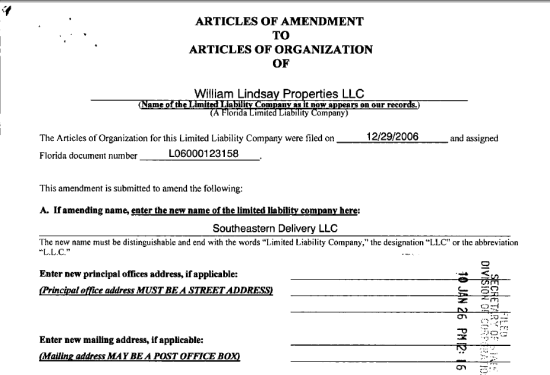
    This document on file in Florida shows that Southeastern Delivery LLC, the grocery arm of the MPB Today MLM program, once was known as William Lindsay Properties LLC. The name change occurred in January 2010. Gary Calhoun, the operator of MPB Today, is associated with both firms, according to records.
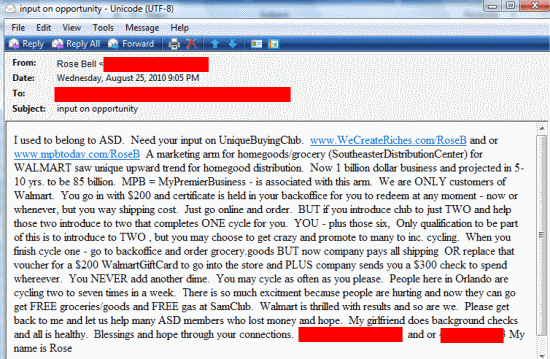
    On Aug. 25, the PP Blog received an unsolicited sales pitch for MPB Today via an email to the Blog's support address. Among the claims in the pitch, which did not include an unsubscribe link, was that "Walmart is thrilled" with the results of MPB Today. The pitch was targeted at members of AdSurfDaily, a company the PP Blog regularly covers because ASD is implicated by the U.S. Secret Service in an alleged Ponzi scheme involving tens of millions of dollars. A similar pitch was sent to another website that covers AdSurfDaily-related news.
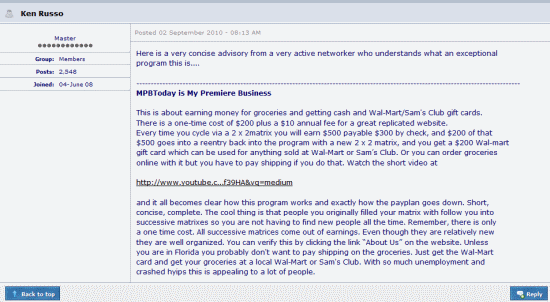
    The names of Walmart and Sam's Club referenced by "Ken Russo" at the ASAMonitor forum, which is notorious for promoting Ponzi schemes.
    In this video, a check and Walmart card are displayed. Unlike other checks written in Southeastern Delivery's name, this check was written in the name of MPB Today Inc. The video, which captured a check-opening ceremony, shows a Walmart "In Store Credit" card
    In this video, an MPB Today affiliate gives a sales pitch while driving an automobile. A check and Walmart card were presented when the vehicle stopped at a highway intersection.The pitch claims a "ONE-TIME" expenditure of $200 can "TOTALLY ELIMINATE" grocery bills.