Tag: affinity fraud

  • Son Says AdSurfDaily’s Andy Bowdoin Used Religion To Fleece Masses And Disgraced Family Name; Huckster’s Scheming Dates Back To 1960s, Another Family Member Says; ‘He Has A Criminal Mind’

    Andy Bowdoin

    Growing up a child of Andy Bowdoin and advancing through adolescence and adulthood was hard because of Bowdoin’s habitual scheming, according to Scott Bowdoin, Andy Bowdoin’s son.

    “He uses religion — always,” Scott Bowdoin, 42, said flatly of his 75-year-old father, noting he had not spoken to Andy Bowdoin in about 15 years because the elder Bowdoin had ripped off his own mother, Scott’s late grandmother, in a credit-card scheme.

    The elder Bowdoin left his own mother “with nothing,” Scott Bowdoin asserted. “The electricity was about to get cut off, the water was about to get cut off. He is a man with no conscience.”

    Scott Bowdoin made the remarks about his father in an interview with the PP Blog this morning. The younger Bowdoin said his father had disgraced the family name — and that it was high time the public in general and AdSurfDaily members in particular knew that Andy Bowdoin did not enjoy the uniform support of his family as the ASD Ponzi case winds its way through the courts.

    There was a long-ago scheme involving telephone calling cards, Scott Bowdoin said.

    And there was an “air-conditioning scam” in Florida, he added, saying his father traded on faith.

    “He’d go around and evangelize,” Scott Bowdoin said. “That was a scam. He did something with cell-phone towers. That was a scam.”

    Andy Bowdoin has been married five times, Scott Bowdoin said, adding that Andy Bowdoin’s financial scheming devastated Scott’s grandmother late in her life.

    “He drained my grandmother,” Scott said.

    Separately, an Andy Bowdoin family member who spoke to the PP Blog on the condition of anonymity said Bowdoin “has been doing this since the 1960s.

    “I always knew he was a con man,” the family member said. “I just didn’t know he could do it at this level.”

    The “level,” according to federal prosecutors and the U.S. Secret Service, exceeds $80 million and may approach $100 million when a final accounting is done. Records show that agents seized more than $65.8 million from 10 Andy Bowdoin bank accounts, including one that contained more than $31 million and another that contained more than $23 million.

    In total, about $80 million was officially listed as forfeited in the case. Andy Bowdoin has appealed the forfeitures, which were ordered by U.S. District Judge Rosemary Collyer. An attempt last year by Bowdoin to force Collyer to withdraw as the presiding judge failed.

    Prosecutors claimed in court filings that ASD was a massive international Ponzi scheme masked as an “advertising” business.

    “I was a little surprised because I didn’t know he could pull off a scam that big,” Scott Bowdoin said. “But, by God, he did it.”

    After the elder Bowdoin scammed his own mother in the 1990s, Scott Bowdoin said, “I told him you are dead to me.” Andy Bowdoin later was implicated in a securities swindle in Alabama. Records show he was making restitution to the Alabama victims even as he was operating ASD in 2008.

    “I pity you when you have to face the Lord when you die,” Scott Bowdoin said he told his father after he had fleeced Scott’s grandmother.

    In July 2008, years after the Alabama swindle and while ASD was gathering tens of millions of dollars per month, ASD money was used to purchase a Lincoln automobile for nearly $50,000, according to court records. At the time, Bowdoin still owed the Alabama victims about $45,000.

    Even more ASD money — more than $1 million — went to acquire real estate, a Honda automobile, an Acura automobile, jet skis, a Cabana boat, marine equipment and haul trailers, according to records. A shell company linked to Andy Bowdoin’s company began to make the purchases in June 2008, less than two weeks after an ASD “rally” in Las Vegas.

    While in Las Vegas, Andy Bowdoin urged members to imagine themselves getting large checks from ASD and thanked God for making him a “money magnet,” according to records.

    Scott Bowdoin described his father as a “classic con artist.”

    “He is a very, very, very smart man,” Scott Bowdoin said. “He knows exactly what he is doing. He uses religion — always.”

    And Scott Bowdoin lamented his father’s appeals in the forfeiture case against his assets.

    “I don’t understand why this man is not sitting in prison,” Scott Bowdoin said. “He pulled off the ultimate [con] this time.”

    Scott said his father left when he was 14 and that father and son had been estranged for years.

    Asked what he would do if his father suddenly materialized in the same room with him, Scott said that Andy Bowdoin “won’t come around me.

    “I’d probably punch him in the face,” Scott said.

    Asked if he had any advice for ASD members, Scott said, “Don’t believe a word he says. He’s a great actor. He is a good bullshitter. He could sell a screen door to a submarine captain.”

    Calling his dad a “charmer,” Scott said he was aware that some ASD members continued to cling to hope that his father came as the “Christian” depicted in sales pitches and motivational talks.  After the company was raided in August 2008, Bowdoin asked his followers to trust in God, saying the government action against his autosurfing company was the work of “Satan.”

    “These people who feel sorry for him thinking he is a good Christian — they have blinders on,” Scott Bowdoin said. “He has hurt more people than just [members of] AdSurfDaily. I can guarantee it.”

    Andy Bowdoin wasted his talents chasing schemes, Scott Bowdoin maintained.

    “If he had gone the right way, he could have been a Donald Trump,” Scott contended. “[But] he wanted to start at the top, not at the bottom.”

    Meanwhile, the other Bowdoin family member interviewed by the PP Blog said that he believed Andy was “a sociopath.”

    “I know that whatever he puts his efforts in to is [designed to] con people out of as much money as he can,” the other family member said. “Andy is a sociopath. There aren’t many sociopaths, but he is one.”

    Both family members said they were not participants in ASD and learned about the alleged scheme on the Internet.

    The family member who spoke on the condition of anonymity explained he had done so in an effort to maintain as much privacy as he could as a sea of allegations swirled around Andy Bowdoin.

    “The man is a genius,” he said of Andy Bowdoin, “but he has a criminal mind. Anyone involved with his companies — they’d be sucked into a Ponzi. To me, he is a sociopath; he will drag other people down. People need to be [careful]. A good con has a little bit of truth to it.”

    Andy Bowdoin, said the family member, has lived a “sad” life.

    “It’s sad because he could have used his talent for good,” the family member said. “I don’t hate the man, but I pity him.”

    When he thinks about Andy Bowdoin, the family member said, he thinks about Bowdoin’s father.

    “Andy Bowdoin’s father was a good man,” the family member said.

  • Peter C. Son Sentenced To 15 Years In Forex Ponzi Scheme That Targeted Korean-Americans; Courtroom Spectator Heckled Scammer, Declaring He Deserved Death For Crime

    A California man accused of bilking Korean-Americans in an $80 million Forex Ponzi scheme was sentenced yesterday to 15 years in federal prison.

    Prior to the sentencing of Peter C. Son of Danville, a courtroom spectator yelled in Korean that “You’ve got to kill that bastard!” according to the San Francisco Chronicle.

    In June 2009, the SEC accused Son, 38, and his business partner, Jin K. Chung, of Los Altos, of targeting Korean-Americans in a scheme in which “funds were not traded in the forex market as claimed.”

    Instead, the SEC said, the funds were used to pay cash “returns” to certain investors in “Ponzi-like fashion” and used to make mortgage payments on Son’s multimillion-dollar home.

    “Supposed” Forex returns were “faked,” and investors were given “monthly account statements showing fictitious returns,” the SEC said.

    Some of the funds were used to pay a $3,000 monthly salary to Son’s wife, who “did no work,” the SEC said. As the scheme was collapsing in 2008, funds were transferred “overseas,” the agency charged.

    Investors were invited to the scheme’s offices purportedly to “view work stations with multiple trading monitors, ostensibly set up to allow . . .  employees to monitor market conditions relevant to forex trading,” the SEC said.

    But representations of Forex success were “false,” and the scheme “conducted little or no forex trading,” the SEC charged.

    The “supposed forex investment program was a fabrication used by Son and Chung to attract investors,” the SEC charged.

    Chung has not been not charged criminally.

    The scheme operated through a company known as SNC Asset Management Inc. (SNCA) of Pleasanton, Calif. It also operated through a company in New York that had a similar name — SNC Investments Inc. (SNCI) — investigators said.

    About 500 investors were defrauded, the SEC said.

    It is not unusual for companies to use multiple names — including confusingly similar names — to pull off a fraud scheme. Nor is it unusual for fraudulent companies to claim they have a local, regional, national or international footprint to disarm skeptical investors.

    Son’s scheme, fueled by advertisements and word-of-mouth, pulled in investors from at least five U.S. states, South Korea and Taiwan, the SEC said. His home in a gated community was valued at $2.6 million, and Son used investors’ money to pay “country club dues,” the agency charged.

    Part of the scheme involved an advertisement that had been altered to appear as through it were an article in Business Week magazine.

    It is common in fraud schemes for operators to imply their product or service is endorsed by famous people or companies. In 2009, members of the failed AdViewGlobal autosurf used the logo of Forbes magazine in a sales promo.

    Separately, members of the alleged AdSurfDaily autosurf Ponzi scheme claimed the program’s operator, Andy Bowdoin, received a special award from the White House for business acumen.

    Read the Son story in the San Francisco Chronicle.

  • BULLETIN: KABOOM x 1,215! Feds Announce ‘Operation Stolen Dreams’ Mortgage-Fraud Sweep; 1,215 Defendants Charged In Largest Mortgage Scammer Takedown In U.S. History

    Attorney General Eric Holder announced the creation of the Financial Fraud Enforcement Task Force last year.

    BULLETIN: UPDATED 1:10 P.M. EDT (U.S.A.) At least 1,215 criminal defendants have been named in “Operation Stolen Dreams,” which U.S. Attorney General Eric Holder described as a “three and a half month takedown of mortgage fraud schemes throughout the country.”

    The mortgage-fraud operation began March 1 and is the largest-such undertaking in U.S. history, Holder said.

    “The staggering totals from this sweep highlight the mortgage fraud trends we are seeing around the country,” Holder said. “We have seen mortgage fraud take on all shapes and sizes — from schemes that ensnared the elderly to fraudsters who targeted immigrant communities. We have seen cases that have resulted in dozens of foreclosures and millions in losses, as well as fraudsters who have bankrupted entire companies and national lenders who were not playing by the rules.

    Holder said the defendants caused more than $2.3 billion in losses. “Operation Stolen Dreams” was brought as part of President Obama’s interagency Financial Fraud Enforcement Task Force. The attorney general was joined in the announcement by Sallie Cooper, deputy director of the IRS Criminal Investigation Unit;  Ken Jenkins, special agent in charge of the U.S. Secret Service Criminal Investigative Division;  FTC Commissioner Edith Ramirez; Ken Donohue, inspector general of the U.S. Department of Housing and Urban Development; FBI Director Bob Mueller;  Illinois Attorney General Lisa Madigan;  Chief Postal Inspector Bill Gilligan; and Jim Freis, director of the Treasury Department’s Financial Crimes Enforcement Network.

    Investigators did not limit the operation to criminal cases.

    “[T]he operation involved 191 civil enforcement actions through which more than $147 million has been ordered recovered, with still millions more pending court approval,” Holder said.

    “This represents the largest collective enforcement effort ever brought to bear in confronting mortgage fraud,” he noted. “The success of this operation is a direct result of our unprecedented focus not just on federal criminal cases, but also on civil enforcement, recovering funds for victims and increasing cooperation with state and local partners.”

    Mueller said the FBI was “tracking” fraudsters aggressively.

    “From home buyers to lenders, mortgage fraud has had a resounding impact on the nation’s economy,” Mueller said. “Those who prey on the housing market should know that hundreds of FBI agents on task forces and their law enforcement partners are tracking down your schemes and you will be brought to justice.”

    Fraudsters lining their pockets at the expense of others have plenty to worry about, said Donohue.

    “The last several years have seen enormous and damaging developments in the mortgage and housing markets, and the government has stepped in to bolster unstable marketplaces and devastated communities,” Donohue said. “The HUD-OIG, in partnership with other agencies, is deeply committed to ensuring that scarce resources are not diverted to those who seek to enrich themselves at the expense of those who so desperately need assistance today.”

    Holder, who ventured to Florida in January and warned fraudsters that they were writing their own tickets to jail, also noted that law-enforcement had broken up yet another Ponzi- and affinity-fraud scheme in the state.

    Suspects were arrested in the case yesterday, which targeted Haitian-Americans in South Florida.

    Arrested were Maxo Francois, also known as “Max Francois,” Jean Fritz Montinard, Aiby Pierre-Louis and Maguy Nereus, also known as “Maguy Jean-Louis.”

    The scheme involved businesses known as Focus Development Center Inc. and Focus Financial Group Inc., also known as Focus Financial Associates Inc.

    Investors were promised annual returns of 15 percent, but it was a Ponzi scheme, authorities said.

    The fraudsters used church presentations to pitch the scheme, prosecutors said.

  • OFFICIALS: Ponzi Schemes, Investment Fraud Have Led To Staggering Losses In Utah; Hundreds Of Potential Perpetrators Identified

    UPDATED 8:38 P.M. EDT (U.S.A.) Recent Ponzi schemes and cases of investment fraud have cost Utah residents an estimated $1.4 billion, the FBI said today.

    About 370 investigative “subjects” — defined as “potential perpetrators” in current cases — have been identified, and the agency and its law-enforcement partners have embarked on a public awareness and education campaign aimed at keeping Utahns safe from scammers.

    About 4,400 people have been affected by investment-fraud schemes in the state, the FBI said. The education campaign includes billboards and public-service messages.

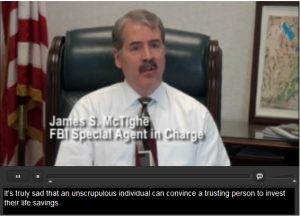
    Under the umbrella of the Utah Securities Fraud Task Force, the FBI and its partners — including the SEC, the IRS, the U.S. Postal Inspection Service, the Utah Department of Commerce’s Division of Securities, the Utah County Attorney’s Office, the United States Attorney’s Office for the District of Utah and the Utah Attorney General’s Office — have produced a video that encourages viewers to be aware that schemers may target them based on their religious affiliation or interests.

    “Affinity fraud is when someone you know — for example a church member, a coworker, or a friendd — takes advantage of you in an investment fraud scheme,” said James S. McTighe, FBI special agent in charge.

    Con artists have been known to deliberately target members of the Church of Jesus Christ of Latter-Day Saints, the FBI said.

    No group of believers — and no group of people who share a common bond — is immune to the cunning of expert con men, the FBI added.

    An investor featured in the educational video said her experience of being duped can serve as a warning to others:

    “He was a religious man, so he says, and he really, he really put on the ‘You know I am so guided by the spirit’, and ‘I know I am here to help you’, and ‘just trust me,’” the woman said.

    Nothing about a Ponzi scheme is good news, warned the SEC’s top official in Salt Lake City.

    “Ponzi schemes always collapse eventually and it’s typically because you run out of newer investors,” said Ken Israel.

    How do fraudsters profit from a Ponzi scheme?

    “The hallmark of the Ponzi scheme is that you use money from new investors to pay off your old investors and of course put a bunch in your pocket at the same time,” said Keith Woodwell, director of the Utah Division of Securities.

    Officials warned the public to be on the look out for “signs of trouble”:

    • The investment offer is unsolicited.
    • It sounds too good to be true.
    • You’re promised big monthly or yearly returns with little or no risk.
    • You’re asked to keep the investment offer secret.
    • The promoter cannot answer specific questions or provide you with written financial documentation.
    • Slick websites and glossy literature can be deceiving, and also be suspicious of documentation that looks unprofessionally produced.
    • The promoter won’t give you time to research the investment.
    • You are told you are one of the lucky few allowed in on the investment.
    • You are required to bring in more investors.
    • The salesperson is not licensed or the product is not registered.

    “Con artists who run Ponzi schemes often promise big financial returns and may tell potential investors they operate programs that can sound impressive,” the FBI said. The agency advised investors to do their homework and be skeptical of pitches for programs such as these:

    • Foreign Exchange Currency Trading.
    • Prime Bank Investment.
    • Commodities Investments.
    • Real Estate Investments.

    “Research before you invest, the FBI warned, recommending these resources for Utah residents:

    Get educated for free at the June 30 “Fraud College” at Utah Valley University in Orem

    Watch the Task Force video.

    Get more information from the FBI:

    NOTE: This story has been republished at a URL that is different than its original URL. Although this post reflects a date of June 13, it is not the original publication date. Click here to read why.

  • PONZI NEWS/UPDATES: Fire Destroys ‘3 Hebrew Boys’ Ponzi Headquarters; Minnesota Man Gets Nearly 10 Years In Prison In Ponzi Case; California Man Gets 25

    Sign of the apocalypse? The headquarters of the “3 Hebrew Boys” Ponzi scheme in Columbia, S.C., was gutted in a fire Monday and Tuesday. Firefighters spent 19 hours over two days battling the blaze, but the “building and all contents . . . were completely destroyed,” according to Beattie B. Ashmore.

    Ashmore is the court-appointed receiver in the case. Proof-of-claim forms for victims of the $80 million Ponzi swindle became available April 15, only 11 days before the fire broke out. The cause of the fire is under investigation, and the building was an asset of the receivership estate.

    “All computers and documents have been stored off-site since the Receiver took possession of the building in October 2007,” Ashmore said. “The building was being managed by a reputable property management company, fully insured and continuously monitored by a security company. The Receiver will make a claim immediately with the Hartford Insurance Company for the full value of the building with the insurance proceeds going to the benefit of the victims.”

    The 3 Hebrew Boys case is one of the strangest in the United States, drawing comparisons to the alleged AdSurfDaily Ponzi scheme owing to elements of affinity fraud and antigovernment rhetoric.

    Joseph Brunson, Tim McQueen and Tony Pough were convicted in November of swindling tens of millions of dollars in a bogus debt-relief “ministry.” The purported aim of the program was to free people from government “bondage,” and the investigation was referred to as “Satan’s handiwork.”

    In the earliest days of the 3 Hebrew Boys case, more than 100 people protested on behalf of the scheme at a rally in Columbia, saying the government did not understand the program, had overreached in its prosecutorial efforts, refused to deny it was wrong and had chosen to move forward with the case in a bid to save face.

    In an approach similar to one used by the AdViewGlobal (AVG) autosurf, members were forced to agree to a confidentially clause that purportedly prohibited them from discussing the company outside the confines of meeting places. Participants were threatened with a $1 million penalty for sharing information.

    AVG, which has close ties to ASD, morphed into a “private association” in February 2009. Members were scolded for sharing information and calling the autosurf an “investment” program. As the company appeared to be collapsing in May and June, members were threatened with copyright-infringement lawsuits for sharing information published by the firm.

    Brunson, McQueen and Pough are jailed awaiting sentencing. After they were found guilty of 174 counts mail fraud, money-laundering and transporting stolen goods, the men filed documents accusing former U.S. Attorney Walt Wilkins of treason and committing acts of war by prosecuting them.

    The men became known as “3 Hebrew Boys” after operating a website with the same name, which is based on a biblical story of believers who escaped a furnace by relying on their faith. The Ponzi scheme operated under the name Capital Consortium Group LLC.

    Minnesota Ponzi Sentencing

    A Ponzi scheme operator in Rosemount, Minn., has been sentenced to 117 months in prison and ordered to pay $21.8 million in restitution to victims.

    Charles “Chuck” E. Hays, 56, has been detained since his arrest in February 2009. He pleaded guilty last year to one count of mail fraud, one count of wire fraud and one count of structuring transactions to avoid financial reporting requirements.

    Among the items seized in the case was a $3 million yacht acquired with investors’ money. Hays operated a firm known as Crossfire Trading LLC and bilked investors out of more than $20 million by operating a Ponzi scheme.

    “Hays told potential investors he was a day trader in stock index futures and other futures contracts,” federal prosecutors said.

    Investors plowed money into the scheme based on lies told by Hays, and he “admitted he diverted and converted those funds for his personal use and other unauthorized purposes,” prosecutors said.

    The sentencing judge in the case was U.S. District Judge Donovan Frank.

    California Ponzi Sentencing

    Milton Retana, 46, of Huntington Park, was sentenced to 25 years in prison for a $62 million Ponzi scheme that bilked mostly Spanish-speaking investors out of at least $33 million.

    The case became known as the “Best Diamond case.” Retana operated a purported real-estate investment company known as Best Diamond Funding. It was yet another instance another in which the name of a precious metal or mineral was used in a Ponzi scheme.

    Evidence of the fraud was hidden in the back of a religious bookstore operated by Retana’s wife, prosecutors said. When investigators searched the bookstore, they found millions of dollars in cash. Best Diamond was located next door to the bookstore.

    The scheme — like many other Ponzi schemes — featured an appeal to religion, prosecutors said.

    “Best Diamond Funding solicited money through advertisements in Spanish-language magazines, on the Internet, and during weekly investment seminars at locations across Los Angeles. The raucous investment seminars often had as many as 300 potential investors and incorporated religious messages,” prosecutors said.

    “Retana guaranteed returns as high as 84 percent each year, claiming that he would purchase properties in bulk at below-market prices and immediately sell them for a profit,” prosecutors said. “However, records obtained by federal investigators showed that Retana used only a tiny fraction of the victims’ money to purchase real estate and that his company was actually losing money.”

    The sentencing judge in the case was U.S. District Judge R. Gary Klausner.

  • Ponzi Guilty Pleas In New York, Tennessee; New Ponzi Case Filed By CFTC In Florida; Relief Defendant Misspelled Its Own Company Name

    EDITOR’S NOTE: There was significant action in Ponzi cases today. Earlier we reported on the guilty plea of Trevor Cook in Minnesota and the issuance of a bench warrant in South Carolina for Michael Derrick Peninger. The brief below summarizes action in the Ponzi and affinity-fraud case case of Steven Byers in New York, the Ponzi case of Barron A. Mathis in Tennessee, and new allegations of a Forex Ponzi scheme against Claudio Aliaga in Florida.

    New York: Steven Byers, 47, of Oak Brook, Ill., pleaded guilty today to felony counts of conspiracy and wire fraud in a Ponzi case said to involve $255 million. U.S. District Judge Denny Chin, who sentenced Bernard Madoff to 150 years in prison, is the presiding judge in the case. Byers will be sentenced in September. He faces a maximum of 25 years in prison.

    Byers was the former president and chief executive officer WexTrust Capital LLC, a private-equity firm. Orthodox Jews were targeted in the scheme, which involved real estate and specialty finance.

    “From at least 2003, Byers and others raised money from investors pursuant to private placement offerings and then used material amounts of that money for other purposes, and did not disclose their diversion of funds to investors,” prosecutors said. “In one such private placement, Byers and others raised approximately $9.2 million in investor funds by representing that the funds would be used to purchase and operate seven commercial properties that were leased to the United States General Services Administration (GSA).

    “According to the GSA private placement memorandum issued to investors by WexTrust Capital,” prosecutors said, “the $9.2 million raised from investors, together with a mortgage of approximately $21 million, would be used to purchase the seven GSA properties and cover related acquisition expenses.

    “The seven GSA properties, however, were never purchased. Instead, virtually all of the funds raised from investors to purchase the properties were diverted by Byers and others to other purposes, but investors were never informed that the funds were used for any purpose other than to purchase and operate the seven GSA properties. Byers and others later agreed to make up a story that they would then tell the GSA investors regarding what happened to their investment,” prosecutors said.

    The guilty plea was entered as a result of a plea deal with prosecutors. Byers “agreed to forfeit $9.2 million and is subject to mandatory restitution and faces criminal fines up to twice the gross gain or loss derived from the offense,” prosecutors said.

    Tennessee: In Nashville, Barron A. Mathis, 29, pleaded guilty to wire fraud. He formerly was vice president and portfolio manager for J.C. Reed & Co., a failed financial services company headquartered in Franklin.

    Mathis sold his Ponzi and fraud scheme to friends, acquaintances and clients, collecting $11 million in the process, prosecutors said. Most of the investors were elderly, inexperienced traders.

    “Cases like these are egregious examples of predators who target vulnerable and innocent victims through false and fraudulent business practices,” said U. S. Attorney Edward M. Yarbrough. “By his own admission, Mathis encouraged people to invest by falsely promising security, growth and inflated returns on their money, but instead the investors lost their savings as part of an elaborate fraud scheme.”

    U.S. District Judge Robert L. Echols will sentence Mathis. A sentencing date has not been set.

    Florida: Claudio Aliaga, of Davie, has been charged civilly by the CFTC with operating a commodity-pool and Forex Ponzi scheme that gathered $4.5 million.

    Also charged was Aliaga’s company, CMA Capital Management LLC of Miami Lakes.

    Named relief defendants were Aliaga’s wife, Betty Aliaga, and a company known as CMA Global Investement (sic) Fund LLC. The CFTC noted that the company misspelled its own name and “received funds as a result of defendants’ fraudulent conduct.”

    U.S. District Judge Marcia G. Cooke ordered an asset freeze.

  • California Man Guilty In $62 Million Ponzi Scheme; Milton Retana Targeted Latinos, Ordered Evidence To Be Hidden In Back Of Religious Bookstore

    In yet another case in which the name of a precious metal or mineral was used in a Ponzi scheme, Milton Retana has been found guilty of six counts of mail fraud and one count of lying to federal investigators.

    Evidence of the fraud was hidden in the back of a religious bookstore operated by Retana’s wife, prosecutors said. When investigators searched the bookstore, they found millions of dollars in cash, prosecutors said.

    Retana, 46, of Huntington Park, Calif., faces a maximum of up to 125 years in prison. Sentencing is set for April 26. Investigators said he operated Best Diamond Funding, a Ponzi, affinity-fraud and real-estate investment scheme that fleeced more than 2,000 victims out of more than $62 million.

    Best Diamond was located next door to the bookstore. The FBI and U.S. Postal Inspection Service smashed the scheme, prosecutors said.

    Jurors returned the verdict in less than an hour, after a week-long trial. Dozens of victims appeared in court to hear the verdict, prosecutors said.

    Beginning in 2006, Retana told investors their money would be used to buy and sell real estate. He targeted mostly a Spanish-speaking audience, and used religion in his pitches, prosecutors said.

    “Retana guaranteed returns as high as 84 percent each year, claiming that he would purchase properties in bulk at below-market prices and immediately sell them for a profit,” prosecutors said.

    But records showed Retana “used only a tiny fraction of the victims’ money to purchase real estate and that his company was actually losing money,” prosecutors said.

    As often is the case in investment schemes, victims “mortgaged their homes and drained their retirement accounts because they believed Retana’s promises that their investments would be safe,” prosecutors said.

    Among the victims were a stone mason, a truck driver and a roofer. The roofer also was the pastor of his church.

    The scheme nearly was detected in 2008, when the California Department of Real Estate audited Best Diamond, prosecutors said.

    Retana, though, stymied the probe “by ordering his employees to hide all of the investor files at the back of his wife’s religious bookstore, La Libreria Del Exito Mundial.

    “His scheme was disrupted in October 2008, when federal agents from the United States Postal Inspection Service and the Federal Bureau of Investigation executed search warrants on the offices of Best Diamond Funding and the bookstore,” prosecutors said.

    Agents found $800,000 in cash stashed in Retana’s desk and $3.2 million in cash hidden in the back of the bookstore. Investigators seized another $8 million from Retana’s bank accounts.

    “Soon after the execution of the federal search warrants, agents interviewed Retana, who lied about how much money he had received from the investors and claimed that he could pay all of them back,” prosecutors said. “Retana was later secretly recorded telling a Best Diamond employee not to tell the government how much money Best Diamond had received from the investors.”

  • UPDATE: California Woman Arrested Last Week In Ponzi Case Charged Separately With Stealing From 90-Year-Old Widow And Using Money For Liposuction

    A woman jailed in California on Ponzi scheme charges has been charged in a separate case with stealing from a 90-year-old widow and using some of the money to have a liposuction procedure performed in Mexico.

    Redondo Beach police said they were investigating Mariana Montes for a separate crime when they discovered she was running a Ponzi scheme targeting Latin immigrants. The separate crime turned out to be financial abuse of the elderly.

    Police described it as a $682,000 fraud case in which it is alleged Montes conned the elderly woman into taking out home-equity loans, refinancing her home three times and making out blank checks that Montes cashed.

    The $900,000 home, which had been in the elderly woman’s family for 100 years, had no mortgage before Montes conned the woman, police said. The Daily Breeze newspaper of Torrance, Calif., reported that the woman was forced to sell the home to pay off the bank after Montes scammed her — and that Montes gave some of the money to friends and used some of it to have liposuction.

    Montes, 41, ran a fraudulent company known as “Fast Results Investments.” Redondo Beach police said she targeted Latin immigrants in a Ponzi scheme. The preliminary loss was estimated at $500,000 in the Ponzi case, but investigators said the figure could increase.

    “[She] used the investors’ money to purchase designer clothing, a new vehicle and to fund her daily activities,” police said.

    See our earlier story on Montes.

    See the Daily Breeze story about the alleged fleecing of the 90-year-old woman.

  • Local Police In California Uncover Ponzi Scheme While Investigating Woman For Unrelated Crime; Ponzi Targeted At Latin Immigrants

    Police in Redondo Beach, Calif., say they were investigating Mariana Montes for a separate crime and seeking her arrest on a warrant, but discovered during their probe that she had wiped out investors by running a Ponzi scheme targeting Latin immigrants.

    Montes, 41, now is jailed on the original warrant, and the Ponzi investigation is proceeding as a separate matter.

    Police said the Ponzi was operated through a bogus company known as “Fast Results Investments.” Montes met with individual investors beginning in 2007, and promised clients who invested a minimum of $5,000 returns of 25 percent within 30 to 90 days.

    At least 55 victims have been identified in the opening days of the probe, police said today.

    Some of the victims “invested their entire life savings or complete retirement account balances,” police said.

    “Montes used the investors’ money to purchase designer clothing, a new vehicle and to fund her daily activities,” police said.

    Police said their preliminary estimate of $500,000 in losses likely would rise, perhaps significantly.

    “It is believed that there are many more victims of Montes’ Ponzi scheme that have not yet been identified,” police said, noting that they already have evidence that Montes was conducting business in Arizona.

    Investigators at the Redondo Beach Police Department have established a special telephone line for possible victims. The phone line has information in both English and Spanish.

    The Police Department is urging any possible victims of this Ponzi scheme to call 310- 379-2477 Ext. 2332.

    Montes is being held in the Los Angeles County jail, on a warrant for “another financial crime” unrelated to the Ponzi scheme, police said. Jail records show the crime was a felony, but the specific crime was not defined.

    Bail was set at $572,465.

  • FINRA Issues Alert On ‘Green Energy’ Scams In Wake Of SEC’s Ponzi Allegations Against Mantria/Speed Of Wealth

    As the year of the Ponzi scheme comes to a close, the Financial Industry Regulatory Authority has issued an Investment Alert warning the public about a relatively new form of fraud: “green energy investments” that trade on investors’ affinity for keeping the planet clean.

    Such schemes “promise large gains from investing in companies purportedly involved in developing or producing alternative, renewable or waste energy products,” FINRA said.

    Among the companies it cited in its fraud alert was Philadelphia-based Mantria Corp., accused by the SEC last month of operating a Ponzi scheme pushed by Colorado-based Speed of Wealth LLC.

    “Right now there are a lot of legitimate stories in the news about green energy initiatives, and con artists want to leverage people’s interest in green energy to make a quick buck at investors’ expense,” said John Gannon, FINRA senior vice president for Investor Education. “There is a lot of interest in companies that claim to provide green energy, but we issued this Alert to remind investors to be vigilant about avoiding investment scams, no matter how they are packaged.”

    Citing the SEC’s Mantria case, FINRA said environmentally conscious investors should pay strict attention to how they’re approached in sales presentations. Language and hype used in pitches can provide important clues that a “fashionable hook” is being used to pick investors’ pockets.

    “[T]he Securities and Exchange Commission alleges that promoters of purported eco-friendly investment opportunities lured 300 investors into a $30 million Ponzi scheme, encouraging participants to finance such ‘green’ initiatives of Mantria Corporation as a supposed ‘carbon negative’ housing community in rural Tennessee and a ‘biochar’ charcoal substitute made from organic waste,” FINRA said.

    “Investors were falsely promised returns ranging from 17 percent to ‘hundreds of percent’ annually, FINRA continued, citing the SEC allegations. “The scammers encouraged investors attending seminars or online webinars to liquidate their traditional investments such as retirement plans, stocks, bonds, and mutual funds. Investors also were urged to borrow as much as possible against their home or business so that they could invest in Mantria. But, according the SEC’s complaint, Mantria did not generate any income from which such extraordinary returns could be paid.”

    FINRA also cited other examples of alleged “green” fraud.

    “One solar panel stock, for example, was touted as ‘set for a 200% gain,’” FINRA said. “A different stock in a China-based wind-power company was extolled as a ‘one in a million’ opportunity that could quickly climb to ’51X its current level.’

    “In another instance,” FINRA continued, “an investment-related blog praised a company with a hydrogen-based solution, claiming the stock ‘soared 500% in one week’ and suggesting a nexus between federal energy research and the company’s prospects for growth. Specifically, the blogger noted: ‘The U.S. Government has a hydrogen initiative. Billions are being spent on hydrogen technologies. [The company] is again at the right place at the right time.’”

    FINRA’s alert advises investors “to ignore unsolicited investment recommendations and to question the source of investment information. Investors should also be wary of investments that claim to be the next big thing and promise exponential returns.”

    Read the FINRA Investment Alert on “green” schemes.

  • Senior Citizen Guilty In Michigan Ponzi Scheme; Feds Say Richard Taft Johnson Sold ‘Charitable’ Program To Fellow Seniors, Duping Them Into Ruin

    U.S. Attorney Terrence Berg
    U.S. Attorney Terrence Berg

    Both state and federal prosecutors in Michigan have been attacking Ponzi schemers and affinity fraudsters. Yesterday the office of Michigan Attorney General Mike Cox charged three men with racketeering for their roles in an alleged time-share Ponzi scheme targeted at senior citizens.

    In a separate Michigan case, federal prosecutors have announced the guilty plea of Richard Taft Johnson, 67, of Orchard Lake. Johnson is a member of an ever-lengthening list of senior citizens implicated in Ponzi schemes. The list includes names such as Bernard Madoff, 71, (New York/Florida); Richard Piccoli, 83, (New York); Andy Bowdoin, 75, (Florida); Julia Ann Schmidt, 68, (Texas); Judith Zabalaoui, 71, (Louisiana); Arthur Nadel, 77, (Florida/NewYork); Ronald Keith Owens, 73, (Texas); James Blackman Roberts, 71, (Arkansas); and Larry Atkins, 65, (North Dakota).

    bowdoinmadoffnadel

    Johnson pleaded guilty to mail fraud for devising a Ponzi scheme known as the “American Charitable Program,” which led investors to believe “investments would benefit
    charitable organizations such as universities or other educational institutions,” prosecutors said.

    But the purported charitable program was a fraud that promised returns of 10 percent per quarter — and the fraud was magnified by bogus “periodic statements showing the purported increasing value of their investment accounts,” prosecutors said.

    “This was an insidious Ponzi scheme because investors were told it was a safe, secure investment that would ultimately help charities,” said U.S. Attorney Terrence Berg of the Eastern District of Michigan.

    “Like most Ponzi schemes, it went undetected for a number of years, allowing some investors to reap a profit on their investments, and encouraging others to invest,” Berg said.

    He added that Ponzi perpetrators often recruit others to spread the word about exciting investment programs, which later prove to be Ponzi schemes that cause embarrassment and ill-will among family and friends.

    “It can be very disturbing for a victim to discover that he has innocently caused friends or relatives financial ruin,” Berg said. “In the end, a number of the [Johnson] investors, some quite elderly, lost everything because their monies were used to keep the scheme going until the inevitable collapse.”

    The Johnson probe is ongoing, despite the plea. “In the course of this investigation, we will be attempting to help ascertain what, if anything, the victims’ might be able to salvage of their financial worth,” Berg said.

    Assisting in the probe are the FBI, the State of Michigan Office of Financial Insurance Regulation and the State of Florida Division of Insurance Fraud. Berg said the agencies have “worked very hard to investigate and compile the information about Mr. Johnson’s fraudulent activities.”

    Johnson faces up to 20 years in prison and a fine of up to $250,000. He conducted business in Bloomfield Hills, Mich., as Investor Planning Services.

    “As in all Ponzi schemes, Mr. Johnson would pay out earlier investors, or investors who demanded a return of their money, with newer investors’ monies,” prosecutors said. “But he also diverted significant funds to his personal use.”

    The Johnson scheme began to collapse in 2008.