Tag: affinity fraud

  • FEDS: Man Bilked $10 Million In Ponzi Scheme That Traded On Name Of The Famous NASCAR Brand

    ponziblotterEven as stock-car fans were celebrating the news that Indy-car driving star Danica Patrick would hopscotch circuits and participate in a limited number of events in NASCAR’s Nationwide Series next year, federal prosecutors were putting together a Ponzi scheme case against a man alleged to have obtained $10 million by using NASCAR’s name.

    Eliott Jay Dresher, 63, of Chatsworth, Calif., was jailed yesterday in California after a federal judge ruled him a flight risk.

    In a case put together by the FBI and the U.S. Postal Inspection Service, prosecutors said Dresher “solicited money from investors with promises that their money would be used to finance a business in which [he] purchased NASCAR apparel and sold the merchandise to ‘big box’ stores such as Costco.”

    Dresher, however, “did not really operate such a business and all of the funds paid to investors were ‘Ponzi’ payments that came from the victims’ principal investments,” prosecutors said.

    NASCAR races are among the most popular spectator sports in the world. Fans are extremely loyal to the brand. It was not immediately clear if investigators were viewing the case against Dresher as a form of affinity fraud or perhaps brand leeching.

    Affinity fraud often is an element in Ponzi schemes, which frequently are targeted at specific groups of people, including members of a particular faith or ethnicity.

    Brand leeching also is associated with Ponzi models. Such approaches may include claims a company is the “next Google” or the “next Microsoft,” for instance. In the alleged $100 million AdSurfDaily Ponzi scheme, prosecutors said the company tried to leech credibility by falsely claiming that its president, Andy Bowdoin, had received a special award from the White House for business acumen.

    Investigators said the Dresher scheme using NASCAR’s name operated for about 10 years before collapsing in 2008.

    About 50 participants invested a total of $10 million over the years, lulled by Dresher’s guarantee that they would receive returns “typically between 20 percent and 25 percent every six months,” prosecutors said.

    The Dresher case has some of the hallmarks of Ponzi schemes under investigation in Minnesota and Illinois in which investors were told their money was being used to finance sales of goods that would be resold at a significant profit.

    Minnesota businessman Tom Petters, 52, was convicted in a $3.65 billion Ponzi scheme earlier this month. Meanwhile, Gerard Frank Cellette Jr., 44, is jailed in the state amid allegations he fleeced $53 million in a Ponzi scheme involving bogus printing contracts.

    In Illinois, Matthew Scott, 50, was accused of running a $28 million Ponzi scheme by assuring investors their funds would be used to purchase or finance the purchase of high-speed commercial printers that would be sold to third-party buyers at a profit.

    The machines were said to be valued in excess of $100,000, and Scott claimed his mark-up of 20 percent led to big profits, the FBI said.

    Scott, 50, of Elmhust, Ill., was charged with mail fraud. His Chicago-area company, Gelsco, neither purchased nor financed such printers, the FBI said.

  • INTRIGUE: Is Our ‘joe’ The Surf’s Up ‘joe?’ Egg-Themed HYIP Pitch Leads To Questions As ASD Members Continue To Promote Programs Associated With Ponzi Model

    UPDATED 5:24 P.M. ET (U.S.A.) Is the “joe” who posted here before being blocked for showcasing an utter lack of restraint the same “joe” who pitched four HYIPs on the Pro-AdSurfDaily Surf’s Up forum two days ago?

    We don’t know.

    We do know, however, that both “joes” have pushed Ponzi programs and displayed an astonishing and unsettling amount of gumption. The Surf’s Up “joe,” for instance, used egg-themed, .info URLs that redirected to HYIPs, despite the fact state or federal prosecutors have brought racketeering charges against three alleged Ponzi schemes this week alone and ASD President Andy Bowdoin and ASD attorney Robert Garner have been sued by members for racketeering.

    Meanwhile, our “joe” — who as recently as three days ago still was pelting us with nuisance communications under multiple identities even after his access to posting here was blocked in September and he was warned publicly to cease — insisted we’d restore his posting privileges or else. He then embarked on a smear campaign against this Blog on Scam.com, using multiple posting identities there, too.

    Scam.com banned our “joe,” who has purported to have been a Prisoner of War in Vietnam, to have served harder time than the late Mafia figure John Gotti — and also to have been a graduate of MIT, whose curriculum is heavy on mathematics.

    Our “joe” hurt himself with the MIT claim. It’s highly unlikely that any MIT graduate could leave the campus without a core understanding of the math of Ponzi schemes. In the unlikely event “joe” did graduate from MIT, he’d be hard-pressed to explain to prosecutors he didn’t understand he was promoting illegal programs such as AdViewGlobal and AdVentures4U.

    He’d be equally hard-pressed to explain to POWs how pushing Ponzi schemes, which nowadays are getting widespread, constant publicity for the massive damage they cause, was a noble pursuit.

    Our “joe’s” most recent effort to stalk this Blog occurred Dec. 2, under yet another user identity. He used the wires to tell us that he’d be paying attention to our reports about the notorious cyberstalker “unclefesta26,” who is pillorying this Blog on YouTube and also stalking people who post here by publishing videos about them on YouTube.

    “By the way I can make excellent videos and have,” our “joe” suggestively told us Wednesday over the Internet. “Ole Festa doesn’t hold a candle to me.” Our “joe” called himself “Jake” in Wednesday’s reminder he was stalking us.

    “joe” has sent us dozens of illegitimate communications designed to harass since September. “joe leaves when joe wants to leave,” he said as the U.S. summer was beginning to transition into fall.

    ”You’ll be scrambling to put out fires,” our “joe” promised.

    “joe” no more has the right to do what he tries to do here than he does, say, to keep messaging his hometown newspaper with harassing communications (or any business) after being warned to cease and desist.

    Another thing we noticed about our “joe” during the summer was that he was sensitive to the word “racketeering” and the acronym RICO. He railed against this Blog in June, after it reported that the AdViewGlobal (AVG) autosurf had been mentioned in a racketeering lawsuit against Andy Bowdoin of AdSurfDaily. Indeed, some ASD members sued Bowdoin for racketeering. (See the comments in the thread for the link above.)

    Federal prosecutors later made a veiled reference to AVG in court filings in the ASD forfeiture case. Both the August 2008 and December 2008 forfeiture filings against ASD cite a racketeering statute in the body of the complaints. Regardless, plenty of ASD members went on to promote AVG, which formally launched in February 2009 — after two racketeering mentions in forfeiture complaints and after Bowdoin was sued by members for racketeering.

    Jaws dropped among people who pay attention to such things. The purveyors of AVG might as well have taken out an ad in the New York Times that read, “Yes, we are racketeers — and here’s how you, too, can harvest hefty profits from our racketeering scheme, especially if you belong to a Christian denomination!!”

    It’s clear that law-enforcement agencies with the power of arrest — the U.S. Secret Service, the FBI and state-level strike forces led by attorneys general and local prosecutors and police officers, for example — have had it up to their ears with Ponzi and affinity-fraud schemes and are treating purveyors like mobsters. They’re using both state and federal racketeering statutes to bring down the schemes.

    It’s also clear that the SEC, which does not have the power of arrest but can sue Ponzi scheme operators back to the Stone Age and works proactively with agencies that do have the power of arrest — also has had its fill of Ponzi and affinity-fraud schemes.

    How could it not? There now are allegations that Trevor Cook, implicated with Christian radio host Pat Kiley in an alleged $190 million Ponzi scheme in Minnesota, bought a private island in Canada with his loot and a submarine to access the island. Cook reportedly told his investors he discovered after purchasing the submersible craft on eBay that the waters surrounding the island were too dark to navigate by submarine, but that he planned to move his two-passenger sub to Panama, a country be believed to have clear waters.

    You can’t make this stuff up. It is an embarrassment to free enterprise, an embarrassment to the United States and the rest of the world. The word “Ponzi” has become positively nuclear as more and more senior citizens in their 80s have been fleeced out of their retirements by schemers and go to bed at night wondering how they’ll ever make ends meet.

    Basically, the U.S. law-enforcement and regulatory communities have been responding to the schemers’ crimes with nukes. Rarely a day passes without a detonation.

    Despite major undertakings by U.S. law-enforcement and regulatory entities such as the SEC, CFTC and state-level attorneys general and securities regulators to destroy Ponzi schemes — and despite racketeering, wire-fraud and money-laundering prosecutions — the “joes” of the Ponzi world apparently continue to believe there is something honorable about banking Ponzi profits earned while banks are failing in the United States, the foreclosure rate is surging in certain areas of the country, people of faith are being fleeced in Ponzi schemes, deaf people are being targeted in Ponzi schemes and 90-year-old men and women are looking for jobs to keep a roof over their heads.

    We don’t know if our “joe” is Surf’s Up’s “joe” — but we do know that “joe” is all about greed and the wanton disregard of the rules of a civilized society.

    Fact is, we did scramble to put out the fires promised by our “joe.” He did affect our ability to publish and asserted a nonexistent right to harass.
    joe“What I’m saying is get ready for the return of joe and then you can block all of these people from your site,” our “joe” said.

    He suggested that, although he is Uncle Festa’s superior in video production, he won’t use YouTube to harass this Blog or its readers.

    It’s our “joe’s” way: He dangles a suggestion, and then wraps it in words designed to create plausible deniability. It escapes him that the words alone constitute a crime because they are designed to chill recipients and put them in the position of scrambling to protect their property.

    That’s exactly what racketeers do. They suggest. They chill. They let you know there are consequences for not playing ball with them.

    “It would be fun [to make videos] but I don’t hate you like [Uncle Festa] does,” our “joe” said three days ago. “[I]n fact i don’t hate you at all. I’ll bet everyone misses me.”

    In a final bit of intrigue, it’s possible that the “joe” on Surf’s Up comes from Erie, Pa. That would be ironic indeed if it proved to be true. Erie is the birthplace of Harry Markopolos, the mathematician and financial analyst who exposed the $65 billion Ponzi scheme of Bernard Madoff.

    Erie has some fine high schools.  Harry Markopolos was a graduate of one of them and went on to become a world-class student of math and authority on Ponzi schemes. The Surf’s Up ” joe,” on the other hand, perhaps left Erie schools and went on to become  a cell-phone trafficker facing a $5 million judgment — and a purveyor of Ponzi schemes who said it was important not to have all of your Ponzi eggs in one Ponzi basket, that you should branch out into other Ponzi schemes.

    “ALL MY EGGS ARE NOT IN ONE BASKET,” the Surf’s Up ‘joe said. “I MAKE $2000.00 A WEEK.”

    And the Surf’s Up “joe” said it after Erie’s Harry Markopolos made the phrase “Ponzi scheme” impossible to ignore and kick-started the nuclear responses of the state and federal governments to those who would sell financial peril so they could own a Rolls-Royce or a submarine — or even make $2,000 a week on the Ponzi misery of others.

  • ‘3 Hebrew Boys’ Guilty In $82 Million Ponzi/Affinity Fraud Scheme; Company Operated In Fashion Similar To AdViewGlobal Autosurf, Imploring Members To Maintain Secrecy

    ponzinewsIn yet another case that may cause widespread unease in the autosurf world, three men accused of defrauding participants in a bogus debt-relief “ministry” have been found guilty of 174 counts of mail fraud, money-laundering and transporting stolen goods.

    Parts of the case against “3 Hebrew Boys” were remarkably similar to events engulfing the AdSurfDaily autosurf. In 2007, for example, the defendants filed a court document that described their investment program as an effort to free people from government “bondage” and referred to the investigation as “Satan’s handiwork.”

    In 2008, AdSurfDaily President Andy Bowdoin described the case against his purported Florida “advertising” firm as the work of “Satan,” comparing it to the 9/11 terrorist attacks. Prosecutors said ASD was selling unregistered securities, while engaging in wire fraud, money laundering and operating a $100 million Ponzi scheme.

    In 2007 and 2008, prosecutors brought essentially the same charges against “3 Hebrew Boys” — Joseph Brunson, Tim McQueen and Tony Pough.

    About 100 supporters of the “3 Hebrew Boys” rallied in Columbia, S.C., in the early days of the probe, to demand that investigators leave them alone. Participants told reporters that the government did not understand the program, had overreached in its prosecutorial efforts and refused to deny it was wrong, choosing to move forward with the case in a bid to save face.

    Prosecutors said the “3 Hebrew Boys” scam was targeted at churchgoers and members of the military from South Carolina and North Carolina, and also from other states. The scam got its name from the company’s website name, which was based on a biblical tale of believers who escaped a furnace by relying on their faith.

    At least $82 million was consumed in the scheme, prosecutors said.

    The company attempted to chill law enforcement, regulators and members of the media from scrutinizing operations, prosecutors said.

    In an approach similar to one used by the AdViewGlobal (AVG) autosurf,  members were forced to agree to a confidentially clause that purportedly prohibited them from discussing the company outside the confines of meeting places. Participants were threatened with a $1 million penalty for sharing information.

    AVG, which has close ties to ASD, morphed into a “private association” in February 2009. Members were scolded for sharing information and calling the autosurf an “investment” program. As the company appeared to be collapsing in May and June, members were threatened with copyright-infringement lawsuits. Critics were told AVG would contact their ISPs to file abuse reports and suspend service.

    Not only did the plan to force secrecy and mute criticism not work in the “3 Hebrew Boys” case, it resulted in intense scrutiny by federal prosecutors, the FBI, the IRS and other agencies. It also resulted in intense scrutiny on the state level.

    South Carolina Attorney General Henry McMaster filed civil and criminal charges, posting all the documents in the case on his website.

    A court-appointed receiver also published documents, listing an astonishing array of luxury purchases made by the schemers with investors’ money. Among the items were a Gulf Stream jet, a Prevost Motorcoach and automobiles with famous names such as Mercedes, Lexus, BMW, Saab, Cadillac and Lincoln.

    Some of the luxury items are missing, meaning they cannot be sold to compensate victims.

    Brunson, McQueen and Pough were found guilty yesterday. The jury in the case, which was heard in Columbia, S.C., returned the verdict in less than three hours, after listening to testimony for weeks.

    Separately, Lee Otis Fluker was charged with perjury and convicted in 2008 for lying about his knowledge of the scheme. He was sentenced to a year in prison.

    Brunson, McQueen and Pough face decades in prison and fines in the millions of dollars.

    Last month, Beattie B. Ashmore, the court-appointed receiver in the case, warned victims about “companies [that] claim to offer professional services for recovering losses associated with your involvement with CCG,” one of the companies associated with the “3 Hebrew Boys” scheme.

    “Please note that you are not required to respond to these letters in order to be considered for a distribution from the Receiver,” Ashmore said on the receiver’s website.  “In addition, the Receiver takes no position as to any consequential effect filing a claim and recovering funds in this case may have upon any action you have taken or may take with Fraud Recovery Group or any similar type company.

    “Therefore, it is strongly recommended that you seek professional legal and tax advice from a trusted advisor, and that you properly research any professional advice before acting upon it,” Ashmore said.

  • BREAKING NEWS: Louisiana Man Indicted In Alleged $20 Million Ponzi Scheme Targeting Senior Citizens; Prosecutors Allege Witness Tampering, Obstruction

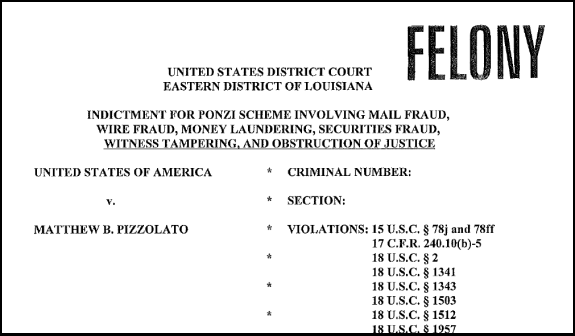
    UPDATED 9:44 P.M. ET (U.S.A.) A Louisiana man has been charged in a 64-count indictment with operating a $20 million Ponzi scheme that fleeced retirees, federal prosecutors said today.

    So many fraud counts were filed against Matthew B. Pizzolato that he faces more than 1,100 years in prison if convicted of all of them. As many as 160 people were duped, prosecutors said.

    Pizzolato, 26, of Tickfaw, was charged with 52 counts of mail fraud, two counts of wire fraud, seven counts of money laundering, and single counts of securities fraud, obstruction of justice and witness tampering.

    It was the second time this week prosecutors alleged witness tampering in a major Ponzi scheme case. Jeffrey Lane Mowen was charged in Utah Nov. 18 with attempting to hire a man to kill four witnesses in a  case against him.

    In the Pizzolato case, prosecutors said he attempted to silence employees with bribes of  $20,000 and get them to destroy records to cover up the scheme. Meanwhile, prosecutors said Pizzolato obstructed justice by stealing documents that could incriminate him from the home of a client.

    pizzolatoartWhen the client called authorities, Pizzolato returned documents that he altered after stealing them,  prosecutors said.

    A veteran FBI agent called the crimes beyond the pale.

    “It is unconscionable that in this stressful economy senior citizens would be targeted and defrauded of their life savings, said Special Agent in Charge David Welker. “We have an obligation to aggressively investigate crimes against those citizens who are most vulnerable. The FBI and our law enforcement partners will continue to aggressively pursue those who target our most vulnerable citizens.”

    Federal agencies are working together to put an end to the Ponzi plague in the United States, said U. S. Attorney Jim Letten of the Eastern District of Lousiana

    “Today’s indictment demonstrates our resolve, along with our partners in federal law enforcement, including the FBI, IRS and U.S. Postal Inspection Service, to aggressively investigate and pursue those who seek to take advantage and prey upon those among us, including our senior citizens,” Letten said.

    The Office of the Louisiana Commissioner of Securities assisted in the probe, Letten said.

    Pizzolato had offices in Hammond, Covington, Lake Charles, Baton Rouge, and also conducted business in Greater New Orleans.

    He “lured his potential victims through advertisements in the local daily newspapers in New Orleans, Baton Rouge and Hammond by promising rates of returns that were higher than market rates for CDs or U.S. Treasury Bills, prosecutors said.

    Among the words Pizzolato used to lure investors into a false sense of security were “guaranteed”, “safe”, “conservative”, “insured”, and “no-risk,” prosecutors said.

    Despite his assurances that clients’ money had been placed in U.S. Treasury Bills, CDs and other government-backed securities, Pizzolato “used the investors’ money to purchase luxury items, to make payments totaling millions of dollars to friends and family, to invest in high-risk futures trading and/or commercial real estate, and to provide lulling payments to investors in an effort to conceal the true nature of the Ponzi scheme,” prosecutors said.

    Among the luxury items he purchased with investors’ money were a BMW 750LI, a Mercedes Benz S430V, a Range Rover Sport and a Chevrolet Corvette, prosecutors said. He also bought sports tickets, a $35,000 engagement ring, a $500,000 home in Ponchatoula, La., and spent $35,000 on Carnival cruises.

    All in all, Pizzolato took about $19.5 million from clients and spent “nearly all” of it, prosecutors said.

    Since 2005, prosecutors said, Pizzolato either operated, owned or was affiliated with several companies: Gulf Region Guaranty Inc. (Gulf Region Guaranty); Acadian Guaranty Group LLC; Allegiance Financial LLC; Annuity Presets LLC; Annuity Recovery Services LLC; Anova Marketing Systems LLC; Anytime Fitness of Sulphur LLC; Cornerstone Wealth Management LLC; Global Assured Financial Inc.; Green Pelican Group Inc.; Gulf South Guaranty Inc.; Gulf States Guaranty LLC; GRG Holdings LLC; GRG I LLC; GRG II LLC; Matt P LLC; National Insurance Advisors LLC; Pelican Guaranty Group Inc. (Pelican Guaranty); and Spectrum Lending Group LLC.

    If convicted, he faces up to 20 years in prison for each count of mail fraud, wire fraud, securities fraud and witness tampering, and up to 10 years for each of the money laundering and obstruction of justice charges. Meanwhile, Pizzolato faces fines of up to $16 million.

    Pizzolato was hit with 56 counts that could result in a maximum sentence of 20 years each if convicted of all of them, meaning he potentially faces more than 1,100 years in prison — even more if convicted of the less serious crimes.

    Michael J. De Palma, Special Agent in Charge of the Internal Revenue Service Criminal Investigation Division, said law enforcement is prepared to “follow the money” to reverse-engineer Ponzi schemes.

    “Financial Fraud and money laundering are not victimless crimes,” De Palma said. “IRS-Criminal Investigation is united with the rest of the law enforcement community in our resolve to disrupt those who commit crimes against our local citizens. Special Agents of IRS Criminal Investigations are expert financial investigators who ‘follow the money’ trail to identify potential offenders.”

    Read the Pizzolato indictment.

    See video on WWL-TV:

  • Madoff Displayed Charms Of A Practiced Huckster

    Bernard Madoff was charged with securities fraud Dec. 11. The story about the alleged $50 billion Ponzi scheme hasn’t been out of the news since then — not even for a few hours.

    Over the weekend we reported that the assets of the Elie Wiesel Foundation had been wiped out in the alleged Madoff fraud. Not even Nobel Prize winners are immune from the charms of a practiced huckster.

    Madoff insisted his trading formula was “proprietary.” Investors say he told them to keep their relationship “secret,” that nobody needed to know he was handing their money — and yet people couldn’t keep the secret, which is how Madoff got more clients. Some charities already have closed, throwing employees out of work, canceling important research and projects and making the world a little darker place.

    Lawsuits are flying left and right: New York University, for example, sued Ezra Merkin, accusing him of entrusting investment money to Madoff while not performing due diligence.  Merkin is a funds manager and also the chairman of GMAC, the lending arm of General Motors Corp.

    Ponzi: There’s not another five-letter word quite like it. High net-worth individuals in Palm Beach are selling real estate and yachts to get by. Members of the Jewish faith have been particularly hard-hit. This case is many things. One of them is affinity fraud, something that is proliferating online.

    Madoff is infamous now, his Hollywood story of rising from humble life guard to corporate baron in tatters. Someone apparently stole a $10,000 statue depicting a life guard from Madoff’s Florida home. Madoff odds and ends are beginning to appear on eBay.

    The Bernard Madoff case is a cautionary tale. At it’s base, however, it’s a simple tale of moving shells and playing word games to hide forbidden math. Forbidden math doesn’t sell because it takes away the dream.