Tag: Arthur Nadel

  • EDITORIAL: Cancel Their Ponzi Ticket, Sen. Leahy

    Sen. Leahy, in oline chat with eighth-graders.
    Sen. Leahy, in online chat with eighth-graders.

    Four more U.S. banks failed yesterday. Three failed on the previous Friday. Thirteen have failed year-to-date. To say this is unsettling is to grossly understate the severity of the banking problem and the drag on the U.S. and world economies.

    Stories about Ponzi schemes and mortgage fraud are in the news daily. The obvious fear among regulators is that more Bernard Madoffs and Arthur Nadels will emerge. The situation is ripe for Ponzi schemes to be exposed because people need cash and actually fear Ponzi fraud now, meaning they’re predisposed to request redemptions just in case. Ponzi operators won’t be able to fund the redemptions, and the fraud will be exposed at the revulsion of the world.

    And yet some members of the Surf’s Up forum, which is associated with the AdSurfDaily Ponzi operation, are writing incredibly brazen letters to Sen. Patrick Leahy. These letters are a bid to get the Senate Judiciary Committee to investigate the prosecutors who prevented the ASD Ponzi from mushrooming. Sen. Leahy is committee chairman.

    Make no mistake about it, Sen. Leahy: ASD is a $100 million Ponzi scheme and every bit as dangerous as the Madoff and Nadel schemes. ASD thrived for months and collected tens of millions of dollars — now subject to forfeiture because of quick action by the U.S. Secret Service, the IRS and the Justice Department — and tried to cover its tracks by drafting investors into a contract that provided no consumer protections at all. The contract was nothing more than an inartful, cynical bid to legalize Ponzi schemes and skirt securities laws by calling an investment program an “advertising” program.

    Members of the Judiciary Committee should pay close attention to the ASD contract, which appears starting on P. 68 of this document, an Aug. 5 forfeiture complaint against assets tied to ASD. The Justice Department filed a second forfeiture complaint on Dec. 19, outlining even more ASD abuses and highlighted by a claim that “Russian” hackers stole $1 million from ASD.

    ASD President Andy Bowdoin did not even file a police report, which raises even more questions — questions such as “Why not?” and “Did a theft actually even occur?”

    Members of the Judiciary Committee also should know that Bowdoin already has surrendered claims to money and property seized in the August forfeiture complaint.

    At the same time, members of the committee should seek to determine if the Robert Garner mentioned beginning on P. 160 of this Senate document pertaining to a 2001 money-laundering investigation is the same Robert Garner mentioned in the ASD forfeiture complaint.

    The Surf’s Up members’ bid to misinform the Judiciary Committee and sanitize Ponzi schemes is reprehensible, an insult to hard-working and underfunded law-enforcement agencies, the highly capable men and women who staff the agencies, and dedicated prosecutors at all levels of government.

    And it is a slap in the face to hard-working Americans who are living through lean times, struggling to make ends meet and are stunned beyond words at the devastation wrought by the Ponzi economy.

    We call on Sen. Leahy, a former prosecutor, and the Judiciary Committee to fully investigate so-called “autosurf” Ponzi fraud and propose legislation that will help federal and state prosecutors combat it. A law that specifically codifies the crime and spells out penalties would be a good first step.

    We suggest that Sen. Leahy and members of the Judiciary Committee work closely with Attorney General Holder and SEC Chairman Schapiro in crafting legislation that specifically addresses autosurf and HYIP Ponzi fraud.

    This insidious business is sucking wealth out of the economy and creating an environment in which criminals and even terrorists can thrive. Mini-Madoffs exist far and wide across the autosurf landscape. They are engaging in the sale of unregistered securities, wire fraud, money-laundering, mail fraud and racketeering, and they are being aided by people who are doing everything in their power to change the subject and sanitize what amounts to organized theft on a global scale.

    Cancel their Ponzi ticket, Sen. Leahy.

  • Bowdoin/Madoff Comparison: Is It Fair?

    andybowdoinartLast night we received a note from a reader who had a bone to pick: He advised us, seemingly politely, that ASD was not an “autosurf.”  Rather, he said, it was a “manual surf.”

    There was a whiff of passive-aggressiveness in the note: He informed us that he did not desire to “address your blog” with the exception of informing us of the differences between a manual surf and an autosurf.

    Because we received this note shortly after publishing a graphic showing Andy Bowdoin, Bernard Madoff and Arthur Nadel in the same image, we wondered if the reader actually had a bigger bone to pick but didn’t want to acknowledge it. He didn’t want to “address your blog,” after all. (View the graphic.)

    We have received many such notes since August. Lots of them have been passive-aggressive in nature — poison arrows and bitter sarcasm delivered with a smile — and some were just plain aggressive. Virtually all of them tried to change the subject in some way and deflect from the core issues. We’ve been told that our “little blog” was universally reviled, told that we had “no right” to write about ASD because we weren’t members and, in the next breath, told that people who really understand how the world works recognize the ASD case for what it is: an attempt by the government to trample on people’s rights.

    ‘Win-At-All-Costs’ Strategy Backfired: ASD Members Destroyed Firm’s Already-Fleeting Credibility

    If you were the owner of an Internet program in almost unimaginable trouble with the government — so much trouble that prosecutors wanted to seize your property and sell it at auction — would you want members trying to “help” your case by insulting or trying to intimidate prosecutors, federal judges and other people who had the power to make a difference?

    Would you want Kool-Aid campaigns to Bill O’Reilly or petition drives aimed at getting politicians to endorse Ponzi schemes during an election year that coincided with an economic crisis? (Talk about a mixed message.) Would you want members trying to influence public opinion by sending chain letters to reporters? Would you want people repeating claims that a deal with a penny-stock company was going to pump $200 million into ASD? Would you want people filing complaints and trying to have a TV station charged with “deceptive business practices” for broadcasting news unflattering to ASD?

    And how about certified-mail campaigns right out of a sham Utah “Indian” tribe’s playbook — a tribe purportedy founded inside an Arby’s restaurant? Finally, would you want people filing complaints with the Office of Inspector General at the Justice Department before there had been a single finding of fact in the case?

    If you want to be taken seriously, you wouldn’t want any of these things. So why encourage them?

    What’s more, why invite even more scrutiny of ASD? The firm and its own out-of-control members destroyed the only chance ASD had to be viewed as a progressive, professional advertising company with a sharp, well-honed message and a well-oiled PR operation.

    Nothing that ASD or its members did was consistent with professionalism. The messages couldn’t possibly have been more at odds with themselves.

    Here is how a professional communications company would have addressed a monumental crisis:

    We emphatically deny the government’s assertions and look forward to explaining our business model to the Court. We are confident these issues will be resolved to our satisfaction and that we’ll continue to provide an extraordinary value and opportunity to our worldwide customer base.

    Compare that simple message to the ultimate messages.

    Back to last night’s note . . .

    The AdSurfDaily case does not hinge on whether ASD was a manual surf or an autosurf. We acknowledge that ASD participants had to click on an object to see the next ad. We have written about this, pointing out that a young girl videotaped clicking on ASD ads said it was so simple a six-year-old could do it. In the same video, the supervising adult implied that Facebook was a paid ASD advertiser. Lots of ASD members were capable of doing or saying anything to get the sale.

    The term “autosurf” generally has come to mean a surf site that loads ads in a rotator and pays people “rebates” to view them. The term is used in virtually all litigation involving similar businesses, so we’re comfortable with it. Readers seem to know what “autosurf” litigation is about, and ASD would be in the same trouble if it offered “rebates” but operated as what commonly is known as a manual traffic exchange.

    As we noted above, the note was polite. But we can’t help but wonder why the reader had the need to define ASD as a manual surf at this late date. It impressed us as yet another bid to change the subject. Andy Bowdoin already has surrendered claims to the lion’s share of the seized assets, and the court has acknowledged his motion to withdraw the claims.

    For all intents and purposes, the forfeiture element of the case is over, and the government has won.

    The Bowdoin/Madoff/Nadel Graphic

    Let us know if you think it was fair or unfair by leaving a comment.

    We believe it is fair for the following reasons:

    • All three men are implicated in big-dollar Ponzi schemes.
    • All three men have close ties to Florida.
    • All three men are in their 70s.
    • Ponzi schemes are very much in the news.
    • A $100 million Ponzi scheme should not be viewed as a minor event simply because there are larger Ponzi schemes.
    • Incredible sums of wealth were destroyed.
    • Although it is true the government intervened in the Bowdoin case before the Ponzi collapsed, it is equally true that it didn’t intervene in the Madoff/Nadel cases — much to the dismay of investors who lost fortunes.
    • Madoff, despite the fact he is Public Enemy No. 1, is said to be cooperating with investigators. If true, it does not minimize the crime or make it any less repulsive — but it is something Bowdoin didn’t do. To say Bowdoin’s approach was cynical is to understate his method. He encouraged members to send in testimonials while shielding them from important facts. He then relied on members to testify at the evidentiary hearing, while notifying the court that he intended to take the 5th.
    • Prosecuors allege in all three cases that company funds were diverted to fuel personal spending, including luxury spending for things such as automobiles. Prosecutors also allege that company funds were directed to family members and that extravagant purchases were made.

    So, make your case: Fair or unfair? We are always pleased to publish dissenting opinions.

  • Seniors In Gallery Of Ponzi Rogues; Grandpa Breaks Bad

    bowdoinmadoffnadel

    We noted Sunday that a startling number of senior citizens have been implicated in Ponzi schemes or accused of monumental financial misdeeds. Featured in this graphic are (left to right): Andy Bowdoin, president of fundamentally defunct AdSurfDaily Inc. of Quincy, Fla.; Bernard Madoff, head man at fundamentally defunct Bernard L. Madoff Investment Securities of New York; and Arthur Nadel, principal in several fundamentally defunct hedge funds in Sarasota, Fla.

    Bowdoin is 74. Prosecutors said he fleeced investors in a $100 million Ponzi scheme by selling unregistered securities and calling them “advertisements.”

    Madoff, who might have presided over the biggest Ponzi scheme in world history, is 70. Losses could reach $50 billion.

    Nadel, 76, was arrested yesterday in Tampa, after being on the lam for two weeks. An estimated $300 million is missing from hedge funds he managed in Sarasota.

    Authorities said all three men lived well while investors were being taken to the cleaners. Just prior to a federal seizure of his assets in August, Bowdoin put a gleaming new Lincoln in the driveway — after setting up a sham entity, diverting ASD money to it in a bid to hide assets, and using ASD cash to fuel personal spending in the hundreds of thousands of dollars by family members and preferred investors, prosecutors said.

    Bowdoin has surrendered claims to approximately $100 million in cash and other assets seized by the Feds. In a second forfeiture complaint that is unresolved, prosecutors seek to take control over other assets tied to the firm, including cars, a 20-foot Triton Cabana boat, jet skis and other property purchased with the proceeds of an illegal enterprise.

    Irving Picard, the trustee in the Madoff case, has filed papers to reject expensive automobile leases. While Madoff was engaging in a Ponzi scheme, Picard said, investors were footing the bill for three Mercedes, a Range Rover, a Lexus and a Cadillac.

    madoffleases

    Lease costs for the Mercedes units alone exceeded $4,200 a month, while the lease for the Range Rover cost $1,153 monthly. The Lexus ($888/month) and the Cadillac ($884/month) were relative bargains compared to the other vehicles.

    Prosecutors now say Nadel also took money from company funds and used it for family businesses. The receiver in the Nadel case, Burton Wiand, said in court filings that one of the family business owns as many as five airplanes.

    Other seniors in Ponzi trouble include Richard Picolli, 82, operator of the alleged Gen-See Ponzi in western New York. Prosecutors said he mostly targeted Catholics.

    Meanwhile, Ronald Keith Owens, 73, was just sentenced in Texas to 60 years in prison for running a “prime bank” Ponzi scheme promising huge returns out of the Bahamas and elsewhere.

    Elsewhere, James Blackman Roberts, 71, of Heber Springs, Ark., was just sentenced to 15 years in prison for running a $43.5 million Ponzi scheme.

  • Nadel Diverted Client Funds To Family: Feds

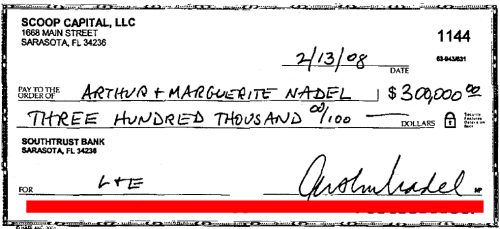
    nadelcheck500

    Florida hedge-fund manager Arthur Nadel turned himself in yesterday to the FBI in Tampa.

    Nadel had gone missing Jan. 14. He was immediately jailed. A bail hearing is set Friday.

    Previously we’ve written about some of the Nadel parallels to the AdSurfDaily Ponzi scheme case. Some of the parallels grew even more striking yesterday, with assertions by federal authorities that Nadel had diverted client funds to family businesses and his wife.

    Federal prosecutors filed a second forfeiture complaint last month against assets tied to ASD. The government seized real estate, automobiles, a boat and other water equipment paid for with ASD money diverted to family members of ASD President Andy Bowdoin.

    In a forfeiture complaint filed in August, prosecutors seized tens of millions of dollars Bowdoin had in bank accounts, plus other real estate tied to ASD. The total amount seized in the case is at least $93.5 million.

    Burton W. Wiand, the receiver in the Nadel case, now has gone to court to attach family assets.

    “Based on our investigation, it is likely that a significant sum of the proceeds of Nadel’s scheme made its way into other accounts controlled by Nadel and/or his wife, Marguerite Nadel,” Wiand said.

    Last year, for instance, Nadel signed checks transferring at least “$1,003,500.00” from Scoop Capital to himself and his wife, Wiand said.

    The scheme likely had been under way for years, Wiand said.

    “Further, in 2003 and 2004 I have already seen documentation showing that at least $685,000.00 was transferred to Nadel and his wife (and have reason to believe that significantly more money was transferred to them),” Wiand said. “In short, it is apparent from the documentation that large quantities of money were diverted from the Hedge Funds to Nadel and Mrs. Nadel. Indeed, to date we have not uncovered any source of income for Nadel or his wife that was not in some manner funded with money from the scheme.”

    Nadel made the checks out by hand, making them payable either to himself or his wife and himself. Sometimes he used the couple’s formal names — “Arthur” and “Marguerite”; other times he used the informal “Art” and “Peg.”

    As the hedge fun assets dwindled, Nadel acquired jets, airplanes and real estate for the family businesses, according to court filings.

    Precisely how clients’ money was plundered virtually it its entirety was unclear. What is clear is that the scheme began to unravel when the alleged Bernard Madoff Ponzi was revealed.

    Nadel, prosecutors said, had been under pressure from colleagues to hire an independent accountant to audit the firms’ assets, but always said no. When the Madoff case made headlines, colleagues insisted on an independent audit. Nadel fled on Jan. 14, a date by which it had become clear that the audit would be performed, prosecutors said.

    Peg Nadel has not been charged with any crimes.

  • Bowdoin, Nadel Cases Have Striking Parallels

    Some of the parallels between the alleged AdSurfDaily Ponzi scheme and the alleged financial misdeeds of Florida hedge-fund manager Arthur Nadel are striking.

    Two obvious parallels are the common Florida venue and the ages of the principals. ASD operated out of Quincy; Nadel out of Sarasota. ASD President Andy Bowdoin is 74; Nadel is 76.

    Beyond the obvious, though, other striking parallels exist.

    Despite checkered pasts, both Bowdoin and Nadel became stars quickly, their ascent fueled by promoting consistent, strong investment returns. Neither man was well-heeled all that long ago, according to court records.

    Bowdoin, prosecutors said, had made no significant money in the past 20 years — despite claims to the contray — and yet suddenly found himself in possession of tens of millions of dollars from his autosurf company. Prosecutors said Bowdoin claimed to sell “advertising,” but actually was selling unregistered securities that advertised a return of 1 percent a day.

    In court filings, Nadel said he was broke in 1995. In the years that followed he claimed to be managing a $300 million portfolio.

    Authorities said Nadel placed $1.25 million into a secret account just prior to his Jan. 14 vanishing act. Prosecutors said Bowdoin told members $1 million had been stolen from ASD by Russian hackers, but Bowdoin never filed a police report.

    A bank closed a Bowdoin account last summer amid Ponzi concerns. Bowdoin told the bank he planned to buy a home in another country, prosecutors said. Members now are wondering if the money actually had been stolen by hackers or if the theft story was just a cover story.

    Neither Bowdoin nor Nadel disclosed information many investors would have found crucial when making decisions to do business with the firms. Bowdoin had a previous run-in with securities regulators more than a decade ago and was charged with felonies.

    Prosecutors said he never disclosed this to prospects, adding that he also didn’t mention he’d pleaded guilty to securities fraud and was sentenced to a year in prison. The sentence was suspended when Bowdoin agreed to make resitution.

    Nadel didn’t disclose that he had been disbarred in New York in 1982, amid assertions he removed $50,000 from an escrow account to pay a client’s debt to a loan shark. One of Nadel’s companies also told investors that its accountant was a CPA. It turns out that the accountant had let his license lapse years before Nadel opened shop and was sanctioned by the state for continuing to claim a CPA credential.

    Both Nadel and Bowdoin also had disputes with ex-wives, according to court documents and newspaper reports.

    In 1995, for instance, Nadel was involved in a divorce dispute with one of four ex-wives and claimed abject poverty, according to the the St. Petersburg Times.

    Less than a decade later, the Times reported, Nadel morphed into the role of philanthropist with hundreds of thousands of dollars to spend to help local charities and civic organizations.

    Bowdoin also had a dispute with an ex-wife in the 1990s, during a period in which he was down and out, the Times reported.

    Bowdoin still owed his ex-wife, JoAnn Kennedy, more than $162,000 in October, even though ASD funds were used for lavish purchases by Bowdoin’s current wife and her son.

    In June, Edna Faye Bowdoin, Bowdoin’s current wife, and her son, George Harris, opened a bank account, funding it with more than $177,000 from an ASD account in a different bank. More than $152,000 of the money was used to retire the mortgage on a Tallahassee home Harris shared with his wife, prosecutors said.

    ASD funds were used on various dates in June to purchase automobiles, a Triton Cabana boat, jet skis and other items. On June 10 and June 11 alone, prosecutors said, almost $240,000 in ASD funds were used to pay for personal items by Bowdoin family members or friends.

    In late July, ASD funds were used to purchase a $50,000 Lincoln. A month later, Bowdoin sent a retitution check in the amount of $100 to victims of the Alabama scam a decade earlier, the Times reported. His ex-wife got nothing.

  • Senior Citizens Dominate Ponzi Headlines

    BLOG UPDATE 10:02 P.M. EST (U.S.A.): This post has been updated with information on Ronald Keith Owens, 73, who was just sentenced to 60 years in prison for running a “prime bank” Ponzi scheme promising huge returns out of the Bahamas. See update at bottom of post.

    Here, directly below, our earlier post . . .

    Noticed how many of the alleged Ponzi operators and investment scammers in law enforcement’s sights are well into their senior years?

    It’s at once fascinating and unnerving. Grandfathers are supposed to be awaiting their dates with grand kids and golfing pals, not legal garrisons and prison guards. This is sad. It makes one wonder how many other gramps are in a high state of panic, desperately seeking ways to create cash flow to stave off the Ponzi fate for another month.

    Topping the list, age-wise, is Richard Piccoli, the alleged operator of the Gen-See Ponzi in the Buffalo, N.Y., area. Piccoli is 82.

    Arthur Nadel, on the lam from Sarasota amid allegations more than $300 million in client funds is missing, is 76. Andy Bowdoin, who presided over the alleged $100 million AdSurfDaily Ponzi scheme in Quincy, Fla., is 74, and Bernard Madoff, implicated in an alleged $50 billion Ponzi, is 70.

    Age is only one area of commonality. Lack of disclosure and a grandiose stretching of the truth also are elements in each of the cases.

    Nadel, for example, didn’t disclose he was disbarred in 1982 for using $50,000 in escrow funds, reportedly to pay off a loan shark. He moved on to a finance career that ultimately called for him to oversee $350 million.

    Madoff? Experts who passed on deals say they were unnerved by his refusal to discuss specifics. They also found it deal-breaking odd that his accountant worked in a 13-by-18-foot office in a Rockland County, N.Y., shopping strip.

    Bowdoin, according to prosecutors, spun a false tale of fabulous business success and did not disclose his previous arrest in Alabama on felony fraud charges — information many investors would have found important.

    Piccoli, meanwhile, issued bogus certificates, telling investors his business was endorsed by prominent Catholics and members of the priesthood, authorities said.

    It must be a confusing thing to be a grandchild these days, seeing all these senior faces in the news and wondering why older — and presumably wiser — people would choose Ponzi operator for an occupation.

    Are there any other gramps out there running Ponzi schemes? And what will they do if asked to say it ain’t so?

    UPDATE: The Texas State Securities Board has announced that another senior,  Ronald Keith Owens, 73, has been sentenced to 60 years in prison for operating a “prime bank” Ponzi scheme that allegedly was set up in the Bahamas and elsewhere.

    Yes, 60 years.

    “Owens promised investment returns of up to 30 percent month, but he was operating a Ponzi scam by paying early investors with money raised from newer investors,” the board said. “Owens also used investors’ money to pay for his business expenses and his and his wife’s personal expenses.”

    Read the board’s News Release on Ronald Owens.

  • BREAKING NEWS: SEC Charges Nadel With Fraud

    Breaking News 2:24 p.m. EST (U.S.A.). The Securities & Exchange Commission has just accused missing fund manager Arthur Nadel of fraud.

    “Nadel provided false and misleading information for dissemination to investors about the Funds’ historical returns and falsely overstated the value of investments in the Funds by approximately $300 million,” the SEC said. “In contrast, the Funds appear to have total assets of less than $1 million.”

    Nadel has been missing since Jan. 14. The Sarasota Herald-Tribune reported today that he was believed to have been in Louisiana in recent days and told family members in a suicide note that he believed people might kill him.

    SEC investigators also allege that Nadel recently moved $1.25 million into a secret account.

    A judge today granted  a temporary restraining order, an asset freeze, and preliminary injunction against Nadel and preliminary injunctions and asset freezes against Scoop Capital and Scoop Management.

    “In addition, the complaint seeks permanent injunctions, disgorgement plus prejudgment interest, and civil money penalties against all the defendants,” the SEC said. “Without admitting or denying the allegations of the complaint, defendants Scoop Capital and Scoop Management consented to the entry of, among other things, preliminary injunctions, asset freezes, and the appointment of a Receiver.”

    The complaint also names as relief defendants two investment management companies, Valhalla Management, Inc. and Viking Management, LLC, and the six Funds, Scoop Real Estate, L.P., Valhalla Investment Partners, L.P., Victory IRA Fund, Ltd., Victory Fund, Ltd, Viking IRA Fund, LLC, and Viking Fund, LLC. The complaint seeks disgorgement plus prejudgment interest against each of the relief defendants.

    Nadel simply doctored client statements, pulling numbers from thin air, the SEC said.

    “[O]ne e investor from Virginia who invested in the Victory IRA Fund received a statement for October 2008 indicating his investment was valued at $599,551.55, and a November 2008 statement indicating his investment was valued at $602,965.39,” the SEC said in its complaint.

    “This same investor made a second investment in Victory IRA Fund through another account and
    subsequently received an October 2008 statement indicating this investment was valucd at
    $172,354.07, and a November 2008 statement indicating this investment was valued at
    $1 73,335.45.

    “These statements were false because the total value of the entire Victory IRA Fund’s holdings was only $2,938.86 at the end of October and November 2008,” the SEC said.

    Read the SEC complaint.

  • SEC Up To Its Ears In Ponzi Investigations

    The Securities & Exchange Commission has charged CRE Capital Corp. with running a Ponzi scheme that sucked millions of dollars from investors.

    Meanwhile, a hedge-fund operator in Florida has gone missing — along with $350 million in clients’ money. Although the Florida case is brand new and the SEC hasn’t announced a probe, it almost certainly will open one.

    Arthur Nadel, 75, has been missing since Wednesday. The Sarasota Herald-Tribune reported Nadel left a suicide note in a case that’s already being called a “mini-Madoff.”

    In the CRE Capital case, the SEC accused the Alpharetta, Ga., company and its president, James G. Ossie, of paying off old investors with money from new investors to create the illusion of profitability.

    Ossie and CRE suffered steep losses, the SEC said in its complaint.

    “In April 2008, CRE and Ossie opened a trading account in the name of CRE at Forex.com, a division of Gain Capital Group, LLC (“Gain Capital”). CRE and Ossie deposited over $5 million into the Forex.com trading account. Since June 18, 2008, CRE and Ossie traded foreign currency futures in the Forex.com account and incurred losses totaling over $4 million, including commissions and fees.

    “On or about December 2, 2008,” the SEC continued, “CRE and Ossie represented to Forex.com, in response to inquiries from that firm, that all of the funds they had deposited into CRE’s trading account were their own funds, and not those of customers or investors. These statements were false.

    “In approximately June 2008,” the SEC said, “CRE and Ossie opened a second trading account in the name of CRE in London, at Deutsche Bank. From June through December 2008, CRE and Ossie transferred $12 million of investor funds to the Deutsche Bank trading account in London. From June 2008 through January 8, 2009, CRE and Ossie’s currency trading in the account generated losses totaling $8,067,032.40.”

    CRE’s assets have been frozen and a receiver has been appointed.

    “CRE and Ossie fraudulently obtained at least $25 million from investors during 2008 by representing that it would use their money to engage in a currency trading program,” the SEC said. “Most investors were advised that they would receive guaranteed returns of 10 percent every 30 days, although a few investors were promised as much as 20 percent.

    The company employed multiple layers of deception to fleece investors, the SEC said.

    “CRE also falsely claimed that the firm and its program were audited by an outside accounting firm, which had concluded that CRE was not a Ponzi scheme,” the SEC said.

    Ossie and CRE also were charged with fraud “relating to their offer to sell $100 million in CRE stock that was slated to begin in early 2009,” the SEC said.

    “The SEC’s emergency action in this case will protect investors from further harm — both those who have invested and need all remaining assets preserved as well as those who were contemplating an investment,” said Katherine S. Addleman, regional director of the SEC’s Atlanta regional office.

    “We also want to remind investors to be skeptical of promoters promising exorbitant returns. Such claims should be a red flag to investors,” Addleman said.

    In the Nadel case, investors grew suspicious when they did not receive statements this month. The Herald-Tribune reported that one of the funds — “Scoop” — in Nadel’s three-fund portfolio could not meet a year-end demand for $50 million in redemptions.

    The others were known as “Viking” and “Valhalla.”

    People have filed complaints with Sarasota police — not the usual place one goes to file an investment-fraud report — but a place that demonstrates the word “Ponzi” has become positively nuclear.

    As was the case with the alleged Madoff Ponzi, local charities have been affected, as have investors’ sense of security and retirement income.

    And to think that some members of AdSurfDaily accorded Ponzi operator Andy Bowdoin folk-hero status.