URGENT >> BULLETIN >> MOVING: Federal prosecutors have asked U.S. District Judge Rosemary Collyer for an order that would reopen the remissions process in the AdSurfDaily Ponzi case, potentially giving victims who missed the January 2011 filing deadline a chance to gain a pro rata share of the balance of seized assets.
The U.S. Secret Service seized about $80 million in the case. To date, the government has returned about $58.8 million to about 9,000 victims. Other victims might have missed the January 2011 filing deadline because ASD’s records were a mess, prosecutors asserted.
“The victims in this case include thousands of domestic and possibly international individuals and entities who provided funds directly to ASD,” prosecutors advised Collyer. “Although the government obtained the ASD member database, which contained the names of approximately 97,000 ASD members, it is entirely possible that this database does not contain all of the ASD victims.”
Separately, the U.S. Department of Justice said it did not oppose a reopening of remissions.
“Although the previous remission process was open for an extended period of time, [the Asset Forfeiture and Money Laundering Section] intends to administer a final remission process, whereby those who missed the original deadlines would be able to submit a petition for remission,” the Justice Department said in a letter to one of the federal prosecutors in the District of Columbia who is handling the ASD case.
“While the final details are still being determined, we envision that process starting shortly after the sentencing in this case, and providing approximately 45 days from the beginning of that process for individuals to file petitions. Petitioners who satisfy the requirements of 28 C.F.R: § 9.8 would be eligible for remission, and the granted petitioners would receive a pro-rata share of the remaining forfeited proceeds. The details of this process will be posted on the Ad Surf Daily page on website of the United States Attorney for the District of Columbia.”
Eligible claimants, according to the government’s filing, must demonstrate (italics added):
(1) he or she incurred pecuniary loss of a specific amount; (2) the pecuniary loss was a direct result of the illegal act; (3) the victim did not knowingly contribute in, participate in, or benefit from, or act in a wilfully blind manner toward the commission of the offense; (4) the victim has not been compensated for the loss; and (5) the victim does not have recourse to other assets to obtain compensation.
The PP Blog will update this information as needed.
In other ASD news, prosecutors have formally put the total amount ASD gathered at $119 million, up from a preliminary figure of $110 million.
And prosecutors noted that “less than $50,000 came from sources other than ASD members.”
Last week, the SEC filed charges against an ASD-like “opportunity” known as Zeek Rewards. In case filings, the agency asserted that only 2 percent of Zeek’s revenue was external to the membership, making Zeek a “classic” Ponzi scheme.
Former ASD President Andy Bowdoin is scheduled to be sentenced Aug. 29.
A Washington state man sentenced in the 1990s to 46 months in federal prison for possessing a pipe bomb now has become the subject of a tax investigation.
A civil case filed Thursday in Seattle against John Lloyd Kirk accuses him of pushing a “redemption” tax scheme. At least 31 of Kirk’s customers sought fraudulent tax refunds totaling about $8 million, the Justice Department said.
Kirk, 70, of Des Moines, Wash., has been identified by the Anti-Defamation League (ADL) as a “sovereign citizen” and member of an extremist group known as the “Little Shell Pembina Band.”
Kenneth Wayne Leaming, an emerging figure in the AdSurfDaily Ponzi scheme story, also has been identified by ADL as a sovereign citizen and member of the Little Shell Pembina Band. Leaming lists an address in Spanaway, Wash. In 2010, he sought unsuccessfully to sue the United States for the apparent sum of more than $29 TRILLION for its actions in the ASD case. The sum sought in the lawsuit was more than twice the U.S. Gross Domestic Product in 2009.
ASD President Andy Bowdoin was indicted last year on charges of wire fraud, securities fraud and selling unregistered securities. ASD is known to have sovereign citizens and tax-deniers in its ranks, and Bowdoin was accused of operating a Ponzi scheme that gathered at least $110 million.
Leaming’s history also includes the filing of bogus liens against government officials and a Franciscan hospital in Washington state, according to records. Like Kirk, he has purported to practice tribal law.
An ADL website publishes brief profiles of both Leaming and Kirk on the same page.
The Justice Department’s lawsuit against Kirk does not reference ASD. Kirk was accused of hatching a redemption scheme individually and through two entities: Indian Nations Advocate Law Office and The Kirk of Yahh Hava.
“Kirk purports to be a member of good standing of the Tulalip Tribal Bar and allowed to
practice law before its tribal court although he is not an attorney,” the Justice Department alleged.
In a redemption scheme, customers typically are told that the government maintains “secret” accounts for U.S. citizens and that the accounts contain vast sums of money that can be accessed and used to retire debts. Another form of the redemption theory holds that individuals can “draw” on their secret accounts with the U.S. Treasury to pay their tax bills and qualify for spectacular refunds.
“Kirk’s scheme is part of a ongoing trend amongst tax protestors to file frivolous tax returns and Forms 1099-OID (or to claim false OID income) with the IRS and courts in an attempt to escape their federal tax obligations and steal from the U.S. Treasury,” the Justice Department said.
“At his 1099 OID seminars, Kirk advises his customers that they can draw on a secret account with the United States Treasury to pay their debts,” the Justice Department alleged. “He further advises his customers to file bogus tax returns with fraudulent Forms 1099-OID to draw on this secret account that the Treasury supposedly maintains for each person. Accordingly, he advises his customers to file false Forms 1099-OID and tax returns seeking tax refunds for amounts equal to the amounts of their mortgages, car loans, credit card debts, and other debts as well as any interest incurred on those obligations.”
Kirk advised one of his customers to file fraudulent paperwork to receive a tax refund of more than $130,000. In another case, a customer of Kirk’s received a fraudulent refund of more than $700,000. At least 31 Kirk customers filed for fraudulent refunds totaling approximately $8 million, the Justice Department said.
The National Consortium for the Study of Terrorism and Responses to Terrorism (START), a terrorism research group based at the University of Maryland, identified Kirk as a member of the Washington state “Freemen.” ADL, meanwhile, reported that Kirk was a friend of infamous Montana Freeman LeRoy Schweitzer.
EDITOR’S NOTE: Blogger Chuck Miller, who posts on the website of the Albany (N.Y.) Times Union, has a post today on the unique circumstances under which he became a self-described “mark” for an MLM pitch nearly 20 years ago. Seems Miller’s MLM memories linger after nearly two decades. (You’ll learn why by clicking on the link to Miller’s column at the bottom of this post.)
First, though, some introductory remarks are in order . . .
McKelvy is a defendant in the Mantria/Speed of Wealth case, which the SEC filed in November 2009. Just days after the case was filed, McGaw began to receive a steady stream of email from McKelvy, who had a $30 million Ponzi scheme case hanging over his head and still was pitching offers for MLMs.
“How the heck can I help you become financially independent if you do not take the action steps that I recommend to you?” McKelvy memorably nudged the columnist just days after the SEC announced its intent to sue McKelvy back to the Stone Age.
Of course, untold numbers of Stepfordian members of Florida-based AdSurfDaily continued to pump autosurf MLMs — even after ASD President Andy Bowdoin had tens of millions of dollars seized from his personal bank accounts and was accused by some of his own members of racketeering.
Accused Ponzi swindler Andy Bowdoin of Florida-based AdSurfDaily has been granted an extra two weeks to argue that the criminal case against him should be transferred from U.S. District Court for the District of Columbia.
Through his attorneys, Bowdoin informed U.S. District Judge Rosemary Collyer on Jan. 3 that he intends to file a Rule 21 motion to transfer his trial to another federal court. Under Rule 21, a defendant can argue that he cannot receive a fair and impartial trial in a specific district. Meanwhile, a defendant can argue that the trial should be moved for the convenience of the parties and witnesses.
It was not immediately clear if prosecutors would oppose the motion. Bowdoin initially was ordered by a federal magistrate judge to file his motion within two weeks of his Dec. 17 arraignment in Washington. Collyer now has granted Bowdoin’s request for an extension to file. The new deadline is Jan. 18.
In December 2009, Bowdoin sought to have Collyer removed from the civil-forfeiture case in which the U.S. Secret Service seized tens of millions of dollars from his personal bank accounts. Collyer refused to step down. In January 2010, she decreed the money forfeited to the U.S. government, which has established a process through which ASD victims can file a claim for a share of the seized proceeds.
In an affidavit in support of his 2009 disqualification motion, Bowdoin claimed Collyer had a “deep seated animosity” toward him and that the judge “has a personal bias and prejudice” against him.
Ironically, Bowdoin’s motion to disqualify Collyer in the civil case was docketed on Dec. 17, 2009. Exactly one year to the day later — on Dec. 17, 2010 — Bowdoin made his first appearance in the criminal case in the District of Columbia. Federal agents arrested Bowdoin in Florida on Dec. 1, 2010, after an indictment from a grand jury that began meeting in May 2009 was unsealed.
Collyer did not preside over Bowdoin’s initial appearance in Washington, but has been assigned the criminal case. She issued her first ruling yesterday: a minute order that granted Bowdoin’s request for the two-week extension to file his Rule 21 motion.
ASD member Curtis Richmond, who emerged as a figure in the civil litigation after filing pro se pleadings that accused Collyer and Chief U.S. District Judge Royce Lamberth of operating a “Kangaroo Court,” also sought unsuccessfully to have Collyer removed from the case in 2009.
Richmond has been linked to a sham Utah “Indian” tribe that once sought unsuccessfully to have a federal judge removed from a different case on the eve of trial by claiming the judge owed Richmond $30 million.
DISCLOSURE: I was a volunteer Moderator at the Warrior Forum (WF) between December 2007 and July 2008. I learned what is best — and worst — about Internet Marketing at the WF. Just as my Mod days were coming to an end, the AdSurfDaily Ponzi scheme case was coming to the fore — and Internet Marketers raced to the forum to “defend” the business.
UPDATED 11:13 P.M. EDT (U.S.A.) The author of The Salty Droid, a Blog that unapologetically skewers highly questionable Internet Marketing practices and some of the trade’s most visible figures, was made the subject of a death wish Aug. 17 by a poster at the Warrior Forum (WF).
“Hopefully one day he will pick the wrong target and that someone will take a shotgun to him,” wrote Robert Puddy, a well-known marketer. The post was in response to a poster who apparently committed the high crime of making a favorable comment about The Salty Droid.
The PP Blog, which itself has been the subject of threats by Internet Marketers, strongly condemns the event at the WF, the actions of Puddy and attempts to chill by force of threat reporters and Bloggers who write about IM-related issues.
Suggesting a human being should be executed by shotgun for his critical point of view about Internet Marketing is thuggery. That Puddy, who provides Internet Marketing training and is regarded an expert, even could suggest that death was an appropriate penalty for a Blogger who opines that some Internet Marketers engage in anticompetitive and racketeering-like marketing practices is a matter for great introspection.
So much for having a sense of the moment — or any PR savvy at all.
A number of Internet Marketers have been implicated in racketeering schemes or found themselves squaring off against racketeering indictments or lawsuits in recent months. Andy Bowdoin of Florida-based AdSurfDaily, for instance, was sued by his own customers for racketeering. One of Bowdoin’s attorneys also was sued for racketeering in the same case, which was placed on hold until the federal Ponzi case against ASD plays out. At least one ASD member was successfully sued for racketeering in Utah for participating in a scheme to place bogus judgments for astronomical amounts against public officials.
The ASD member — Curtis Richmond — sat as an “arbitrator” on a bogus panel set up by a bogus “Indian” tribe and signed a bogus “award” for more than $300,000 against a Family Services worker. Not to be outdone, Richmond claimed the federal judge hearing the Utah case owed him $30 million.
Richmond later claimed the federal judge overseeing the ASD case was guilty of “TREASON.” Dozens of Internet Marketers attempted to intervene in the case, filing pleadings from a kit. The pleadings, including one that claimed the government was guilty of interference with commerce for seizing the proceeds of an alleged crime, were downright bizarre.
Now, Puddy, an Internet Marketer, opines that death is the answer for what he apparently believes should be the entire industry’s problem with The Salty Droid — as though monolithic thinking is the only option and that any person who believed the author could be right about anything should be shouted down and ridiculed.
Adopting an ad hominem approach, Puddy, the marketing trainer and expert, called The Salty Droid fan an “idiot” — apparently for suggesting the author even could frame a point worth pondering over. He then called the Salty Droid author a “disgusting little worm,” opining that the author uses “innuendo and false info to slag off other people.” He did not provide any example or any support material to back up his claim The Salty Droid dispensed innuendo and false info. Puddy concluded his comment with the shotgun remark, later denying he was angry when posting it.
In a later comment, Puddy claimed he knew of two “people who [received] physical threats of violence [because] of the lies on that blog.
“In one case,” Puddy claimed, “the [person’s] family was also included in the threat.”
The Salty Droid (SD) author, who was made aware of Puddy’s remarks when contacted by the PP Blog for comment, said he was not surprised that violence had become part of the discussion.
“I don’t doubt that the scammers also receive threats from the same type of persons that are threatening me,” SD said. “People can react in scary ways when they find out they’ve been the victim of the long con.”
Puddy’s incendiary comment was posted Aug. 17 and escaped deletion on the WF for days. The comment finally disappeared either late Saturday or early Sunday. How and why it disappeared were not explained. Comments left by the PP Blog and other posters who challenged Puddy also disappeared.
The PP Blog, which retained its Warrior Forum membership after giving up a volunteer moderator’s job in July 2008, challenged Puddy on his shotgun comment Saturday. The Blog was not alone in challenging the inflammatory remarks. Indeed, other WF members — including long-standing members — also challenged Puddy. Three WF members thanked the PP Blog in the forum for challenging Puddy’s assertion that The Salty Droid author should have a date with death by shotgun blast.
At least three WF posters asked Puddy to retract his remarks.
“I stand by my comments,” Puddy said, suggesting that WF members and others who disagreed with him are “brain dead.”
By coincidence, “brain dead” was the exact same phrase members of ASD used to describe the federal judge presiding over the Ponzi litigation brought by the U.S. Secret Service in August 2008. The word choice did not go over well in the ASD case, either. Nor did Internet Marketers’ explanation that the case against ASD by the Secret Service and federal prosecutors was the work of “Satan” and the equivalent of the 9/11 terrorist attacks on the United States.
Saturday, indeed, was another a dark day for Internet Marketing, which already has a miserable reputation for scamming, turning a blind eye to scammers, advocating on behalf of scammers and closing ranks when one of its own is challenged by prosecutors or web critics.
Although some Internet Marketers — including members of the Warrior Forum — speak out routinely against scams and shady or illegal marketing practices, they often are derided as jealous “haters,” whiners, malcontents and people who cannot stand “success.”
SD told the PP Blog that he routinely has been subjected to threats.
“That happens to me all the time,” SD said. “They threaten with me with all sorts of horrible atrocities . . . in public and in private. They also talk amongst themselves about the possibility of my death with fondness . . . and regularly . . . this in rooms that contain crazily loyal sycophants/cult followers.”
That the “conversation” at the WF “so quickly deteriorated to that level says pretty much everything you need to know about this ‘industry,’” the SD said.
Robert Hodgins of Dallas-based Virtual Money Inc. is wanted by Interpol in an international money-laundering case that allegedly involves proceeds from the sale of narcotics. Virtual Money Inc.'s name is referenced in the AdSurfDaily autosurf Ponzi scheme case brought by the U.S. Secret Service and the PhoenixSurf autosurf Ponzi scheme case brought by the Securities and Exchange Commission. The case against VM and Hodgins was brought by the U.S. Drug Enforcement Administration and the IRS. PHOTO SOURCE: Interpol.
A Colombian national implicated in an international conspiracy to launder drug money has been sentenced to 45 months in prison, federal prosecutors announced.
Meanwhile, another figure in the alleged scheme — Robert Hodgins, the operator of Dallas-based Virtual Money Inc. (VM) — remains at large, prosecutors said. Hodgins is wanted by Interpol on a warrant issued by a federal judge in Connecticut.
Hodgins is Canadian by birth and lived in the Oklahoma City area of the United States, according to records.
VM’s name is referenced in the forfeiture allegations in the AdSurfDaily autosurf Ponzi scheme case brought by the U.S. Secret Service in the District of Columbia in August 2008. It also is referenced in the PhoenixSurf Ponzi prosecution brought by the SEC in Los Angeles in July 2007.
Juan Merlano Salazar, 36, of Medellin, Colombia, was sentenced to 45 months Aug. 9 by U.S. District Judge Mark R. Kravitz of the District of Connecticut. Salazar is among five defendants convicted so far in the money-laundering case, which allegedly involved the use of debit cards provided by VM to launder drug proceeds at ATMs in Colombia, according to court filings.
Hodgins also is alleged to have accepted $100,000 to launder drug proceeds in the Dominican Republic.
The Colombian narco business used “stored value cards” to enable drug proceeds to be withdrawn from banks in Medellin as Colombian pesos, prosecutors said.
Medellin was home base to the late drug lord Pablo Escobar.
In August 2009, the PP Blog reported that VM’s name appeared in advertising materials for ASD in 2007. Records suggest that Hodgins or a VM designate attended an ASD function in Orlando in November 2006, about a month after ASD began its rollout.
This 2007 ad for ASD promoted the VM debit card.
Some ASD members have said they observed large sums of cash and briefcases full of cashiers’ checks at ASD “rallies” in U.S. cities in the spring and summer of 2008, which led to questions about whether ASD was laundering money for a drug cartel and international criminals.
If the allegations against VM and Hodgins are true, it means the company that provided the debit cards ASD used was in the business of laundering money for at least one international narco business.
On Aug. 1, 2008, the U.S. Secret Service seized more than $80 million in the ASD case. The money allegedly was tied to at least three autosurfs: ASD, GoldenPandaAdBuilder and LaFuenteDinero.
ASD, which had operated under at least one other name and perhaps as many as three or more, claimed in 2007 that one of the reasons it could not make payments to members was that $1 million had been stolen by “Russian” hackers.
Prosecutors said ASD never filed a police report — not even to report the theft of a huge sum of money. ASD instead relaunched as ASD Cash Generator. By the summer of 2008, it was gathering tens of millions of dollars per week.
One bank account in the name of ASD President Andy Bowdoin seized by the Secret Service contained more than $31 million, according to court filings. Another account in Bowdoin’s name contained more than $23 million. Bowdoin was referenced as the “Sole Proprietor” of the accounts.
All in all, the Secret Service seized more than $65.8 million from 10 Bowdoin bank accounts, and more than $14 million from at least five bank accounts linked to Golden Panda, according to records.
If a thousand people tell you the autosurf they’re promoting is the “real deal” and that they’ve done their “due diligence” — they are lying.
If you believe them, you are setting yourself up to be fleeced and perhaps even dragged into court, perhaps as a reluctant victim or perhaps even as a defendant in a fraud case.
If you promote the surfs, email prospects, attach your referral URL to forum and web posts, set up forums to pimp these miserable businesses, accept commissions, provide strategic advice or an “earnings calculator” or spreadsheet, tell people to “call” you for details, maintain a list of surfs that are “working” and surfs that are not, defend the surfs in forums, repeat Garbage In, Garbage Out (GIGO) from the program owners and claim you had no ill intent when the surf failed because you were relying on the assertions of your upline sponsor or the program owner, well, you are asking for trouble.
The SEC told you that three years ago with the 12DailyPro prosecution and the follow-up prosecutions of Phoenix Surf and CEP.
And the U.S. Secret Service told you that almost 18 months ago with the prosecution of AdSurfDaily, Golden Panda Ad Builder and LaFuenteDinero. Moreover, the President of the United States and the Attorney General of the United States told you that last year with the creation of the Interagency Financial Fraud Enforcement Task Force.
Plan to defend your surf participation on the grounds people are free to make up their own minds and that the government has no right to interfere with commerce? Congratulations. You’ve just provided aid and comfort to securities fraudsters, narcotics traffickers, drug dealers and people engaged in human trafficking.
That’s their argument, and that makes you their intellectual soulmate. It also was the argument for slavery in the 19th century and earlier. Society rejected the argument long ago. It was far too taxing on the intellect and the human soul to be assigned any continuing credibility. The poison you deliver through your Ponzi is at least the equal of the poison the man hiding in the shadows of the school yard wants to deliver to your child.
Selling a Ponzi? You are selling people into financial bondage. You might as well sell human beings to the highest bidder on Public Square: Ponzi = Slavery To Money Lost. That’s what you’re selling, and it consumes human souls.
Willful Blindness
Still an autosurf player? There you are, still ignoring information published in the open, still flailing, still pimping, still telling people this one is “different,” still pretending that the enterprises are wholesome or a “game” or a nontraditional investment, still persuading yourself daily that there is no way that any of the money gathered by these schemes could fall into the hands of people who’d sooner drop a bomb on your office than assign you or your family members and friends any worth as human beings.
Perhaps you’re even signing your emails with a “God Bless” or a religious reference. Maybe you’re even including a disclaimer of some sort, perhaps not recognizing that you’re setting the stage to be labeled an affinity fraudster in addition to being labeled a financial fraudster — and providing investigators the evidence of “consciousness of guilt” by all the ducking and weaving and dancing you’re doing in your bid to find words to insulate yourself from liability.
“God bless” makes you look like a crook in the context of autosurfs and HYIPs. The disclaimer makes you look like a common fraudster who’s made a cold calculation and arrived at the conclusion you’re smarter than the cops and the regulators.
You likely haven’t seen a disclaimer along these lines, but here is what the standard disclaimers mean — no matter how they’re dressed up, no matter how polite the language:
I am a common fraudster, but I’d like you to think I’m an “industry” expert and a thoughtful sponsor. Basically I’m a parrot: I repeat what the program owners tell me. Usually I’m better with words than they are, so I dress it up. I’m smart enough to know that no real due diligence is possible with these things. They don’t publish financials. They all use offshore payment processors. There is no real way to check on any financial claims. I got “paid” and others got “paid” is good enough for me. I’m willing to take the risk that the money generated by the surfs will be used for peaceful purposes, rather than building bombs.
Every autosurf (and HYIP) I’ve pitched has failed. Some of the operators are the subjects of criminal actions and lawsuits filed by the government and members of the surfs. Some of the participants had criminal records, had been arrested for felonies, had been charged civilly with securities fraud or had been sued for other wrongdoing. I didn’t bother to tell you these things because I didn’t really know and, besides, it was not my job to do the research. My job is to be willfully blind. My job is to show you what’s out there and let you make up your own mind — you being an adult and thus free to make your own choices. I just want your money.
Don’t come crying to me if the surf fails after you’ve signed up under me. I’m a victim, too, but I won’t whine about it. Too much risk of getting caught. Stick with me and we’ll become victims in one scheme after another. For now, I’ll make the most money because my list is bigger than yours and I run a forum and am an active participant in other forums. Follow my lead. Build your surf list. Start a forum — and you can be a victim just like me!
You are on thin ice for even participating in a surf. This ice becomes thinner yet if you make the decision to become a pimp. You could find yourself all alone — in need of an attorney.
Under The Microscope
Have you read any of our coverage of the alleged Trevor Cook/Pat Kiley Ponzi scheme in Minnesota? We have published a number of stories demonstrating that local communities are paying close attention to the Ponzi players in their midst. Neighbors and local cops are putting the alleged schemers under the microscope.
Cook was videotaped in a grocery store after the Ponzi allegations surfaced because a loss-prevention specialist thought he just might be using the store to deplete assets of the receivership estate. His wife also was videotaped. The 71-member police department in Eagan, Minn., contacted the receiver in the case to report Cook was using a credit card after his assets were frozen.
The general public and its representatives have connected the dots autosurf and HYIP promoters refuse to connect, let alone acknowledge: Ponzi = Pain, and Ponzi = Scrutiny — even by the local cops and grocers and retailers.
Trevor Cook now has been jailed for contempt of court. A federal judge has ordered him to turn over tens of millions of dollars investigators have traced to the alleged scheme. Jamie Solow was ordered to jail in Florida for trying to hide assets in the Cook Islands in another fraud scheme.
Still undecided on where you stand on the issue of autosurfs and HYIPs? Ask yourself if you want to be videotaped when you go into the store to buy a loaf of bread — or videotaped as you return to your car. Ask yourself if you want to be sitting in court watching a video produced by a camera that even captured the numbers on your license plate.
That’s how much regard society has for Ponzi schemers these days. If you get named in a Ponzi complaint, you’re going to be on TV, in the newspapers, on the radio, on the Internet. You’re even going to be on the video the store detective is shooting because he figures you’re up to no good.
And if you are promoting autosurf and HYIP schemes today, you are sticking out like a sore thumb. You may be putting your freedom at risk because you cannot say no to the money and continue to believe that, if there’s a hole, you can wiggle out of it with your command of language or by playing the victims’ card.
You are not a victim if you are continuing to promote autosurfs and HYIPs. You are a perpetrator.
‘Offshore’ Beacon Signals The Crime
Ever receive a pitch highlighting the advantages of an “offshore” surf or HYIP enterprise? The people who send you such pitches want you to think that “offshore” equals “safe.” You should regard such pitches as clear evidence you are being scammed by a criminal, one who is willing to lie to separate you from your money and perhaps even make you part of a court case.
The three so-called AdSurfDaily clones — BizAdSplash, AdGateWorld and AdViewGlobal — all have tanked. Each launched in the aftermath of the federal seizure of tens of millions of dollars from ASD. Each domain name for the clones was registered after the seizure. Each of the clones highlighted “offshore” locations. Promoters preached the gospel of having learned from ASD’s mistakes.
Like a bunch of Stepford children, ASD members lined up to promote the clones. The clones filled their “membership” rosters with ASD members looking for a way to retrieve their ASD losses.
Andy Bowdoin put some ASD members in desperate straits. All three of the clones traded off that misery, positioning themselves as cures for what ailed ASD, while they also benefited from Bowdoin’s antigovernment missives. He fanned the flames, told the troops that the U.S. Secret Service — the agency that guards the President and the Treasury — was comprised of Nazis and terrorists responsible for losses 30 times greater than the 9/11 losses.
We’re of the mind that very few true BAS, AGW and AVG victims exist. There is good reason to believe that most of the earliest members of the clones also belonged to ASD. Their participation in the clones speaks of a willful blindness — and also of a desire to enrich themselves by trading off the misery of those who would come later.
It is particularly galling — almost galling beyond measure — that some of the earliest members of the clones were complaining about “slow” refunds in the ASD case. They were perfectly willing to see themselves as ASD “victims” if it meant getting back a share of their money from restitution proceeds. At the same time, they were perfectly willing to rail against the members of law enforcement who stopped the ASD scheme from mushrooming — all while they were trying to help the clones mushroom to pocket commissions and make up for ASD losses.
Those positions are irreconcilable. They speak compellingly of egregious intent to defraud.
Looking for your BAS, AGW or AVG money? Good luck. It could be in the pocket of an insider or a serial promoter. It could be in any number of offshore banks or payment processors — or it could be hidden practically anywhere. The cash is not in plain view, to be sure.
We sincerely hope the investigators dug down deep into the filthy laboratories of these schemes — and just observed and observed and observed and interacted with the “players” undetected, using the intelligence they gathered to set the stage for a spectacular autosurf and HYIP takedown to come.
In the near term, members of BAS, AGW and AVG who also were members of ASD should be excluded from the proposed ASD restitution fund. The days of willful blindness and wink-nod need to come to an end.
UPDATED 2:03 P.M. ET (U.S.A.) Two attorneys for AdSurfDaily President Andy Bowdoin are asking a federal judge to vacate orders she issued granting a default judgment to the government and granting a final order of forfeiture to tens of millions of dollars and a home seized in the case.
Attorneys Charles A. Murray and Michael R.N. McDonnell assert that U.S. District Judge Rosemary Collyer issued the orders granting the judgment and forfeiture in error — before Bowdoin’s legal remedies were exhausted in the August 2008 civil-forfeiture case against ASD-connected assets.
Although Bowdoin’s defense counsel asserted the government did not oppose the motions, prosecutors fired back with a motion to clarify their point of view, suggesting they did not want anyone to get the impression that they believed Bowdoin’s new arguments had merit.
Collyer issued the judgment and forfeiture order Jan. 4, Bowdoin’s counsel argued. The order was entered into the record Jan. 6, 57 days after Collyer issued an order in November that denied Bowdoin’s bid to reassert claims to money he forfeited to the government in January 2009.
Bowdoin still had three days remaining to challenge Collyer’s November ruling when the final judgment and forfeiture order were entered Jan. 6, Bowdoin’s counsel argued, asserting that Collyer had entered the judgment and forfeiture order “erroneously” and prejudiced their client.
A decision by Collyer not to vacate the orders would result in a “manifest injustice” to Bowdoin, his attorneys argued.
Bowdoin may turn to the U.S. Court of Appeals for a remedy, his attorneys said. They argued that “intervening circumstances beyond [Bowdoin’s] control” had affected the outcome of the case, suggesting that a clerical error of some sort had prejudiced their client.
Assistant U.S. Attorneys Deborah L. Connor and Barry Wiegand said Collyer’s issuance of the default and forfeiture orders was legally sound.
“[T]he United States will contest in every Court at any level any challenge to any of these rulings as error,” Connor and Wiegand said.
Prosecutors said the government had spoken with Murray and related to him that it did not oppose providing Bowdoin time to argue his motions. But Connor and Wiegand said the government wanted to make its position “clear” that it did not believe Collyer had erred.
“The Court’s rulings and issuance of a default judgment and final order or forfeiture were correct in law and fully justified by [the] case’s posture when [Collyer] ruled,” the prosecutors said.
They added that they intended to file a supplemental brief. How the case would proceed was not immediately clear.
Prosecutors said last week that there might be a delay of “several months” before final adjudication of a separate forfeiture case brought against ASD-connected assets in December 2008. Bowdoin’s new filings in the August 2008 case suggest both cases could be delayed.
UPDATED 8:31 P.M. ET (U.S.A.) Federal prosecutors today asked the Clerk of U.S. District Court for the District of Columbia to enter a default notice for assets seized in the December 2008 forfeiture complaint against AdSurfDaily.
The clerk entered the notice, and the forfeiture of the property is pending. It will be finalized when U.S. District Judge Rosemary Collyer enters a forfeiture order. Collyer issued an order last week for the forfeiture of ASD assets seized in the August 2008 case.
Seized in the December 2008 complaint were the Tallahassee home of George and Judy Harris; a 2008 Honda car registered to the Harrises; a 2009 Lincoln luxury sedan registered to Bowdon/Harris Enterprises; a 2009 Acura registered to Hays Amos, an $800,000 building in Quincy, Fla. paid for in cash; jet skis; a Cabana boat; marine equipment; computers; and $634,266.13 surrendered by Golden Panda Ad Builder.
No claimant ever came forward in the December 2008 case, prosecutors said.
With Collyer’s forfeiture order in the August case, prosecutors now have title to about 99.2 percent of the liquid assets in the overall forfeiture case (August 2008 and December combined). A forfeiture order in the December case, which included only a fraction of the liquid assets, would give them title to 100 percent.
The real-estate, automobiles, computers, boat, jet skis and marine equipment are illiquid assets that must be sold before they can become part of a compensation pool for ASD victims.
Prosecutors alleged that ASD was operating a Ponzi scheme, while selling unregistered securities under the guise of being an “advertising” service and engaging in wire fraud and money-laundering.
A year ago yesterday these words appeared on AdSurfDaily’s Breaking News site:
“All ASD Members are encouraged to join the ASD Members Advocate forum. The ASD Members Advocate forum should be your source for up-to-the-minute opinions and commentaries about ASD. We encourage you to join and get involved. Log on to http://asdmembers.ning.com/
“Surf’s Up, Baby!”
At about the same time, the AdViewGlobal (AVG) autosurf was preparing to set up shop — purportedly from Uruguay. The announcement by ASD that it had endorsed Surf’s Up occurred eight days after U.S. District Judge Rosemary Collyer issued a devastating ruling that ASD had not demonstrated it was a lawful business and not a Ponzi scheme that had gathered tens of millions of dollars from participants, placing the money in ASD President Andy Bowdoin’s personal bank accounts.
Some of the Surf’s Up Mods went on to start a forum for AVG. That forum went missing during the summer of 2009, after AVG announced it was suspending cashouts and exercising its version of a “rebates aren’t guaranteed” clause. At first AVG, which had promoted a series of 200-percent, matching-bonus offers virtually nonstop in 2009, blamed its lack of cash on the greed of members.
It later backed away from that position, saying it had been a victim of a $2.7 million theft. George and Judy Harris were AVG’s purported owners. George Harris is Bowdoin’s stepson. Bowdoin identified Harris as the head of ASD’s “real estate division” at an ASD rally in Miami on July 12, 2008. The company reportedly gathered millions of dollars at the rally.
Less than three weeks later, the U.S. Secret Service seized 10 Bowdoin bank accounts containing a total of about $65.8 million, according to court filings. Money from two of Bowdoin’s accounts was used to start a new account at a separate bank, and more than $157,000 of the opening deposit was used to pay off the mortgage on the Tallahassee home shared by George and Judy Harris, according to federal prosecutors.
Prosecutors made the announcement in a forfeiture complaint filed Dec. 19, 2008, exactly one month after Collyer’s November ruling went against ASD. Regardless, AVG launched in February 2009, in the wake of two forfeiture complaints and the filing of a racketeering lawsuit against Bowdoin.
AVG spent part of the month of December 2008 gathering money from prospects and all of the month of January 2009. By March 20, 2009, AVG was announcing its bank account had been suspended because too many members had wired transactions in excess of $9,500.
At the same time, AVG also announced the resignation of Gary Talbert, its chief executive officer. In January, AVG said it had no connection to ASD, despite the fact Talbert had been an executive at ASD and filed sworn court filings in the August 2008 forfeiture case against ASD.
Even as AVG was making its series of announcements about bad financial news, promoter Shad Foss sent out an email claiming that $5,000 spent on ASD turned into $15,000 “instantly!” according to recipients of the email.
In May 2009 — on the same day the Obama administration announced a crackdown on offshore financial fraud — AVG announced it had found a new company to facilitate offshore wire transfers. The surf provided members detailed wiring instructions. Three days later, the company AVG described as a facilitator of the wire transfers issued a public denial that it had any business relationship with AVG.
AVG never addressed the denial, choosing instead to say it had removed the new wire facility it had just announced because of a breakdown in negotiations. By June 25, AVG was announcing the suspension of cashouts. The AVG forum set up by the Surf’s Up Mods then went dark, as did a forum set up by AVG itself.
AVG threatened to sue members who spoke out about the firm, saying its communications were protected by copyright laws. The surf also threatened forum members that it would contact their ISPs and file abuse reports for questioning AVG in public.
Both Surf’s Up and the AVG forum operated by some of its Mods championed the pro se pleadings of Curtis Richmond in the ASD case. Richmond was convicted of contempt of court for harassing federal judges in a separate case, and was among a number of RICO defendants in a separate lawsuit ordered to pay more than $108,000 in damages and costs for engaging in racketeering and mail fraud by nuisancing public employees with vexatious lawsuits.
Surf’s Up has a history of deleting posts from members who attempt to raise the issue of AVG. The forum’s official explanation is that it is an ASD forum, not an AVG forum, even though its Mods started the AVG forum. Some Surf’s Up members said they joined AVG because of representations made by the Mods.
A number of Surf’s Up members participated in letter-writing campaigns on Bowdoin’s behalf. Surf’s Up sent an email to members in February 2009, speaking approvingly of the campaigns.
The email endorsed a mail campaign led by “Professor” Patrick Moriarty. One month later, Moriarty was indicted on tax-fraud charges in a separate case. Research showed that he once started a nonprofit organization for a Missouri man accused of murdering a woman in cold blood and shooting a police officer four times.
Dozens of Surf’s Up members congratulated Bowdoin in March 2009, after the forum published a letter from Bowdoin. The letter said Bowdoin was reentering the ASD case as a pro se litigant, even though he had given up his claims to tens of millions of dollars in January, assuring Collyer and the prosecutors that he never intended ever to reassert the claims.
In April 2009, in their final response to a series of pro se motions from Bowdoin to reenter the case, prosecutors revealed he had signed a proffer letter in the case prior to submitting to the forfeiture in January. Bowdoin, prosecutors said, had admitted ASD was operating illegally at the time of the August 2008 seizure and that the company made up numbers in a bid to keep new money flowing into the firm.
In the fall of 2008 and thereafter, Surf’s Up perpetuated a myth that the government had admitted privately that ASD was not a Ponzi scheme. The claim, which was cited on both the forum and in emails, sustained itself even through the summer of 2009.
Even after the government filed a second forfeiture complaint in December 2008 that accused ASD of operating a Ponzi scheme, Surf’s Up and some of its members continued to insist that prosecutors had said ASD was not a Ponzi scheme and were filing reckless motions in a bid to save face.
Surf’s Up has not sought to dispel the myth — and a year into its tenure as a Bowdoin-endorsed blather shop, members have raised questions about why it is improper to discuss AdViewGlobal.
Defining himself as “One,” a South Carolina man convicted Friday of operating an $82 million Ponzi scheme with two colleagues has filed a series of pleadings declaring himself “sovereign” and accusing a federal prosecutor of committing treason against the United States.
The convicted schemer, Joseph B. Brunson of Hopkins, appears to trying to bolster his claim he is sovereign by constructing an argument that he is immune from prosecution because the United States is insolvent and has no jurisdiction over him. The pleadings were filed on the same day a jury found him guilty of mail fraud, money-laundering and transporting stolen goods and issued a special verdict for forfeiture of $82 million — the proceeds of the Ponzi scheme.
Brunson is one of the so-called “3 Hebrew Boys” who operated a website with the same name. The name is taken from a biblical tale of believers who escaped a furnace by relying on their faith.
Bond Revoked
Upon the jury verdicts, prosecutors moved to revoke the bond of Brunson and co-defendants Tim McQueen and Tony Pough, asking a federal judge to jail them immediately, pending sentencing.
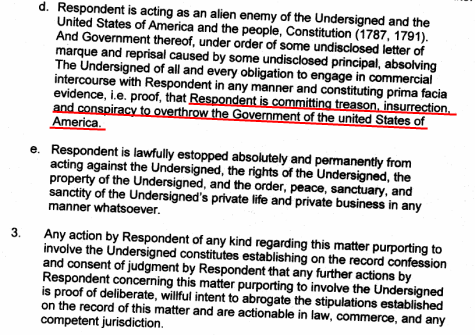
Judge Margaret B. Seymour granted the request, pointing to a Brunson pleading that accused U.S. Attorney Walt Wilkins of treason.
Screen shot: Joseph Brunson declares that U.S. Attorney Walt Wilkens is guilty of treason, insurrection and conspiracy to overthow the U.S. government in his efforts to prosecute Brunson.
‘Pembina’ Tie
Web references connect Brunson to The Little Shell Pembina Band of North America, a reputed splinter group of a legitimate tribe of Native Americans in Montana. WIS News 10, the news arm of a TV station in South Carolina, reported in 2007 that Brunson was stopped by police for driving with illegal tribal license plates while out on bond after being charged by state authorities in the “3 Hewbrew Boys” case.
“Members of the group claim that they belong to a ‘sovereign’ Native American tribe and therefore are not subject to laws and regulations,” ADL reports.
Activities of the splinter group range from “driving with bogus license plates to perpetrating insurance fraud schemes [and] tax evasion,” ADL reports.
ADL notes that the Little Shell Band of Montana is a legitimate tribe, but is not recognized by the federal government. It has no connection to extremism or to the Little Shell Pembina Band of North America, according to ADL.
Bizarre Filings In Securities Cases
Brunson’s filings in the South Carolina case are similar to pro se pleadings in the alleged AdSurfDaily Ponzi scheme case in the District of Columbia. Filings in both cases have included wild arguments, using words directed at prosecutors or judges such as “treason” and “conspiracy” in bids to short-circuit the government’s efforts to prosecute Ponzi and securities cases.
Screen shot: Joseph Brunson asserts his purpurted sovereignty in the '3 Hebrew Boys' Ponzi scheme case.
Curtis Richmond, a mainstay pro se litigant in the ASD case, has been associated in court filings with a version of the Pembina tribal name and the name of a separate Utah tribe a federal judge ruled a “complete sham.” The purported Utah tribe filed enormous financial judgments against prosecutors and members of law-enforcement, and was successfully sued under federal racketeering and mail-fraud statutes.
Richmond was among a group of litigants ordered to pay more than $108,000 in damages and costs for their roles in harassing members of the Utah law-enforcement community with vexatious legal filings. In a separate case, Richmond was found guilty in California of contempt of court for harassing federal judges.
Despite the RICO ruling that went against him and his contempt conviction, members of the AdSurfDaily autosurf and a closely associated surf known as AdViewGlobal hailed Richmond a “hero.”
ASD is implicated in an alleged $100 million Ponzi scheme. Federal prosecutors are attempting to force the forfeiture of tens of millions of dollars in the case, which includes two other autosurfs: Golden Panda Ad Builder and LaFuenteDinero. “LaFuenteDinero” means the “fountain of money,” and the surf was the purported Spanish arm of ASD. Golden Panda was the purported Chinese arm.
For more than a year — at least since May 2008 — various operators or participants in alleged Ponzi schemes have claimed to be immune from U.S. law because they were “sovereign” beings or members of a “sovereign” Indian tribe.
Screen shot: Joseph Brunson he is 'One' and that U.S. Attorney Walt Wilkins is engaged in acts of war against 'One.'
The arguments have been both bizarre and implausible. Gold Quest International (GQI), an alleged multimillion Ponzi scheme operating out of Las Vegas, claimed Panamanian registration and immunity from U.S. law because it was associated with a North Dakota Indian tribe.
GQI attempted unsuccessfully to sue the SEC for the spectacular sum of $1.7 trillion for bringing the prosecution. The company reportedly relied on the services of a nonattorney as its “attorney general” and a nonnotary as its notary public to certify documents.
“You are in an imaginary world where you belong to an unrecognized Indian group,†a federal judge advised Robert Neilson Baker, the nonnotary notary.
In the “3 Hewbrew Boys” case, Brunson filed documents that appear to have been designed to force Wilkens, the U.S. Attorney, to default on a contact to which he never had agreed. The approach sometimes is referred to as “paper terrorism” or “mailbox arbitation.”
A similar approach was used by litigants in the ASD case.
Brunson wrote in a court filing he described as a “Bill of Peace” last week that Wilkens had a duty to appear before a notary public and acknowledge Brunson’s assertion of sovereignty in “red ink.” The document demanded that Wilkens use his “Christian name” in his response to Brunson.
A refusal by Wilkens’ to carry out the demands within three days, Brunson said, would result in a contractual agreement that Wilkens was “an enemy of One and the [U]nited States of America and the people, Constitution, and Government thereof.”
Read a statement by acting U.S. Attorney Jeffrey Sloman on Audie Watson, a Florida man found guilty of selling bogus memberships in a “Pembina” tribe for $1,500 to illegal aliens.
 URGENT >> BULLETIN >> MOVING: Federal prosecutors have asked U.S. District Judge Rosemary Collyer for an order that would reopen the remissions process in the AdSurfDaily Ponzi case, potentially giving victims who missed the January 2011 filing deadline a chance to gain a pro rata share of the balance of seized assets.
 A Washington state man sentenced in the 1990s to 46 months in federal prison for possessing a pipe bomb now has become the subject of a tax investigation.