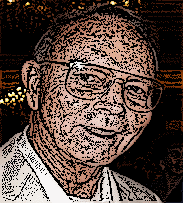
Andy Bowdoin has been positioned as "David" in a courtroom clash with "Goliath."
“David” apparently needs five more days of “testing” before he can equip himself properly to stone “Goliath” with $50 “rocks” in federal court.
A fundraising website for accused felon and MLM huckster Thomas A. “Andy” Bowdoin missed its advertised launch date Friday. Bowdoin, 76, was positioned as “David” on a “temporary” site that advertised his purported need to start an “official” site to raise a “minimum” of $500,000 to do battle with the government, which was positioned as “Goliath.”
The “temporary” site now has announced that the launch date of the “official” site has been “revised.” Bowdoin won’t begin collecting cash for $50 “rocks” until July 20, five days later than advertised.
Bowdoin, the head of Florida-based AdSurfDaily, was accused in December 2010 by federal prosecutors in the District of Columbia of wire fraud, securities fraud and selling unregistered securities.
ASD was a Ponzi scheme that had gathered at least $110 million, prosecutors said.
“As of today, July 15th, the launching of the Official Website for Andy’s Fundraising Army is in it’s (sic) final stages of creation & systems testing, and the new launch date is on target for this coming Wednesday, July 20th. (sic) only 5 days from now.”
Bowdoin has been described in federal court filings as being “tardy” on certain pleadings. The fundraising website also appears to be tardy.
ASD never told members that Bowdoin was involved in a previous securities swindle before he launched ASD in 2006, according to federal prosecutors.
And he never told incoming members that the original iteration of ASD collapsed under the weight of a Ponzi scheme in 2007 and that new members were paying his original set of victims when ASD later relaunched under a different name, prosecutors said.
Prior to a U.S. Secret Service raid on ASD in August 2008, the firm’s website was inaccessible for days at a time, according to members.
EDITOR’S NOTE: Clarence Busby Jr., a figure associated with at least four autosurfs — AdSurfDaily, Golden Panda Ad Builder, LaFuenteDinero and BizAdSplash — has encountered a recent string of troubles, including a mortgage foreclosure and tax liens. Owing to his association with ASD President Andy Bowdoin, who operated ASD and LaFuenteDinero and once had a partnership with Busby in Golden Panda, Busby also was forced to spend an unknown sum on legal fees after the seizure of ASD- and Golden Panda-connected assets in 2008.
Bowdoin said in September 2009 that he’d spent more than $1 million on legal fees in the first 13 months of ASD-related litigation. He was arrested on federal charges on Dec. 1, 2010, and had to arrange a bond of $350,000. Sixteen days later — on December 17, 2010 — federal prosecutors filed yet another (the third) civil-forfeiture complaint against Bowdoin-connected assets. Bowdoin filed appeals in the first two forfeiture cases, losing both and driving up his legal costs.
Despite the costly troubles encountered by both Bowdoin and Busby — and the remarkable staying power of those troubles, which next month will enter their fourth year — promoters on TalkGold, MoneyMakerGroup and other Ponzi forums still are pushing autosurfs and HYIPs.
They’re pushing them even though Bowdoin and others potentially face long prison sentences and have lost significant dollar sums and property as a result of their infatuation with what prosecutors have described as serial lawlessness.
On July 6, a federal judge ordered Gregory N. McKnight, the operator of the Legisi HYIP Ponzi scheme, to pay more than $6.81 million in disgorgement and penalties. Like ASD and countless schemes, Legisi was promoted on TalkGold and MoneyMakerGroup — and court filings in the Legisi case specifically reference MoneyMakerGroup.
Still pushing ‘surfs and HYIPs?
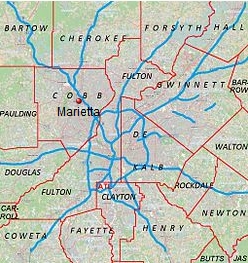
Apparently using a fill-in-the-blank litigation template, Clarence Busby Jr. sought foreclosure relief on a central Cobb County property in Marietta, Ga. Busby's filing also placed the property in Gwinnett County, which does not border Cobb County. (Graphic from Wikipedia.)
When former autosurf operator Clarence Busby Jr. filed a lawsuit last year last seeking relief from from a bank and other parties involved in a mortgage foreclosure against him, he’d already been put on notice by the Internal Revenue Service that the agency intended to collect thousands of dollars in back taxes from him, according to records in Cobb County, Ga.
The taxes were from 2009, according to records. During the same year, Busby launched an autosurf known as Biz Ad Splash — but the tax bill was for a different Busby entity.
On Aug. 11, 2010, the IRS prepared a federal tax lien against Busby and a company known as Freedom Achievement LLC for $15,481. The lien was formally recorded on Aug. 26, 2010. A note on the lien described Busby as “SOLE MBR” of Freedom Achievement, whose business purpose was not immediately clear.
About four months later — in December 2010 — Busby filed a pro se lawsuit demanding relief from Quicken Loans, OneWest Bank, MERSCorp and 1,000 “Doe” defendants in Cobb County Superior Court.
OneWest and MERS responded in January 2011 by moving to have Busby’s case transferred to federal court in the Northern District of Georgia because the lawsuit named defendants in multiple states and involved a controversy that exceeded the sum of $75,000.
Busby’s case was assigned to Senior U.S. District Judge Robert L. Vining Jr., who dismissed it for failure to state a claim. Beyond dismissing the lawsuit for failure to state a claim, Vining agreed with the defendants that Busby’s arguments had no legal merit. Busby’s pro se pleadings appeared to have come from a fill-in-the-blank legal kit.
These words appeared on the first page of Busby’s complaint: “COMES NOW, name here, as plaintiff” — and Busby did not insert his name in the “name here” space.
By contrast, some filings in the ASD/Golden Panda forfeiture case begin with these words, “COMES NOW, plaintiff United States of America, by and through its attorney.”
The Busby complaint also claims the Busby property in dispute is located in “Gwinnett County.” The document claimed elsewhere that the property was located in the city of Marietta in “Cobb County,” the venue in which Busby sued.
Marietta is situated in central Cobb County. Cobb County and Gwinnett County do not border one another. and the property is listed in Cobb County courthouse records, meaning it is possible that Busby used an existing legal template and never swapped out an existing reference to Gwinnett County — in the same manner in which he did not insert his name in the “name here” space.
Whether Busby’s apparent fill-in-the-blank oversights added to the defendants’ costs in successfully defending against the lawsuit is unclear. What is clear is that Busby came out on the losing end and that the defendants referenced the IRS tax lien against Busby in Cobb County in their response to his complaint.
Separately, the state of Georgia dissolved a Busby company known as Homeshare Investment Club Corp. The dissolution occurred on Sept. 13, 2010, less than a month after the IRS tax lien was filed against Freedom Achievement LLC, according to records.
Records pertaining to Homeshare Investment Club show that it used the same address used by Busby in the formation of Biz Ad Splash NA LLC.
BizAdSplash, or BAS, was an autosurf that ceased operating in January 2010. BAS launched in the aftermath of the ASD- and Golden Panda-related asset seizures. A separate address associated with the BAS filing in Georgia is the address of a maildrop in Kennesaw.
BAS purported to operate offshore. Its apparent U.S. domestic brand is listed in noncompliance by the office of Georgia Secretary of State Brian P. Kemp.
Members of BAS have complained to the PP Blog about not getting refunds from the autosurf. How much money the surf collected is unclear.
At the same time the state of Georgia was dissolving Homeshare Investment Club, it also was dissolving another Busby enterprise: Ocean View Enterprises Inc. Meanwhile, yet another Busby firm — Legacy Premier Properties Inc. — is listed in a state of noncompliance.
Even as bank failures and foreclosures were piling up in Georgia last year, a man associated with at least four failed autosurf companies was filing lawsuits against mortgage companies and 1,000 “Doe” defendants amid claims he did not know the “true names” of the “real lenders.”
Clarence Busby Jr. of Acworth, Ga., advised a Cobb County judge that it was “long standing black letter Mortgage law” from the 19th century that he should receive foreclosure relief from Quicken Loans, OneWest Bank, a service company and the “Does.”
In January 2011, the defendants moved to have the cases removed to federal court in Northern Georgia and filed for dismissal. The dismissal was granted in March.
A street address for Busby that appeared in both the county and federal filings corresponds with an address used by Biz Ad Splash NA LLC (BAS) in Georgia corporate filings dated May 13, 2009. BAS was an autosurf associated with Busby that went missing last year. Busby also was the president of Golden Panda Ad Builder, yet another autosurf, and a onetime business partner of Thomas A. “Andy” Bowdoin, the operator of the Florida-based AdSurfDaily autosurf.
The address BAS used in the Georgia filings was a mail drop, according to records.
Bowdoin was arrested in December 2010. The U.S. Secret Service said he had presided over an international Ponzi scheme that had gathered at least $110 million. Assets tied to both Bowdoin and Busby were seized as part of the ASD/Golden Panda probe, which also involved an autosurf known as LaFuenteDinero.
Busby was implicated in three prime-bank schemes by the SEC in the 1990s and was enjoined from violating securities laws by a federal judge. An FDIC-insured bank that once held Golden Panda funds failed in April 2011.
Georgia leads the United States in bank failures, with Florida nipping on its heels. Both states also are high on the list of mortgage foreclosures. Foreclosures tend to lower the value of surrounding properties.
Busby has described himself in court filings as a minister and real-estate professional. The actions in Cobb County that were removed to federal court were filed pro se, meaning Busby acted as his own attorney.
The defendants in the cases claimed Busby was seeking to “invalidate and/or void” in its “entirety” a $120,000 security instrument held on a property in Marietta, Ga.
Records suggest the property has been bought and sold twice in recent months for wildly different prices.
Among Busby’s claims in the Cobb County lawsuit was that the “true names and identities of any or all” of the “real” lenders, investors and others involved in his mortgage “were hidden from the plaintiff.”
BAS, which purported to be headquartered offshore, entered the autosurf world in January 2009 — after the ASD, Golden Panda and LaFuenteDinero-related asset seizures.
The entry of BAS began with the stern bang of a drum and a dire message in a promotional video: “The World Is In Crisis,” the video warned. “Turn On The News, And You’ll See. The Stock Market Is At A Record Low. Foreclosures Are At An All-Time High. Thousand’s (sic) Are Losing Their Jobs. Banks Are Closing. There Has To Be A Solution!”
The dire bang of the drum faded, replaced by a riff from an organ. The riff grew frantic, building toward a crescendo. The video never said the tones were from a 1999 work by Fatboy Slim: “Right Here, Right Now.”
Messages flashed in front of viewers’ eyes for more than a minute before the video announced the company’s name — BizAdSplash — and positioned the surf as the cure for all the economic misery in the world.
“Biz Ad Splash Has The Answer,” it said. “The Plan Is Simple. Advertise Your Business, A Product Or Service, Introduce Others To The Value Of Advertising. View A Few Ads For A Few Minutes A Day. Earn Profits. It’s That Simple!”
This old ad for AdSurfDaily features an image of Hank Needham, the purported owner of Club Asteria. An ASD affiliate link in the ad summons ASD’s old ASDCashGenerator.com URL, which went dormant after the federal raid on ASD’s Florida headquarters in August 2008. In recent hours, however, the old ASDCashGenerator URL began to resolve to an apparent new business opportunity known as Ad Sales Daily International. Needham’s one-time tie to ASD leads to questions about whether Virginia-based Club Asteria, through Needham or ASD downline members, could have benefited from ASD cash prior to the federal seizure of tens of millions of dollars from the personal bank accounts of ASD President Andy Bowdoin nearly three years ago. The Club-Asteria domain name was registered in June 2009, the same month an autosurf with ASD connections known as AdViewGlobal collapsed. Club Asteria’s domain now is registered behind a proxy, but once was registered to Needham, according to web records.
BULLETIN: (UPDATED 9:36 P.M. EDT (U.S.A.) A website identified in a 2008 forfeiture complaint as the site of a major financial crime allegedly engineered by AdSurfDaily President Andy Bowdoin and unidentified co-conspirators is active again and appears to be redirecting traffic to an entity named “Ad Sales Daily International” (ASDI) and a second entity known as ASD2Day.
“Make $10 per direct referral & $5 for every 2nd level indirect!” the site exclaims. “Recieve (sic) $2000 Account Initiation Credits! Hurry, while we are in pre-launch.”
A spokesman for U.S. Attorney Ronald C. Machen Jr. in the District of Columbia declined to comment on the development, saying that ASD is part of an active investigation.
The ASDI site is accessible through an affiliate link to Bowdoin’s old ASDCashGenerator.com site, which appears to have been re-registered in the name of Barbara Cruz, whose name previously has appeared in the context of ASD. The PP Blog accessed the ASDI site by clicking on an old ASDCashGenerator affiliate link . The link was within an ASD ad from 2008 that featured an image of Club Asteria’s purported owner Hank Needham.
The ASD ad with Needham’s image positioned ASD as a “Perfectly Credible Business” and included a contact email address that used the characters “ptigold.” The ASD ad, however, does not load Needham’s name as an ASDI affiliate when the link is clicked. Instead, it loads the name of another individual. The reason was not immediately clear.
This page for ASDI, an apparent upstart, is accessible when a link is clicked in an old ad for Andy Bowdoin's ASD Cash Generator program. The old ASD ad features a photo of Hank Needham, the purported owner of Club Asteria, but the ad does not load Needham's name as an ASDI affiliate when the link is clicked. Instead, the ad loads the name of another person. The reason was not immediately clear. Bowdoin is under federal indictment for wire fraud, securities fraud and selling unregistered securities. Questions have been raised about whether Club Asteria also was selling unregistered securities as part of a purported "passive" investment program.
A separate link within the ad with Needham’s image forwards to a page that displays pornography ads.
All or part of the old ASDCashGenerator site appears to be redirecting to the domain name of ASD2Day.com. In 2009, the ASD2Day site was registered with Cruz listed as the contact person at an address in Florida that state investigators had tied to a major insurance scam. Although Cruz now is listed as the registrant of the ASDCashGenerator site, the ASD2Day site is registered in the name of another individual.
In October 2009, the PP Blog published a story about the ASD2Day site, which was making odd claims about the state of the ASD litigation a year after the federal seizure of Bowdoin’s assets and assets linked to Golden Panda Ad Builder, an autosurf implicated by the U.S. Secret Service in the ASD probe.
ASD2Day.com claimed, among other things, that ASD could not be a Ponzi scheme because the script employed by the autosurfing firm could not be programmed to permit a Ponzi scheme to occur. It also made a puzzling claim that U.S. District Judge Rosemary Collyer was on an Aug. 28, 2009, deadline “to determine if the US Attorney General’s case against ASD should move forward.” (Also see this story and comments thread.)
Collyer was on no such deadline. In January 2010, Collyer issued a forfeiture order that awarded $65.8 million seized from Bowdoin’s bank accounts to the U.S. government, which is using the seized money to compensate victims of ASD. In July 2009, Collyer issued a forfeiture order for more than $14 million linked to Golden Panda, ASD’s one-time purported “Chinese” option.
The ASD ad that featured Needham’s image also made a veiled reference to Golden Panda.
A section of the ad read, “OPENING IN CHINA[:] July 2008.”
Undercover agents from a Secret Service/IRS task force began to investigate ASD and Golden Panda on July 3, 2008, according to court filings. The court process of seizing cash linked to both entities began on Aug. 1, 2008, with the issuance of seizure warrants.
It appears to be the case that all old ASD Cash Generator affiliate links, including the links in the ad that featured Needham’s photograph, now load the new ASDI webpage at the old ASD Cash Generator URL.
Claims made about Club Asteria are under investigation by Italian authorities. Club Asteria first slashed payouts to members then reportedly suspended them for 60 days. The firm also reportedly has had its PayPal account frozen.
Like ASD, Club Asteria was promoted on Ponzi scheme forums such as TalkGold and MoneyMakerGroup.
In a video dated July 8, a Club Asteria executive claimed the firm had “a philanthropic foundation both domestically and internationally where we help causes all over the world.”
Among the claims in the video, which appeared online after Club Asteria reportedly suspended payouts, was this one:
“We donate cows and pigs and water buffaloes and camels to help families all over the world.”
Virginia-based Club Asteria trades on the name of the World Bank. Members said payments came from an entity known as Asteria Holdings Limited (Hong Kong) — before the payments stopped.
One of Club Asteria’s principal concerns, according to a new video, is children.
Investigators long have fretted that some promoters of online business “opportunities” simply race from fraud scheme to fraud scheme, collecting commissions for introducing others to “programs” that prove to be scams.
Like the now-collapsed AdViewGlobal (AVG) autosurf, Club Asteria has blamed its reported problems on members. AVG had promoters and members in common with Bowdoin’s ASD, which the Secret Service described as a massive international Ponzi scheme.
Among other things, AVG plucked the heartstrings of members by telling them that the company was interested in saving the rain forest.
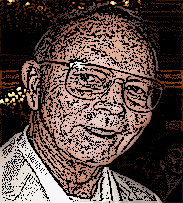
Some ASD members say this smiling and vigorous Andy Bowdoin is ready to do battle with the government in a "David vs. Goliath" clash. Bowdoin himself has advised a federal judge that he suffers from various medical maladies, including a lack of quality sleep, and his trial should be moved from the District of Columbia to Florida. The judge denied Bowdoin's bid to move the trial.
Although AdSurfDaily President Andy Bowdoin has described himself in court filings as an elderly man suffering from diabetes, lack of sleep caused by worrying about his ill wife, hyperlipidemia, coronary heart disease and multiple Transient Ischemic Attacks (ministrokes), some of his supporters apparently disagree with Bowdoin’s assessment of his own medical condition.
A website with a URL of AndysFundraisingArmy.com has posted a photo of Bowdoin purportedly taken on June 24. The photo shows a vigorous-looking Bowdoin seated in a chair and smiling broadly.
The website features a second photo of Bowdoin wearing a business suit, smiling at the camera and taking care of paperwork. A claim is made on the website that “over 88% of the members surveyed said that once Andy wins his court case and ASD is found to not be a Ponzi Scheme, they would want to immediately continue with their Ad Surf Daily business, because it is a proven, popular and successful way to advertise and build a great income with the ASD home business opportunity.”
What’s needed to get ASD restarted on a date uncertain — presumably with Bowdoin at the helm — is a $500,000 “minimum requirement” to pay for lawyers, according to the fundraising website. The website appears to have been registered using an address of a Florida law firm that is not the same firm associated with either of Bowdoin’s current civil and criminal attorneys.
Precisely who registered the site is unclear. The name on the domain registration is “Andys Defense Fund.”
And the fundraising website also makes other broad claims, including a claim that a survey sample of 140 ASD members can be reliably applied to a group of 123,000 ASD members as a whole.
“[P]er standard and accepted industry guidelines, public opinion surveying of 140 members of a large group of members that all share a common interest or purpose, of any size, even in the millions, will give an excellent cross section of the opinions and viewpoints of the entire group,” the fundraising site claims while asking ASD members to prepare to fork over a donation.
Among the claims below a subhead of “MORE GOOD NEWS” is that “A Recent Survey of ASD Members Proves that the Vast Majority of You Want to Join Andy’s Fundraising Army.”
The fundraising site, however, does not describe the characteristics of the 140 ASD members purportedly sampled. Nor does it define what specific surveying “standard” it applied or define the source of the purported “industry guidelines.”
Any claim that a small sampling result culled from individual ASD members can be applied to a much larger group is dubious, if not reckless. The fundraising site did not define any variables in the purported sample — for instance, whether the sample was top-heavy with members inclined to disbelieve the government’s take on events for personal or political reasons or out of fear they could become implicated in the ASD probe, whether the sample consisted of people who made money or lost money in ASD, the amount made or lost and the amount directed at ASD, whether members had large downlines, midsized downlines or small downlines and the degree to which downline members were affected by ASD developments and whether survey respondents had filed claims for restitution that the government announced more than two years ago would be paid from funds seized from Bowdoin’s personal bank accounts.
One of the accounts contained more than $31 million; another contained more than $23 million, and Bowdoin’s accounts contained more than $65.8 million in the aggregate, according to court filings. Bowdoin also allegedly moved “several million” dollars offshore prior to the August 2008 seizure of funds in his identified U.S. bank accounts. Meanwhile, ASD was alleged to have about $1 million in an account on the Caribbean island nation of Antigua in an account under a different name, according to court filings.
Although the fundraising site also claims Bowdoin “never backed down” in his battle against the government and “has always kept on fighting,” federal prosecutors said in 2009 that Bowdoin had signed a proffer letter in the case and acknowledged the government’s material allegations were all true.
Bowdoin’s own court filings show that he met with federal prosecutors over a period of at least four days, provided information against his interests and sought to cooperate because cooperation possibly could keep him out of jail.
Meanwhile, the fundraising site claims that Bowdoin lost his fight over the seized money “due to the lone decision made by that one single Civil Court Judge,” but it does not reveal that Bowdoin also lost two forfeiture appeals and that the U.S. Court of Appeals for the District of Columbia circuit upheld the rulings made by U.S. District Judge Rosemary M. Collyer.
At the same time, the fundraising site claims that ASD members who send in $50 or a smaller sum to fund a legal war chest “can finally have a strong fighting chance to get their advertising money returned to them.”
But the fundraising site does not reveal that the government already has set up a restitution program and that prosecutors alleged that ASD was an investment program disguised as an “advertising” program — one consisting of multiple illegal parts and one that Bowdoin and others were maneuvering to move offshore before it popped up on the radar of U.S. regulatory and law-enforcement agencies.
Nor did the fundraising site reveal that the government has alleged that ASD had “special” members and that at least some of the special members were participants in a previous autosurf fraud scheme.
Missouri-based Erma Seabaugh, known among members of Florida-based AdSurfDaily as a company trainer and the "Web Room Lady," was the president of Carpe Diem, a purported "religious" entity in Oregon.
On Jan. 16, 2008, the state of Oregon recorded the business registration of an entity known as “Carpe Diem,” a purported “religious” nonprofit firm. AdSurfDaily figure Erma Seabaugh of Cape Girardeau, Mo., was listed as Carpe Diem’s president and secretary. ASD members described Seabaugh as a “trainer” for the Florida-based autosurf firm whose operator, Thomas A. “Andy” Bowdoin, 76, is under federal indictment for wire fraud, securities fraud and selling unregistered securities.
The Oregon registration of Carpe Diem coincides with a period in which ASD allegedly was ratcheting up the criminality to drive more business to its $110 million Ponzi scheme — first by introducing a companion “Spanish” autosurf known as LaFuenteDinero and later by launching a “Chinese” surf known as Golden Panda Ad Builder and producing a video in which an attorney who appeared with Bowdoin preemptively denied ASD was operating a Ponzi scheme, according to federal court filings.
As an ASD trainer and a person with “privileges within the ASD computer database system to post and remove ‘ad packages’ from individuals’ accounts,” Seabaugh was positioned to benefit from ASD’s crimes and engage in crimes of her own, according to federal court filings.
The filings raise the possibility that Seabaugh was seeking to disguise personal income as the proceeds of a purported religious entity and use ASD itself to launder money or hide income.
Prosecutors said in December that it appeared as though Seabaugh “was selling her own investment ‘ad packs’ to clients and representing herself as ASD.” The Cape Girardeau, Mo., address for Carpe Diem in Oregon records is associated with a firm that provides mailbox and parcel services.
Oregon dissolved Carpe Diem’s registration in March 2010, about 26 months after the entity was registered in the state.
Just weeks prior to the January 2008 creation of Carpe Diem — on Nov. 11, 2007, Dec. 9, 2007 and Dec. 19, 2007 — Seabaugh opened three separate ASD accounts. Each of the accounts used a variation of the Carpe Diem name: Carpe Diem, Carpe Diem2 and Carpe Diem3, according to federal prosecutors in the District of Columbia.
The presence of a form of the Carpe Diem name in three ASD accounts leads to a question about whether Seabaugh or others were seeking to structure transactions to avoid tax-reporting requirements or to minimize the risk that a bank might begin to ask uncomfortable questions.
Seabaugh used the Carpe Diem account to sponsor “48 additional investors into the ASD investment scheme,” federal prosecutors said in a forfeiture complaint filed on Dec. 17, 2010, about 16 days after Bowdoin was arrested in Florida.
Known as ASD’s “Web Room Lady,” Seabaugh withdrew $107,997 from the Carpe Diem account “through checks that issued from ASD,” according to the complaint. The account was funded with “ad packs” that “originated” at LaFuenteDinero, the “Spanish” version of ASD.
It also was funded with $10,510 that originated at e-Bullion, which prosecutors described as an online digital currency.
Two of Seabaugh’s Carpe Diem accounts — Carpe Diem2 and Carpe Diem3 — were used to promote an apparent “pyramid scheme” known as StreamlineGold.net, according to the forfeiture complaint. Although Seabaugh appears not to have made a withdrawal from the Carpe Diem3 account, she withdrew $83,994 from the Carpe Diem2 account, which also had been opened with a transfer of “ad packs” from LaFuenteDinero, according to the forfeiture complaint.
LaFuenteDinero means the “fountain of money.” Different email addresses were used to open each of the Carpe Diem accounts, according to the forfeiture complaint.
In addition, Seabaugh used an address with the letters “ASD” and the word “admin” included among the characters comprising a free gmail address, according to the forfeiture complaint.
E-bullion operator James Fayed was convicted in May of arranging the contract murder of his estranged wife, Pamela Fayed, a potential witness against him on matters pertaining to fraud. James Fayed faces the death penalty for the slaying.
Investigators have linked e-Bullion to multiple Ponzi schemes.
At least $10,510 flowed from E-Bullion to ASD through Seabaugh’s Carpe Diem account prior to the gruesome slashing murder of Pamela Fayed in a California parking garage on July 28, 2008.
About four days later — on Aug. 1, 2008 — the U.S. Secret Service seized tens of millions of dollars in the personal bank accounts of ASD’s Bowdoin. Seabaugh has not been charged with a crime, but agents seized at least $153,087 from bank accounts linked to Carpe Diem and Seabaugh, according to court filings.
EDITOR’S NOTE: The disturbing information that follows this intro is presented largely in capsule form, with links to CFTC charging documents in three new cases. Perhaps the most notable case in this summary is the one filed in Georgia. As things stand, it demonstrates:
Interconnectivity: Ties between and among scams and scammers are common in the fraud universe, contributing to a condition the PP Blog has described as “fraud creep.” The CFTC says two of the defendants charged in the Georgia case were investors in Botfly LLC, an alleged Ponzi scheme that operated internationally from Florida. The Botfly case is just plain creepy. Elements of it are reminiscent of the AdSurfDaily case. ASD, too, was based in Florida.
Familiarity/Affinity: Two of the Georgia defendants are employees of the U.S. government — specifically air-traffic controllers employed by the Federal Aviation Administration (FAA). Based on court filings, it appears as though the FAA employees were moonlighting as Forex managers and that other FAA employees got sucked into one or more scams.
Vulnerability: Can anybody be truly safe in this unprecedented era of white-collar crime and rampant hucksterism? Government employees allegedly got sucked into a Ponzi caper operated by Kenneth “Wayne” McLeod, a Florida man who reportedly killed himself last year after the SEC opened a probe. If the allegations by the CFTC in the Georgia case are true, it may mean that other government workers saw their wealth eviscerated in a fraud scheme. It is unclear if retirement savings were plowed into the alleged Georgia scam. What is clear, however, is that the U.S. government now has at least two cases on its books in which it is alleged that federal workers were drafted into fraud schemes by individuals either employed by the government or paid by the government.
We are presenting summaries because the information is voluminous. Here, now, the capsules . . .
In an extraordinary series of actions on the Ponzi and fraud front, the CFTC has closed out the month of June by filings fraud cases in federal courts in Georgia, Colorado and Nebraska.
Georgia Case
Charged civilly with fraud and misappropriation in the Georgia case were Louis J. Giddens Jr. of Fayetteville, Ga., and Anthony W. Dutton of Peachtree City, Ga. Giddens and Dutton are air-traffic controllers, the CFTC said.
Also charged in the Georgia case was Michael Gomez of Valrico, Fla. Gomez is a commodity trader, the CFTC said.
The men are charged with operating a Forex fraud scheme that gathered about $1.4 million and involved at least four companies: Currency Management Group LLC, Pinnacle Capital Partners LLC, Pinnacle Trade Group LLC and Elyon LLC.
Giddens, the CFTC said, was an air-traffic controller in Atlanta. In “late 2008,” according to the CFTC, he learned about Botfly LLC, a Florida Forex company that offered investors a return of 10 percent a month.
After meeting with a “principal” of Botfly, Giddens became a Botfly investor and solicited fellow Federal Aviation Administration (FAA) employees in Georgia to become Botfly investors, the CFTC charged.
Dutton, Giddens’ fellow air-traffic controller, became a Botfly investor, the CFTC said. So did other FAA employees.
In April 2010, the state of Florida charged Botfly in a Ponzi case and froze its assets.
Giddens and Dutton used essentially the same business model as Botfly, and started their own pooled Foex business, using their unregistered companies to do so, the CFTC charged.
Eventually, Gomez, who also was unregistered, became part of the mix, the CFTC charged.
Investors plowed $1.4 million into the fraud scheme, the CFTC charged.
Shawon McClung of Denver and Flint-McClung Capital LLC (FMC) of Englewood, Colo., have been charged civilly with fraud and misappropriation in an alleged $1.9 million Forex Ponzi scheme.
The scheme operated in part through a website, and McClung positioned himself and the company as “sophisticated” players with a cash reserve of nearly $100 million.
Investors were told their funds were “guaranteed” against loss, the CFTC charged.
Prospects were lured “with the prospect of quickly making large profits with returns such as 50 percent in thirty days or 15 percent per month for six months,” the CFTC charged.
McClung “has never been registered” with the CFTC, the agency charged, adding the FMC also “has never been registered.”
Grace Elizabeth Reisinger of Grand Island, Neb., and ROF Consulting LLC (ROF) have been charged civilly with operating a fraudulent commodity pool scheme known as NCCN LLC (NCCN), the CFTC said.
The unregistered scheme gathered about $4 million and falsely claimed registration exemptions, the CFTC said.
A Virginia-based company that trades on the name of the World Bank and claims to help lift some of the poorest people on earth out of poverty by involving them in an income and MLM-like recruitment scheme has suspended member cashouts, according to posts on Ponzi scheme and criminals’ forums.
If the news about Club Asteria is true — and the company is not confirming it on its news webpage — then the firm may be following the AdViewGlobal (AVG) autosurf into the darkness virtually two years to the day after AVG suspended cashouts after collecting an unknown sum of money and declaring member payouts never were guaranteed.
Club Asteria, according to chatter on infamous Ponzi forums such as MoneyMakerGroup, did not call its decision not to pay members a suspension. Rather, the firm described it as a “decision to accumulate revenue share disbursements for the next 30 to 60 days.”
Members have claimed in promos for months that Club Asteria provided a “passive” investment opportunity and that earnings were guaranteed. The company itself has implied as much, according to promotional materials. Club Asteria is under investigation by Italian authorities, and confirmed in May that its PayPal account had been frozen.
After the PayPal freeze, which involved an unspecified sum of money, Club Asteria slashed its weekly payout rate to less than 1 percent and urged members to use offshore payment processors.
Like AVG, Club Asteria blamed negative developments on its own members. The firm does not publish verifiable financial data, and members say payments come via wire from an entity known as Asteria Holdings Limited in Hong Kong.
Why a Virginia-based company would route money through an apparent Hong Kong-based subsidiary to both U.S.-based members and international members never has been clear. Some members have published spreadsheets and ads that state plainly or imply that Club Asteria members can count on earning $400 a week for a payment of $19.95 a month, with earnings projected at a rate of 10 percent a week.
Other members have claimed Club Asteria pays 3 percent to 4 percent a week, numbers that project to a return of between 156 percent and 208 percent per year. References to a “passive” earnings opportunity with guaranteed payouts gave rise to questions about whether Club Asteria and its members were selling unregistered securities as investment contracts.
Meanwhile, the presence of promotions and “I got paid” posts on infamous Ponzi forums led to questions about whether Club Asteria had come into possession of funds tainted by one or more Ponzi or fraud schemes.
When AVG collapsed two years ago this week, the firm said it was retooling and would make an 80/20 program mandatory upon relaunch. Club Asteria, whose domain name appears to have been registered on June 25, 2009, reportedly incorporated an 80/20 program into its business model upon its launch in 2010.
Club Asteria’s domain, according to web records, was registered on the very same day news about the collapse of AVG surfaced. On June 30, 2009 — five days after its collapse — AVG’s name was referenced as an iteration of Florida-based AdSurfDaily in a racketeering lawsuit filed against ASD President Andy Bowdoin.
Bowdoin was arrested by the U.S. Secret Service for wire fraud, securities fraud and selling unregistered securities in December 2010. In August 2008, prior to the launches of both AVG and Club Asteria, tens of millions of dollars were seized from Bowdoin’s 10 personal bank accounts by the Secret Service.
It is believed that ASD, AVG and Club Asteria had promoters and members in common.
In the online Ponzi world, 80/20 programs are used to minimize cash outflow and disguise the nature of the programs. Club Asteria members preemptively have claimed the firm was not operating a Ponzi, a highly dubious claim given that the company does not publish audited financial information and that members — perhaps particularly members from Third World countries, countries ravaged by war or countries governed by dictators or strongmen — likely lacked the means or ability to visit Club Asteria’s U.S. headquarters to examine the books in person.
Two weeks after a purported “sovereign citizen” allegedly opened fire with an AK-47 on a Pensacola seafood store because it was out of crawfish, Floridians may be confronting yet-another bizarre and disturbing drama.
Indeed, members of Quincy-based AdSurfDaily appear to be circulating an email call to raise defense funds for ASD President Andy Bowdoin, accused criminally in December 2010 by federal prosecutors and the U.S. Secret Service of operating an international Ponzi scheme involving at least $110 million.
After earlier evoking the image of the President of the United States to sanitize the ASD scheme, Bowdoin’s apologists now are evoking the image of famed golfer Arnold Palmer and his famed “Arnie’s Army.”
“So now we have a strong chance to build ‘Andy’s Army’ made up of many tens of thousands of caring ASD members and other Freedom Fighters across America who are all joining together in this extremely important fight for Truth and Justice,” the email read in part.
It went on to describe the U.S. government as a “giant common enemy that destroyed Andy’s life and reputation.” The email further accused the Secret Service of seizing “all the ASD member’s advertising money from their accounts” and keeping it.
Curiously, though, the email did not explain that Bowdoin — in 2008 — agreed with the government that money seized by the Secret Service belonged to him, not individual ASD members. Nor did the email explain how the government, which has described Bowdoin as a recidivist felon involved in at least five bids over the years to fleece investors, had “destroyed” Bowdoin’s life and reputation.
After not explaining those two things, the email went on not to explain that the government announced more than two years ago that it was establishing a restitution program through a remissions administrator appointed by the Justice Department and the Secret Service — and that scammed ASD investors would be compensated from cash seized from Bowdoin’s bank accounts.
Three of Bowdoin’s bids to scam investors over the years occurred while he was operating ASD between 2006 and 2008, renaming the company to launch a new Ponzi scheme under a new brand — and coming up with two other autosurfs to scam investors, according to the government. Two previous Bowdoin efforts to defraud investors occurred more than a decade ago, according to court filings.
Instead of telling investors about his true history, he falsely led them to believe he was a highly successful businessman who’d earned a nod for business achievement from the President of the United States. Donations Bowdoin provided the National Republican Congressional Committee were funded with Ponzi proceeds, according to the government.
In September 2009, federal prosecutors described Bowdoin, now 76, as “delusional.” The assertion was made just days after Bowdoin — in a conference call with members — claimed his fight against the government was inspired by a former Miss America.
Crucially, prosecutors alleged nearly two years ago, Bowdoin had told members the seized money belonged to them. But he had told a federal judge that the money belonged to him.
“[T]his con man cannot manage to keep his stories straight,” prosecutors said.
But what the government described as an autosurf Ponzi scheme with at least two other autosurf Ponzi schemes feeding it now is being described by Bowdoin’s apologists as a “wonderful” opportunity.
And the U.S. government, which stopped an alleged Ponzi scheme in its tracks before it could further mushroom, is being described as the “enemy.”
“This same enemy destroyed and stopped the wonderful ASD business that Andy and his staff had continually created for 2 years that was making ASD member’s dreams of Financial Freedom come true,” the email continued.
Although ASD has not been associated with acts of violence, the company is known to have within its membership ranks people who define themselves as “sovereign” beings. In 2008, after the Secret Service seized 10 of Bowdoin’s personal bank accounts amid allegations he disguised a securities business as an “advertising” business and was falsely trading on the name of President George W. Bush to sanitize his scheme, Bowdoin claimed the seizures were the work of “Satan.” For good measure, he said the government’s acts against his company were comparable to the 9/11 terrorist attacks, which killed nearly 3,000 people. When reporters called ASD’s office, they were greeted by Bowdoin’s voice on an answering machine.
Bowdoin assured callers that God was on the company’s side.
Now, nearly three years later — with Bowdoin facing serious felony charges and having lost two federal appeals for more than $65.8 million seized through civil forfeiture while confronting at least one more civil-forfeiture case and a racketeering lawsuit filed by three of his members — Bowdoin says he is out of money, according to ASD members.
The remedy for Bowdoin’s purported lack of funds, according to his apologists, is for ASD members to provide cash $20 and $50 at a time. The money will go into a legal war chest from which Bowdoin, positioned as “David,” can draw funds to stone his enemy in court, with the government positioned as “Goliath.”
We presume the David-and-Goliath reference in the email is figurative, but the language employed by the apologists is disturbing even if no actual rocks will be thrown at the people who prosecute criminal cases and protect the life of the President of the United States while guarding the U.S. financial infrastructure.
“In the Biblical Story of David & Goliath, little David, all alone, threw only one rock with a strong force and deadly aim and killed Goliath with a sharp powerful blow to the forehead,” the email read. “And now each member of Andy’s Army can throw one rock (one contribution of up to $50), and when combined all together will become tens of thousands of these financial ‘rocks’ that are each propelled by the powerful force of Truth, and these ‘rocks’ will strike the common enemy by giving Andy’s Legal Defense Team the massive funds they need to fight and win this giant case for Andy, for ASD and for each of you. Together the combined financial force of Andy’s Army can destroy this giant nightmare and make that wonderful dream described above come true for everyone.”
The new bid to raise funds for Bowdoin follows on the heels of a bid by some Florida members of ASD to raise funds for themselves — reportedly $10,000 to sue the United States in Florida’s federal courts. Dozens of ASD members previously had failed in their pro se bids to derail the forfeiture cases against Bowdoin’s money in federal court in the District of Columbia.
Prior to the failed bids in the District of Columbia, a federal judge was described as “brain dead” if she ruled against ASD. One ASD member called for other members to form a “militia” and storm Washington with guns. Another opined that a federal prosecutor should be placed in a torture rack — with ASD members drawing straws to see who got the honor of turning the wheel.
ASD critics were described as “rats,” “maggots” and “cockroaches” — and these things happened after Bowdoin advised the troops that “Satan” was on the prowl and that God was on ASD’s side.
This madness is hardly limited to Florida.
About the only things for certain is that Andy Bowdoin is no Arnold Palmer, and ASD was no “wonderful” company.
What is was was a criminal mirage that triggered a mass delusion.
UPDATED 1:46 P.M. EDT (U.S.A.) AdSurfDaily “paid out millions of dollars to operators and insiders,” according to a U.S. Secret Service affidavit originally filed under seal in February 2009.
But ASD President Andy Bowdoin changed the subject when people told him that what Florida-based ASD was doing not only was illegal, but also was “not mathematically possible,” according to the affidavit.
What he was trying to do, according to court filings, was establish at least three autosurfs that would generate Ponzi-extending cash while Bowdoin positioned them as legitimate “advertising” businesses.
And Bowdoin also wanted to persuade members that he had discovered a formula that purportedly made it possible for ASD to set aside 50 percent of its daily revenue and pay participants 125 percent of what they paid in — all while planting the seed that members could expect a return of 8 percent a day on some days.
Investigators saw things a different way, saying ASD was creating a minimum liability of $1.25 for every dollar it took in.
“Try it — it works,” Bowdoin simply told the doubters, changing the subject instead of addressing the mathematical realities, according to the Secret Service.
There was too little profit in operating legitimately, Bowdoin told a consultant, according to the Secret Service.
As ASD was facing a Ponzi abyss, a consultant told Bowdoin there was a way for ASD to clean up its act, according to the Secret Service.
“Bowdoin, however, was dissatisfied with the consultant’s revenue sharing proposal and with the limited revenue a legitimate business would produce,” the Secret Service alleged in the February 2009 affidavit. “Bowdoin rejected the consultant’s plan and terminated his relationship with the consultant.”
Bowdoin had arrived at his 50-in/125-out formula after an earlier formula in which ASD purportedly had set aside 60 percent of its revenue to pay participants 150 percent of what they paid in had brought on a Ponzi collapse that caused the company to cease operations and leave investors in limbo for weeks in 2007, according to the Secret Service.
ASD’s original formula was concocted by Bowdoin and his “silent partner,” a man who recruited Bowdoin into the 12DailyPro autosurf Ponzi scheme, according to the Secret Service.
Both of ASD’s formulas were just a means of hiding ASD’s true nature as a financial beast with a fatal disease, according to court filings.
Despite the spectacular collapse of 12DailyPro amid Ponzi allegations filed by the SEC in early 2006, Bowdoin and his silent partner ruminated that 12DailyPro simply had promised to pay out too much money on a daily basis, according to the Secret Service.
Upstart ASD, Bowdoin and his silent partner speculated, could take regulators out of play and avoid the Ponzi fate of 12DailyPro by telling investors that the firm would pay out less money and by introducing verbal sleight-of-hand to disguise the true nature of the business, according to the Secret Service.
ASD also speculated that it could circumvent the Ponzi problem and law-enforcement scrutiny by suggesting that ASD’s payouts, which the firm called “rebates,” were not “guaranteed,” according to the Secret Service.
Despite telling members to “Try it — it works,” Bowdoin had no confidence in his business model and knew it was still a Ponzi despite the post-12DailyPro tweaking. In the end, according to court documents and other records, ASD still was telling investors they’d get back more than they paid in and, on a yearly basis, would receive a return of 365 percent at a “rebate” rate of 1 percent a day.
Even as ASD was playing in the post-12DailyPro fields and grew eventually to suck in tens of millions of dollars a week, less than 2 percent of its revenue came from external sources. More than 98 percent came from members and was simply being recycled to other members to keep the Ponzi afloat, according federal prosecutors.
At a certain point in time, Bowdoin did away with unlimited purchases and limited the amount investors could pay ASD to $12,000 “because he did not want members to lo[]se too much money should ASD collapse,” according to the February 2009 Secret Service affidavit.
The import of the claim is that prosecutors can argue to a jury that Bowdoin himself was worried about the imminent demise of ASD — a demise Bowdoin brought on through the use of various mathematical concoctions, linguistic fantasies and fabrications designed to separate people from their money to keep the Ponzi afloat.
Meanwhile, the claim sets the stage for prosecutors to tell a jury that Bowdoin anticipated a catastrophe and sought to insulate himself from prosecution by suggesting that ASD did not guarantee rebates and that customers were purchasing “advertising,” as opposed to entering into an investment contract with ASD.
“[T]o ensure that no individual investor monopolized the rebate pool, and to reduce the
likelihood that any individual investor would suffer a catastrophic loss, Bowdoin placed a limit on the amount of ‘advertising’ members could purchase,” the Secret Service said. “Of course, it would have made no sense to impose such limitations if ASD was actually selling, and members actually were purchasing, Internet advertising.”
Bowdoin’s various stories were at odds with themselves, the Secret service alleged. Even as Bowdoin was telling members ASD was not in the investment business and instead was a provider of advertising “rebates,” ASD’s computer systems described member payouts as “ROI” — for Return on Investment.
And even as he positioned himself as a Christian “money magnet” and merchant who’d been recognized by the President of the United States — and even as he purportedly was enforcing a $12,000 purchase ceiling to minimize the chance an individual investor would become engulfed in a calamity — Bowdoin told attendees of company “rallies” in U.S. cities that ASD would match the money they plowed into the firm 50 cents on the dollar.
“At the rallies, to raise more money, Bowdoin concocted the idea of running ‘rally-only promotions,’” the Secret Service alleged. “New members were told they would receive a 50% bonus for joining at the rally. For example, if a new member purchased $500 in ‘ad packages’ as a bonus she would be credited $750 to her account. Representatives of ASD stated this was a ‘World Wide Wealth’ program that was available to anyone with Internet access.”
In early 2008, Bowdoin became a participant in a scheme with a “North Carolina” attorney to assure prospects that ASD had been vetted and was operating lawfully. ASD’s 26-minute legality video and the rallies caused tens of millions of dollars suddenly to flow into the firm, according to the Secret Service.
Just a year earlier, the company suspended operations because it was starved for cash flow and faced a collapsed Ponzi, according to the Secret Service. ASD’s response to the collapse was to launch a new autosurf Ponzi under a new name — and to port the accounts of its original set of victims into the new scheme, where the payouts early loyalists had expected would be funded by incoming participants who did not know their money was being distributed to Bowdoin’s orginal victims.
Later in 2008, as spring and summer warmth returned to northern climes, ASD found people throwing money at it. Some of the people who threw money at ASD did so at rallies in Iowa, according to the Secret Service.
Affidavit For Seizure Targeted At At Least 7 Iowa Bank Accounts
The PP Blog reported in December 2010 that funds traced to Bowdoin and two other ASD members had been targeted in yet-another forfeiture action in the District of Columbia. The action was filed less than three weeks after Bowdoin’s Dec. 1 arrest by federal agents in Florida on Ponzi-related charges of wire fraud, securities fraud and selling unregistered securities.
Prosecutors’ December civil-forfeiture action was at least the third targeted at assets owned by Bowdoin. Assets of two other ASD members — Erma “Web Room Lady” Seabaugh and Robyn Lynn Stevenson (also: Robyn Lynn) of Florida — also were targeted.
The civil case against Bowdoin’s assets is on hold because of the criminal allegations against him. But the cases against the assets of Seabaugh and Lynn remain active. Neither Seabaugh nor Lynn had filed a claim for the money as of Friday.
In the case against Seabaugh’s assets, the government was authorized to seize $213,693 from a bank account, but found only $153,097 in the account. The Secret Service seized $96,525 from two bank accounts linked to Lynn.
Some of the money Seabaugh plowed into ASD originated at E-Bullion, a shuttered California money-services business operated by convicted murderer James Fayed, who ordered the execution of his estranged wife in 2008.
Pamela Fayed, a potential witness against her husband on matters pertaining to E-Bullion and an associated business known as Goldfinger Coin & Bullion, was slashed to death in a Los Angeles-area parking garage on July 28, 2008.
On Aug. 1, 2008, the Secret Service seized tens of millions of dollars from Bowdoin’s bank accounts. The December 2010 claim by federal prosecutors that Seabaugh had used E-Bullion to fund one of her ASD accounts was the first public tie between ASD and E-Bullion, which has been linked to multiple Ponzi schemes.
Seabaugh had multiple ASD accounts with multiple email addresses — and appeared to be “selling her own investment ‘ad packs’ to clients and representing herself as ASD,” the Secret Service alleged.
The PP Blog learned on June 10 that the Secret Service, in February 2009, also targeted proceeds in seven bank accounts belonging to ASD members in Iowa for forfeiture. In an affidavit, the agency said the accounts contained at least $413,018.
How the cases are evolving was not immediately clear. The Secret Service, according to the affidavit, identified the assets as proceeds of an ASD-related wire-fraud scheme.
Acting as pro se pleaders and using a litigation template associated with ASD participant Curtis Richmond, one of the so-called Arby’s Indians, two of the individuals associated with the Iowa accounts cited by the Secret Service in the February 2009 affidavit later attempted unsuccessfully to intervene in the main civil-forfeiture case against Bowdoin’s assets.
The February 2009 Secret Service affidavit identifies the individuals as Joyce and Michael Haws.
“Joyce Haws was an active participant in and large promoter of the ASD wire fraud
scheme,” the Secret Service alleged in the affidavit. “Ms. Haws was one of several people who requested and facilitated one of the first rallies within ASD, in Ankeny, Iowa, on about March 15th, 2008.”
Haws recruited her mother and others into the scheme, according to the affidavit.
Walter Clarence Busby Jr., a Georgia minister and Bowdoin’s alleged business partner in Golden Panda Ad Builder, identified Joyce Haws and her “spouse” in 2008 as “founders” of Golden Panda.
In the same Busby affidavit, filed on Aug. 29, 2008, Busby identified Robyn Lynn as the person who introduced him to ASD.
Curtis Richmond was an early mainstay in the ASD story. He has a contempt-of-court conviction for threatening federal judges, has been banned from the practice of law in Colorado even though he is not an attorney and has been sued successfully under the federal racketeering statute for harassing public officials and participating in schemes to place bogus financial judgments against them.
Richmond, who proclaimed himself a sovereign being answerable only to God, was a member of a Utah “Indian” tribe a federal judge ruled a “sham.” The “tribe” got its derisive name — the Arby’s Indians — because it once held a meeting in an Arby’s restaurant.
The “tribe” also used the address of a Utah doughnut shop as the address of its “Supreme Court,” while threatening public officials with arrest and detention for carrying out their official duties.
EDITOR’S NOTE:First of two parts. Part Two will be published later tonight or tomorrow.
Even as AdSurfDaily President Andy Bowdoin was venturing to Washington in June 2008 to receive what his members and prospects were told was the “Medal of Distinction” from the President of the United States, he was harboring terrible secrets and knew full well his autosurf business was a Ponzi scheme that could collapse at any second and lay waste to thousands of investors, according to court records and an affidavit originally filed under seal by the U.S. Secret Service.
Much of the information from the affidavit, which was filed in February 2009, is being published today for the first time. Companion court documents in ASD-related litigation show that part of a third civil-forfeiture case brought in December 2010 against assets alleged to be owned by ASD and Bowdoin has been put on hold while Bowdoin is battling criminal allegations — and that some individual ASD members whose assets were targeted for forfeiture in the same case have not filed claims for money seized from their bank accounts. Although the forfeiture action against Bowdoin has been suspended, the cases against the assets of the individual ASD members remain active.
Just two months prior to his June 2008 Washington jaunt — in April 2008 — Bowdoin had flown at the prompting of a “North Carolina lawyer” to Panama and Costa Rica with his wife and the lawyer. The purpose of the trip, according to the affidavit, was to incorporate ASD Cash Generator and an entity known known as La Sorta Trading outside of U.S. jurisdiction to create wiggle room if U.S. regulators came knocking.
ASD Cash Generator was the replacement name for the original ASD autosurf business, which was known simply as AdSurfDaily. The first scheme collapsed in 2007, leaving Bowdoin’s first set of investors holding the bag, according to the affidavit. Bowdoin’s later investors were not told about the firm’s dubious history.
La Sorta Trading, whose purpose was not immediately clear, never before has been referenced in the ASD case. La Sorta is the name of a city in Honduras, another country in Central America. It is not known if the firm was named after the city.
Bowdoin also was exploring the possibility that he and his wife would move from the small town of Quincy, Fla., to Costa Rica, the Secret Service advised U.S. District Judge Rosemary Collyer.
“Bowdoin’s wife did not like Costa Rica, however, and his plans to move ASD’s operations off shore were shelved,” according to the affidavit.
The February 2009 affidavit paints Bowdoin, now 76, as a man experiencing pressure from multiple points of contact — and as a man who made one disastrous decision after another. One of the things allegedly pressuring Bowdoin was fear that the Ponzi could come tumbling down before enough new members were recruited to keep cash churning and the facade of a successful and lawful business in place. Yet-another was fear that insiders, ordinary members and even employees could turn on him. Still-another was fear that a government intervention could occur at any time, according to the affidavit.
Of the millions of dollars that had flowed into ASD, “less tha[n] $25,000 was derived from independent revenue,” according to the affidavit. The rest had come from members and was being recycled in classic Ponzi scheme fashion, with Bowdoin initially empowering himself and a “silent partner” to rake 10 percent of ASD’s “gross sales” and split it evenly: 5 percent each.
But even as he was in Washington in June 2008 to receive an award he positioned as a Presidential acknowledgment of his business acumen, Bowdoin knew that his silent partner posed a risk to him, according to the affidavit.
That silent partner, according to the affidavit, was Bowdoin’s “sponsor” in 12DailyPro, an autosurf the SEC accused of running a massive Ponzi scheme more than two years earlier.
Through his sponsor, Bowdoin had invested $100 in 12DailyPro. The money was lost quickly because the SEC shut down 12DailyPro soon after Bowdoin joined. But Neither Bowdoin nor his silent partner took the clue from the SEC’s action, according to the affidavit. Instead, they worked on ways to channel 12DailyPro-like revenue to themselves and disguise what they were doing.
“Based on his experience with 12daily Pro, and his review of the SEC’s filings against it, Bowdoin knew that a paid auto-surf program that promised returns of that magnitude and recycled member funds was a business model that was both unsustainable and illegal. He also knew that selling an unregistered investment opportunity to thousands of investors was illegal. Nevertheless, after the collapse of 12daily Pro, Bowdoin agreed with his 12daily Pro sponsor to start a similar autosurf program. Both individuals were aware that, before its collapse, 12daily Pro had taken in millions of dollars from its members.”
Under Bowdoin’s agreement with his silent partner, Bowdoin was responsible for managing ASD’s operations. The partner, meanwhile, was responsible for marketing ASD.
In December 2006, about a year and a half prior to Bowdoin’s June 2008 trip to Washington amid claims he was receiving a Presidential award for business smarts, Bowdoin arbitrarily slashed the silent partner’s cut of the upstart ASD business from 5 percent of the gross to 1 percent, according to the affidavit.
Despite the fact Bowdoin had been a 12DailyPro member recruited into that SEC-smashed Ponzi scheme by the same person who’d later emerge as his silent partner in ASD, Bowdoin explained to the silent partner that he — meaning Bowdoin — “was performing most of the work, and bearing most of the risk in operating ASD,” according to the affidavit.
With those words, Bowdoin imposed a pay cut on the silent partner, who later asserted Bowdoin had ripped him off, according to the affidavit.
In August 2008, during a search of Bowdoin’s home in Quincy less than two months after the Washington jaunt and the Presidential claims, the Secret Service found Bowdoin’s handwritten notes from December 2006 that “show his and his silent partner’s awareness of the risks of the auto-surf program they were conducting,” the Secret Service said in the affidavit.
“Bowdoin’s notes indicate that he told his silent partner that the partner should have made him better aware of those risks ‘knowing regulators were on the prowl for surfing sites,’” the Secret Service alleged.
It is known from other documents that the Secret Service opened the ASD probe after becoming aware of the company on July 3, 2008, about 17 days after Bowdoin had ventured to Washington amid claims he’d be be receiving a Presidential award and dining with President George W. Bush and Vice President Dick Cheney.
One of the documents is a 57-page evidence exhibit that includes surveillance photos taken in Quincy prior to the seizure of tens of millions of dollars from Bowdoin’s 10 personal bank accounts, one of which allegedly contained more than $31.6 million. The Secret Service was alarmed as it began the process of peeling back layers of the onion, according to court records
Before July had come to a close, the agency — confronted with a murky fact set and trying to figure out how a man who claimed to have had a remarkable business career that had captured the attention of the President of the United States — had assigned multiple undercover agents to the ASD case.
One of the earliest puzzles to solve, according to court documents, was that Bowdoin had left behind a string of dissolved companies in Florida and professed to be wealthy — but had “earned no significant income from legal employment in the twenty years prior to his commencement of ASD’s operation.”
As the investigation progressed, according to court documents and the February 2009 affidavit, agents discovered that ASD had “special” members who provided Bowdoin start-up capital to varying degrees. These “special” members were grouped as members of ASD’s “President’s Circle,” “President’s Advisory Board” and “President’s Advisory Counsel,” and also knew about the 12Daily Pro Ponzi.
At least “some” of them, according to the affidavit, counseled Bowdoin not to use the name he initially contemplated in 2006 for the upstart enterprise: DailyProSurf.
Some of the special members, who were entitled to higher compensation than ordinary members, “complained” that DailyProSurf sounded too much like 12DailyPro. In response to the concerns, the enterprise abandoned the DailyProSurf name and used the name AdSurfDaily as a means of avoiding “law enforcement scrutiny,” according to the February 2009 affidavit.
The document did not name the “special” members. It was filed under seal on Feb. 26, 2009, during a period in which an autosurf known as AdViewGlobal (AVG) was launching. AVG may represent the fourth iteration of ASD, one launched months after the seizure of Bowdoin’s bank accounts by the Secret Service in August 2008.
AVG’s name is not referenced in the February 2009 affidavit. In June 2009, however, AVG’s name surfaced in a racketeering lawsuit brought against Bowdoin and North Carolina attorney Robert Garner. In September 2009, the government made a veiled reference to AVG in court filings.
Lawyers Referenced In Secret Service Affidavit As Bowdoin’s Partners In LaFuenteDinero, The ‘Spanish’ ASD
NOTE: The PP Blog became aware in 2010 that the government had subpoenaed at least three North Carolina attorneys, including Robert Garner, in the ASD case. The other two attorneys were husband and wife. The husband, who was sentenced to a year in federal prison in 2006 for lying to the FBI in a real-estate case, was disbarred in 2009. Bowdoin challenged the subpoenas, arguing that his communications with the lawyers were privileged. A federal judge ruled that the attorneys had to testify.
The Blog, which previously has published stories that reference Garner, is doing so again today. Garner is listed in Nevada records as a “director” of AdSurfDaily Inc., with Bowdoin as the president, secretary and treasurer. However, the Blog is choosing today not to publish the names of the husband-and-wife attorneys, but reserves its right to do so in the future.
Moving on . . .
One of the most stunning allegations in the February 2009 Secret Service affidavit, which became a public record when the seal was lifted in May 2009 and which the PP Blog is reporting on for the first time today, was that two of the North Carolina lawyers were proposed as Bowdoin’s business partners in LaFuenteDinero (LFD). LFD was ASD’s so-called Spanish autosurf. The proposal was made by one of the lawyers, who described the other lawyer as his “law partner.”
The section below is verbatim from the February 2009 Secret Service affidavit:
“In approximately September or October 2007, ASD’s North Carolina lawyer suggested to Bowdoin that they should start a new site that was in Spanish. In addition, the North Carolina lawyer suggested that the company associated with this site should be set up off shore because when these type of companies raise too much money the government comes in and shuts them down. The North Carolina lawyer recommended that he, his ‘law partner’ and Bowdoin would each share ownership of the Spanish site (as 1/3 share partners). In return for the others’ ownership interests, the North Carolina lawyer and his associate would handle the incorporation work and all of the work needed to move operations offshore.”
By early 2008, with nearly a year and a half of troubled operation under its belt and a Ponzi collapse that had caused ASD to cease operations for weeks in 2007 as it tooled up for a second try under the ASD Cash Generator brand, Bowdoin was growing “suspicious” of at least one of the North Carolina lawyers, according to the affidavit.
“In February 2008, Bowdoin, the North Carolina lawyer and an ‘Internet marketer’ discussed expanding ASD by beginning a new site in Chinese, which would be called Golden Panda Ad Builder,” according to the affidavit. “The North Carolina lawyer suggested a person that would be well suited to run the site offshore, but Bowdoin was beginning to get suspicious of the lawyer. Bowdoin decided, instead, to split the Chinese site with the Georgia minister. Bowdoin told the Georgia minister that ASD had no outside income sources and that ASD’s survival was depend[e]nt on an ever growing base of new contributors. The Georgia minister began working on developing the Chinese auto-surf site.”
‘Georgia Minister’ Allegedly Caught Stealing By ASD Employees; Bowdoin Allegedly Stays Silent About Theft
Bowdoin, according to the affidavit, confronted trouble from any number of fronts. One of his colleagues — the “silent partner” who had been Bowdoin’s 12DailyPro sponsor whose rake Bowdoin allegedly had slashed after they started ASD — told Bowdoin he believed he was owed $20,000 and threatened to expose ASD’s new operation.
“Bowdoin agreed to compensate the sponsor” after initially balking, according to the affidavit.
And Bowdoin also was under pressure from the “North Carolina lawyer” to move the ASD operation offshore — counsel Bowdoin earlier had resisted but agreed to explore in April 2008, despite his suspicions about the lawyer, according to the affidavit.
During the first half of 2008, with Golden Panda still not off the ground during a period in which the “Georgia minister” had access to ASD’s computer system, ASD employees began to complain that the minister was “padding” his ASD account by “secretly using his access to the computer system to increase his/relatives’ number of ad packages,” according to the affidavit.
Bowdoin personally investigated the complaints, comparing the “Georgia minister’s” account with banking records.
Bowdoin “confirmed for himself that the Georgia minister was in fact stealing money from ASD by creating free ad packages,” according to the affidavit. “When confronted, the Georgia minister denied the allegations and asserted that he had proof that the ad packages he created flowed from legitimate deposits of funds into ASD’s bank accounts. The Georgia minister never showed Bowdoin this proof, however, and each time Bowdoin or someone else inquired about the evidence of deposits, the Georgia minister created an excuse to explain why he did not then have it.”
Instead of firing the Georgia minister and ending the relationship, “Bowdoin did not pursue the matter,” according to the affidavit.
Things took a dramatic turn “in about June 2008,” when ASD employees discovered that “the Georgia minister had been permanently enjoined by a court from committing violations of the federal securities laws.
“When ASD employees disclosed this information to Bowdoin, they told him that ASD needed to distance itself from the minister,” according to the affidavit. “Bowdoin agreed to severe his ties to the Golden Panda operation after several ASD employees indicated that they were unwilling to work with the Georgia minister.”
Walter Clarence Busby Jr. of Acworth, Georgia, has been identified by the government in other court filings as Bowdoin’s Golden Panda partner. Separate court documents describe Busby as a minister and real-estate professional, and the SEC described Busby in 1997 as a prime-bank swindler.
In court filings in the ASD case, Busby advised Collyer that he had prevailed upon another minister to assist him in arranging a relaxing day of fishing with Bowdoin in April 2008. During that same month, according to the February 2009 Secret Service affidavit, Bowdoin ventured to Central America with his wife and a “North Carolina lawyer.”
The fishing excursion took place in Brunswick, Georgia, on April 11, 2008, according to court filings by Busby. Five days later, according to the February 2009 Secret Service affidavit, Bowdoin was in Panama and Costa Rica, discussing ASD business and the formation of the La Sorta Trading firm.
Coming later: Government moves against money in ASD-related bank accounts in Iowa and other states.


 Even as bank failures and foreclosures were piling up in Georgia last year, a man associated with at least four failed autosurf companies was filing lawsuits against mortgage companies and 1,000 “Doe” defendants amid claims he did not know the “true names” of the “real lenders.”



 EDITOR’S NOTE: The disturbing information that follows this intro is presented largely in capsule form, with links to CFTC charging documents in three new cases. Perhaps the most notable case in this summary is the one filed in Georgia. As things stand, it demonstrates:
 A Virginia-based company that trades on the name of the World Bank and claims to help lift some of the poorest people on earth out of poverty by involving them in an income and MLM-like recruitment scheme has suspended member cashouts, according to posts on Ponzi scheme and criminals’ forums.