Tag: Bernard Madoff

  • Senior Citizen Guilty In Michigan Ponzi Scheme; Feds Say Richard Taft Johnson Sold ‘Charitable’ Program To Fellow Seniors, Duping Them Into Ruin

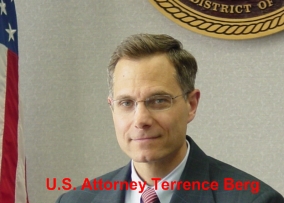
    U.S. Attorney Terrence Berg
    U.S. Attorney Terrence Berg

    Both state and federal prosecutors in Michigan have been attacking Ponzi schemers and affinity fraudsters. Yesterday the office of Michigan Attorney General Mike Cox charged three men with racketeering for their roles in an alleged time-share Ponzi scheme targeted at senior citizens.

    In a separate Michigan case, federal prosecutors have announced the guilty plea of Richard Taft Johnson, 67, of Orchard Lake. Johnson is a member of an ever-lengthening list of senior citizens implicated in Ponzi schemes. The list includes names such as Bernard Madoff, 71, (New York/Florida); Richard Piccoli, 83, (New York); Andy Bowdoin, 75, (Florida); Julia Ann Schmidt, 68, (Texas); Judith Zabalaoui, 71, (Louisiana); Arthur Nadel, 77, (Florida/NewYork); Ronald Keith Owens, 73, (Texas); James Blackman Roberts, 71, (Arkansas); and Larry Atkins, 65, (North Dakota).

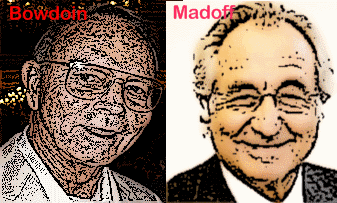
    bowdoinmadoffnadel

    Johnson pleaded guilty to mail fraud for devising a Ponzi scheme known as the “American Charitable Program,” which led investors to believe “investments would benefit
    charitable organizations such as universities or other educational institutions,” prosecutors said.

    But the purported charitable program was a fraud that promised returns of 10 percent per quarter — and the fraud was magnified by bogus “periodic statements showing the purported increasing value of their investment accounts,” prosecutors said.

    “This was an insidious Ponzi scheme because investors were told it was a safe, secure investment that would ultimately help charities,” said U.S. Attorney Terrence Berg of the Eastern District of Michigan.

    “Like most Ponzi schemes, it went undetected for a number of years, allowing some investors to reap a profit on their investments, and encouraging others to invest,” Berg said.

    He added that Ponzi perpetrators often recruit others to spread the word about exciting investment programs, which later prove to be Ponzi schemes that cause embarrassment and ill-will among family and friends.

    “It can be very disturbing for a victim to discover that he has innocently caused friends or relatives financial ruin,” Berg said. “In the end, a number of the [Johnson] investors, some quite elderly, lost everything because their monies were used to keep the scheme going until the inevitable collapse.”

    The Johnson probe is ongoing, despite the plea. “In the course of this investigation, we will be attempting to help ascertain what, if anything, the victims’ might be able to salvage of their financial worth,” Berg said.

    Assisting in the probe are the FBI, the State of Michigan Office of Financial Insurance Regulation and the State of Florida Division of Insurance Fraud. Berg said the agencies have “worked very hard to investigate and compile the information about Mr. Johnson’s fraudulent activities.”

    Johnson faces up to 20 years in prison and a fine of up to $250,000. He conducted business in Bloomfield Hills, Mich., as Investor Planning Services.

    “As in all Ponzi schemes, Mr. Johnson would pay out earlier investors, or investors who demanded a return of their money, with newer investors’ monies,” prosecutors said. “But he also diverted significant funds to his personal use.”

    The Johnson scheme began to collapse in 2008.

  • BREAKING NEWS: FBI Tells Senate Judiciary Committee It Is Probing 314 HYIP Schemes Only Months After ASD Members Asked Panel To Probe Prosecutors

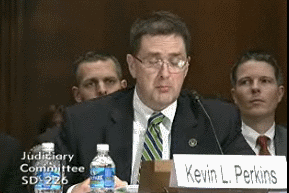
    Kevin L. Perkins of the FBI tells the Senate Judiciary Committee that the agency is investigating 1,500 cases of securities fraud and that 314 of them involve HYIP fraud in various forms.
    Kevin L. Perkins of the FBI tells the Senate Judiciary Committee that the agency is investigating 1,500 cases of securities fraud and that 314 of them involve HYIP fraud in various forms.

    And to think that only months ago — in February 2009 — various members of AdSurfDaily wrote to the Senate Judiciary Committee trying to elicit support for Ponzi schemes. The letter-writing campaign was spearheaded by “Professor” Patrick Moriarty and pushed by the Pro-AdSurfDaily Surf’s Up forum.

    But now the FBI has told the committee, led by Sen. Patrick Leahy, D.-Vermont, that it has registered a 105 percent increase in HYIP fraud and opened 314 investigations in 2009, up from 154 in 2008.

    “[M]any [had] losses exceeding $100 million,” said Kevin L. Perkins, assistant director of the FBI’s Criminal Investigations Division.

    Perkins said the probes cover the gamut — from the massive Ponzi scheme fraud of Bernard Madoff to smaller variations of the Ponzi scheme.

    “These schemes use money collected from new victims, rather than profits from an underlying business venture, to pay the high rates of return promised to earlier investors,” Perkins told the Committee.  “This arrangement gives investors the impression there is a legitimate, money-making enterprise behind the fraudster’s story; but in reality, unwitting investors are the only source of funding.”

    During his testimony, Perkins also referenced “prime-bank schemes” in which victims are told that “certain financial instruments such as notes, letters of credit, debentures, or guarantees have been issued by well-known institutions such as the World Bank, and offer a risk-free opportunity with high rates of return.”

    In August 2008, in a forfeiture complaint against the assets of AdSurfDaily and Golden Panda Ad Builder, federal prosecutors revealed that Golden Panda President Clarence Busby had been sued civilly by the SEC in the 1990s after he was implicated in three prime-bank schemes. At the same time, prosecutors revealed ASD President Andy Bowdoin had been arrested for felony securities fraud in Alabama during the same decade.

    Despite the Ponzi allegations against ASD and the histories of Bowdoin and Busby, Surf’s Up urged the Judiciary Committee to investigate the prosecutors who brought the forfeiture cases against ASD and Golden Panda in August 2008.

    “We each need to explain [to Leahy] how thousands of innocent Americans have suffered and continue to suffer because of these incredible and despicable acts” by prosecutors, Surf’s Up urged members.

    Law enforcement is investigating a stunning number of securities-fraud cases, the FBI revealed.

    “The FBI continues to aggressively investigate this criminal threat, and currently has more than 1,500 related securities fraud investigations,” Perkins said.

    Read about the Moriarty/Surf’s Up letter-writing campaign to the Senate Judiciary Committee.

  • Madoff Confessed Ponzi Scheme Year Ago Today; AdViewGlobal Prepared Ponzi Roll-Out Even As Stunned Public Watched Madoff Spectacle Unfold

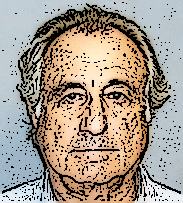
    Bernard Madoff
    Bernard Madoff

    One year ago today Bernard Madoff uttered a memorable phrase, describing his securities business economically as “one big lie” — and his Ponzi house of cards came tumbling down.

    Even as Madoff was uttering those three words to his sons and the FBI soon was to knock on his door, the insiders behind the AdViewGlobal (AVG) autosurf were busy putting together and getting ready to promote their own Ponzi scheme. For many, it would be their second — and they’d be greasing the wheels of their new Ponzi even as virtually the entire world was jeering Madoff and New Yorkers were demanding justice on the streets.

    Hundreds and hundreds of AVG promoters appear to have been slow on the Ponzi uptake, ignoring the lesson of instant villainy the Madoff case provided and seriously misreading their ability to repackage a Ponzi scheme and sell it all over again.

    Madoff was arrested Dec. 11, within 24 hours of confessing “one big lie.”  His arrest amid allegations of a $50 billion Ponzi fraud created a media spectacle. The crime was unimaginably huge. In the hours and days that followed, personal, corporate and charitable fortunes collapsed. The word “Ponzi”  instantly became associated with greed, criminality and reprehensible acts, and was burned into the public consciousness like never before.

    One place it was not used was the Unemployable Hobo Lifestyle Forum. There is a mention of the soon-to-launch AVG dated Dec. 13, 2008, two days after the arrest of Madoff, but no simultaneous reference to Madoff or the word “Ponzi.”

    “Call me if you [don’t] have [a] leader,” said Mark Simmons, the head of the forum and a witness in the Ponzi scheme case involving AdSurfDaily, a company with close ties to AVG. The headline of the thread was, “for those waiting on ADVIEWGLOBAL.”

    In the autosurf Ponzi business, the word “leader” is used to describe the people who make the most money by lining up sheep and leading them to the slaughter. In the months prior to the launch of AVG, the “leaders” had led sheep to the slaughter in ASD, Golden Panda Ad Builder, LaFuenteDinero (the “fountain of money”), MegaLido, Instant2U, Frogress, DailyProfitPond, AdGateWorld, BizAdSplash and Noobing, among others.

    The leaders still are leading the sheep to slaughter on various HYIP and autosurf Ponzi forums — even with Madoff serving a prison sentence of 150 years. They get paid a commission of 10 percent or more for leading people to the slaughter.

    Another reference to AVG appeared on Simmons’ forum Dec. 18, exactly a week after Madoff’s arrest. Some autosurf critics say the leaders are “out of touch.” Others use less-generous phrases to describe them, painting the “leaders” as the purveyors of “Kool-Aid” for consumption by the sheep.

    Some of the sheep sign up to be slaughtered over and over again. They’re sometimes also known as the “Stepfords.”

    “Our specific [AVG] group will have some additional perks that will not be tied to this and will allow you to grow exponentially and outpace everyone,” Simmons said Dec. 18 on his forum. The headline of the thread was, “STAY TUNED FOR ADVIEWGLOBAL.”

    Simmons was a former member of the AdSurfDaily autosurf, which was caught up in pre-Madoff allegations that it was a $100 million Ponzi scheme. The ASD allegations were made in August 2008, about four months before Madoff’s name and “Ponzi scheme” became household words. Simmons’ name was on ASD’s witness list for an evidentiary hearing held Sept. 30-Oct. 1, 2008.

    He never was called to the stand. U.S. District Judge Rosemary Collyer ruled Nov. 19, 2008, that ASD had not demonstrated it was a lawful business and not a Ponzi scheme. ASD had operated from the United States. Within days of the devastating ruling against ASD, word began to spread that AVG would launch and become a sort of ASD2 — only operating “offshore” from Uruguay and out the reach of U.S. authorities

    Collyer is apt to remember the ASD case for many reasons. The key ruling she made against ASD was issued on her 63rd birthday, for example.

    In the months that followed, Collyer would hear from dozens of pro se litigants who appeared to be arguing in favor of a presumptive right to operate or participate in a Ponzi scheme with no interference by the government.

    AVG’s formal launch occurred in February 2009, less than two months after the Dec. 13 reference on Simmons’ forum, less than two months after the spectacular Ponzi allegations against Madoff surfaced.

    But the autosurf’s days of having a tin ear for news and PR were far from over. Indeed, the surf that launched in the midst of the public hue and cry over Madoff’s Ponzi scheme and in the wake of Ponzi and racketeering allegations against ASD, went on to demonstrate for all time that it considered greed a virtue.

    On May 4, the same day the Obama administration announced a crackdown on offshore fraud carried out by Americans, AVG announced it had acquired a new offshore wire facility to replace one lost in March.

    “I’m asking Congress to pass some commonsense [antifraud] measures,” Obama told the American people at 11:37 a.m. on May 4.  At 5:44 p.m., a member of an AVG forum operated by some of the Mods and members of the Pro-AdSurfDaily Surf’s Up forum announced the new offshore wire facility.

    AVG collapsed less than two months later, on June 24. Five days later, on June 29, Madoff was sentenced to 150 years in prison. One day after that, on June 30, AVG’s name was mentioned in a racketeering lawsuit filed against ASD President Andy Bowdoin and ASD attorney Robert Garner.

    Some of the autosurf leaders are still leading on Internet forums, but Simmons’ Unemployable Hobo forum appears not to have had an update on any online program since September

  • BREAKING NEWS: Two Madoff Computer Programmers Charged With Conspiracy For Enabling Massive Ponzi Scheme

    Federal prosecutors and the FBI demonstrated again this morning that people who enable Ponzi schemers are subject to arrest and prosecution.

    Today’s announcement that two computer programmers for Bernard Madoff have been charged with serious felonies could send shockwaves across the so called autosurf “industry,” which relies heavily on computers and programming tweaks to fleece participants.

    Charged in New York were programmers Jerome O’Hara, 46, of Malverne, N.Y., and George Perez, 43, of East Brunswick, N.J. If convicted, they each face up to 30 years in prison and fines that could total in the millions of dollars.

    O’Hara and Perez were charged with conspiracy, falsifying books and records of a broker-dealer, and falsifying books and records of an investment adviser.

    “Jerome O’Hara and George Perez allegedly helped construct Bernie Madoff’s house
    of cards,” said U.S. Attorney Preet Bharara of the Southern District of New York. “The computer codes and random algorithms they allegedly designed served to deceive investors and regulators and concealed Madoff’s crimes. Today they have been charged for their roles in Madoff’s epic fraud, and the investigation remains ongoing.”

    An FBI official said Madoff could not have pulled of his Ponzi scheme without the aid of programmers, adding that Madoff bought their silence for a a price.

    “O’Hara and Perez are charged with being instrumental in facilitating the Ponzi scheme that was the Bernard Madoff investment advisory business,” said Joseph M. Demarest Jr., assistant director-in-charge of the FBI’s New York field office.

    “Their subterfuge was designed to conceal the fraud from regulators and others, and when they told Madoff they would no longer lie for him, their continued complicity was bought for a price,” Demarest said.

    It is common knowledge in the autosurf “industry” that the operators install scripts to make the programs functional online and that the scripts are tailored by programmers to the specifications of the operators.

    bowdoinmadoffart2Today’s charges against O’Hara and Perez give surf operators — and their programming employees and contractors — something else to worry about, beyond being forced to give up ill-gotten gains in forfeiture proceedings and being charged with crimes such as wire fraud and money-laundering.

    By charging the programmers who helped Madoff carry out the scheme, the Feds sent a clear message that they view Ponzi-enablers as co-conspirators.

    The website of AdSurfDaily, a Florida company accused of operating a $100 million Ponzi scheme, was offline for much of July 2008, amid reports that programmers were tweaking the website and programming the system to enable it to accommodate higher volumes of traffic and perform more database functions.

    ASD President Andy Bowdoin repeatedly relied on programmers to tweak systems, members said.

  • FBI Arrests 14, Including 2 Lawyers, In Major Insider-Trading Probe; SEC Says Attorneys Provided Tips For Kickbacks In Latest Scandal That Rocks Wall Street

    As the FBI and IRS executed search warrants at the Florida office of attorney Scott Rothstein this morning amid allegations he ran a covert Ponzi scheme that could have drained as much as $500 million from investors, prosecutors up north were concentrating on arresting lawyers in a separate case involving insider trading on Wall Street.

    U.S. Attorney Preet Bharara of the Southern District of New York announced the arrests of attorneys Arthur J. Cutillo of the prestigious law firm Ropes & Gray LLP of New York, and Jason Goldfarb, a New York attorney.

    Cutillo and Goldfarb were among 14 people charged in a case with ties to the alleged Raj Rajaratnam insider-trading scandal at the Galleon Group. Rajaratnam’s arrest last month rocked Wall Street.

    Today’s news demonstrated again that law-enforcement and regulatory agencies in all corners of the United States are seeking to put an end to a wave of financial crime that could undermine the public’s confidence in the markets and imperil economic recovery in the age of the corporate bailout.

    “When Wall Street professionals or others exploit inside information for an illegal tip-and-trade binge, they undermine the level playing field that is fundamental to our capital markets,” said Robert Khuzami, director of the SEC’s Division of Enforcement. “These defendants thought the rules that apply to all investors did not apply to them, but the one rule they cannot avoid is the rule of law. Now they face the prospect of financial penalties, industry bars, and even jail time for their indiscretions.”

    ‘A Bag Of Cash’

    Attorneys will not be permitted to ignore the law and hide behind their legal shingles, added Scott W. Friestad, associate director of the SEC’s Enforcement Division, using stark language.

    “Today’s action highlights the apparent ease with which far too many lawyers, hedge funds and Wall Street traders are willing to break the law to obtain a bag of cash, a trading advantage or other perceived benefit,” Friestad said. “It is fundamentally unfair for these individuals to profit at the expense of honest investors and compromise the integrity of our markets.”

    Although the emerging Rothstein Ponzi allegations in Florida are not connected to the Galleon Group insider-trading investigation in New York, California and elsewhere, dramatic developments last night and this morning in Fort Lauderdale were a stark reminder that financial crimes that were once unthinkable suddenly have become commonplace in the aftermath of the arrests of Bernard Madoff, Tom Petters, Allen Stanford, Arthur Nadel, Nicholas Cosmo and others implicated in Ponzi schemes for mind-boggling sums.

    Agents in Fort Lauderdale hauled away dozens of boxes of evidence, seized computers and thumb drives, copied computer hard drives, took control over an unspecified amount of cash, sifted through financial and other records — and also seized the key to a Ferrari.

    Though Rothstein has not been charged, the case has become a spectacle in Florida. The state has been rocked by one financial scandal after another involving allegations of mortgage fraud, hedge-fund fraud, affinity fraud targeting vulnerable residents, HYIP fraud, autosurf Ponzi scheme fraud and Ponzi schemes in general.

    In New York, far north of Florida’s warm climate, Bharara and the FBI released some of the details surrounding today’s arrests of lawyers and Wall Street insiders. For its part, the SEC made a separate flow chart to demonstrate how part of the fraud worked.

    SEC Flow Chart" Source: SEC
    SEC Flow Chart: Source: SEC

    Attorney Cutillo “had access to confidential information about at least four major proposed corporate transactions in which his firm’s clients participated,” the SEC said. “Through his friend and fellow attorney Jason Goldfarb, Cutillo tipped this inside information to Zvi Goffer,” a proprietary trader at Schottenfeld Group of New York.

    “Goffer promptly tipped four traders at three different broker-dealer firms and another professional trader Craig Drimal, who each then traded either for their own account or their firm’s proprietary accounts,” the SEC said.

    Cell Phone Intrigue Part Of Allegations

    In allegations that read like a cross between an Ian Fleming and Robert Ludlum novel, the SEC outlined some of the case.

    “Goffer was known as ‘the Octopussy’ within the insider trading ring due to his reputation for having his arms in so many sources of inside information,” the agency said. “Cutillo, Goldfarb, and Goffer at times used disposable cell phones in an attempt to conceal the scheme. For example, prior to the announcement of one acquisition, Goffer gave one of his tippees a disposable cell phone that had two programmed phone numbers labeled ‘you’ and ‘me.’

    “After the announcement, Goffer destroyed the disposable cell phone by removing the SIM card, biting it, and breaking the phone in half, throwing away half of the phone and instructing his tippee to dispose of the other half,” the SEC charged.

    Read the SEC news release.

    Read Bharara’s news release on the criminal charges to get the full list of defendants, at least five of whom already have pleaded guilty.

    Read part of the South Florida Business Journal’s ongoing coverage of the Rothstein allegations, which are not connected to the insider-trading case announced in New York today.

  • ‘Key Enabler’: Madoff Accountant Pleads Guilty; Faces 114 Years; Forfeits More Than $3.1 Million, Real Estate

    David G. Friehling was one of Bernard Madoff’s “key enablers,” U.S. Attorney Preet Bharara said today after Friehling pleaded guilty to nine criminal charges.

    Friehling, 49, Madoff’s small-shop accountant, faces up to 114 years in prison, but has agreed to cooperate with the government, Bharara said.

    “David Friehling was one of the key enablers of Bernard Madoff’s historic fraud,” Bharara said. “With his guilty plea, Friehling has taken responsibility for his crimes and will now assist us in holding others accountable for their involvement in Madoff’s epic fraud
    against so many victims.”

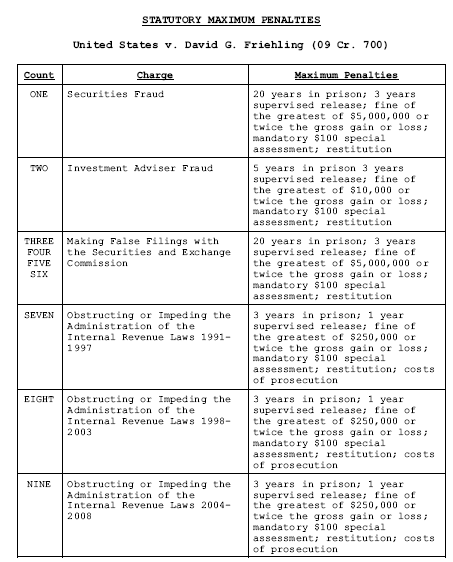
    Prosecutors announced last week that Friehling was expected to plead guilty to a criminal information that superseded one filed in July. It became official today, with Friehling’s plea to securities fraud, investment adviser fraud, four counts of filing false audit reports with the Securities and Exchange Commission and three counts of obstructing or impeding the administration of the internal revenue laws.

    In essence, Friehling pleaded guilty to rubber-stamping bogus information supplied by Madoff and helping Madoff and unnamed others file false tax returns.

    Prosecutors said he is “subject to mandatory restitution and faces criminal fines up to twice the gross gain or loss derived from the offense.”

    The graphic below is a screen shot of a document provided by Bharara’s office in New York that shows the maximum penalties Friehling faces:

    David Friehling faces these maximum penalties.
    David Friehling faces these maximum penalties.

    Friehling will forfeit $3.18 million, representing “the total amount of compensation he
    received from [Madoff’s securities business] for his accounting and tax services, plus the
    amount that he, his wife, and his children withdrew from their BLMIS investment advisory accounts,” prosecutors said.

    He also agreed to forfeit his interest in certain real estate, “to the extent that those properties constitute, or were derived from, the securities fraud charge to which he pleaded guilty,” prosecutors said.

  • LETTER TO READERS: Senior Citizens, The Culture Of Ponzi Schemes — And America’s Longing For A Return To The Age Of ‘Blue Light’ Specials, The Age Of Innocence

    Dear Readers,

    From time to time I publish a post in letter form. This usually happens when a post in story, editorial or essay form does not seem appropriate. This is one of those times.

    Honestly, just how strange could things get in Ponzi Land?

    Ponzi Land, which relatively few people outside of law enforcement even knew existed a year ago,  suddenly and notoriously is populated by senior citizens — and not only as victims, but also as perpetrators.  So much of it seems upside down, a world that challenges assumptions.

    Are we entering a sort of awkward cross between a Lewis Carroll-like world and an Orwellian world, a world in which illogic passes for logic and, because news travels so quickly on the Internet and because negatives get spun so furiously as positives these days, bizarre crime gets positioned or explained away as a new form of nobility?

    Let’s take a look at today’s news on Ponzi schemes.

    Before we begin, did you notice the phrasing in the sentence above — today’s news on Ponzi schemes? Ponzi schemes are breaking out like Blue Light Specials broke out at the Kmart of my youth. Men and women whose hair is blue or tinting toward blue are running Ponzis — instead of doing recon in the aisles and waiting for the famous voice to intone, “Attention Kmart shoppers.

    It used to be that you made money by not spending it or shopping patiently and even furiously for the best possible deal, perhaps especially if you were a senior.

    Allegations now have emerged that Julia Ann Schmidt, the 68-year-old alleged Ponzi schemer from Texas, posed as an investment adviser using the name of Fortis Investments, a famous European brand with U.S. reach.

    Schmidt allegedly said she was working for a man named  “Jack Layne” — and when investors became skeptical, she hired a man to pretend to be “Jack Layne Jr.,” saying “Jack Layne” had died.

    The case is new, and few facts have emerged. But the allegations read as though Schmidt knew she was about to get caught, and called a meeting of investors, telling them that she was rolling over their investments into an insurance annuity. She allegedly brought the man pretending to be “Jack Layne Jr.” to the meeting, telling investors their money was safe because “Jack Layne Jr.” was handling “all the investor accounts through a local Waco law firm.”

    To add a false air of nobility to the alleged scheme, senior-citizen Schmidt put on a show for investors, prosecutors said.

    “In order to falsely lend credibility to the annuity transfer, [Schmidt] completed an application for her and her husband for the transfer of a non-existent sum of $500,000 from Fortis Investments to Life Insurance Company of the Southwest,” prosecutors said.

    For good measure, Schmidt “provided the false address for ‘Jack Layne’ and Fortis Investments where the annuity contracts and authorizations were to be mailed,” prosecutors said.

    The investment firm’s address proved to be a vacant parcel of land.

    So, if we’re reading this correctly, the alleged Schmidt plot involved:

    • A Ponzi scheme Schmidt pulled off by posing as an investment adviser for a prominent company that did not have a clue who she was.
    • Schmidt’s knowledge that her story and the scheme were collapsing.
    • An attempt by Schmidt to create plausible deniability by introducing “Jack Layne Jr.” and explaining that “Jack Layne” had died.
    • An attempt by Schmidt to sanitize the fraud and calm fears by explaining that “Jack Layne Jr.” was working with a “law firm.”
    • A subplot in which Schmidt further hoped to calm fears by creating nobility where none existed, saying investment accounts were being rolled over into an insurance annuity.
    • A false demonstration of nobility in which Schmidt pretended she was rolling over $500,000 into an insurance annuity.
    • Schmidt’s use of U.S. mail  in furtherance of a bizarre scheme to create nobility where none existed.

    Kmart, which dialed down Blue Light specials in the 1990s but still brings them back from time to time, needs to make them a fixture in stores again.

    Right away.

    Here is more news involving alleged senior Ponzi schemers or proven senior Ponzi schemers:

    In Buffalo, N.Y., Richard Piccoli, 83 — yes, 83 — was sentenced to 20 years in prison for recruiting Catholics and senior citizens into a Ponzi scheme he’d been operating since 1975. He’d managed to fleece investors out of as much as $25 million, leading to “devastating” consequences for the victims, prosecutors said.

    One of his victims said Piccoli had tried to turn the world upside down, putting on an air of nobility and youthful vigor when he was selling the scheme, but expecting the dignity and respect normally accorded a frail, 83-year-old man after the scheme was exposed.

    “He wanted to reverse his age when he wanted us as victims,” a woman told WGRZ-TV. “And now, he’s like, saying just the opposite: ‘Oh, I’m too old to be punished.’ So, you know, he worked his age in his own favor.”

    Piccoli ultimately cooperated with investigators — in no small part because the evidence was overwhelming. Authorities had cataloged ads he had placed in Catholic newspapers and publications. The ads, which promised a payout, specifically targeted seniors and people of faith.

    An undercover agent from the U.S. Postal Inspection Service, which had worked with the IRS to target Piccoli in a sting, posed as a man seeking to invest money for his aging mother.

    Piccoli, always looking for senior-citizen marks even in his 80s and trading for decades on the noble names of Catholic priests and churches, was happy to oblige.

    The churches were getting a 3 percent return on investments in safe institutions. Piccoli told them he could get 7 percent and provided a guarantee, reportedly even saying the investments were tax-free. This was music to the ears of churches and parishioners who’d watched a consolidation of Catholic entities across the United States that had resulted in the closure of schools and churches, owing to a lack of resources.

    “During one taped conversation, Piccoli promised the investigator ‘we can make a hell of a profit,’ and boasted that his list of clients included at least 50 priests,” The Buffalo News reported.

    Piccoli’s attorney asked for a sentence of six years. A federal judge said such a light sentence would not reflect the severity of a crime that involved tens of millions of dollars and as many as 500 victims over the years, and sent Piccoli to prison for 20 years — effectively a life sentence.

    In the end, justice was served, including justice for a 79-year-old man Piccoli had fleeced. The man said he suffered a heart attack after news of Piccoli’s arrest broke last winter. Authorities, acting swiftly after Piccoli’s name had been brought to their attention and an investigation began, recognized almost instantly that he had been operating a Ponzi scheme for decades.

    They froze the crime in its tracks, trapping $6 million that still remained. Piccoli had gathered at least $500,000 in November 2008 alone, and at least $16 million since 2007, depositing the money and writing checks to earlier investors as money came in from new investors. He promised a payout of between 7.1 percent and 8.3 percent, but had been insolvent for years — and owed unsuspecting clients up to $25 million.

    Piccoli’s attorney — doing what attorneys are paid to do — pointed out that Piccoli had cooperated after getting caught, a sort of last shot at nobility. The attorney criticized neither the judge who sentenced his elderly client to 20 years nor the prosecutors who brought the case.

    Judith Zabalaoui, 71, was accused in February of swindling Greater New Orleans investors out of more than $3.2 million in an elaborate Ponzi fraud in which she set up fake companies, pretended to have employees and called her mailboxes at UPS stores “suites” to trick clients into thinking they were dealing with real firms. In August, she was sentenced to eight years in prison.

    Zabalaoui became emotional in the courtroom at her sentencing, explaining that she had committed crimes because she wanted her family to live well and had a predisposition for over-protecting her loved ones.

    Her victims cried — not for her, but for themselves.

    Elsewhere, in reports about the Bernard Madoff Ponzi scheme published yesterday, Madoff was said to have sponsored cocaine parties at his securities company.

    Madoff, 71, was sentenced in June to 150 years in prison. His Ponzi wiped out personal, charitable and corporate fortunes. An attorney with whom Madoff granted a prison interview — the same attorney now is suing Madoff and others — said Madoff  “spends time” in prison with a Mafia crime boss and a convicted spy. The attorney claimed Madoff enjoys pizza cooked by a child molester.

    Madoff told the FBI he had acted alone in the $65 billion swindle. No one believes that, not the FBI, not the attorney who is suing him.

    Bernard Madoff was not the sort of customer who performed recon in the aisles at Kmart and spent extra time in the store, hoping to be there when the famous Blue Light flashed.

    Regardless, Kmart can’t bring back the Blue Light Special for Americans of average or noble means fast enough. America needs the Blue Light Special, if for no other reason than to signal that Lewis Carroll and George Orwell wrote fiction, that the world is not upside down, that the Age of Innocence has returned.

    Let’s just hope it’s not the Age of Innocence described in Edith Wharton’s Pulitzer Prize-winning novel — and that an age of innocence truly once existed and is worth going back to to seek a cure for what ails us now.

    Patrick

    P.S. You’ve noticed, of course, that it has become increasingly fashionable to claim nobility and to blame the government if you get named in a Ponzi prosecution or a prosecution that alleges fraud in general. We have been reporting on the fraud allegations against Affiliate Strategies Inc. (ASI), the umbrella company under which the Noobing autosurf set up shop. Noobing targeted deaf people.

    On Sept. 4, an unnamed party issued a news release with this bold headline:

    “FTC on Rampage! Are they really out to help the Consumers or out to raise money?”

    Among the assertions in the news release, which apparently was a third-party bid to position ASI and other companies as noble enterprises, was this:

    “During our investigation of the tactics used by the FTC we wanted to see how the process was done to protect the consumer and the procedures they had to follow to prove that consumers were being harmed. To our amazement the FTC does not have to follow the law of the Constitution, and there is no Due process given to those that they claim are harming the public.”

    The claim was made despite the fact the civil prosecution against ASI is occurring in a federal court under the watchful eye of a federal judge to ensure fairness for all parties — alleged perpetrators and alleged victims.

    Federal investigators were described in the news release as “The “NEW AGED MAFIA.” The FTC was described as extorting “money from companies all across the country” in a bid to raise money “for the states that join them in the law suits.”

    In late August, the court-appointed receiver in the case against ASI said an affiliated company named a defendant in the prosecution charged a 70-year-old Philadelphia man on Social Security $995 for the names and addresses of three entities that possibly could help him secure a grant to repair his deteriorating home.

    One of the addresses proved to be the address of the Philadelphia Regional Office of the U.S. Department of Housing and Urban Development, which had been misidentified as a benevolent organization known as “World Changers,” according to court filings.

    The companies named defendants in the FTC lawsuit were insolvent “and had less than one day’s operating cash requirements in their bank accounts,” according to the receiver.

    “The Receiver’s work over the past three weeks suggests the Defendants’ operations were insolvent on the date [July 24] the [Temporary Restraining Order] was entered and that for at least all of 2009, Defendants operated only by signing up new victims faster than the old victims could obtain refunds,” the receiver said.

  • LAWSUIT: Madoff Had Prebust Cocaine Parties; ‘Spends Time’ In Prison With Mafia Crime Boss, Convicted Spy; Eats Pizza Cooked By Child Molester; Cell Mate Is Convicted Drug Dealer

    Bernard Madoff
    Bernard Madoff

    Bernard Madoff has made friends in prison and “spends time” with Carmine Persico, a reputed former Colombo crime family boss, and Jonathan Pollard, convicted of spying for Israel in a case that strained America’s relationship with Israel in the 1980s.

    Madoff’s cell mate is a convicted drug dealer, and Madoff eats pizza cooked by a convicted child molester, according to a lawsuit filed yesterday.

    The complaint was filed by California attorney Joseph Cotchett. Cochett sued on behalf of clients, and interviewed Madoff July 28 at the Butner Federal Correctional Complex in North Carolina.

    Jay Wexler is the lead plaintiff. Madoff family members and friends are named defendants in the 264-page complaint, along with firms such as JPMorgan Chase & Co., Bank of New York Mellon,  KPMG, the accounting firm, and other companies.

    Cotchett said the interview lasted more than four hours. Some of the details in the lawsuit paint a picture of reckless and nonfinancial criminal behavior inside Madoff’s securities business, in what appears to be a bid to point out that key business partners of Madoff ignored red flags and continued to do business with the now-infamous Ponzi swindler.

    Madoff had a “dark side,” Cotchett said.

    “Starting in 1975, Madoff began sending a long-time employee and office messenger to obtain drugs for himself and the company who worked with another individual who became a supplier to BMIS,” the lawsuit claims.

    “These two men were described as street tough men from Harlem ‘who were not to be messed with.’ Their job was to get drugs and bring them to the office for use at BMIS. The employees in the office were well known and everyone knew, including some special investors,” the lawsuit continued.

    “Drug use in the office was described as rampant and likened the office to the ‘North Pole’ in reference to the cocaine use. Eventually the main employee supplier was fired for his drug abuse when cocaine and other undisclosed drugs were found in his desk in 2003. Madoff worried that it might bring in drug prosecutors who might uncover the big scam,” the lawsuit claimed.

    Wild parties were held at the office, the lawsuit claimed. Entertainment featured “topless entertainers wearing only ‘G-string’ underwear serving as waitresses, and a culture of sexual deviance existed in the office,” the lawsuit claimed. “The employees had late night affairs in exciting places — such as their boss’ sofa ‘with whomever they could find.’ Employees described it as a wild, fast-talking, drug-using office culture.”

    Key insiders knew the end was near in 2008, despite Madoff’s insistence that he acted alone in the fraud, Cotchett contended in the lawsuit.

    A panic among some insiders ensued prior to Madoff telling the FBI that the enterprise was a colossal fraud in December 2008, Cotchett said.

    “In the final months of 2008, several of Madoff’s closest friends, family and supporters allegedly learned about the dire situation at BMIS and became afraid for their own fortunes and began formulating a plan for withdrawing their own monies from BMIS at the expense of other investors,” the lawsuit claimed.

    Read the Joseph Cotchett lawsuit against Bernard Madoff.

  • 68-Year-Old Texas Woman Charged In Alleged Ponzi

    A 68-year-old Texas woman has been charged with running a $500,000 Ponzi scheme.

    Julia Ann Schmidt was indicted in Waco. She now joins a roster of other senior citizens recently implicated in alleged Ponzi schemes or convicted of crimes in which a Ponzi was the modus operandi.

    Federal prosecutors said today that Schmidt posed as an agent for Fortis Investments.

    Between April 2007 and May 2009, Schmidt “solicited money from clients promising to generate an approximate 30% return on their investments,” prosecutors said. “Schmidt informed clients that portions of their investments would involve the Texas Ranger Museum, Hillcrest Hospital and the Waco Riverwalk Project.”

    Unsuspecting investors were fleeced out of more than $500,000, prosecutors said. The FBI is handing the probe. Investors who believe they were scammed by Schmidt are asked to call the Waco office at 254-772-1627, according to Acting U.S. Attorney John E. Murphy.

    Some Recent Ponzi Schemes Featuring Seniors

    Topping the list of seniors implicated in Ponzi schemes, age-wise, is Richard Piccoli, the alleged operator of the Gen-See Ponzi in the Buffalo, N.Y., area. Piccoli is 82.

    Arthur Nadel, implicated in Florida amid allegations more than $300 million in investor funds went missing in a Ponzi scheme, is 76.

    Andy Bowdoin, who presided over the alleged $100 million AdSurfDaily Ponzi scheme in Quincy, Fla., is 74.

    Bernard Madoff, convicted in an alleged $65 billion Ponzi, is 71. In June, Madoff was sentenced to 150 years in prison.

    Ronald Keith Owens, 73, was sentenced in January to 60 years in prison for operating a “prime bank” Ponzi scheme that allegedly was set up in the Bahamas and elsewhere.

    James Blackman Roberts, 71, of Heber Springs, Ark., was sentenced in January to 15 years in prison for running a $43.5 million Ponzi scheme.

    Larry Atkins, 65, was convicted of swindling investors of $3 million in a North Dakota Ponzi scheme. In February, he was sentenced to eight years in prison.

    Judith Zabalaoui, 71, was accused in February of swindling Greater New Orleans clients out of more than $3.2 million in an elaborate Ponzi fraud. In August, she was sentenced to eight years in prison.

    Zabalaoui established a bogus entity known as Paragon Co., which actually was a mailbox Zabalaoui rented at a UPS store in Montrose, Colo., prosecutors said.

    Part of the scheme was to call the mailbox a “suite,” prosecutors said.

    Zabalaoui also set up a fake company known as Omni Clearing, this time using a UPS store in Dover, Del. Prosecutors said she invented “fictitious people,” claiming they were employees, fabricated emails using the names of fictitious employees, and she set up a phone, fax and email systems to help perpetrate the fraud.

    She collected millions in the the scheme by promising “safe” and “guaranteed” returns ranging from 13 percent to 26 percent, prosecutors said.

    Read a prosecution filing on Zabalaoui.

  • Bank Failure Brings 2009 Total To 99; Foreclosures Pile Up In California, Florida; Prosecutors Battle Mortgage Fraudsters And Ponzi Schemers

    Andy Bowdoin
    Andy Bowdoin

    UPDATED 1:33 P.M. EDT (U.S.A.) The failure yesterday of San Joaquin Bank in Bakersfield, Calif., brought the total of bank failures in the United States this year to 99.

    With weeks remaining in the year, it is a virtual certainty that failures will top the 100 mark. Banks have been failing at an average rate of slightly less than 10 per month in 2009. Last year, 25 banks failed in the United States. In 2007, only three banks failed.

    As many as 416 names of other troubled banks appear on a confidential list maintained by the Federal Deposit Insurance Corp. (FDIC). The hemorrhage of bank failures — in large measure caused by a severe recession, consumer and business defaults, a collapse of real-estate prices in many parts of the country, brazen fraud in the mortgage sector and a contraction of development — is not over.

    Although banks and the government are working together to find ways to curb an explosion in the mortgage-foreclosure rate, foreclosures continue to suck wealth from the economy.

    “Bank repossessions, or REOs, jumped 21 percent from the second quarter to the third quarter, corresponding to jumps in defaults and scheduled auctions in the previous two quarters,” said James J. Saccacio, chief executive officer of RealtyTrac.

    RealtyTrac tracks foreclosure activity in the United States. On Oct. 14, the company said foreclosures in the third quarter set a record and were up 23 percent from the total reported in the third quarter of 2008.

    Foreclosure filings, default notices, scheduled auctions and bank repossessions totaled 937,840 in this year’s third quarter, RealtyTrac reported.

    Although foreclosure filings in September totaled 343,638 — a 4 percent decrease from August’s total — the number still represented a 29 percent increase from September 2008.

    September’s monthly total was among the highest figures reported since January 2005, trailing only July and August of this year.

    “REO activity increased from the previous quarter in all but two states and the District of Columbia, indicating that lenders may be starting to work through some of the pent-up foreclosure inventory caused by legislative delays, loan modification efforts and high volumes of distressed properties,” Saccacio said.

    Florida, California Battered By Foreclosures

    Six states — California, Florida, Arizona, Nevada, Illinois and Michigan — accounted for 62 percent of the foreclosure total in the third quarter, RealtyTrac reported. Foreclosures in the six states totaled 579,541.

    Foreclosures in California totaled 250,054 in the third quarter; Florida posted 156,924 foreclosures, a 23 percent increase from the total reported in the third quarter of 2008.

    Because Florida is an attractive state for retirees — and because those retirees have friends and loved ones in all corners of the United States — the state is an attractive target for scammers.

    Florida also has a large population of immigrants, another attractive target of scammers.

    Agencies Battle Florida Ponzi Fraud

    In the past 72 hours alone, the SEC, the CFTC, the FBI, the U.S. Postal Inspection Service, and federal prosecutors have announced three Florida Ponzi scheme prosecutions, a conviction in a separate Ponzi case — and a conviction in a fraud case in which a Florida man created more than 260 identities on eBay and fleeced customers out of $717,000.

    On the Florida Ponzi front:

    • David F. Merrick, Traders International Return Network (TIRN), MS Inc., GTT Services Inc., MDD Consulting Inc. and Go ! Tourism Inc. were named defendants in emergency actions in U.S. District Court for the Middle District of Florida. Merrick, 61, of Apopka, is accused of operating a $22 million Ponzi scheme with ties to Panama, Mexico, Malaysia, Switzerland and the Netherlands.
    • HomePals Investment Club LLC, HomePals LLC (Home Pals), Ronnie Eugene Bass Jr., Abner Alabre and Brian J. Taglieri were charged in South Florida with securities fraud, conspiracy to commit securities fraud, wire fraud and money laundering. The defendants were accused of targeting Haitian-Americans in a $14.3 million Ponzi scheme that promised investment returns of 100 percent every 90 days. The scheme gathered money from as many as 64 “investment clubs,” the SEC said.
    • Sean Healy, 38, of Weston, Fla., was charged in a 55-count indictment unsealed in Pennsylvania with multiple counts of wire fraud, mail fraud, money laundering and obstruction of justice. The Florida-based scheme led to at least $14.6 million in losses in Pennsylvania alone, prosecutors said, adding that Healy purchased “numerous exotic vehicles and sport cars, including a Bentley and several Ferraris, Lamborghinis and Porsches worth over $2.3 million.” Healy also bought a $2.4 million waterfront mansion furnished with more than $2 million of home improvements, plus $1.5 million in men’s and women’s jewelry, prosecutors said.
    • Michael Riolo, 38, of Boca Raton, was sentenced to more than 24 years in prison for bilking investors in a $44 million Ponzi scheme. Prosecutors accused Riolo of cooking the books and sending false statements to investors that reported “consistent trading profits and increasing account balances.” In reality, Riolo “misdirected money he received from some investors to make distributions to other investors who sought to withdraw money from their investment accounts,” prosecutors said.
    • Andy Bowdoin, 74, of Quincy, Fla., continued his efforts to get back into a Ponzi case in which he had already submitted to the forfeiture of tens of millions of dollars seized last year by the U.S. Secret Service in an international wire-fraud and money-laundering probe. Bowdoin, who submitted to the forfeiture in January, fired his attorneys and began to file as his own attorney in February. In April, federal prosecutors announced that Bowdoin had signed a proffer letter in the case prior to acting as his own attorney and acknowledged his company, AdSurfDaily Inc., had been operating illegally. “Mr. Bowdoin also confirmed that the revenue figures of the enterprise were managed to make it appear to prospective members that the enterprise called Ad Surf Daily was a consistently profitable, and brilliant, passive income opportunity,” prosecutors said. Despite his own acknowledgments of illegal conduct, despite the proffer — and despite the fact Bowdoin had asked the court to grant his request to submit to the forfeiture and that the court granted Bowdoin’s request — Bowdoin climbed back on the litigation saddle. “Mr. Bowdoin says that after discussing this case with his supporters, and concluding that they were smarter than his attorneys, he has changed his mind,” prosecutors said.

    Total funds gathered in the alleged Bowdoin, Merrick, Bass, Alabre, Taglieri and Healy Ponzi schemes in Florida are estimated at $156.3 million, during a period in which U.S. banks are failing, the U.S. economy is confronting the worst business conditions since the Great Depression and mortgage foreclosures are piling up across the country, including hard-hit Florida.

    With the Riolo conviction added to the estimate, the number totals $200.3 million. The estimate does not reflect the massive, $65 billion Ponzi fraud of Bernad Madoff, who wiped out clients in Florida and elsewhere. Nor does it take into account allegations that Arthur Nadel, another man implicated in a large-scale fraud in Florida, may be responsible for tens — if not hundreds — of millions of dollars of Ponzi pain.

    “During these tough economic times, it is more important than ever that those who lie to and steal from the investing public be held accountable for their misconduct,” said Jeffrey H. Sloman, Acting U.S. Attorney for the Southern District of Florida, commenting on the 24-year prison sentence Riolo received.

    “The United States Attorney’s Office will continue to investigate and prosecute those who perpetrate these large-scale fraud schemes,” Sloman said.

  • BREAKING NEWS: Michael Riolo Sentenced To More Than 24 Years In Prison For Bilking Clients In Florida Ponzi Scheme That Collapsed After Nine Years

    To many residents of Florida, Michael Riolo was their Bernard Madoff.

    Riolo, 38, of Boca Raton, was sentenced to more than 24 years in prison (293 months) today for bilking investors in a $44 million Ponzi scheme. The scheme began in 1999 and collapsed in 2008.

    “During these tough economic times, it is more important than ever that those who lie to and steal from the investing public be held accountable for their misconduct,” said Jeffrey H. Sloman, Acting U.S. Attorney for the Southern District of Florida. “The United States Attorney’s Office will continue to investigate and prosecute those who perpetrate these large-scale fraud schemes.”

    Riolo’s sentence was imposed by U.S. District Judge Kenneth A. Marra.

    Police officers were among victims of Sterling Wentworth Currency Group Inc. and LaSalle International Clearing Corp., Riolo’s companies.

    “From August 1999 to December 2008, Riolo caused more than 80 investors to invest approximately $44 million, based on materially false statements and omissions of material facts,” prosecutors said today.

    Like Madoff, Riolo cooked the books.

    “To encourage participating investors to keep their investments with the defendant, he would prepare and distribute to investors monthly profit and loss statements that falsely reported consistent trading profits and increasing account balances,” prosecutors said.

    “In furtherance of the scheme, Riolo misdirected money he received from some investors to make distributions to other investors who sought to withdraw money from their investment accounts.”

    Riolo took money from new investors to pay old ones in classic Ponzi fashion, prosecutors said.

    “[He] disbursed more than $29.5 million to investors as a purported return of principal and profits, when in fact, most of the returns paid by the defendant to the investors came directly from new investment monies, not profits,” prosecutors said.

    Investigators have exposed two significant Ponzi schemes in Florida in the past 48 hours alone. The alleged schemes occurred on the heels of Madoff’s massive, $65 million Ponzi fraud, and allegations that Florida residents Arthur Nadel and Andy Bowdoin has schemed hundreds of millions of dollars from investors in Ponzi frauds.

    Read story about another Florida Ponzi case Sloman’s office is prosecuting.

    Read story about yet another Florida Ponzi scheme exposed in the past 48 hours.

    Florida’s real-estate market has been battered by the recession. The state has one of the highest mortgage-foreclosure rates in the United States, and some counties have high concentrations of residents vulnerable to scams, including senior citizens and immigrant populations.

    Despite the fact senior citizens are vulnerable to Ponzi schemes, some members of the Pro-AdSurfDaily Surf’s Up forum discussed a plan to ask AARP, an association that advocates for seniors, to advocate on behalf of ASD.

    AARP later joined with Florida Attorney General Bill McCollum in an effort to strengthen securities laws in the state.