UPDATED 5:45 P.M. EDT (U.S.A.) A federal judge has issued a bench warrant for Michael Derrick Peninger after Peninger did not show up for sentencing yesterday in a $7 million, Ponzi-scheme case in South Carolina.
Peninger, 50, of Charleston, was convicted in October of eight counts of mail fraud and one count of making a false statement to an FBI agent, the CFTC said.
The Post and Courier newspaper of Charleston is reporting that prosecutors argued last fall that Peninger should have been kept in jail upon conviction because he posed a flight risk.
Peninger was released until his sentencing date after his 72-year-old mother appealed to U.S. District Judge P. Michael Duffy to permit her son to leave jail to assist with the care of her husband, who has Alzheimer’s disease.
Duffy permitted Peninger to assist his mother and stepfather, ordering him to wear an ankle monitor. The judge now has dispatched the U.S. Marshals Service to locate and arrest Peninger, the Post and Courier is reporting.
Just days ago a judgment of more than $3.9 million was placed against Peninger in a fraud case brought by the CFTC in 2008. The judgment was ordered by U.S. District Judge C. Weston Houck.
Peninger was charged criminally in January 2009. Prosecutors said he operated three companies: Cooper River Group Inc., CSA Trading Group Inc., and Daniel Island Builders LLC.
“[A]t least 20 investors provided Peninger and others with funds to invest on their behalf, but . . . Peninger and others misappropriated the money to pay personal expenses, to pay employees, to fund unauthorized business ventures, and to pay previous investors in a manner akin to a Ponzi scheme,” prosecutors said.
Peninger faced a maximum penalty of nearly two decades in prison.
South Carolina has had some unusual Ponzi cases, including the curious case of the “3 Hebrew Boys.â€
In that case, convicted Ponzi schemer Joseph B. Brunson of Hopkins declared himself “sovereign” and therefore immune from U.S. law. The claim was reminiscent of claims made by Curtis Richmond, a mainstay, pro se litigant in the AdSurfDaily Ponzi scheme case.
In the 3 Hebrew Boys case, Brunson declared that former U.S. Attorney Walt Wilkens was guilty of treason, insurrection and conspiracy to overthrow the U.S. government in his successful efforts to prosecute Brunson.
Richmond argued in the ASD case that U.S. District Judge Rosemary Collyer was guilty of treason.
BULLETIN: (UPDATED 12:35 P.M. EDT (U.S.A.) Trevor G. Cook, implicated in a $190 million Ponzi scheme that pushed tremendous sums of money all over the world and is believed to have fleeced investors out of at least $139 million, has entered a guilty plea in federal court in Minnesota.
No sentencing date has been sent.
Cook, 37, of Apple Valley, faces up to 25 years in federal prison after pleading guilty to mail fraud and tax evasion. Cook has been in jail since January, after a finding he had violated a court order by not cooperating with investigators and continuing to spend investors’ money after he was sued by the SEC and CFTC in November. His plea deal is contingent on assisting the government in unraveling the scheme.
Criminal charges were filed against Cook last month.
The guilty plea included acknowledgments by Cook that he lied to investors and was “aided and abetted by others” in a scheme “to defraud no fewer than 1,000 people out of approximately $190 million by purportedly selling investments in a foreign currency trading program,” prosecutors said.
Cook did not have $4 billion under management, as he told investors, prosecutors said.
During his plea hearing this morning, Cook admitted that he diverted investors’ money, deceived Swiss regulators when Crown Forex SA was plunging into bankruptcy in 2008, purchased ownership interest in two trading firms with investors’ money, bought property in Panama with investors’ money, bought the Van Dusen mansion in Minneapolis with investors’ money and raided investors’ money to make personal purchases and pay gambling debts.
“To carry out his scheme, Cook caused false statements to be made to potential investors, including promises that the investment program would generate annual returns of ten to twelve percent, and that trading would present little or no risk to investors’ principal,” prosecutors said. “He also caused material information to be withheld from investors, such as the precarious financial position of Crown Forex, SA” in Switzerland.
Meanwhile, prosecutors said, Cook “withheld the fact that trading at PFG in Chicago generated losses in excess of $35 million between July 1, 2006, and August 31, 2009.”
A company with a name confusingly similar to Crown Forex SA was part of the scheme, prosecutors said.
“In furtherance of the scheme, Cook caused an account to be opened in the name of Crown Forex, LLC, at Associated Bank, which he used for depositing investor funds that he subsequently diverted for his personal use as well as the personal use of others,” prosecutors said. “He also caused statements to be sent to investors that misrepresented the status of their investments. In addition, he caused due-diligence letters to be prepared that falsely represented Oxford Global Advisors as having more than $4 billion in assets under management, and that all accounts were liquid.”
Prosecutors gave credit for the probe, arrest and conviction to the interagency Financial Fraud Enforcement Task Force. President Obama created the task force in November 2009.
Assistant U.S. Attorney Frank J. Magill is the lead prosecutor in the criminal aspect of the case.
In November, the SEC and CFTC sued Cook, along with Pat Kiley. Kiley, 71, formerly hosted a program on Christian radio and is accused civilly of steering people into the international scheme.
Law enforcement officials and prosecutors in Minnesota say they are battling several Ponzi schemes that have fleeced investors out of hundreds of millions of dollars.
Last month, FBI Director Robert Mueller III said criminals increasingly were relying on “shell corporations” and hard-to-trace financial-services products to commit fraud on a massive scale.
EDITOR’S NOTE: As is the case with other Ponzi schemes, the alleged Trevor Cook/Pat Kiley scheme in Minnesota is proving to be an incredible paper chase that is consuming hundreds of hours of manpower as attorneys, investigators and support staff work to reverse-engineer what authorities say was an epic, international fraud.
Want to be a Ponzi receiver? Expect to be criticized — and also expect to put in long hours, perhaps for months or even years. It simply is not an easy job, especially if a scheme has fleeced investors by the hundreds or thousands. Simply put, there is no way to make all parties happy. Perhaps all one can hope for is to contain the devastation of a Ponzi scheme.
This is part of the story of R.J. Zayed, as told through court filings and a statement before Chief U.S. District Judge Michael J. Davis March 29. Zayed is the receiver in the Cook/Kiley case . . .
Investor losses will be huge in the alleged Trevor Cook/Pat Kiley Ponzi scheme in Minnesota, the court-appointed receiver in the case said.
Painting a picture that deception was the rule and not the exception in the alleged $190 million fraud, receiver R.J. Zayed said that money was moved “all over the world” and that $139 million of investor funds was “spent or hid.”
Management of the scheme was so screwed up that Trevor Cook, whom Zayed described as the “architect,” reportedly paid $2.6 million from investors’ resources in 2008 for the historic Van Dusen mansion in Minneapolis — but then did not bother to maintain property insurance or even to maintain the property.
Zayed’s early findings are alarming, and his statement and reports to Chief U.S. District Judge Michael J. Davis cannot be ignored. Indeed, Zayed suggested, Cook used investors’ money to buy the mansion, but put the entire purchase price at risk and potentially invited catastrophic downstream liabilities by not insuring the property and letting it fall into a state of disrepair.
Welcome to the bitter world of the Ponzi. Easy come, easy go.
Although Cook purchased an island property in Canada for $250,000, a contractor who performed work for Cook has filed a “lien for unpaid work.” The filing of the lien added another layer of complexity to an already-complex case that involves multiple international jurisdictions.
“We are working to get that issue resolved and clear title to the land,” Zayed said, noting that he has hired lawyers in Canada to help navigate the jurisdictional issues. The receivership estate also is working to convert assets in Panama to cash.
Cook, 37, was charged criminally with mail fraud and tax evasion March 30. It is believed he may enter a guilty plea during a court appearance April 13.
The Van Dusen mansion, which was used as a headquarters for the alleged $190 million scheme, quickly became a white elephant to the receivership estate, Zayed said.
“Ongoing expenses, such as utilities and property maintenance, cost approximately $12,000 per month,” Zayed said. “In addition, we had to obtain property insurance (there was none under Mr. Cook’s management).”
Moreover, Zayed said, the mansion’s furnace was not working and its security system had been “dismembered.”
“Numerous individuals had ‘worked,’ lived, and socialized throughout the house,” Zayed said. “The property was littered with trash and paraphernalia from these activities. Evidence had to be preserved and the remainder had to be cleaned out — this was a tremendous task.”
Spectacular Sums Collected, But No Books Kept
Cook and Kiley both were charged civilly by the SEC and the CFTC in November. Kiley, 71, is a former host on Christian radio. Cook was a purported money manager.
“The damage that Trevor Cook and Pat Kiley have done is nothing short of devastating to each of over 1000 investors who trusted and invested their life savings with these individuals,” Zayed said.
In many cases, individual investors lost their life savings, Zayed said. Some of them had borrowed against the value of their homes.
“Many of these investors are so destitute that they cannot afford to hire private counsel to represent their interests,” Zayed said.
He described the scheme as an “incredible tragedy” that has been “nothing short of devastating” to investors, saying he is aware that some people believe the receivership estate has billed “extensive fees and costs.”
Zayed, though, said he had arranged for discounted billings with key personnel such as attorneys and professional investigators and, in some cases, was relying on recent law-school graduates and criminal-law students to perform work for the estate to contain costs.
WayPoint Inc., a professional investigations firm whose staff consists of former FBI and IRS agents and a former postal inspector, has performed some work at no charge because it recognizes the grave circumstances confronting Cook/Kiley investors, Zayed said.
“It is the right thing to do,” Zayed said, quoting Rick Ostrom, one of WayPoint’s principals. Ostrom is well-known in Greater Minneapolis. He spent 26 years with the FBI.
“WayPoint has been instrumental in cost containment,” Zayed said. “For example, to effectuate a proper distribution plan, the Receiver has to have as complete a list as possible of all investors who have lost money in this scam. Approximately 580 investors have registered claims with the Receiver — this is about half of the individuals who are believed to have invested with the Defendants.
“In an effort to identify the remaining individuals in the most cost-effective manner possible, WayPoint interviewed and engaged local criminal-law students to review Defendants’ investor files to create a list that is complete and as accurate as possible,” Zayed continued. “These students reviewed 75 boxes of investor files and are in the process of updating the investor database with the information they reviewed. This work was performed at no cost to the Receivership, except that we paid for these students to park downtown while they worked at the U.S. Attorney’s Office.”
Moreover, Zayed said his own firm, Carlson, Caspers, Vandenburgh & Lindquist (CCVL), cut its billing rate by 15 percent. The firm’s CFO has been working as a “de facto CFO” for the estate “without a single of her many hours billed.”
Meanwhile, Zayed said, the “entire administrative staff of CCVL has also worked on behalf of the Receivership, often with late hours at the expense to their family and home lives, without billing a single hour.”
At the same time, the firm’s technical staff also contributed to the Receivership, constructing a separate part of the firm computer infrastructure to handle the tremendous volume of electronic documentation that the Receivership has collected and created.”
‘Complicated Web’ Of Deceit
Management of the Cook/Kiley entities was an unqualified disaster, Zayed said.
“[T]he scope and depth of this fraud are so severe . . . that the recovery in this case will be nowhere near the loss,” Zayed said. “The Defendants’ construction of this Ponzi scheme and their maintenance of the fraud lured investors into a scheme that produced a complicated web through which assets were sent all over the world.”
Although investors filed lawsuits last summer and the SEC and the CFTC launched probes that resulted in the filing of the civil charges, the scheme continued to consume investors’ money even after the allegations were filed, Zayed said.
“Trevor Cook was spending tens of thousands of dollars to buy gift cards around the city for his own personal gain,” Zayed said. He added that the receivership estate, the SEC, the CFTC and federal prosecutors in Minnesota worked to preserve assets and that the consequence to Cook was that he was jailed in January for not cooperating.
“Suffice it to say that there was no legitimate book keeping of the Defendants and Relief Defendants,” Zayed said. “There were no accounting systems in place, or even a general ledger.”
A grand jury has returned an indictment against a suburban Philadelphia man, accusing him of operating a Ponzi scheme that gathered at least $95 million and fleeced investors of more than $25 million.
Charged criminally with mail fraud and money-laundering was Donald Anthony Young, who also has been sued by the SEC.
Meanwhile, Matthew Pizzolato has pleaded guilty in a separate Ponzi case targeting senior citizens in Louisiana, prosecutors said.
Pizzolato, 26, of Tickfaw, pleaded guilty to 21 counts of mail fraud, three counts of money-laundering, and single counts of wire fraud, securities fraud and witness tampering. In all, Pizzolato pleaded guilty to 27 felonies. He also was sued by the CFTC.
At the same time, accused Ponzi schemer Jeffrey Lane Mowen has lost his monstrous collection of vehicles in Utah. The U.S. Marshals Service began selling the 210-vehicle collection at auction yesterday — April Fool’s Day.
Marshals were authorized to sell the cars because the bill to store them cost $21,000 a month. Mowen, 47, was arrested in Panama in 2009, extradited to the United States and jailed in Utah on Ponzi charges. He later was charged in an alleged murder-for-hire plot in which he was accused of trying to recruit a fellow prisoner to kill witnesses in the Ponzi case.
The auction had been delayed twice, but proceeded yesterday. It was billed by Erkelens & Olson Auctioneers as the “Largest collection of Muscle, Collector & Exotic vehicles ever [offered] in Utah!”
Elsewhere, NBC’s “Today” show this morning featured a daughter who turned in her mother in a Ponzi scheme. The mother ultimately was not charged because authorities came to view her as a victim who had been recruited to sell the scheme.
Authorities busted the California scheme, operated by Pastor Robert Jennings and Henry Uliomereyon Jones, a magnetic figure. The affinity-fraud scheme involved investments in coal and a bogus international gold deal.
Jones was arrested in Hong Kong and extradited to the United States. He and Jennings were convicted last year.
Kim Flanigan told Today that she reached her limit when she observed her mother, a widow, trying to recruit a widow with nine children into the Ponzi scheme. Both widows attended the same church.
“That was my breaking point,†Flanigan told Today. (See link to story below. NBC’s “Dateline” program will feature Flanigan tonight 9 EDT.)
In the Donald Anthony Young case in Pennsylvania, prosecutors said Young stole from investors so he could live in the lap of luxury.
“Ponzi schemes are usually a vehicle for an unscrupulous person to live high off of someone else’s wealth,†said U.S. Attorney Michael L. Levy. “According to the indictment, this defendant helped himself to others’ fortunes, living a life of luxury, with little or no regard for the damage to our financial markets, our economy, and the reputation of the investment advisors who follow the rules.â€
A veteran FBI agent said the agency was committed to destroying Ponzi fraud.
“The FBI views these types of financial investment Ponzi fraud schemes as significant criminal problems, because of the devastating effect they have not only on the individual victims who are preyed upon but also the effect they have on financial markets and on the overall economy,†said Janice K. Fedarcyk, special agent-in-charge of the Philadelphia Division of the FBI.
Prosecutors and agents involved in the Pizzolato case, meanwhile, also said Ponzi fraud will not stand in the United States.
“[Pizzolato’s] plea demonstrates our resolve, along with our partners in federal law enforcement, including the FBI, IRS and U.S. Postal Inspection Service, to aggressively investigate and pursue those economic predators who seek to take advantage and prey upon the most vulnerable among us, including our senior citizens who most desperately need our protection,” said U.S. Attorney Jim Letten.
Letten thanked the Office of the Louisiana Commissioner of Securities for its assistance in the Pizzolato case.
An FBI agent said the case sends a signal.
“This guilty plea represents once again, the FBI’s resolve to aggressively investigate financial crimes which victimize our most vulnerable citizens,” said David Welker, special agent in-charge. “It is reprehensible that Mr. Pizzalotto would target senior citizens and defraud them of their life’s savings. The FBI, along with our law enforcement partners, will continue to identify and investigate frauds such as this.â€
An IRS investigator said authorities would leave no stone unturned to expose financial fraudsters.
“This investigation shows that the appearance of success can be a mask for a tangled financial web of lies,” said Michael J. DePalma, special agent in-charge of the IRS New Orleans’ office.
“No matter what we call this type of crime, the bottom line is that Mr. Pizzolato robbed over a hundred investors of more than $19 million and spent just about all of it,” DePalma said. “Special Agents of IRS Criminal Investigation will continue to work with our federal and state law enforcement partners and the United States Attorney’s Office to pursue evidence of criminal activity wherever it leads, leaving no financial stone unturned.”
Visit the Today show site to read about Flanigan’s experience.
A federal judge has ordered a Florida man to spend nearly 16 years in prison and pay $16.7 million in restitution for fleecing investors in a Ponzi scheme.
Sean Healy, 39, of Weston, scammed dozens of investors in Pennsylvania. He went on to live in the lap of luxury in Florida, acquiring a $2.4 million waterfront home, a Bentley, several Ferraris, Lamborghinis and Porsches worth more than $2.3 million and jewelry worth $1.5 million.
Meanwhile, Trevor Cook, charged criminally with mail fraud and tax evasion in a separate, $190 million Ponzi case in Minnesota, has struck a deal with prosecutors, the AP is reporting. Details about the deal are unclear, but the AP, citing comments by Bill Mauzy, Cook’s attorney, reported that Cook will plead guilty in the coming weeks.
Healy became infamous in Florida, and was described as a smaller version of former Wall Street titan Bernard Madoff and former Fort Lauderdale attorney Scott Rothstein. He was charged in a 55-count indictment unsealed in Pennsylvania last year with multiple counts of wire fraud, mail fraud, money laundering and obstruction of justice.
Initially Healy tried to sandbag prosecutors by providing “phony bank statements and phony trading records” to thwart a grand-jury probe, but the government didn’t buy it.
“When the authentic records were obtained, they revealed that Healy had simply spent the money on his extravagant lifestyle and used some of it to pay back earlier investors who he defrauded between 2003 and 2008,†prosecutors said.
Healy was sued separately by the SEC and the CFTC, which said he used investor funds to purchase gold bullion and “to lease a luxury suite at Miami’s BankAtlantic Arena.â€
For its part, the SEC said the sky was the limit for Healy.
“Rather than investing the money as he promised, Sean Healy used investor funds to finance an extravagant lifestyle for himself and his family,†the SEC said.
BULLETIN: Trevor Cook, the reputed head of a $190 million Ponzi scheme in Minnesota, has been charged criminally with mail fraud and income-tax evasion.
Cook, 37, previously had been charged civilly by the SEC and the CFTC. The criminal charges filed today came after a probe by the FBI and the IRS Criminal Investigations Unit, working with the regulatory agencies.
Prosecutors alleged Cook filed a false tax return in 2009, failing to report report taxable income of at least $5.2 million “upon which there was tax due in the amount of at least” $1.8 million, prosecutors said.
Cook was charged via a criminal information, rather than an indictment. Such charging documents sometimes mean a defendant is negotiating with prosecutors.
Prosecutors said Cook was “aided and abetted by others” in a scheme that fleeced at least 1,000 people “out of at least $190 million by purportedly selling investments in a foreign currency trading program,” prosecutors said.
“In reality,” prosecutors continued, “he was diverting the money provided him for other purposes, including making payments to previous investors; providing funds to Crown Forex, SA, in an effort to deceive Swiss banking regulators; purchasing ownership interest in two trading firms; buying a real estate development in Panama; paying personal expenses, including substantial gambling debts; and acquiring the Van Dusen Mansion in Minneapolis.”
The mansion has been sold by R.J. Zayed, the court-appointed receiver in the civil case. Zayed also has sold large-screen TVs and automobiles linked to the scheme, including a Rolls-Royce.
Prosecutors said the Cook case was being tackled by the Financial Fraud Enforcement Task Force, which President Obama formed late last year.
U.S. Attorney B. Todd Jones of the District of Minnesota made the announcement of the criminal charges against Cook.
Cook has been in jail since January as a result of a contempt of court order in the civil case, which was brought by the SEC and the CFTC.
Former Christian radio host Pat Kiley also was charged in the civil case.
The narrative of the Cook story occasionally has played out like a James Bond movie, with references to a submarine, an island retreat, Faberge eggs and foreign currency purportedly acquired by Cook with fraud proceeds.
A real-estate agent ventured to Cook’s island in Canada during the winter on a snowmobile to get the lay of the land, according to court filings.
A Florida man has been arrested by the FBI on 21 counts of wire fraud amid allegations he operated a forex Ponzi scheme, collecting more than $10.2 million and pocketing $1 million for himself.
The announcement of the arrest of Patrick H. Rakotonanahary, 34, of Punta Gorda, Fla., was made in Hawaii after a joint probe by the FBI, the Commodity Futures Trading Commission (CFTC), and the State of Hawaii Department of Commerce and Consumer Affairs (DCCA).
His arrest was credited to a joint investigation by the agencies, which operated under the umbrella of the Interagency Financial Fraud Enforcement Task Force, the FBI said.
President Obama formed the task force in November.
“[I]nstead of using investor money to engage in Forex trading, Rakotonanahary primarily paid investment returns to earlier investors with investment funds from later investors as part of a ‘Ponzi scheme,’ using only about $1,864,000 for Forex trading, which generated losses of $814,806,” the FBI said. “Rakotonanahary used approximately $8,375,703 to pay investment returns and another $1 million personally.”
Most of Rakotonanahary’s 100 investors hailed from Hawaii, the FBI said.
Separately, CFTC announced yet another Ponzi case — this one in North Carolina.
The agency charged Dennis Todd Hagemann and Yellowstone Partners Inc., both of Raleigh, with operating a forex Ponzi scheme involving the fraudulent solicitation of at least $700,000 from at least nine individuals.
Hagemann was arrested and jailed by North Carolina state authorities.
In yet another bizarre Ponzi twist, CFTC said Hagemann purported to have a tie to former Russian Federation President Boris Yeltsin.
Hagemann failed to inform a potential investor “that Mr. Yeltsin is deceased, and was deceased at the time he made the representation,” CFTC said.
Ronald W. Smith used YouTube to promote a Ponzi scheme, according to CFTC.
In a case that may spread a chill among fraudsters who use YouTube to promote bogus money-making schemes, the Commodity Futures Trading Commission (CFTC) has charged a Virginia man with fraud.
Ronald W. Smith Jr. of Vansant used a YouTube video to promote a Forex Ponzi scheme that gathered more than $800,000 from 34 investors, CFTC said. In the video, Smith claimed that more than 95 percent of his trades in the “Safeguard 3030 Investment Club” were winning trades and that Safeguard “made a whopping 298 percent in just a mere 17 trading days.”
The CFTC transcribed the YouTube video and presented it and other investigative materials to a federal judge, who ordered Smith’s assets to be frozen, as well as the assets of Smith’s wife, Angela Smith, and the assets of a company known as Tigre Systems Inc.
In reality, “Smith used little, if any, of the funds to trade forex,” CFTC said. “Instead, he used customer funds for personal expenses, such as for a pool service, carpeting and furniture.”
Customer funds also were used for “purported profit payouts” and for business expenses, CFTC said.
At least one “third party solicitor or marketer” helped Smith sell the scheme, which operated between January 2009 and December 2009, CFTC said. The unnamed person who assisted Smith received more than $157,000.
Smith also marketed the scheme in Florida, CFTC said.
Investors’ money was used for personal purchases such as eyewear, clothing, roofing, flooring, furniture and swimming-pool expenses. It also was used for purported business expenses such as payments for hotels, a car and a limousine service.
Smith issued false account statements, which prompted some customers to give him more money, CFTC said.
The scheme began to collapse in October 2009, and Smith told customers he could not pay them because of a “purported on-going investigation by the SEC,” CFTC said.
That claim was false, CFTC said.
In December, Smith told customers he had been cleared of any wrongdoing in the “purported” SEC probe.
That claim was false, CFTC said.
In January 2010, CFTC said, Smith told customers their payments were being held up by a bank.
That claim, too, was false, CFTC said.
Smith had never been registered with CFTC in any capacity, the agency said.
U.S. District Judge James P. Jones issued the asset freeze and an order prohibiting the destruction of documents, including the YouTube video and other evidence.
David Krywenky of KINGZ Capital Management: Source: Marketwire
UPDATED 5:25 P.M. ET (U.S.A.) KINGZ Capital Management Corp. (KCM) might have been used or contemplated for use as a tool in two far-reaching, incredibly elaborate Ponzi schemes, according to an analysis of public records and other information.
One of the schemes ultimately appears to have consumed tens of millions of dollars in a squalid venture that used a royalty theme trading off the name “Crown.” It involved purported forex trading in Switzerland under the name “Crown Forex SA” and an American namesake called “Crown Forex LLC” allegedly set up to confuse investors and perhaps authorities.
The other scheme, which appears to have been nipped before it could mushroom on a grand scale, sought to kickstart a rapidly collapsing autosurf believed to be an offshoot of an existing criminal enterprise desperately seeking to extend its reach from the United States into the Caribbean, Central America, South America and perhaps Europe to keep itself alive.
The first scheme, which included other confusingly similar corporate names such as Oxford Global Partners LLC and Oxford Global Advisors LLC, became the subject of fraud charges filed by the SEC and the CFTC in November. Investors appear to be out tens of millions of dollars.
Charged in the $190 million November case were Trevor Cook, former Christian radio host Pat Kiley and several other companies. The allegations paint the picture that Crown Forex LLC set up a U.S.-based bank account to siphon money investors believed was destined for the Swiss entity, which they knew as Crown Forex SA.
“Cook and [Pat] Kiley, directly and acting through others, deposited checks from many investors, into a U.S. bank account in the name of a domestic shell company, with a name — Crown Forex, LLC –Â that was misleadingly similar to the Swiss firm Crown Forex, S.A.,” the SEC said.
Cook was jailed earlier this week for violating a court order that required him to turn over assets.
Separately, the National Futures Association (NFA) charged KCM in September with permitting Cook — who was not accredited and previously was disciplined by NFA for highly questionable business practices — to manage a KCM fund that purportedly contained “somewhat above and below $300 million” between September 2008 and July 2009.
KCM now has been permanently banned from NFA membership. David Krywenky, KCM’s vice president, has been banned for three years.
It’s anybody’s guess how much money the fund actually contained and what happened to the money. The SEC, the CFTC and a court-appointed receiver are turning over numerous domestic and international rocks to find assets of Cook and Kiley’s alleged epic fraud.
NFA’s allegations against KCM are disturbing. Not only was Cook managing a KCM pool known as KCI, according to the allegations, Cook’s Oxford Global Partners “appeared to be the only investor” in the KCI pool and all of the pool’s money was dumped into Crown Forex SA, a company in which Cook purportedly owned a majority stake and a company Swiss authorities declared bankrupt.
Was Cook At The Intersection Of A Second Scheme?
The second scheme to which KCN’s name has been linked was called AdViewGlobal (AVG), an autosurf purportedly headquartered in Uruguay but believed actually to have operated from inside the United States, most likely from Florida but perhaps also from Arizona. Autosurfs pose as “advertising” companies to skirt securities laws, authorities say.
AVG had close family, membership and promoters’ ties to AdSurfDaily, a Florida company implicated by the U.S. Secret Service in a $100 million Ponzi scheme. Federal prosecutors are well aware of AVG. So are attorneys suing ASD President Andy Bowdoin and ASD attorney Robert Garner for racketeering.
KCM’s tie to AVGÂ — according to AVG — was as the surf’s new facilitator of offshore wire transfers after AVG earlier had lost access to a bank whose name was not disclosed. AVG, among other things, claimed to own a payment processor known as eWalletPlus.
Records suggest eWalletPlus was an extension of corporate shells in Nevada and Arizona. At least two other companies claimed to own eWalletPlus during the same time period in which AVG claimed ownership. In March 2009, AVG announced its back account had been suspended. Problems with eWalletPlus were reported at the same time.
AVG identified KCM as its new wire facilitator on May 4, 2009, the same day the Obama administration announced a crackdown on international financial fraud. KCM denied AVG’s claim on May 7, saying it believed AVG had targeted it in a scam and perhaps was tying to use a third company based in Florida to route money to itself.
KCM identified the third company as Living Legacy One LLC. Records in Florida identified Gerald Castor as Living Legacy One’s principal, and a communication from AVG identified Castor as an employee of the surf’s “Compliance” department.
Michael P. Krywenky, David Krywenky’s father, denied any AVG ties in an interview with the PP Blog. The interview was conducted in May 2009, after Michael Krywenky contacted the Blog and asked it to remove a story citing AVG’s wire claim.
The Blog declined to remove the story. Instead, it published a story about Michael Krywenky’s denial. The story was based on an interview the Blog conducted with Michael Krywenky and an email Michael Krywenky sent the Blog on May 7, 2009.
“I think that we may be victims of a scam here and we are investigating this further at our end as well,” Michael Krywenky said in the email. “Thank you for bringing this to our attention. In the meantime, we please (sic) remove this posting since it contains false information that is detrimental to our company.”
A month later, in June 2009, the SEC began to investigate the Cook/Kiley entities. By September 2009, the NFA was accusing David Krywenky and KCM of permitting Cook to manage an investment fund and not making a claim for money lost when the Swiss entity went bankrupt.
Whether NFA questioned David Krywenky and KCM about AVG is unclear.
“KCM and D. Krywenky failed to act in the best interests of KCI’s participants, both known and unknown, in that when they knew or should have known that funds on deposit at Crown Forex, SA were frozen pursuant to that firm’s bankruptcy they took no action on behalf of the KCI pool to participate in the bankruptcy as a creditor or otherwise protect KCI’s equity,” NFA said.
NFA further accused David Krywenky and KCM of turning a blind eye to Cook, now implicated with Kiley in a colossal fraud.
AVG, which shielded members from knowing the identities of its owners by signing communications “The AVG Management Team,” never explained how it had identified KCM as a possible facilitator. The surf also ignored Michael Krywenky’s public denial that it had any business relationship with AVG, explaining that the wire deal it had announced as completed only days earlier — up to and including providing detailed wiring instructions — had fallen through as a result of failed negotiations.
Meanwhile, the surf also did not address Michael Krywenky’s claim that AVG appeared to be trying to route money to itself through Living Legacy One, the entity associated with Castor.
Michael Krywenky said KCM was consulting with attorneys to address AVG’s false claims and that the company had taken steps to ensure AVG could not receive money through KCM. AVG spent the balance of May promoting the launch of a new website and telling both prospects and recruiters that they could earn matching bonuses of 200 percent for sending money to the company or causing money to be sent to it.
Like ASD, AVG used offshore payment processors such as Canada-based Solid Trust Pay.
AVG collapsed in June, taking an unknown amount of money with it. Before the collapse, AVG identified George and Judy Harris of Tallahassee, Fla., as its owners. They previously had been identified as “Trustees” of AVG’s “private association,” which had cited U.S. Constitutional protections while purporting to he headquartered in Uruguay.
AdSurfDaily members later said ASD President Andy Bowdoin was a silent partner in AVG, claiming that Bowdoin had dispatched George Harris to Switzerland to establish bank accounts.
George Harris is Bowdoin’s stepson. The Harrises were named beneficiaries by the U.S. Secret Service of ASD’s illegal conduct in December 2008. AVG formally launched two months later, in February 2009, after the Harrises and Bowdoin’s wife, Edna Faye Bowdoin, had been named recipients of ill-gotten ASD gains — and after a major court ruling went against ASD, and after Bowdoin had been named a defendant in a racketeering lawsuit brought by members.
In May 2009 — the month during which AVG purportedly had turned to KCM to establish a wire facility and during a period in which Trevor Cook allegedly was managing money for a KCM entity known as KCI — the alleged Cook/Kiley Ponzi scheme appears to have been collapsing.
Cook has not been publicly linked to AVG. At a minimum, however, someone within AVG appears to have identified Barbados-based KCM as a solution to the company’s wire problem — and the NFA allegations establish a tie between KCM and Cook.
At least for a few days in May 2009, AVG was sufficiently confident that its wire problem was solved, so much so that it provided members detailed wire instructions with KCM’s name and an account number.
Given the nature of NFA’s allegations that Cook somehow had wormed his way into KCM’s purported forex operations with KCM turning a blind eye, it is reasonable to ask whether Cook also somehow had wormed his way into an intersection at which he could have cherrypicked funds from other KCM customers — and whether AVG and other autosurfs and HYIPs had turned to KCM to solve domestic banking and wire problems.
Investigators might be interested in determining if Cook somehow positioned himself to cherrypick fresh autosurf cash and apply it to his alleged existing Ponzi scheme, thus funding it with proceeds from other Ponzi schemes. Indeed, it is reasonable to ask if Cook’s influence with KCM extended from the forex fund to other areas of the business.
Why?
Because KCM, which became an NFA member in November 2007, issued two news releases less than a year later — in October 2008 — announcing it was managing more than $330 million. In a release dated Oct. 15, 2008, KCM said it had “received investment subscriptions of $334,263,000.” In a release eight days later — on Oct. 23, 2008, KCM said “clients who participated in their first raise of just over $330 Million US . . . have reported a very steady and consistent cash flow and rate of return.”
The Star-Tribune of Minneapolis/St. Paul, quoting a lawyer for KCM, reported in November 2009 that Cook offered to provide KCM start-up funding. KCM executives met Cook at a function in West Palm Beach, Fla., according to the attorney. Florida has become Ground Zero for Ponzi schemes.
A Mysterious Investor
NFA asserted in this filing that Cook perhaps peeled off $75 million from the purported Swiss fund and directed it to a mysterious investor. Cook also was alleged to have changed “passwords” on KCI “accounts” as part of the scheme.
KCM, according to the NFA allegations, “permitted Cook to effectuate a purported $75 million withdrawal from KCI’s trading accounts for a purported [Oxford Global Partners] investor who was identified to them by Cook only as “Fased.”
KCM is said to be cooperating with investigators from more than one state and federal agency.
It is unclear if “Fased” is a person, a business, an acronym, a proper name, a misspelling of the word “phased” or a slang spelling of “phased,” an amalgamation of some sort or a complete fiction.
What is clear is that Cook allegedly was managing money for KCM, a company to which AVG said it had turned last year to facilitate offshore wire transfers. AVG’s announcement — and the subsequent actions by the NFA, the SEC and the CFTC, may put KCM at the intersection of two murky worlds — the worlds of underground currency-trading schemes and offshore autosurf and HYIP schemes that promise enormous returns.
It’s worth investigators’ time to check it out — if for no other reason than to rule out the possibility that Cook also was playing the autosurf and HYIP games either as an investor or by somehow positioning himself at an intersection in these noxious worlds to siphon funds and divert them to his alleged principal Ponzi scheme.
What’s more, an HYIP known as Gold Nugget Invest (GNI) collapsed earlier this month, several weeks after NFA brought its action against KCM, and the SEC and CFTC brought their actions against Cook and Kiley.
GNI reportedly was having trouble accessing needed funds in a European bank, but announced a “Re-organization” plan that would reduce payouts from 7.5 percent a week to a mere 20 percent a month.
No, it’s not a misprint. GNI purportedly launched in October 2006, the same month AdSurfDaily was preparing for launch. ASD promoters advertised returns of 1 percent a day for viewing “advertisements.” Prosecutors said it operated as a virtually pure Ponzi scheme.
Some GNI members have referred to money — or representations of money — in their “ewallets.” It is unclear if the “ewallets” to which they refer have any connection to eWalletPlus or if the term “ewallet” is being used as a generic.
What is clear is that HYIP, autosurf and forex schemes have many players in common — and that tremendous sums of money go missing routinely.
Player in a Ponzi scheme? If alleged Minnesota schemer Trevor Cook’s experience is any indication, you should expect to be placed under a microscope by local merchants and police if you’re named in a complaint by regulators.
Cub Foods, a Minnesota-based grocery chain, placed Cook under video surveillance when he entered a local store. A loss-prevention specialist cited fears Cook might use the store to purchase gift cards in a scheme to hide assets from investigators.
Meanwhile, the 71-member police department in Eagan, Minn., alerted the court-appointed receiver in the alleged Cook/Pat Kiley scheme that Cook was using a credit card after a federal judge froze his assets, according to court filings.
Cook now is the subject of a contempt hearing. Receiver R.J. Zayed said Cook initially failed to disclose the existence of four credit cards and is not cooperating, and the SEC said U.S. Chief District Judge Michael Davis may have to jail Cook to enable investigators to prevent assets from being dissipated.
Cook had at least one other undisclosed credit card, Zayed said.
“The only reason the fifth card was known to the Receiver was because the Eagan Police Department informed the Receiver of this account after Cook used it to purchase” gift cards, Zayed said.
Zayed said Cook used credit cards after the asset freeze was imposed in November to purchase more than $30,000 in gift cards at Target, Holiday, SuperAmerica, Home Depo, AMC Theater, Regal Cinema, Nordstroms, Cheesecake Factory, Olive Garden, Old Chicago, Ruby Tuesday, Chilis, Applebees, PetSmart and Bath&Body Works.
Cook also purchased “numerous phone cards,” Zayed said.
Although Cook now has turned over the gift cards and the credit cards, he has taken the 5th Amendment in the case. Zayed, though, argued that Cook was using the 5th Amendment in a bid to pick and choose when and how he would cooperate in locating and preserving receivership assets.
“Cook now tells the Court that he will not turn over any additional assets because it would violate his privilege against self-incrimination,” Zayed argued in a brief to Davis. “Cook cannot have it both ways, turning over assets when it benefits him while continuing to hide other assets from the Receiver. Approving Cook’s strategy would make a mockery of the Court’s Orders and runs afoul of basic Fifth Amendment jurisprudence.”
By turning over some assets and testifying to the existence of others, Zayed argued, Cook has waived his 5th Amendment protections.
“Cook voluntarily testified about assets in his possession when he turned over a portion of those assets to the Receiver,” Zayed said. “He did not do this accidentally or out of the goodness of his heart.
“He did it to present himself in the most positive light he could to the Court when he was caught violating the Court’s Orders,” Zayed continued. “Cook also testified with respect to his assets when he provided the Receiver with a laundry list of expenses and asked the Receiver to provide him and his wife with thousands of dollars in monthly living expenses from the Receivership estate to maintain his lifestyle. Having ‘testified about certain assets for his benefit, Cook cannot now shield all other relevant facts on these topics.”
Counting holiday delays and time scheduled for attorneys to file briefs, the Cook contempt proceedings have been under way for more than a month. The SEC and the CFTC sued Cook and Kiley in November, alleging an international Ponzi scheme involving more than $190 million.
In 2006, the National Futures Association (NFA) fined Cook $25,000, saying he had committed a “very serious violation” in the manner in which he treated funds entrusted to him by an 80-year-old woman who was the guardian over her elderly sister. The case featured assertions of side-dealing and fabricated signatures on account documents.
A footnote in NFA’s summary of the case concluded that Cook was operating an unregulated gold and bullion business. The name he chose for the business closely resembled the name of a futures-trading firm, but Cook told NFA that the name was a coincidence.
Read NFA’s summary of the evidence in the Cook case and its decision. Pat Kiley, a former Christian radio host, was among the witnesses called.
UPDATED 4:06 P.M. ET (U.S.A.) A federal judge in the SEC and CFTC Ponzi scheme cases against Trevor Cook and Pat Kiley has paved the way for the receiver to begin selling property linked to the alleged $190 million scheme.
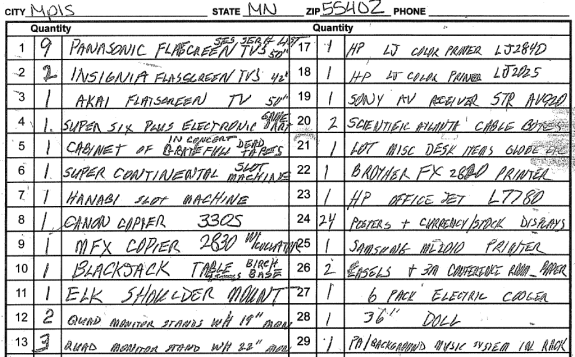
Among the first items up for bid will be 12 large-screen televisions, two slot machines and a Craps table, according to court filings. The items were discovered at the Van Dusen mansion in Minneapolis and at a property in Burnsville, Minn.
Receiver R.J. Zayed also wants to sell the mansion and the Burnsville property, and has begun the process of finding qualified professionals to assist. If court approval is gained for the sale of the real estate, it, too, will be auctioned, according to Zayed’s proposed plan.
Cook, who had previous run-ins with CFTC over his business practices, is not cooperating with Zayed, according to court filings. Kiley is a former host on Christian radio. He is accused of pitching the scheme, which collapsed last year. The scheme’s alleged tentacles extended from the United States to Europe, and also to Panama.
Zayed sought court approval earlier this week to sell the TVs and other items found at the Van Dusen mansion and the Burnsville property. Chief U.S. Chief District Judge Michael Davis now has issued an order, approving the sale.
In addition to the large-screen TVs and gambling equipment, Zayed found 39 computer monitors with 22-inch screens; 19 monitors with smaller screens; 23 computers; a “keg cooler/tap”; a “Beertender dispenser”; a Karaoke machine; three shredders; and miscellaneous other equipment.
Screen shot: Slice from receiver's filing on Cook/Kiley items up for sale.
The alleged Cook/Kiley scheme has featured an assertion that Cook also bought a private island in Canada with proceeds from the scheme, and a submarine to access the island.
One investor told the SEC that he’d heard Cook had purchased the two-person submarine on eBay for $40,000, but discovered the waters in Canada were too dark for the craft. Allegedly undeterred, Cook said he simply would move the sub to Panama on the belief its waters were clearer than Canada’s.
 UPDATED 5:45 P.M. EDT (U.S.A.) A federal judge has issued a bench warrant for Michael Derrick Peninger after Peninger did not show up for sentencing yesterday in a $7 million, Ponzi-scheme case in South Carolina.