Tag: CFTC

  • CAPTURED: FBI Nabs Perry And Rachelle Griggs In Arizona; Fugitive Ponzi Couple Will Be Transported To Hawaii To Face Charges They Bilked Investors While Perry Griggs Was In Prison

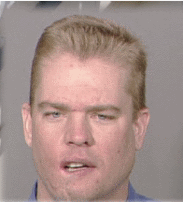
    CAPTURED: Perry and Rachelle Griggs

    The FBI has captured Perry and Rachelle Griggs, the fugitive Ponzi couple accused of running a scam while Perry Griggs was a federal prisoner in Nevada. The arrest was made in Kingman, Ariz., yesterday.

    Perry and Rachelle Griggs were indicted in October for wire fraud and mail fraud. They had been missing since January 2010. Perry Griggs had been released from prison in 2008. An investigation later revealed that the scam had begun while he was in custody and was directed largely at Hawaii residents.

    They operated a company known as Aloha Trading.  The couple also has been charged by the CFTC. Rachelle Griggs was accused of soliciting money from families of her husband’s fellow prisoners.

    The FBI said the manhunt for the fugitive couple was “intense,” and used websites, national news coverage and “electronic highway billboards” to dial up the heat on the alleged Ponzi schemers.

  • BIZARRE: California Man Charged In Precious Metals And Commodities Swindle Claimed Same Award As Andy Bowdoin; Ryan A. Nassbridges Charged By CFTC In $5.5 Million, Ponzi-Like Scheme In California

    The Commodity Futures Trading Commission has gone to federal court in California to halt a precious-metals and options scheme operated by a man who claimed to have the same award for business achievement as AdSurfDaily President Andy Bowdoin, according to web listings.

    Like Bowdoin, the head of Florida-based AdSurfDaily, Ryan A. Nassbridges of Laguna Niguel, Calif., claimed to possess an important award known as the Congressional Medal of Distinction, according to a website that bears his name and is registered in his wife’s name.

    Also like Bowdoin, Nassbridges now has been charged in a massive fraud scheme. The CFTC said today that Nassbridges, who once was known as Ryan Nasserabadi, was operating a “precious metals futures and options fraud” that gathered $5.5 million from at least 80 customers.

    He also was accused of lying to investigators about the scheme.

    Also charged were Nassbridges-affiliated companies known as American Bullion Exchange (ABEX Corp.) and American Bullion Exchange LLC (ABEX LLC).

    Other web listings suggest Nassbridges was referred to by multiple names online. While one site refers to him as Ryan A. Nassbridges, another refers to him as both Ryan A. Bridges and Ryan N. Bridges. The site that uses the  Ryan A. Bridges and Ryan N. Bridges names is registered behind a proxy, meaning the owner of the domain is unclear. Curiously, documents on the domain list the name of Ryan A. Nassbridges.

    Equally curiously, the entire left sidebar of both websites stream images of the awards purportedly received by Ryan A. Nassbridges.

    It was not immediately clear if Nassbridges operates the sites and why the sites used different names.

    Both sites tout the Congressional Medal of Distinction and include photographs of Nassbridges posing with prominent Republican politicians, including former President George W. Bush. Whether the photos were authentic was not immediately clear.

    One thing that is clear is that the medal now has been linked to at least two alleged Ponzi schemes and that both alleged schemes have traded on the name of the President of the United States.

    In the ASD case, the medal was described as a marketing memento for making campaign contributions to the National Republican Congressional Committee. Bowdoin was accused earlier this month of using Ponzi proceeds to make the donations and not correcting the record when affiliates told prospects he had received an important award from the President of the United States.

    The websites that use the one or more forms of the Nassbridges’ name claim that he received the medal for his “contribution toward the passage of the tax cut.”

    CFTC did not reference the medal in its allegations against Nassbridges, saying only that he used participants’ funds to make “political contributions” of an unspecified amount.

    He also used about $586,100 to make mortgage payments, $305,000 to make credit-card payments, $90,100 to make car payments and $157,700 for cash withdrawals, CFTC charged.

    Some investors received Ponzi-like payments, CFTC charged. It added that investors did not know that Nassbridges and the companies were trading commodity futures and options while “sustaining significant trading losses.”

    Investors believed they were trading in precious metals, including gold, palladium, platinum, silver bullion and gold and silver coins, CFTC said, noting that the alleged scheme was advertised on Fox, MSNBC and Home and Garden Television.

    The complaint described an operation by which “account representatives” were required to make a minimum of 350 “prospecting calls” per day.

    The websites tout Nassbridges as the “2005 Businessman of Year” and the recipient of the “Presidential Certificate of Merit Signed by the President of United States of America.”

    “[H]e is among those few who are Awarded with the ‘Eisenhower Commission’ Signed and presented by 3 former President’s (sic) of United States of America for helping the USA Small Business Organization and talented entrepreneurs create jobs for the American working class,” according to the websites.

    His wife, Bita Nassbridges, who was named a relief defendant by CFTC for allegedly receiving ill-gotten gains from the scheme, is referred to as “Mrs. Bridges” on one of the sites and “Mrs. Nassbridges” on the other. The couple is pictured in poses with Republicans Bush, former New York Mayor Rudy Guiliani and Sen. John Thune.

  • BULLETIN: Company That Did Business With Steve Renner’s Cash Cards International Charged In Massive Forex Swindle; Case Against MXBK Group S.A. De CV Grew Out Of Cooperative Probe Among SEC, CFTC, FBI And IRS; SEC Charges Pitchmen With Blindly Promoting Scam, Even After Collapse

    BULLETIN: UPDATED 9:18 A.M. ET (U.S.A., DEC. 8.)

    A Mexican company listed as a customer of Steve Renner’s Cash Cards International (CCI) in a 2005 scam known as MegaFund now has been charged by the CFTC with running a massive Forex fraud scheme that gathered at least $28 million from more than 800 U.S. customers.

    Named defendants by the CFTC were MXBK Group S.A. de CV, a private Mexican financial services holding company, and its Forex trading division, MBFX S.A. Court records show that MXBK Group S.A. de CV formerly was known as MexBank Group SA de CV or MexBank.

    Separately, the SEC has charged three men with fraud for blindly pitching the MexGroup program and raising “tens of millions” of dollars in the process. Charged in Utah federal court were Clifton K. Oram, Don C. Winkler and William R. Michael.

    “Beyond the fact that none of the defendants understood how the Forex market or Forex trading functioned, neither Oram, Winker or Michael took any significant steps to investigate MexGroup, its principals, or the viability of the investment,” the SEC charged. “Instead, they blindly accepted MexGroup’s representations about its background, veracity, and track record.

    “Further, Michael and his company used MexGroup’s purported performance numbers on his company’s website and made misleading representations and omissions regarding their own Forex trading experience,” the SEC continued. “Even more egregious, Winkler and Oram continued to offer and sell the MBFX offering even after the November 2008 collapse.”

    Renner, the operator of both CCI and the INetGlobal autosurf, currently is serving an 18-month prison sentence for tax evasion. In February 2010, the U.S. Secret Service alleged that Renner was operating a Ponzi scheme through INetGlobal.

    Renner has denied the Ponzi allegations.

    The CFTC case against the Mexican companies and the SEC case against the promoters were brought as a result of a joint cooperative investigation among the regulators, the FBI and the IRS, officials said.

    Read the CFTC complaint, which alleges the MXBK Group Forex scam began in 2005.

    Here is a snippet:

    “U.S. customers sign up to participate in the Defendants’ forex trading enterprise by completing forms electronically on the Defendants’ internet website. However, when completing their customer applications, U.S. customers are required to designate certain U.S. individuals or entities, sometimes called ‘resellers’ or ‘introducers,’ who in turn act as liaisons for U.S. customers with Defendants’ operations in Mexico. The resellers or introducers receive rebates described as ‘PIPs,’ which are purportedly based upon the volume of trading.”

    (NOTE: The full complaint is highly recommended reading if you follow HYIP and Forex fraud schemes.)

  • BULLETIN: National Investment-Fraud Sweep Dubbed ‘Operation Broken Trust’ Nets 532 Defendants; AG Holder Says Capers Caused More Than $10 Billion In Losses; ‘Undercover Operations’ Part of Task Force Arsenal

    U.S. Attorney General Eric Holder and members of President Obama’s Financial Fraud Enforcement Task Force said this morning that a nationwide sweep known as “Operation Broken Trust” has netted 343 criminal defendants and 189 civil defendants.

    Among the targets of the sweep were purveyors of Ponzi schemes, affinity fraud, prime bank/high-yield investment scams, foreign exchange (FOREX) frauds, business-opportunity fraud and other similar schemes, investigators said.

    Some of the defendants “filed for bankruptcy in an attempt to avoid claims by victim-investors,” investigators said.

    The combined losses in the schemes, which affected 120,000 investors, were estimated at $10.4 billion, Holder said. He was joined in the announcement by FBI Executive Assistant Director Shawn Henry; U.S. Securities and Exchange Commission (SEC) Director of Enforcement Robert Khuzami; U.S. Postal Inspection Service (USPIS) Chief Postal Inspector Guy Cottrell;  Deputy Chief Rick Raven of the Internal Revenue Service Criminal Investigation (IRS-CI); Acting Director of Enforcement Vince McGonagle of the U.S. Commodity Futures Trading Commission (CFTC); and other members of the Financial Fraud Enforcement Task Force.

    “With this operation, the Financial Fraud Enforcement Task Force is sending a strong message,” said Holder.  “To the public: be alert for these frauds, take appropriate measures to protect yourself, and report such schemes to proper authorities when they occur. And to anyone operating or attempting to operate an investment scam: cheating investors out of their earnings and savings is no longer a safe business plan — we will use every tool at our disposal to find you, to stop you, and to bring you to justice.”

    The calling card of the schemes was greed, Henry said, adding that undercover probes are part of the Task Force’s arsenal.

    “This operation highlights the scope of this problem, and its impact on individuals from all walks of life,” said Henry.  “This one sweep alone involves fraud schemes that harmed more than 120,000 victims. The schemes may change, but the underlying greed does not. Working with our partners, we in the FBI will use all the investigative techniques in our arsenal, including undercover operations, to bring those responsible to justice.”

    Khuzami, meanwhile, said the law-enforcement community was pursuing multiple forms of fraud.

    “Fraud by well-known companies or high-profile executives gets the biggest headlines, but other scams are equally devastating to hard working families and retirees,” said Khuzami. “Victims want justice and don’t much care who the fraudster is or how unique the fraud. Today’s actions underscore that law enforcement agrees and will pursue fraud in whatever form.”

    Read Holder’s announcement, made this morning in Washington.

    President Obama authorized the Financial Fraud Enforcement Task Force in November 2009. In January 2010, Holder ventured to Florida to speak about the aims of the Task Force and to warn scammers that the government was serious about putting them in jail.

  • BREAKING NEWS: OLINT Boss David A. Smith Extradited To United States From Turks And Caicos Islands; Faces Charges In Spectacular Forex-Fraud Case In Orlando Region

    BULLETIN: Agents from U.S. Immigration and Customs Enforcement (ICE) traveled to the Turks And Caicos Islands to take accused Ponzi schemer David A. Smith into custody. Smith has been transported to the United States and is jailed in Florida.

    Smith, who was serving a prison term in the islands for fraud and conspiracy, became the subject of an official request by the United States to extradite him to face federal charges in Florida for bilking investors out of more than $220 million.

    The director of ICE said the Smith fraud posed a danger to the U.S. banking system, and the Department of Homeland Security is involved in the probe of Smith’s business activities.

    “One of ICE-Homeland Security Investigations’ critical missions is investigating the flow of illicit money across U.S. borders and the criminal enterprises behind that money,” said ICE Director John Morton. “Not only do these kinds of financial schemes damage the lives of the thousands of victims, but the international money laundering involved poses a direct threat to the security of the U.S. financial system.”

    Smith was at the head of a Jamaican company known as Overseas Locket International Corp. (OLINT), prosecutors said. In 2006, he started another firm known as OLINT TCI Corp. Ltd. in the Turks and Caicos Islands.

    Both firms were described as “private investment clubs,” prosecutors said.

    Smith also was the majority owner in a Lake Mary, Fla., firm known as I-Trade FX LLC, prosecutors said.

    The scheme was pulled off with the help of unindicted co-conspirators in the United States, prosecutors said.

    The conspiracy was carried out in Seminole County, Fla., and was designed to channel money from the scheme into U.S. banks, prosecutors said.

    Residents of Orange County were affected by the scheme, prosecutors said. They noted that the unindicted co-conspirators were affiliated with a Florida company known as JIJ Investments. Prosecutors did not name the unindicted co-conspirators, describing them as “Directors” of JIJ.

    Federal prosecutors in the Middle District of Florida are involved in several actions targeted at alleged purveyors of massive fraud schemes.

    Assisting in the Smith case are U.S. Immigration and Customs Enforcement (ICE) Homeland Security Investigations (HSI), the Internal Revenue Service (IRS), Federal Bureau of Investigation (FBI), Commodity Futures Trading Commission (CFTC), National Futures Association (NFA), U.S. Customs and Border Protection (CBP) and the Royal Turks and Caicos Islands Police Force.

    See earlier story.

  • CFTC: South Carolina Pastor Ran Forex Ponzi Scheme From House Of Worship; Historic Church Property In Charleston Has Seen It All — From Lincoln Presidency And Civil War To Kennedy Assassination And Election Of Obama

    The religious facility that ultimately became St. John’s Reformed Episcopal Church has seen a lot of history in its 160 years on Anson Street in Charleston, S.C. Construction predated the Civil War by 11 years. The facility opened in 1850 as the Anson Street Chapel for black Presbyterians, according to records maintained by the Charleston County Public Library.

    During this time, the United States was transitioning after the sudden death in office of President Zachary Taylor in 1850. Taylor was the 12th President of the United States. He was succeeded in office by Vice President Millard Fillmore, who never gained election in his own right after filling out Taylor’s term because voters in the North viewed him as willing to appease the South on the issue of slavery.

    When the Anson Street Chapel opened in 1850, Abraham Lincoln was a prairie lawyer in Illinois, his ascension to the Presidency still four administrations away and the Great Civil War still more than decade away. The church, renamed St. Joseph’s Roman Catholic Church in 1861, was hit by shells during the Civil War and “badly damaged,” but was rebuilt, according to library records. The facility survived to serve congregants for more than 100 years, before closing in 1965 — two years after the assassination of President John F. Kennedy and 20 years after the end of World War II.

    St. John’s Reformed Episcopal Church bought the property and restored it in 1971, during the Vietnam War-era administration of President Richard M. Nixon and about a year before the word “Watergate” became part of the national consciousness. Barack Obama was 10 years old in 1971, 37 years away from his election as the 44th President and 28 administrations removed from Lincoln’s Civil War-era Presidency.

    Now the church has seen another sort of history: Its pastor, the Rev. Ronald Satterfield, has been accused by the CFTC of operating a Forex Ponzi scheme from inside the facility. One of the company’s he allegedly formed — Graham Street Forex Group LLC — used the church’s address of 91 Anson Street, according to documents.

    Co-defendant Nicholas Bos of Ludington, Mich., used a business card that depicted a “one million dollar bill” and described the scam as an opportunity to earn “24% a year” as a participant in “Special programs,” CFTC alleged.

    Also named a defendant was an entity known as Shore-2-Summit Financial LLC.

    Satterfield “independently solicited acquaintances, members of his church congregation and their friends and family, and others in North Carolina, South Carolina, and Maryland, for funds to trade forex,” CFTC alleged.

    The scam operated “at least” between March 2006 and March 2009, CFTC alleged.

    To conceal the fraud, “Satterfield and Bos issued false customer account statements reflecting the promised returns and forex trading profits, when in fact Satterfield’s forex trading resulted in losses almost every month,” CFTC said.

    “The false statements also allegedly concealed their misappropriation of customer funds. In total, the complaint charges Satterfield and Bos with misappropriating more than $850,000 of customer funds for personal use,” CFTC said.

    More than 70 customers were fleeced in a scheme that gathered about $3.3 million, CFTC said.

    Satterfield told the Post and Courier of Charleston that CFTC had mischaracterized his trading activities.

  • BULLETIN: FBI Seeks Arrest Of Perry and Rachelle Griggs; Agency Alleges Husband-And-Wife Team Ran Ponzi Scheme While Husband Was Federal Prisoner In Nevada; Manhunt Under Way

    WANTED BY FBI: Perry and Rachelle Griggs

    BULLETIN: UPDATED WITH INFORMATION FROM THE CFTC AT 7:03 P.M. EDT (U.S.A.) Perry and Rachelle Griggs are on the lam after running a Ponzi scheme while Perry Griggs was a federal prisoner in Nevada, the FBI said.

    The alleged commodities scheme consumed about $3 million and was targeted principally at inmates and family members of inmates, the FBI said.

    Separately, the CFTC said Perry Griggs ran a previous Ponzi scheme that resulted in convictions for wire fraud and money-laundering, a restitution order for more than $3 million and a 96-month prison sentence. Perry Griggs began serving the sentence in 2003, but hatched the new scheme while incarcerated.

    Yet-another scheme grew out of the scheme Perry Griggs hatched from prison, according to the CFTC. If the allegations are true, it means that Perry Griggs has been at the center of at least three fraud schemes since 2003, and launched two of them while in federal custody.

    The scheme for which Perry Griggs began serving time in 2003 involved coffee futures, the CFTC said. Even as he was serving time, Perry Griggs executed trades for the new scheme from prison by using the Internet and a telephone, according to court filings.

    Perry Griggs and his wife lost investors’ money in the new scheme and made Ponzi-style payments to cover up the fraud, while also stealing about $1 million to pay “for personal expenses, including luxury car leases, renting a home in Hawaii, purchasing jewelry and chartering a private jet,” the CFTC said.

    The couple went missing from a halfway house after Perry Griggs’ release from prison. Perry Griggs was on parole for the earlier Ponzi scheme when he fled while the second scheme was unraveling, the CFTC said.

    Perry Griggs was housed “with a large number of inmates from Hawaii,” the FBI said. He was released from prison in late 2008, and went missing with his wife from Las Vegas in January 2010.

    Indictments against the husband and wife were returned by a federal grand jury in Hawaii yesterday.

    The FBI has launched what it described as a “national fugitive manhunt with a primary focus on the states of Nevada, Washington, and California.”

    PERRY JAY GRIGGS is 49 years old, 5’10” tall, 180 pounds, with grey hair and blue eyes. He is known to have expensive tastes in sports cars, high-end clothing, cigars, and golf, the FBI said.

    RACHELLE LOUISE GRIGGS, also known as RACHELLE RUTLEDGE, is 42 years old, 5’4” tall, 150 pounds with blonde hair and green eyes.

    Anyone recognizing PERRY and RACHELLE GRIGGS or having information as to their current location is asked to call the Honolulu FBI at 808-566-4300.

    Perry Griggs also spent time in federal prisons in California and Texas. The Ponzi that put the couple on the lam operated through a scam company known as Aloha Trading Co., which purported to be in the business of trading commodities, the FBI said.

    Meanwhile, the CFTC said investors in the second scheme were lured by the promise of high returns. Some investors refinanced their homes and liquidated retirement accounts to invest with Perry and Rachelle Griggs.

    A third scheme grew from the second scheme and involved a company known as Paradise Trading LLC, the CFTC said.

    Read the CFTC complaint.

  • Forex Ponzi Schemers Who Targeted Deaf Investors Hit With $6.2 Million In Sanctions; ‘Billion Coupons’ Case Drew Comparisons To Defunct Noobing Autosurf

    A Hawaii man and his company were hit with sanctions totaling $6.2 million in a case that alleged they targeted people with hearing impairments in a Forex Ponzi scheme.

    Both the SEC and the CFTC filed actions against Marvin Cooper and his Honolulu-based firm, Billion Coupons Inc. (BCI). The CFTC announced the judgment against Cooper and the company.

    Investigators said Cooper and BCI “solicited funds from deaf American and Japanese individuals for the sole purported purpose of trading forex,” luring them with payout promises of up to 25 percent per month.

    For his part, Cooper took “more than $1.4 million of customer funds for personal use, including for flying lessons and to purchase a $1 million home,” investigators said.

    He was ordered to pay $3.9 million in restitution to customers and more than $2.3 million in penalties. The company is liable for the same amounts.

    The “Billion Coupons” case drew comparisons to the now-defunct Noobing autosurf, which also targeted the deaf. Noobing became popular in the aftermath of the August 2008 federal seizure of tens of millions of dollars in the AdSurfDaily Ponzi scheme case.

    Despite the federal seizure, some ASD members promoted Noobing. Noobing effectively went bust in July 2009, when the FTC charged its parent company — Affiliate Strategies Inc. — with pushing a scheme that promised “guaranteed” government grants of $25,000 from economic stimulus funds.

    Noobing later was named a receivership defendant in the case. Receiver Larry Cook sold the company’s assets lock, stock and barrel — right down to a lavatory wastebasket. Like ASD, Noobing’s parent firm also owned a jet ski. Cook sold that, too.

    Despite dramatic asset seizures and the federal actions against ASD and Noobing’s parent — and despite previous actions against autosurfs, including 12DailyPro, PhoenixSurf and CEP — some ASD members have continued to promote autosurfs.

    This has occurred against the backdrop of a racketeering lawsuit against ASD President Andy Bowdoin and public filings in which prosecutors claimed Bowdoin had signed a “proffer” letter in the case and met with members of law enforcement over a period of four days in December 2008 and January 2009.

    It also is known that Interpol is seeking the arrest of Robert Hodgins, whose Dallas-based debit-card company, Virtual Money Inc., is alleged to have agreed to launder drug money in the Dominican Republic and assist a Colombian drug operation launder money at ATMs in Medellin.

    ASD members said Hodgins’ company supplied debit cards to AdSurfDaily, and web records suggest that Hodgins or a Virtual Money designate attended an ASD function in the Orlando area in late 2006.

    Even though Bowdoin acknowledged in court filings that he had given information against his interests to the government, some ASD members continue to promote autosurfs and HYIPs. After signing the proffer letter and surrendering his claims to more than $65.8 million seized from his personal bank accounts, Bowdoin later reentered the case as his own attorney.

    One of Bowdoin’s 10 personal bank accounts contained more than $31 million, according to court filings. Another contained more than $23 million. Three other bank accounts contained the exact same amount — a little over $1 million.

    After submitting to the forfeiture in January 2009, Bowdoin fired his attorneys without notice and attempted to reenter the case weeks later as his own attorney. This set in motion a series of bizarre pleadings from Bowdoin, including one in which he claimed he had not been provided “fair notice” of his illegal conduct by the government. ASD members by the dozens then filed their own bizarre, pro se pleadings. U.S. District Judge Rosemary Collyer ruled against each of the filers, saying they had no standing in the case.

    Collyer since has ruled against Bowdoin, awarding title to more than $80 million seized in the case to the government, which said it intends to implement a restitution program. Bowdoin is appealing Collyer’s forfeiture decisions.

    Court filings show that Bowdoin told Collyer the seized money belonged to him. In September 2009, the U.S. Secret Service presented Collyer a transcript of a conference-call recording in which Bowdoin told members the money belonged to them. Although Bowdoin insisted he had big plans for ASD, records show that he let the firm’s registration lapse in the state of Florida — even as he was telling members they should be excited about the company’s future.

    In the recording, Bowdoin claimed his fight against the government was inspired by the compelling personal story of a former Miss America.

  • WRETCHED, TAWDRY AND CHEAP: AdSurfDaily Members Now Targeted In Pitches For An MLM 2X2 Cycler — One That Trades On Walmart’s Name While Affiliate Offers ‘Blessings’

    UPDATED 7:11 P.M. EDT (U.S.A.) When U.S. District Judge James Rosenbaum sentenced Ponzi schemer Trevor Cook to a quarter of a century in federal prison earlier this week, the judge used some powerful words to describe Cook’s colossal fraud.

    Rosenbaum described the scheme that bilked investors out of at least $158 million as “wretched, tawdry and cheap.” Some of the victims were rendered destitute.

    It’s easy to see why a federal judge would use such words. Not only did Cook steal by the tens of millions of dollars, he stole even after the SEC and the CFTC went to court last November to bring the scheme to a halt. Cook spent money that had been frozen by court order, thus thumbing his nose at both victims and the judicial system. He later failed to disclose the whereabouts of assets — this until he failed a lie-detector test.

    All of those acts — and the $190 million scheme itself — easily qualify as “wretched, tawdry and cheap.” One could argue rationally that even stronger adjectives could be applied to Cook’s behavior and still fall within the bounds of decorum.

    And this brings us to the subject of AdSurfDaily — specifically, what at least one member appears to be doing to recruit former ASD members and people interested in ASD into yet-another scheme.

    That’s been done before, of course. AdViewGlobal, itself a scheme that could be described fairly as “wretched, tawdry and cheap,” rose from ASD’s ashes to bilk anew.

    Along those lines, who could forget MegaLido? It was yet another autosurf that became popular in the aftermath of the domestic seizure of tens of millions of dollars in the ASD Ponzi case. One former ASD member described MegaLido as “fool proof.”

    It’s “OFFSHORE!!!” he exclaimed.

    Some ASD members also saddled up and starting promoting the Noobing autosurf, which targeted people with hearing impairments. There were plenty of HYIPs, too. These included Genius Funds, believed to have gathered up more than $400 million; Gold Nugget Invest, which promoted itself as a betting arbitrage and later implied in was in Forex; and CashTanker, which used an image of Jesus in its sales pitch.

    Look here to see a list of some of the “programs” promoted by ASD members. (Most of the programs, by the way, were promoted after the ASD seizure.)

    How To Irritate A Sleeping Dog

    At 9:05 p.m. yesterday, Maddy the Wonder Puppy — always and forever a wonder puppy in my mind, even though she’s two now — was going through her endearing presleep maneuvers under my desk. This is one of those things that make me feel good about the world.

    As Maddy was going through her positioning dance and stretching and yawning routine, an email popped into my box. It proved to be one of those things that make me feel bad about the world.

    “input on opportunity” — all lowercase — was the subject line of the email. So, I knew right away that I was about to get a sales pitch — and I suspected before opening it that was going to a disingenuous pitch at that.

    “I used to belong to ASD,” the email began. “Need your input on UniqueBuyingClub.”

    OK. Here’s what’s important so far: The pitch was completely unsolicited and came through the Blog’s support address; it used ASD’s name (sixth word) to catch my attention; the subject line suggested I was being asked for “input,” as though the sender saw something fishy on the Internet and wanted to get my take on it; and the pitch proved to be for MPB Today, not an entity called “UniqueBuyingClub.”

    Let’s proceed. It gets worse.

    The first affiliate link appeared 12 words into the pitch, meaning I wasn’t really being solicited for input — unless it was input after the fact — because the sender already had registered for MPB Today. (Note: I checked the email address of the sender against the affiliate email addresses on the MPBToday page. They matched, meaning it is highly likely that the sender was an affiliate who was spamming me.)

    There was no way to unsubscribe from the “list” I now found myself on. (BTW, I’m wondering if the sender knows if Warren Buffet and Donald Trump really have endorsed MPB Today, a business that bizarrely mixes the home delivery of groceries with a 2×2 cycler.  Their pictures are right at the top of the sales page, which implies an endorsement. Perhaps MPB Today missed the news about the FTC action last week in a case that alleges an Internet Marketing company that hawks Acai berry products tried to make people believe Oprah and Rachel Ray were on board.)

    But it got worse from there. Not only was the “UniqueBuyingClub” angle confusing, the link asked me to visit a site called WeCreateRiches. Then, a second link asked me to visit the MPB Today site. We are only 14 words into the pitch at this point.

    Let’s take another brief pause. The import of what’s happening here is that a former ASD member who perhaps got bilked in a $100 million MLM and securities scheme that promised riches now is urging me to visit a website called WeCreateRiches to sign up for a company that uses a home-delivered groceries business to promote an MLM scheme that uses a 2×2 matrix cycler. The U.S. Secret Service, which is investigating ASD, also has experience investigating cyclers.

    Prior to receiving the email, I knew about MPB Today, which Rod Cook had written about. I just haven’t gotten around to writing about it yet, mostly because there is only so much time in the day. In some ways, I almost hate to write about it because writing about it potentially means that the MLM Stepfords will come of the woodwork to “defend” the company. It also potentially means the Blog will start getting spam from people angry that I dared mention the MPB Today name on a blog about scams. (Spam, in this context, means people who “defend” the company not by leaving a comment that actually defends the company, but by submitting their affiliate link on the theory that they might be able to cherry-pick a new downline member from the Blog’s readership ranks.)

    In any event, the email went on to inform me that “Walmart is loving the results!!” generated by MPB Today.

    Oh, really? I do hope the sender leaves a comment in this thread to substantiate the Walmart claim. It will spare me some work.

    The email also wished me “Blessings and hope through your connections,” while urging me to “Please get back to me and let us help many ASD members who lost money and hope.”

    Well, email sender, consider this post “getting back” to you.

    It is my view that your email — and I haven’t gotten into the most revolting part yet — is “wretched, tawdry and cheap.” Like Judge Rosenbaum, I feel that way about Trevor Cook’s actions — as I do the actions of ASD’s Andy Bowdoin, who also traded on religion.

    Take your “blessings” and “hope” elsewhere. I think the idea of using religion and identifying yourself as an ASD member to pitch other ASD members on MPB Today is “wretched, tawdry and cheap.”

    Meanwhile, I think that sending a reporter who covers fraud schemes an email titled “input on opportunity” also is “wretched, tawdry and cheap.”

    It makes me believe you’d sell anything for a commission and say anything to gain a commission. My thoughts on this subject were further reinforced this morning when I learned you sent a largely identical email to another forum.

    “Blessings,” the email to the other forum concluded.

    It made me want to retch. Is this what you believe Internet Marketing to be?

    OK. Here’s the part of the pitch that irked me most (emphasis added):

    “Just go online and order. BUT if you introduce club to just TWO and help those two introduce to two that completes ONE cycle for you. YOU – plus those six, Only qualification to be part of this is to introduce to TWO , but you may choose to get crazy and promote to many to inc. cycling. When you finish cycle one – go to backoffice and order grocery.goods BUT now company pays all shipping OR replace that voucher for a $200 WalmartGiftCard to go into the store and PLUS company sends you a $300 check to spend whereever. You NEVER add another dime. You may cycle as often as you please. People here in Orlando are cycling two to seven times in a week. There is so much excitment because people are hurting and now they can go get FREE groceries/goods and FREE gas at SamClub.”

    Yep. Florida. Again.

    Florida was ASD’s home. Florida means retirees — and ASD members again are being targeted in pitches to send money to MPB Today, whose headquarters also happens to be in Florida.

    Here is who runs MPB Today.

    And here’s hoping that no ASD member will submit to the email pitch of the affiliate who contacted the PP Blog and another forum that covers ASD-related issues.

    “Blessings,” the emailer wrote — in pitches to both places — while also claiming her “girlfriend did [a] background check” and that “all is good” in the land of 2×2 cyclers targeted at victims of previous fraud schemes and prospects from a state favored by retirees who saved to get there.

    Florida has one of the highest foreclosure rates in the United States. Just three seconds — three seconds — into the video pitch for MPB Today, the word “Foreclosure” appears on the screen. It appears again at the 11-second mark.

    In MPB Today’s world, the apparent remedy for the foreclosure problem is to get Florida seniors and other struggling residents to join a 2×2 cycler.

    “Wretched, tawdry and cheap” — for sure.

  • BULLETIN: Trevor Cook Sentenced To 25 Years In Federal Prison; Victims Lost At Least $158 Million In International Forex Ponzi Scheme That Traded On Religion

    Trevor Cook

    BULLETIN: Ponzi schemer Trevor Cook has been sentenced to 25 years in federal prison for his role in an international Forex Ponzi scheme that gathered more than $190 million and fleeced victims out of more than $158 million.

    In ordering the prison term, U.S. District Judge James Rosenbaum sided with the prosecution’s recommendation of a quarter of a century. It is believed to be the longest prison term ever imposed in a Minnesota financial-fraud case in which the defendant pleaded guilty.

    “Such a sentence fairly, adequately, and justly punishes the defendant for his offense, reflecting the seriousness of the offense, his willingness to plead guilty and provide information to law enforcement, and the need to protect the public,” prosecutors said last week in a sentencing recommendation to Rosenbaum.

    “Over the course of a few years, the defendant executed an investment fraud, victimizing approximately 923 victims and defrauding them of over $158 million,” prosecutors said. “As is all too common, the defendant often used victims’ religious beliefs as a means of enticing them to give him their money.”

    Cook, 38, is not out of legal harm’s way — even with the sentence of 25 years. Prosecutors disclosed last week that he has signed a waiver that would subject him to further punishment if the ongoing investigation shows he has “somehow secreted undisclosed assets.”

    Victims have expressed concerns that Cook could have stashed money from the scheme anywhere on earth. Cook failed a lie-detector last month about the whereabouts of assets.

    FBI and IRS agents later found more than $400,000 in undisclosed assets under the control of Graham Cook, Trevor Cook’s brother.

    Despite Cook’s lack of disclosure, prosecutors contended that it made no sense to delay Cook’s sentencing any longer as the asset search by the government and R.J. Zayed, the court-appointed receiver in a civil case filed against Cook and former Christian radio host Pat Kiley last year by the SEC and the CFTC, continued.

    Cook had been scheduled to be sentenced last month. Kiley, who called his radio listeners “truth seekers,” has not been charged criminally in the case.

    “The government has worked closely with the court-appointed receiver to assist its efforts in finding and identifying assets,” prosecutors said of Cook. “The government and the receiver now agree that any additional time prior to sentencing will not result in any additional information or assistance to the receiver’s efforts.”

    It is possible that Cook could prove to be a valuable source of information for the government — in the same sense that disbarred attorney, convicted racketeer and Ponzi schemer Scott Rothstein has become an information source.

    Rothstein, who presided over a $1.2 billion Ponzi scheme in Florida, was sentenced to 50 years in federal prison earlier this year. It is known that Rothstein has provided information helpful to the government.

    Cook “has been repeatedly debriefed by law enforcement in an effort to identify assets and to provide information regarding other individuals,” prosecutors said. “He has done so. The information has been of assistance to law enforcement in its ongoing investigation.”

    Ponzi schemes are toxic — and frequently are incredibly elaborate. Court documents in case after case show that the schemes frequently feature schemes within schemes and elaborate money-laundering networks. Criminals often go to fantastic lengths to disguise the conduits of the schemes, using shell companies and multiple bank accounts to funnel money and make the schemes difficult to reverse-engineer.

    FBI Director Robert Mueller has warned Congress at least twice this year about a “shadow” banking system criminals employ and an increasing reliance on “shell corporations” to commit crimes and hide from investigators.

    Cook’s scheme featured companies with confusingly similar names.

    Records show that Cook had a tie to a company the AdViewGlobal (AVG) autosurf claimed to be its facilitator of offshore wires.

    KINGZ Capital Management, AVG’s purported facilitator, denied any affiliation with AVG, which has close ties to the AdSurfDaily autosurf. ASD is implicated in a Ponzi scheme alleged to involve tens of millions of dollars.

    AVG collapsed in June 2009, after running a virtually nonstop promotion that advertised matching bonuses of 200 percent for both recruits and their sponsors.

    The National Futures Association said last year that Cook was managing money for KINGZ. AVG made the claim KINGZ was its wire facilitator on May 4, 2008 — the same day the Obama administration announced a crackdown on offshore fraud.

  • BULLETIN: Church Pastor Was Running Forex Ponzi Scheme, CFTC Says; Agency Gets Emergency Asset Freeze Against Jeremiah C. Yancy

    A church pastor targeted congregants in a Forex Ponzi scheme in which he misappropriated at least $462,000, the CFTC said.

    The pastor, Jeremiah C. Yancy, previously had been implicated by Idaho regulators in a real-estate swindle and scheme to sell unregistered securities that resulted in ruinous losses for investors, according to records.

    Yancy also is known as Jeremiah Christian Yancy, Jeremiah C. Yancey, Jeremiah C. Glaub, Jeremy Christian Glaub and Jeremiah Christian Glaub, regulators said. The Idaho real-estate scheme was centered around the city of Nampa in the Boise and Meridian region, according to records.

    When the real-estate fraud scheme was collapsing, Yancy turned to a Forex fraud scheme, according to the Idaho Securities Bureau.

    In the CFTC case, Yancy and a company known as Longbranch Group International LLC were charged with operating a Forex Ponzi scheme that targeted at least 64 people, including church members.

    “Yancy and Longbranch told prospective customers that they managed forex trading for non-profit organizations, including churches and orphanages,” CFTC said.

    Clients were recruited through “fund-raising entities,” telephone conference calls set up by the entities and email pitches, the CFTC said.

    Customers were promised “monthly returns of 20 to 40 percent from forex trading” and given false account statements, the CFTC said. Some customers allegedly were told their principal would be guaranteed.

    “Yancy and Longbranch allegedly sent prospective customers account statements from demonstration forex trading accounts showing high returns from accounts purportedly containing up to $10 million traded by the defendants,” the CFTC said. “Defendants, however, did not inform customers that these forex accounts were demonstration and/or test accounts and did not represent actual customer account trading.”

    The CFTC case was filed in federal court in Houston. Yancy’s last-known address was in Atoka, Okla., the CFTC said.

    Read the CFTC complaint, which also alleges that Yancy was unlicensed and that his clients were not qualified investors.

    Read the Idaho complaint from 2009, which was decided against Yancy earlier this year by default. Idaho regulators alleged that Yancy often spoke to church-connected groups and told attendees that he had risen above a difficult childhood to become a successful family man and businessman.

    Yancy was ordered to pay $600,000 in restitution and more than $450,000 in penalties in the Idaho case.

    “When the real estate investments failed, Yancy solicited friends, fellow church members and previous investors to invest with him in a foreign currency program,” Idaho investigators said in February. “Yancy was not properly registered to engage in foreign currency trading as required by the Idaho Commodity Code. Idaho investors who participated in Yancy’s foreign currency trading program have not received a return of their investment or any profit.