Paul Burks, the 70-year-old operator of the Zeek Rewards Ponzi scheme, now is listed as prisoner No. 29723-058 at FMC Lexington. The facility is an administrative security federal medical center with an adjacent minimum security satellite camp in Lexington, Ky.
After being sentenced in February to more than 14 years, Burks was ordered to report to the facility no later than yesterday. He reportedly is suffering from significant medical issues.
Burks has become the third and senior-most Zeek executive sent to jail. Dawn Wright-Olivares and Daniel Olivares earlier began serving respective terms of 7.5 years and two years.
U.S. District Judge Max O. Cogburn Jr. of the Western District of North Carolina was the sentencing judge in all of the cases against the Zeek braintrust.
Zeek’s operations were similar to the AdSurfDaily Ponzi scheme, which sent ASD President Andy Bowdoin to federal prison in 2012. Bowdoin, now 82, is scheduled to be released in February 2018. He is listed as a prisoner at Butner Medium FCI in Butner, N.C. The Butner prison also has a medical facility. Bowdoin, like Burks, had health issues prior to sentencing.
Like ASD, Zeek was a Ponzi-board “program.”
Troy Barnes, one of the principals of “The Achieve Community” (TAC) scam, was sentenced in April to 33 months in prison. TAC also was a Ponzi-board “program.”
Barnes’ Achieve colleague Kristi Johnson was sentenced to 21 months.
Paul Burks will be sentenced Feb. 13 for his criminal role in Zeek Rewards, and the court-appointed receiver is soliciting letters from victims of the combined Ponzi- and pyramid scheme that affected hundreds of thousands of people.
Zeek gathered hundreds of millions of dollars in a massive fraud scheme broken up by the SEC and the U.S. Secret Service in 2012.
Victims of these offenses are entitled to be heard at sentencing. If a victim would like to have a letter describing the impact that ZeekRewards had on them submitted to the Court please send an email to HearingLetter@zeekrewardsreceivership.com. In particular, the Court would like to hear about any of the below circumstances:
Becoming insolvent;
Filing for bankruptcy under the Bankruptcy Code;
Suffering substantial loss of a retirement, education, or other savings or investment fund;
Making substantial changes to his or her employment, such as postponing his or her retirement plans;
Making substantial changes to his or her living arrangements, such as relocating to a less expensive home; and
Suffering substantial harm to his or her ability to obtain credit.
I will be attending the hearings on behalf of all ZeekRewards victims and will present your letters to the Court.
Bell also is special master of the criminal case against Burks.
Burks, then 67, was indicted in 2014 on charges of wire and mail fraud, wire- and mail-fraud conspiracy and tax-fraud conspiracy. He was convicted by a jury in July 2016 at age 69 on all charges and potentially faces decades in federal prison.
The landing spots for two key Zeek Rewards figures now are known. Former Zeek COO Dawn Wright-Olivares is listed as inmate 29336-058 at FMC Carswell in Fort Worth, Texas. The facility is a Federal Medical Center for female offenders and has an adjacent minimum security satellite camp, according to the Federal Bureau of Prisons website.
Daniel C. Olivares, the stepson of Wright-Olivares and the former senior technology officer at Zeek, is listed as inmate 29335-058 at CI Taft, a contracted correctional institution operated by a private corporation in Taft, Calif., according to the BOP website.
Wright-Olivares and Olivares were sentenced in September 2016 by U.S. District Judge Max O. Cogburn Jr. of the Western District of North Carolina. Both defendants had agreements with prosecutors and pleaded guilty in February 2014.
Cogburn imposed a term of seven and a half years on Wright-Olivares. Olivares was sentenced to two years. Each defendant pleaded guilty to investment-fraud conspiracy, with Wright-Olivares also pleading guilty to tax-fraud conspiracy.
The Winston-Salem Journal is reporting this morning that Zeek operator Paul Burks tentatively is scheduled to be sentenced Feb. 13.
Zeek was one of the largest combined Ponzi- and pyramid schemes in U.S. history.
Wright-Olivares and Olivares were not immediately sentenced to prison after their guilty pleas. Their situation was not unique, and some defendants are given time to report after their formal sentencing.
BULLETIN: Dawn Wright-Olivares, the former COO of Zeek Rewards, has been sentenced to seven and one-half years in federal prison. The sentence was imposed by U.S. District Judge Max O. Cogburn Jr. of the Western District of North Carolina. The office of U.S. Attorney Jill Westmoreland Rose prosecuted Wright-Olivares for investment- and tax-fraud conspiracy.
Daniel Olivares, the stepson of Wright-Olivares and Zeek’s key programmer, also was sentenced today. Cogburn imposed a two-year prison term against Olivares, who was charged with investment-fraud conspiracy.
Both defendants had agreements with prosecutors and pleaded guilty in February 2014, more than two years in advance of the trial of Zeek operator Paul Burks. Burks, 69, was convicted by a jury in July 2016 on charges of mail fraud, wire fraud, conspiracy to commit both and tax-fraud conspiracy. No sentence date has been set.
Prosecutors said Zeek was a cross-border fraud that had gathered hundreds of millions of dollars operating over the Internet. Hundreds of thousands of victims were defrauded. Only TelexFree, another cross-border MLM “program,” may be larger when measured by the number of persons fleeced.
In addition to the criminal charges, Wright-Olivares, 48, and Olivares, 34, both of Clarksville, Ark., faced serious civil litigation from the SEC and from the court-appointed receiver in the Zeek case. The SEC accused them of keeping Zeek participants in the dark about a federal investigation and Zeek’s “imminent collapse” while accepting “substantial sums of money from the scheme.”
In the end, Wright-Olivares and Olivares ended up with nothing.
Before its August 2012 collapse in a pile of Ponzi rubble, Zeek tried to dupe people into believing they were not making an investment. Any number of current schemes are doing the same thing.
Among other things, the Zeek case shows that key executives aren’t the only people who risk prosecution for pushing online fraud schemes. In December 2015, the SEC charged alleged Zeek promoter Trudy Gilmond with fraud.
Separately, Kenneth D. Bell, the Zeek receiver, has been pursuing hundreds of millions of dollars in clawback claims against alleged net winners globally. Bell said he’d be in court today to present the sentencing judge letters from Zeek victims.
2ND UPDATE 12:53 P.M. EDT U.S.A. With sentence court set next month for Zeek Rewards’ figures Dawn Wright-Olivares and Daniel Olivares, Zeek receiver Kenneth D. Bell has established an email address for victims who wish to tell their story to the court.
“Victims of these offenses are entitled to be heard at sentencing,” Bell wrote in an Aug. 29 announcement on the receivership website. “If a victim would like to have a letter describing the impact that ZeekRewards had on them submitted to the Court please send an email to HearingLetter@zeekrewardsreceivership.com. I will be attending the hearings on behalf of all ZeekRewards victims and will present your letters to the Court.”
Sentencing is set for 9:30 a.m. on Sept. 13, Bell wrote.
Under the terms of her plea agreement, Wright-Olivares faces a maximum of 10 years for investment-fraud conspiracy and tax-fraud conspiracy. Olivares face a maximum of five years for investment-fraud conspiracy.
Bell wrote that “the Court would like to hear about any of the below circumstances”:
Becoming insolvent;
Filing for bankruptcy under the Bankruptcy Code;
Suffering substantial loss of a retirement, education, or other savings or investment fund;
Making substantial changes to his or her employment, such as postponing his or her retirement plans;
Making substantial changes to his or her living arrangements, such as relocating to a less expensive home; and
Suffering substantial harm to his or her ability to obtain credit.
Burks potentially faces 65 years in federal prison.
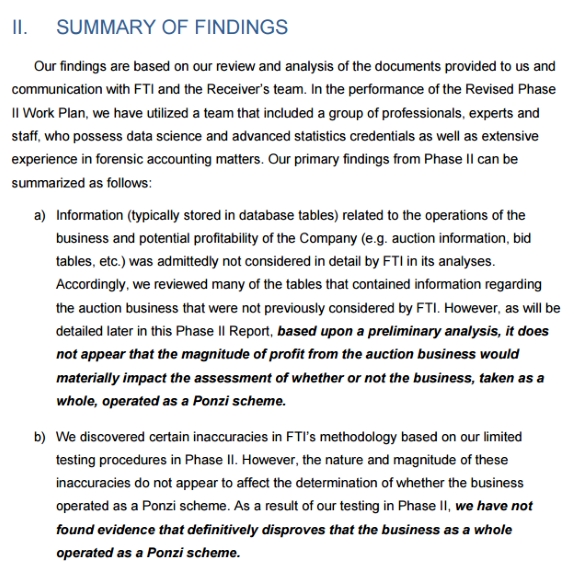
Berkeley Research Group, an expert working for the defense in Zeek clawback litigation, has not been able to disprove the presence of a Ponzi scheme. Source: Screen shot of a Berkeley report to Senior U.S. District Judge Graham C. Mullen Jr. The report is dated May 26, 2016.
URGENT >> BULLETIN >> MOVING: (3RD UPDATE 6:11 P.M. EDT U.S.A.) On virtually the eve of the criminal trial of Paul Burks, receiver Kenneth D. Bell has asked the court presiding over a huge class-action lawsuit against 9,400 alleged Zeek “winners” for a finding the MLM program was a Ponzi scheme.
Such a finding would mandate winners to return nearly $300 million. Bell contended that “[o]f the over $900 million that was paid in to Zeek, only approximately $10 million (1.1%) came from actual retail purchases.”
Retail sales are crucial to the determination of whether an MLM program is legitimate. Bell contends Zeek, which offered a penny auction, was both a Ponzi scheme and a pyramid scheme. Zeek affiliates allegedly believed enormously profitable auctions made Zeek sustainable.
“Two of the primary creators and operators of the ZeekRewards scheme have already admitted it was a Ponzi scheme and pleaded guilty to criminal conduct in connection with the scheme,” Bell argued to Senior U.S. District Judge Graham C. Mullen in a June 30 motion. “In sum, the evidence that ZeekRewards was a Ponzi scheme is overwhelming. Even the Defendant class’ expert has acknowledged finding no evidence that ‘disproves that the business as a whole operated as a Ponzi scheme.’
“Because Zeek’s net winners ‘won’ (the victims’) money in an unlawful Ponzi scheme, under long settled law those winners are not permitted to keep their winnings and must return the fraudulently transferred funds back to the Receiver for distribution to Zeek’s victims,” Bell argued.
At stake in the civil clawback case is more than $282 million allegedly paid to winners by Zeek. Berkeley Research Group is the expert for the defense. Bell used FTI Consulting Inc. as his expert.
Burks’ criminal trial is scheduled to begin Tuesday (July 5).
What kind of financial environment did Zeek create?
According to FTI, only about 8 percent (75,000 usernames) were winners, while 90 percent (841,000 usernames) were losers. Meanwhile, only 0.3 percent (2,778 usernames) were net neutral, with only 1.6 percent (14,500 usernames) classified as auction bidders only.
Bell sued 9,400 alleged winners who’d received more than $1,000 each. FTI asserted that the net losers lost more than $822 million and the net winners hauled away more than $282 million. The small number of auction bidders suggests that Zeekers by and large joined for the purported money-making venture.
But Zeek, Bell alleged, was insolvent even while paying out large sums of money.
Cocaine Allegation Made By Alleged Insider
During a deposition conducted in April 2016 by an attorney for the receivership, alleged Zeek insider Darryle Douglas made a claim that former Zeek COO Dawn Wright-Olivares was a user of “crack cocaine” who was “asked to leave” Free Store Club, a Zeek predecessor, according to a partial transcript included in Bell’s June 30 motion.
Wright-Olivares also is an alleged Zeek insider and one of two Zeek figures to plead guilty to Ponzi-related criminal charges. (The other is Daniel Olivares, her stepson.) Wright-Olivares and Olivares both are expected to testify against Burks at his criminal trial.
Whether Burks intended to use the cocaine allegation against Wright-Olivares to impeach her credibility as a witness was not immediately clear. But Wright-Olivares and Olivares both lived with Douglas at one time in Lexington, N.C., according to the transcript.
Zeek, as part of Rex Venture Group, was based in Lexington.
While living in Lexington, a “separation” developed between Douglas and Wright-Olivares and a once-strong business relationship between Douglas and Burks became “fractured,” according to the transcript.
“And that’s where our separation began,” Douglas said, according to the transcript. “Dawn was a crack cocaine user . . . Dawn used cocaine and was asked to leave the company eventually . . . This was FreeStore Club. She left but came back with the idea for a penny auction, which no one had ever heard of. Because we had a fractured relationship, we created MyBidShack, they created Zeekler. Eventually Paul decided to get rid of MyBidShack and that the company would only go under Zeekler, which made our rift expand. It set up a war that we — that’s when I was no longer allowed to have access codes or key information from accessing the system . . .”
“Rather, [Andy] Bowdoin manufactured the revenue numbers to deceive members into believing that they could reasonably expect to receive an average daily return on their investment with [AdSurfDaily] of at least 1%. This percentage in no way corresponded to the daily revenue that ASD was generating, but had been determined by ASD’s operators to be the amount needed to attract a steady stream of newcomers.” — U.S. Secret Service affidavit in AdSurfDaily forfeiture case, Feb. 26, 2009
“Defendant [Paul] Burks simply made up the ‘daily net profit’ without any reference at all to profits. The true revenue from the [Zeek] scheme, approximately 98% of all incoming funds, came from victim-investors . . . [T]he co-conspirators published bogus daily figures of Zeek’s profits, averaging approximately 1.4% a day . . .” — Office of U.S. Attorney Jill Westmoreland Rose, June 24, 2016
“Burks and his co-conspirators were very aware of ASD and of the fact that it was shut down. For example, on March 26, 2011, a few months after the owner of ASD was indicted, Burks and Dawn Wright-Olivares emailed regarding an affiliate[‘]s advertisement for ZeekRewards that included in the title, ‘[i]f you were in ASD or AVG then you will know how good this is.'” — Office of U.S. Attorney Jill Westmoreland Rose, June 24, 2016
With the July 5 trial date for alleged Zeek Rewards’ operator Paul Burks fast approaching, federal prosecutors making a case for willful blindness now say Burks and co-conspirator Dawn Wright-Olivares plowed forward even though they were “very aware” of the Ponzi-scheme case against AdSurfDaily and operator Andy Bowdoin.
In fact, the office of U.S. Attorney Jill Westmoreland Rose said in June 24 filings, the subject of ASD had come up at Zeek at least by March 2011, only a few months after Bowdoin had been indicted in November 2010.
The triggering event for an email discussion between Burks and Wright-Olivares had been an affiliate’s promotion for Zeek that in part read, “[i]f you were in ASD or AVG then you will know how good this is,” prosecutors said.
“AVG” is short for AdViewGlobal, a 1-percent-a-day scam Bowdoin and others launched just two months after the U.S. Secret Service, using forfeiture law, seized tens of millions of dollars from Bowdoin for his operation of ASD in August 2008. A federal judge revoked Bowdoin’s bail in the ASD case after she found out about AVG.
Wright-Olivares, in February 2014, pleaded guilty to criminal charges for her role in Zeek. She and stepson Daniel Olivares, who also pleaded guilty, are expected to testify against Burks.
The Zeek affiliate’s March 2011 promo using the names of both ASD and AVG prompted Wright-Olivares to advise the affiliate to be “careful with [her] subject line,” prosecutors said. A lecture using all-caps allegedly ensued.
“We cannot have ZeekRewards compared to ASD or AVG EVER for ANY REASON,” Wright-Olivares allegedly wrote to the affiliate. “They were both shut down. We are very very different from both companies.”
It was unclear from the filing whether the Zeek affiliate also had belonged to ASD and AVG. Zeek receiver Kenneth D. Bell has raised the issue of some MLMers moving from one fraud scheme to another, actions that lead to a sort of permanent fog of preposterous disingenuousness and willful blindness in the HYIP sphere.
After ASD had become a topic of discussion inside Zeek in March 2011, the subject came up again in June of that year, prosecutors alleged.
“Similarly, on June 28, 2011, over [S]kype, Wright-Olivares told Burks that changes needed to be made to the program to make it sustainable,” prosecutors alleged. “Burks retorted: ‘I’m the one with my neck in the noose…not you…If the swat team shows up it’s MY ass in the can…’ Wright-Olivares responded, ‘[i]’ll be there too… they will seize it all and we are liable ask the ASD people.'”
By June 2011, it was public knowledge that ASD had gathered at least $110 million. Burks’ prosecutors now are suggesting that, despite the lessons of the ASD case, Burks and Wright-Olivares did not abandon Zeek because the money was simply too good.
“In 2011 alone, Burks received approximately $11 million in income from ZeekRewards out of total revenue of approximately $37 million,” prosecutors alleged in their June 24 brief. They earlier pegged the total haul of Wright-Olivares at about $7.2 million.
Burks is facing charges of with mail- and wire-fraud conspiracy, mail fraud, wire fraud and tax-fraud conspiracy. Some MLMers have insisted for years that the issuance of tax forms by a “program” demonstrates no fraud is under way.
With Zeek, prosecutors have laid bare that notion.
From prosecutors’ assertions (italics added):
In total, Defendant Burks, and others, reported to the IRS supposed income by the victim-investors of over $96 million for the year 2011 on the 1099s issued, while ZeekRewards actually paid out less than approximately $13 million in cash to victim-investors during that year. As a result, individual victim-investors filed false tax returns with the IRS reporting phantom income that they never actually received, and Burks, and others were able to use the false tax notices to perpetuate the Ponzi scheme by making the phantom money seem like it actually existed.
URGENT >> BULLETIN >> MOVING: (5th Update 9:15 p.m. ET U.S.A.) The SEC has gone to federal court in the Western District of North Carolina and charged Zeek Rewards’ figure Trudy Gilmond with securities fraud, selling unregistered securities and failure to register as a broker-dealer.
Among the allegations: Gilmond knew Zeek was under investigation in 2012 and cashed out without telling investors the “program’s” days likely were numbered. She also is accused of joining with Zeek’s principals in playing word games to sanitize the fraud.
Gilmond, 45, of Vermont, is the first individual Zeek promoter charged in an alleged Ponzi- and pyramid scheme said to have gathered more than $850 million. She previously had been sued by court-appointed receiver Kenneth D. Bell as an alleged “winner” in the scheme.
In its complaint, the SEC said Gilmond is a “self-described network marketer who has participated in numerous MLM programs, operating under the trade name ‘Team Fired Up’ to attract followers and new recruits to join her ‘downline’ in those MLM programs (several of which ultimately collapsed in a fashion similar to ZeekRewards).”
Zeek’s former COO Dawn Wright-Olivares, an SEC civil defendant who also has been charged criminally, recruited Gilmond, the SEC charged.
Bell has raised the issue of MLMers or direct marketers moving from one fraud scheme to another. Gilmond now joins MLM promoter Matthew John Gagnon as a roving huckster pursued by both a receiver and the SEC. Gagnon also was pursued by criminal authorities.
With respect to Gilmond, the SEC described her as “one of the most successful and prolific promoters of ZeekRewards. From at least September 2011 until ZeekRewards was shut down in August 2012, Gilmond worked closely with the company founders and served as a senior ‘field liaison’ to promote the scheme, persuading scores of unsophisticated retail investors to buy ZeekRewards securities upon the promise of profit sharing. Gilmond reaped more than $1.7 million in transaction-based commissions and bogus profit-sharing for her recruiting efforts.”
Some of the specific allegations against Gilmond in the SEC complaint (italics added/editing performed):
Based on Gilmond’s efforts and the misstatements on the website, many of Gilmond’s team members ultimately purchased the ZeekRewards securities, earning Gilmond substantial commissions.
As a field liaison, Gilmond had access to portions of ZeekRewards’ internal electronic investor database so that she could make adjustments to individual accounts to address her affiliates’ concerns or complaints. Among other things, Gilmond had the ability to adjust the number of “points” earned and could assign downline recruits to certain affiliates, both of which impacted the measure of profit sharing or commissions paid to those affiliates. In addition, Gilmond developed close ties with Wright-Olivares and other ZeekRewards insiders, which gave her unique access and insight not available to a typical investor.
Having worked closely with the company founders and insiders to promote the scheme in her role as a senior field liaison, and given her prior experience with similar MLM programs that ultimately collapsed, Gilmond knew or should have known that the ZeekRewards scheme’s outsize returns (averaging 1.5% per day) were too good to be true and could not be sustained.
Gilmond also helped conceal from investors and regulators the true nature of the ZeekRewards scheme. To that end, Wright-Olivares and others directed, and Gilmond helped implement, several superficial or nominal changes to certain ZeekRewards features. This included removing any references on the website to the terms “investment” and “ROI”; substituting a daily award percentage that in the aggregate approximated 125% every 90 days rather than “guaranteeing” a 125% return; and requiring investors to give away VIP bids to foster the illusion of contributing efforts to the enterprise.
Aware that ZeekRewards was under investigation by several law enforcement agencies and that the business was in serious trouble in 2012, Gilmond and others withdrew substantial sums of money from the scheme before it was shut down, without advising investors that the scheme was likely to collapse.
Sentencing for Dawn Wright-Olivares, a former Zeek Rewards’ executive who pleaded guilty in February 2014 to investment-fraud conspiracy and tax-fraud conspiracy, has been postponed, the office of U.S. Attorney Jill Westmoreland Rose of the Western District of North Carolina said today.
Wright-Olivares, whose age was listed as 45 by federal prosecutors at the time of her guilty plea, was to have been sentenced yesterday at 2:30 pm EDT before U.S. District Judge Max O. Cogburn Jr., according to the government’s Victim/Witness site for the Zeek Ponzi- and pyramid case.
No new sentencing date has been scheduled for Wright-Olivares, prosecutors said.
Sentencing delays are not unusual in federal cases. The plea agreement for Wright-Olivares requires her to be a prosecution witness if called by the government in “any trial, hearing, or grand jury proceeding, including, but not limited to, testimony against any co-defendants, as the United States designates.”
Zeek’s alleged haul clocked in at about $897 million. In terms of the number of victims, it appears to one of the two largest Ponzi schemes in U.S. history, possibly trailing only the TelexFree MLM scheme.
Now, a year later, a member of the TelexFree MLM scheme shut down by the SEC and other agencies last year is telling a federal judge that it appears TelexFree engaged in accounting fraud that caused him to pay taxes on income he never actually received.
Unlike Zeek’s Paul Burks and Dawn Wright-Olivares, alleged TelexFree operators James Merrill and Carlos Wanzeler have not been charged criminally with tax offenses. But the assertion by Shoyfer gives rise to questions about whether they and others could be as the federal probe of the enterprise continues. Merrill and Wanzeler currently face charges of wire fraud.
Shoyfer, through attorneys from two Boston law firms, says U.S. District Judge Timothy S. Hillman should not permit the plaintiffs to amend the complaint to make him the class-representative. He further contends that “TelexFree has engaged in what appears to be fraudulent accounting practices intending to show that it paid Mr. Shoyfer in excess of $750,000 – however this is simply false.”
“Although TelexFree credited Mr. Shoyfer with large amounts to his TelexFree account, he never withdrew or had access to the vast majority of these funds,” he contended through counsel.
Shoyfer did not identify who might have helped TelexFree hatch a bogus accounting scheme. The SEC, in 2014, charged former TelexFree CFO Joseph H. Craft of Boonville, Ind., with securities fraud. Craft is an accountant. In its civil complaint, the SEC alleged Craft “has been the chief financial officer of other multi-level marketing companies” in addition to his work for TelexFree.
From Shoyfer’s argument (italics added/light editing performed):
Mr. Shoyfer worked with TelexFree from March of 2013 through April of 2014 . . . Over the course of those thirteen months, Mr. Shoyfer received a total of $122,000 from TelexFree . . . However, Shoyfer also spent many thousands of dollars in expenses in order to make this money from TelexFree . . . Mr. Shoyfer estimates that he paid nearly $60,000 to TelexFree in order to be a part of the MLM (including dozens of purchases of the $1,425 AdCentral Family packages, . . . plus other expenses . . . Contrary to the allegations in the proposed amended complaint, Shoyfer never earned $300,000 per week . . . Mr. Shoyfer cannot afford to be the class representative in this lawsuit: it would almost certainly bankrupt him (again), and it would work an immeasurable hardship on his wife, his daughter, his unborn daughter, his two sons, his father, his sister and others that depend on him.
The argument describes Shoyfer as a teenager when he fled the Soviet Union for America years ago with his mother to escape “persecution because of their Jewish heritage.”
Living in the United States, Shoyfer, now believed to be in his forties, eventually became a full-time occupational therapist who started a staffing business in that profession and also dabbled in MLM, according to the argument.
Shoyfer asserts that he believed TelexFree to be legitimate.
“Prior to TelexFree closing down and being charged with fraudulent acts, Mr. Shoyfer had no knowledge that TelexFree was engaged in any unlawful, unfair, or improper practices,” his lawyers argued. “To the contrary, Mr. Shoyfer relied upon the statements of TelexFree’s officers and legal representatives that TelexFree was a fully legitimate and legal enterprise . . . Mr. Shoyfer had no reason to believe otherwise (nor did he) until TelexFree and its officers were charged.”
More from the argument (italics added/light editing performed):
The defense costs Mr. Shoyfer would have to absorb as the named defendant for the putative defendant class would easily exceed the amounts he received from TelexFree and he, therefore, has no incentive to pay the defense costs of being the named defendant . . . If a defendant class is certified, Mr. Shoyfer intends to opt out of the class . . . Mr. Shoyfer has no interest in being lumped together with 20,000 or so other defendants, some of whom may have known more than he did about TelexFree’s activities and the purported pyramid scheme, and some of whom liked caused Mr. Shoyfer to suffer damages himself.
The argument further contends Shoyfer is a good son and sibling who sends between $200 and $300 each month to both his father in Russia and his sister in Lithuania. He also has paid support of about $2,000 a month since 2008 for two children from his first marriage. Shoyfer now has a child with his second wife, with another child on the way.
In June 2015, The PP Blog reported that Shoyfer also was promoting a scheme known as MyAdvertisingPays — or MAPS, for short. MAPS resembles the AdSurfDaily Ponzi scheme, a $119 million fraud uncovered by the U.S. Secret Service in 2008.
Kenneth D. Bell, the Zeek receiver, has raised questions about MLMers moving from one fraud scheme to another.
URGENT >> BULLETIN >> MOVING: (7th Update 8:33 p.m. EDT U.S.A.) The court-appointed receiver in the Zeek Rewards Ponzi- and pyramid-scheme case has sued MLM attorney Gerald Nehra and his law firm and law partner.
Named defendants are Nehra as an individual and as a member of the Nehra and Waak law firm of Michigan, and Richard W. Waak. Like Nehra, Waak is named as an individual and as a member of the firm. The two lawyers’ individual professional LLCs also are named.
The 21-page complaint by Zeek receiver Kenneth D. Bell is dated Sept. 21 and alleges damages of at least $100 million. A section of the complaint quotes a July 22, 2012, email from Waak that reads, “I have primary responsibility for the Zeek Rewards account with our law firm.”
The SEC moved against Zeek a month later, in August 2012, alleging a massive Ponzi- and pyramid scheme. At least three Zeek executives, including alleged operator Paul R. Burks of North Carolina, later were charged criminally. Two of the executives — Dawn Wright-Olivares and her stepson Daniel Olivares — have pleaded guilty.
From the receiver’s complaint (italics added):
By virtue of their knowledge of [Zeek operator Rex Venture Group] and ZeekRewards and their legal expertise, Nehra and Waak knew or should have known that RVG was perpetrating an unlawful scheme which involved a pyramid scheme, an unregistered investment contract and a Ponzi scheme. Despite this knowledge, Nehra and Waak encouraged investors to participate in the scheme by knowingly allowing their names to be used in providing a false façade of legality and legitimacy and gave improper legal advice that allowed the scheme to continue far longer than it would have without the Defendants’ support. Nehra and Waak’s improper and negligent actions, which breached their fiduciary duties to RVG and assisted RVG’s Insiders to breach their fiduciary duties, caused significant damage to RVG.
In a complaint filed May 3, 2014, plaintiffs accused Nehra of counseling TelexFree “on methods to evade United States securities laws that were intended to offer, in part, protection from pyramid Ponzi schemes; all to enrich himself financially and serve his own selfish interests.”
He further was accused of encouraging unknowing TelexFree members to “participate in the evasion of federal and state securities laws.”
The Zeek receiver made similar claims against the lawyers.
“With their inside knowledge of multi-level marketing schemes and access to RVG’s Insiders, Nehra and Waak knew or should have known that insufficient income from the penny auction business was being made to pay the daily ‘profit share’ promised by ZeekRewards,” Bell alleged.
“The Defendants knew or should have known that the money used to fund ZeekRewards’ distributions to Affiliates came almost entirely from new participants rather than income from the Zeekler penny auctions. Further, based on their inside knowledge and access, Nehra and Waak knew or should have known that the alleged ‘profit percentage’ was nothing more than a number made up by Burks or one of the other Insiders. Rather than reflecting the typical variances that might be expected in a company’s profits, the alleged profits paid in ZeekRewards were remarkably consistent, falling nearly always between 1% and 2% on Monday through Thursday and between .5% and 1% on the weekends, Friday through Sunday.”
Nehra also was a figure in the 2008 AdSurfDaily Ponzi scheme story, opining that ASD was not a Ponzi scheme despite remarkably consistent returns. ASD operator Andy Bowdoin later pleaded guilty to wire fraud and acknowledged his company was a Ponzi scheme and never operated lawfully from its inception in 2006.
Like Bowdoin, Zeek’s Burks is accused of making up numbers to dupe participants. In TelexFree-related matters, class-action lawyers argued that “Attorney Nehra’s extensive experience in multi-level marketing, and particularly his involvement with the Ponzi schemes involving Ad SurfDaily and Zeek Rewards, armed him with the knowledge of what constitutes violations of United States securities law. Indeed, Attorney Nehra was well aware that the use of semantics and obscured phraseology to obfuscate securities laws fails to legitimize TelexFree’s illegal Pyramid Ponzi Scheme.”
Zeek receiver Bell accused Nehra and Waak of turning a “blind eye” to incredible claims by Zeek and of suggesting cosmetic changes to language instead of “recommending substantive changes that would make the program lawful.”
At least one alleged TelexFree promoter accused by the SEC last year of securities fraud has alleged she was duped by both the company and Nehra. That claim was made by veteran HYIP Ponzi pitchwoman Faith Sloan.
 Paul Burks, the 70-year-old operator of the Zeek Rewards Ponzi scheme, now is listed as prisoner No. 29723-058 at FMC Lexington. The facility is an administrative security federal medical center with an adjacent minimum security satellite camp in Lexington, Ky.
 Paul Burks will be sentenced Feb. 13 for his criminal role in Zeek Rewards, and the court-appointed receiver is soliciting letters from victims of the combined Ponzi- and pyramid scheme that affected hundreds of thousands of people.