Tag: Dwight Owen Schweitzer

  • UPDATE: (1) Article In Portuguese By Zeek Affiliate On Google News Says Program Has 100,000 Members In Brazil Alone; (2) American Pitchman Calls Zeek An ‘Investment’ On YouTube — And Then Takes It Back

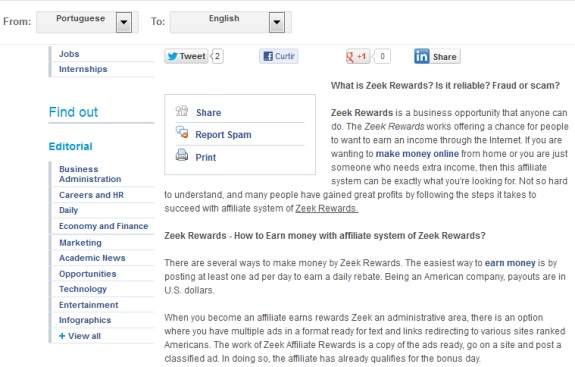
    Screenshot: Part of a promo for Zeek translated from Portuguese to English by Google Translate

    UPDATED 1:59 P.M. EDT (U.S.A.) An article on Google News by an apparent Portuguese-speaking affiliate of the U.S.-based Zeek Rewards MLM “program” that is married to a penny-auction site known as Zeekler claims that Zeek has more than 100,000 members in Brazil alone.

    Meanwhile, a promo by an American affiliate dated July 7 on YouTube describes Zeek as an investment program — before the affiliate backtracks and says Zeek is not an investment program. The YouTube development first was reported by BehindMLM.com. (Link at bottom of story.)

    Portuguese is the official language of Brazil, the largest country in South America. The claim of 100,000 Brazilian members could not immediately be confirmed, and no breakdown of the specific Zeek membership ranks Brazilian members had chosen was provided in the article. Zeek categorizes members as “Free,” “Silver” ($10 a month), “Gold” ($50 a month) and “Diamond” ($99 a month).

    In addition to selecting a membership rank within the Zeek MLM organization, affiliates can opt to send the company up to $10,000 as a means of gaining a daily share of what is known as the Retail Points Pool (RPP). Those shares later can be converted to cash payouts that correspond to an annualized return in the hundreds of percent. The RPP program has led to questions about whether Zeek is selling unregistered securities as investment contracts and using linguistic sleight-of-hand in a bid to avoid regulatory scrutiny.

    Zeek, purportedly part of Rex Venture Group LLC,  is based in North Carolina. On June 20, the office of North Carolina Attorney General Roy Cooper said it had concerns about the company, which plants the seed that members can earn a return of between 1 percent and 2 percent a day but denies it is offering an investment program. Zeek’s business model resembles that of AdSurfDaily, which the U.S. Secret Service said in 2008 was a massive, online Ponzi scheme that was offering securities and disguising itself as an “advertising” program.

    Andy Bowdoin's booking photo in the District of Columbia.

    ASD President Andy Bowdoin is now jailed in the District of Columbia after pleading guilty to wire fraud in the ASD Ponzi case in May 2012. ASD’s purported payout of 1 percent a day was on par with Zeek’s purported daily payout. Because it is known that some affiliates of the ASD Ponzi scheme also are promoting Zeek and because Zeek has highlighted some of those ASD promoters on its website, questions have been raised about whether a core group of MLMers who move individually or as part of “teams” from one investment scheme to another is engaging in willful blindness by promoting Zeek, which is similar to ASD in key respects.

    And because the U.S. government returned millions of dollars to ASD victims last year in the form of remissions payments that came from funds seized in the ASD Ponzi case, questions have been raised about whether Zeek’s growth has been fueled at least in part by the funds originally seized in the ASD case. The government is believed to have returned about $59 million to former ASD members.

    Although Zeek says it is not offering a return on investment and instead is offering revenue-sharing program, the resultant payouts correspond to figures typically associated with HYIP Ponzi investment schemes. Like Zeek, ASD also claimed to be a revenue-sharing program.

    The English version of the Portuguese article for Zeek, according to Google Translate, includes this line: “The easiest way to earn money is by posting at least one ad per day to earn a daily rebate.” (Emphasis added by PP Blog.)

    ASD also called its payouts to members “rebates.” The affiliate article for Zeek in Portuguese includes this phrase: “uma bonificação diária.” The phrase, according to Google Translate, means “a daily subsidy” or “a daily rebate.”

    In the ASD case, federal prosecutors said use of the word “rebate” was a means of masking the investment element of the ASD “program.”

    Zeek also may have a presence in Portugal itself, according to text below a YouTube video (www.youtube.com/watch?v=w07uP5XF39w) in which former ASD pitchman Todd Disner appears. Disner speaks in English in the video, but others appear to be speaking Portuguese and a link below the video points to a website styled in part as zeekportugal.com. Other text at the YouTube site points to a YouTube site styled “parttimezeekrewards’s channel.”

    Disner and former ASD member Dwight Owen Schweitzer sued the United States in November 2011, claiming that ASD was a legitimate business and that government undercover agents who joined ASD had a duty to identify themselves to ASD management. Schweitzer also is promoting Zeek, according to an online promo on a classified-ad site.

    ASD’s Andy Bowdoin’s guilty plea and acknowledgement ASD was a Ponzi scheme were recorded in May 2012, about six months after Disner and Schweitzer sued the government. Both men are seeking to press forward with the lawsuit, despite Bowdoin’s guilty plea to wire fraud and Ponzi concession. The duo claims the seizure of information from ASD’s database by the government was unconstitutional under the 4th Amendment. A federal judge in Florida is expected to rule soon on whether the Disner/Schweizer claims can proceed.

    Virality And Customer-Service Concerns

    The article on Google News that claims that Zeek has 100,000 members in the Portuguese-speaking country of Brazil may speak to the virality of the “program” on the Internet. At the same time, it may explain — at least in part — why Zeek’s customer-support systems appear to be severely taxed if not broken, with Zeek instructing its members to go to their uplines for support. Requests for help through Zeek itself have backed up for weeks or even months. Some English-speaking members of Zeek have complained their support tickets were ignored or closed without explanation.

    Having thousands or even tens of thousands of affiliates in countries whose citizens may not be fully conversant in English leads to questions about whether Zeek has both the resources and the infrastructure to support a global membership base, even as some Zeek members who may not speak English are sending the company one-time sums of up to $10,000 and monthly fees on top of that. It also leads to questions about whether Zeek can police its own global network of affiliates, whether Zeek has the capacity to adequately monitor claims about the “program” in languages other than English and whether Zeek can determine whether its U.S. domestic and international affiliates are operating in “teams” to engage in downline “stacking” designed to concentrate earnings in favored familial or local pools.

    Like ASD, Zeek has instructed members not to describe the “opportunity” as an investment program. But BehindMLM reported yesterday that a Zeek member on YouTube was doing just that before catching himself and going into backtrack mode. From BehindMLM.com, quoting from a Zeek affiliate’s July 7 YouTube promo (italics added):

    [8:58] Do it, I did it! Do it and you’ll see how quickly you can recoup your investm..recoup your investment-ahh, I’m sorry, it’s not an investment – your original purchasing of bids.

    Visit this story thread on BehindMLM.com.

  • BULLETIN: Federal Judge Denies Motion By ASD Figures Dwight Owen Schweitzer And Todd Disner For Government To Produce Names Of Potentially Thousands Of ASD Members Who Filed For Remissions

    BULLETIN: (UPDATED 8:06 P.M. EDT U.S.A.) A federal judge in Florida has denied a motion by AdSurfDaily figures Todd Disner and Dwight Owen Schweitzer that, if granted, could have made the duo privy to information on the identities of any ASD participant who filed a claim for remissions in the ASD Ponzi case, their financial stake in ASD and how much money was returned to them by the government through the remissions claims process.

    U.S. District Judge Cecilia M. Altonaga said no today, ruling that Schweitzer and Disner had not shown why they were entitled to the information and that the government was not compelled to produce it.

    The flap started when Disner and Schweitzer asserted earlier this month that a certificate of interested parties filed by the government in the Disner/Schweitzer lawsuit was “inadequate as a matter of law” because it didn’t include the information on individuals who filed remissions claims. Court records show that about 11,000 ASD members filed claims in the case.

    The government countered by arguing that Disner and Schweitzer were confusing the ASD forfeiture case filed in the District of Columbia with their own lawsuit filed in Florida.

    Altonaga sided with the government today, ruling that the government certificate as it stands “is not necessarily incomplete for failing to list those who have a financial interest in other forfeiture proceedings.”

    “Plaintiffs fail to explain in their Motion why unnamed parties who may have a financial interest in other forfeiture proceedings also have an interest in Plaintiffs’ declaratory judgment action,” Altonaga ruled.

    And the judge further pointed out that Disner and Schweitzer had not complied with her order to file their own certificates in the case. She now has given them until July 6 to do so, warning that “[f]ailure to comply will result in the entry of an order of dismissal without prejudice without further notice.”

  • UPDATE: AdSurfDaily-Like Weirdness Increasingly Creeps Into Lawsuit Against United States By ASD Pitchmen Dwight Owen Schweitzer And Todd Disner, Who Now Are Promoting Zeek Rewards

    Federal prosecutors went to court in the Southern District of Florida today, saying AdSurfDaily figures Todd Disner and Dwight Owen Schweitzer were confusing their November 2011 lawsuit against the government with two forfeiture actions filed in the District of Columbia by federal prosecutors and the U.S. Secret Service in the ASD Ponzi case.

    An assistant U.S. Attorney serving under U.S. Attorney Wifredo A. Ferrer of the Southern District of Florida is serving as the attorney for the United States in the case because Disner and Schweitzer sued the government. Although the ASD Ponzi case was brought in the District of Columbia, Disner and Schweitzer sued the government in Florida. They later claimed that prosecutors had gone forum shopping in Washington to bring the Ponzi forfeiture case.

    Among other things, Disner and Schweitzer claim that undercover agents who joined ASD had a duty to identify themselves to ASD management and that the ASD Ponzi case is a “house of cards” despite ASD President Andy Bowdoin’s guilty plea and public acknowledgment he presided over a Ponzi scheme.

    In a puzzling motion stamped June 20 and entered on the docket of U.S. District Judge Cecilia M. Altonaga on June 21, Schweitzer and Disner claimed they had personally determined that a certificate of interested parties filed by the government in response to an order was “inadequate as a matter of law.”

    Disner and Schweitzer, according to Disner and Schweitzer, had a right to know the identities of any ASD participant who filed a claim for remissions in the ASD Ponzi case, how much money they put into ASD and how much was returned to them by the government through the remission claims process.

    Nonsense, the government said today.

    “The plaintiffs misapprehend the purpose and spirit of the court’s order requiring a certificate of interested parties,” the government said in its response to the Disner/Schweitzer motion. “The instant case is not a forfeiture case as the two forfeiture cases involving AdSurfDaily have already been resolved in the District of Columbia.

    “The certificate of interested parties is not some kind of alternative discovery vehicle collateral to the discovery provisions in the Federal Rules of Civil Procedure,” the government continued. “Rather, the certificate of interested parties in both the federal district and appellate courts is designed ‘to assist judges in making a determination of whether they have any interests in any of a party’s related corporate entities that would disqualify the judges from hearing the [appeal].’”

    Moreover, the government argued, Disner and Schweitzer “did not confer with the defense” as required by the local rules in the Southern District of Florida prior to filing the motion.

    As many as 11,000 parties filed remissions claims in the ASD case, according to federal court records.

    Disner and Schweitzer apparently want to know who all of them are and to ascertain “the financial interest of each[,] including those individuals, separately identified, who applied for remission and, as to each, stating whether the request was approved, approved in part, or denied.”

    The government, however, advised Altonaga that neither Disner nor Schweitzer have filed their own certificates of interested parties in the case.

    Separately, Altonaga today granted the government’s June 4 motion by default to stay discovery in the case, explaining that Disner and Schweitzer have “not filed an opposing memorandum of law to the Motion, nor have they sought an extension of time to do so.”

    Disner is a co-founder of the Quiznos sandwich franchise. Schweitzer is a former attorney now living in Miami whose license was suspended in Connecticut.

    Both men later became pitchmen for Zeek Rewards, an MLM firm whose business model closely resembles the ASD business model that ASD’s Bowdoin admitted was a Ponzi scheme. Bowdoin is jailed in the District of Columbia. A federal judge revoked his bond June 12 after prosecutors proffered evidence that he continued to promote fraud schemes after the U.S. Secret Service seized tens of millions of dollars in the ASD Ponzi case and after Bowdoin was arrested on Ponzi-scheme charges in December 2010.

    Bowdoin pleaded guilty in May to wire fraud in the ASD Ponzi case. His formal sentencing is set for August. He has been banned from multilevel marketing, Internet programs and mass marketing.

    Other ASD-Related News From The OneX Fraud Wing

    In other ASD-related news, a conference call cheerleading session for the purported “OneX” program was canceled tonight after a rah-rah session that had been scheduled for last Thursday also was canceled.

    Tonight’s cheerleading session was to be sponsored by a downline with ASD ties and was contemplated to be one that would build on the purportedly exciting announcement OneX said would be made last week to identify its new payment processor, a source told the PP Blog.

    But OneX apparently canceled the Thursday conference call and never identified a new payment processor, so there was nothing for the OneX downline with ASD ties to cheer about tonight.

    “It is not possible to move forward without the processor being in place,” the ASD downline group said, according to the source.

    But the group held out hope that OneX would announce its new payment processor tomorrow, according to the source.

    In April, federal prosecutors said OneX was a “fraudulent scheme” and “pyramid” that was operating in ASD-like fashion.

  • KABOOM! Alleged International Scammer Targeted In Secret Service Undercover Probe Extradited To United States; ‘Prosecution Demonstrates That Those Who Try To Rip Off Americans From Behind A Computer Screen Across An Ocean Will Not Escape American Justice,’ Top Federal Prosecutor Says

    EDITOR’S NOTE: The PP Blog first reported on the arrest in France of alleged international fraudster Vladislav Anatolievich Horohorin on Aug. 11, 2010. The arrest came as the result of an undercover operation the U.S. Secret Service conducted on online forums.

    As the Blog reported at the time, “The arrest of Vladislav Horohorin is notable on a number of levels. First, the arrest in Europe was a result of an online fraud scheme that allegedly crossed international borders and made its way to the United States, where criminal charges were filed. At the same time, the crime allegedly involved the transfer of money though international payment processors. Perhaps more than anything, however, the case against Horohorin demonstrates that the U.S. Secret Service is “plugged into” forums that promote international lawlessness. His arrest is very bad news for credit-card crooks and HYIP and autosurf Ponzi schemers — and their corrupt colleagues.”

    Today the PP Blog is reporting that the United States successfully arranged the extradition of Horohorin. His first court appearance was made in the District of Columbia, the venue from which the AdSurfDaily Ponzi case brought by the Secret Service is playing out. The office of U.S. Attorney Ronald C. Machen Jr., which was instrumental in guiding the ASD case, is in charge of certain elements of the Horohorin case.

    The office of U.S. Attorney Sally Quillian Yates of the Northern District of Georgia also is handing elements of the Horohorin prosecution.

    The allegations in the case are alarming: “According to the indictment filed in the Northern District of Georgia, Horohorin was one of the lead cashers in an elaborate scheme in which 44 counterfeit payroll debit cards were used to withdraw more than $9 million from over 2,100 ATMs in at least 280 cities worldwide in a span of less than 12 hours,” the Justice Department said in a statement.  “Computer hackers broke into a credit card processor located in the Atlanta area, stole debit card account numbers, and raised the balances and withdrawal limits on those accounts while distributing the account numbers and PIN codes to lead cashers, like Hororhorin, around the world.”

    ** ______________________________________ **

    UPDATE: Alleged international credit-card fraudster Vladislav Anatolievich Horohorin, also known as “BadB,” is in an American jail after an undercover probe on online forums by the U.S. Secret Service and a parallel investigation by the FBI.

    Ronald C. Machen Jr., U.S. Attorney for the District of Columbia

    “We are pleased that he has been extradited to the United States to face these criminal charges in a District of Columbia courtroom,” said U.S. Attorney Ronald C. Machen Jr. of the District of Columbia.  “This prosecution demonstrates that those who try to rip off Americans from behind a computer screen across an ocean will not escape American justice.”

    Horohorin, whose age was listed as 27 after his August 2010 arrest in France on U.S. charges, also will be prosecuted in U.S. District Court for the Northern District of Georgia.

    “International cyber criminals who target American citizens and businesses often believe they are untouchable because they are overseas,” said U.S. Attorney Sally Quillian Yates of the Northern District of Georgia.  “But as this case demonstrates, we will work relentlessly with our law enforcement partners around the world to charge, find and bring those criminals to justice.”

    News of Horohorin’s extradition by France to U.S. soil occurred against the backdrop of claims by an HYIP “program” known as JSS Tripler/JustBeenPaid that members must affirm they are not with the “government” and that the “program” is not located in any “unfriendly political jurisdictions.”

    A JSS/JBP “defender” known as “MoneyMakingBrain” asserted in March that “law enforcement agencies don’t pay attention to what’s being said on forums and blogs.” The claim was at odds with various public records that show U.S. law enforcement pays close attention to forums and Blogs and even conducts undercover operations by infiltrating forums.

    Among other things, “MoneyMakingBrain” asserted he’d defend JSS/JBP’s purported operator Frederick Mann “so help me God.” The PP Blog became the subject of threats from “MoneyMakingBrain.” JSS/JBP, which uses offshore payment processors, purports to provide a return of 60 percent a month, has no known securities registrations and may have ties to the “sovereign citizens” movement.

    Underscoring the importance of the Horohorin arrest and extradition, Machen and Yates were joined in the announcement by the head of the U.S. Department of Justice’s Criminal Division and top officials from both the U.S. Secret Service and the FBI.

    Horohorin, said Assistant Attorney General Lanny Breuer, was “one of the most notorious credit card traffickers in the world.”

    “Due to our strong relationships with our international law enforcement partners, we secured his extradition to the United States, where he now faces multiple criminal counts in two separate indictments,” Breuer said.  “We will continue to do everything we can to bring cybercriminals to justice, including those who operate beyond our borders.”

    A top U.S. Secret Service official, meanwhile, said the agency viewed the alleged Horohorin caper as an “attack” on America’s financial system.

    “The Secret Service is committed to identifying and apprehending those individuals that continue to attack American financial institutions and we will continue to work through our international and domestic law enforcement partners in order to accomplish this,” said David J. O’Connor, assistant director of investigations.

    In addition to providing security for the President of the United States, the Secret Service is in charge of protecting America’s financial infrastructure. The agency has described AdSurfDaily as a “criminal enterprise,” with the Justice Department asserting that ASD was an example of an “insidious” business that permitted fraud to spread globally.

    Just two days after Horohorin’s first appearance in a U.S. courtroom in the District of Columbia, AdSurfDaily members Todd Disner and Dwight Owen Schweitzer claimed that the federal prosecutors who brought the ASD Ponzi case in August 2008 had gone shopping for a “frendly [sic] forum” in which the government could enlist “some of their Washington D.C. operatives to become members of ASD, thereby making them potential witnesses.”

    Disner and Schweitzer sued the United States in November 2011 for alleged misdeeds in the ASD case. Among other things, Disner and Schweitzer asserted that undercover agents who joined ASD had a duty to inform ASD management.  The Secret Service described ASD as a massive online Ponzi scheme involving at least $110 million. ASD President Andy Bowdoin pleaded guilty to wire fraud last month, admitting ASD was a Ponzi scheme and that the company never operated legally from its inception in 2006.

    Disner and Schweitzer now are affiliates for Zeek Rewards, a “program” that plants the seed it can provide an ASD-like return of 1 percent or more per day without being a pyramid scheme and without constituting an investment opportunity. The payout Zeek plants the seed it can provide is on par with the returns advertised by JSS Tripler/JustBeenPaid, which does not disclose its base of operations.

    A top FBI official said the arrest of Horohorin showed that international agencies are working together to divorce criminals from their abilities to use computers to reach across borders to pull off egregious crimes.

    “Horohorin’s extradition to the United States demonstrates the FBI’s expertise in conducting long-term investigations into complex criminal computer intrusions, resulting in bringing the most egregious cyber criminals to justice, even from foreign shores,” said Brian D. Lamkin , special agent in charge of the Atlanta division. “The combined efforts of law enforcement agencies to include our international partners around the world will ensure this trend continues.”

    Court and other records show that Horohorin, like ASD, had a presence in both the District of Columbia and the Northern District of Georgia.

  • BULLETIN: AdSurfDaily Figures (And Zeek Rewards Pitchmen) Todd Disner And Dwight Owen Schweitzer Raise Possibility Of Prosecution For Tax Evasion Because Of Government Seizure Of ASD Database

    After the August 2008 seizure by the U.S. Secret Service of tens of millions of dollars in the AdSurfDaily Ponzi case, Dwight Owen Schweitzer became a pitchman for the Zeek Rewards "program," according to this ad. Schweitzer, a former attorney whose license was suspended in Connecticut, and fellow ASD figure Todd Disner sued the United States in November 2011 for alleged misdeeds in the ASD case, claiming the government had authored a "tissue of lies" in the ASD case and that ASD was a legitimate business. ASD President Andy Bowdoin admitted last month that ASD was a Ponzi scheme and that his business never operated legally from its 2006 inception, putting Bowdoin at odds with both Disner and Schweitzer and also purported MLM expert Keith Laggos, who curiously opined ASD was not a "Ponzie" scheme. Bowdoin is now jailed in the District of Columbia after a federal judge revoked his bond. The judge ordered Bowdoin jailed pending formal sentencing after the government proffered evidence that Bowdoin continued to promote fraud schemes after the seizure of $65.8 million from his personal bank accounts in 2008 and after Bowdoin was arrested in December 2010 on ASD-related charges of wire fraud, securities fraud and selling unregistered securities.

    EDITOR’S NOTE: The filing by Todd Disner and Dwight Owen Schweitzer to which the PP Blog refers in this story was in response to a May 18 government motion to dismiss a lawsuit filed by Disner and Schweitzer against the United States in the Southern District of Florida or to transfer the case to U.S. District Court for the District of Columbia. The government filed its motions on the same date ASD President Andy Bowdoin pleaded guilty to wire fraud and admitted that ASD was a Ponzi scheme . . .

    BULLETIN: In a curious, 23-page narrative, AdSurfDaily figures Todd Disner and Dwight Owen Schweitzer — who went on to become promoters of the Zeek Rewards MLM — have raised the prospect that they could be prosecuted for tax evasion because of the government seizure of ASD’s database in August 2008.

    Neither Disner nor Schweitzer referenced Zeek in a filing stamped June 15 and entered today on the docket of U.S. District Judge Cecilia M. Altonaga of the Southern District of Florida. But the filing includes the name of Zeek consultant Keith Laggos, positioning Laggos as an expert on Ponzi schemes who ventured an opinion that ASD was not a Ponzi scheme.

    The Disner/Schweitzer filing does not mention that Laggos repeatedly misspelled “Ponzi” as “Ponzie” in his purported expert opinion in the ASD case. Nor does it mention that Laggos was prosecuted by the SEC in a 2004 case that alleged he issued laudatory press releases and a laudatory article for a company that later become the subject of a securities investigation without disclosing he was being compensated for touting the purported opportunity.

    Laggos neither admitted nor denied the SEC’s allegations, which involved a company known as Converge Global Inc. and a subsidiary known as TeleWrx Inc. The future Zeek consultant settled the 2004 SEC case by disgorging nearly $12,000, paying interest of nearly $2,000, paying a civil fine of $19,500 and agreeing to a five-year penny-stock ban.

    Laggos was permanently enjoined in the case from violating Section 17(b) of the Securities Act, which makes it unlawful to tout a stock without disclosing the nature and substance of any consideration, whether present or future, direct or indirect, received from an issuer, underwriter or dealer.

    An image of Laggos now appears in a commercial for Zeek, and a publication owned by Laggos has issued laudatory coverage of the purported MLM opportunity, which plants the seed it provides a return of between 1 percent and 2 percent a day without being a “pyramid scheme” and without constituting an investment opportunity.

    It is known that Zeek and ASD had common promoters and that, beginning in about July 2011, some well-known figures in the ASD story began to emerge publicly as Zeek boosters. Among them are former “Surf’s Up” moderator Terralynn Hoy and former ASD pitchman Jerry Napier.

    Hoy, who has been listed as a “Zeek” employee and has hosted at least once conference call for Zeek, was a moderator of a defunct ASD cheerleading forum known as “Surf’s Up.” While “Surf’s Up” still was operating, Hoy became a moderator of a forum that led cheers for an autosurf known as AdViewGlobal, which federal prosecutors now say was a fraudulent scheme backed by ASD President Andy Bowdoin. Both Surf’s Up and the AdViewGlobal forum, which also now is defunct, described ASD figure and purported “sovereign citizen” Curtis Richmond as a “hero.”

    Richmond has a contempt of court conviction for threatening federal judges and once was sued successfully under the federal racketeering statute for participating in a scheme in which enormous purported judgments were filed against public officials and the officials were threatened with arrest. ASD is known to have had ties to tax deniers and “sovereign citizens.”

    Some Zeek promoters also are pushing a purported “opportunity” known as JSS Tripler/JustBeenPaid that may have links to the “sovereign citizens” movement. Frederick Mann, the purported operator of JSS/JBP, does not identify where the purported opportunity operates from and has speculated that the servers of JSS/JBP could be targeted in a “cruise missile” attack by the government.

    JSS/JBP advertises a return of 2 percent a day, a percentage that Zeek sometimes says it has matched or exceeded — though Zeek generally stays between 1 percent and 2 percent a day when the purported payout is averaged over a week, Zeek promoters claim.

    As a Zeek promoter, Napier was given a puff piece last summer by the purported Zeek opportunity. An individual with the same name appears to have signed a petition in December 2008 calling for the U.S. Senate not to investigate ASD and Bowdoin, but to investigate various federal prosecutors and the U.S. Secret Service agent who brought the ASD Ponzi case in August 2008. The petition showing the name of “Jerry Napier” appears to have been signed by “Jerry Napier” after federal prosecutors brought a second forfeiture case against ASD-related assets on Dec. 19, 2008. As was the case with the August 2008 forfeiture filing by the government, the December 2008 case alleged a Ponzi scheme.

    Today’s filing by Disner and Schweitzer advances a theory — even after Bowdoin’s guilty plea to wire fraud last month and public acknowledgment that he presided over a Ponzi scheme — that the government’s Ponzi claims constituted a “house of cards.”

    It also plants the seed that prosecutors shopped the ASD case to a “frendly [sic] forum” in the District of Columbia to make it easier for the government to enlist “some of their Washington D.C. operatives to become members of ASD, thereby making them potential witnesses.”

    Disner and Schweitzer claim that the seizure of ASD’s database in Florida was unconstitutional because it subjected them to an invasion of privacy and potentially a tax investigation.

    “The plaintiffs have alleged that the information taken by the defendant places the plaintiffs in jeopardy of the defendant seeking to prosecute the plaintiffs for tax evasion as a result of the defendant having taken the plaintiffs records which are necessary to enable the plaintiffs to file accurate tax returns for the period covered by those records,” Disner and Schweitzer argued.

    And Disner and Schweitzer further ventured (italics added):

    As a result of the government’s action, the plaintiffs cannot file accurate tax returns, have lost both past and future business revenues, their reputations have been damaged to the extent that they recruited others to join in the program that the defendant alleged to be a Ponzi scheme, and by inference the plaintiffs have therefore enlisted others to participate in an illegal enterprise. The injuries suffered by the plaintiffs are not hypothetical or conjectural but are both finite and calculable. They have alleged that the actions taken against them were authorized without meeting the constitutionally guaranteed and statutorily increased requirements to establish probable cause and resulted in an illegal search and seizure of their property and effects.

    Neither Zeek nor any of its executives or promoters have been accused of wrongdoing. Zeek, though, claimed last month that it was closing two U.S. bank accounts and looking to open an account with a bank it did not name.

    Zeek is using offshore payment processors linked to numerous schemes that promote outsize returns. A Zeek auction arm known as Zeekler is auctioning sums of U.S. cash and telling winners it will pay them via offshore processors.

    Components of the Zeek scheme are similar to components of the ASD Ponzi scheme.

    In 2008, an HYIP scheme known as Legisi resulted in an an SEC civil prosecution. Court papers showed that the U.S. Secret Service and state regulators in Michigan were conducting an undercover probe of Legisi which, like JSS/JBP, sought to make participants affirm they were not government employees.

    Like ASD’s Bowdoin, Legisi operator Gregory McKnight pleaded guilty to wire fraud. Records show that a tier of the purported Legisi program offered a daily return that was about one-fourth the daily return Zeek plants the seed can be realized through its purported opportunity.

    Although Surf’s Up, which received ASD’s official endorsement as a news outlet with Hoy as a moderator, led cheers for ASD and Bowdoin until the forum mysteriously vanished in January 2010, Hoy appears to believe that Ponzi schemes actually can exist.

    SSH2 Acquisitions, a Nevada company that listed Hoy as a director, claimed in 2010 that it had been defrauded in a Ponzi scheme.

  • Site That Sells Zeek Rewards ‘Customers’ Uses PayPal, Serves Confusing Pop-Up Screens, References AdSurfDaily Figure Todd Disner — And Sends Traffic To JSSTripler/JustBeenPaid Site That May Have ‘Sovereign Citizens’ Link

    Depending on how they navigate the site, PennyAuctionCustomers.com visitors may encounter a confusing series of screens and ultimately may be shown an ad for JSS Tripler/JustBeenPaid, which may have ties to the "sovereign citizens" movement. The PennyAuctionCustomers site purports to sell customers for the ZeekRewards MLM "program" that plants the seed it provides a daily return of between 1 percent and 2 percent while not being a "pyramid scheme" and while not constituting an investment program.

    PennyAuctionCustomers.com advertises that it sells “customers” to members of the Zeek Rewards MLM, collects money through PayPal, serves confusing pop-up messages, uses the name of AdSurfDaily figure Todd Disner in its meta data — and sends traffic to the preposterous JSS Tripler/JustBeenPaid “program” that advertises a return of 60 percent a month.

    Whether the site has any affiliation with Disner is unclear. What is clear is that Disner is a Zeek Rewards member who sued the U.S. government last year for alleged misdeeds in the AdSurfDaily Ponzi case, including a claim that federal prosecutors and the U.S. Secret Service had relied on a “tissue of lies” in bringing the ASD case.

    This Zeek ad attributed to former AdSurfDaily member Dwight Owen Schweitzer paints Zeek as an investment program through which participants can "earn 1%+ a day compounded."

    Disner’s co-plaintiff in the case was fellow ASD (and Zeek) member Dwight Owen Schweitzer, a former attorney whose license was suspended in Connecticut. The government asked a federal judge last month to dismiss the Disner/Schweitzer complaint, pointing out that ASD President Andy Bowdoin had pleaded guilty to wire fraud in the ASD case.

    Bowdoin, 77, is now detained in Washington, D.C., awaiting formal sentencing by U.S. District Judge Rosemary Collyer in August. Court papers show that Bowdoin admitted ASD was a Ponzi scheme and that he had presided over an illegal money-making business since the inception of ASD in 2006.

    Zeek’s business model closely resembles that of ASD. Like ASD, Zeek plants the seed that it provides a daily return that corresponds to an annual return in excess of 300 percent. Zeek participants must place an ad online daily to earn the purported daily payout. ASD members were required to view ads.

    The U.S. Secret Service seized more than $80 million in the ASD Ponzi case, including more than $65.8 million from Bowdoin’s bank accounts in August 2008.

    When the PP Blog visited PennyAuctionCustomers.com, accessed the “FAQ” page and sought to leave the page, the Blog’s browser encountered multiple pop-up screens that displayed confusing messages. Eventually the Blog was shown a page on the site with banner ads for the JSS/JBP “program” and a “program” known as Banners Broker.

    The banner ad near the bottom of this page on the PennyAuctionCustomers.com website points visitors to the JSS Tripler/JustBeenPaid "program" after soliciting visitors to purchase "customers" for the Zeek Rewards MLM "program." A JSS/JBP site loads when the "Triple Your Money" banner is clicked.

    “DO YOU LIKE ZEEK REWARDS?” the PennyAuctionCustomers site inquires.

    “WELL YOU WILL LOVE THIS,” it asserts. “Two Other Highly Lucrative Programs That Do Not Require Any Sponsoring of Other Affiliates That You May Wish To Join If You Are Looking To Boost Your Income!”

    It then points visitors toward JSS/JBP and Banners Broker.

    Like Zeek (and ASD before it), the JSS/JBP and Banners Broker “programs” are being advertised on well-known Ponzi scheme forums such as TalkGold and MoneyMakerGroup. The various promotions lead to questions about whether fraudulent schemes are simply recycling money from scam to scam to scam, polluting the money stream at multiple points nationally and internationally.

    These phrases are among the meta data on the PennyAuctionCustomers site:

    • zeekrewards 90 day strategy
    • zeekrewards calculator
    • is zeekrewards legit
    • is zeekrewards legal
    • todd disner zeek rewards

    An Oregon entity known as Media Clinch LLC appears to be conducting the Zeek “customer” sales through PayPal while at once pointing traffic toward Banners Broker and JSS/JBP, which purportedly is operated by Frederick Mann. Mann and JSS/JBP may have ties to the so-called “sovereign citizens” movement in which adherents display an irrational belief that laws do not apply to them and courts have no jurisdiction over them.

    Although JSS/JBP appears to rely on “offshore” payment processors linked to fraud scheme after fraud scheme, the PennyAuctionCustomers Zeek promos through the Media Clinch LLC PayPal account introduces the prospect that soiled proceeds from multiple fraud schemes also could be flowing into PayPal.

    Media Clinch LLC, according to Oregon records, is managed by Sean Walters. Zeek has an affiliate by the same name.


  • BULLETIN: Feds Move To Stay Discovery In Lawsuit Filed By ASD Figures Dwight Owen Schweitzer And Todd Disner; Prosecutors Say Neither Schweitzer Nor Disner Responded To May 23 Email

    BULLETIN: Federal prosecutors have gone to federal court in the Southern District of Florida, asking a judge to delay discovery in the November 2011 lawsuit filed against the government by AdSurfDaily figures Dwight Owen Schweitzer and Todd Disner.

    In cases in which plaintiffs sue the government in federal court, assistant U.S. Attorneys who ordinarily may assist in the prosecution of civil and criminal cases put on a new hat and become lawyers representing the government as a client.

    An assistant U.S. Attorney is now the lawyer for the government because Schweitzer and Disner effectively sued the office of U.S. Attorney Ronald C. Machen Jr. in the District of Columbia for alleged misdeeds in the ASD case even as they accused the U.S. Secret Service of assisting in the government presentation of a “tissue of lies” against AdSurfDaily President Andy Bowdoin and ASD itself.

    Schweitzer and Disner have not been accused of wrongdoing. Among the curious assertions in their lawsuit against the government was that undercover agents who had infiltrated ASD had a duty to report the agents’ alleged ASD Terms of Service violations to ASD management.

    After their ASD days, Disner and Schweitzer moved on to become affiliates for Zeek Rewards, an MLM “program” that plants the seed that returns between 1 percent and 2 percent a day are possible and that Zeek does not constitute an investment opportunity. ASD planted the seed that it paid 1 percent a day and also claimed it was not offering an investment opportunity.

    In 2008, prosecutors said ASD was relying on wordplay to try to skirt securities laws. ASD President Andy Bowdoin pleaded guilty to wire fraud in the ASD case on May 18 and acknowledged he was at the helm of a Ponzi scheme and illegal money-making business that had defrauded members since its inception in 2006.

    By the end of the business day on May 18, prosecutors asked a federal judge in Southern Florida — the venue in which Disner and Schweitzer brought their lawsuit — to take notice of Bowdoin’s guilty plea before U.S. District Judge Rosemary Collyer more than 1,000 miles north in the District of Columbia. Even as they pointed to Bowdoin’s guilty plea, prosecutors asked that the Disner/Schweitzer case be dismissed.

    Prosecutors say their dismissal motion would eliminate the need for any discovery if approved by U.S. District Judge Judge Cecilia M. Altonaga in the Southern District of Florida. If Altonaga chooses not to dismiss the Schweitzer/Disner complaint, prosecutors said, the case should be moved to the District of Columbia, the venue in which at least three civil-forfeiture actions against ASD-related assets were brought in 2008 and 2009.

    In their June 4 motion to delay discovery pending a ruling on the dismissal motion, prosecutors said they emailed Schweitzer and Disner on May 23 “seeking their positions on the defendant’s motion to stay” discovery, but that neither Schweitzer nor Disner responded to the emails.

  • ZEEK: Now, A Problem With ‘Mislabeled’ Purchases, MLM ‘Opportunity’ Married To Penny-Auction Site Says

    After wrapping itself in the American flag on Memorial Day and authoring a vague announcement that it “will be closing our old accounts” at two named U.S. banks and transitioning to an unnamed bank “that can handle our growing needs,” the Zeek Rewards MLM “program” now says it experienced a problem with “mislabeled” credit-card purchases.

    Zeek blamed a vendor for the problem, which resulted in Zeek purchases being mislabeled as purchases from a company named “Zonalibre1,” Zeek said.

    “We have just been informed that our credit card processing mis labeled [sic] zeek purchases with the company name Zonalibre1 for the past 15 hours,” Zeek said on its news Blog last night. “This is currently being corrected on all billing statements. If you have purchased anything from zeek in the past 15 to 20 hours and have a ‘Zonalibre1’ charge for the same dollar amount as your zeek purchase, please do not dispute the charge.”

    “Zona Libre” is a Spanish phrase that means “free zone.” Zeek did not say who informed it about the problem. Nor did it identify the vendor or say whether it was using a U.S. domestic or offshore processor to handle credit card transactions.

    Zeek announced Monday that it was dumping two U.S. banks, adding a layer of mystery by saying it “is currently in the process of moving to a bank” — but not saying whether its new bank was U.S. domestic or offshore.

    A Zeek-related business known as Zeekler is a penny-auction site. Among other things, Zeekler puts up for bid sums of U.S. currency, saying successful bidders can receive their winnings via the payment processors AlertPay (now Payza) and SolidTrustPay. Both firms are offshore from a U.S. perspective and have gained reputations as enablers of fraud schemes.

    Among the many other Ponzi-forum promoted “programs” that use AlertPay and SolidTrustPay is JSS Tripler/JustBeenPaid, which purportedly is operated by Frederick Mann and may have ties to the so-called “sovereign citizens” movement. JSS/JBP purports to pay 2 percent a day. “Sovereign citizens” have an irrational belief that laws do not apply to them.

    Promos in 2008 identified Mann as a pitchman for AdSurfDaily, which the U.S. Secret Service described as a “criminal enterprise” and Ponzi scheme that had gathered at least $110 million online. ASD is known to have had “sovereign citizens” in its ranks. ASD President Andy Bowdoin pleaded guilty to wire fraud last month, acknowledging that ASD was a Ponzi scheme that had defrauded participants from Day One of its operation, beginning in late 2006.

    Some former ASD affiliates also are known to be promoting Zeek. Included among them are Todd Disner and Dwight Owen Schweitzer, who sued the United States last year for alleged misdeeds in bringing the ASD Ponzi case. One text ad for Zeek that includes a photo of Schweitzer includes this phrase (italics added):

    “I earn 1%+ a day compounded & you can too!”

    Schweitzer is a former attorney whose license was suspended in Connecticut. Disner is a co-founder of the Quiznos sandwich franchise.

    Both Zeek Rewards and Zeekler say they are part of an entity known as Rex Venture Group. Rex operates in North Carolina, the same state in which the banks it announced it was dumping operate. On Monday, Zeek instructed customers to “Please be sure to deposit or cash any commission checks immediately so they clear before June 1st, 2012 or they will be returned to you with ‘account closed’ and will need to be reissued.”

    Two days later — on Wednesday, during evening hours in the United States — Zeek issued a strange announcement that used the term “claw-back.” “Clawback” is a word often associated with Ponzi schemes. For instance, if investors in Ponzi schemes emerge as winners among a pool of losers, the government or court-appointed receivers may file clawback lawsuits that demand the return of funds from winners as a means of ensuring that all victims of a fraud scheme are treated equally.

    Here, in one instance, is how Zeek used the term (italics added):

    “As you know, we are currently in the process of transferring accounts to our new banks. While we will be able to resume check runs when the transfers are finalized, we do not want to cause any additional delay to our affiliates who are waiting for their May 21st or 28th commission checks. Therefore we are going to be issuing a claw-back of all requested checks into a special Zeek portal where any affiliate who is awaiting a physical check can instead choose their preferred eWallet for their commission payment. All three fully integrated eWallets (below) will be made available for this and future paydays.

    • SolidTrust Pay
    • AlertPay

    Although Zeek initially said on Wednesday it had three eWallet providers, it now appears to be referencing only two — apparently editing its original news-Blog post. (In the original announcement Wednesday, Zeek also listed NXPay.)

    Adding another layer of mystery to Wednesday’s announcement was Zeek’s use of the plural “banks” in the context of its transition to new service-providers. On Monday, Zeek used the singular “bank,” implying that it was selecting a single new bank to handle its needs.

    Zeek affiliates have a presence on well-known Ponzi scheme forums such as TalkGold and MoneyMakerGroup, forums whose members promote “programs” that purportedly offer returns that are both unusually consistent and outsize — typically at preposterous ROIs that exceed 1 percent a day.

    Affiliates of Zeek say the Zeek “program” pays out between 1 percent and 2 percent a day, although Zeek claims it is not an investment program and has preemptively denied it is a pyramid scheme.

    Among Zeek’s claimed consultants are the MLM law firm of Gerald Nehra, and purported MLM expert Keith Laggos. Both Nehra and Laggos ventured opinions that ASD was not a Ponzi scheme. Disner and Schweitzer pointed to those opinions when suing the United States in November 2011.

    The government has moved for dismissal of the lawsuit, pointing to Bowdoin’s guilty plea and acknowledgement that ASD was a Ponzi scheme. Among other things, Disner and Schweitzer argued that undercover agents who joined ASD prior to the seizure of $65.8 million in the personal bank accounts of Bowdoin violated ASDs Terms of Service and had a duty to report their alleged violations to ASD.

    Disner and Schweitzer also sued Rust Consulting Inc., the government-approved claims administrator in the ASD case. A federal judge dismissed Rust as a defendant weeks ago.

  • WILL JSS/JBP AND ‘ONEX’ MEMBERS PAY ATTENTION? Andy Bowdoin’s Plea Agreement Bans Him From MLM, Internet Programs And Mass Marketing; ‘I Am Pleading Guilty Because I Am In Fact Guilty . . .,’ AdSurfDaily Patriarch Tells Judge

    Under the terms of his plea agreement, AdSurfDaily President Andy Bowdoin effectively has been banned from multilevel marketing, Internet opportunities and businesses that employ mass marketing.

    The agreement contains this provision, and Bowdoin consented to it in writing as a condition of release before he is formally sentenced: “Your client shall not participate in any business venture using the internet, multi-level marketing, or mass marketing.” (Italics added.)

    Language in the agreement suggests the bans could last until Bowdoin is well into his eighties — until Bowdoin, now 77, serves any prison or probationary term imposed. No sentencing date has been scheduled. Bowdoin’s next court date is set for June 12 “to determine if he should be incarcerated pending his sentencing,” federal prosecutors said.

    Bowdoin pleaded guilty yesterday to wire fraud for the web-based ASD scam.  The information in the numbered entries (below) was confirmed by Bowdoin himself in a “Statement of Offense” that bears his signature. It is in stark contrast to earlier online claims by the ASD patriarch that he had been railroaded and that ASD members should send him money to pay for his criminal defense.

    Second Key Win For Government

    Bowdoin’s guilty plea marked the second recent win by the government in a major online HYIP case. Gregory N. McKnight, the operator of the Legisi HYIP and Ponzi scheme, pleaded guilty to wire fraud in February. The Legisi and ASD schemes fetched a combined haul of more than $180 million, according to court filings. Bowdoin’s scheme was a form of HYIP fraud known as “autosurfing” in which participants were promised enormous returns for viewing advertisements. The schemes spread in part through social networking and shilling sites such as the TalkGold and MoneyMakerGroup forums.

    The U.S. Secret Service was involved in both the ASD  and Legisi probes.

    ASD Discussed In HYIP’s Conference Call Day Before Bowdoin Guilty Plea

    A current HYIP scheme known as JSS Tripler/JustBeenPaid continues to make inroads online. Frederick Mann, the purported operator of JSS/JBP, was identified in 2008 promos as an ASD pitchman. Bowdoin’s legal problems were among the subjects of a JSS/JBP conference call Thursday that appeared to be heavily populated by U.S. residents, including some who expressed worry about the “program.” JSS/JBP purports to provide a daily return of 2 percent, twice that of ASD.

    Less than 24 hours after Thurday’s JSS/JBP call ended, Bowdoin pleaded guilty in open court and subjected himself to a possible prison term of 78 months, along with three years’ supervised release. Under the terms of his plea agreement, Bowdoin potentially faces court supervision for the next 9 and a half years.

    During Thursday’s call, Mann — an older man, like Bowdoin  — did not rule out the possibility that his program could encounter an ASD-like intervention by the government.

    “The slavemasters don’t want their slaves to escape,” Mann said, casting the U.S. government as wicked.

    “What you need to realize is that the de facto U.S. Constitution is ‘anything goes’ that we can get away with. So, that’s how Obama operates. That’s how Romney would operate if he were elected President. That’s how George Bush operates.”

    Like ASD, JSS/JBP may have ties or be sympathetic to the so-called “sovereign citizen” movement. “Sovereign citizens” have an irrational belief that laws do not apply to them. JSS/JBP is so secretive that the “opportunity” does not identify where it is operating from and makes members affirm they are not with the “government.”

    After a caller asked Mann Thursday about ASD, Mann said this:

    “If they want to arrest people and take their money, they will find some pretext.”

    HYIPs operate as virtually pure Ponzi schemes. Victims can pile up by the tens of thousands in a single scheme. The schemes redistribute wealth from the masses and put it in the hands of a select few.

    Bowdoin’s Statement

    ASD's Andy Bowdoin

    Before getting into some of the specifics of Bowdoin’s signed statement — a statement also signed by Bowdoin’s attorney Charles A. Murray and a federal prosecutor — it perhaps is worth noting that Bowdoin’s plea agreement contains this provision to which Bowdoin agreed in writing: “Your client represents to the Court that his attorney has rendered effective assistance.” (Italics added.)

    Though boilerplate  language, it is important in the context of Bowdoin’s history. Indeed, he has a history of publicly blaming lawyers for his problems. In 2011, for example, he appeared in a video solicitation in which he asked the people he now admits he defrauded to pay for his criminal defense. Bowdoin blamed his prior counsel, a federal judge, two federal prosecutors and three agents of the U.S. Secret Service for his predicament. The final page of the plea agreement contains this language to which Bowdoin agreed in writing:

    “I have read this Plea Agreement and discussed it with my attorneys, Michael McDonnell, Esq. and Charles Murray, Esq. I fully understand this Plea Agreement and agree to it without reservation. I do this voluntarily and of my own free will, intending to be legally bound. No threats have been made against me nor am I under the influence of anything that could impede my ability to understand this Plea Agreement fully. I am pleading guilty because I am in fact guilty of the offense(s) identified in this Plea Agreement.” (Italics/bolding added)

    Because of the plea agreement and the MLM/Internet/mass-marketing bans, Bowdoin’s role as an an online pitchman for a program known as “OneX” has ended.

    In essence, because of what Bowdoin did in ASD — and allegedly what he continued to do even after being arrested for running a Ponzi scheme — Bowdoin has been banned from MLM, kicked out of the business side of the Web and barred from making mass solicitations in any form.

    Prosecutors said last month that OneX was a “fraudulent scheme” and “pyramid” that was recycling money to members in ASD-like fashion. Bowdoin was arrested on ASD-related charges in December 2010. In October 2011 — 10 months after his arrest — he told OneX prospects that God had provided the OneX program and that he intended to use money from the scheme to pay for his criminal defense.

    On Tuesday — just three days before Bowdoin pleaded guilty to a felony for his operation of ASD — a fellow OneX pitchman described Bowdoin as “our Mentor.”

    Here, now, some highlights from Bowdoin’s signed “Statement of Offense” — along with editorial notes. Bolding added by the PP Blog . . .

    1.) “Bowdoin called ASD’s operation a revenue-sharing advertising program . . .” (NOTE: All kinds of HYIP schemes use the phrase “revenue sharing” as a means of masking the Ponzi elements. The phrase, for example, appears on the website of JSS/JBP. It “works” because it sounds plausible. After all, many businesses share revenue legally. The connection many new HYIP enlistees do not make is that scammers have co-opted the term to sanitize their fraud schemes.)

    2.) “But, contrary to its representations, the advertising packages sold by ASD generated insufficient revenue to fund the returns it promised to the members. Instead, ASD operated as a ‘Ponzi’ scheme.” (NOTE: ASD members Dwight Owen Schweitzer and Todd Disner sued the government last year, alleging that ASD was a legitimate business. Bowdoin now publicly disagrees with them, based on his admission that ASD was a Ponzi scheme.)

    3.) “Throughout ASD’s operation, Bowdoin was aware that ASD was an illegal money making business, and that he was intentionally defrauding ASD members.”

    4.) ASD, according to Bowdoin’s statement, actually gathered more than “$119 million” from members. (NOTE: This figure is about $9 million higher than the rough amount of $110 million cited by the government in previous filings. The PP Blog will check next week to see if it can confirm that the $119 million figure is the final sum identified after investigation. As things stand, both Bowdoin and the government agree on the $119 million figure.)

    5.) ASD made more than $45 million in Ponzi payments and spent more than $10 million on operations. About $1.161 million was directed at Bowdoin or his family.

    6.) During ASD’s initial iteration at AdSurfDaily.com, Bowdoin realized “[a]fter only a few months of operation” that ASD was in over its head “because he was not selling any independent products or services sufficient to generate an income stream needed to support the returns and commissions ASD was paying . . .” (NOTE: The JSS/JBP scheme has a commission-payout scheme (two tiers, one paying 10 percent the other 5 percent) that is virtually identical to ASD. Incredibly, JSS/JBP  says it can pay double ASD’s daily return of 1 percent on top of the two-tiered commissions.)

    7.) “In approximately March 2007, Bowdoin ceased ASD’s operations because it was paying out money to its employees and members faster than it was taking in new money.” (NOTE: Bowdoin’s concession proves the government’s longstanding theory that ASD collapsed in its original iteration because of the Ponzi pressure. At one point, according to court filings, Bowdoin blamed ASD’s inability to pay on script problems and a purported theft of $1 million by “Russian” hackers.)

    8.) Bowdoin — instead of getting out of the Ponzi business — thereafter launched ASD under a new name at a new website: ASDCashGenerator.com. Bowdoin, according to his statement, admits he made some cosmetic tweaks — lowering the return from 150 percent to 125 percent, for example. “By not changing ASD’s business model in any meaningful way, Bowdoin continued to intentionally defraud members.” (NOTE: It is common in the HYIP fraud sphere for “admins” to claim they’ve employed tweaks to take Ponzi issues out of play. An obvious Ponzi scheme known as JSS Tripler 2 appears recently to have employed some Bowdoin-like tweaks, including a name change to T2MoneyKlub — while adding to its claims that the “opportunity” had income streams sufficient to pay an absurd return of 2 percent a day on top of referral commissions.)

    9.) Bowdoin never told his second group of fraud victims that they were paying for the fraud Bowdoin committed against his first group of victims.

    10.) “Bowdoin also intentionally failed to explain to old and new members that, in the 1990s, he was convicted in Alabama of three securities-related crimes, charged in Alabama in at least 13 additional indictments alleging securities fraud, and barred from ever selling securities in Alabama.”

    11.) Bowdoin compounded lies told about his lack of a criminal record by permitting lies to be told about an award for business achievement purportedly given Bowdoin by President George W. Bush. The “award” actually was a memento from the National Republican Congressional Committee (NRCC) that was “entirely dependent” on a Bowdoin money contrbution to NRCC of $25,000 “and was not based on Bowdoin’s business acumen or any other evaluation of his prior business practices.”


  • AdSurfDaily Member Dwight Owen Schweitzer Ordered Not To Send Email To Federal Judge

    If you’re keeping a list of the strange sidebars associated with the AdSurfDaily Ponzi case, here is another entry for your notebook: U.S. District Judge Cecilia M. Altonaga of the Southern District of Florida has ordered onetime practicing attorney Dwight Schweitzer not to contact her by email.

    The order was issued Monday, more than five months after Altonaga formally laid down the rules of decorum on how a lawsuit filed by Schweitzer and fellow pro se plaintiff Todd Disner in November against the United States and Rust Consulting Inc. would proceed.

    On Nov. 9, 2011, Altonaga specifically advised Schweitzer and Disner that they were required to follow the rules, one of which was that “[n]o letters, pleadings, motions or other documents may be sent directly to the District Judge or Magistrate Judge’s chambers.”

    The judge cautioned that “[e]very pleading, motion, memorandum or other paper required and/or permitted to be filed with the Court must be filed directly with the Clerk of the Court.”

    Regardless, Schweitzer sent an email pertaining to a scheduling matter directly to Altonaga on Monday. The judge responded by reminding Schweitzer of the Nov. 9 order and ordering him not to send her any more emails.

    “[T]he Plaintiff shall file his e-mail and all future filings directly with the Clerk of the Court,” Altonaga told Schweitzer.

    Her order was issued six days after she granted Rust’s motion to be dismissed as a defendant in the case, leaving the government as the sole defendant.

    It was not the first time Schweitzer allegedly had cut corners and sent an inappropriate communication directly to a judge. On April 17, 2009, the Statewide Grievance Committee of the Connecticut Bar found that he had sent an improper, ex parte communication via fax in July 2008 to a state judge in Florida on the same day she made a ruling against Schweitzer in a case in which he was suing a defendant pro se.

    The 2008 fax, according to the committee findings, inappropriately identified Schweitzer as a practicing attorney and was not copied to opposing counsel.

    “On or about July 1, 2008, the Respondent (Schweitzer) sent correspondence via facsimile to the chambers of the Honorable Sarah Zabel of the 11th Judicial Circuit of the State of Florida requesting that the dismissal of his case be reopened sua sponte or a hearing be noticed on a motion to set aside the dismissal,” the committee found.

    “The judge had made a ruling on the case that morning,” the committee continued. “The Respondent did not send, contemporaneously, a copy of the correspondence to opposing counsel. On the correspondence, the Respondent indicated that he was an ‘Attorney and Counselor at Law[,] licensed solely in the state of Connecticut.’ The Respondent was suspended from the practice of law on August 21, 2003, and his license has been inactive since that time. The Respondent did not indicate to the judge that his license in Connecticut has been suspended.”

    In response to the committee’s allegations, Schweitzer wrote, “The purpose of identifying my licensure in correspondence to a judge in a case where I am suing the very same attorney . . .  for malpractice and willful misconduct was to let the court know that I was not the typical pro se litigant and felt it completely appropriate to indicate my being licensed with all that it implies.”

    But the committee begged to differ, finding that Schweitzer had violated the Connecticut Rules of Professional Conduct even as his license to practice law in the state was under suspension. Schweitzer has not filed papers to regain his license, saying he is retired from the practice of law and interested in other pursuits.

    In his April 16 email to Altonaga, Schweitzer did copy opposing counsel, according to the address listed in the “To” line. Whether counsel received the email was unclear.

    What is clear is that Altonaga received it — and ordered Schweitzer not to do it again.

    On April 10, Altonaga dismissed Rust — the government-approved claims administrator in the civil portion of the ASD Ponzi case — as a defendant.

    The claims by Schweitzer and Disner were hypothetical in nature and “far from the ‘definite and concrete’ dispute required for the maintenance of a declaratory judgment action,” Altonaga ruled.

    The government has not responded to the complaint.

    Among other things, Schweitzer and Disner have contended that the government seized their private information illegally in seizing ASD’s database in August 2008 and that undercover agents who had joined ASD had violated the firm’s Terms of Service.

    ASD was running an international Ponzi scheme in which a securities business was disguised as an advertising company, according to the U.S. Secret Service.

  • UPDATE: Judge Tosses Lawsuit Filed By AdSurfDaily Members Dwight Owen Schweitzer And Todd Disner Against Rust Consulting

    U.S. District Judge Cecilia M. Altonaga of the Southern District of Florida has dismissed a lawsuit by AdSurfDaily members Dwight Owen Schweitzer and Todd Disner against Rust Consulting Inc., the government-approved claims administrator in the civil portion of the ASD Ponzi case.

    The claims by Schweitzer and Disner were hypothetical in nature and “far from the ‘definite and concrete’ dispute required for the maintenance of a declaratory judgment action,” Altonaga ruled.

    And Schweitzer and Disner did “not explain how their allegations relate to their declaratory action against Rust,” Altonaga ruled.

    “Indeed,” she continued, “the declaration Plaintiffs seek in this action relates to the government’s verified complaint for forfeiture . . . the Court cannot find — nor do Plaintiffs identify — anything in the Complaint indicating what declaration Plaintiffs seek with regard to Rust.”

    Schweitzer and Disner sued Rust and the United States in November. A response by the U.S. Department of Justice is expected soon.

    Rust moved for dismissal last month, arguing that Schweitzer and Disner were impermissibly seeking to relitigate the forfeiture action against tens of millions of dollars in the personal bank accounts of ASD President Andy Bowdoin.

    Those issues already had been decided in the District of Columbia, where the forfeiture case was filed in August 2008, Rust argued.

    In dismissing the claims by Schweitzer and Disner against Rust, Altonaga ruled that the Schweitzer/Disner complaint had presented a “conjectural, hypothetical, or contingent” controversy as it pertained to Rust.

    Read the dismissal order in Rust’s favor.