
Tag: George S. Canellos

  • BULLETIN: ‘Bags Of Cash And A Rolex’: KPMG Auditor Charged In Alleged Insider-Trading Scheme Involving Herbalife, Others; SEC Says Tips Went To Auditor’s Golfing Buddy In The Jewelry Business

    The FBI has a photo of Scott London accepting cash in an insider-trading sting. Source: Exhibit A from FBI criminal complaint.
    The FBI has a photo of Scott London, left, accepting cash in an insider-trading sting. Source: “Exhibit A” from FBI criminal complaint filed today against London.

    BULLETIN: (UPDATED 4:44 P.M. EDT U.S.A.) The SEC has gone to federal court in the Central District of California, accusing a former KPMG “lead partner” and auditor of KPMG’s Herbalife account of insider trading by providing nonpublic information on Herbalife and other companies to a golfing buddy.

    Scott London, 50, of Agoura Hills, Calif., was fired last week by KPMG. He now stands formally accused of passing information unlawfully to Bryan Shaw, who also has been charged.  Shaw, 52, lives in Lake Sherwood, Calif., and operates a jewelry business in Encino, the SEC said.

    The men met at a country club and became close friends, the SEC charged.

    London has claimed he wanted to help Shaw because Shaw’s business was struggling, the SEC said.

    At a minimum, however, London’s alleged misdeeds have resulted in civil and criminal liability for himself, while creating a PR crisis for KPMG. At the same time, it put KPMG client Herbalife in the awkward position of having to explain why its stock stopped trading briefly Tuesday morning while its auditor was handling fallout from London’s actions and why it suddenly had no auditor.

    At 2:58 p.m. EDT today, Herbalife’s stock was showing a gain of 3.68 percent. The company said on Tuesday that KPMG had resigned its account  after “it had concluded it was not independent because of alleged insider trading in Herbalife’s securities by one of KPMG’s former partners.”

    Among the SEC’s alarming allegations is that Shaw paid London “at least $50,000 in cash that was usually delivered in bags outside of his Encino, Calif. jewelry store.”

    For good measure, the SEC alleged, Shaw also provided London “an expensive Rolex watch as well as other jewelry, meals, and tickets to entertainment events.”

    “London was honored with the highest trust of public companies, and he crassly betrayed that trust for bags of cash and a Rolex,” said George S. Canellos, acting director of the SEC’s Division of Enforcement.

    Using information provided by London, Shaw made more “more than $1.2 million in illicit profits trading ahead of earnings or merger announcements,” the SEC said.

    And, the SEC said, London has been charged criminally. (See photo above from FBI criminal complaint filed today against London, who is charged with criminal conspiracy to commit securities fraud through insider trading. Link to the complaint is in the Comments thread below.)

    On at least one occasion, “London disclosed nonpublic information in the presence of others during a golf outing,” the SEC charged.

    “Prior to public announcements, Shaw received material non-public information from London about numerous earnings announcements and releases of financial results for Herbalife, Skechers [USA Inc.] and Deckers [Outdoor Corp.],” the SEC charged.

    Shaw “grossed profits of more than $714,000 from trading based on confidential financial data about Herbalife, Skechers, and Deckers,” the SEC alleged.

    But the abuse didn’t stop there, the SEC alleged.

    London “also gained access to inside information about impending mergers involving two former KPMG clients – RSC Holdings [Inc.] and Pacific Capital [Bancorp],” the SEC alleged. “London tipped Shaw with the confidential details. Shaw made nearly $192,000 by purchasing RSC Holdings stock the day before its Dec. 15, 2011, merger announcement. He made more than $365,000 in illicit profits from his well-timed purchase of Pacific Capital securities prior to a merger announcement on March 9, 2012.”

    “As a leader at a major accounting firm, London’s conduct was an egregious violation of his ethical and professional duties,” said Michele Wein Layne, director of the SEC’s Los Angeles Regional Office.

    “KPMG advised the Company it resigned as Herbalife’s independent accountant solely due to the impairment of KPMG’s independence resulting from its now former partner’s alleged unlawful activities and not for any reason related to Herbalife’s financial statements, its accounting practices, the integrity of Herbalife’s management or for any other reason,” Herbalife said on Tuesday.

    Herbalife has been the subject of a battle between titans Carl Icahn, who is bullish on the company, and Bill Ackman, who claims Herbalife is a pyramid scheme. On its website, Herbalife denies it is either a pyramid scheme or a Ponzi scheme.
     

  • FLORIDA — AGAIN (BOCA RATON VIA NEW YORK): John A. Mattera, Purported Philanthropist, Arrested By Feds And Sued By SEC Amid Allegations He Set Up Scam Using Names Of Groupon And Facebook; Suspect Also Traded On Name Of Red Cross; Investigators Call Him A Recidivist Felon

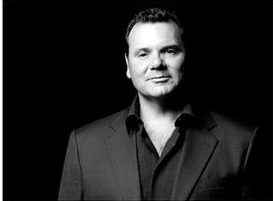
    John Mattera: Source: Mattera Foundation Nov. 2. 2011, news release

    EDITOR’S NOTE: So, you recognize the power of the names of  Groupon and Facebook and want to trade on their magnetism to drive traffic to your purported “opportunity” — and you want to further sanitize your scheme by describing yourself as a philanthropist and trading on the name of a charity such as the American Red Cross?

    And you perhaps want to give money from your scheme to your wife and your mother, a senior citizen?

    What follows is a story about the allegations against John Mattera and some of his activities in Florida . . .

    John A. Mattera of Boca Raton, Fla., pleaded guilty in 2003 to seven counts of grand theft in three separate Florida criminal cases, according to court records. Among other things, “Mattera stole $34,000 from two Florida investors by promising to provide them with shares of stock that Mattera falsely represented he owned,” the SEC said of the 2003 cases.

    In 2009, the SEC charged Mattera “with fraudulently attempting to avoid registration requirements by backdating promissory notes to obtain improperly unrestricted shares of a company,” according to the agency.

    And now Mattera, 50, has been sued civilly by the SEC and charged criminally by federal prosecutors in New York in yet another alleged scheme — this one involving claims that Mattera traded on the names of Groupon, Facebook and others in a scam that netted between $11 million and $12.6 million.

    The SEC said it is seeking an emergency court order to freeze the assets of Mattera; John R. Arnold, 61, of Florida; Joseph Almazon, 22, of Hicksville, N.Y.; David E. Howard II, 32, of New York City;  Bradford Van Siclen, 43, of Montclair, N.J., and eight different business entities. (Ages in this paragraph approximate.)

    Authorities said Mattera and “cohorts” duped investors into believing that they could convert shares in Mattera’s purported hedge fund — a company that happened to be pushed by “a web of registered and unregistered broker-dealers” — into shares of companies such as Groupon and Facebook in advance of the famous firms’ IPOs.

    Both the SEC and federal prosecutors used descriptive verbs when describing what is alleged to be Mattera’s latest scam — a scam that allegedly involved a network of associates and a company with the high-sounding name of “The Praetorian Global Fund.”

    (Emphasis added to SEC’s choice of verbs.)

    “By conjuring up a seemingly prestigious hedge fund and touting the safety of an escrow agent, these men exploited investors’ desire to get an inside track on a wave of hyped future IPOs,” said George S. Canellos, director of the SEC’s New York Regional Office. “Even as investors believed their funds were sitting safely in escrow accounts, Mattera plundered those accounts to bankroll a lifestyle of private jets, luxury cars, and fine art.”

    (Emphasis added to U.S. Attorney’s choice of verbs and other descriptors.)

    “As alleged, John Mattera duped investors into believing they had bought rights to shares of coveted stock in Facebook and other highly visible and attractive companies which had not yet gone public,” said U.S. Attorney Preet Bharara of the the Southern District of New York. “As the complaint describes, Mattera told elaborate lies about stock he did not own and about how he would keep investors’ money safe in escrow accounts. Instead, Mattera took the investors’ money to fund his own extravagant lifestyle. With today’s charges, his charade is exposed and he will be held to account for his alleged crimes.”

    Named relief defendants in the SEC case are Ann Mattera, Mattera’s 71-year-old mother, and Lan T. Phan, Mattera’s wife. Phan, 43, is a physician and yoga practitioner. Authorities say the women, who are not charged with an offense, were beneficiaries of the scheme. (Ages in this paragraph approximate.)

    The publicity surrounding John Mattera’s alleged business misdeeds has caused embarrassment for a local chapter of the American Red Cross in South Florida. John Mattera, who is linked on the web to numerous companies or philanthropic organizations even in the wake of previous lawsuits and criminal charges against him, was on the Red Cross board in Broward County until last month, according to the Sun-Sentinel.

    On Nov. 2, just days before the SEC and the Feds came knocking, John Mattera was quoted in this news release about an entity known as the Mattera Foundation, which purported to look “to support those in need” by making it easier for them to find grant funding.

    “John Mattera hopes that organizations across South Florida will use the new grant application tool to contact The Mattera Foundation and secure funding for their causes,” the news release read in part.

    On March 24, 2011, meanwhile, John Mattera was quoted in this news release about a Red Cross golf tournament sponsored by the Mattera Foundation.

    From March 2011 news release by the Mattera Foundation.

    “Investor and American Red Cross board member John Mattera announced today that his eponymous The Mattera Foundation will sponsor the upcoming American Red Cross Golf Tournament,” the release read in part. “The tournament will be held at the Inverrary Country Club on April 1, and all proceeds will benefit the American Red Cross, South Florida Region.”

    It was not immediately clear if Mattera plowed investors’ money into charities. What is clear, according to federal prosecutors, is that he had high appetites and caused investors to believe their money was going into escrow accounts.

    “Based on the misrepresentations of Mattera and others, investors sent more than $11 million into escrow accounts maintained at a Florida bank,” prosecutors charged. “Mattera reassured investors that their money would be held in the escrow accounts until either the offering was completed or another triggering event took place, at which time the investors would receive their ownership interest in the particular special purpose entity. However, instead of maintaining the investor money in the escrow accounts as he promised, Mattera caused the vast majority of it to be transferred to other entities with which he was associated. Ultimately, Mattera misappropriated more than $11 million of investor money and spent nearly $4 million on personal items for his family and himself, such as expensive jewelry, interior decorating and luxury cars.”

    A veteran IRS agent also used strong language when describing Mattera’s latest alleged fraud scheme. (Emphasis added.)

    “The allegations against Mr. Mattera show that the appearance of success can be a tangled web of financial lies,” said Victor W. Lessoff, special agent-in-charge of the Newark (N.J.) Field Office of the IRS Criminal Investigation Unit (IRS-CI).

    Such descriptions also surfaced in the epic Scott Rothstein Ponzi caper, which also operated in South Florida.

    Read SEC news release on John Mattera’s latest alleged scam.

    Read the SEC complaint.

    Read Feds’ news release on John Mattera’s latest alleged scam.

  • URGENT >> BULLETIN >> MOVING: Feds Make 3 Arrests In New York In Alleged ‘Green’ Ponzi Caper; SEC Files Emergency Parallel Action To Halt Alleged $26 Million Swindle Over Which Convicted Felon Presided With Alleged Help From Attorney

    URGENT >> BULLETIN >> MOVING: A bizarre case featuring spectacular allegations of Ponzi fraud coupled with verbal strong-arming of victims is unfolding in New York. Three people have been arrested by federal agents, and the SEC has filed an emergency action in federal court to halt what it described as a “green-product themed Ponzi scheme” involving stone pavers imported from Australia.

    Arrested by federal agents were Eric Aronson, 43, of Syosset, N.Y.; Vincent Buonauro Jr., 40, of West Islip, N.Y.; and Robert Kondratick, 41, of  Syosset. All three men are executives of a Long Island group of firms known as “PermaPave Companies,” investigators said.

    Kondratick is Aronson’s brother-in-law, investigators said.

    Aronson is a convicted felon who used proceeds from the emerging scheme to pay restitution to victims of a scheme to which “he pleaded guilty to conducting in 2000” and was sentenced to 40 months in prison, the SEC said.

    The allegation against Aronson that he used fraud proceeds from a new scam to pay restitution to victims of a previous swindle marked the second time today that the SEC made such a claim. This morning, the SEC accused Roger D. Shearer, who is implicated in a separate New York scam, of doing the same thing.

    And a separate allegation in the Aronson complaint against an attorney marked the second time today that a member of the bar had been accused of helping fleece investors. In the SEC’s Aronson complaint, attorney Fredric Aaron, 47, of Port Washington, N.Y., is accused of helping Aronson and other co-defendants dupe investors.

    “Aaron drafted the agreements used to defraud investors, participated in the solicitations conducted by Aronson, repeated during his extensive dealings with investors many of the misleading statements made by Aronson, and developed strategies for concealing the fraud,” the SEC charged.

    Earlier today, the SEC accused Miami attorney Stewart A. Merkin of aiding the alleged Shearer fraud.

    In the case against Aronson, Buonauro, Kondratick, Aaron and the PermaPave firms, the SEC said  140 individuals from the construction and landscaping trades became investors between 2006 and 2010 and were bilked out of $26 million.

    “Aronson and his associates operated the PermaPave Companies as a classic Ponzi scheme,” said George S. Canellos, director of the SEC’s New York Regional Office. “They created the façade of a profitable business, promised investors extraordinary rates of return, and used much of their investors’ money to fund their own lavish lifestyle.”

    Aronson, Buonauro and Kondratick “used new investments to make payments to earlier investors and then siphoned off much of the rest for themselves, buying luxury cars, gambling trips to Las Vegas, and jewelry,” the SEC charged.

    U.S. District Judge Jed S. Rakoff  froze the assets of the defendants and eight relief defendants.

    “Investors were told that PermaPave Companies had a tremendous backlog of orders for pavers imported from Australia, which could be sold in the U.S. at a substantial mark-up, yielding monthly returns to investors of 7.8% to 33%,” the SEC said. “In reality, the complaint states that there was little demand for the product, and the cost of the pavers far exceeded the revenue from sales.”

    Moreover, the SEC said, Aronson tried to turn the table on investors by accusing them of felonies when they asked for their money.

    “Aronson accused them of committing a felony by lending the PermaPave Companies money at the interest rates he promised them, which he suddenly claimed were usurious,” the SEC charged. “Aronson and . . . Aaron then allegedly made false statements to persuade investors to convert their securities into ones that deferred payments owed them for several years.”

    Most of the investors “had little or no prior investment experience” and were told that “they were purchasing high-yield instruments that were free of risk,” the SEC charged.

    “The PermaPave Entities operated from the same offices, shared the same employees, commingled assets, and purported to sell PermaPave pavers, which are squares comprised of small rocks glued together that purportedly assist with storm drainage,” the SEC charged.

    Of the $26 million raised in the scheme, only $600,000 was used to purchase pavers, the SEC charged.

    Read the SEC complaint.


  • BULLETIN: FLORIDA — AGAIN (VIA NEW YORK): SEC Says Men Gathered $8 Million Through Lure Of Nonexistent IPO And ‘Contracts’ With Famous Companies; Angelo Cuomo And Recidivist George Garcy Of E-Z Media Inc. Charged With Securities Fraud

    BULLETIN: A recidivist securities offender in Florida and his business partner in New York have been charged by the SEC with fraud in a case that alleges they pumped an IPO that never happened.

    Charged in the civil case were George Garcy, 54, of Aventura, Fla., and Angelo Cuomo, 62, of Staten Island, N.Y. Garcy also is known as Jorge Garcia, and was charged by the SEC in 1997 with improperly selling stock, the SEC said.

    Today’s case was brought in federal court in the Eastern District of New York. It involved an offering fraud for a company known as E-Z Media Inc., the SEC said.

    “Garcy and Cuomo conducted an offering fraud that was rife with false statements and omissions to entice unsuspecting investors,” said George S. Canellos, director of the SEC’s New York Regional Office. “Instead of using the offering proceeds to develop their business, Garcy and Cuomo treated E-Z Media’s bank account as a personal slush fund and diverted millions of dollars to line their pockets.”

    Both Garcy and Cuomo failed to tell investors of E-Z Media Inc. about Garcy’s previous encounter with regulators when he was a California resident, the SEC charged.

    As part of the newly detected fraud, E-Z Media investors were told the firm had “contracts” with Heineken, Anheuser Busch and Aramark Corp. for its beverage and -food carrier product, but no contracts existed, the SEC said.

    Investors also were lured by the promise of a profitable IPO, but E-Z Media “never took even the basic steps to prepare” for an IPO, the agency said.

    The scheme attracted “at least” 200 investors and gathered about $8 million between April 2003 and March 2009, the SEC charged.

    Garcy and Cuomo diverted about half of the scheme proceeds to themselves and family members, the agency charged.

    A carrier patent E-Z Media purportedly held also was used to lure investors, but the patent was contingent upon a $14.5 million payment to Cuomo and may not have been valid to begin with because “Cuomo had previously transferred his ownership rights” to his sister, the agency charged.

    Cuomo’s sister,  Judith Guido, 55,  received at least $1.7 million from the scheme, the SEC said. She has been named a relief defendant, as have two sons of Cuomo: Ralph Cuomo, 37, and Vincent Cuomo, 31.

    The Cuomo brothers received a combined total of at least $240,500 from the scheme, the SEC said.

    Also named a relief defendant was attorney Joseph Lively, 55, of Farmingdale, N.Y. Lively received at least $120,000, the SEC said.

    The SEC described the payments to the relief defendants as ill-gotten gains, saying none of the relief defendants had any legitimate claim to the money.


  • SEC: Broker Ripped Off Elderly Nuns In New York; Paul George Chironis Targeted Sisters Of Charity In Churning Scam, Agency Says

    A Long Island, N.Y.-based broker ripped off  “a congregation of mostly elderly nuns in the Bronx” in a churning scheme in which he repeatedly executed trades that eroded the value of two accounts held by the Sisters of Charity to line his own pockets, the SEC said.

    Paul George Chironis, 58, of Melville, N.Y.,  has settled the SEC’s administrative action by agreeing to pay the Sisters of Charity $350,000. He further was barred from associating with with any broker, dealer, investment adviser, municipal securities dealer, transfer agent, municipal adviser or nationally recognized statistical ratings organization.

    “Chironis took advantage of the trust placed in him by the Sisters of Charity and convinced the nuns to engage in a high turnover trading strategy unfit for their investment needs,” said George S. Canellos, director of the SEC’s New York Regional Office. “Chironis’s irresponsible actions virtually guaranteed the convent’s accounts would lose money due to the undisclosed and excessive costs being incurred while Chironis focused on generating substantial commissions for himself.”

    Meanwhile, Chironis was barred from serving or acting as an employee, officer, director, member of an advisory board, investment adviser or depositor of, or principal underwriter for, a registered investment company or affiliated person of such investment adviser, depositor, or principal underwriter.

    The Sisters of Charity used the investment accounts to pay “for the care of members of the Congregation living in assisted living facilities” and to support the Congregation’s charitable endeavors, the SEC said.

    Chironis, who neither admitted nor denied the allegations as part of a settlement agreement, had a history of churning, the SEC said.

    “Chironis has worked in the securities industry since 1981 and maintained Series 7 and 63 licenses since 1983,” the SEC said in administrative filings. “Prior to his association with Capital Growth [Financial Inc.,] Chironis received seven customer complaints filed with the NASD/FINRA, including complaints for churning and unsuitability.

    “As a result of customer complaints, in January 2006, the Michigan Securities Division required that Chironis be placed on heightened supervision, and in March 2006 the Vermont Securities Division prohibited Chironis from soliciting investors in Vermont. Chironis was associated with Capital Growth from November 2005 until February 2008, when Capital Growth ceased business operations. Since March 2009, Chironis has been associated with another registered broker-dealer located in New York, New York.”

    Capital Growth, which had offices in New York and Boca Raton, Fla., now is defunct, the SEC said.

    Chironis’ scheme targeting the nuns occurred between Jan. 1, 2007, and Jan. 31, 2008, the SEC said.

    Here is one example of how Chironis ripped off the nuns, according to the SEC administrative filing (emphasis added):

    “Chironis frequently replaced one bond with a bond or bonds of similar duration and yield. For example, on July 24, 2007, Chironis sold a Ginnie Mae bond with a 6% coupon rate, a maturity date of 2033 and a principal amount of $258,504.43. The very next day, Chironis purchased a Ginnie Mae bond with the same 6% coupon rate, the same 2033 maturity date and a principal amount of $201,636.05, along with a second Ginnie Mae bond with a 6% coupon rate, a 2032 maturity date and principal amount of $199,956.51. Capital Growth, through Chironis, charged the Accounts approximately $18,352 in transaction fees – in the form of markups and markdowns – on these three transactions. On September 26, 2007, Chironis sold one of the two bonds he purchased two months earlier, and on October 24, 2007, he sold the second.”

    During a 13-month period, the SEC said, the Sisters of Charity paid nearly 11 percent of the value of the nuns’ accounts to Chironis in the form of transaction fees.

  • BULLETIN: SEC Says Attorney Jonathan Star Bristol Helped Convicted Ponzi Swindler Kenneth Ira Starr Steal Millions Of Dollars From Celebrity Clients

    BULLETIN: The SEC has charged attorney Jonathan Star Bristol with aiding and abetting the Ponzi and fraud scheme of convicted swindler Kenneth Ira Starr, the so-called “financial adviser to the stars.”

    Starr pleaded guilty to securities fraud, wire fraud and money-laundering in September. Among his former clients were former U.S. Secretary of State Henry Kissinger, actress Uma Thurman, actor/producer Ron Howard, singer/songwriter Carly Simon and celebrity outfitter Jacob Arabo, known as “Jacob The Jewler.”

    Bristol, according to the SEC, permitted Starr to use “attorney trust accounts” hidden from the management of a law firm for which Bristol worked “as conduits when Starr stole money from advisory clients.”

    “Bristol had a legal and professional responsibility not to assist Ken Starr in conduct that he knew was unlawful,” said George S. Canellos, director of the SEC’s New York Regional Office. “Bristol crossed the line from lawyer to conspirator when he failed to safeguard funds entrusted to him, helped Starr steal client money, and lied to the victims to perpetuate the scheme.”

    When one of Starr’s victims “confronted” Bristol about an unauthorized transfer of $1 million,  “Bristol lied to the victim that the funds were being bundled with other clients’ funds for an investment with UBS Financial Services,” the SEC said. “In fact, Bristol had already used the misappropriated funds to pay a multi-million dollar legal settlement with one of Starr’s former clients.”

    Taking the deception one step farther, the SEC said, “Bristol subsequently sought to represent that same victim after the victim was contacted by SEC staff in its investigation. In addition to the fact that such representations violated the ethical obligations of lawyers, Bristol’s clear intent was to obstruct and undermine the SEC’s investigation in order to conceal the wrongdoing.”

    Read the SEC complaint.

    Kenneth Ira Starr also is known as Kenneth Starr, but he is not the same Kenneth Starr whose famous “Starr Report” led to impeachment proceedings against President Bill Clinton in 1998 and 1989 in the aftermath of the Monica Lewinsky scandal.

    That Kenneth Starr was Kenneth Winston Starr.

  • Now, A ‘Belgian Royalty’ Ponzi Scheme; SEC Says Guy Albert de Chimay Used Investors’ Funds To Pay Divorce Lawyer, ‘Massive’ Credit-Card Bills, Rent, Payroll

    UPDATED 9:31 A.M. EDT (U.S.A.) Saying Guy Albert de Chimay and his unregistered investment-advisory business “simply stole” clients’ funds while telling investors their money was safe with the “U.S. investment arm of the Chimay royal family of Belgium,” the SEC has gone to court in New York to halt what it described as a massive fraud.

    Separately, Chimay, 47, was arrested in North Carolina after being indicted by prosecutors in New York on charges of forgery and grand larceny. Chimay claims to be a cousin to a Belgian prince, according to court documents.

    In an emergency action, the SEC is seeking to freeze the assets of Chimay and Chimay Capital Management Inc. and obtain an order to repatriate assets to the United States. The SEC has advised a federal judge that Chimay was operating a fraudulent “bridge loan” scheme in which investors were told their money would be used to make loans to creditworthy borrowers locked out of the banking system owing to the “credit crisis.”

    “Chimay used the trappings of royalty to perpetrate the most common of frauds,” said George S. Canellos, director of the SEC’s New York Regional Office. “Chimay blatantly lied to investors about nonexistent investments and then used their money to bankroll his exorbitant personal and business debts.”

    Although the number of victims is not yet known, the scheme netted Chimay and his company at least $6 million. Some of the money instantly was used in “classic Ponzi scheme fashion” and “diverted to payoff disgruntled counterparties in Defendants’ other business ventures,” the SEC charged.

    In some cases, the SEC said, money sent in by investors lured by the promise of an annual return of 12 percent was diverted the very same day it was received.

    On April 21, 2009, a client the SEC described as “Investor A” wired an initial BLF [Bridge Loan Facility] investment of $500,000 to a Chimay-controlled account at Goldman Sachs Execution and Clearing,” the SEC said. “The GSEC account had been opened in March 2009 and contained only $10,000 when Investor A’s funds were deposited. At the time of his investment, Defendants represented to Investor A that the size of the ‘bridge loan’ pool into which he would be depositing his funds was $50 million.

    “On the same day Investor A transmitted his funds to Defendants, the SEC continued, “Chimay instructed his introducing broker to direct GSEC to wire the bulk of Investor A’s investment to three external accounts: (i) $289,000 for “legal fees – re Chimay” to the . . . account of the New York law firm representing Chimay in a divorce proceeding in New York state court; (ii) $61,000 to a TD Bank account maintained by Chimay Capital for purported use as generic ‘working capital’; and (iii) $100,000 to another entity to satisfy Chimay Capital’s unrelated contractual obligation to provide operating capital to the entity.”

    Wanting to invest more with Chimay less than a month later, Investor A wired an additional sum of $170,000 to the GSEC account on May 12, 2009, the SEC said.

    On the very same day, Chimay “directed that $140,000 be wired to a Chimay Capital (Int’l) account at TD Bank,” the SEC said. “Later that day, after the $140,000 had been received at TD Bank, $90,000 of Investor A’s investment were transferred to Chimay’s personal account at TD Bank, where it was thereafter used to subsidize Chimay’s costly personal and living expenses, including his mortgage, car payment, credit card payments, utilities and cash withdrawals.”

    A client described by the SEC as “Investor B” entrusted more money to Chimay than did Investor A, and was fleeced in similar fashion, the SEC said. The agency added that the transaction was routed through Bermuda, and that the Bermuda Monetary Authority had provided assistance in the probe.

    “Investor B invested $2 million in the BLF in October 2008 by wiring his investment to an account at Butterfield Bank in Bermuda,” the SEC said. “Among other things, Investor B’s funds were used to fund a $200,000 personal check made out to Defendant Chimay, which he deposited the same day into his personal checking account at TD Bank.

    “Chimay thereafter used Investor B’s money to make tens of thousands of dollars in rapid fire payments to Chrysler Finance, American Express, Indymac Bank, and Capital One,” the SEC charged. “Investor B’s funds were also used to pay $330,000 to another investment firm to meet Defendants’ contractual agreement to provide operational capital to the firm, and to pay Chimay Capital’s rent and payroll in November 2008.”

    Described as “[o]blivious to the fact that his money had been diverted for improper purposes, and still under the belief that he would receive safe and steady returns of 12%, Investor B entrusted another $2 million to Chimay in January 2009, the SEC said.

    “The day after Investor B wired his second $2 million investment to Butterfield Bank on January 29, 2009, Defendants transferred approximately $1.8 million from the account to another Butterfield account controlled by Chimay. Chimay thereafter immediately used Investor B’s funds to make a payment of $250,000 to his divorce counsel, and to fund the $643,000 redemption of an investor in a Chimay Capital hedge fund.”

    Other investors identified by the SEC with a letter of the alphabet suffered similar fates, the agency said.

    One of the investors — “Investor D” — became worried, and asked Chimay to provide proof the money had been invested as advertised, the SEC said.

    “In order to reassure Investor D that Defendants had ample liquidity, and that Investor
    D’s BLF investment was safe, on October 5, 2009, Chimay provided Investor D with a bank
    account statement from Butterfield Bank purporting to show liquid assets of approximately $14 million,” the SEC said.

    “The Butterfield statement was fraudulent; the actual account balance was zero,” the agency said.

    In reverse-engineering Chimay’s dealings with Investor D, the agency discovered that nearly all of the $1 million investment made in August 2009 had been misappropriated, the SEC said.

    “Defendants misappropriated Investor D’s funds by, among other things, using them to make a $500,000 payment to a third party that had loaned Defendants approximately $1.4 million in July 2009 to purchase shares in a technology company,” the SEC said. “Defendants also misappropriated Investor D’s funds to make a $339,000 payment to the firm that had served as the custodian of the Spartan Mullen funds, which Defendants claimed to have liquidated in March 2009.”

    In July 2009, Chimay and his company claimed to have $200 million under management and to have served as custodian for the Bermuda-based Spartan Mullen Chimay funds, which the SEC described as “now-defunct hedge funds.”

  • FIVE ARRESTED: SEC Says Bogus Stock-Tips Website Faked Testimonial From George Soros; Gryphon Holdings Inc., Kenneth E. Marsh, Others Charged With Operating ‘Sham’

    BULLETIN: Five people have been arrested in New York on charges of conspiracy to commit securities fraud and wire fraud.

    Their preliminary court appearances  are occurring now — and the allegations in the case are spectacular.

    Separately, the SEC has gone to federal court in New York to obtain an emergency court order freezing the assets of a company and defendants allegedly involved in the fraud. The company is a Staten Island investment-advisory business that allegedly sold bogus stock tips from “fictional trading experts.”

    Federal prosecutors said the firm has no trading desk, despite professing to have a “legendary” one. Prosecutors added that false academic claims about “Harvard, Oxford, Colombia, and Wharton” were part of the scheme — and that the purported ringleader used multiple names to pull off the fraud.

    U.S. District Judge Jack B. Weinstein of the Eastern District of New York granted the emergency freeze.

    Charged criminally in the case were Kenneth E. Marsh, 43, of Staten Island; Baldwin Anderson, 55, and Robert Anthony Budion, 28, both of Staten Island, Jeanne Lada, 44, of Freehold, N.J., and James Levier, 34, of Beachwood, N.J.

    Each of the criminal defendants also was named a defendant in the SEC’s civil case, which also names Gryphon Holdings Inc., which is operated by Marsh.

    Several relief defendants who benefited from Gryphon’s alleged misconduct also were named in the SEC’s civil complaint.

    “Gryphon and its associates attracted clients through postings on the Internet that falsely exaggerated their investment prowess,” said George S. Canellos, director of the SEC’s New York Regional Office. “They sold a bill of goods by pretending to be legitimate money managers with a long track record of extraordinary returns, distinguished clients, and hundreds of millions of dollars under management.”

    The company  “touted offices on Wall Street and around the world while, in reality, defrauding investors from a strip mall on Staten Island,” said David Rosenfeld, associate director of the SEC’s New York Regional Office.

    “Gryphon was nothing more than a sham designed to separate clients from their money,” Rosenfeld said.

    Like other recent securities cases, the complaint reads almost like a work of fiction. Multiple company names were used, and multiple aliases were used to pull of the scam, authorities said.

    “Gryphon is a New York corporation doing business under various names, including Gryphon Holdings, Gryphon Financial, Gryphon Daily, Gryphon Consulting Group, Gryphon Hedge Fund Partners LLC, Gryphon Management Hedge fund, Gryphon Financial UK Ltd, and Gryphon Australia,” the SEC said in the complaint.

    “Gryphon’s physical offices are located in a strip mall in Staten Island, New York, but the firm’s Internet posts depict an international operation with offices located on Wall Street, in Chicago, California, London, England, and Australia,” the SEC said. “The firm claims to have twenty-five to thirty employees and affiliations with expert, successful securities traders.”

    The defendants also used aliases, the SEC said.

    “In communications with Gryphon’s prospective or existing clients, Defendant K. Marsh has used various aliases, including ‘Kenneth Maseka,’ ‘Michael Warren,’ and ‘Marcus Thorn,’” the SEC said. Federal prosecutors added that “Warren” and “Maseka” are fictional, and the SEC said “Thorn” was, too.

    Other bogus storylines and identities included “Chris Wolfe,” whose average profit since 1995 purportedly ‘exceeded 1000% per trade’; ‘Marc Seigel,’ who purportedly ‘manage[s] in excess of 700 million in daily option trading volume’ and whose ‘talents trading options can be traced back five generations’; ‘John Gage,’ a graduate of Columbia and Wharton, a partner at Gryphon Financial and head of ‘equity Hedge Strategies,’” the SEC said.

    The bogus “Marcus Thorn” was claimed to have “delivered ‘189% gain’ on an ‘Intel play in one day,’” the SEC said.

    Marsh was banned in 2007 by the National Association of Securities Dealers, the predecessor to the Financial Industry Regulatory Authority, “from associating in any capacity with any firm that is a member of the NASD,” the SEC said.

    “Since at least 2007, Gryphon has advertised its services on several websites, which at various times included, among others, www.gryphondaily.com, www.gryphonfmancial.net, www.poisonpilltrader.com, www.cnbceffect.com, www.6ammoneymachine.com,” the SEC said.

    “Gryphon describes itself as the ‘World’s No. 1 Investment Newsletter,’ and provides its investment recommendations through various services bearing names such as ‘6AM Money Machine,’ ‘Raging Bull,’ ‘Wolves of Wall Street,’ ‘Wall Street’s Most Wanted,’ ‘Put Play of the Day,’ ‘Pure Profit,’ ‘WolfOption Trader VIP,’ ‘Elite Option Service,’ ‘Inner Circle,’ ‘Brain Trust,’ and ‘Mafia Trader.’ Once a client pays Gryphon for one or more of these advisory services, Gryphon representatives provide the client with investment recommendations on an individualized basis via telephone, e-mail, and/or through a password-protected section of Gryphon’s website,” the SEC said.

    Meanwhile, the SEC said fake testimonials were part of the scheme.

    “Gryphon’s website and promotional materials were also replete with false testimonials from clients about its performance and affiliations, and a purported endorsement of Gryphon by George Soros, that in fact Gryphon fabricated.

    “Gryphon claimed that Soros stated: ‘Alone the traders of Gryphon Financial are incredible, together the [sic] are unstoppable.’  The client testimonials falsely attested to the success of Gryphon’s recommendations, which purportedly resulted in a ‘huge nest egg,’ the ability to buy expensive cars, and freedom to no longer work,” the SEC charged.

    The scheme gathered more than $17.5 million over the past three years, the SEC said.

    Read the agency’s astonishing complaint.