Tag: Gerald W. Hodgkins

  • BULLETIN: Entities Operating As Fleet Mutual Wealth Limited And MWF Financial Are Online Frauds, SEC Says; ‘Program’ Has Presence On TalkGold And MoneyMakerGroup Ponzi Forums; Money Ordered Frozen In SolidTrustPay, EgoPay And Perfect Money Accounts

    mutualwealthsmall
    A website styled MutualWealth.com is fraudulent and is part of an international pyramid scheme, the SEC says.

    BULLETIN: (7th Update 8:51 p.m. ET U.S.A.) Entities known as Fleet Mutual Wealth Limited, MWF Financial Limited and Mutual Wealth are frauds that filed invalid forms with the SEC to dupe the masses, the SEC said.

    An associated web domain styled MutualWealth.com also is a fraud, the SEC said in a statement and emergency court filing that alleges a pyramid scheme in which promoters become referral agents or purported “accredited advisors” to earn recruitment commissions.

    “Mutual Wealth used Facebook and Twitter as well as a team of recruiters to spread a steady stream of lies that tricked investors out of their money,” said Gerald W. Hodgkins, an associate director in the SEC’s Division of Enforcement.

    Some recent scams have purported to operate out of Hong Kong, something that appears also to be the case with Mutual Wealth.

    “[A]lmost nothing that Mutual Wealth represents to investors is true,” the SEC said.  “The company does not purchase or sell securities on behalf of investors, and instead merely diverts investor money to offshore bank accounts held by shell companies.  Mutual Wealth’s purported headquarters in Hong Kong does not exist, nor does its purported ‘data-centre’ in New York.  Mutual Wealth also lists make-believe ‘executives’ on its website, and falsely claims in e-mails to investors that it is ‘registered’ or ‘duly registered’ with the SEC.

    And, the SEC said, Mutual Wealth may operate through entities in Panama and the United Kingdom “and through Russian or Belarussian nationals.”

    From the SEC complaint (italics added):

    Investors who complete an account application are instructed to transfer money to Mutual Wealth either by wire transfer to banks located in Latvia and Cyprus or through third-party payment processors such as SolidTrust Pay, EgoPay, or Perfect Money.

    Like other fraud schemes, Mutual Wealth has a presence on the MoneyMakerGroup and TalkGold Ponzi forums.

    U.S. District Judge Dolly M. Gee of the Central District of California has ordered an asset freeze on all accounts “at any bank, financial institution, brokerage firm, or third-payment payment processor (including those commercially known as SolidTrust Pay, EgoPay, and Perfect Money) maintained for the benefit of Mutual Wealth,” the SEC said.

    Assisting in the probe are the FBI, the Financial and Capital Market Commission of Latvia, the Ontario Securities Commission and the Cyprus Securities and Exchange Commission, the SEC said.

    From the SEC’s statement (italics added):

    According to the SEC’s complaint, Mutual Wealth operates through entities in Panama and the United Kingdom and uses offshore bank accounts in Cyprus and Latvia and offshore “payment processors” to divert money from investors.  Mutual Wealth’s sole director and shareholder presented forged and stolen passports and a bogus address to foreign government authorities and payment processors.

    As in previous scams, the Mutual Wealth fraud spread on social media, the SEC said.

    “Mutual Wealth maintains Facebook and Twitter accounts that link to its website and serve as platforms through which it lures new investors,” the SEC said.  “Some of Mutual Wealth’s ‘accredited advisors’ then use social media channels ranging from Facebook and Twitter to YouTube and Skype to recruit additional investors and earn referral fees and commissions.

    “Mutual Wealth’s Facebook page spreads such misrepresentations as ‘HFT portfolios with ROI of up to 250% per annum.  Income yield up to 8% per week,’” the SEC said.  “A Facebook post on Aug. 12, 2013, boasted ‘$1000 investment into the Growth and Income Portfolio made on April 8th, 2013 is now worth $2,112.77.’  Mutual Wealth regularly posts status updates for investors on its Facebook page, and the comment sections beneath the posts are often filled with solicitations by the accredited advisors.  Mutual Wealth also tweets announcements posted on its Facebook page.”

    Regulators have been warning for years about scams spreading on social media.

    Scammers recently have been purporting they are conducting IPOs or pre-IPOs or are registered with the SEC.

    “Mutual Wealth has filed three Securities Act Forms D with the Commission,” the SEC said. “Each Form D purports to give notice of offerings of securities that are exempt from registration with the Commission under Regulation D of the Securities Act.

    “But Mutual Wealth’s offers and sales of securities do not qualify for the exemptions cited in the Forms D or any exemption under from registration under Regulation D of the Securities Act. Consequently, the Forms D are invalid and of no legal effect,” the SEC said.

    About 150 U.S. investors opened Mutual Wealth accounts, plowing “at least” $300,000 into the scheme, the SEC said.

    Note: Thanks to Jordan Maglich at PonziTracker.com.
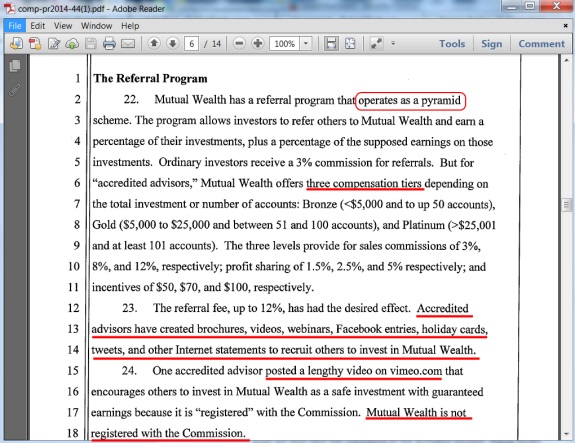
    Screen stot of section of SEC complaint alleging that Mutual Wealth is a pyramid scheme. Red highlights by PP Blog.
    Screen shot of section of SEC complaint alleging that Mutual Wealth is a pyramid scheme. Red highlights by PP Blog.
  • URGENT >> BULLETIN >> MOVING: SEC: Las Vegas-Based Ponzi Scheme Targeted Japanese Investors, Gathered At Least $800 Million, Planned To Have New Marks Prop Up The Massive Swindle — And Started In 1998

    breakingnews72URGENT >> BULLETIN >> MOVING: (SECOND UPDATE 4:28 P.M. EDT (U.S.A.) The SEC says Edwin Fujinaga and his company MRI International Inc. were operating a Ponzi scheme from 1998 onward that gathered at least $800 million and targeted Japanese and other investors.

    After MRI received a letter in March 2013 from the SEC instructing it not to destroy evidence, the SEC said, “a truck from a “document shredding company . . . picked up boxes of documents from MRI.”

    An MRI executive assistant “made several telephone calls to prevent the pickup,” the SEC charged, alleging that “Fujinaga called her and said, ‘Why are you concerned about this?’”

    “MRI fired the executive assistant because of her efforts to prevent the document destruction,” the SEC charged.

    Fujinaga is 66. He resides in Las Vegas, the SEC said. Part of the scam featured “tours” of MRI’s offices in Las Vegas. The alleged scam is evoking images of Bernard Madoff’s colossal Ponzi scheme, in the sense it appears to have gone undetected for years.

    At the same time, the alleged Fujinaga/MRI fraud is reminiscent of the epic Trevor Cook Ponzi scheme in Minnesota, in the sense that investors appear to have been lulled into a false sense of security because the company had a physical presence. It is somewhat common for fraudsters to tout a brick-and-mortar presence as “proof” no fraud scheme is occurring, even though case after case has demonstrated that the frauds may be buried deep inside an enterprise that at first glance appears to be legitimate.

    MRI investors “were told that their money would be used to buy accounts from U.S. medical providers with outstanding balances to collect from insurance companies,” the SEC said. “Fujinaga and MRI falsely represented that they purchased the accounts at a discount so they could recover the full amount and turn a profit for investors. They purchased no such accounts in reality, and merely used investor money to pay the principal and interest due to earlier investors in typical Ponzi fashion.”

    Similar to other Ponzi schemers whose operations are on the verge of collapse, Fujinaga appeared in 2012 to be preparing to double-down on his fraud, the SEC complaint suggests.

    In a memo, the SEC charged, Fujinaga “proposed to resolve the delinquencies by doubling the amount of money raised from new investors.”

    The SEC alleged that Fujinaga wrote: “I propose that we reinstate our consultants to fund raise for MRI to secure a larger base of consultants soliciting funds and possibly double the amount off funds raised on a monthly basis.”

    Cooperation between the United States and Japan was instrumental in exposing the massive international swindle, the SEC said, noting that the “Financial Services Agency of Japan (JFSA) and the Japanese Securities and Exchange Surveillance Commission (SESC)” exchanged “documents and other evidence critical to the case.”

    “Cross-border cooperation can successfully halt fraudsters who attempt to use international boundaries to avoid prosecution,” said Gerald W. Hodgkins, associate director in the SEC’s Division of Enforcement. “The close coordination between the SEC and Japanese regulators was critical to freezing Fujinaga’s assets and foiling his scheme.”

    From a statement by the SEC (italics added):

    According to the SEC’s complaint, the Ponzi scheme began in October 1998. Fujinaga, who lives in Las Vegas, operated from there but also had a sales office in Tokyo. MRI and Fujinaga hosted Japanese investors in the U.S. for solicitation presentations and tours of MRI’s Las Vegas offices. They told investors they could invest in either U.S. dollars or Japanese yen, and promised returns ranging from 6 to 10.32 percent depending on the size and duration of the investment. Fujinaga and MRI falsely represented that they used investor money solely and exclusively to buy medical accounts receivable. Besides misappropriating money between investors, Fujinaga illicitly transferred investor money to MRI’s operating accounts, where it was used to pay for general operating expenses instead of medical accounts. He also transferred money to other entities he owned that were not in the business of collecting medical account receivables. Investor funds also were siphoned to another company owned by Fujinaga called The Factoring Company, which bought Fujinaga’s cars and paid his bills.

    Here is a section from the SEC’s complaint, which was filed under seal two weeks ago (italics added):

    As all Ponzi schemes eventually do, the fraudulent enterprise perpetrated by Fujinaga and MRI collapsed. Since at least 2011, MRI has been in default on the payments it is obligated to pay investors. More than 8,000 people invested in MRI and, as of 2012, MRI’s investments totaled approximately $813 million. Notwithstanding MRI’s defaults to investors, this is an ongoing Ponzi scheme, in which Fujinaga and MRI have planned to make up their losses by enlisting new investors for the same treatment suffered by existing investors.

    Investors in places other than Japan also were targeted, the SEC said. Those countries included Canada, Malaysia and New Zealand.