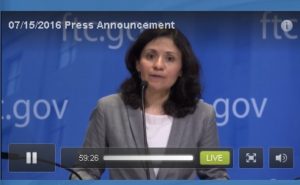
Edith Ramirez makes the announcement this morning. Source: Screen shot of live news- conference feed.
URGENT >> BULLETIN >> MOVING: (13th Update 3:45 p.m. EDT U.S.A.) The FTC is going to federal court in the Central District of California, alleging that Herbalife engaged in “deceptive and unlawful acts and practices.”
Separately, the agency announced a settlement with the company that will have Herbalife pay $200 million and change the way it does business. The company has not formally been accused of operating a pyramid scheme, although the agency directed harsh words at the MLM enterprise.
“This settlement will require Herbalife to fundamentally restructure its business so that participants are rewarded for what they sell, not how many people they recruit,” FTC Chairwoman Edith Ramirez said in a statement. “Herbalife is going to have to start operating legitimately, making only truthful claims about how much money its members are likely to make, and it will have to compensate consumers for the losses they have suffered as a result of what we charge are unfair and deceptive practices.”
Herbalife described the FTC settlement and a separate, $3 million settlement with the state of Illinois as wins.
“The settlements are an acknowledgment that our business model is sound and underscore our confidence in our ability to move forward successfully, otherwise we would not have agreed to the terms,” said Michael O. Johnson, chairman and CEO, in a statement.
Although Herbalife contended in a statement this morning that the “terms of the settlement do not change Herbalife’s business model as a direct selling company and set new standards for the industry,” the FTC’s complaint paints a picture of a company the institutionalized deception and pyramid behavior.
Herbalife currently “does not offer participants a viable retail-based business opportunity,” the FTC alleged.
And, it alleged, the firm’s “compensation program incentivizes not retail sales, but the recruiting of additional participants who will fuel the enterprise by making wholesale purchases of product . . . The retail sale of Herbalife product is not profitable or is so insufficiently profitable that any retail sales tend only to mitigate the costs to participate in the Herbalife business opportunity.”
Said Herbalife: “While the Company believes that many of the allegations made by the FTC are factually incorrect, the Company believes settlement is in its best interest because the financial cost and distraction of protracted litigation would have been significant, and after more than two years of cooperating with the FTC’s investigation, the Company simply wanted to move forward. Moreover, the Company’s management can now focus all of its energies on continuing to build the business and exploring strategic business opportunities.”
Herbalife’s stock soared when Wall Street opened this morning. At 9:36 a.m., it was up more than $10 — or more than 17 percent.
Guide for the Perplexed on $HLF: FTC slaps co.’s wrist really hard – but Ackman needed them to go after co. with an AR-15, and they didn’t.
“The FTC’s action today addresses many of the concerns that NCL and other experts on pyramid schemes raised about Herbalife’s business practices. Specifically, consumers will benefit greatly from the settlement’s requirement that Herbalife base its compensation structure on verifiable retail sales to end-users of the product, not recruitment of new distributors. This is the core distinction, as enumerated by more than 30 years of case law, between a legal direct-selling company and a fraudulent pyramid scheme. The settlement’s requirement that at least 80 percent of product sales, companywide, must be made to end-users will further address concerns about a lack of retail sales to buyers outside the business opportunity. The FTC’s settlement will also address many of the blatantly unsubstantiated earning claims made by Herbalife’s distributors to entice new recruits to join the business opportunity and keep existing distributors paying to remain in the business opportunity. We look forward to the FTC’s forthcoming guidance to the direct selling industry as an opportunity to address the persistent lack of clarity that has characterized many industry practices.”
“This scheme preyed on people looking to make a better life for themselves and their families,” said Illinois Attorney General Lisa Madigan. “Herbalife created an incentive structure that made it easy for people to invest, but impossible for most people to make any money.”
From Madigan’s office (italics added):
Madigan alleged that Herbalife’s current business model involved luring members with promises of lavish rewards for selling the company’s products, when in fact, the majority of incentives were given to people who recruited others to sell the company’s products. As a result, most people who joined Herbalife never made any money from the company but lost the costs of starting a business.
The FTC settlement requires Herbalife to change its business model to ensure all compensation is based on retail sales that are verified. It also prohibits Herbalife from making statements that indicate that participation in Herbalife is likely to result in a lavish lifestyle, such as you “can quit your job,” “be set for life,” “earn millions of dollars,” or “make more money than they ever have imagined or thought possible.” That also includes images of opulent mansions, private helicopters, private jets, yachts and exotic automobiles in their promotions.
Ackman famously has called Herbalife a pyramid scheme.
“The FTC complaint and settlement provide a roadmap for regulators in 90 other countries around the world to enforce similar requirements,” Pershing Square said in a statement. “We intend to work with these regulators to ensure that no future victims are harmed whether in the U.S. or otherwise.”
Moreover, Pershing Square said the forced changes at Herbalife might cause core distributors to flee — something that could affect Herbalife’s bottom line.
“The [FTC] settlement also requires Herbalife to eliminate minimum purchase requirements and other inventory loading incentives,” Pershing Square said. “Furthermore, in order to maintain eligibility or advance in the plan, distributor requirements must be met through ‘Profitable Retail Sales’ or sales to ‘Preferred Customers,’ who are not buying product to participate in the business opportunity.
“We expect that once Herbalife’s business restructuring is fully implemented, these fundamental structural changes will cause the pyramid to collapse as top distributors and others take their downlines elsewhere or otherwise quit the business.”
Even though the FTC didn’t use the phrase “pyramid scheme” today in its actions against Herbalife, the agency’s “findings are clear,” Pershing Square contended.
It “appears that Herbalife negotiated away the words ‘pyramid scheme’ from the settlement agreement,” Pershing Square said.
UPDATED 3:59 P.M. EDT U.S.A. It surfaced on Twitter today in the $HLF search thread that Herbalife products are being marketed through Mater Dei High School in Santa Ana, Calif. The Catholic school bills itself “the largest non-public school west of Chicago.”
Mater Dei says its 2,145-member student body consists of 38% Caucasian, 33% Hispanic, 19% Asian, 4% African-American, 1% Native American, 1% Pacific Islander and 4% “Other Race.”
The school did not immediately respond today to a request for comment in which the PP Blog asked it whether it was aware of an Herbalife-related promo on its website, whether the promo was a school-endorsed activity and whether Mater Dei students were being recruited to sell Herbalife.
Herbalife did not respond immediately to a request for comment on whether it was aware its products were being offered to Mater Dei students, whether students were being targeted for recruitment and whether the company had any concerns given the targeting allegations against Vemma.
The Mater Dei website has a page styled “Herbalife Program > Consent & Waiver Form.” The page says “ALL current Mater Dei student-athletes are required to have a signed consent and waiver form on file in order to participate in the HERBALIFE Program.”
A link to the form is provided, along with a text prompt that says forms also are distributed by “coaches.” (See PP Blog screen shot of form.)
The affiliate site says, “MATER DEI HIGH SCHOOL INFORMATION . . . All H24 Products are available to MD students (except Prepare).”
A search of the Mater Dei website returns hundreds of results for the search term “Herbalife” (without the quotation marks). One of the results is an “Order NOW & Coupon Codes” page that says discounts are available to nearly two dozen school athletic teams and “Alumni, Dance, Faculty and Pep Squad” groups.
“And while the company claims its primary objective is selling products, many of its distributors tell a different story. ESPN interviewed more than 30 current and former salespeople, the vast majority of whom said their focus, and the focus of their superiors, was on recruiting other distributors. These new members, many of whom are drawn to the business’ strong religious culture or convinced of its credibility by its ties to the sports world, infuse the company with new funds — money that ultimately flows up to the powerful people who walk the stage at Success School.” — From “Drew Brees Has A Dream He’d Like To Sell You,” ESPN The Magazine And “Outside The Lines,” March 15, 2016
With Herbalife under investigation by the Federal Trade Commission and Vemma charged by the FTC with operating a pyramid scheme, ESPN has asked one of its own sponsors — AdvoCare, an MLM company — whether it is pushing a pyramid scheme.
“Absolutely not,” replied Allison Levy, AdvoCare’s executive vice president and chief legal officer. (Link to March 11 AdvoCare video below. In its story (link below), ESPN said AdvoCare set up two cameras to record ESPN’s recording of the March 2 interview and also changed some info on its website after the network began to ask questions.)
With MLM, one of the key questions is whether a significant percentage of products end up in the hands of retail users or whether a program’s distributors load up on product to qualify for commissions.
Levy did not discuss the Herbalife and Vemma matters, although AdvoCare says on its website that it has 320,147 “retail customers.” Herbalife once famously said it didn’t have “visibility” into its number of retail customers, fueling concerns it was a pyramid scheme.
One of the questions posed in the ESPN story is whether AdvoCare is drafting the unwary into its MLM program by relaying on professional athletes such as Drew Brees of the New Orleans Saints to be spokespeople for the firm. And is the company also trading on religion?
DEVELOPING STORY: (Updated 9:23 p.m. ET U.S.A.) A TelexFree rep being sued by the court-appointed bankruptcy trustee for the return of more than $2.6 million in alleged winnings from the judicially declared Ponzi- and pyramid scheme claims that Herbalife “executives” and “personnel” attended a March 2014 TelexFree event in Boston and helped sell him on the ill-fated deal.
In January, Trustee Stephen B. Darr sued Jose Neto of Worcester, Mass., in one of two proposed defendant class actions that includes thousands of other alleged TelexFree “winners” globally. Neto was one of 23 named winners with U.S. addresses. The other lawsuit is against 33 named winners with addresses outside the United States. All in all, the cases could affect nearly 100,000 TelexFree members who allegedly received fraudulent transfers.
Neto responded to the lawsuit in a filing docketed Feb. 16. Among other things, he claims he believes TelexFree was a legitimate business and that executives from both TelexFree and Herbalife showed proof of TelexFree’s legitimacy.
From the body of Neto’s response (italics added/light editing performed):
TelexFree was presented to me as a multi-level marketing network, similar to Herbalife . . . (as a matter of fact, executives of Herbalife gave us several lectures and workshops about this topic). As such, it is intrinsic to the nature of this business that the highest level members, meaning the ones that started to work with the product before and built a stronger network, will have higher gains compared to the others.
From an affidavit by Neto (italics added):
In March 2014 at the International Love Event in Boston (ON YOUTUBE), TelexFree announced that it would be launching its own credit card, and people could no longer use money order or cashier’s check to buy more “partnership shares”, but solely the “TelexFree Card”. On this same, held for over 4,000 people, Carlos Wanzeler and James Merrill asserted to us once again that the company was 100% in compliance with the laws and along with the Herba Life personnel, he showed us on a PowerPoint presentation the certificates from the Secretary of State.
The filing by Neto does not name the Herbalife “executives” or “personnel” on hand at the Boston TelexFree event. Wanzeler and Merrill are TelexFree executives who were charged criminally by the office of U.S. Attorney Carmen Ortiz of the District of Massachusetts after an investigation by the U.S. Department of Homeland Security. The SEC has sued Wanzeler and Merrill.
Herbalife, which is confronting a Federal Trade Commission probe over its business practices, did not immediately respond to a request for comment from the PP Blog on Neto’s claims. The claims raise new questions about whether MLM firms may be targeting vulnerable population groups and the extent to which Herbalife reps also were involved in TelexFree.
Neto claims in his filing that he recruited 24 participants for TelexFree. Many members of his downline appear to have Hispanic names. The SEC has said TelexFree targeted Spanish- and Portuguese-speaking communities.
Neto claims he has paid taxes on TelexFree money he earned legitimately and that Darr is trying to hold him accountable for money he never removed from the program.
5th Update 8:04 p.m. EDT U.S.A. New York state Sen. Jeffrey D. Klein of the Bronx has called Herbalife a pyramid scheme whose “house of cards is tumbling down.”
Klein’s comments came in the context of an “undercover investigation” conducted by his office into Herbalife nutrition clubs in “The Bronx, Queens, and Brooklyn,” according to a PDF report released today. It is titled, “The American Scheme: Herbalife’s Pyramid ‘Shake’down.”
Partners in the probe, according to the report and a statement by Klein, were the New York City Office of the Public Advocate Letitia James and Make The Road New York, an advocacy group that consists at least in part of former Herbalife distributors.
Said Klein, in perhaps the most hostile words to date directed at Herbalife by an American politician (italics added):
“Herbalife’s house of cards is tumbling down. This fraudulent company’s efforts to lure in vulnerable New Yorkers and recent immigrants in pursuit of the American Dream is downright shameful. With false promises of wealth and extravagance, a disproportionate number of Hispanic families are falling prey to these schemes and sacrificing their hard earned dollars.”
Klein added that he intended to sponsor legislation that “will significantly boost protections for consumers and distributors, drastically strengthen financial reporting requirements for Herbalife independent members and increase oversight of this deceptive company in New York.”
Herbalife has been under investigation by the FTC for more than a year. No charges have been announced, and the Klein report raises the prospect that Herbalife has found a way to hoodwink regulators.
From the report (italics/bolding added):
As applicable to Herbalife International, the FTC does not classify the organization as an illegal pyramid scheme because the required $60 to $100 fee to receive a membership kit is not money used to compensate higher up distributors who recruit. Furthermore, once an Herbalife member becomes a supervisor, she is allowed to maintain the title and royalty collecting privilege for an entire year before having to re-qualify. However, our research and investigation reveal that Herbalife distributors do not follow the rules set by the FTC and are in fact running an illegal pyramid scheme. Our analysis demonstrates that higher up distributors encourage recruits to make large first-time product purchases, which the recruiters stands to gain on. And once the new members are unable to sell off their inventory, recruiters encourage them to recruit other members to increase their compensation claims and maintain operation. By contractually following FTC guidelines, Herbalife International has managed to skirt the law, but in reality their lack of proper financial disclosure and supervision over their members allows distributors on the ground to operate illegal pyramid schemes to the benefit of Herbalife International.
2ND UPDATE 4:16 P.M. EDT U.S.A. Former Herbalife President’s Team member Anthony Powell is referenced in a report by the court-appointed receiver in the Vemma pyramid-scheme case filed by the FTC last month.
The mention is potentially embarrassing to the MLM trade, which has a reputation for recruiters dragging financially strapped prospects from scheme to scheme.
Powell, an MLM recruiter, joined Vemma after leaving Herbalife in 2013 and has been a subject of scorn by activist-investor and Herbalife short-seller Bill Ackman. Herbalife is under investigation by the FTC. Ackman has claimed since 2012 that Herbalife is a pyramid scheme.
With the FTC calling Vemma a pyramid scheme, Vemma receiver Robb Evans says a firm operated by Powell was the subject of at least 16 complaints to Vemma and that Vemma appears disingenuously to have tried to distance itself from Powell.
At least one such complaint about Global Pro Systems or GPS — the Powell firm — was submitted to the Arizona Attorney General, according to the report by Evans.
Trying to play dumb about Powell could constitute a material misrepresentation by Vemma, the receiver opines.
From the receiver’s report dated Sept. 4 (carriage returns added/formatting may not be precise):
The Temporary Receiver has made reference to GPS several times in this report. The Temporary Receiver located a document at the premises that stated GPS is operated by Anthony Powell. In a letter to the Arizona Attorney General dated August 29, 2013 wherein the Field Compliance Manager attempted to distance themselves from GPS by stating that, “Global Pro Systems is not owned or operated by Vemma Nutrition Company or BK Boreyko.”
Similar statements were made by the company in all of the responses sent to the Arizona Attorney General and the Arizona BBB regarding complaints that also involved GPS. While these statements on their face are true and may not be a misrepresentation, they are not completely forthcoming. In an email communication from the field compliance
manager to the BBB, the company stated, “Unfortunately, since Global Pro Systems (GPS) is not owned or operated by Vemma Nutrition Company or BK Boreyko, we do not have any control over their marketing tactics (emphasis added).”
The Temporary Receiver has determined that Anthony Powell is in fact a Star Ambassador with Vemma. Assuming Mr. Powell had to sign an Affiliate Agreement like every other Affiliate, he and his business practices would be subject to the same terms and conditions as any other Affiliate. The company made a material misrepresentation when they claimed that they had no control over GPS’ marketing tactics.
The Temporary Receiver also viewed a video posted by the company showing the defendant, Boreyko personally welcoming Anthony Powell to Vemma. Anthony Powell claims that he made millions with Herbalife and decided to bring his team to Vemma. The video indicated that Mr. Powell was a Star Ambassador. The Temporary Receiver is not aware of any disciplinary action taken against Mr. Powell or any of the other Affiliates associated with GPS. This would indicate that the most successful Affiliates are not subject to the same level of scrutiny as the less successful Affiliates.
UPDATED 3:33 P.M. EDT U.S.A. Herbalife International of America Inc. has sued Twitter Inc. in a reported bid to out the identity of a person posting on Twitter as @AfueraHerbaLIES and then potentially sue that person for defamation, Reuters and other media outlets are reporting.
The PP Blog this morning identified the action as case No. 2015-L-007373. It was filed July 20 in the Law Division of the Circuit Court of Cook County, Ill. Dentons US LLP is listed as counsel for Herbalife. The complaint is styled a “Petition for Discovery.” It was not immediately clear if Twitter had been served.
From Reuters (italics added):
Herbalife said it wants Twitter to provide information such as IP addresses and account details of the user who vilified the company and its management as “thieves, pill pushing frauds and bullies”.
The @AfueraHerbaLIES Twitter site appears to have posts in both Spanish and English and to position Herbalife as a pyramid scheme that rips off Latinos. One post — apparently from yesterday — features an image of a space alien puffing on a cigarette (or weed) while flipping Herbalife the bird.
Another — dated July 14 — is positioned as a “Media Alert.” It tells readers “El Chapo” was seen entering Herbalife’s corporate office.
“El Chapo” is the reputed druglord Joaquin Guzman Loera, who escaped from a prison in Mexico on July 11, prompting the U.S. Department of Justice to issue a statement on a Sunday that offered assistance to Mexico in recapturing him.
Herbalife sued six days after the “Media Alert” post, which included a superimposed image of Guzman in a frame that also included an image of Herbalife CEO Michael O. Johnson outside an Herbalife office building.
“Wonder what he could be doing there? $$$,” the Tweet inquired (and answered) about Guzman.
Billionaire businessman, MLM aficionado and GOP Presidential hopeful Donald Trump last week reportedly declared he’d kick Guzman’s ass. Trump reportedly later called the FBI, when a Twitter account purportedly linked to Guzman was used to threaten him.
Herbalife has been under fire from activist investor Bill Ackman, who has called the company a pyramid scheme that targets vulnerable population groups. (See Nov. 13, 2013, PP Blog editorial: Herbalife And Polarization In The Latino Community. Use the Blog’s search function for other references to Ackman and Herbalife.)
Herbalife has hired former government officials as it seeks to stem the tide of attacks against the company, which faces investigations in multiple jurisdictions. As it gets more and more entrenched in politics, the MLM firm, which was ripe for parody before Ackman produced a serious analysis in 2012, now may be particularly ripe.
If Trump, displeased with the state of immigration in America, drops out of the Presidential race, for example, might the Herbalife braintrust consider hiring him to bolster the relationship between the company and Latinos? (It might not be a good idea.)
Might the company be in the market to hire the “two 20-week old, 48-pound” Thanksgiving turkeys President Obama pardoned last year — simply because they were available and potentially useful as part of Washington’s revolving door? Could those grossly overweight birds have benefited from a month or two on Herbalife weight-loss shakes? Will there be “before” and “after” pictures if Herbalife takes them on?
An opinion piece at ValueWalk this afternoon illustrates some of the PR dangers Herbalife faces with its action aimed at @AfueraHerbaLIES, an account that appears to have only 93 followers.
NOTE ADDED AT 8:35 P.M. EDT U.S.A. See the first comment in the thread below, which includes a link to a report today in the Cook County Record. Herbalife appears to be bringing this action under Illinois Supreme Court Rule 224. The PP Blog has provided additional links below that contain information on Rule 224.
EDITOR’S NOTE: Clients of attorney Douglas M. Brooks object to the proposed Herbalife-class-action settlement on a number of grounds. This story focuses on only one of them: one that cites “clawback” actions flowing from the Zeek Rewards’ Ponzi- and pyramid case. The Zeek clawback actions underscore the litigation dangers MLM distributors may encounter after harrumphing for a mother ship alleged to be a fraud.
Risk may be particularly elevated if distributors emerged with a profit or if they offered deceptive “leads” or “training” programs . . .
The PP Blog accessed the objections of Brooks’ clients through the website of TruthInAdvertising, which also is objecting to the proposed Herbalife settlement. The link appears at the bottom of this story . . .
Source: Screen shot from federal court filing.
At least 18 individuals objecting to a proposed class-action settlement in Dana Bostick v. Herbalife International of America Inc et al say the $17.5 million settlement, as stipulated by both sides, could shield “high-level distributors” from “clawback” lawsuits.
All of the objectors have filed complaints against Herbalife with the Federal Trade Commission, according to their Bostick declarations. They are represented by Massachusetts attorney Douglas M. Brooks.
In their objections, Brooks’ clients specifically argue that “The Release in the Settlement Stipulation is too broad in that it will release claims against high level Herbalife distributors.” As examples of the types of Herbalife distributors who could be sued for return of winnings, the objectors cite “leads” providers and providers of “training” courses.
Although the Bostick case was not brought by the government, the FTC has been investigating Herbalife since March 2014. “[S]everal state Attorneys General” also are investigating the company, the objectors contend.
Made “under penalty of perjury,” their affidavits in Bostick list complaints to the attorneys general of Illinois, Nevada and Connecticut.
Should one or more agencies bring a case against Herbalife, lawsuits against certain individual distributors could provide an additional compensation remedy. This particular route to recovery would be blocked under the current stipulated settlement agreement, the objectors say.
They also say the current pot of $17.5 million is far too small and that the stipulated agreement is defective in other ways.
Objectors Cite Zeek, Fortune Hi-Tech Cases
“The potential for claims against Herbalife’s high level distributors is not merely theoretical,” the objectors contend. “For example, in an action by the receiver arising out of the SEC’s prosecution of a multilevel marketing firm known as Zeek Rewards, the court recently certified a defendant class comprised of the ‘net winners.'”
The case is known as Bell v. Disner. Kenneth D. Bell, a North Carolina attorney and the court-appointed receiver in the SEC’s Ponzi- and pyramid case against Zeek filed in August 2012, is suing more than a dozen individuals for a combined sum in the millions of dollars. He’s also suing certain alleged shell companies used by distributors to harvest illicit profits from Zeek.
At the same time, Bell is suing more than 9,000 other individuals or business entities in a defendant class-action case that already has been certified by a federal judge. The class consists of U.S. Zeek affiliates who allegedly received sums in excess of $1,000 from Zeek.
These actions combined pursue the recovery of about $283 million Zeek allegedly paid out to top promoters in an environment in which “over 92% of the money paid in to Zeek came from net losers.”
Zeek appears to have created approximately 800,000 losers, according to court filings
“[B]ecause ZeekRewards’ net winners ‘won’ (the victims’) money in an unlawful Ponzi and pyramid scheme, they are not permitted to keep their winnings and must return the fraudulently transferred winnings back to the Receiver for distribution to Zeek’s victims,” Bell wrote in March 2014.
Since that time, he also has sued dozens of alleged Zeek winners with addresses in Australia, New Zealand, the United Kingdom, the British Virgin Islands, Canada and Norway. The actions also seek the return of millions of dollars.
But the Zeek clawbacks are not a unique example of the type of litigation that may surface if an MLM company is accused of fraud, the Herbalife objectors represented by Brooks say.
“In an action by the Federal Trade Commission and four state Attorneys General against the multilevel marketing firm Fortune Hi-Tech Marketing, the court-appointed receiver recently received approval to commence litigation against ‘highly compensated representatives,'” they say.
“The staff also has recently seen what appears to be an increase in pyramid schemes . . . under the guise of ‘multi-level marketing’ and ‘network marketing’ opportunities . . . These schemes often target the most vulnerable investors, and social media has expanded their reach. The Division is deploying resources to disrupt these schemes through a coordinated effort of timely, aggressive enforcement actions along with community outreach and investor education. We are also using new analytic techniques to identify patterns and common threads, thereby permitting earlier detection of potential fraudulent schemes.” — Andrew Ceresney, SEC Enforcement Division director, March 19, 2015
3RD UPDATE 6:09 P.M. EDT U.S.A. Bad news for “program” scammers and their willfully blind enablers: Andrew Ceresney, the director of the SEC’s Divison of Enforcement, told lawmakers on Capitol Hill today that scams using an MLM or network-marketing business model are on the radar.
In fact, according to written testimony Ceresney delivered to the House Capital Markets and Government Sponsored Enterprises subcommittee, they are enforcement “priorities” — right up there with insider trading, microcap fraud and other forms of securities fraud.
“The Division is deploying resources to disrupt these schemes through a coordinated effort of timely, aggressive enforcement actions along with community outreach and investor education,” Ceresney told the panel.
New Jersey Republican Rep. Scott Garrett chairs the panel. Rep. Carolyn B. Maloney, a New York Democrat, is ranking member.
Ceresney didn’t reference the task force in his prepared remarks today. However, the agency already has filed two actions against MLM or network-marketing schemes this year. In February, the agency sued the “Achieve Community,” alleging it was a Ponzi- and pyramid scheme that had gathered about $3.8 million and had spread on social media. One or more criminal probes related to the SEC’s Achieve investigation are believed to be under way, amid concerns Achieve was funneling scam proceeds offshore.
Also in February, the SEC sued a “program” known as Wings Network, alleging it was targeting Latino communities and that its promoters “used Facebook to publicize ‘business meetings’ that took place at hotels and other locations in Connecticut, California, Florida, Massachusetts, Pennsylvania, Texas, Georgia, and Utah.
“The promoters also set up storefronts or ‘training centers’ to lure investors into attending Wings Network presentations,” the agency charged. “For example, one promoter used a storefront in downtown Philadelphia to make presentations to prospective investors, and another promoter rented office space in Pompano Beach, Fla., and spread the word in the local Latino community to attract prospective investors to come in and hear presentations.”
Wings appears to have gathered at least $23.5 million.
In addition to targeting vulnerable population groups, Wings Network tried to sanitize itself by falsely trading on the name of the Direct Selling Association, the SEC said in court filings. Wings has been tied to two companies that used the name Tropikgadget.
Both ostensibly operated from Portugal through business entities set up in Madeira, a Portuguese island in the North Atlantic, and through Sharjah, a city in the United Arab Emirates, the SEC alleged.
Court records suggest Wings had a strong presence in Marlborough, Mass., the town from which the TelexFree MLM scheme was based. In April 2014, the SEC described TelexFree as a massive Ponzi- and pyramid scheme largely targeting immigrant populations. A court-appointed trustee says TelexFree may have gathered $1.8 billion through its pyramid scheme in about two years.
Participants hailed from dozen of countries. A partial list of U.S. participants shows many names that appear to be Latino. Trustee Stephen B. Darr said in court filings that the full list of worldwide participants “contains 1,894,940” names and spans “35,110 pages.”
A list of alleged “winners” in the 2012 Zeek Rewards scheme broken up the SEC and the U.S. Secret Service also appears to include a disproportionate share of Latino names or names from other vulnerable population groups. Zeek is estimated to have rounded up $897 million in less than two years and to have affected on the order of 800,000 victims.
Zeek’s name (through parent Rex Venture Group LLC) was referenced in a footnote and related link in today’s written testimony by Ceresney.
So was the name of CKB168, a “program” that allegedly targeted members of Asian-American communities in New York and California and was taken down by the SEC in 2013. The alleged haul was pegged at at least $20 million.
The footnote pointed to an SEC investor alert dated Oct. 1, 2013, and titled, “Beware of Pyramid Schemes Posing as Multi-Level Marketing Programs.” The alert, which has been translated into Chinese, Spanish, Portuguese, Vietnamese and Creole, has been updated to include information on “programs” such as TelexFree and Wings Network.
Though not referenced specifically in the October 2013 alert, “programs” such as eAdGear, Zhunrize and WCM777 also have encountered SEC actions. All three appear to have affected Asian population groups. WCM777 also clearly affected Latino groups and has emerged as one of the strangest MLM schemes of all time.
Some WCM777 promoters had claimed that $14,000 sent to the California-based “program” returned $500,000 in 52 weeks. WCM777 appears to have gathered more than $80 million in about a year, with the proceeds from the MLM “program” diverted to purchase golf courses, real estate and more. Tens of millions of dollars appear to have been diverted to Hong Kong.
Today’s Congressional testimony took place against the backdrop of continuing clashes between Herbalife and activist investor Bill Ackman, an Herbalife short-seller who has accused the MLM program of being a pyramid scheme that targets Latinos.
Herbalife, which was not referenced in today’s testimony, denies it is a pyramid scheme and says it is proud of its appeal to Latinos and serves the community honorably. (Ackman also isn’t mentioned in the testimony.)
Responding on web forums such as Seeking Alpha, fans of Herbalife have accused Ackman of pandering to enforcement agencies, members of Congress and Latino groups as part of a scheme to inspire investigations that would line his pockets by driving down Herbalife’s stock price.
In media accounts, Ackman has said he won’t keep personal profits if his Herbalife short pays off. At the same time, he asserts he is pursuing profit for his hedge-fund investors through a strategy that also delivers social justice.
Perhaps the only thing clear right now is that MLM, no stranger to controversy, never before has been under a light this intense.
The Capital Markets and Government Sponsored Enterprises subcommittee is under the House Financial Services Committee. The committee is chaired by Rep. Jeb Hensarling, a Texas Republican. Rep. Maxine Waters, a California Democrat, is ranking member.
EDITOR’S NOTE: The MLM “program” known as Wings Network is alleged to have operated through two business entities that used the name “Tropikgadget.” The SEC’s case, announced Friday, is filed in U.S. District Court for the District of Massachusetts. That’s the same venue in which the agency’s epic TelexFree case was filed last year.
There can be no doubt — zero, none — that vulnerable immigrant populations in Massachusetts are being targeted in one MLM scheme after another. Speakers of Spanish or Portuguese may be particularly at risk. It’s also apparent that Asian, Haitian and African population groups are being targeted and that the risk is not unique to Massachusetts residents. The WCM777 “program,” for example, brushed through Massachusetts, where it was aimed at speakers of Portuguese and was stopped by the Massachusetts Securities Division in late 2013.
MSD also has squared off against a “program” known as EmGoldEx. In this scam, investors were promised returns of up to 1,105% and photos of children “getting paid” were used as lures to drive dollars.
One of the Tropikgadget entities — Tropikgadget Unipessoal LDA — allegedly was set up in the Madeira Free Trade Zone in November 2013 and later abandoned. Madeira, whose largest city is Funchal, is a North Atlantic Portuguese archipelago slightly closer to continental Africa than continental Europe. It is worth pointing out that the SEC publicly thanked both Portugal’s securities regulator (Comissão do Mercado de Valores Mobiliários) and the office of Portugal’s Attorney General (Procuradoria-Geral da República of Portugal) for assistance in the American probe.
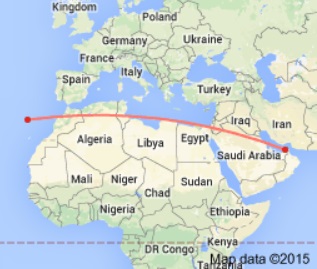
The other Tropikgadget entity — Tropikgadget FZE — appears to have been set up in Sharjah, United Arab Emirates, also in November 2013. Sharjah, on the Persian Gulf, is the UAE’s third most populous city, behind Dubai and Abu Dhabi, according to WikiPedia. The paper presence of these companies at geographic points on the North Atlantic and the Persian Gulf more than 4,300 miles away from each other and how they enlisted Massachusetts residents to do their bidding probably is a story unto itself, but it is a story for another day. What’s news today is that Wings Network was operating in Massachusetts at Ground Zero for TelexFree after the TelexFree action and, like TelexFree, is accused of fleecing vulnerable immigrant populations.
At least seven of the 12 charged Wings Network promoters had addresses in Marlborough, Mass. This is potentially important because TelexFree’s U.S. operations were based in Marlborough. TelexFree operated through various U.S. entities and a Brazilian entity known as Ympactus. Brazil-based TelexFree/Ympactus figure Carlos Costa has TelexFree business partners in Massachusetts, waved the flags of Madeira and Portugal in a 2013 TelexFree promo and invoked God in appeals to support TelexFree. Sann Rodrigues, a charged TelexFree promoter associated with an MLM entity known as iFreeX that also operated in Massachusetts and has come under scrutiny, has claimed “God” invented MLM and “binary.” Rodrigues, according to the SEC, is a recidivist pyramid-schemer.
There’s also evidence that the Zeek Rewards “program” taken down by the SEC in 2012 targeted vulnerable people.
**____________________**
Funchal, Madeira, to Sharjah, UAE. Source: Google Maps.
UPDATED 11:32 A.M. ET U.S.A. The SEC’s “Wings Network” case announced Friday is the latest example of the MLM world’s intolerable capacity to deceive. Though the facts alleged by the SEC are alarming, the action against two companies, three officers and 12 promoters is not an indictment of the trade. Indeed, the agency worked with the Direct Selling Association to expose one of the most mind-numbing lies.
But you still have to wonder if MLM and network marketing in general are on the road to perdition. This is because the horrifying abuses and thematic lies that propped up Wings Network are so common across the larger MLM trade that one can be forgiven for wondering if targeting vulnerable population groups and institutionalizing prevarication is Rule No. 1.
How DSA Got Involved In The Wings Network Case
Adolfo Franco, the trade association’s executive vice president and chief operating officer, sits at the intersection of commerce and government affairs. He’s an old political hand and has worked as a Republican strategist and assistant administrator for Latin America and the Caribbean for the U.S. Agency for International Development (USAID). Franco wants the MLM industry to prosper, and he wants to make sure he has a wholesome story to tell in government corridors.
Wings Network didn’t give him one, to be sure.
You see, Wings Network is accused by the SEC of using the DSA’s name to sugarcoat a creeping, cross-border fraud scheme that ultimately gathered at least $23.5 million. What actually happened, according to the SEC and an affidavit prepared by Franco, is that DSA received an “e-mailed request” for a DSA membership “application.” It then sent out the application, which was never returned. Not only was the application not returned, according to the affidavit, DSA never even heard back from Wings Network.
What allegedly happened next will surprise no one who follows the bizarre dramas MLM has been serving up for the past several years. This simple request for a membership application was conflated by Wings Network and affiliates as an endorsement by DSA of Wings Network.
By April 2014, according to the SEC, DSA became aware of this ribald deception. The association reacted by sending Wings Network a cease-and-desist letter, directing Wings Network and affiliates to stop claiming membership in DSA and stating point-blank that “any indication that Wings Network is a member of the DSA is fraudulent.”
Multiple Layers Of Deception
Could it get worse? Sure. Wings Network hucksters also are accused of duping participants into believing the “program,” which advertised guaranteed income, had the additional benefit of insuring them against loss.
Anyone who’s been following the unbelievably noxious example of TelexFree can tell you that the same thing allegedly happened there. The same thing currently is happening in a “program” known as “MooreFund,” and it previously happened in the AdSurfDaily Ponzi scheme in 2008 broken up by the U.S. Secret Service.
The MLM scammers look for a tiny kernel of truth and then wrap a lie around it: A “program” may have a bank account, for example. Money in the account may be insured by the FDIC in the event of a bank collapse.
From this, the “programs” themselves and affiliates conflate a fantastically malignant construction by which no one can lose money because of the “insurance.” It is just a contemptible lie. It’s also one that has been bettered by new versions of the lie. These versions — as is the case with Wings Network, TelexFree and MooreFund — hold that private insurers or even software companies such as Symantec have the companies’ backs and that these private insurers never would do business with a fraud scheme.
Supplementing this lie are companion lies — advanced by Wings Network, TelexFree and others — that a business registration with a Secretary of State or equivalent agency domestically or overseas is proof that there is no underlying scam. (One need only to look at Bernard L. Madoff Investment Securities LLC to understand just how preposterous this type of lie is.)
Here’s the thing: The type of lies advanced by Wings Network are not unusual for “opportunities” using an MLM or network-marketing business model. DSA happened to be the victim of brand-leeching and runaway disingenuousness in this case, but other cases show it’s hardly alone. Even the names of the U.S. government and various U.S. agencies have been dropped in this fashion.
Not even the “brands” of God and Jesus Christ are off-limits in the MLM sphere. Sometimes an asserted endorsement by a deity is supplemented by suggestions that living legends of entertainment and business have piled aboard a “program” train.
This is a short summary of these tactics as employed by recent MLM or network-marketing schemes that either cratered on their own or collapsed after regulatory intervention. (Note: Some background information also appears in the summary):
WCM777. Operated by Ming Xu. Targeted people who spoke Spanish, Portuguese, English and Asian languages. Dropped names of God, “Yahweh,” Jesus Christ, Al Gore, Steve Wozniak, Sylvester Stallone, “Rocky,” Eric Garcetti, Siemens, Goldman Sachs, the Denny’s restaurant chain and many, many more famous companies. (As many as 700.) Basic sales message: Send us money. Get rich. Estimated haul: $80 million in less than a year. Estimated number of victims: tens to hundreds of thousands.
TelexFree. Operated by James Merrill, Carlos Wanzeler and Carlos Costa. Largely targeted people in the United States and internationally who spoke Spanish, Portuguese and English. Global penetration at an almost unfathomable level. Appears to have created black market and back-alley economy in Massachusetts. Became subject of undercover investigation by the U.S. Department of Homeland Security. Dropped names of God, Jesus Christ, MLM Attorney Gerald Nehra, President Obama, Massachusetts Commonwealth Secretary William Galvin, the SEC, the U.S. Attorney General. Basic sales message: Send us money. Get rich. Estimated haul: $1.82 billion in about two years. Estimated number of victims: hundreds of thousands to more than 1.8 million.
Zeek Rewards. Operated by Paul R. Burks. Targeted people who spoke Spanish, Portuguese, English and Asian languages. Global penetration at an almost unfathomable level. Affiliates targeted Christians. Dropped names of the Association of Network Marketing Professionals, MLM attorneys Gerald Nehra and Kevin Grimes, plus MLM consultants Keith Laggos and Troy Dooly. Basic sales message: Send us money. Get rich. Estimated haul: $897 million in less than two years. Estimated number of victims: hundreds of thousands. “Clawback” cases to return alleged ill-gotten gains may affect 10,000 or more affiliates.
eAdGear. Operated by Charles Wang and Francis Yuen. “Primarily” targeted “investors in the U.S., China, and Taiwan,” according to the SEC. Dropped names of Google, Yahoo, Target Corp., Lbrands (Victoria’s Secret), Avon, Sears, Nordstrom, eBay, QVC, HSN, J.C. Penney, Banana Republic, Dillard’s, Kohl’s, Macy’s, Amazon.com, Men’s Wearhouse, Kmart, New York magazine and many, many more. (As many as 253 brands were abused.) Basic sales message: Send us money. Get rich. Estimated haul: $129 million. Estimated number of victims: tens of thousands.)
Wings Network now stands accused of targeting “many members of the Brazilian and Dominican immigrant communities in Massachusetts” in a combined pyramid- and Ponzi scheme that raised at least $23.5 million.
If that sounds familiar, perhaps it is because the TelexFree “program” was accused last year by the SEC of doing the same thing in the same place. Like Wings Network, TelexFree reached across national borders to plunder investors. Recent filings by the court-appointed trustee in the TelexFree bankruptcy case — and these filings are subject to amendment in part because there are more than 1 trillion disparate data points involved in the reverse-engineering of TelexFree — list the “nature” of the company’s business as “pyramid scheme.”
Other filings by Stephen B. Darr, the trustee, suggest that TelexFree gathered more than $1.8 billion in about two years of operation through a series of entities in the United States and an affiliate in Brazil known as Ympactus. The dollar volume alone is simply mind-boggling, more so when one considers the records so far denote “1,894,940 Participant names, spanning 35,110 pages.”
Some readers who sift through the TelexFree material will need a name-pronunciation guide and a world atlas. TelexFree didn’t just mow down Americans. The records suggest, for example, that the “Embassy Of Nigeria P O Box 1019 Addis Ababa Ethiopia” has contacted Darr. One document lists “Baker Island,” which WikiPedia says is an uninhabited Pacific atoll tended to by the U.S. Fish and Wildlife Service, as the “country” of an investor.
It is clear that TelexFree had investors (at least) in Argentina, Australia, Belarus, Belgium, Bolivia, Cambodia, Canada, Chile, China, Colombia, Croatia, Cyprus, Dominican Republic, Ecuador, Egypt, El Salvador, France, French Polynesia, Germany, Ghana, Guatemala, Honduras, Hong Kong, Hungary, India, Indonesia, Ireland, Italy, Japan, Jordan, Kenya, Lebanon, Luxembourg, Malaysia, Mexico, Moldova, Netherlands, New Zealand, Nigeria, Norway, Paraguay, Peru, Philippines, Poland, Portugal, Puerto Rico, Qatar, Romania, Russia, Rwanda, San Marino, Serbia, Singapore, South Africa, Spain, Sweden, Switzerland, Taiwan, Tanzania, Thailand, Togo, Turks and Caicos, U.S. Virgin Islands, Uganda, Ukraine, United Arab Emirates, United Kingdom, United States, “Unknown” country, Uruguay, Uzbekistan and Venezuela.
MLM in this form is “fraud creep” running wild. It is posing dangers to individual participants, including those who can ill afford to take a financial hit. Beyond that, it is posing a danger to the U.S. financial infrastructure.
Economic security is national security, friends. These MLM HYIP “programs” pose an untenable security threat. Many of them are shrouded in multiple layers of mystery.
DSA Needs To Do More
It is good to see that the DSA worked with the SEC on the Wings Network case. It would be better yet if the organization studied why so many MLM HYIPers appear to move from fraud scheme to fraud scheme to fraud scheme.
Where did these people start their “MLM journeys?” Did they start at, say, Herbalife or Amway after buying into the dream and the attendant hype? And did they get churned by those “traditional” MLMs, only to become shark bait for the HYIPs?
With so many of the scams selling the message that it’s nearly impossible to make money in “traditional” MLMs and that 97 percent of people who latch onto the MLM dream of riches emerge as losers or highly vulnerable treaders of water in rough seas, isn’t it time for those traditional MLMs to question whether they are creating the refugees and providing the training for the targeting?
Herbalife is not an HYIP. But it sells a dream and has a high burn rate. The most recent scheme to sell against traditional MLM is “Achieve Community,” taken down by the SEC last month.
Whether or not “the 97 percent” claim is precisely true is immaterial. What’s material is the ready availability of vulnerable population groups and refugees from “traditional” MLMs.
TelexFree even may have channeled Herbalife, calling its cheerleading sessions “extravaganzas” and latching onto the sport of soccer.
Stemming this hurtful tide should be a top priority at DSA. The wave of scams is not docile. It very well might be eroding protective shores in violent fashion and creeping up on the road to perdition.
2ND UPDATE 3:23 P.M. ET U.S.A. In another swipe at Herbalife and perhaps MLM recruiting schemes in general, activist investor Bill Ackman says he’s out to combat pyramid schemes by creating one himself.
Ackman’s apparent tongue-in-cheek approach adopts a typical “tell five” MLM marketing technique as part of a bid to create Internet virality for a video released last week that is designed to educate the public about pyramid schemes. The video is available in English and Spanish. It was produced by Ackman’s Pershing Square Capital Management LP.
“This video will help consumers avoid being defrauded,” Ackman said today in a news release issued through BusinessWire. “I encourage you to send it to five friends and encourage them to send it to five friends who can send it to five friends and so on, and we can fight pyramids with our own pyramid.”
BusinessWire is a subsidiary of Berkshire Hathaway, the Warren Buffett-led company that also owns Pampered Chef, an MLM company. Pershing Square previously has used BusinessWire to spread Ackman’s long-running contention that Herbalife is a pyramid scheme that incentivizes recruits to gather more recruits.
Buffett’s name has been used in any number of promos for commission-based MLM or network-marketing schemes, even when the legendary investor has no ties to the “opportunity” being promoted. The disingenuous message has been that Buffett’s corporate interest in Pampered Chef means that all MLM schemes pass muster.
In 2011, Buffett’s image was hijacked by the JSSTripler/JustBeenPaid scheme, a Ponzi-board “program” with possible ties to the “sovereign citizen” movement. Earlier, in 2010, Buffett’s image was appropriated by MPBToday, a “get two” MLM “program.”
As the PP Blog reported last week, Ackman’s video also channels an approach used by promoters of TelexFree, an alleged Ponzi/pyramid scam that may have gathered more than $1.2 billion in about two years of operation. The video also may provide a subtle reminder of Zeek Rewards, an MLM venture and alleged Ponzi/pyramid scheme that traded on images of the American Flag on its way to raising about $897 million in less than two years.
Ackman’s video also shows a representation of the American Flag, suggesting that franchise companies such as Burger King, H&R Block and Midas legitimately are part of the American Dream but that MLM schemes such as Herbalife may not be.
“Some of the start-your-own business offers you’ll see are legitimate opportunities,” according to the narration in the Ackman video. “But some are scams, designed to take advantage of you.”
Herbalife is not mentioned in the video, but one of the animated characters looks suspiciously like Herbalife CEO Michael O. Johnson.
The accompanying news release from Ackman does mention Herbalife, noting that “Funds managed by Pershing Square are short the stock of Herbalife Ltd and own put options on the Company. Pershing Square may increase, decrease, dispose of, or change the form of its investment in Herbalife for any or no reason, at any time.”
 UPDATED 3:59 P.M. EDT U.S.A. It surfaced on Twitter today in the
  With Herbalife under investigation by the Federal Trade Commission and
  DEVELOPING STORY: (Updated 9:23 p.m. ET U.S.A.) A TelexFree rep being sued by the court-appointed bankruptcy trustee for the return of more than $2.6 million in alleged winnings from the