Tag: IC3

  • ALERT! On Heels Of SEC’s Complaint Against Alleged Latvian Hacker Accused Of Manipulating Stock Prices By Hijacking Brokerage Accounts, FINRA Warns Of Plots Targeting Email Accounts

    “Investors who suspect that their email account has been hacked should immediately notify their brokerage firm and other financial institutions, and anyone who suspects they have been defrauded should file a complaint with FINRA.” Gerri Walsh, vice president for Investor Education, Financial Industry Regulatory Authority, Jan. 26, 2012

    The Financial Industry Regulatory Authority (FINRA) yesterday issued an alert and regulatory notice, saying that it “has received an increasing number of reports involving investor funds being stolen by fraudsters who first gain access to the investor’s email account and then email instructions to the firm to transfer money out of the brokerage account.”

    FINRA’s announcement occurred on the same day the SEC charged that a 34-year-old Latvian trader “broke into” customers’ brokerage accounts between June 2009 and August 2010 and made trades to manipulate the prices of stock he owned to create a personal windfall while causing losses to customers and broker-dealers.

    In just one 32-minute period on Oct. 26, 2009, Igors Nagaicevs “generated more $14,000 in illegal profits” by twice taking a position a NYSE-listed security, driving up the stock price by purchasing shares through a hacked account and then “liquidating his position at a profit.”

    All in all, Nagaicevs repeated his fraudulent scheme 159 times over 14 months, manipulating the prices of “104 different NYSE and Nasdaq securities” and pocketing more than $850,000 in illegal profits, the SEC charged.

    Nagaicevs, in effect, caused his hacking targets to lose at least $2 million while passing the bill for the losses to broker-dealer firms, which reimbursed the affected customers, according to the SEC complaint in federal court.

    FINRA did not reference Nagaicevs in its alert yesterday, but warned that email intrusions were on the rise.

    “In some instances, the perpetrators appear to have obtained customers’ brokerage information by accessing customers’ email accounts and searching contact lists or emails sent from the account,” FINRA cautioned in its regulatory notice.

    After breaching the email accounts, FINRA said, the scammers typically “email brokerage firms from customers’ personal email accounts with instructions to wire funds to an account, often overseas, controlled by the perpetrator.”

    Document forgeries may follow the initial email chicanery, FINRA said.

    “The instructions may be accompanied or followed by fraudulent letters of authorization also emailed from compromised email accounts. In some instances, firms have released funds after unsuccessfully attempting to verify emailed instructions by phone. In at least one case, the fraudulent email stressed the urgency of the requested transfer, pressuring the firm to release the funds before verifying the authenticity of the emailed instructions.”

    Read the FINRA Alert.

    Read a new alert from the FBI, the Financial Services Information Sharing and Analysis Center (FS-ISAC) and the Internet Crime Complaint Center (IC3) that warns that scammers are using devious email plots to siphon cash from “banks, broker/dealers, credit unions and other institutions.”

    NOTE: If you follow the criminal madness on the various Ponzi-scheme boards, you’ll notice that the new alert from the FBI, FS-ISAC and IC3 cites the type of scam-talk frequently seen on the huckster forums.

    An outtake from the alert (emphasis added):

    “The excuse is typically based on an illness or death in the family which prevents the account holder from conducting business as usual.”
  • WELCOME TO PLANET CYBERFRAUD, U.S. REGION: IC3 Report Shows Tremendous Surge In Dollars Lost To Online Scams; Nevada, Utah, Florida, D.C. Among Cyberscam Capitals

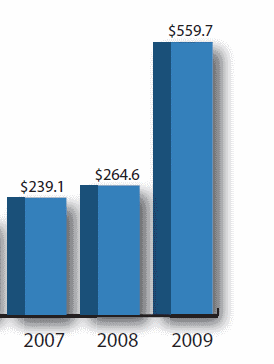
    Dollar value (in millions) of fraud referred for investigation by IC3 between 2007 and 2009. Source: IC3 2009 Internet Crime Report.

    Welcome to the rapidly evolving world of Planet Fraud, U.S. Region — or, more precisely, the U.S. Region of Planet Cyberfraud, the electronic web of deceit that often exists out of view and is sucking wealth at an alarming pace.

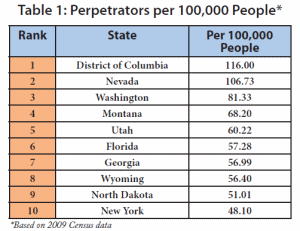
    Its capitals last year, according to a new report from The Internet Crime Complaint Center (IC3), included California, Florida, New York, Texas, Washington and the District of Columbia, with cyberfraud — viewed on a per-capita basis — particularly concentrated in D.C., Nevada, Washington, Montana, Utah and Florida.

    People who complained about fraud — and the fraudsters they complained about — most often did not live in the same state. Complainants often weren’t able to identify the state in which a fraudster resided, according to the report.

    Countries mentioned in the IC3 report include the United States, United Kingdom, Nigeria, Canada, Malaysia and Ghana. The report focuses on reports to IC3’s website, which operates in the United States.

    Highest, per-capita concentration of cyerfraud in the United States in 2009. Source: IC3 2009 Internet Crime Report.

    Not even law enforcement was immune from attacks by cybercriminals. The most common complaint that IC3 received last year was about an email scam in which the perpetrators used the name of the FBI — one of the world’s premier police agencies — “in an effort to gain information from the target,” IC3 said.

    IC3 is a partnership between the FBI and the National White Collar Crime Center (NW3C).

    “The figures contained in this report indicate that criminals are continuing to take full advantage of the anonymity afforded them by the Internet,” said NW3C Director Donald Brackman. “They are also developing increasingly sophisticated means of defrauding unsuspecting consumers. Internet crime is evolving in ways we couldn’t have imagined just five years ago.”

    IC3 placed the dollar losses in cases it referred for investigation last year at $559.7 million, up more than double from 2008’s figure of $264.6 million. The number of complaints in 2009 surged to 336,655, up 22.3 percent from 2008’s total of 275,284.

    Peter Trahon, section chief of the FBI’s Cyber Division, reissued the age-old warning:

    “[I]f something seems too good to be true, it likely is,” Trahon said. He added that computer users should ensure they have “up-to-date security protection on their devices and evaluate e-mail solicitations they receive with a healthy skepticism.”

    Why? Various appeals for money and various rogue attempts to corrupt computers by installing unwanted software and malicious code, including misery delivered by fake pop-up ads that “directed [victims] to purchase anti-virus software to repair their computers.”

    In some instances this resulted in viruses, Trojans, or key loggers being downloaded onto victims’ computers, IC3 said.

    Some highlights of the report:

    • In 2009, IC3 received several complaints presenting a new spin on the media coined “Hitman Scam,” a type of email extortion scheme. Victims are reportedly being threatened in an attempt to extort money. The victim receives an email from a member of an organization such as the “Ishmael Ghost Islamic Group.”
    • One of the components of crime committed via the Internet that makes investigation and prosecution difficult is that the offender and victim may be located anywhere in the world. This is a unique characteristic not found with “traditional” crime.
    • Another popular scam of 2009 involved unsolicited calls regarding fraudulent “government stimulus money.” IC3 received numerous complaints from victims receiving unsolicited telephone calls with a recorded message. The recorded voice message reportedly sounds very much like President Barrack Obama discussing alleged government funds available for those who apply.
    • IC3 received numerous complaints about work-at-home scams and survey scams related to online job sites.
    • Of the complaints involving financial harm that were referred to law enforcement, the highest median dollar losses were found among investment fraud ($3,200), overpayment fraud ($2,500), and advance fee fraud ($1,500).

    Read the IC3 Internet Crime Report for 2009.